In memory of…
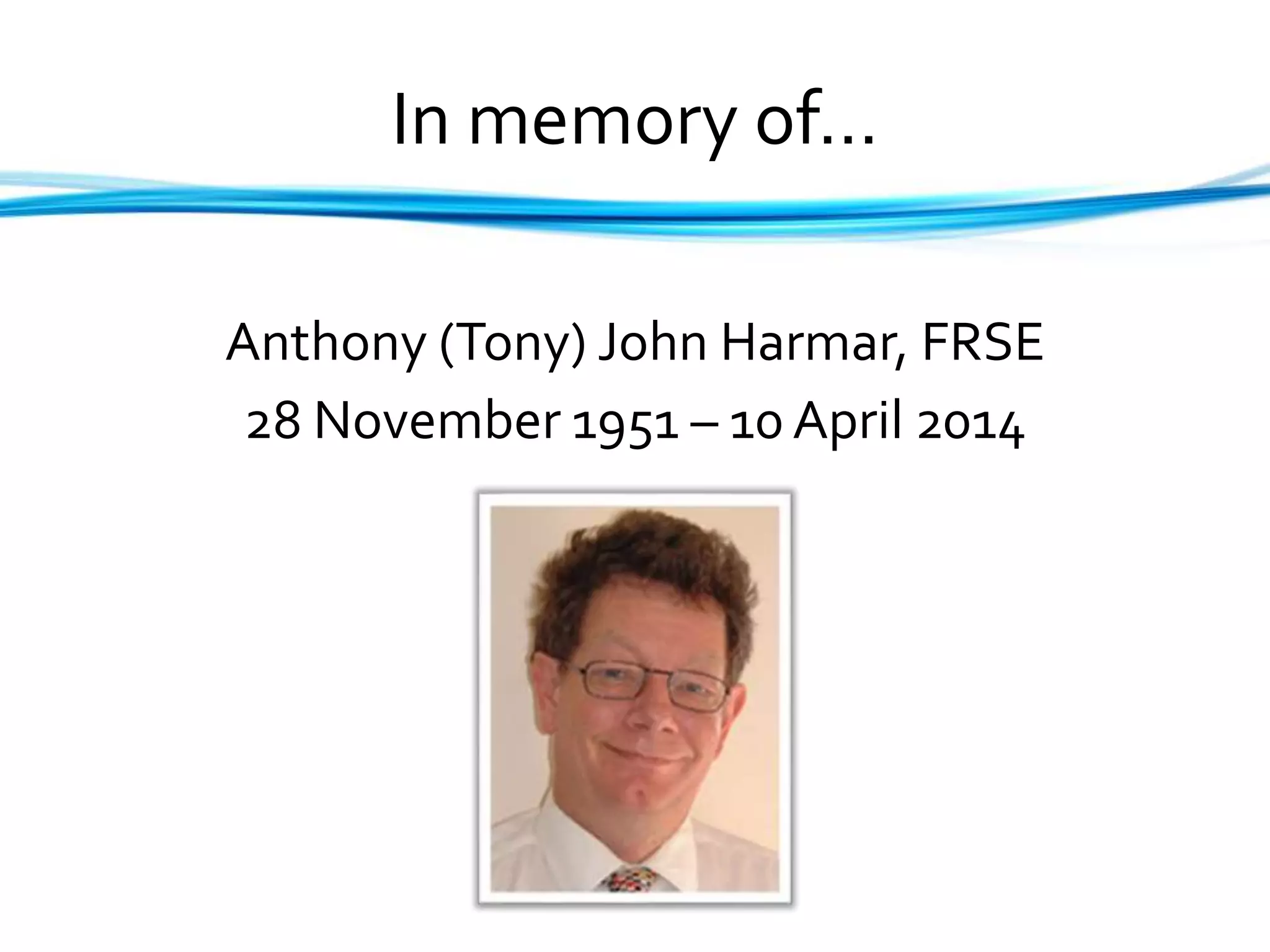
Anthony (Tony) John Harmar, FRSE
28 November 1951 – 10 April 2014
Orphan GPCRs: an update
Adam J. Pawson
Monday 14th July 2014,WCP2014
Background
• The Nomenclature Committee of IUPHAR (NC-
IUPHAR; since 1992);
• The IUPHAR database (since 2000);
• In-depth coverage of the properties and
pharmacology of G protein-coupled receptors
(including orphans), voltage- and ligand-gated
ion channels, and nuclear hormone receptors.
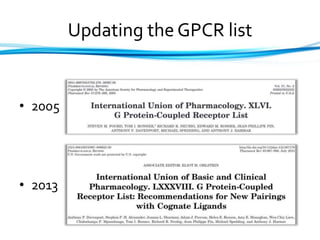
Updating the GPCR list
• 2005
• 2013
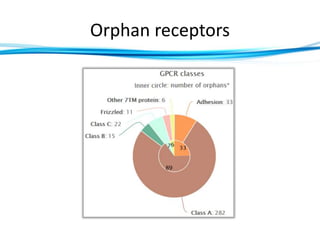
Orphan receptors
• An orphan receptor is an apparent receptor that
has a similar structure to other identified
receptors but whose endogenous ligand has not
yet been identified;
• Examples of orphan receptors are found in the
GPCR and nuclear receptor families;
• GPCR orphan receptors are usually given the
name “GPR” followed by a number, e.g. GPR1.
• Status monitored by the Evolving Pharmacology
Group (Chaired by Anthony Davenport);
Orphan receptors
Criteria for deorphanisation (1)
• Several criteria are used by NC-IUPHAR in
considering the assignment of an endogenous
ligand to a receptor;
• It is recognized that these criteria are exacting
and are unlikely to be met in all instances;
• Reproducibility of orphan-ligand pairing is the
minimum criterion;
Criteria for deorphanisation (2)
• Two or more refereed papers from
independent research groups should
demonstrate activity of the ligand at the
receptor with a potency that is consistent
with a physiologic function;
• Preferably, both radioligand binding and
functional assays should be employed; both in
vitro and in native tissues;
Criteria for deorphanisation (3)
• Selective agonists should mimic and selective
antagonists should block the action of the
putative endogenous ligand;
• The putative endogenous ligand should be
present in tissues in appropriate concentrations;
• Receptor gene deletion (in mice) should abolish
receptor characteristics (radioligand binding/
actions of ligand in functional assays);
• Receptor overexpression may be expected to
potentiate these actions;
Additional considerations
• Lipids as putative endogenous orthosteric
ligands for GPCRs pose distinct difficulties;
• Absence of endogenous ligand?
– Genetically modified mice and overexpression of
genes encoding target receptors can provide
evidence for a physiological or pathophysiological
role;
– May lead to the development of a “surrogate”
ligand for therapeutic use.
Recommendations for Formal Receptor
Nomenclature (1)
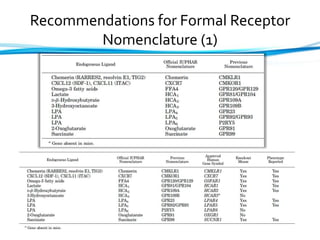
• Recommendations based on 11 pairings for
class A GPCRs;
• No recommendations for class B and class C
orphan GPCRs
Recommendations for Formal Receptor
Nomenclature (1)
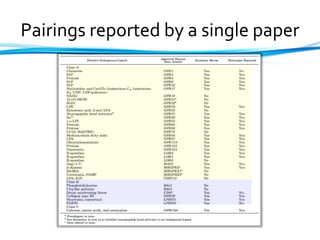
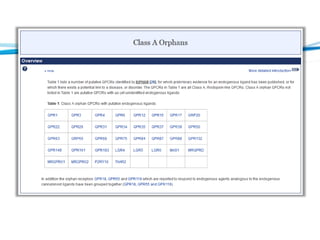
Pairings reported by a single paper
• Pairings have been highlighted for:
– 30 class A orphan GPCRs
– 6 class B orphan GPCRs
– 1 class C orphan GPCR
• Minimum criterion is reproducibility;
• Majority are receptor overexpression linked to
reporter system; potential for false positives;
• Further input is needed from the scientific
community to validate these findings.
Pairings reported by a single paper
What are the remaining druggable
orphan GPCRS? (1)
• No reported pairings (91 in total):
– 57 class A orphan GPCRs
– 28 class B orphan GPCRs
– 6 class C orphan GPCRs
• Remaining orphan GPCRs with knockout
mouse phenotype reported = 22
• No knockout mouse reported (yet?) = 62
• Gene absent in mouse and rat = 7
• Pseudogenes in human = 6
What are the remaining druggable
orphan GPCRS? (2)
• These may include:
– Orphan receptors with activity in absence of an
endogenous ligand; receptors may function
without ligands by being constitutively active or
by modulating the activity of other GPCRs, for
example, by dimerization;
– Orphans activated by “surrogate” ligands; they
may still represent a druggable target by the
discovery of synthetic ligands;
– Orphans where a significant phenotype has been
reported in genetically modified animals.
Conclusions
• The objective is to stimulate research into
confirming pairings of orphan receptors
where there is currently limited information
and to identify cognate ligands for the
remainingGPCRs;
• We need your expertise!!!
• www.guidetopharmacology.org
• Email: curators@guidetopharmacology org
The IUPHAR/BPS Guide to
PHARMACOLOGY (since 2011)
• Increased target coverage to additionally
include catalytic receptors, enzymes (including
all kinases) and transporters; over 2600 targets
in total;
• Detailed annotation for over 6800 small
molecule and peptide ligands;
• www.guidetopharmacology.org;
• Please come to the NC-IUPHAR
symposium tomorrow, Tues 15th,
15:30-17:00 to hear more!
Acknowledgements
• Tony Harmar
• Michael Spedding,Anthony Davenport, Steve
Alexander andTom Bonner
• Members of NC-IUPHAR
• Joanna Sharman, Helen Benson, Elena
Faccenda,Christopher Southan and Jamie
Davies
• Amy E. Monaghan andWen Chiy Liew

Orphan GPCRs: an update

  • 1.
    In memory of… Anthony(Tony) John Harmar, FRSE 28 November 1951 – 10 April 2014
  • 2.
    Orphan GPCRs: anupdate Adam J. Pawson Monday 14th July 2014,WCP2014
  • 3.
    Background • The NomenclatureCommittee of IUPHAR (NC- IUPHAR; since 1992); • The IUPHAR database (since 2000); • In-depth coverage of the properties and pharmacology of G protein-coupled receptors (including orphans), voltage- and ligand-gated ion channels, and nuclear hormone receptors.
  • 4.
    Updating the GPCRlist • 2005 • 2013
  • 5.
    Orphan receptors • Anorphan receptor is an apparent receptor that has a similar structure to other identified receptors but whose endogenous ligand has not yet been identified; • Examples of orphan receptors are found in the GPCR and nuclear receptor families; • GPCR orphan receptors are usually given the name “GPR” followed by a number, e.g. GPR1. • Status monitored by the Evolving Pharmacology Group (Chaired by Anthony Davenport);
  • 6.
  • 7.
    Criteria for deorphanisation(1) • Several criteria are used by NC-IUPHAR in considering the assignment of an endogenous ligand to a receptor; • It is recognized that these criteria are exacting and are unlikely to be met in all instances; • Reproducibility of orphan-ligand pairing is the minimum criterion;
  • 8.
    Criteria for deorphanisation(2) • Two or more refereed papers from independent research groups should demonstrate activity of the ligand at the receptor with a potency that is consistent with a physiologic function; • Preferably, both radioligand binding and functional assays should be employed; both in vitro and in native tissues;
  • 9.
    Criteria for deorphanisation(3) • Selective agonists should mimic and selective antagonists should block the action of the putative endogenous ligand; • The putative endogenous ligand should be present in tissues in appropriate concentrations; • Receptor gene deletion (in mice) should abolish receptor characteristics (radioligand binding/ actions of ligand in functional assays); • Receptor overexpression may be expected to potentiate these actions;
  • 10.
    Additional considerations • Lipidsas putative endogenous orthosteric ligands for GPCRs pose distinct difficulties; • Absence of endogenous ligand? – Genetically modified mice and overexpression of genes encoding target receptors can provide evidence for a physiological or pathophysiological role; – May lead to the development of a “surrogate” ligand for therapeutic use.
  • 11.
    Recommendations for FormalReceptor Nomenclature (1) • Recommendations based on 11 pairings for class A GPCRs; • No recommendations for class B and class C orphan GPCRs
  • 12.
    Recommendations for FormalReceptor Nomenclature (1)
  • 13.
    Pairings reported bya single paper • Pairings have been highlighted for: – 30 class A orphan GPCRs – 6 class B orphan GPCRs – 1 class C orphan GPCR • Minimum criterion is reproducibility; • Majority are receptor overexpression linked to reporter system; potential for false positives; • Further input is needed from the scientific community to validate these findings.
  • 14.
    Pairings reported bya single paper
  • 15.
    What are theremaining druggable orphan GPCRS? (1) • No reported pairings (91 in total): – 57 class A orphan GPCRs – 28 class B orphan GPCRs – 6 class C orphan GPCRs • Remaining orphan GPCRs with knockout mouse phenotype reported = 22 • No knockout mouse reported (yet?) = 62 • Gene absent in mouse and rat = 7 • Pseudogenes in human = 6
  • 16.
    What are theremaining druggable orphan GPCRS? (2) • These may include: – Orphan receptors with activity in absence of an endogenous ligand; receptors may function without ligands by being constitutively active or by modulating the activity of other GPCRs, for example, by dimerization; – Orphans activated by “surrogate” ligands; they may still represent a druggable target by the discovery of synthetic ligands; – Orphans where a significant phenotype has been reported in genetically modified animals.
  • 17.
    Conclusions • The objectiveis to stimulate research into confirming pairings of orphan receptors where there is currently limited information and to identify cognate ligands for the remainingGPCRs; • We need your expertise!!! • www.guidetopharmacology.org • Email: curators@guidetopharmacology org
  • 20.
    The IUPHAR/BPS Guideto PHARMACOLOGY (since 2011) • Increased target coverage to additionally include catalytic receptors, enzymes (including all kinases) and transporters; over 2600 targets in total; • Detailed annotation for over 6800 small molecule and peptide ligands; • www.guidetopharmacology.org; • Please come to the NC-IUPHAR symposium tomorrow, Tues 15th, 15:30-17:00 to hear more!
  • 21.
    Acknowledgements • Tony Harmar •Michael Spedding,Anthony Davenport, Steve Alexander andTom Bonner • Members of NC-IUPHAR • Joanna Sharman, Helen Benson, Elena Faccenda,Christopher Southan and Jamie Davies • Amy E. Monaghan andWen Chiy Liew

Editor's Notes

  • #2 This presentation was due to be given by Tony Harmar who sadly passed away in April. Tony was head of the IUPHAR database of receptors and ion channels which he founded in 2000, and developed at the University of Edinburgh where he was Professor of Pharmacology. We have for many years been annotating the evolving pharmacology of orphan GPCRs in the database under the guidance of Tony, Anthony Davenport and members of the Nomenclature Committee of the International Union of Basic and Clinical Pharmacology, of which Tony was also a core member, and this presentation serves to provide an update on the status of orphan GPCRs as potential drug targets. It was a great personal privilege to work with Tony in developing the database in recent years, and he will be sadly missed by everyone.
  • #14 Highlight Chemerin, S1P (there are already 5), LPA, Angiotensin (there are already 2), and chemokine CCL5