

SERVICES
MARKETING
CHAPTER 4
SERVICE DELIVERY PROCESS
HIGHLIGHTS
 Marketing & Operations
 Art of Blueprinting
OUTCOME
 Identify & understand services’ unique delivery system
 Importance of customer’s involvement in services
 Know the basics of blueprinting
CUSTOMER’S INVOLVEMENT
 Replace the work done by employees with work done by
customers
 Pro: convenient for customers, flexibility & accessibility
 Cons: increased risk, less control & loss of human contact
MARKETING & OPERATIONS
1. Balance is critical
2. Service firms must be efficient (in a perfect world)
3. Applying the efficiency models
4. Art of blueprinting
1. BALANCE IS CRITICAL
 A trade-off in terms of:
 Type of demand; High-contact Vs. Low-contact
 Cycle of demand; scheduling, production & capacity, planning
& forecasting
 Length of service experience
BALANCE: HIGH-CONTACTVS.
LOW CONTACT
 High-contact: operations must be near customers
 Low-contact: operations must be placed near supply,
transportation or labour
BALANCE: CYCLE OF DEMAND
 Scheduling:
 customer is part of schedule & must be accommodated
(High-contact)
 Customer is concerned mainly with completion date (Low-
contact)
 Production Planning:
 Orders cannot be stored (High-contact)
 Backlogging is possible (Low-contact)
BALANCE: CYCLE OF DEMAND
 Forecasting:
 Short term, time oriented (High-contact)
 Long term, output oriented (Low-contact)
BALANCE: LENGTH OF SERVICE
EXPERIENCE
 High-contact: service time depends on customer’s needs
 Low-contact: work is performed on customer surrogates
(ex: forms), time standard can be tight
2. SERVICES FIRMS MUST BE
EFFICIENT (IN A PERFECT WORLD)
i. Thompson’s Perfect-World Model
ii. Focused Factory Concept
iii. Plant-Within-A-Plant Concept
THOMPSON’S PERFECT-WORLD
MODEL
 Technical core: the place within a firm where primary
operations are conducted
 Perfect world: efficiency is possible only if inputs, outputs &
quality happen at a constant rate and remain known &
certain
FOCUSED FACTORY CONCEPT
 An operation that concentrates on performing one
particular task in one particular part of the service
experience (specialization)
PLANT-WITHIN-A-PLANT
CONCEPT
 Breaking up large, unfocused activities into smaller units
buffered from one another
 Buffering: surrounding the technical core with input &
output to shield it from outside influences
 Done through smoothing, anticipating & rationing
APPLYING EFFICIENCY MODELS
TO SERVICES
1. Isolating the technical core (decoupling)
&
2. Minimizing the servuction model (decoupling)
3. Production –lining the whole system
4. Creating flexible capacity
5. Moving the time demand
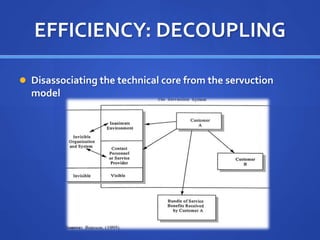
EFFICIENCY: DECOUPLING
 Disassociating the technical core from the servuction
model
EFFICIENCY: PRODUCTION-
LINING
 Production line approach: application of hard & soft
technologies
 Hard tech: hardware that facilitates the production of
standardized services
 Soft tech: rules, regulations & procedures
EFFICIENCY: FLEXIBLE
CAPACITTY
 Part time employees
 Cross-training employees
 Sharing capacity with other firms
THE ART OF BLUEPRINTING
 Flowcharting of a service operation:
1. Identify the directions in which processes flow
2. The time it takes to move from one process to the next
3. Cost involved with each process
4. Amount of inventory build-up at each step
5. Bottlenecks in the system
 Point where customers wait the longest
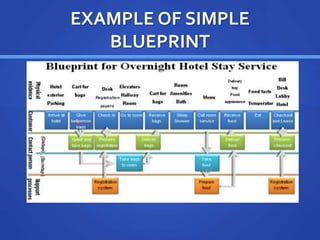
EXAMPLE OF SIMPLE
BLUEPRINT
THANKYOU
Q&A

Servmarkchpter4

  • 1.
  • 2.
    HIGHLIGHTS  Marketing &Operations  Art of Blueprinting
  • 3.
    OUTCOME  Identify &understand services’ unique delivery system  Importance of customer’s involvement in services  Know the basics of blueprinting
  • 4.
    CUSTOMER’S INVOLVEMENT  Replacethe work done by employees with work done by customers  Pro: convenient for customers, flexibility & accessibility  Cons: increased risk, less control & loss of human contact
  • 5.
    MARKETING & OPERATIONS 1.Balance is critical 2. Service firms must be efficient (in a perfect world) 3. Applying the efficiency models 4. Art of blueprinting
  • 6.
    1. BALANCE ISCRITICAL  A trade-off in terms of:  Type of demand; High-contact Vs. Low-contact  Cycle of demand; scheduling, production & capacity, planning & forecasting  Length of service experience
  • 7.
    BALANCE: HIGH-CONTACTVS. LOW CONTACT High-contact: operations must be near customers  Low-contact: operations must be placed near supply, transportation or labour
  • 8.
    BALANCE: CYCLE OFDEMAND  Scheduling:  customer is part of schedule & must be accommodated (High-contact)  Customer is concerned mainly with completion date (Low- contact)  Production Planning:  Orders cannot be stored (High-contact)  Backlogging is possible (Low-contact)
  • 9.
    BALANCE: CYCLE OFDEMAND  Forecasting:  Short term, time oriented (High-contact)  Long term, output oriented (Low-contact)
  • 10.
    BALANCE: LENGTH OFSERVICE EXPERIENCE  High-contact: service time depends on customer’s needs  Low-contact: work is performed on customer surrogates (ex: forms), time standard can be tight
  • 11.
    2. SERVICES FIRMSMUST BE EFFICIENT (IN A PERFECT WORLD) i. Thompson’s Perfect-World Model ii. Focused Factory Concept iii. Plant-Within-A-Plant Concept
  • 12.
    THOMPSON’S PERFECT-WORLD MODEL  Technicalcore: the place within a firm where primary operations are conducted  Perfect world: efficiency is possible only if inputs, outputs & quality happen at a constant rate and remain known & certain
  • 13.
    FOCUSED FACTORY CONCEPT An operation that concentrates on performing one particular task in one particular part of the service experience (specialization)
  • 14.
    PLANT-WITHIN-A-PLANT CONCEPT  Breaking uplarge, unfocused activities into smaller units buffered from one another  Buffering: surrounding the technical core with input & output to shield it from outside influences  Done through smoothing, anticipating & rationing
  • 15.
    APPLYING EFFICIENCY MODELS TOSERVICES 1. Isolating the technical core (decoupling) & 2. Minimizing the servuction model (decoupling) 3. Production –lining the whole system 4. Creating flexible capacity 5. Moving the time demand
  • 16.
    EFFICIENCY: DECOUPLING  Disassociatingthe technical core from the servuction model
  • 17.
    EFFICIENCY: PRODUCTION- LINING  Productionline approach: application of hard & soft technologies  Hard tech: hardware that facilitates the production of standardized services  Soft tech: rules, regulations & procedures
  • 18.
    EFFICIENCY: FLEXIBLE CAPACITTY  Parttime employees  Cross-training employees  Sharing capacity with other firms
  • 19.
    THE ART OFBLUEPRINTING  Flowcharting of a service operation: 1. Identify the directions in which processes flow 2. The time it takes to move from one process to the next 3. Cost involved with each process 4. Amount of inventory build-up at each step 5. Bottlenecks in the system  Point where customers wait the longest
  • 20.
  • 21.