SERVICES MARKETING
Course Code : MKT504
Educational Level:
Masters/Bachelor
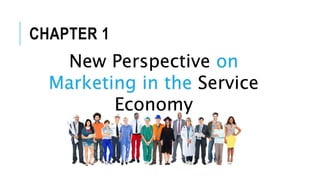
CHAPTER 1
New Perspective on
Marketing in the Service
Economy
OVERVIEW OF CHAPTER 1
 Why Study Services ?
 What Are the Principal Industries of the Service Sector ?
 Powerful Forces Are Transforming Service Markets
 What Are Services ?
 Four Broad Categories of Services-A Process Perspective
 Service Pose Distinct Marketing Challenges
 The Traditional Marketing Mix Applied to Services
 The Extended Services Marketing Mix for Managing the Customer Interface
Why Study Services ?
WHY STUDY SERVICES ?
“… because services are not just valuable in there
own right, they are the source of much of the
(added) value in the manufacturing sector today…”
Forbes Magazine
WHY STUDY SERVICES ?
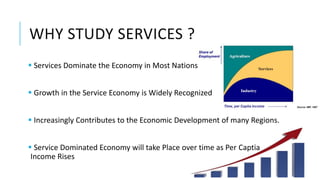
 Services Dominate the Economy in Most Nations
 Growth in the Service Economy is Widely Recognized
 Increasingly Contributes to the Economic Development of many Regions.
 Service Dominated Economy will take Place over time as Per Captia
Income Rises
WHY STUDY SERVICES ?
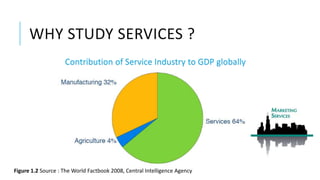
Contribution of Service Industry to GDP globally
Figure 1.2 Source : The World Factbook 2008, Central Intelligence Agency
WHY STUDY SERVICES ?
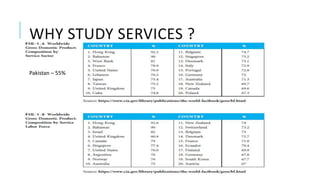
Pakistan – 55%
WHY STUDY SERVICES ?
 China Accounts for only 40%
 But it’s Economy has been dominated by Agriculture,
Manufacturing and Construction Industries
 China is investing heavily in Service Infrastructure, shipping
facilities, new airports
 Saudi Arabia Services only contribute 35%
 It’s Core source of Income is Oil
WHY STUDY SERVICES ?
 Most New Jobs Are Generated by Services
 Employment to Shrink in Manufacturing, Mining and Agriculture
 Demand will increase in knowledge based industries
 Service Jobs will require significant training and educational qualifications,
but employees will be more highly compensated
 Understanding Services Offers a Personal Competitive Advantage
PRINCIPAL INDUSTRIES OF THE
SERVICE SECTOR
 Diverse Sector Includes many services
 Are not Highly Visible unless you happen to work in that industry
 US Government has developed a new way to classify industries
 Standard Industrial Classification (SIC) developed in 1930s
 NAICS—North American Industry Classification System—now
used to compile and record economic data by national statistical
agencies of the U.S., Canada, Mexico
EXAMPLE OF SERVICE INDUSTRIES
 Health Care : Hospital, Medical Practice, Dental Care, Eye Care
 Professional Services : Accounting, Legal, Architectural
 Financial Services : Banking, Investment Advising, Insurance
 Hospitality : Restaurant, Hotel, Bed and Breakfast, Ski resort
 Travel : Airline, Travel Agency, Theme Park
 Others : Hair styling, Pest Control, Plumbing, Lawn Maintenance,
Counseling services, Health Club, Interior Design
TRANSFORMATION OF SERVICE
MARKETS
 Powerful Forces are Transforming Service Markets
 Government Policies
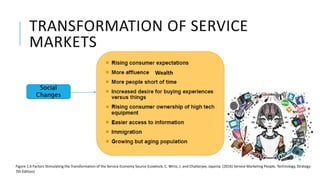
 Social Changes
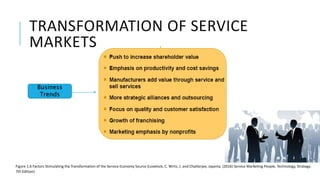
 Business Trends
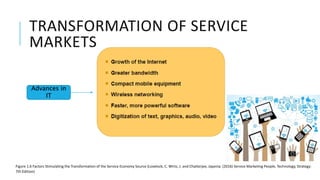
 Advances in Information Technology
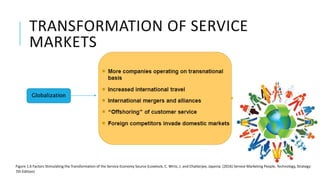
 Globalization
TRANSFORMATION OF SERVICE
MARKETS
What they Influencing?
 Demand
 Supply
 The Competitive Landscape
 Customers’ Choices, Power, and
Decision Making
TRANSFORMATION OF SERVICE
MARKETS
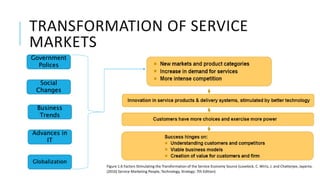
Government
Polices
Social
Changes
Business
Trends
Advances in
IT
Globalization
Figure 1.6 Factors Stimulating the Transformation of the Service Economy Source (Lovelock, C. Wirtz, J. and Chatterjee, Jayanta.
(2016) Service Marketing People, Technology, Strategy: 7th Edition)
TRANSFORMATION OF SERVICE
MARKETS
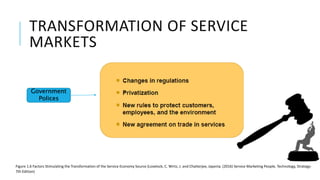
Government
Polices
Figure 1.6 Factors Stimulating the Transformation of the Service Economy Source (Lovelock, C. Wirtz, J. and Chatterjee, Jayanta. (2016) Service Marketing People, Technology, Strategy:
7th Edition)
TRANSFORMATION OF SERVICE
MARKETS
Social
Changes
Figure 1.6 Factors Stimulating the Transformation of the Service Economy Source (Lovelock, C. Wirtz, J. and Chatterjee, Jayanta. (2016) Service Marketing People, Technology, Strategy:
7th Edition)
Wealth
TRANSFORMATION OF SERVICE
MARKETS
Business
Trends
Figure 1.6 Factors Stimulating the Transformation of the Service Economy Source (Lovelock, C. Wirtz, J. and Chatterjee, Jayanta. (2016) Service Marketing People, Technology, Strategy:
7th Edition)
TRANSFORMATION OF SERVICE
MARKETS
Advances in
IT
Figure 1.6 Factors Stimulating the Transformation of the Service Economy Source (Lovelock, C. Wirtz, J. and Chatterjee, Jayanta. (2016) Service Marketing People, Technology, Strategy:
7th Edition)
TRANSFORMATION OF SERVICE
MARKETS
Globalization
Figure 1.6 Factors Stimulating the Transformation of the Service Economy Source (Lovelock, C. Wirtz, J. and Chatterjee, Jayanta. (2016) Service Marketing People, Technology, Strategy:
7th Edition)
WHAT ARE SERVICES?
 The Historic View
 Adam Smith (1776) Services are Different from Goods because
they are perishable.
 Say (1803) Consumption cannot be separated from
production, services are intangible
 A Fresh Perspective : Benefits without Ownership
 Christopher Lovelock and Evert Gambeson , Services involve a
form of rental which customers can obtain benefits .
DEFINITION OF SERVICES
McDonald and Payne (2011)
“A service is an activity which typically has some element of intangibility
associated with it. It involves some interaction with customers or property in
their possession, and does not result in a transfer of ownership. A change of
condition may occur and provision of the service may or may not be closely
associated with a physical product.”
McDonald, M. Frow, P. and Payne, A. (2011) Marketing Plans for Services A Complete Guide: 3rd
Edition
DEFINITION OF SERVICES
Gilmore (2003 )
“A service has been described as an act, a process and a performance.
Services can be more widely described as economic activities that create
‘added value’ and provide benefits for customers (consumers or
organizations).”
Gilmore, A. (2003) Services, Marketing and Management
DEFINITION OF SERVICES
Lovelock and Chatterjee (2016)
“A service is an act or performance offered by one party to another. Although
the process may be tied to a physical product, the performance is essentially
intangible and does not normally result in ownership of any of the factors of
production.”
Lovelock, C. Wirtz, J. and Chatterjee, Jayanta. (2016) Service Marketing People, Technology, Strategy:
7th Edition)
SCOPE OF SERVICE
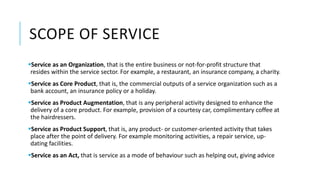
Service as an Organization, that is the entire business or not-for-profit structure that
resides within the service sector. For example, a restaurant, an insurance company, a charity.
Service as Core Product, that is, the commercial outputs of a service organization such as a
bank account, an insurance policy or a holiday.
Service as Product Augmentation, that is any peripheral activity designed to enhance the
delivery of a core product. For example, provision of a courtesy car, complimentary coffee at
the hairdressers.
Service as Product Support, that is, any product- or customer-oriented activity that takes
place after the point of delivery. For example monitoring activities, a repair service, up-
dating facilities.

Service as an Act, that is service as a mode of behaviour such as helping out, giving advice
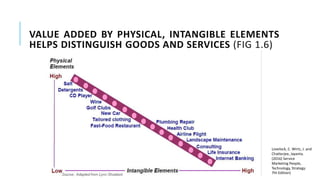
VALUE ADDED BY PHYSICAL, INTANGIBLE ELEMENTS
HELPS DISTINGUISH GOODS AND SERVICES (FIG 1.6)
Lovelock, C. Wirtz, J. and
Chatterjee, Jayanta.
(2016) Service
Marketing People,
Technology, Strategy:
7th Edition)
4 CATEGORIES OF SERVICES
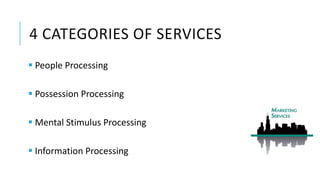
 People Processing
 Possession Processing
 Mental Stimulus Processing
 Information Processing
PEOPLE PROCESSING
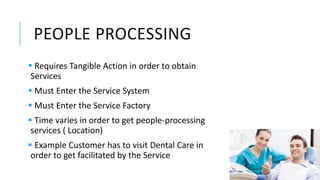
 Requires Tangible Action in order to obtain
Services
 Must Enter the Service System
 Must Enter the Service Factory
 Time varies in order to get people-processing
services ( Location)
 Example Customer has to visit Dental Care in
order to get facilitated by the Service
POSSESSION PROCESSING
 Customer are less Physically Involved
 Customer's involvement usually is limited to dropping
off the item
 Production and Consumption are Separable
 Customer may prefer to be present during service
Delivery
 Example Car maintenance, Pest Control ,
Malfunctioning Elevator
MENTAL STIMULUS PROCESSING
 Ethical Standards are Required
 To Obtain full benefits requires investment
of time and mental effort
 Recipients doesn’t need to be Physically
present
 Example Educational Institutes
INFORMATION PROCESSING
 Most Intangible form of Service
 It can be transformed into more enduring tangible forms
Neither customer nor the recipient is needed to be present
 Only requires Information
 Example Banks, Law Firms, Marketing Research
SERVICES POSE DISTINCT MARKETING
CHALLENGES
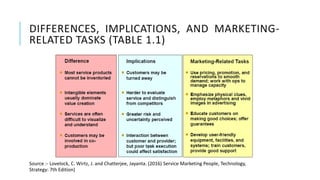
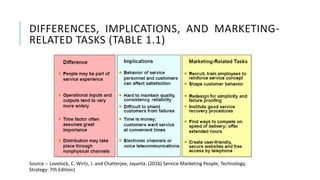
 Eight Common differences between Services and
Goods, they do not apply to all equally to all Services
 Marketing management tasks in the service sector
differ from those in the manufacturing sector
DIFFERENCES, IMPLICATIONS, AND MARKETING-
RELATED TASKS (TABLE 1.1)
Source :- Lovelock, C. Wirtz, J. and Chatterjee, Jayanta. (2016) Service Marketing People, Technology,
Strategy: 7th Edition)
DIFFERENCES, IMPLICATIONS, AND MARKETING-
RELATED TASKS (TABLE 1.1)
Source :- Lovelock, C. Wirtz, J. and Chatterjee, Jayanta. (2016) Service Marketing People, Technology,
Strategy: 7th Edition)
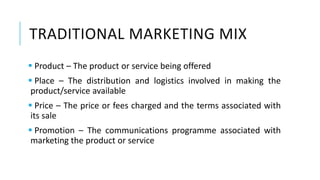
TRADITIONAL MARKETING MIX
 Product – The product or service being offered
 Place – The distribution and logistics involved in making the
product/service available
 Price – The price or fees charged and the terms associated with
its sale
 Promotion – The communications programme associated with
marketing the product or service
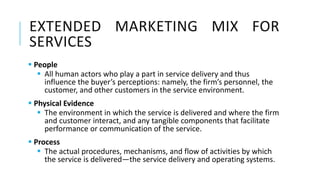
EXTENDED MARKETING MIX FOR
SERVICES
 People
 All human actors who play a part in service delivery and thus
influence the buyer’s perceptions: namely, the firm’s personnel, the
customer, and other customers in the service environment.
 Physical Evidence
 The environment in which the service is delivered and where the firm
and customer interact, and any tangible components that facilitate
performance or communication of the service.
 Process
 The actual procedures, mechanisms, and flow of activities by which
the service is delivered—the service delivery and operating systems.
THANK YOU
REFERENCES
Forbes :- https://www.forbes.com
The World Factbook 2008, Central Intelligence Agency
https://www.cia.gov/index.html
McDonald, M. Frow, P. and Payne, A. (2011) Marketing Plans for Services A
Complete Guide: 3rd Edition
Gilmore, A. (2003) Services, Marketing and Management
Lovelock, C. Wirtz, J. and Chatterjee, Jayanta. (2016) Service Marketing
People, Technology, Strategy: 7th Edition)

Services Marketing

  • 1.
    SERVICES MARKETING Course Code: MKT504 Educational Level: Masters/Bachelor
  • 2.
    CHAPTER 1 New Perspectiveon Marketing in the Service Economy
  • 3.
    OVERVIEW OF CHAPTER1  Why Study Services ?  What Are the Principal Industries of the Service Sector ?  Powerful Forces Are Transforming Service Markets  What Are Services ?  Four Broad Categories of Services-A Process Perspective  Service Pose Distinct Marketing Challenges  The Traditional Marketing Mix Applied to Services  The Extended Services Marketing Mix for Managing the Customer Interface
  • 4.
  • 5.
    WHY STUDY SERVICES? “… because services are not just valuable in there own right, they are the source of much of the (added) value in the manufacturing sector today…” Forbes Magazine
  • 6.
    WHY STUDY SERVICES?  Services Dominate the Economy in Most Nations  Growth in the Service Economy is Widely Recognized  Increasingly Contributes to the Economic Development of many Regions.  Service Dominated Economy will take Place over time as Per Captia Income Rises
  • 7.
    WHY STUDY SERVICES? Contribution of Service Industry to GDP globally Figure 1.2 Source : The World Factbook 2008, Central Intelligence Agency
  • 8.
    WHY STUDY SERVICES? Pakistan – 55%
  • 9.
    WHY STUDY SERVICES?  China Accounts for only 40%  But it’s Economy has been dominated by Agriculture, Manufacturing and Construction Industries  China is investing heavily in Service Infrastructure, shipping facilities, new airports  Saudi Arabia Services only contribute 35%  It’s Core source of Income is Oil
  • 10.
    WHY STUDY SERVICES?  Most New Jobs Are Generated by Services  Employment to Shrink in Manufacturing, Mining and Agriculture  Demand will increase in knowledge based industries  Service Jobs will require significant training and educational qualifications, but employees will be more highly compensated  Understanding Services Offers a Personal Competitive Advantage
  • 11.
    PRINCIPAL INDUSTRIES OFTHE SERVICE SECTOR  Diverse Sector Includes many services  Are not Highly Visible unless you happen to work in that industry  US Government has developed a new way to classify industries  Standard Industrial Classification (SIC) developed in 1930s  NAICS—North American Industry Classification System—now used to compile and record economic data by national statistical agencies of the U.S., Canada, Mexico
  • 12.
    EXAMPLE OF SERVICEINDUSTRIES  Health Care : Hospital, Medical Practice, Dental Care, Eye Care  Professional Services : Accounting, Legal, Architectural  Financial Services : Banking, Investment Advising, Insurance  Hospitality : Restaurant, Hotel, Bed and Breakfast, Ski resort  Travel : Airline, Travel Agency, Theme Park  Others : Hair styling, Pest Control, Plumbing, Lawn Maintenance, Counseling services, Health Club, Interior Design
  • 13.
    TRANSFORMATION OF SERVICE MARKETS Powerful Forces are Transforming Service Markets  Government Policies  Social Changes  Business Trends  Advances in Information Technology  Globalization
  • 14.
    TRANSFORMATION OF SERVICE MARKETS Whatthey Influencing?  Demand  Supply  The Competitive Landscape  Customers’ Choices, Power, and Decision Making
  • 15.
    TRANSFORMATION OF SERVICE MARKETS Government Polices Social Changes Business Trends Advancesin IT Globalization Figure 1.6 Factors Stimulating the Transformation of the Service Economy Source (Lovelock, C. Wirtz, J. and Chatterjee, Jayanta. (2016) Service Marketing People, Technology, Strategy: 7th Edition)
  • 16.
    TRANSFORMATION OF SERVICE MARKETS Government Polices Figure1.6 Factors Stimulating the Transformation of the Service Economy Source (Lovelock, C. Wirtz, J. and Chatterjee, Jayanta. (2016) Service Marketing People, Technology, Strategy: 7th Edition)
  • 17.
    TRANSFORMATION OF SERVICE MARKETS Social Changes Figure1.6 Factors Stimulating the Transformation of the Service Economy Source (Lovelock, C. Wirtz, J. and Chatterjee, Jayanta. (2016) Service Marketing People, Technology, Strategy: 7th Edition) Wealth
  • 18.
    TRANSFORMATION OF SERVICE MARKETS Business Trends Figure1.6 Factors Stimulating the Transformation of the Service Economy Source (Lovelock, C. Wirtz, J. and Chatterjee, Jayanta. (2016) Service Marketing People, Technology, Strategy: 7th Edition)
  • 19.
    TRANSFORMATION OF SERVICE MARKETS Advancesin IT Figure 1.6 Factors Stimulating the Transformation of the Service Economy Source (Lovelock, C. Wirtz, J. and Chatterjee, Jayanta. (2016) Service Marketing People, Technology, Strategy: 7th Edition)
  • 20.
    TRANSFORMATION OF SERVICE MARKETS Globalization Figure1.6 Factors Stimulating the Transformation of the Service Economy Source (Lovelock, C. Wirtz, J. and Chatterjee, Jayanta. (2016) Service Marketing People, Technology, Strategy: 7th Edition)
  • 21.
    WHAT ARE SERVICES? The Historic View  Adam Smith (1776) Services are Different from Goods because they are perishable.  Say (1803) Consumption cannot be separated from production, services are intangible  A Fresh Perspective : Benefits without Ownership  Christopher Lovelock and Evert Gambeson , Services involve a form of rental which customers can obtain benefits .
  • 22.
    DEFINITION OF SERVICES McDonaldand Payne (2011) “A service is an activity which typically has some element of intangibility associated with it. It involves some interaction with customers or property in their possession, and does not result in a transfer of ownership. A change of condition may occur and provision of the service may or may not be closely associated with a physical product.” McDonald, M. Frow, P. and Payne, A. (2011) Marketing Plans for Services A Complete Guide: 3rd Edition
  • 23.
    DEFINITION OF SERVICES Gilmore(2003 ) “A service has been described as an act, a process and a performance. Services can be more widely described as economic activities that create ‘added value’ and provide benefits for customers (consumers or organizations).” Gilmore, A. (2003) Services, Marketing and Management
  • 24.
    DEFINITION OF SERVICES Lovelockand Chatterjee (2016) “A service is an act or performance offered by one party to another. Although the process may be tied to a physical product, the performance is essentially intangible and does not normally result in ownership of any of the factors of production.” Lovelock, C. Wirtz, J. and Chatterjee, Jayanta. (2016) Service Marketing People, Technology, Strategy: 7th Edition)
  • 25.
    SCOPE OF SERVICE Serviceas an Organization, that is the entire business or not-for-profit structure that resides within the service sector. For example, a restaurant, an insurance company, a charity. Service as Core Product, that is, the commercial outputs of a service organization such as a bank account, an insurance policy or a holiday. Service as Product Augmentation, that is any peripheral activity designed to enhance the delivery of a core product. For example, provision of a courtesy car, complimentary coffee at the hairdressers. Service as Product Support, that is, any product- or customer-oriented activity that takes place after the point of delivery. For example monitoring activities, a repair service, up- dating facilities. Service as an Act, that is service as a mode of behaviour such as helping out, giving advice
  • 26.
    VALUE ADDED BYPHYSICAL, INTANGIBLE ELEMENTS HELPS DISTINGUISH GOODS AND SERVICES (FIG 1.6) Lovelock, C. Wirtz, J. and Chatterjee, Jayanta. (2016) Service Marketing People, Technology, Strategy: 7th Edition)
  • 27.
    4 CATEGORIES OFSERVICES  People Processing  Possession Processing  Mental Stimulus Processing  Information Processing
  • 28.
    PEOPLE PROCESSING  RequiresTangible Action in order to obtain Services  Must Enter the Service System  Must Enter the Service Factory  Time varies in order to get people-processing services ( Location)  Example Customer has to visit Dental Care in order to get facilitated by the Service
  • 29.
    POSSESSION PROCESSING  Customerare less Physically Involved  Customer's involvement usually is limited to dropping off the item  Production and Consumption are Separable  Customer may prefer to be present during service Delivery  Example Car maintenance, Pest Control , Malfunctioning Elevator
  • 30.
    MENTAL STIMULUS PROCESSING Ethical Standards are Required  To Obtain full benefits requires investment of time and mental effort  Recipients doesn’t need to be Physically present  Example Educational Institutes
  • 31.
    INFORMATION PROCESSING  MostIntangible form of Service  It can be transformed into more enduring tangible forms Neither customer nor the recipient is needed to be present  Only requires Information  Example Banks, Law Firms, Marketing Research
  • 32.
    SERVICES POSE DISTINCTMARKETING CHALLENGES  Eight Common differences between Services and Goods, they do not apply to all equally to all Services  Marketing management tasks in the service sector differ from those in the manufacturing sector
  • 33.
    DIFFERENCES, IMPLICATIONS, ANDMARKETING- RELATED TASKS (TABLE 1.1) Source :- Lovelock, C. Wirtz, J. and Chatterjee, Jayanta. (2016) Service Marketing People, Technology, Strategy: 7th Edition)
  • 34.
    DIFFERENCES, IMPLICATIONS, ANDMARKETING- RELATED TASKS (TABLE 1.1) Source :- Lovelock, C. Wirtz, J. and Chatterjee, Jayanta. (2016) Service Marketing People, Technology, Strategy: 7th Edition)
  • 35.
    TRADITIONAL MARKETING MIX Product – The product or service being offered  Place – The distribution and logistics involved in making the product/service available  Price – The price or fees charged and the terms associated with its sale  Promotion – The communications programme associated with marketing the product or service
  • 36.
    EXTENDED MARKETING MIXFOR SERVICES  People  All human actors who play a part in service delivery and thus influence the buyer’s perceptions: namely, the firm’s personnel, the customer, and other customers in the service environment.  Physical Evidence  The environment in which the service is delivered and where the firm and customer interact, and any tangible components that facilitate performance or communication of the service.  Process  The actual procedures, mechanisms, and flow of activities by which the service is delivered—the service delivery and operating systems.
  • 37.
  • 38.
    REFERENCES Forbes :- https://www.forbes.com TheWorld Factbook 2008, Central Intelligence Agency https://www.cia.gov/index.html McDonald, M. Frow, P. and Payne, A. (2011) Marketing Plans for Services A Complete Guide: 3rd Edition Gilmore, A. (2003) Services, Marketing and Management Lovelock, C. Wirtz, J. and Chatterjee, Jayanta. (2016) Service Marketing People, Technology, Strategy: 7th Edition)