SERIOUS BUSINESS
Playing serious games to accelerate learning & deliver better outcomes
David Colls - dcolls@thoughtworks.com
p l a y i n g g a m e s
A BIG CALL CENTRE
How do we re-design a big call centre for better performance?
2
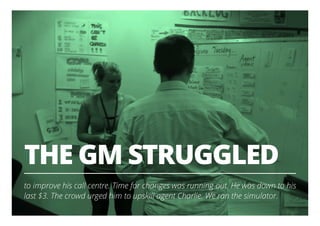
THE GM STRUGGLED
to improve his call centre. Time for changes was running out. He was down to his
last $3. The crowd urged him to upskill agent Charlie. We ran the simulator.
3
4
$3?
Crowd?
Simulator?
What kind of business is this?
CONTEXT
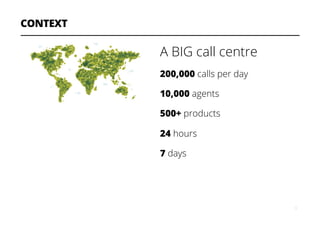
A BIG call centre
200,000 calls per day
10,000 agents
500+ products
24 hours
7 days
5
CONTEXT
A BIG improvement program
New paradigms for:
■  Staff management, and
■  Telephony technology
To better design which agents get which calls
With the aim of continual learning-led performance improvement:
■  Customer satisfaction
■  Cost
6
APPROACH
Big Bang Launch is Risky!
New design can’t be tested on current systems.
We can build new technology and implement new
management processes.
But, when we switch it on,
Can we be sure the design will work?
7
UNRESOLVED QUESTIONS
8
Can we find a
design that
works?
Success of improvement
program at stake!
UNRESOLVED QUESTIONS
9
Can we find a
design that
works?
Maybe games
can help us…
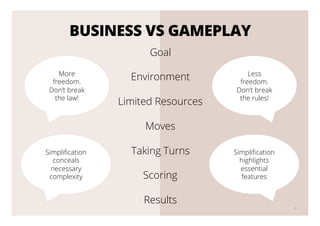
BUSINESS VS GAMEPLAY
10
Goal
Environment
Limited Resources
Moves
Taking Turns
Scoring
Results
More
freedom.
Don’t break
the law!
Less
freedom.
Don’t break
the rules!
Simplification
highlights
essential
features
Simplification
conceals
necessary
complexity
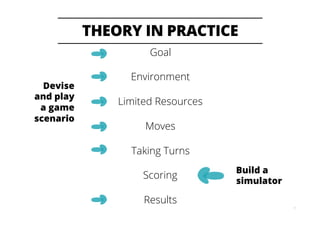
THEORY IN PRACTICE
11
Goal
Environment
Limited Resources
Moves
Taking Turns
Scoring
Results
Build a
simulator
Devise
and play
a game
scenario
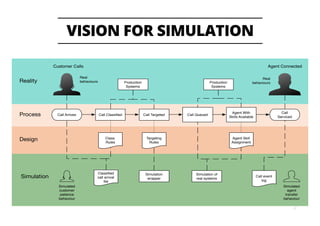
VISION FOR SIMULATION
12
Call Arrives Call Classified
Class.
Rules
Call Targeted
Targeting
Rules
Call Queued
Agent With
Skills Available
Agent Skill
Assignment
Call
Serviced
Customer Calls Agent Connected
Classified
call arrival
file
Production
Systems
Production
Systems
Simulation
wrapper
Simulation of
real systems
Call event
log
Real
behaviours
Real
behaviours
Simulated
customer
patience
behaviour
Simulated
agent
transfer
behaviour
Reality
Process
Design
Simulation
GOAL – TO MINIMISE
ABANDONED CALLS
Abandon = when a caller hangs up before talking to an agent
13
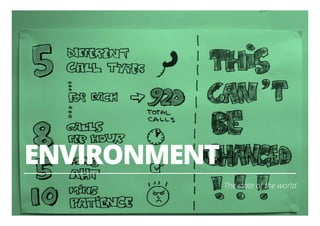
ENVIRONMENT
The state of the world
14
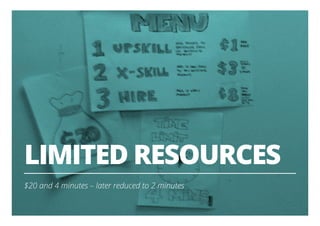
LIMITED RESOURCES
$20 and 4 minutes – later reduced to 2 minutes
15
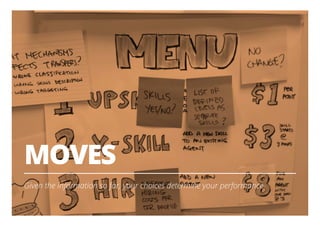
MOVES
Given the information so far, your choices determine your performance
16
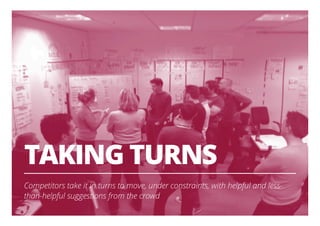
TAKING TURNS
Competitors take it in turns to move, under constraints, with helpful and less-
than-helpful suggestions from the crowd
17
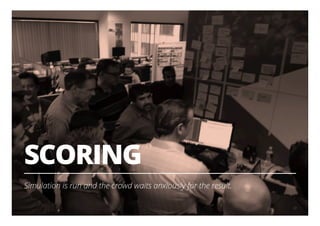
SCORING
Simulation is run and the crowd waits anxiously for the result.
18
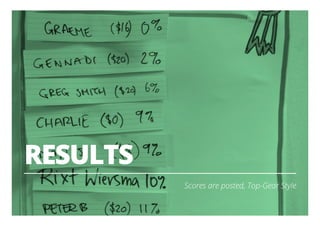
RESULTS
Scores are posted, Top-Gear Style
19
20
“What [the winner] has done is add
agents and implement default
routing, just like [our newest
operation]!”
CONFIDENCE BOOST
21
Can we find a
sufficiently good
design to launch?
The game
produced the
same design as
the real world!
MORE OUTCOMES
22
We have a great
communications and
training resource
Management and
technology change teams,
and other stakeholders,
now understand one
another
There is value in further
simulator development
AND THEN WE
CHANGED SOME
MECHANICS AND DID
IT ALL AGAIN
This time with the aim of minimal transfers
23
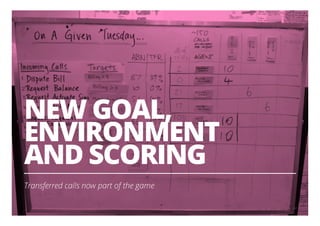
NEW GOAL,
ENVIRONMENT
AND SCORING
Transferred calls now part of the game
24
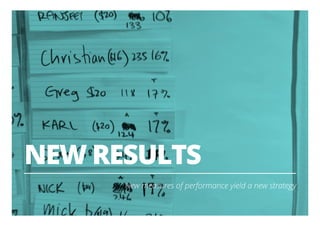
NEW RESULTS
New measures of performance yield a new strategy
25
MORE OUTCOMES
26
What we measure will
affect what we design
WHAT HAPPENED NEXT?
More people played the game
Effective communications about the program
Simulator scaled to
production complexity
To find the launch design
New system launched!
Which was the real game after all
27
BUSINESS OUTCOMES
Validation
Focus
Knowledge sharing
Accelerated program
Better launch design
28
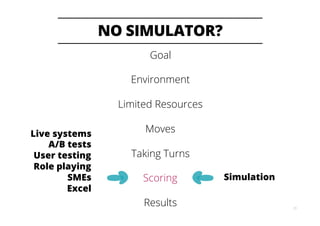
NO SIMULATOR?
29
Goal
Environment
Limited Resources
Moves
Taking Turns
Scoring
Results
Simulation
Live systems
A/B tests
User testing
Role playing
SMEs
Excel
THANK YOU
For questions or suggestions:
David Colls
dcolls@thoughtworks.com

Serious Business: Playing serious games to accelerate learning & deliver better outcomes