
SERA-46 Overview
Amanda Gumbert
Water Quality Extension Specialist
University of Kentucky
College of Agriculture, Food & Environment
Structure
 Research and Extension Representative from each state
(others can join)
 Executive Committee – Co-chairs, Secretary, and
Administrative Advisors
 Quarterly conference calls
 Workgroups to focus on priority items
Strengthening Networks
SN 1. Refer the pertinent work of other multistate committees
and land-grant university researchers and extension
educators to the HTF and its member agencies. A
specific priority is to communicate to the HTF the reasons
for differences in state LGU recommended N/P application
rates for similar soil types and fields.
Strengthening Networks
SN 5. Identify common attributes and gaps across state nutrient
reduction strategies - Review the HTF states’ nutrient
reduction strategies to identify the state goals, approaches and
common attributes. Highlight opportunities for cross state
information sharing to enhance other HTF state strategies.
 Mississippi State University providing leadership for a preliminary
snapshot.
 Some ongoing work on reviewing Science Assessments
Conservation Systems
Research and Outreach
CSRO2. Translate science regarding the issues and solutions in tile
drained areas into accessible information for states to adopt
into policies to address nutrient use and movement,
particularly where corn is the main crop and where N
movement is the main issue in the broad landscape.
 NCERA 217 publication, Ten Ways to Reduce Nitrogen Loads From
Drained Cropland in the Midwest, on target to be released by the end
of the summer.
 Project underway, funded by EPA grant to complement USDA-NIFA
Transforming Drainage project
Conservation Systems
Research and Outreach
Conservation Systems
Research and Outreach
CSRO 6. Develop and implement a social indicators system
that will guide, evaluate and advance implementation
of strategies to reduce nutrient loss from agricultural
lands across the 12 HTF states.
 Develop a social indicators framework and develop social
indicators system to meet needs at state and basin-wide levels
 Project underway, funded by EPA grant
Conservation Systems
Research and Outreach
CSRO 8. Develop network of watershed practitioners and farmer
leaders to strengthen the implementation effectiveness of
nutrient management strategies that reduce nutrient
movement.
 Organize infrastructure for 12-state leadership team with members
from LGUs, agribusiness, NGOs, and state and local conservation
agencies
 Identify common areas and gaps in state extension programs
 Connect watershed practitioners and farmer leaders
 Project underway, funded by EPA grant
Conservation Systems
Research and Outreach
CSRO 9. Develop training and educational materials that will provide
basic information about agriculture and nutrient
management to agency staff, conservation NGOs and
others who are less familiar with agriculture. Training
could be state-specific or regional in nature.
 Putting together a one-page prospectus on a project to develop
series of one-page documents on agriculture in the region and
practices
 Definition
 What can it do for you
 What does it do for water quality
 What is the cost
 More information
Conservation Systems
Research and Outreach
CSRO 10. Work in partnership with ASA’s CCA Program to:
 Met with Luther Smith from American Society of
Agronomy to discuss current and future opportunities from
training through articles through Crop and Soil Science and
webinars
Future Priorities and Opportunities
1. Develop economics shared priorities around on-farm
economic tools, costs, and benefits – small group identified
to begin working on this
2. *Encourage additional dialogue between SERA-46
members and state HTF members
3. Shared priorities document is a living document that can be
updated – updated document this fall
Other Benefits of
SERA-46 and HTF
Collaboration
 Strengthening ties among LGUs and HTF and CC members
at state and regional scales
 Shared priorities have brought land-grant university faculty
and educators together across the Mississippi River Basin to
work toward common goals
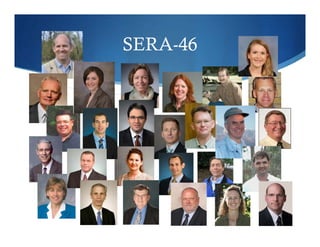
SERA-46
For More Information
http://northcentralwater.org/sera-46/
https://www.epa.gov/ms-htf/hypoxia-task-
force-partnerships
Thank you!
Strengthening Networks
SN 1 Response
• Working with NCERA 217 on a
drainage publication and
NC1190 on social dimensions of
water resource management.
• Gathering existing publications
on comparisons of LGU
recommendations
Regional N Rate Guidelines
• Nitrogen and Corn Use – Brad Joern (Purdue University) and
John Sawyer (Iowa State University)
• Why Evaluate Corn Nitrogen Recommendation Systems –
Larry Bundy (University of Wisconsin- Madison)
• Factors that Affect Suggested Fertilizer Nitrogen Rates –
George Rehm (University of Minnesota)
• Risks Associated with Nitrogen Rate Decisions – Gyles
Randal (University of Minnesota)
• Regional Approach to Corn Nitrogen Rate Guidelines –
John Sawyer (Iowa State University) and Emerson Nafziger
(University of Illinois)
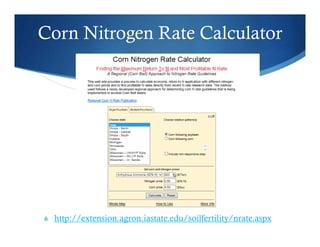
Corn Nitrogen Rate Calculator
 http://extension.agron.iastate.edu/soilfertility/nrate.aspx
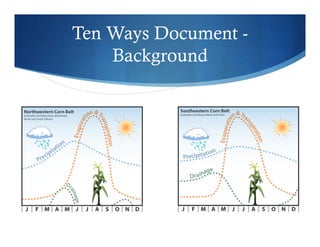
Ten Ways Document -
Background
Ten Ways Document
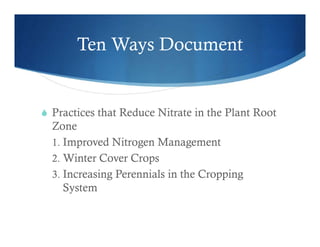
 Practices that Reduce Nitrate in the Plant Root
Zone
1. Improved Nitrogen Management
2. Winter Cover Crops
3. Increasing Perennials in the Cropping
System
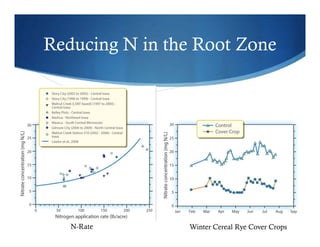
Reducing N in the Root Zone
N-Rate Winter Cereal Rye Cover Crops
Ten Ways Document
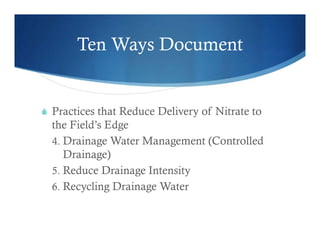
 Practices that Reduce Delivery of Nitrate to
the Field’s Edge
4. Drainage Water Management (Controlled
Drainage)
5. Reduce Drainage Intensity
6. Recycling Drainage Water
Ten Ways Document
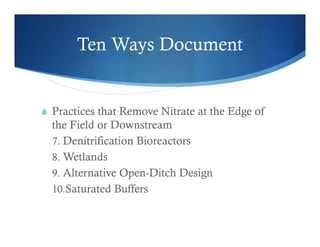
 Practices that Remove Nitrate at the Edge of
the Field or Downstream
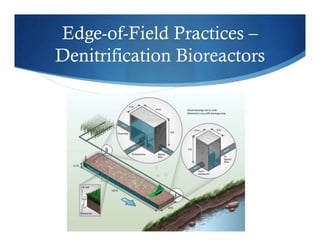
7. Denitrification Bioreactors
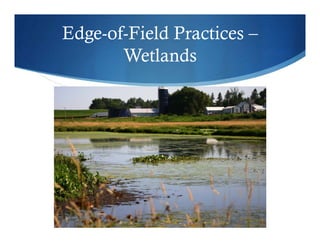
8. Wetlands
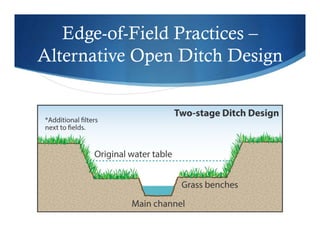
9. Alternative Open-Ditch Design
10.Saturated Buffers
Edge-of-Field Practices –
Denitrification Bioreactors
Edge-of-Field Practices –
Wetlands
Edge-of-Field Practices –
Alternative Open Ditch Design

Sera 46 overview - gumbert

  • 1.
     SERA-46 Overview Amanda Gumbert WaterQuality Extension Specialist University of Kentucky College of Agriculture, Food & Environment
  • 2.
    Structure  Research andExtension Representative from each state (others can join)  Executive Committee – Co-chairs, Secretary, and Administrative Advisors  Quarterly conference calls  Workgroups to focus on priority items
  • 3.
    Strengthening Networks SN 1.Refer the pertinent work of other multistate committees and land-grant university researchers and extension educators to the HTF and its member agencies. A specific priority is to communicate to the HTF the reasons for differences in state LGU recommended N/P application rates for similar soil types and fields.
  • 4.
    Strengthening Networks SN 5.Identify common attributes and gaps across state nutrient reduction strategies - Review the HTF states’ nutrient reduction strategies to identify the state goals, approaches and common attributes. Highlight opportunities for cross state information sharing to enhance other HTF state strategies.  Mississippi State University providing leadership for a preliminary snapshot.  Some ongoing work on reviewing Science Assessments
  • 5.
    Conservation Systems Research andOutreach CSRO2. Translate science regarding the issues and solutions in tile drained areas into accessible information for states to adopt into policies to address nutrient use and movement, particularly where corn is the main crop and where N movement is the main issue in the broad landscape.  NCERA 217 publication, Ten Ways to Reduce Nitrogen Loads From Drained Cropland in the Midwest, on target to be released by the end of the summer.  Project underway, funded by EPA grant to complement USDA-NIFA Transforming Drainage project
  • 6.
  • 7.
    Conservation Systems Research andOutreach CSRO 6. Develop and implement a social indicators system that will guide, evaluate and advance implementation of strategies to reduce nutrient loss from agricultural lands across the 12 HTF states.  Develop a social indicators framework and develop social indicators system to meet needs at state and basin-wide levels  Project underway, funded by EPA grant
  • 8.
    Conservation Systems Research andOutreach CSRO 8. Develop network of watershed practitioners and farmer leaders to strengthen the implementation effectiveness of nutrient management strategies that reduce nutrient movement.  Organize infrastructure for 12-state leadership team with members from LGUs, agribusiness, NGOs, and state and local conservation agencies  Identify common areas and gaps in state extension programs  Connect watershed practitioners and farmer leaders  Project underway, funded by EPA grant
  • 9.
    Conservation Systems Research andOutreach CSRO 9. Develop training and educational materials that will provide basic information about agriculture and nutrient management to agency staff, conservation NGOs and others who are less familiar with agriculture. Training could be state-specific or regional in nature.  Putting together a one-page prospectus on a project to develop series of one-page documents on agriculture in the region and practices  Definition  What can it do for you  What does it do for water quality  What is the cost  More information
  • 10.
    Conservation Systems Research andOutreach CSRO 10. Work in partnership with ASA’s CCA Program to:  Met with Luther Smith from American Society of Agronomy to discuss current and future opportunities from training through articles through Crop and Soil Science and webinars
  • 11.
    Future Priorities andOpportunities 1. Develop economics shared priorities around on-farm economic tools, costs, and benefits – small group identified to begin working on this 2. *Encourage additional dialogue between SERA-46 members and state HTF members 3. Shared priorities document is a living document that can be updated – updated document this fall
  • 12.
    Other Benefits of SERA-46and HTF Collaboration  Strengthening ties among LGUs and HTF and CC members at state and regional scales  Shared priorities have brought land-grant university faculty and educators together across the Mississippi River Basin to work toward common goals
  • 13.
  • 14.
  • 15.
  • 16.
    Strengthening Networks SN 1Response • Working with NCERA 217 on a drainage publication and NC1190 on social dimensions of water resource management. • Gathering existing publications on comparisons of LGU recommendations
  • 17.
    Regional N RateGuidelines • Nitrogen and Corn Use – Brad Joern (Purdue University) and John Sawyer (Iowa State University) • Why Evaluate Corn Nitrogen Recommendation Systems – Larry Bundy (University of Wisconsin- Madison) • Factors that Affect Suggested Fertilizer Nitrogen Rates – George Rehm (University of Minnesota) • Risks Associated with Nitrogen Rate Decisions – Gyles Randal (University of Minnesota) • Regional Approach to Corn Nitrogen Rate Guidelines – John Sawyer (Iowa State University) and Emerson Nafziger (University of Illinois)
  • 18.
    Corn Nitrogen RateCalculator  http://extension.agron.iastate.edu/soilfertility/nrate.aspx
  • 19.
    Ten Ways Document- Background
  • 20.
    Ten Ways Document Practices that Reduce Nitrate in the Plant Root Zone 1. Improved Nitrogen Management 2. Winter Cover Crops 3. Increasing Perennials in the Cropping System
  • 21.
    Reducing N inthe Root Zone N-Rate Winter Cereal Rye Cover Crops
  • 22.
    Ten Ways Document Practices that Reduce Delivery of Nitrate to the Field’s Edge 4. Drainage Water Management (Controlled Drainage) 5. Reduce Drainage Intensity 6. Recycling Drainage Water
  • 23.
    Ten Ways Document Practices that Remove Nitrate at the Edge of the Field or Downstream 7. Denitrification Bioreactors 8. Wetlands 9. Alternative Open-Ditch Design 10.Saturated Buffers
  • 24.
  • 25.
  • 26.