TSBF INSTITUTE of CIAT Program TS2:  Sustainable Land Management for Eco-efficient Agriculture in the Tropics
Objectives of the TS2 program To enhance  knowledge and understanding of soil ecological functions  that sustain a productive agriculture and maintains or improves biodiversity and ecosystem services  To utilize  targeting of land use and soil management interventions  to better reverse erosion of the soil resource base; To  enhance the production of ecosystem services  through sustainable agricultural production and payments for ecosystem services. Goal     Rationale Outputs  Institutional
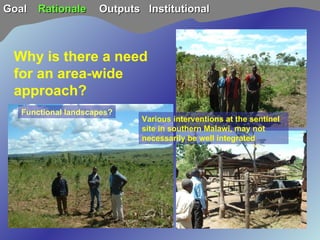
Why is there a need for an area-wide approach? Goal   Rationale Outputs  Institutional Various interventions at the sentinel site in southern Malawi, may not necessarily be well integrated Functional landscapes?
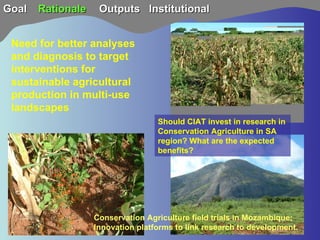
Should CIAT invest in research in Conservation Agriculture in SA region? What are the expected benefits? Need for better analyses and diagnosis to target interventions for sustainable agricultural production in multi-use landscapes Conservation Agriculture field trials in Mozambique; Innovation platforms to link research to development.  Goal   Rationale Outputs  Institutional
Targeting production and land use systems; arguments for an area-wide approach Atkinson & Wilkins (2004) and Entz et al. (2005) both suggested that an  area-wide approach may be appropriate for improving nutrient management and forage supply.  Atkinson & Wilkins (2004) proposed linkage between specialist farms with the contract  transfer of, particularly, manure between farms   specializing in intensive animal production and specialist crop producers.  Eco-efficiency can be increased by altering  (i) the method of production of individual crops or animals and  (ii) the land-use system. An area-wide approach is clearly needed for preventing soil deterioration  [and salinization]  and for remediation when damage has already occurred, owing to the many factors operating over the whole catchment  [which will influence water tables, the movement of solutes and effects on production]. Powell et al. (2004): the evolution of crop–livestock integration begins with separate crop and livestock production (in subsistence farming), followed in sequence by integration (mixed farming),  specialization and finally integration on an area-wide basis. Goal   Rationale Outputs  Institutional
Eco-efficient agriculture Five key attributes: it  uses resources efficiently  and makes the maximum use of renewable inputs,  it is neither locally polluting nor does it transfer pollution to elsewhere it provides a  predictable output ,  It conserves  functional biodiversity  in relation to strengthening  ecological processes , reducing greenhouse gas emission and pollution generally and limiting  soil erosion, and  it is capable of  responding rapidly to changes in the social, economic and physical environment . (It is also crucial that eco-efficient farming satisfies economic criteria in relation to farm profitability). Goal   Rationale Outputs  Institutional
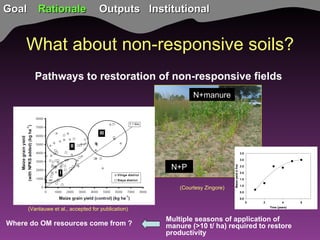
What about non-responsive soils? N+P N+manure Multiple seasons of application of manure (>10 t/ ha) required to restore productivity Pathways to restoration of non-responsive fields  (Courtesy Zingore) (Vanlauwe et al., accepted for publication) Where do OM resources come from ? Goal   Rationale Outputs  Institutional
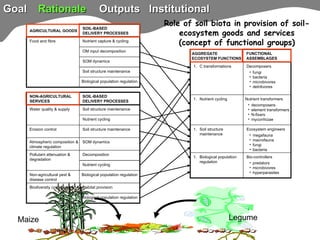
Role of soil biota in provision of soil-ecosystem goods and services (concept of functional groups) Goal   Rationale Outputs  Institutional Food and fibre Water quality & supply Pollutant attenuation & degradation Non-agricultural pest & disease control Biodiversity conservation Erosion control AGRICULTURAL GOODS C transformations Soil structure maintenance Biological population regulation AGGREGATE ECOSYSTEM FUNCTIONS Nutrient cycling Decomposers fungi bacteria microbivores detritivores Nutrient transformers decomposers element transformers N-fixers mycorrhizae Ecosystem engineers megafauna macrofauna fungi bacteria Bio-controllers predators microbivores hyperparasites FUNCTIONAL ASSEMBLAGES NON-AGRICULTURAL SERVICES Atmospheric composition & climate regulation Nutrient capture & cycling SOM dynamics Soil structure maintenance Biological population regulation Soil structure maintenance Decomposition Nutrient cycling Soil structure maintenance Biological population regulation Biological population regulation Habitat provision OM input decomposition SOM dynamics Nutrient cycling SOIL-BASED DELIVERY PROCESSES SOIL-BASED DELIVERY PROCESSES Maize Legume
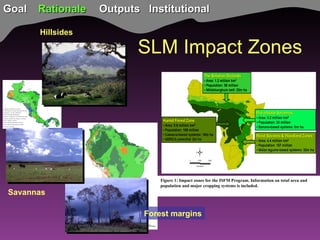
SLM Impact Zones Goal   Rationale Outputs  Institutional Hillsides Savannas Forest margins Figure 1: Impact zones for the ISFM Program. Information on total area and population and major cropping systems is included.
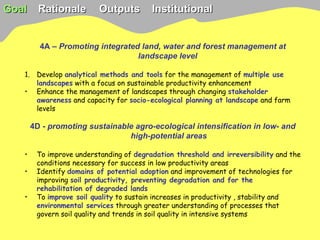
Goal    Rationale Outputs  Institutional 4A –  Promoting integrated land, water and forest management at landscape level   1. Develop  analytical methods and tools  for the management of  multiple use landscapes  with a focus on sustainable productivity enhancement Enhance the management of landscapes through changing  stakeholder awareness  and capacity for  socio-ecological planning at landscape  and farm levels 4D -  promoting sustainable agro-ecological intensification in low- and high-potential areas To improve understanding of  degradation threshold and irreversibility  and the conditions necessary for success in low productivity areas Identify  domains of potential adoption  and improvement of technologies for improving  soil productivity, preventing degradation and for the rehabilitation of degraded lands To  improve soil quality  to sustain increases in productivity , stability and  environmental services  through greater understanding of processes that govern soil quality and trends in soil quality in intensive systems
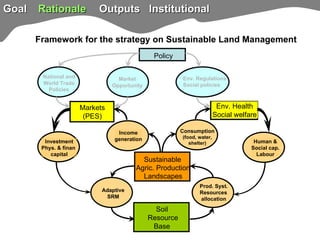
Sustainable Agric. Production  Landscapes Soil Resource Base Markets (PES) Env. Health Social welfare Policy Adaptive SRM Consumption (food, water, shelter) National and World Trade Policies Market Opportunity Env. Regulations Social policies Prod. Syst. Resources allocation Goal     Rationale Outputs  Institutional Framework for the strategy on Sustainable Land Management Income generation Human & Social cap. Labour Investment Phys. & finan  capital
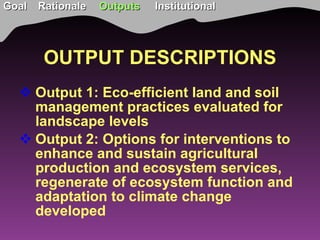
OUTPUT DESCRIPTIONS Output 1: Eco-efficient land and soil management practices evaluated for landscape levels Output 2:  Options for interventions to enhance and sustain agricultural production and ecosystem services, regenerate of ecosystem function and adaptation to climate change developed Goal     Rationale Outputs  Institutional
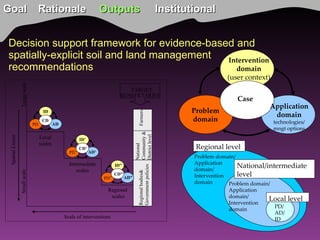
Decision support framework for evidence-based and spatially-explicit soil and land management recommendations Regional level National/intermediate level Local level Problem domain/ Application domain/ Intervention domain Problem domain/ Application domain/ Intervention domain PD/ AD/ ID Goal     Rationale Outputs  Institutional Intervention domain (user context) Problem domain Application domain technologies/ mngt options Case Large scale Small scale Spatial Extent Regional  scales Intermediate scales Local scales Farmers National Community &  District level Regional bodies& Government policies Scale of interventions TARGET BENEFICIARIES ID PD AD CD ID’ PD’ AD’ CD’ ID” PD” AD” CD”
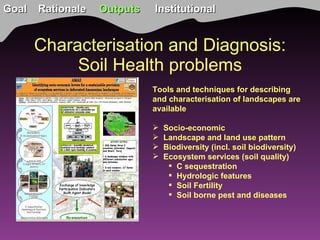
Characterisation and Diagnosis: Soil Health problems Goal     Rationale Outputs  Institutional Tools and techniques for describing and characterisation of landscapes are available  Socio-economic Landscape and land use pattern Biodiversity (incl. soil biodiversity) Ecosystem services (soil quality) C sequestration Hydrologic features Soil Fertility Soil borne pest and diseases
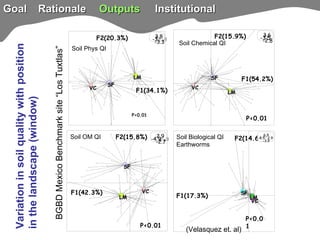
BGBD Mexico Benchmark site “Los Tuxtlas” Soil Biological QI Earthworms Soil Chemical QI Soil Phys QI Soil OM QI (Velasquez et. al) Variation in soil quality with position in the landscape (window) Goal     Rationale Outputs  Institutional F1(54.2%) F2(15.9%) P<0.01 LM SF VC -2.8 3.6 -3 5 F2(20.3%) F1(34.1%) LM SF VC -3.3 3.8 -3 3.8 P<0.01 F1(42.3%) F2(15.8%) P<0.01 LM SF VC -2.7 2.9 -4.9 2.9 F1(17.3%) F2(14.6%) SF VC -3.9 6.9 -8.5 2.9 LM P<0.01
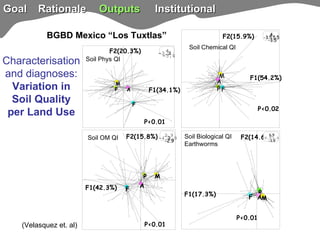
Soil Phys QI BGBD Mexico “Los Tuxtlas” F1(42.3%) F2(15.8%) M -2.9 2.9 -4.9 2.9 P F A P<0.01 Soil OM QI Soil Biological QI Earthworms Goal     Rationale Outputs  Institutional Characterisation and diagnoses: Variation in Soil Quality per Land Use (Velasquez et. al) F A M -3.4 4 -3.2 4 P P<0.01 F2(20.3%) F1(34.1%) F M -3.5 4 -3.5 5.5 A P F1(54.2%) F2(15.9%) P<0.02 Soil Chemical QI F1(17.3%) F2(14.6%) F M -3.9 6.9 -8.5 2.6 P A P<0.01
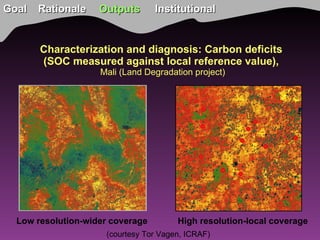
Characterization and diagnosis: Carbon deficits  (SOC measured against local reference value),   Mali (Land Degradation project) Low resolution-wider coverage High resolution-local coverage (courtesy Tor Vagen, ICRAF) Goal     Rationale Outputs  Institutional
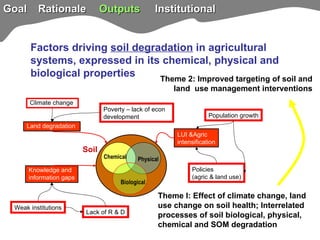
Chemical Physical Biological Land degradation  LUI &Agric intensification Knowledge and  information gaps Population growth Poverty – lack of econ development Policies (agric & land use) Weak institutions Lack of R & D Climate change  Factors driving  soil degradation  in agricultural systems, expressed in its chemical, physical and biological properties Theme I: Effect of climate change, land use change on soil health; Interrelated processes of soil biological, physical, chemical and SOM degradation  Theme 2: Improved targeting of soil and land  use management interventions Soil Goal     Rationale Outputs  Institutional
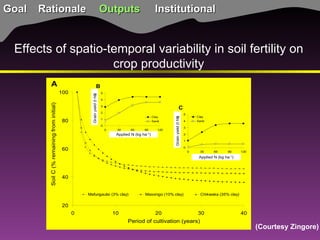
Effects of spatio-temporal variability in soil fertility on crop productivity Goal     Rationale Outputs  Institutional (Courtesy Zingore)
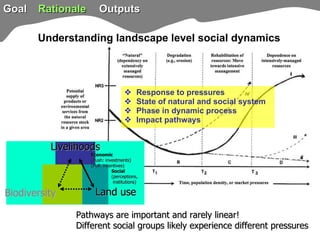
Understanding landscape level social dynamics Response to pressures State of natural and social system Phase in dynamic process Impact pathways Pathways are important and rarely linear!  Different social groups likely experience different pressures Goal     Rationale Outputs
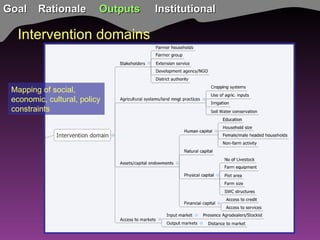
Intervention domains Mapping of social, economic, cultural, policy constraints Goal     Rationale Outputs  Institutional
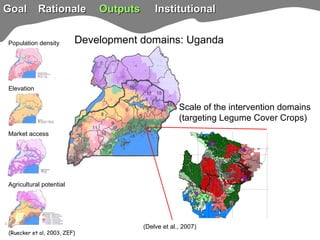
Development domains: Uganda (Ruecker et al, 2003, ZEF) Population density Elevation Agricultural potential Market access Scale of the intervention domains (targeting Legume Cover Crops) Goal     Rationale Outputs  Institutional (Delve et al., 2007)
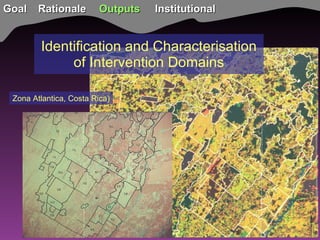
Identification and Characterisation of Intervention Domains Goal     Rationale Outputs  Institutional Zona Atlantica, Costa Rica)
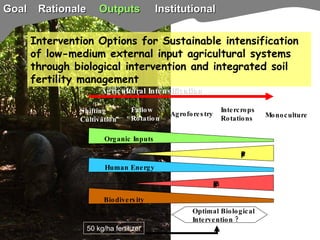
Intervention Options for Sustainable intensification of low-medium external input agricultural systems through biological intervention and integrated soil fertility management Goal     Rationale Outputs  Institutional Fertility Soil Biology TSBF CBD 2001 Agricultural Intensification Shifting Cultivation Fallow Rotation Agroforestry Intercrops Rotations Monoculture Optimal Biological Intervention ? Organic Inputs Human Energy Biodiversity Petro-Chemical Energy Purchased Inputs 50 kg/ha fertilizer
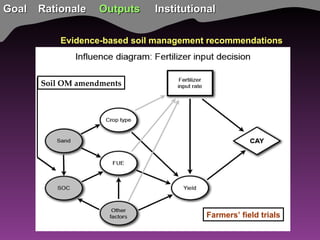
Evidence-based soil management recommendations Soil OM amendments Farmers’ field trials Goal     Rationale Outputs  Institutional
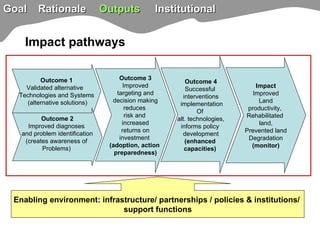
Outcome 1 Validated alternative  Technologies and Systems (alternative solutions) Outcome 2 Improved diagnoses  and problem identification (creates awareness of  Problems)  Outcome 3 Improved targeting and  decision making reduces  risk and  increased returns on  investment  (adoption, action  preparedness) Outcome 4 Successful  interventions implementation Of  alt. technologies, informs policy  development (enhanced  capacities)   Impact Improved Land productivity,  Rehabilitated  land, Prevented land Degradation (monitor) Enabling environment: infrastructure/ partnerships / policies & institutions/  support functions Impact pathways Goal     Rationale Outputs  Institutional
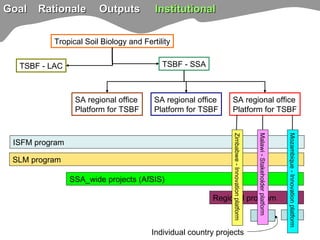
Regional program SSA_wide projects (AfSIS) ISFM program SLM program SA regional office Platform for TSBF Malawi - Stakeholder platform Zimbabwe - Innovation platform Mozambique - Innovation platform SA regional office Platform for TSBF SA regional office Platform for TSBF TSBF - SSA TSBF - LAC Individual country projects Goal     Rationale Outputs   Institutional Tropical Soil Biology and Fertility