Phosphate oxygen isotopes as a tracer for
phosphorus cycling in agricultural soils
July 29, 2015
Deb Jaisi*, Sunendra Joshi, Wei Li, and Xiaona Li
Department of Plant and Soil Sciences
University of Delaware, DE 19716
RapidlyexchangeableInorganicP
RAPIDLY MINERALISABLE
ORGANIC P
SLOWLY AND NOT
MINERALISABLE ORGANIC P
PHOSPHATE
IONS IN THE SOIL
SOLUTION
MICROBIAL
BIOMASS
Micro and
macro
fauna
Erosion/
Death Assimilation
Adsorption/
Precipitation
Desorption/
Solubilisation
Leaching
Mineral fertilizers
Mineralization
Immobilization
Enzymatic
hydrolysis
Biological
solubilisationRapidly mineralizable
Organic P
Slowly and not mineralizable
Organic P
Phosphate in soil
solution
Microbial biomass
Micro and macro fauna
Weathering of
parent material
Erosion/runoff
Death Assimilation
Adsorption/
Precipitation
Desorption/
Solubilisation
P exports
Leaching
Mineralization
Immobilization
Enzymatic
hydrolysis
Biological /abiotic
solubilization
Organic fertilizers
Plant residue
Root Uptake
Slowlytonotexchangeable
InorganicP
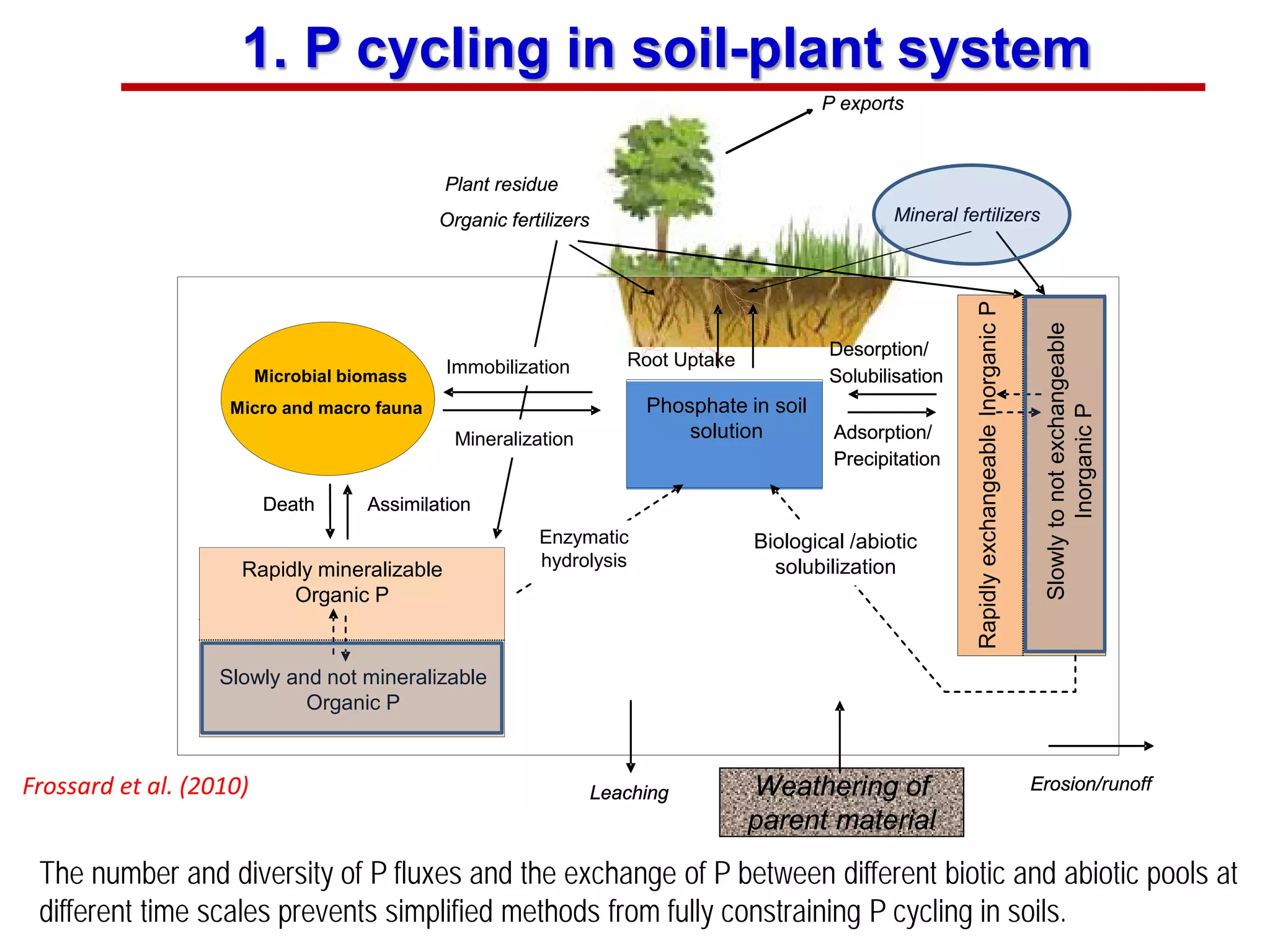
1. P cycling in soil-plant system
Frossard et al. (2010)
The number and diversity of P fluxes and the exchange of P between different biotic and abiotic pools at
different time scales prevents simplified methods from fully constraining P cycling in soils.
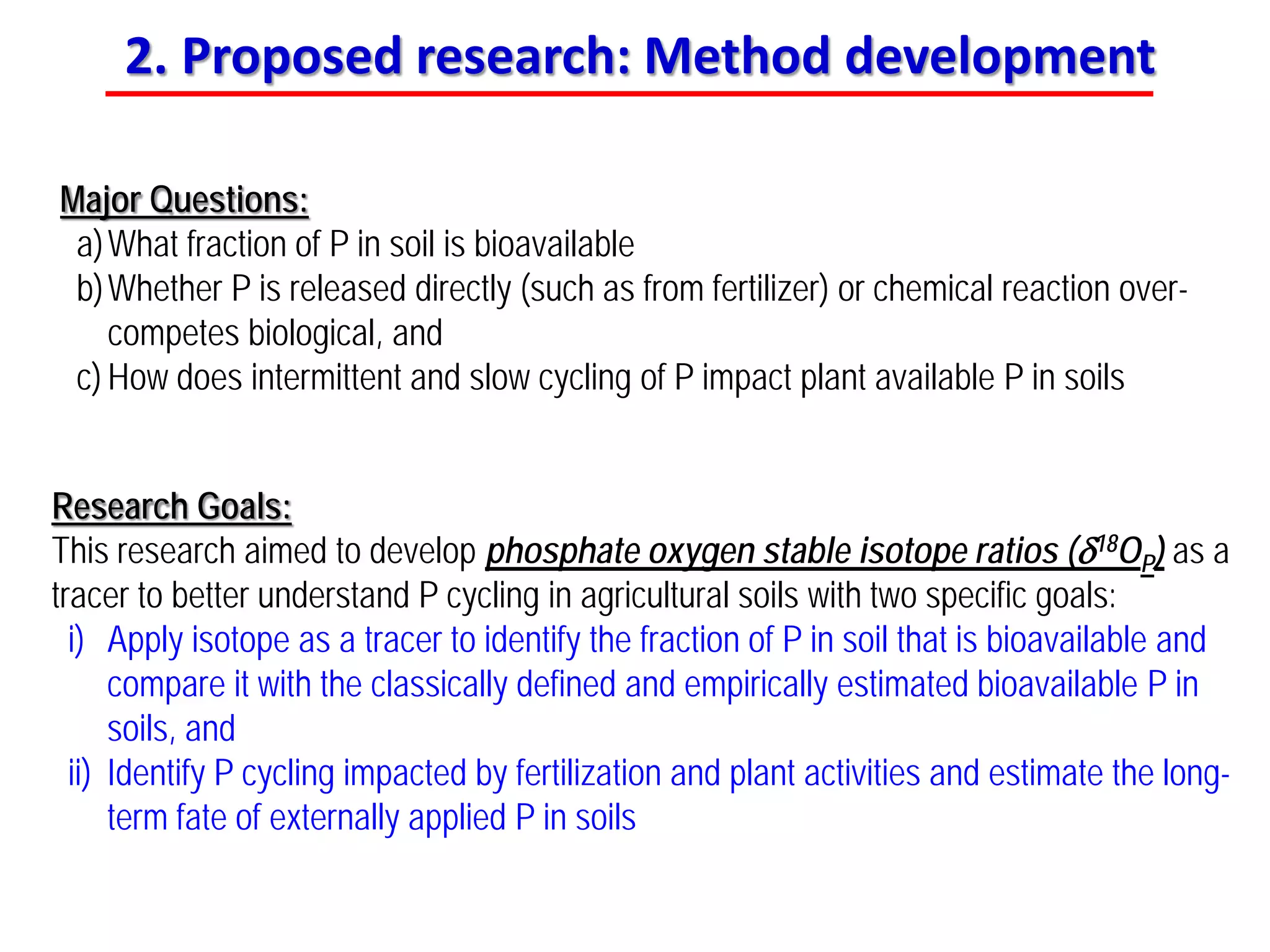
Major Questions:
a)What fraction of P in soil is bioavailable
b)Whether P is released directly (such as from fertilizer) or chemical reaction over-
competes biological, and
c) How does intermittent and slow cycling of P impact plant available P in soils
Research Goals:
This research aimed to develop phosphate oxygen stable isotope ratios (δ18OP) as a
tracer to better understand P cycling in agricultural soils with two specific goals:
i) Apply isotope as a tracer to identify the fraction of P in soil that is bioavailable and
compare it with the classically defined and empirically estimated bioavailable P in
soils, and
ii) Identify P cycling impacted by fertilization and plant activities and estimate the long-
term fate of externally applied P in soils
2. Proposed research: Method development
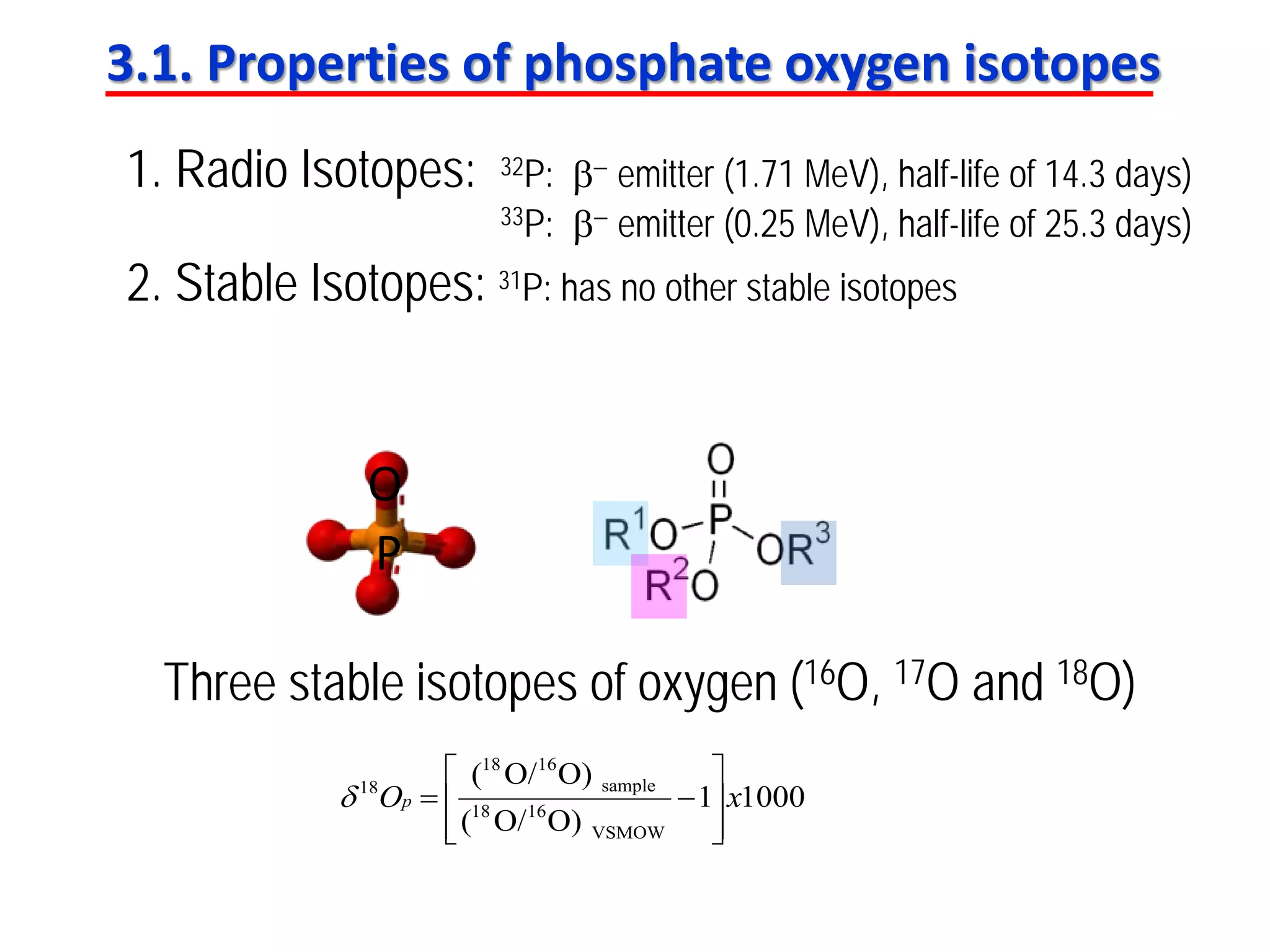
Three stable isotopes of oxygen (16O, 17O and 18O)
P
O
1. Radio Isotopes: 32P: β− emitter (1.71 MeV), half-life of 14.3 days)
33P: β− emitter (0.25 MeV), half-life of 25.3 days)
2. Stable Isotopes: 31P: has no other stable isotopes
10001
O)O/(
O)O/(
VSMOW
1618
sample
1618
18
xOp








−=δ
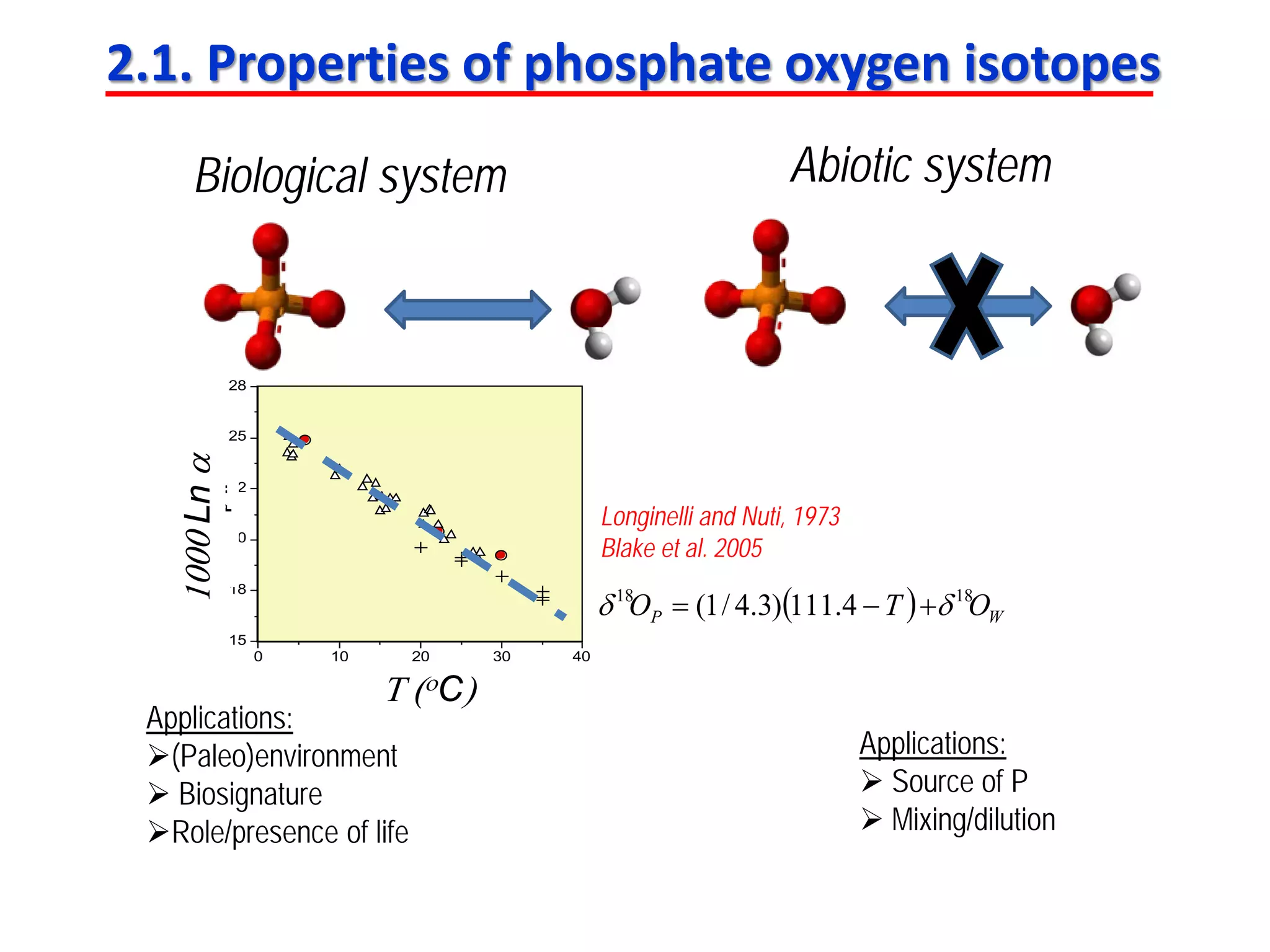
3.1. Properties of phosphate oxygen isotopes
Biological system Abiotic system
15
18
20
22
25
28
0 10 20 30 40
T (°C)
1000Lnα
Τ (οC)
Applications:
(Paleo)environment
 Biosignature
Role/presence of life
Applications:
 Source of P
 Mixing/dilution
Longinelli and Nuti, 1973
Blake et al. 2005
( ) WP OTO 1818
4.111)3.4/1( δδ +−=
2.1. Properties of phosphate oxygen isotopes
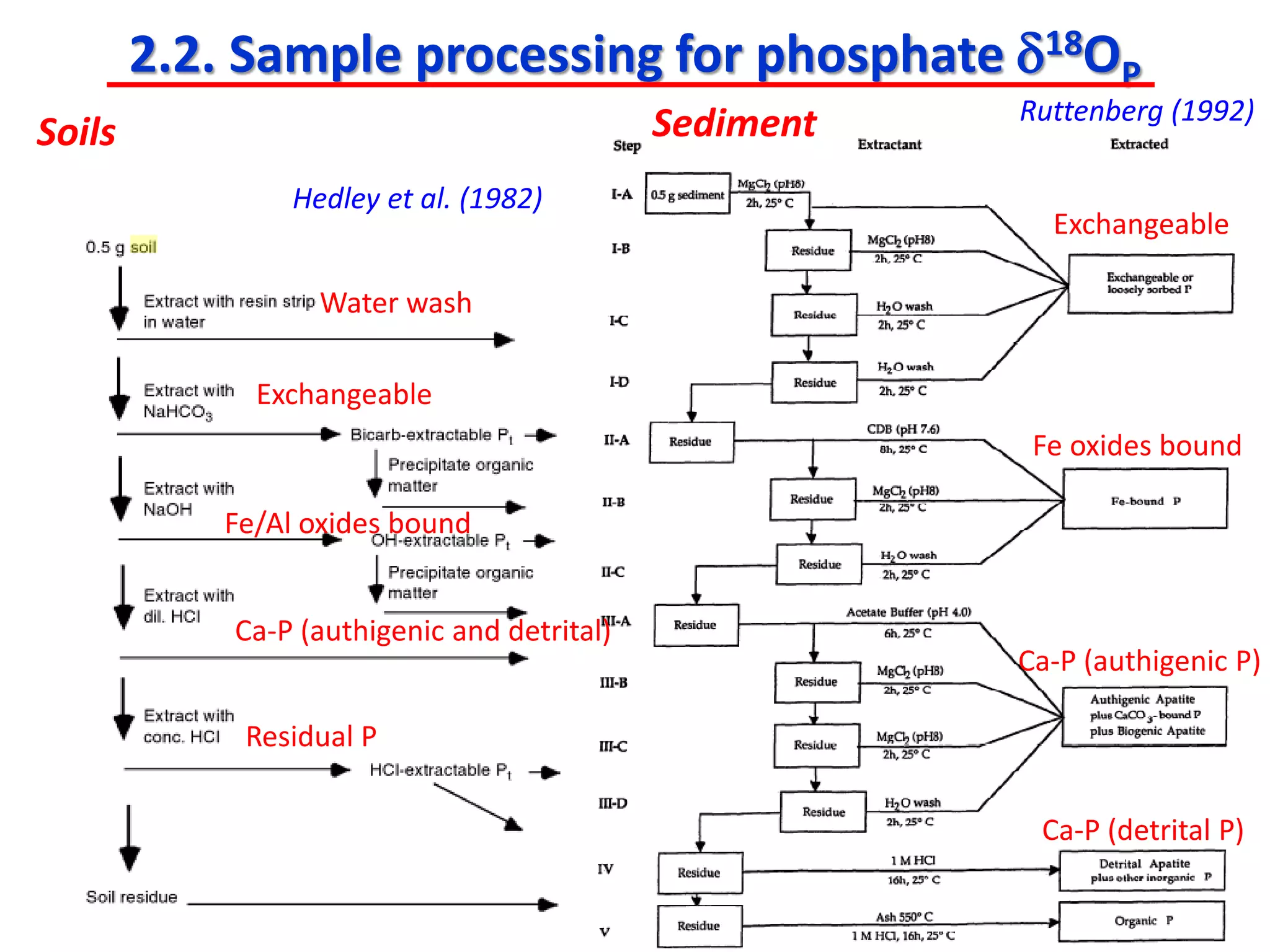
2.2. Sample processing for phosphate δ18OP
Hedley et al. (1982)
Soils
Ruttenberg (1992)
Exchangeable
Exchangeable
Fe/Al oxides bound
Fe oxides bound
Ca-P (authigenic and detrital)
Residual P
Ca-P (authigenic P)
Ca-P (detrital P)
Water wash
Sediment
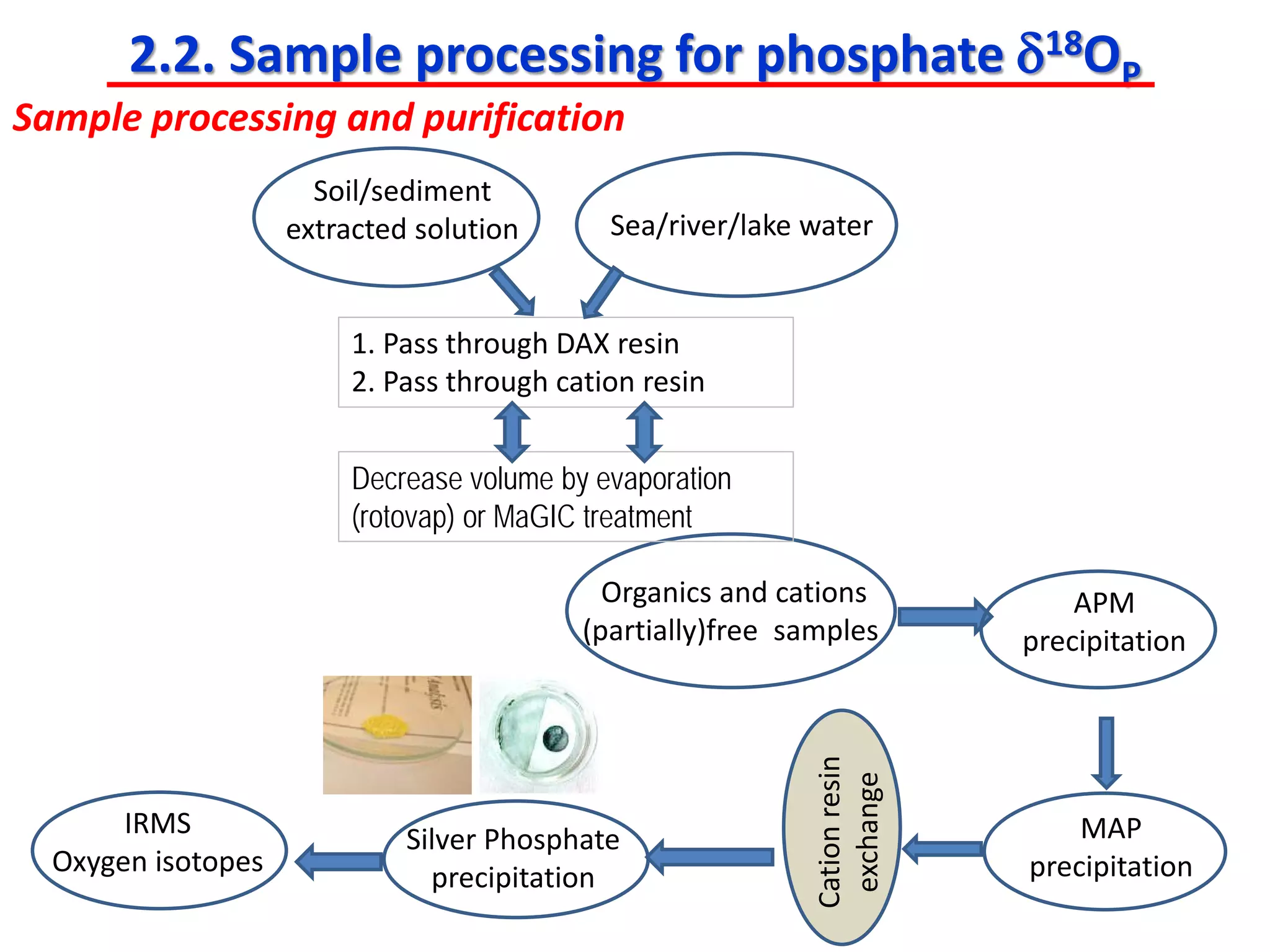
2.2. Sample processing for phosphate δ18OP
Soil/sediment
extracted solution
1. Pass through DAX resin
2. Pass through cation resin
Organics and cations
(partially)free samples
APM
precipitation
MAP
precipitation
Silver Phosphate
precipitation
IRMS
Oxygen isotopes
Decrease volume by evaporation
(rotovap) or MaGIC treatment
Sea/river/lake water
Sample processing and purification
Cationresin
exchange
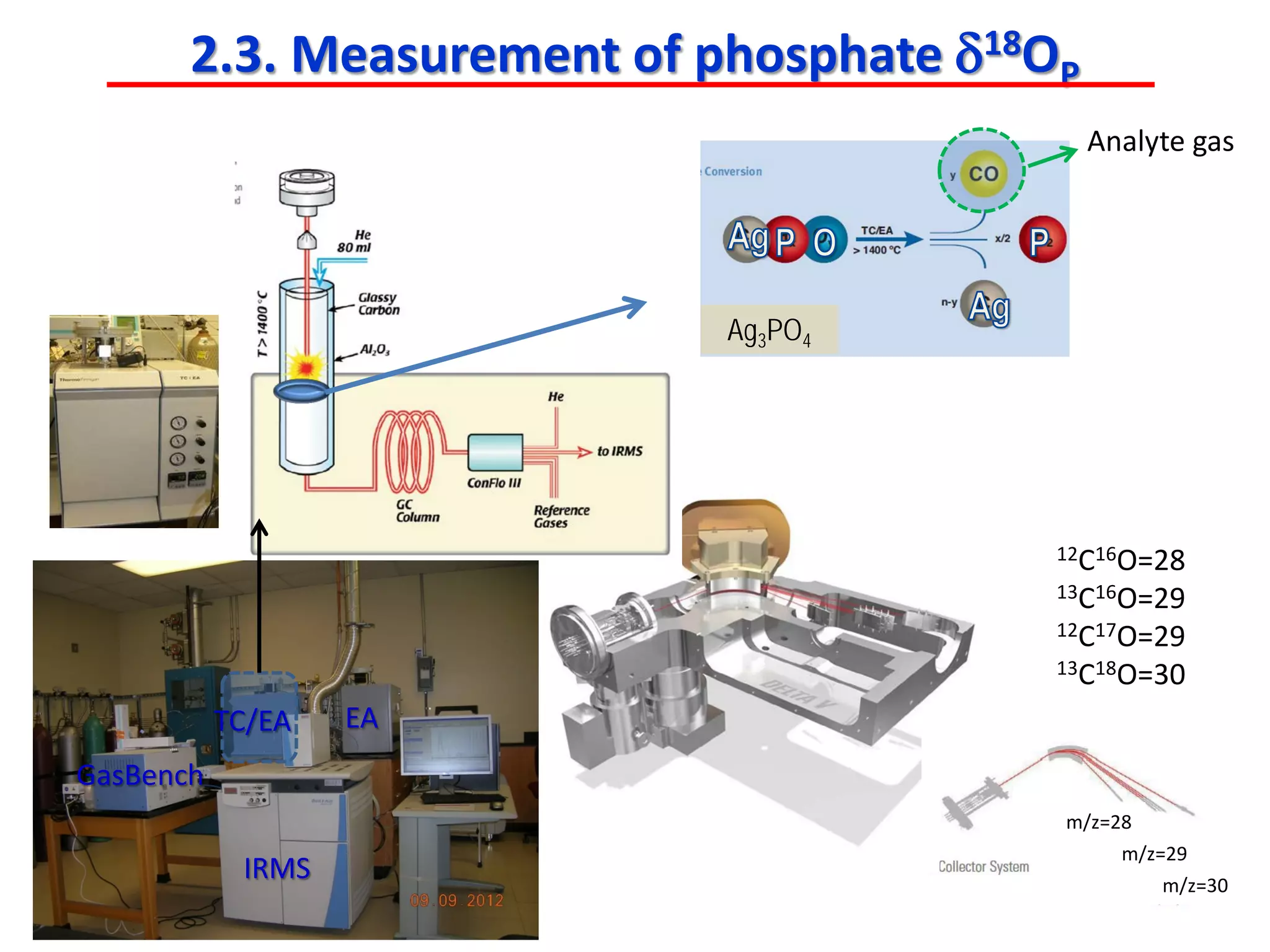
m/z=28
m/z=29
m/z=30
12C16O=28
13C16O=29
12C17O=29
13C18O=30
Ag3PO4
2.3. Measurement of phosphate δ18OP
Analyte gas
IRMS
TC/EA EA
GasBench
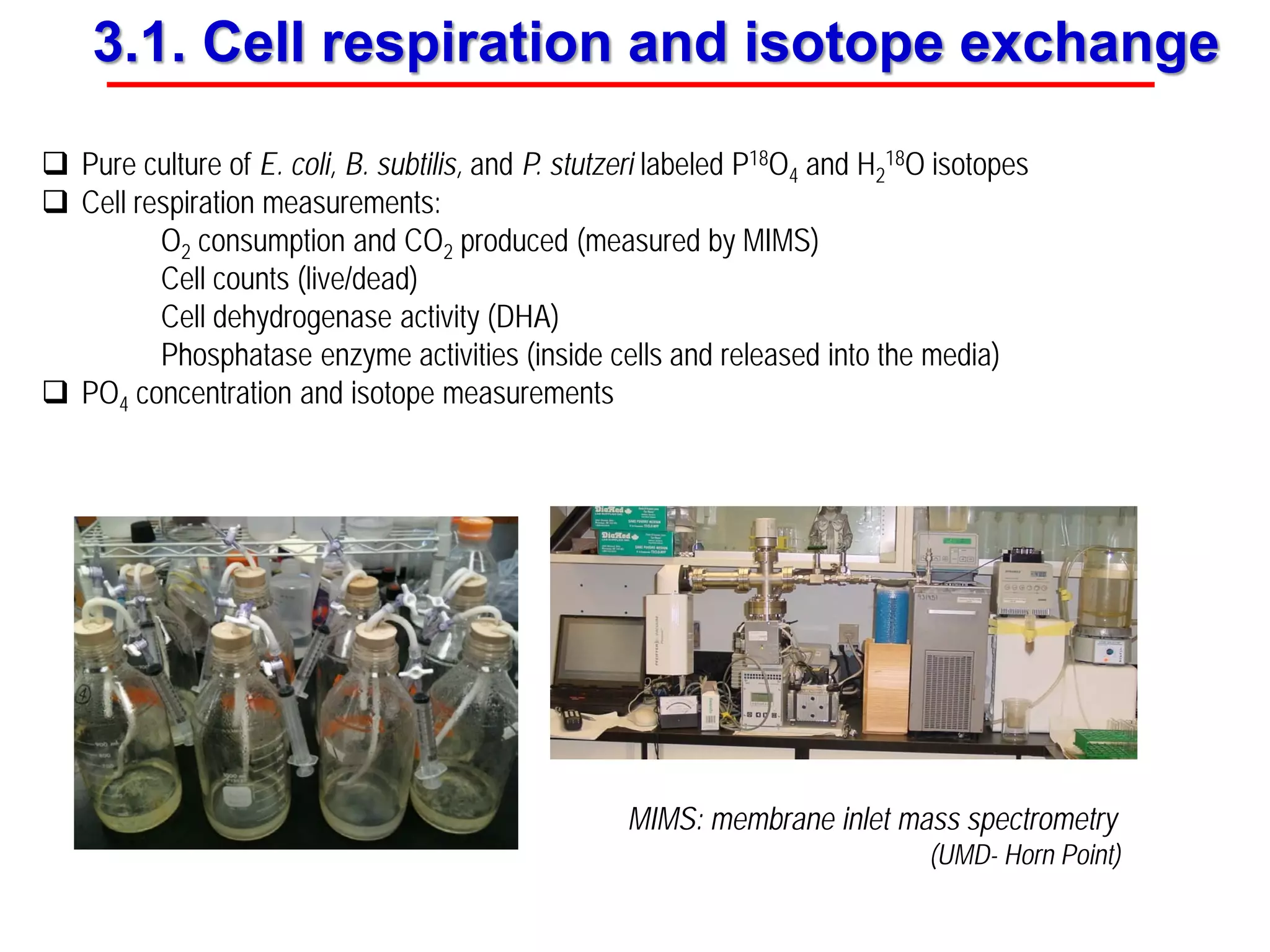
MIMS: membrane inlet mass spectrometry
(UMD- Horn Point)
 Pure culture of E. coli, B. subtilis, and P. stutzeri labeled P18O4 and H2
18O isotopes
 Cell respiration measurements:
O2 consumption and CO2 produced (measured by MIMS)
Cell counts (live/dead)
Cell dehydrogenase activity (DHA)
Phosphatase enzyme activities (inside cells and released into the media)
 PO4 concentration and isotope measurements
3.1. Cell respiration and isotope exchange
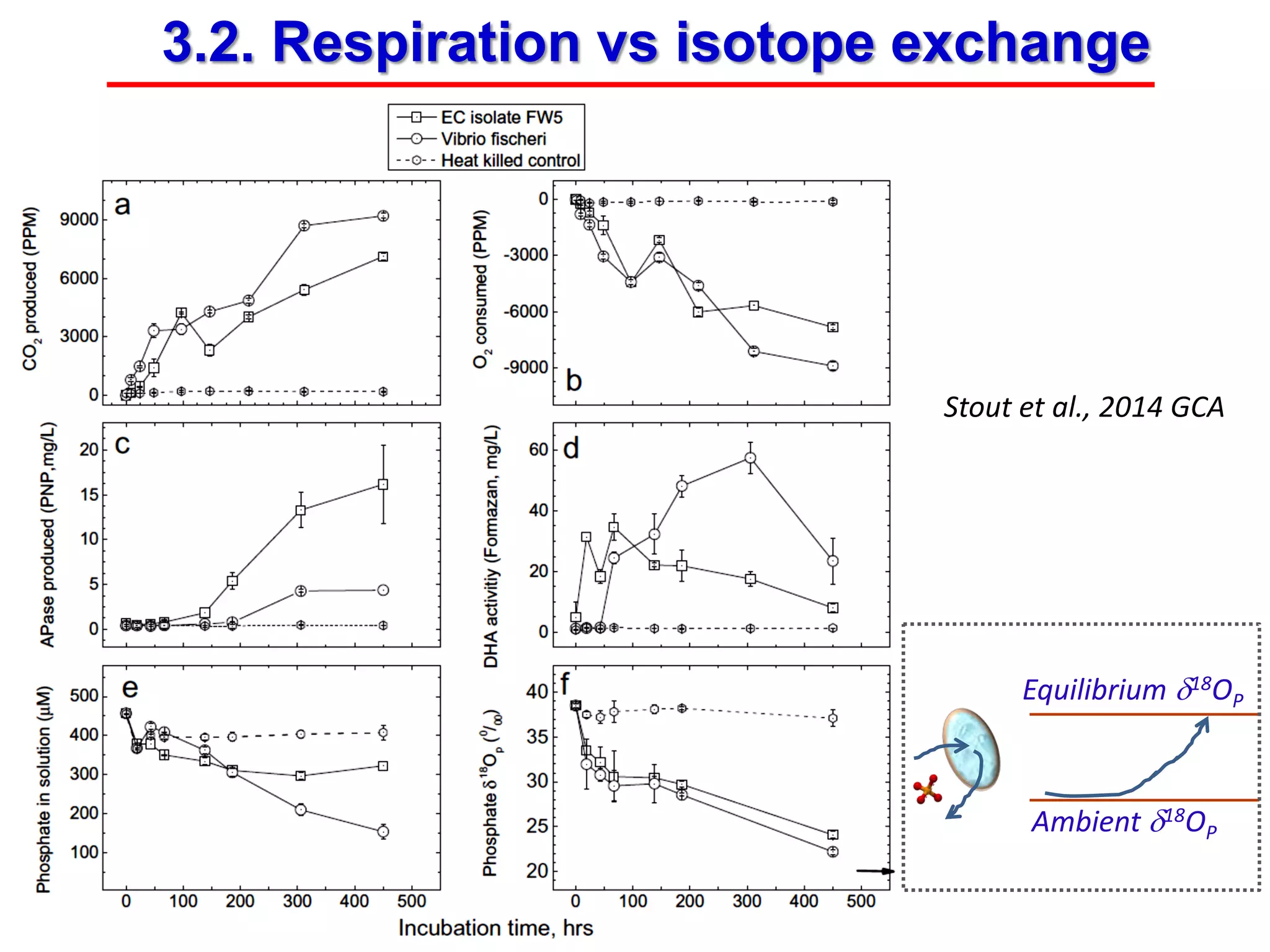
Stout et al., 2014 GCA
3.2. Respiration vs isotope exchange
Equilibrium δ18OP
Ambient δ18OP
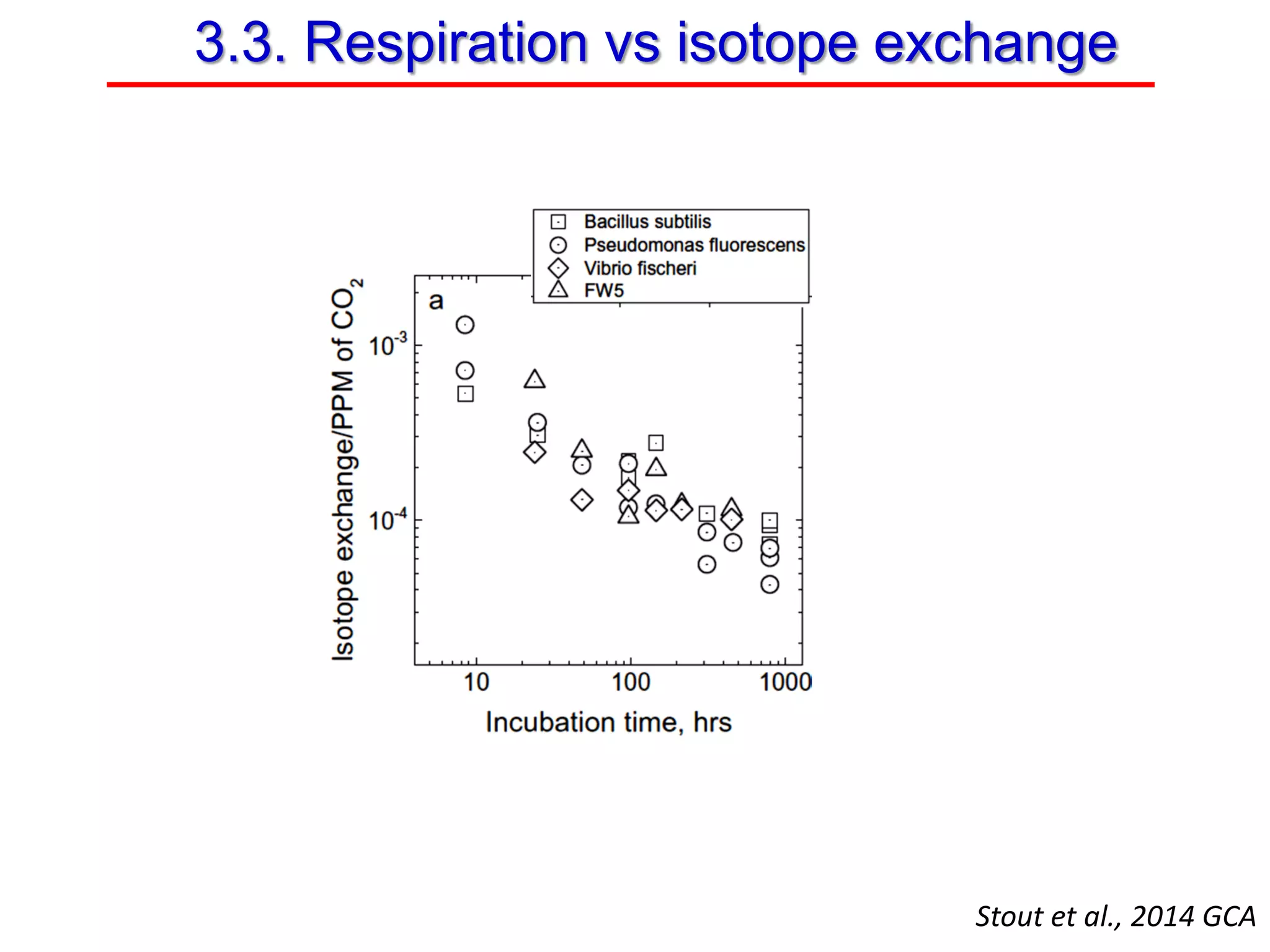
Stout et al., 2014 GCA
3.3. Respiration vs isotope exchange
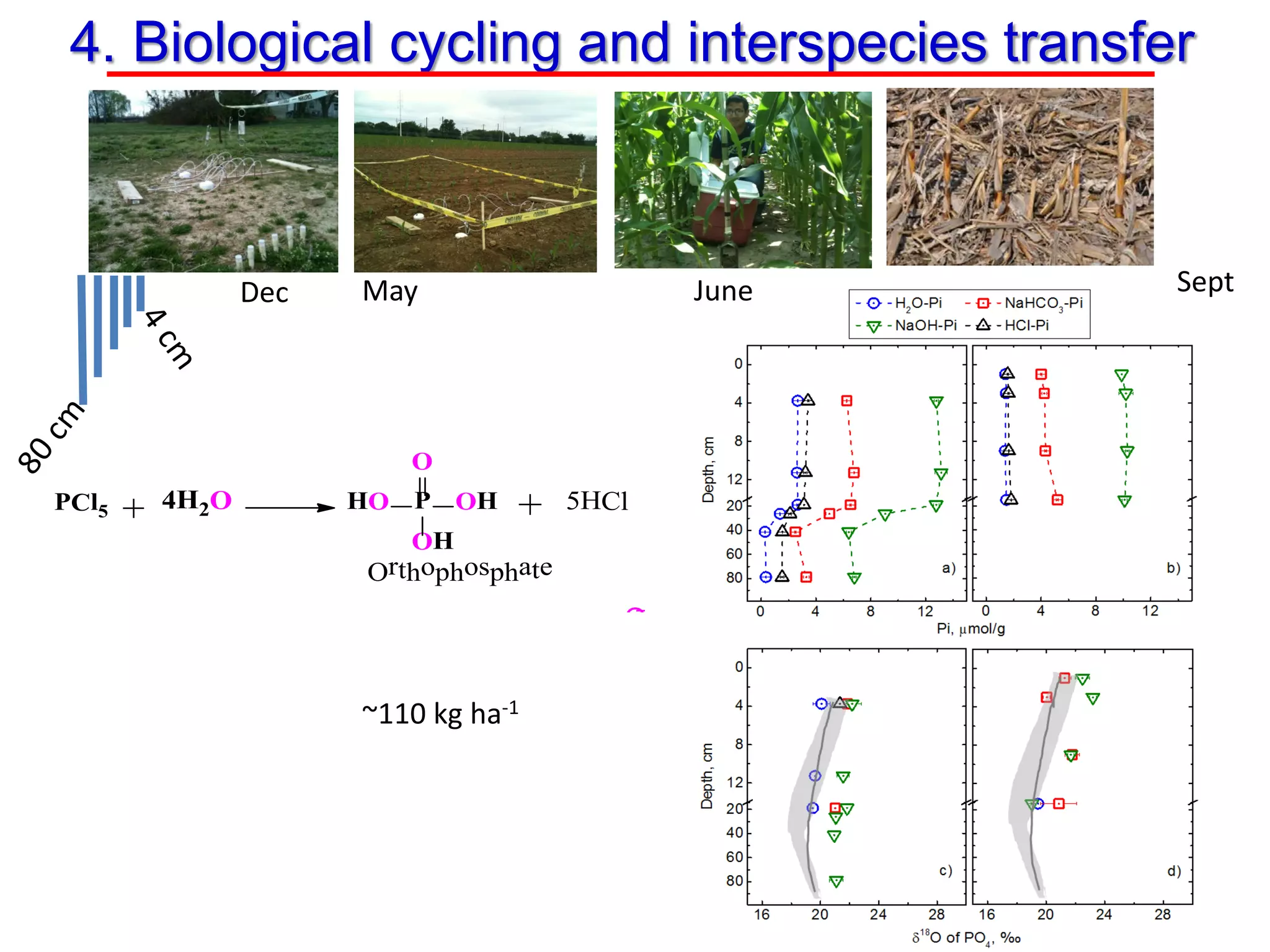
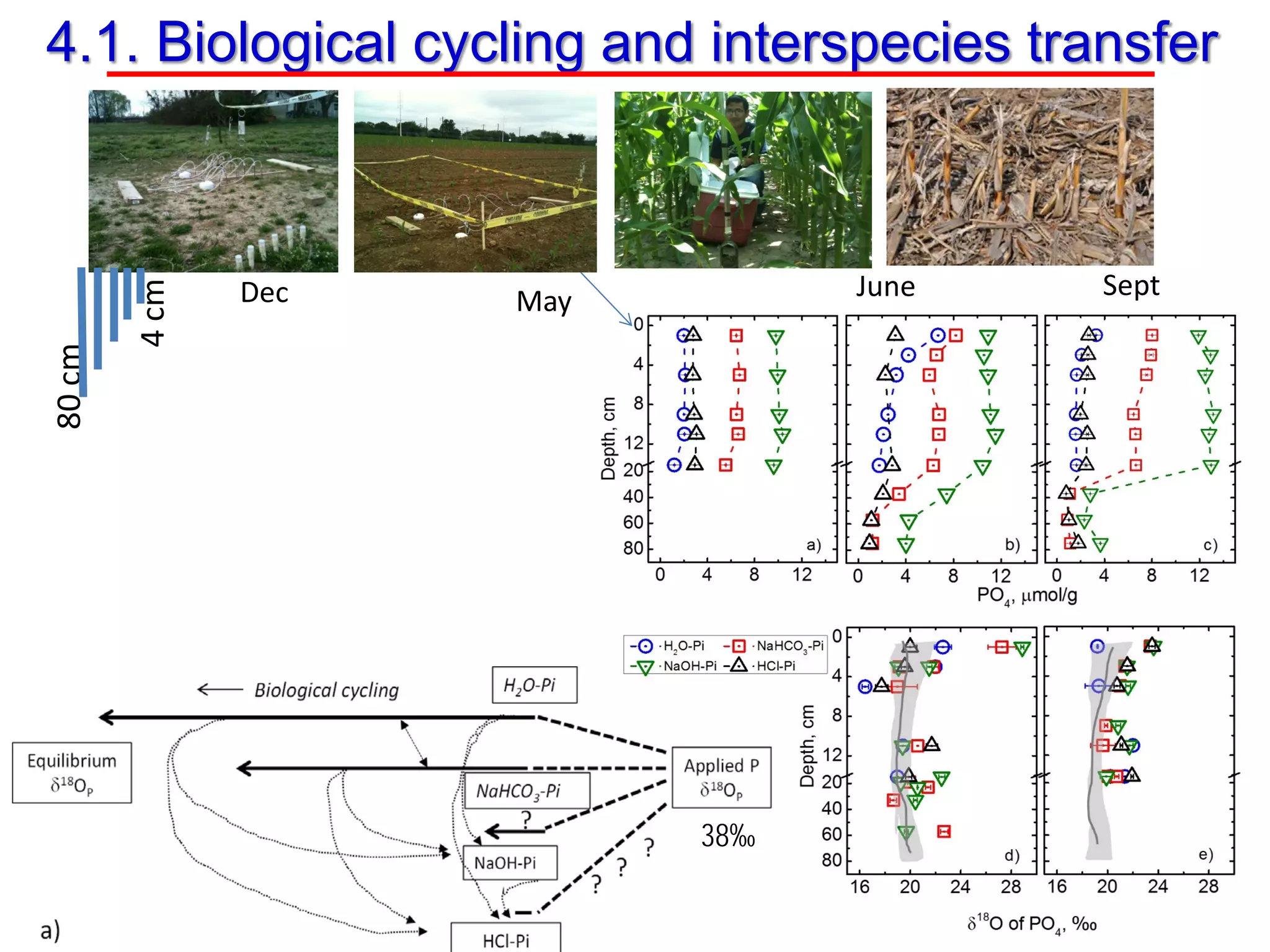
Dec May June Sept
4. Biological cycling and interspecies transfer
~110 kg ha-1
PCl5 4H2O 5HClP OHHO
OH
O
Orthophosphate
O
Dec May June Sept
80cm
4cm
38‰
4.1. Biological cycling and interspecies transfer
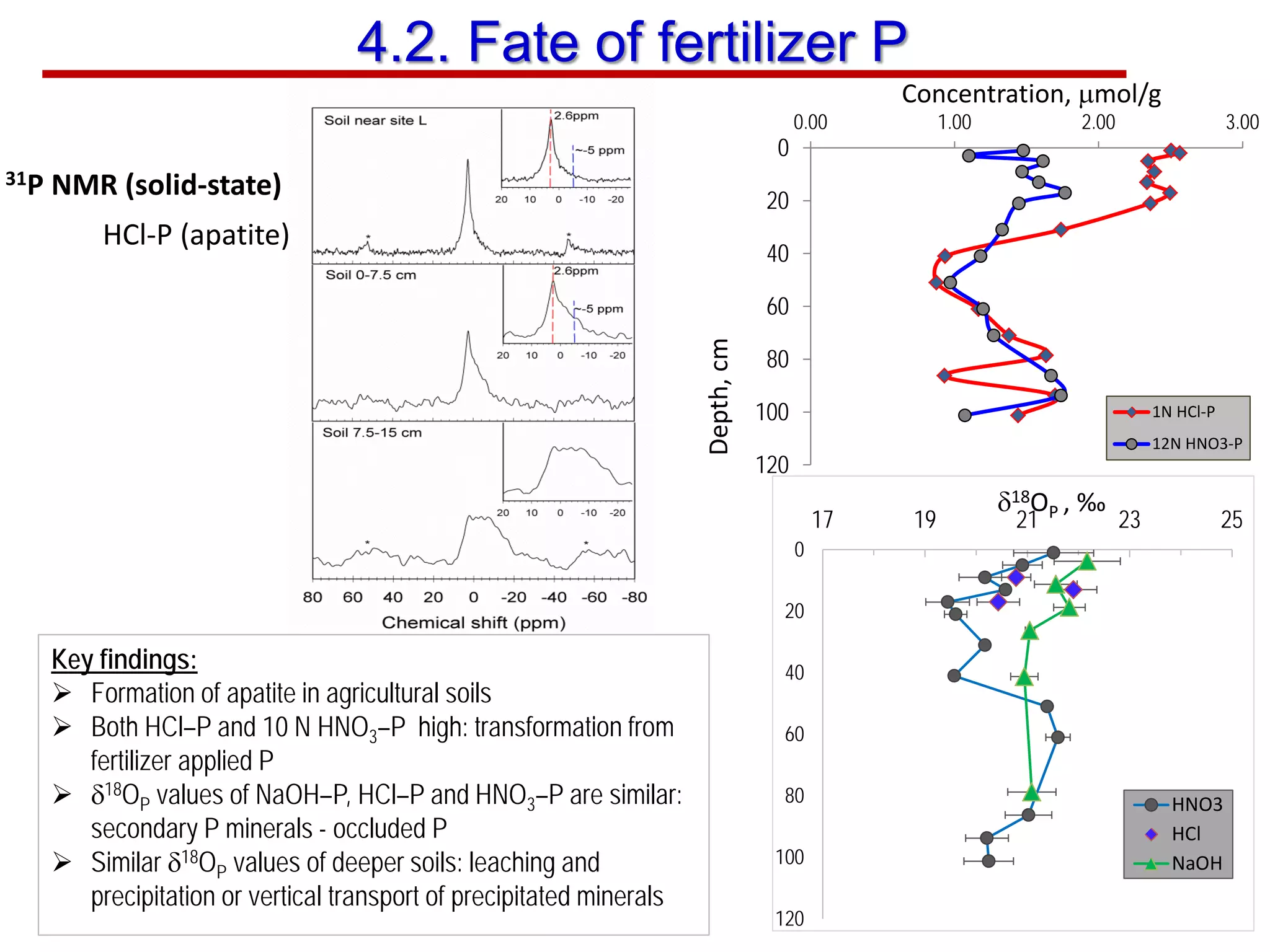
HCl-P (apatite)
31P NMR (solid-state)
0
20
40
60
80
100
120
0.00 1.00 2.00 3.00
1N HCl-P
12N HNO3-P
0
20
40
60
80
100
120
17 19 21 23 25
δ18OP , ‰
HNO3
HCl
NaOH
Key findings:
 Formation of apatite in agricultural soils
 Both HCl–P and 10 N HNO3–P high: transformation from
fertilizer applied P
 δ18OP values of NaOH–P, HCl–P and HNO3–P are similar:
secondary P minerals - occluded P
 Similar δ18OP values of deeper soils: leaching and
precipitation or vertical transport of precipitated minerals
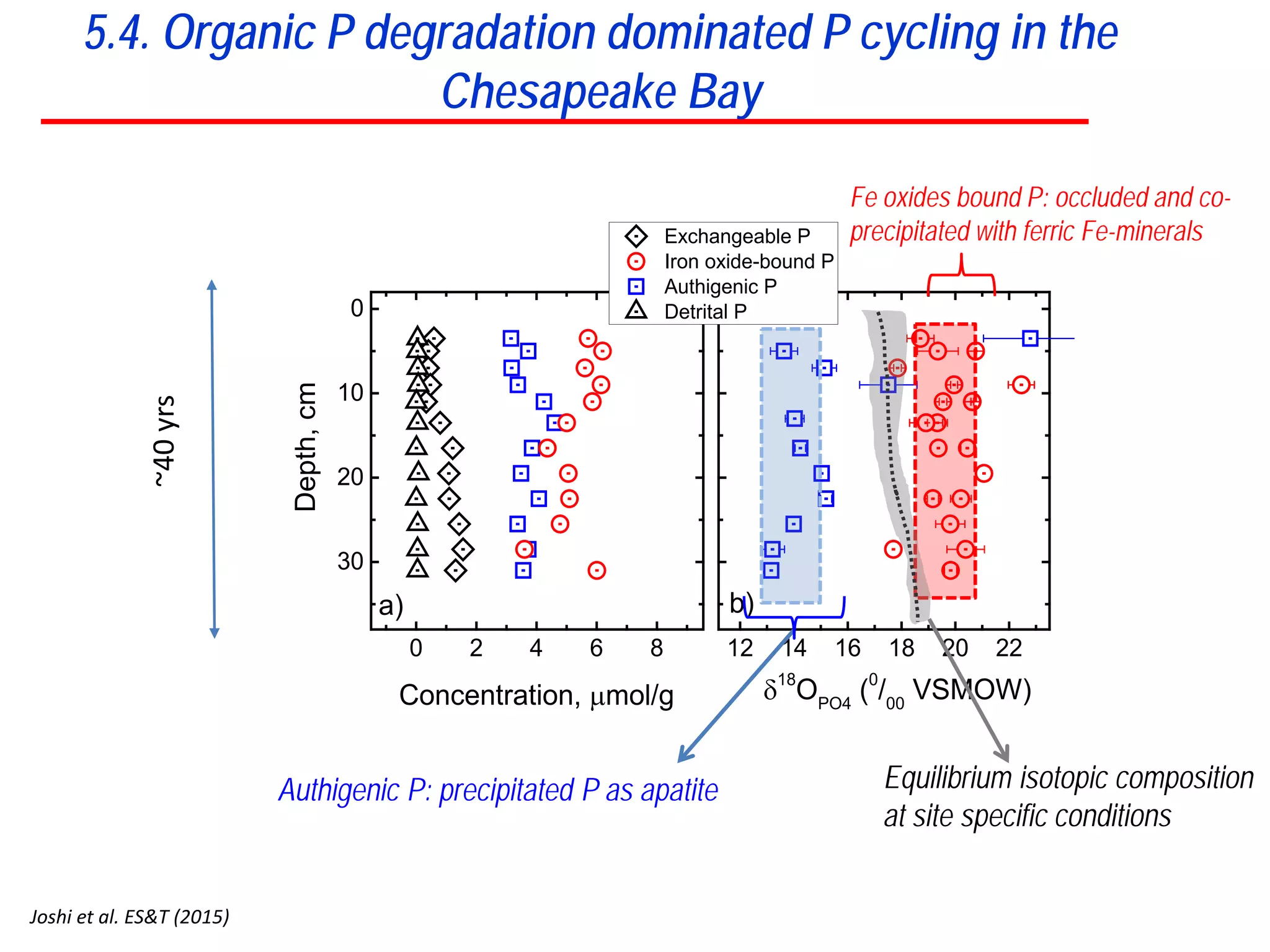
Concentration, µmol/g
Depth,cm
4.2. Fate of fertilizer P
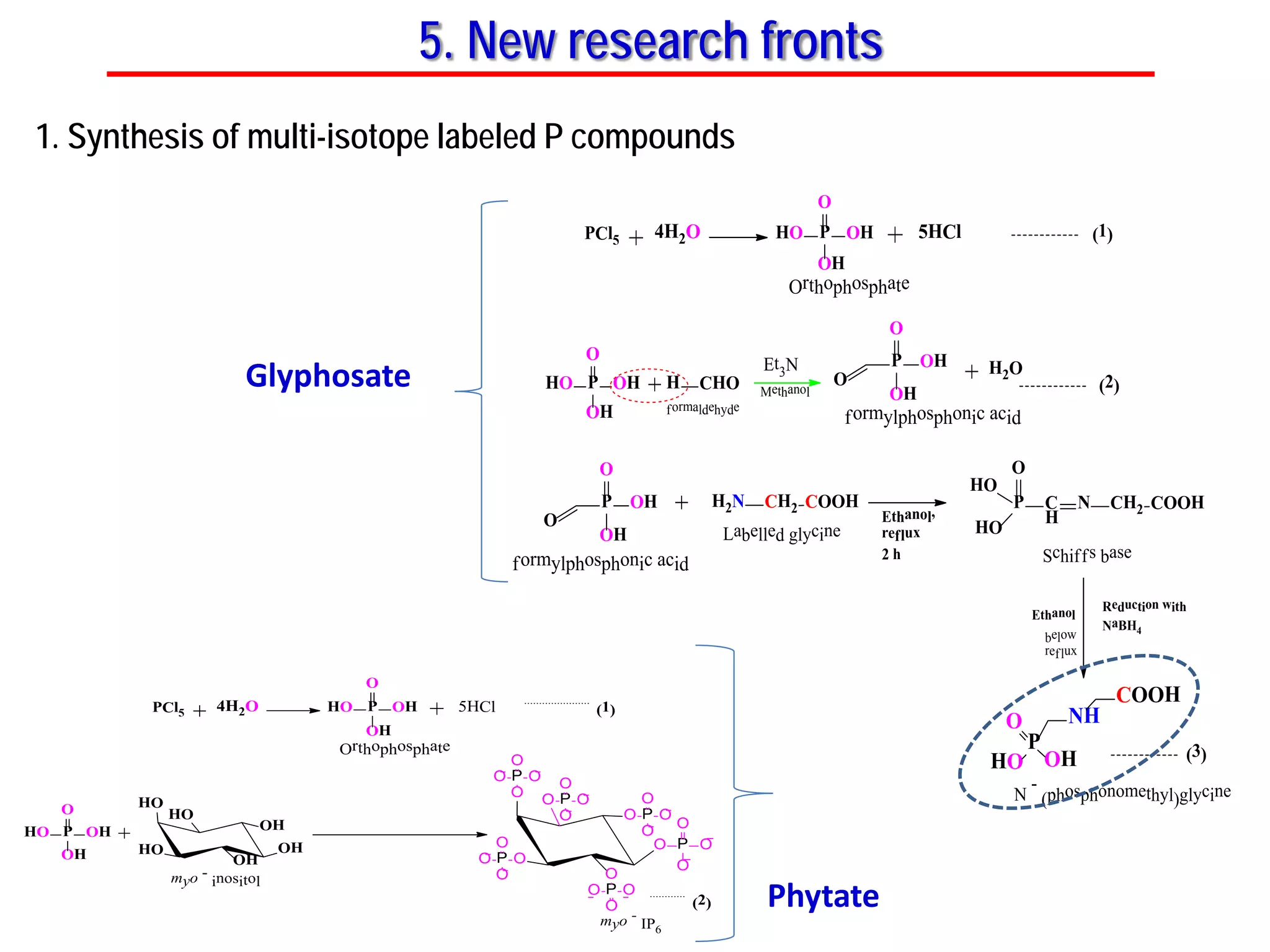
5. New research fronts
H2N CH2 COOH N CH2 COOHC
H
P
O
HO
HO
Schiffs base
Reduction with
NaBH4
N
-
(phosphonomethyl)glycine
Ethanol,
reflux
2 h
Synthesis of Isotope labelled ( C, N and O) glyphosate
Ethanol
Labelled glycine
below
reflux
PCl5 4H2O 5HClP OHHO
OH
O
P OHHO
OH
O
CHO
NH
COOH
P
O
HO OH
Orthophosphate
P OH
OH
O
O
formylphosphonic acid
P OH
OH
O
O
formylphosphonic acid
H
formaldehyde
(1)
(2)
(3)
Et3N
Methanol
H2O
1. Synthesis of multi-isotope labeled P compounds
PCl5 4H2O 5HClP OHHO
OH
O
P OHHO
OH
O
Orthophosphate
O P
O
O
O
O P
O
O
O
OP
O
O
O
O P
O
O
OO P
O
O
O
O P
O
O
O
myo -
IP6
......................
(1)
............
(2)
HO
HO
OH
OH
OH
HO
myo -
inositol
Glyphosate
Phytate
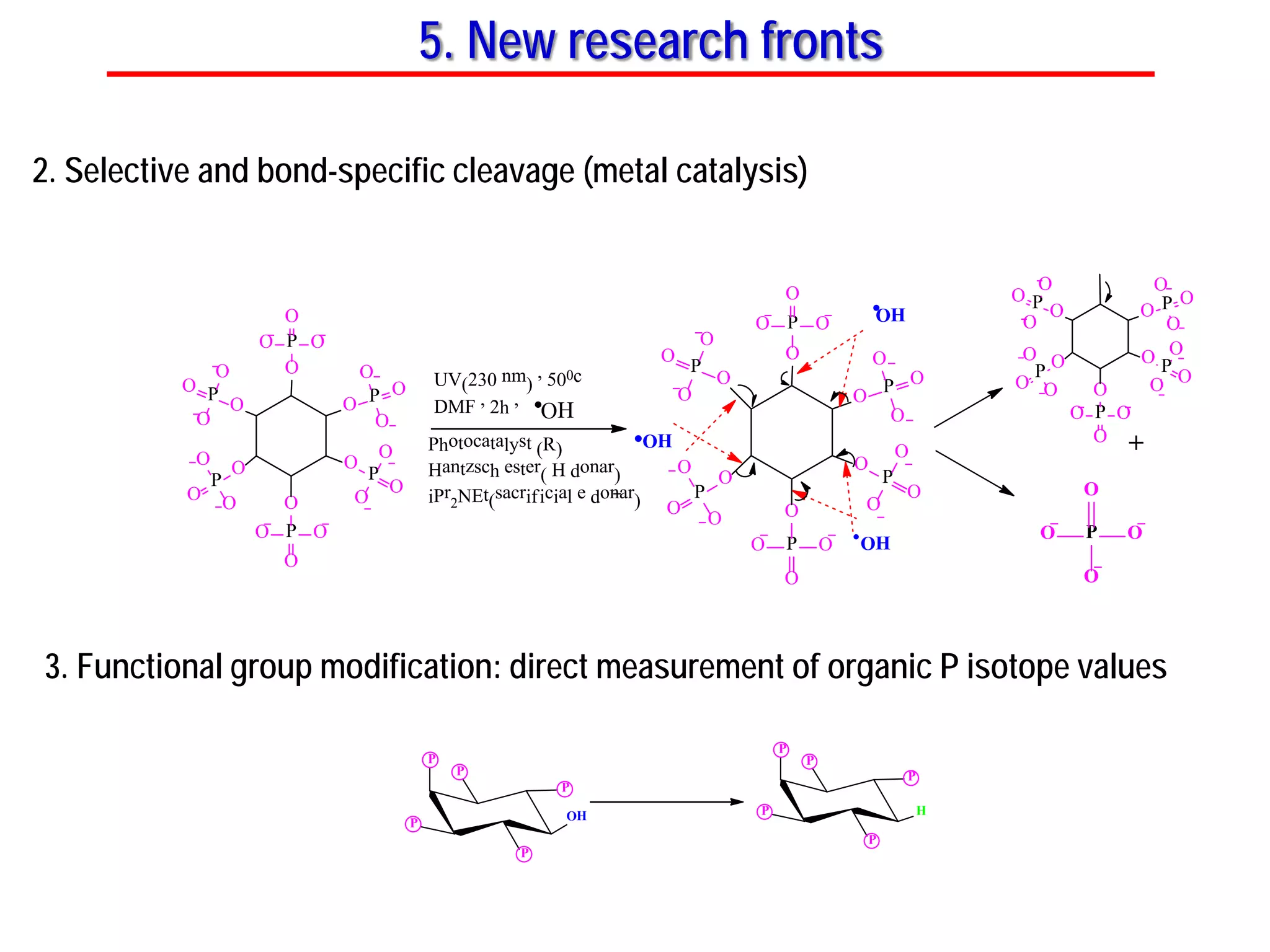
5. New research fronts
OH
OH
OH
P O
O
O
O
+Photocatalyst (R)
Hantzsch ester( H donar)
iPr
2NEt(sacrificial e donar)
UV(230 nm)
, 500c
DMF , 2h ,
OH
Scheme: : Photoredox-catalyzed direct C
-
O bond scission in InsP6
O P
O
O
O
O
P
O
O
O
O
P
O
O
O
O
P
OO
O
O
PO
O
O
O P
O
O
O
O P
O
O
O
O
P
O
O
O
O
P
O
O
O
O
P
O
O
O
O
P
O
O
O
O P
O
O
O
O
PO
O O
O
P O
O
O
O
P OO
O
O
PO
O
O
O P
O
O
O
OH
P
P
P
P
P
100 % removal of
-
OH in
Ins(1,2,3,4,6)P5
P
P
P
P
P
H
2. Selective and bond-specific cleavage (metal catalysis)
3. Functional group modification: direct measurement of organic P isotope values
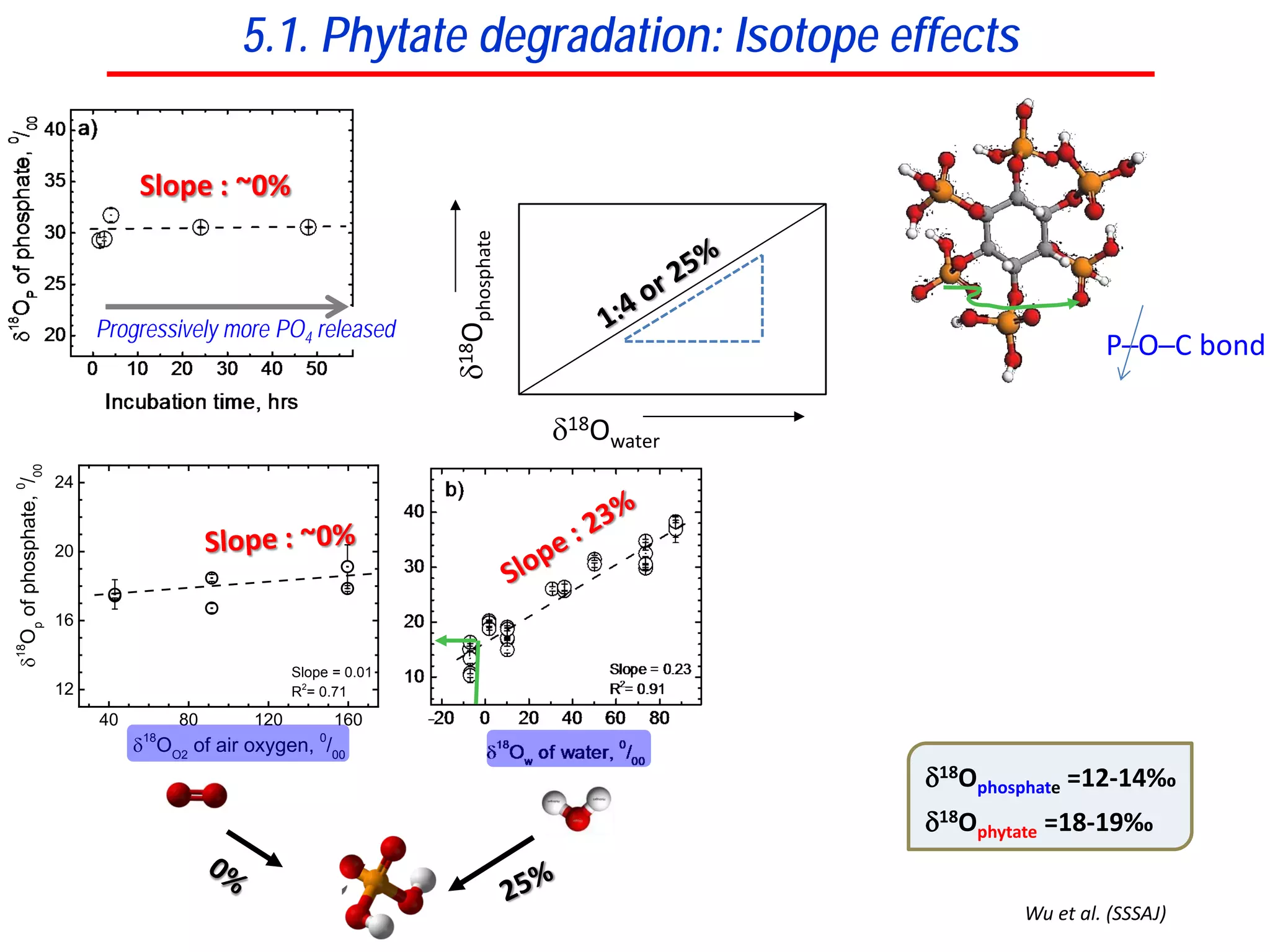
5.1. Phytate degradation: Isotope effects
40 80 120 160
12
16
20
24
Slope = 0.01
R2
= 0.71
δ18
Op
ofphosphate,0
/00
δ18
OO2
of air oxygen, 0
/00
Slope : ~0%
δ18Ophosphate =12-14‰
δ18Ophytate =18-19‰
Wu et al. (SSSAJ)
Progressively more PO4 released
δ18Owater =-6 to 0‰
P─O─C bond
δ18Owater
δ18Ophosphate
0 20 40 60
0
5
10
15
20
δ18
Op
ofphosphate,0
/00
δ18
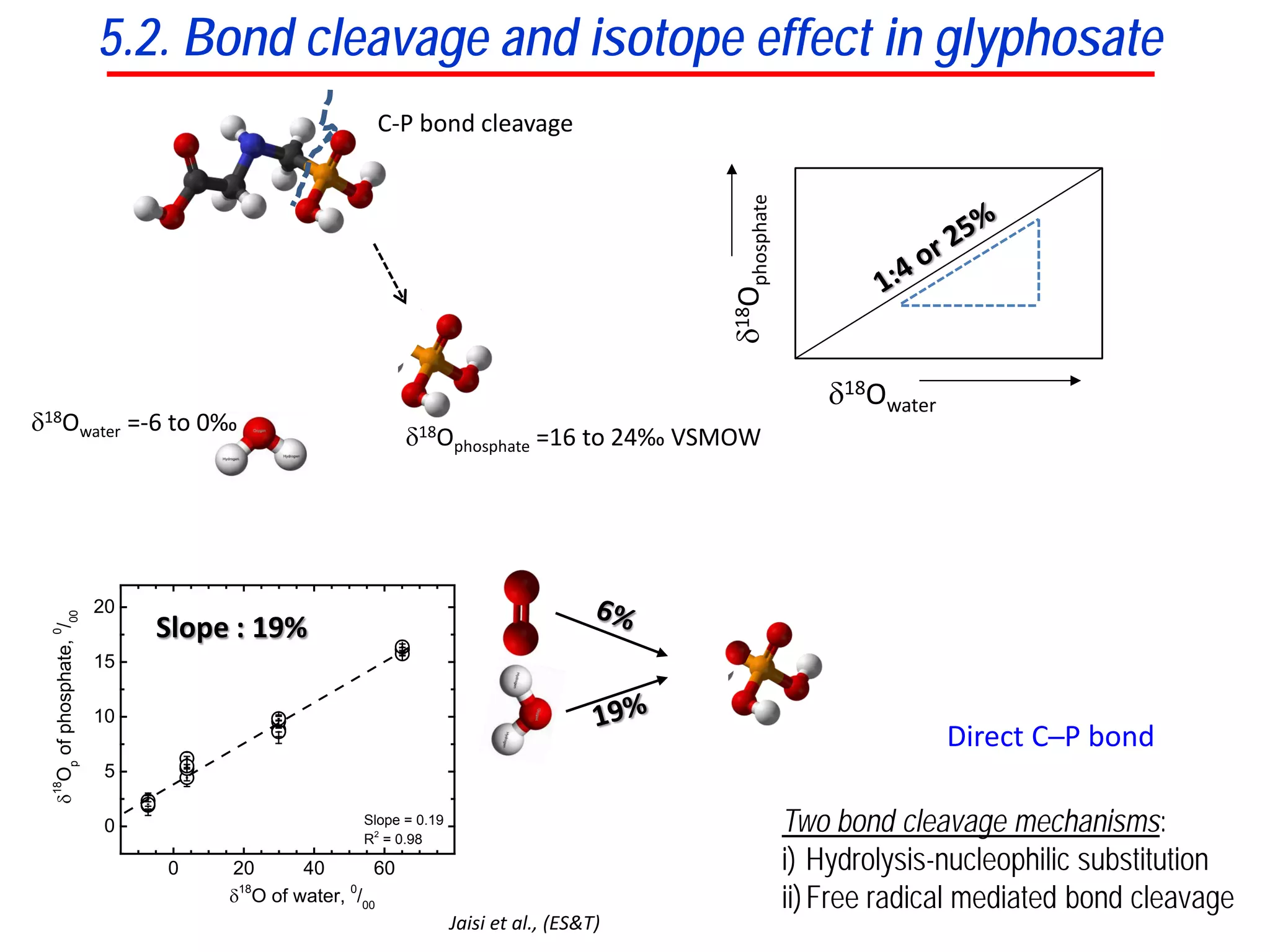
O of water, 0
/00
Slope = 0.19
R2
= 0.98
δ18Owater =-6 to 0‰
C-P bond cleavage
5.2. Bond cleavage and isotope effect in glyphosate
δ18Owater
δ18Ophosphate
Slope : 19%
Two bond cleavage mechanisms:
i) Hydrolysis-nucleophilic substitution
ii)Free radical mediated bond cleavage
δ18Ophosphate =16 to 24‰ VSMOW
Jaisi et al., (ES&T)
Direct C─P bond
C N
H
P
OH
OH
OO
HO
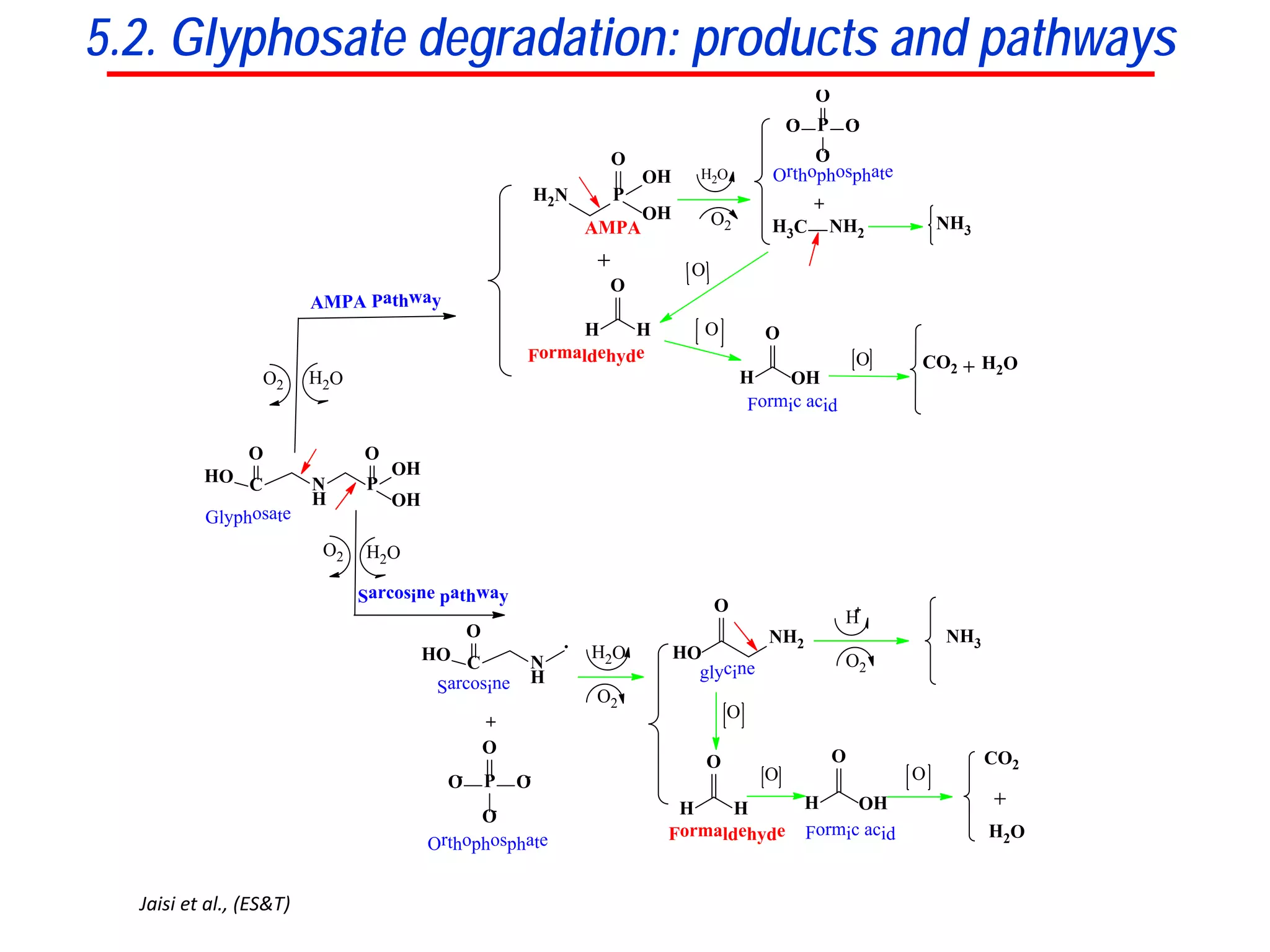
AMPA Pathway
Sarcosine pathway
P
OH
OH
O
H2N
H H
O
H OH
O
Formic acid
AMPA
CO2 H2OO
H2O
O2
P
O
O
O
O
NH2
Formaldehyde
Orthophosphate
O
C N
H
O
HO
P
O
O
O
O
O2
O
HO
NH2
glycine
H OH
O
H H
O
Formaldehyde Formic acid
O
CO2
H2O
O2
H
NH3
O
Sarcosine
Orthophosphate
Glyphosate
H2OO2
H3C NH3
O
H2OO2
O
H2O
5.2. Glyphosate degradation: products and pathways
Jaisi et al., (ES&T)
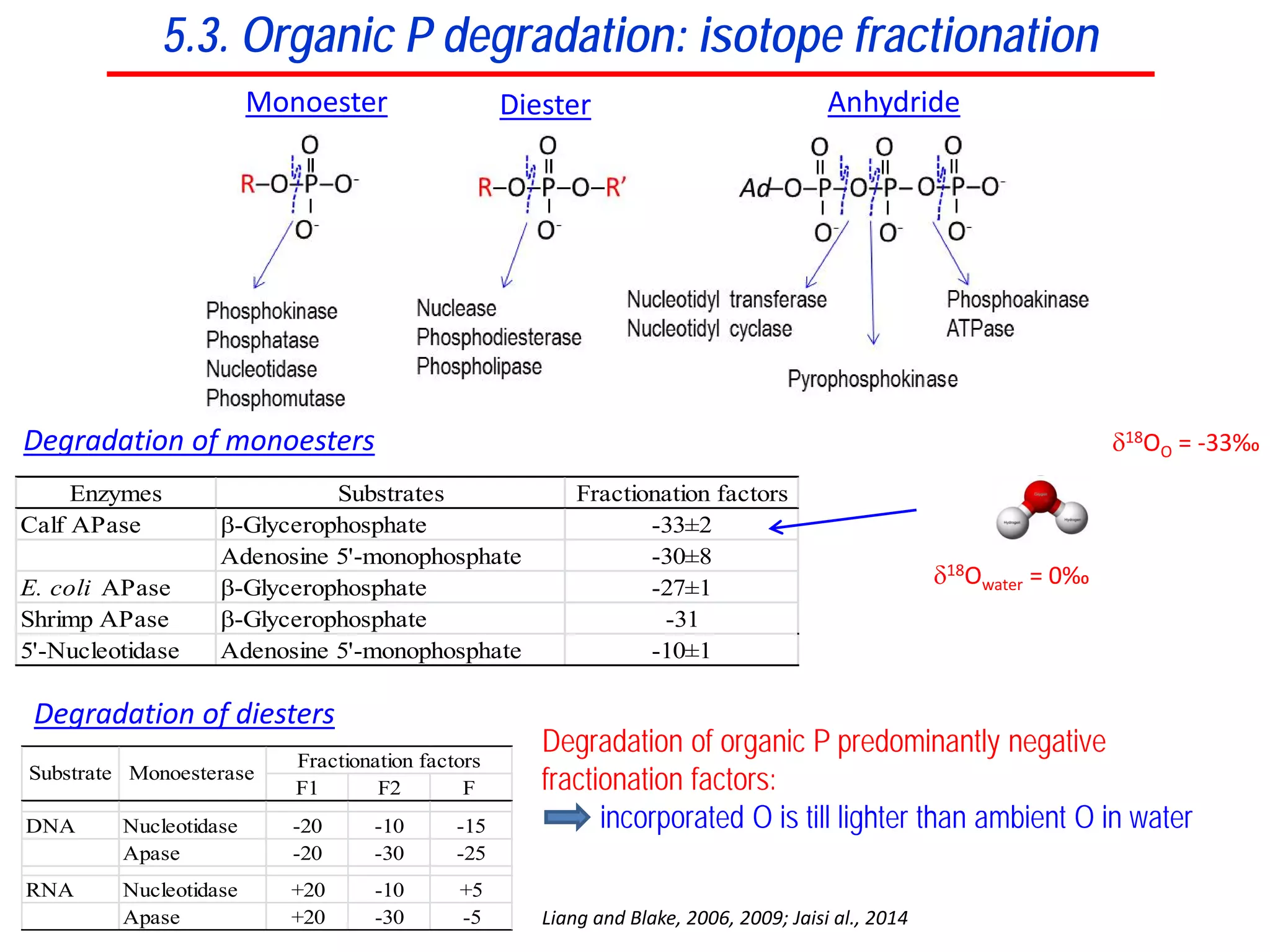
F1 F2 F
DNA Nucleotidase -20 -10 -15
Apase -20 -30 -25
RNA Nucleotidase +20 -10 +5
Apase +20 -30 -5
Substrate Monoesterase
Fractionation factors
Degradation of diesters
Liang and Blake, 2006, 2009; Jaisi al., 2014
Degradation of organic P predominantly negative
fractionation factors:
incorporated O is till lighter than ambient O in water
5.3. Organic P degradation: isotope fractionation
Monoester Diester Anhydride
δ18Owater = 0‰
δ18OO = -33‰
Enzymes Substrates Fractionation factors
Calf APase β-Glycerophosphate -33±2
Adenosine 5'-monophosphate -30±8
E. coli APase β-Glycerophosphate -27±1
Shrimp APase β-Glycerophosphate -31
5'-Nucleotidase Adenosine 5'-monophosphate -10±1
Degradation of monoesters
0 2 4 6 8
30
20
10
0
12 14 16 18 20 22
b)
Exchangeable P
Iron oxide-bound P
Authigenic P
Detrital PDepth,cm
Concentration, µmol/g
a)
δ18
OPO4
(0
/00
VSMOW)
Fe oxides bound P: occluded and co-
precipitated with ferric Fe-minerals
Authigenic P: precipitated P as apatite
~40yrs
Equilibrium isotopic composition
at site specific conditions
5.4. Organic P degradation dominated P cycling in the
Chesapeake Bay
Joshi et al. ES&T (2015)
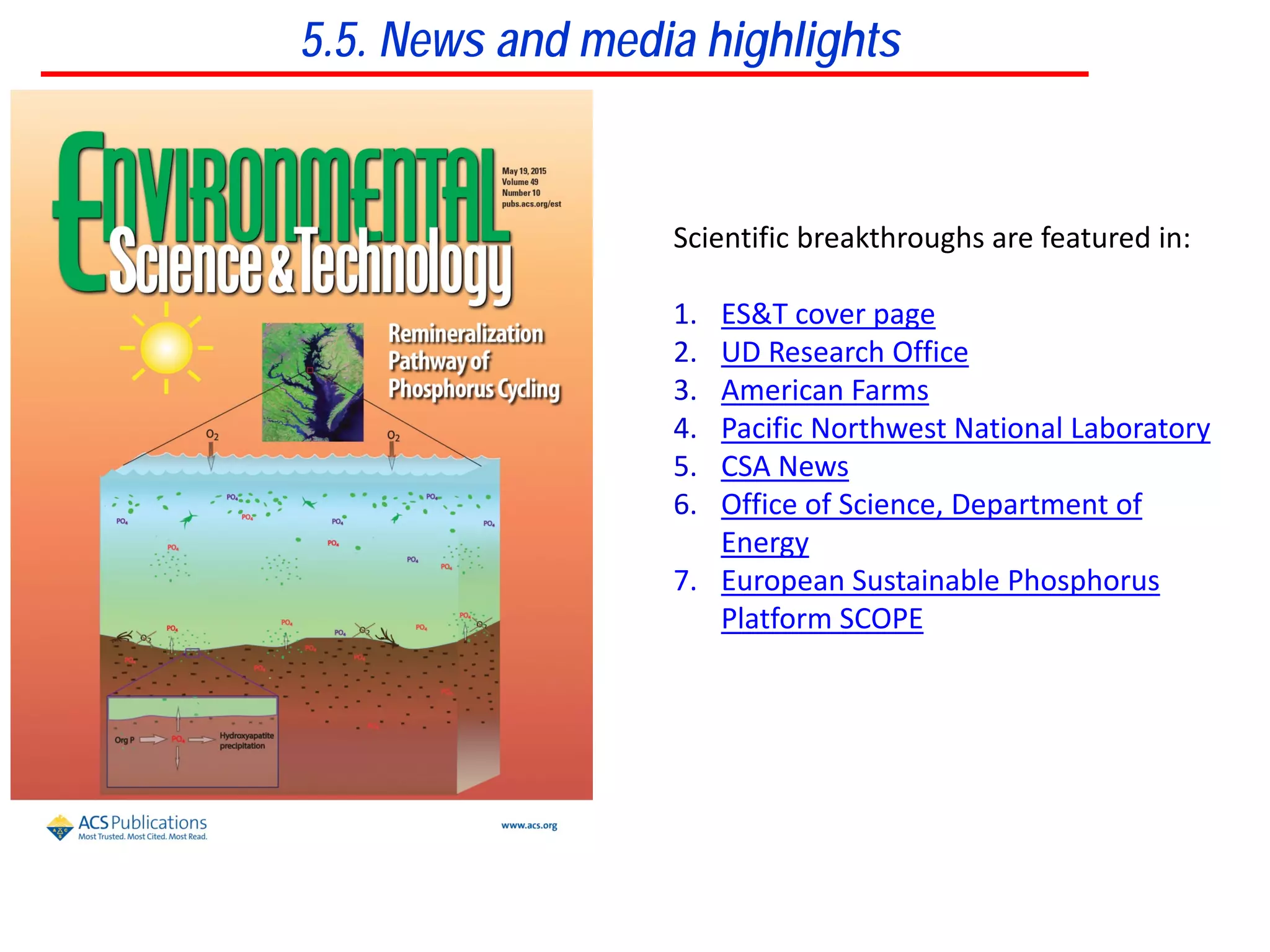
Scientific breakthroughs are featured in:
1. ES&T cover page
2. UD Research Office
3. American Farms
4. Pacific Northwest National Laboratory
5. CSA News
6. Office of Science, Department of
Energy
7. European Sustainable Phosphorus
Platform SCOPE
5.5. News and media highlights
Conclusions and implications
 Microbial cycling of P is reflected in corresponding
changes isotope values.
 P readily transforms into recalcitrant P pool (apatite P) in
agriculture soils while the pathway is normally opposite in
non-agricultural soils.
 Stable isotope labeling and isotope tracking allows
specific and in-depth understanding of source, transfer
and transformation of P in natural environments
Acknowledgements
USDA 2012, 2013, 2015
 NSF-EPSCoR
 PA-DE-MD Soybean Boards 2013, 2014, 2015
ORAU Foundation
 UD Research Foundation
 ACS Petroleum Research Fund
Environmental Biogeochemistry Lab @UD
www.sites.udel.edu/ebl

Application of Oxygen Isotopes In Phosphate as a Tracer To Quantify Phosphorus Cycling in Agricultural Environments

  • 1.
    Phosphate oxygen isotopesas a tracer for phosphorus cycling in agricultural soils July 29, 2015 Deb Jaisi*, Sunendra Joshi, Wei Li, and Xiaona Li Department of Plant and Soil Sciences University of Delaware, DE 19716
  • 2.
    RapidlyexchangeableInorganicP RAPIDLY MINERALISABLE ORGANIC P SLOWLYAND NOT MINERALISABLE ORGANIC P PHOSPHATE IONS IN THE SOIL SOLUTION MICROBIAL BIOMASS Micro and macro fauna Erosion/ Death Assimilation Adsorption/ Precipitation Desorption/ Solubilisation Leaching Mineral fertilizers Mineralization Immobilization Enzymatic hydrolysis Biological solubilisationRapidly mineralizable Organic P Slowly and not mineralizable Organic P Phosphate in soil solution Microbial biomass Micro and macro fauna Weathering of parent material Erosion/runoff Death Assimilation Adsorption/ Precipitation Desorption/ Solubilisation P exports Leaching Mineralization Immobilization Enzymatic hydrolysis Biological /abiotic solubilization Organic fertilizers Plant residue Root Uptake Slowlytonotexchangeable InorganicP 1. P cycling in soil-plant system Frossard et al. (2010) The number and diversity of P fluxes and the exchange of P between different biotic and abiotic pools at different time scales prevents simplified methods from fully constraining P cycling in soils.
  • 3.
    Major Questions: a)What fractionof P in soil is bioavailable b)Whether P is released directly (such as from fertilizer) or chemical reaction over- competes biological, and c) How does intermittent and slow cycling of P impact plant available P in soils Research Goals: This research aimed to develop phosphate oxygen stable isotope ratios (δ18OP) as a tracer to better understand P cycling in agricultural soils with two specific goals: i) Apply isotope as a tracer to identify the fraction of P in soil that is bioavailable and compare it with the classically defined and empirically estimated bioavailable P in soils, and ii) Identify P cycling impacted by fertilization and plant activities and estimate the long- term fate of externally applied P in soils 2. Proposed research: Method development
  • 4.
    Three stable isotopesof oxygen (16O, 17O and 18O) P O 1. Radio Isotopes: 32P: β− emitter (1.71 MeV), half-life of 14.3 days) 33P: β− emitter (0.25 MeV), half-life of 25.3 days) 2. Stable Isotopes: 31P: has no other stable isotopes 10001 O)O/( O)O/( VSMOW 1618 sample 1618 18 xOp         −=δ 3.1. Properties of phosphate oxygen isotopes
  • 5.
    Biological system Abioticsystem 15 18 20 22 25 28 0 10 20 30 40 T (°C) 1000Lnα Τ (οC) Applications: (Paleo)environment  Biosignature Role/presence of life Applications:  Source of P  Mixing/dilution Longinelli and Nuti, 1973 Blake et al. 2005 ( ) WP OTO 1818 4.111)3.4/1( δδ +−= 2.1. Properties of phosphate oxygen isotopes
  • 6.
    2.2. Sample processingfor phosphate δ18OP Hedley et al. (1982) Soils Ruttenberg (1992) Exchangeable Exchangeable Fe/Al oxides bound Fe oxides bound Ca-P (authigenic and detrital) Residual P Ca-P (authigenic P) Ca-P (detrital P) Water wash Sediment
  • 7.
    2.2. Sample processingfor phosphate δ18OP Soil/sediment extracted solution 1. Pass through DAX resin 2. Pass through cation resin Organics and cations (partially)free samples APM precipitation MAP precipitation Silver Phosphate precipitation IRMS Oxygen isotopes Decrease volume by evaporation (rotovap) or MaGIC treatment Sea/river/lake water Sample processing and purification Cationresin exchange
  • 8.
  • 9.
    MIMS: membrane inletmass spectrometry (UMD- Horn Point)  Pure culture of E. coli, B. subtilis, and P. stutzeri labeled P18O4 and H2 18O isotopes  Cell respiration measurements: O2 consumption and CO2 produced (measured by MIMS) Cell counts (live/dead) Cell dehydrogenase activity (DHA) Phosphatase enzyme activities (inside cells and released into the media)  PO4 concentration and isotope measurements 3.1. Cell respiration and isotope exchange
  • 10.
    Stout et al.,2014 GCA 3.2. Respiration vs isotope exchange Equilibrium δ18OP Ambient δ18OP
  • 11.
    Stout et al.,2014 GCA 3.3. Respiration vs isotope exchange
  • 12.
    Dec May JuneSept 4. Biological cycling and interspecies transfer ~110 kg ha-1 PCl5 4H2O 5HClP OHHO OH O Orthophosphate O
  • 13.
    Dec May JuneSept 80cm 4cm 38‰ 4.1. Biological cycling and interspecies transfer
  • 14.
    HCl-P (apatite) 31P NMR(solid-state) 0 20 40 60 80 100 120 0.00 1.00 2.00 3.00 1N HCl-P 12N HNO3-P 0 20 40 60 80 100 120 17 19 21 23 25 δ18OP , ‰ HNO3 HCl NaOH Key findings:  Formation of apatite in agricultural soils  Both HCl–P and 10 N HNO3–P high: transformation from fertilizer applied P  δ18OP values of NaOH–P, HCl–P and HNO3–P are similar: secondary P minerals - occluded P  Similar δ18OP values of deeper soils: leaching and precipitation or vertical transport of precipitated minerals Concentration, µmol/g Depth,cm 4.2. Fate of fertilizer P
  • 15.
    5. New researchfronts H2N CH2 COOH N CH2 COOHC H P O HO HO Schiffs base Reduction with NaBH4 N - (phosphonomethyl)glycine Ethanol, reflux 2 h Synthesis of Isotope labelled ( C, N and O) glyphosate Ethanol Labelled glycine below reflux PCl5 4H2O 5HClP OHHO OH O P OHHO OH O CHO NH COOH P O HO OH Orthophosphate P OH OH O O formylphosphonic acid P OH OH O O formylphosphonic acid H formaldehyde (1) (2) (3) Et3N Methanol H2O 1. Synthesis of multi-isotope labeled P compounds PCl5 4H2O 5HClP OHHO OH O P OHHO OH O Orthophosphate O P O O O O P O O O OP O O O O P O O OO P O O O O P O O O myo - IP6 ...................... (1) ............ (2) HO HO OH OH OH HO myo - inositol Glyphosate Phytate
  • 16.
    5. New researchfronts OH OH OH P O O O O +Photocatalyst (R) Hantzsch ester( H donar) iPr 2NEt(sacrificial e donar) UV(230 nm) , 500c DMF , 2h , OH Scheme: : Photoredox-catalyzed direct C - O bond scission in InsP6 O P O O O O P O O O O P O O O O P OO O O PO O O O P O O O O P O O O O P O O O O P O O O O P O O O O P O O O O P O O O O PO O O O P O O O O P OO O O PO O O O P O O O OH P P P P P 100 % removal of - OH in Ins(1,2,3,4,6)P5 P P P P P H 2. Selective and bond-specific cleavage (metal catalysis) 3. Functional group modification: direct measurement of organic P isotope values
  • 17.
    5.1. Phytate degradation:Isotope effects 40 80 120 160 12 16 20 24 Slope = 0.01 R2 = 0.71 δ18 Op ofphosphate,0 /00 δ18 OO2 of air oxygen, 0 /00 Slope : ~0% δ18Ophosphate =12-14‰ δ18Ophytate =18-19‰ Wu et al. (SSSAJ) Progressively more PO4 released δ18Owater =-6 to 0‰ P─O─C bond δ18Owater δ18Ophosphate
  • 18.
    0 20 4060 0 5 10 15 20 δ18 Op ofphosphate,0 /00 δ18 O of water, 0 /00 Slope = 0.19 R2 = 0.98 δ18Owater =-6 to 0‰ C-P bond cleavage 5.2. Bond cleavage and isotope effect in glyphosate δ18Owater δ18Ophosphate Slope : 19% Two bond cleavage mechanisms: i) Hydrolysis-nucleophilic substitution ii)Free radical mediated bond cleavage δ18Ophosphate =16 to 24‰ VSMOW Jaisi et al., (ES&T) Direct C─P bond
  • 19.
    C N H P OH OH OO HO AMPA Pathway Sarcosinepathway P OH OH O H2N H H O H OH O Formic acid AMPA CO2 H2OO H2O O2 P O O O O NH2 Formaldehyde Orthophosphate O C N H O HO P O O O O O2 O HO NH2 glycine H OH O H H O Formaldehyde Formic acid O CO2 H2O O2 H NH3 O Sarcosine Orthophosphate Glyphosate H2OO2 H3C NH3 O H2OO2 O H2O 5.2. Glyphosate degradation: products and pathways Jaisi et al., (ES&T)
  • 20.
    F1 F2 F DNANucleotidase -20 -10 -15 Apase -20 -30 -25 RNA Nucleotidase +20 -10 +5 Apase +20 -30 -5 Substrate Monoesterase Fractionation factors Degradation of diesters Liang and Blake, 2006, 2009; Jaisi al., 2014 Degradation of organic P predominantly negative fractionation factors: incorporated O is till lighter than ambient O in water 5.3. Organic P degradation: isotope fractionation Monoester Diester Anhydride δ18Owater = 0‰ δ18OO = -33‰ Enzymes Substrates Fractionation factors Calf APase β-Glycerophosphate -33±2 Adenosine 5'-monophosphate -30±8 E. coli APase β-Glycerophosphate -27±1 Shrimp APase β-Glycerophosphate -31 5'-Nucleotidase Adenosine 5'-monophosphate -10±1 Degradation of monoesters
  • 21.
    0 2 46 8 30 20 10 0 12 14 16 18 20 22 b) Exchangeable P Iron oxide-bound P Authigenic P Detrital PDepth,cm Concentration, µmol/g a) δ18 OPO4 (0 /00 VSMOW) Fe oxides bound P: occluded and co- precipitated with ferric Fe-minerals Authigenic P: precipitated P as apatite ~40yrs Equilibrium isotopic composition at site specific conditions 5.4. Organic P degradation dominated P cycling in the Chesapeake Bay Joshi et al. ES&T (2015)
  • 22.
    Scientific breakthroughs arefeatured in: 1. ES&T cover page 2. UD Research Office 3. American Farms 4. Pacific Northwest National Laboratory 5. CSA News 6. Office of Science, Department of Energy 7. European Sustainable Phosphorus Platform SCOPE 5.5. News and media highlights
  • 23.
    Conclusions and implications Microbial cycling of P is reflected in corresponding changes isotope values.  P readily transforms into recalcitrant P pool (apatite P) in agriculture soils while the pathway is normally opposite in non-agricultural soils.  Stable isotope labeling and isotope tracking allows specific and in-depth understanding of source, transfer and transformation of P in natural environments
  • 24.
    Acknowledgements USDA 2012, 2013,2015  NSF-EPSCoR  PA-DE-MD Soybean Boards 2013, 2014, 2015 ORAU Foundation  UD Research Foundation  ACS Petroleum Research Fund Environmental Biogeochemistry Lab @UD www.sites.udel.edu/ebl