PROFESSOR JAYASHANKAR TELANGANA
STATEAGRICULTURAL UNIVERSITY
COLLEGE OFAGRICULTURE, RAJENDRANAGAR
COURSE NO : SOIL 510
COURSE TITLE : Analytical Techniques and instrumental methods in soil and
plant analysis
TOPIC : “DETERMINATION OF PHOSPHATE FIXING CAPACITY OF SOIL.”
Submitted to:
Dr. K. Shailaja Submitted by :
Assistant professor BANOTH PAVANI
Department of soil science RAM/2023-105
Department of soil science
2.
INTRODUCTION
• Fixation :Adsorption of ions by soils or minerals in such form
that they are neither water soluble nor readily exchangeable .
MECHANISM OF FIXATION
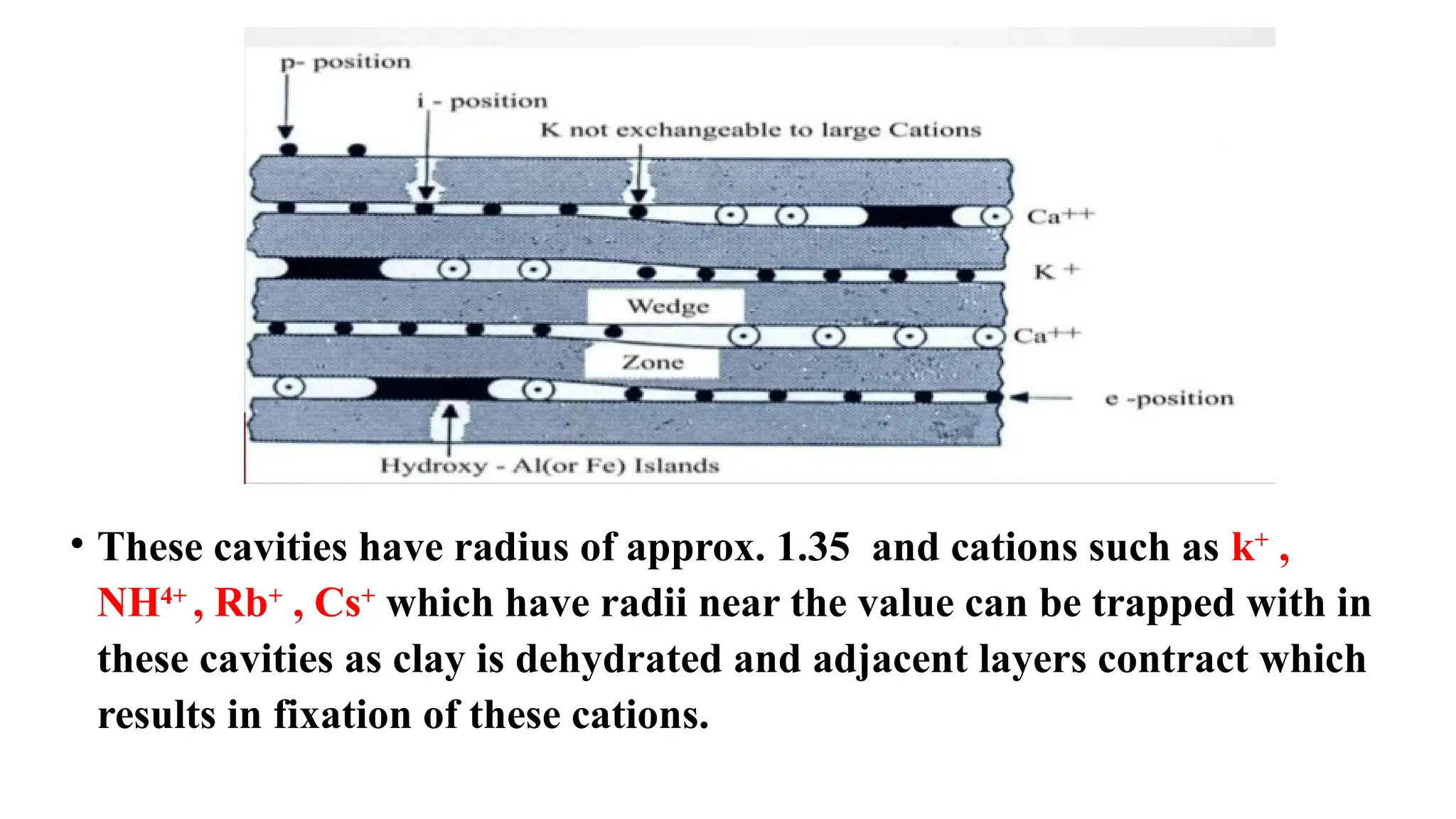
• Fixation occur’s through trapping of cations in the cavities formed
by hexagonal oxygen rings of silica sheets of two superimposed layers
of 2:1 type mineral .
3.
• These cavitieshave radius of approx. 1.35 and cations such as k+
,
NH4+
, Rb+
, Cs+
which have radii near the value can be trapped with in
these cavities as clay is dehydrated and adjacent layers contract which
results in fixation of these cations.
4.
PHOSPHOROUS FIXATION
• Phosphorusfixation is a process whereby the readily available
forms of P are changed to sparingly soluble ones by reacting with
inorganic and organic components of soil.
• The presence of clay, Al, Fe and sesqui oxides is responsible for
fixation of applied P (Doddamani and Seshagiri Rao, 1996)
• Al3+
+ H2PO4
-
+ 2H20 Al(OH)2H2PO4 + 2H+
• CaCO3 + 2H2(PO4)-
Ca [H2(PO4)]2 + CO3
2-
5.
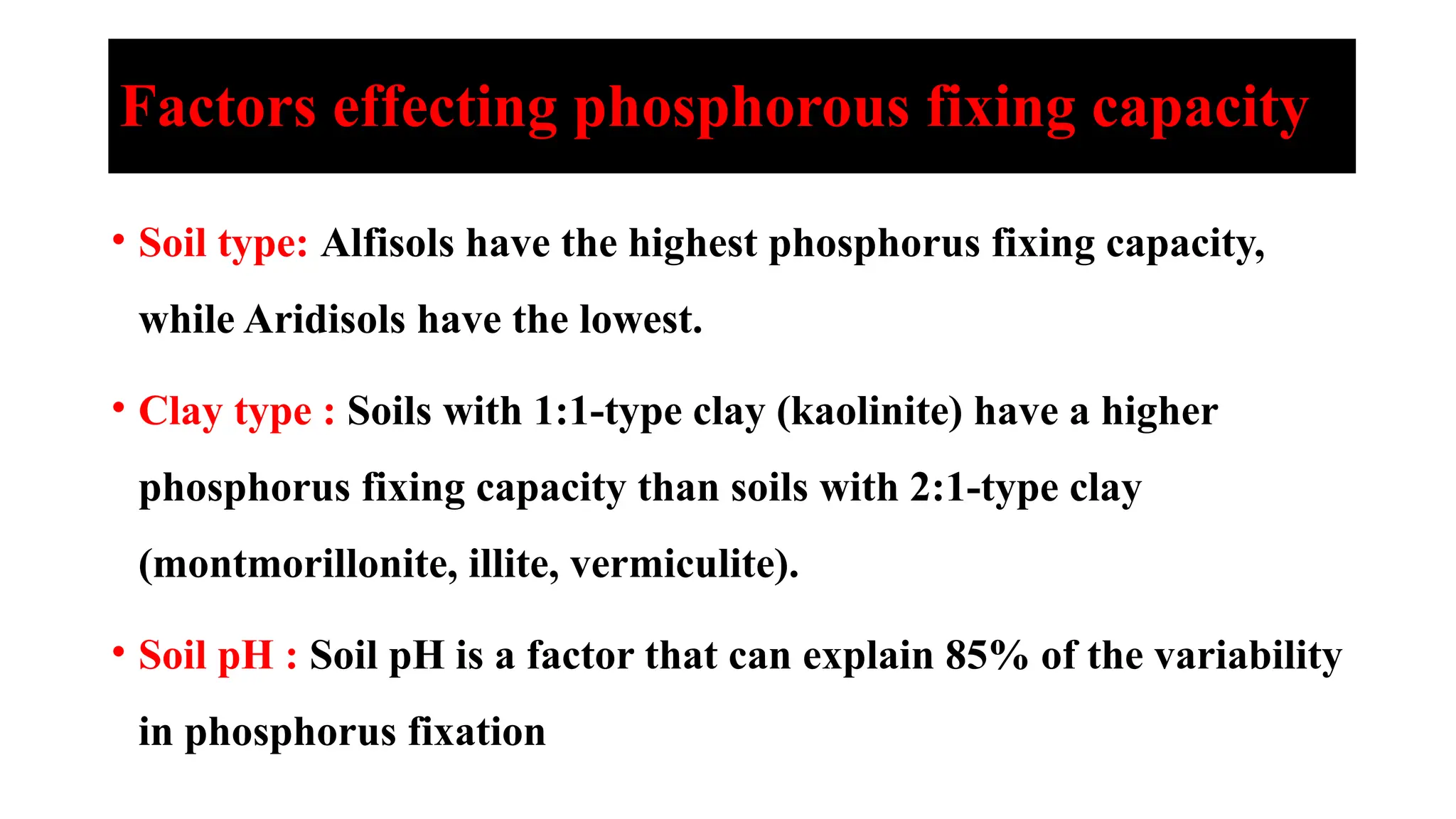
Factors effecting phosphorousfixing capacity
• Soil type: Alfisols have the highest phosphorus fixing capacity,
while Aridisols have the lowest.
• Clay type : Soils with 1:1-type clay (kaolinite) have a higher
phosphorus fixing capacity than soils with 2:1-type clay
(montmorillonite, illite, vermiculite).
• Soil pH : Soil pH is a factor that can explain 85% of the variability
in phosphorus fixation
6.
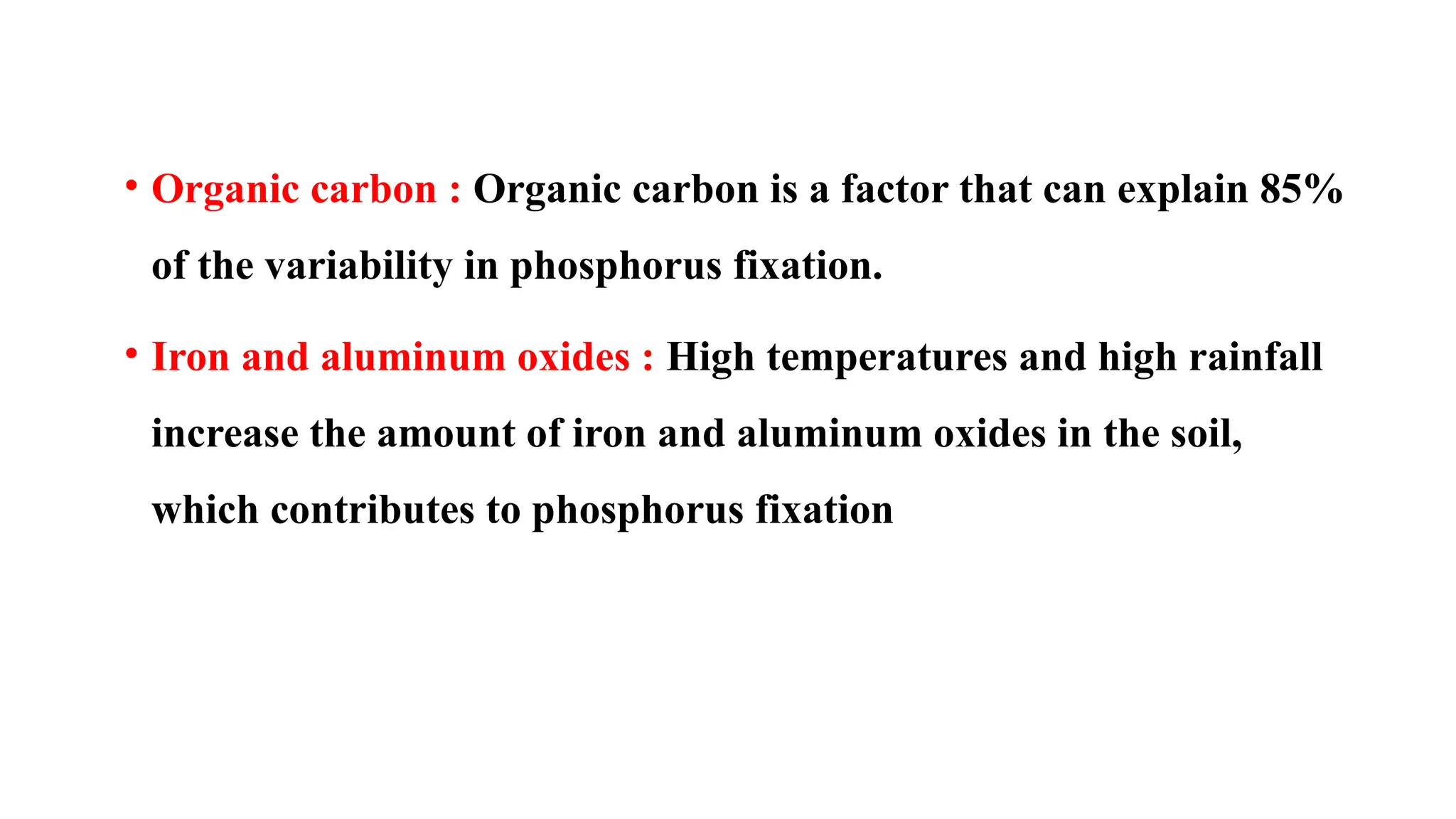
• Organic carbon: Organic carbon is a factor that can explain 85%
of the variability in phosphorus fixation.
• Iron and aluminum oxides : High temperatures and high rainfall
increase the amount of iron and aluminum oxides in the soil,
which contributes to phosphorus fixation
7.
PHOSPHOROUS FIXATION DETERMINATION
-S.C Chnag and M.L Jhakson (1957)
The method described by S.C Chnag and M.L Jhakson (1957) is used to
determine fractions of P as
1. Saloid-P
2. Al-P
3. Ca-P
4. Fe-P
8.
• 1 gmof soil samples were taken in a100 mL tube add 50 mL 1 N NH4Cl,
shake it for ½ hour and after this centrifuge it for 5 min.
• 5 mL of the colorless filtrate was taken in 25 mL of volumetric flask for
determination
• After dilution shake the content and add 4 mL reagent mixture (Ascorbic
acid)
• The contents of flasks were shaken well and diluted to the mark.
• Colour intensity was measured in spectrophotometer within 10 minutes after
setting the instrument to 100 reading of transmittance with Blank prepared.
• The amount of phosphorus was calculated as P in kg ha-1
.
Extract Saloid –P
9.
• 50 mLof 0.5 N NH4F was added in the same tube after filtering the
first solution, now shake it for ½ hour and after this centrifuge it for
5 min.
• 5 mL of the colorless filtrate was taken in 25 mL of volumetric flask
for determination
• After dilution shake the content and add 4 mL reagent mixture
(Ascorbic acid)
• The contents of flasks were shaken well and diluted to the mark.
• Colour intensity was measured in spectrophotometer within 10
minutes after setting the instrument to 100 reading of transmittance
with blank prepared.
• The amount of phosphorus was calculated as P in kg ha-1
.
Extract Al-P
10.
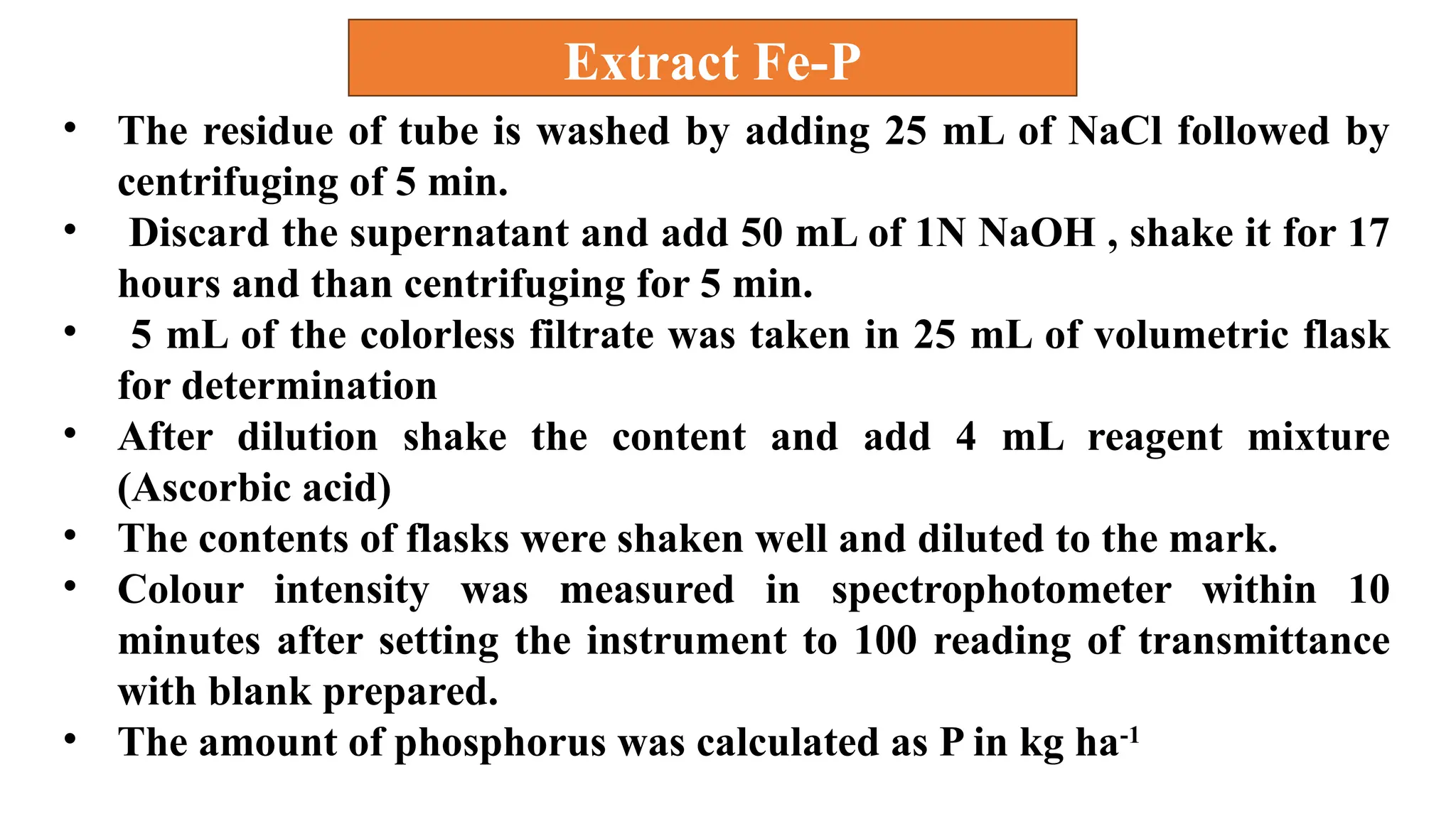
• The residueof tube is washed by adding 25 mL of NaCl followed by
centrifuging of 5 min.
• Discard the supernatant and add 50 mL of 1N NaOH , shake it for 17
hours and than centrifuging for 5 min.
• 5 mL of the colorless filtrate was taken in 25 mL of volumetric flask
for determination
• After dilution shake the content and add 4 mL reagent mixture
(Ascorbic acid)
• The contents of flasks were shaken well and diluted to the mark.
• Colour intensity was measured in spectrophotometer within 10
minutes after setting the instrument to 100 reading of transmittance
with blank prepared.
• The amount of phosphorus was calculated as P in kg ha-1
Extract Fe-P
11.
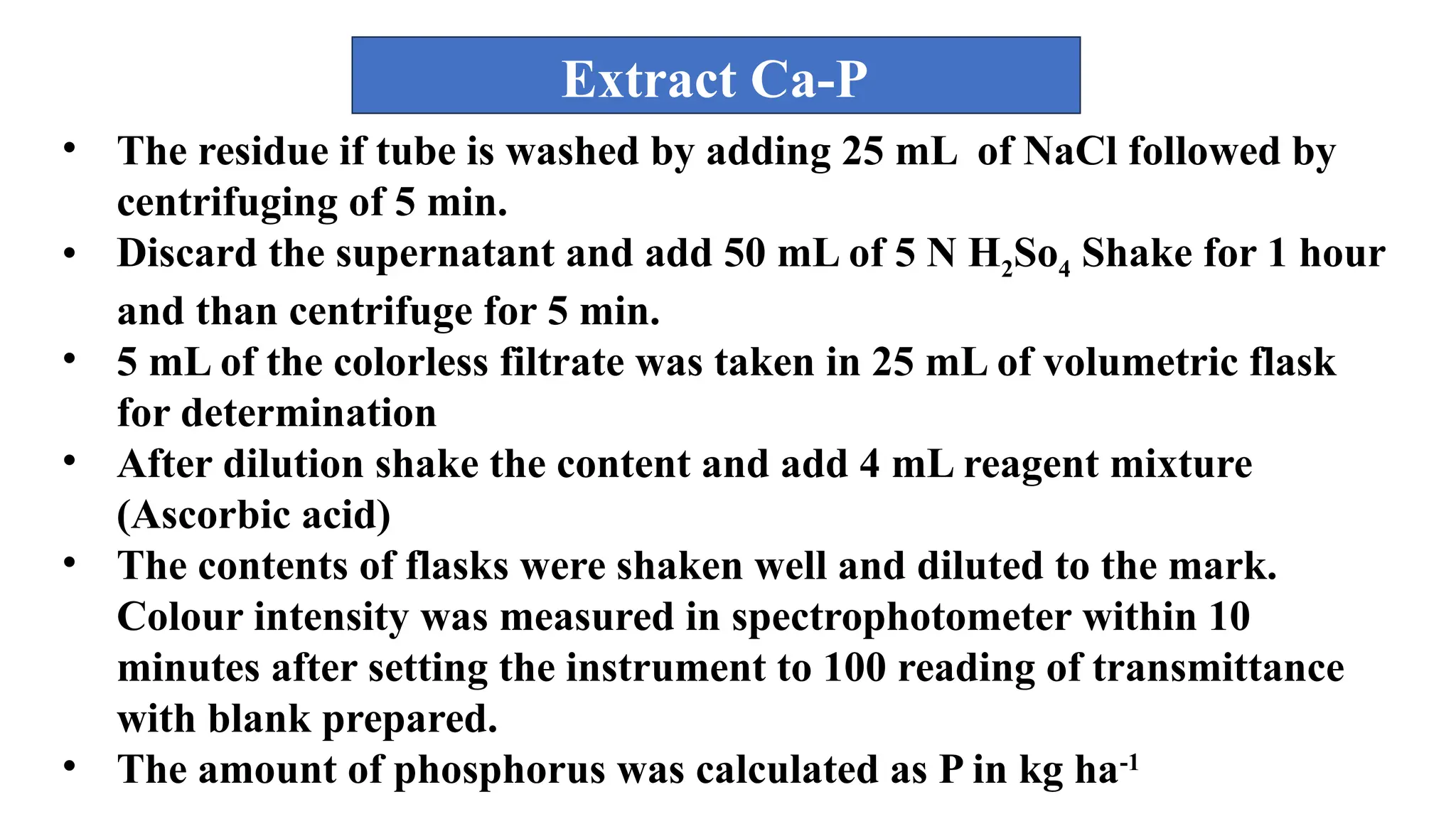
• The residueif tube is washed by adding 25 mL of NaCl followed by
centrifuging of 5 min.
• Discard the supernatant and add 50 mL of 5 N H2So4 Shake for 1 hour
and than centrifuge for 5 min.
• 5 mL of the colorless filtrate was taken in 25 mL of volumetric flask
for determination
• After dilution shake the content and add 4 mL reagent mixture
(Ascorbic acid)
• The contents of flasks were shaken well and diluted to the mark.
Colour intensity was measured in spectrophotometer within 10
minutes after setting the instrument to 100 reading of transmittance
with blank prepared.
• The amount of phosphorus was calculated as P in kg ha-1
Extract Ca-P
12.
REFERENCE
Chang ,S.C., andJackson ,M.L. 1957 a . Fractionation of soil
phosphorous. Soil Sci.84 ,33-44
Gupta, A. K., Maheshwari, A., & Khanam, R. 2020. Assessment of
phosphorus fixing capacity in different soil orders of India. Journal
of Plant Nutrition, 43(15), 2395–2401.
Bidisha. B., Ashish Rai., Bharati. U., and Subhra Sahoo. 2020.
Phosphorus fixation capacity as a guide for phosphorus availability
in Entisol soil order of North-East India. The Pharma Innovation
Journal 2020; 9(5): 176-180


![PHOSPHOROUS FIXATION
• Phosphorus fixation is a process whereby the readily available
forms of P are changed to sparingly soluble ones by reacting with
inorganic and organic components of soil.
• The presence of clay, Al, Fe and sesqui oxides is responsible for
fixation of applied P (Doddamani and Seshagiri Rao, 1996)
• Al3+
+ H2PO4
-
+ 2H20 Al(OH)2H2PO4 + 2H+
• CaCO3 + 2H2(PO4)-
Ca [H2(PO4)]2 + CO3
2-](https://image.slidesharecdn.com/pavani510final-250817133100-ad09135a/75/PAVANI510-final-pptx-phosphate-fixing-capacity-4-2048.jpg)