Cancer vulva recapitulating the FACTS
Dr. Sunaina wadhwa
Dr. Pratima mittal
Department of obstetrics &
gynecology
Vmmc & sjh.
Objectives of this presentation
 To know the out lines of
etiology,diagnosis and mangment of
cancer vulva.
 To understand the importance of
early dectection of cancer vulva to
improve prognosis and survival rate
Introduction
 Vulval cancer is uncommon & accounts for
approximately 1-4% of all gynecological cancer
 4th most common malignancy of the female
genital tract
 Incidence : 1.8 /100.000, It is predominantly seen
in postmenopausal and old women (mean age 65
years ) ,and only 2% were less than 30 years.
 As the 6th , 7th decade of life and does increase
with increasing age.
- The incidence increases with age.
- Recently there was a rise in the incidence, due
to
 Longevity (Long standing preinvasive
stage)
 Increased HPV infections.
 Increased smoking habits
Risk factors for carcinoma of the vulva
1- Human papillomavirus infection.
Genital condylomas: these are detected in 5 %
of vulvar cancer.
Vulvar intraepithelial neoplasia (VIN) and also
CIN.
2- Medical history of:
Vulvar dystrophy.
Chronic vulvar pruritus.
3- Patients with a history of squamous cell ca of
cervix or vagina.
4- Chronic immunosuppression.
5- Smoking
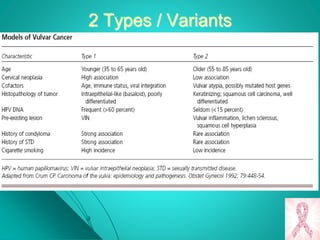
2 Types / Variants
(15%) (85%)
(90%)
(2-3%)
(5%)
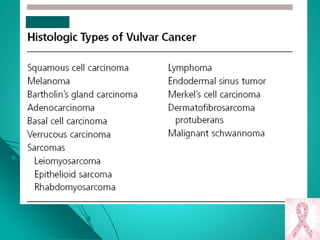
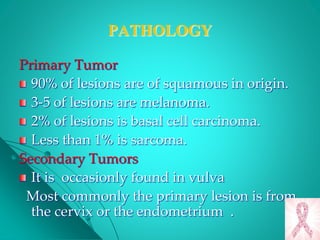
PATHOLOGY
Primary Tumor
90% of lesions are of squamous in origin.
3-5 of lesions are melanoma.
2% of lesions is basal cell carcinoma.
Less than 1% is sarcoma.
Secondary Tumors
It is occasionly found in vulva
Most commonly the primary lesion is from
the cervix or the endometrium .
Essentials of Diagnosis
 Typically occurs in postmenopausal
women.
 Long history of vulvar irritation with pruritus,
local discomfort, and bloody discharge.
 Appearance of early lesions like that of
chronic vulvar dermatitis.
 Appearance of late lesions like that of a
large cauliflower, or a hard ulcerated area
in the vulva.
 Biopsy necessary for diagnosis.
Clinical Features & Diagnosis
Most patients with invasive disease
complain of:
Irritation or purities in 70% of cases
Vulvar mass or ulcer in 55% of cases
Bleeding in 28% of cases
Discharge in 2-3% of cases
The major problem in invasive vulvar cancer is
delay between the first appearance of the
symptoms and referral to the gynecological
opinion due to :
1. The doctor fails to recognize the gravity
of the lesion and prescribes topical
therapy.
2. Older women are often embarrassed and
shy.
Diagnosis
1) Local examination of the relevant areas: early lesions appears as
chronic vulvar dermatitis.
2) Clinical assessment of the lymph nodes is to be performed in the
relevant regions.
3) Biopsy: 1- From the suspected lesions:
a) Dermal punch biopsy using a local anesthetic: Lesions
< 1 cm
b) Excisional biopsy under general anesthesia: Lesions >
1 cm:
2- From the lymph nodes in the relevant regions when
suspected for metastasis.
Differential diagnosis:
1- Venereal diseases: syphilis, chancroid, lymphogranuloma venereum,
granuloma inguinale.
2- VIN. An association between invasive and noninvasive lesions is a
possibility.
3- Condyloma acuminatum.
In order to make a diagnosis
 you need to get tissue, and wedge
biopsy, excisional biopsies,
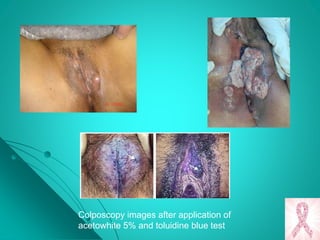
colposcopy,
 It’s very important to remember that you
have to examine the remainder of the
genital tract looking for vaginal lesions and
also for cervical dysplasia or early invasive
cancer because often times these can be
metastatic from another site,
Squamous Cell carcinoma
 65% arises in labia majora and minora
 25% percent in clitoris or perineum
 Appearance varies from a large,
exophytic, cauliflowerlike lesion to a small
ulcer crater superimposed on a dystrophic
lesion of the vulvar skin
 primary determinant of nodal metastases
is tumor size.
SITES.
 The most frequent sites are on the labia
majus, followed by the labium minorum,
and then some patient’s will have
combined lesions about 15%.
SQUAMOUS CELL
CARCINOMAAre usually seen in the anterior part of the
vulva.
2/3 of cases in the labia majora.
1/3 of cases in the clitoris ,labia
minora,fourchitte, and perineum.
Spread:-
1. LYMPHATIC > 50%
2. Direct spread occurs in 25% to the urethra,
vagina and rectum
3. Hematogenous spread to bone or lung is rare
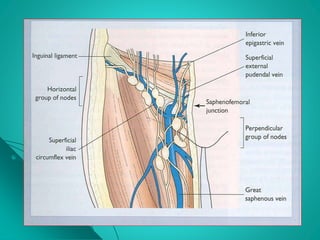
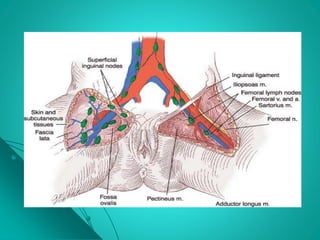
The lymph nodes are arranged in 5 groups in
each groin:
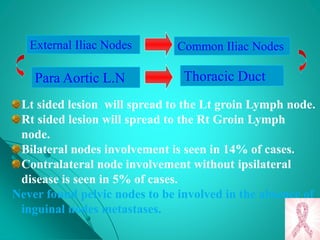
Lt sided lesion will spread to the Lt groin Lymph node.
Rt sided lesion will spread to the Rt Groin Lymph
node.
Bilateral nodes involvement is seen in 14% of cases.
Contralateral node involvement without ipsilateral
disease is seen in 5% of cases.
Never found pelvic nodes to be involved in the absence of
inguinal nodes metastases.
External Iliac Nodes Common Iliac Nodes
Para Aortic L.N Thoracic Duct
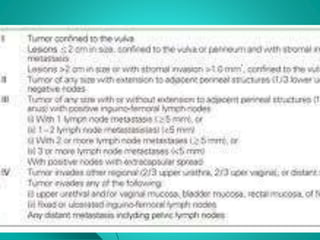
STAGING:
FIGO suggest clinical staging in 1969 based
on TNM (Tumor node metastasis)
classification taking into consideration:
The size of the local lesion.
Groin node involvement.
Metastases.
A new FIGO staging based on surgical
findings in 1988, which underwent
revision in 2009 to provide better
prognostic discrimination b/w stages
and less hetrogeneity
The main changes are:
While stage 1a remains unchanged as s
only group of patients with negligible
risk of ln involvment , former stage 1
and 11 have been combined to 1b
 The new stage 11 segregates pts whose
tumors involve the lower adjacent perineal
structure from those with positive ln
 For stages iii and iv the no. and
morphology of the involved nodes are
taken into account and the bilaterality of
lymphnodes is discounted
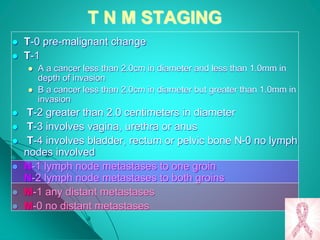
T N M STAGING
 T-0 pre-malignant change
 T-1
 A a cancer less than 2.0cm in diameter and less than 1.0mm in
depth of invasion
 B a cancer less than 2.0cm in diameter but greater than 1.0mm in
invasion
 T-2 greater than 2.0 centimeters in diameter
 T-3 involves vagina, urethra or anus
 T-4 involves bladder, rectum or pelvic bone N-0 no lymph
nodes involved
 N-1 lymph node metastases to one groin
N-2 lymph node metastases to both groins
 M-1 any distant metastases
 M-0 no distant metastases
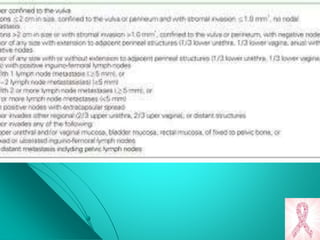
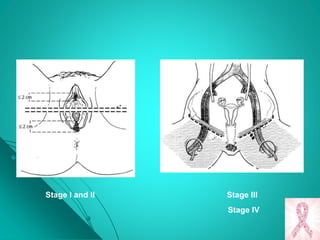
Stage I and II Stage III
Stage IV
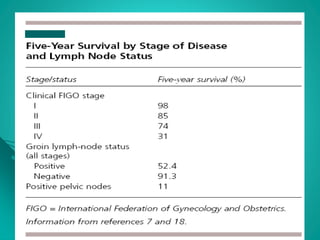
PROGNOSIS
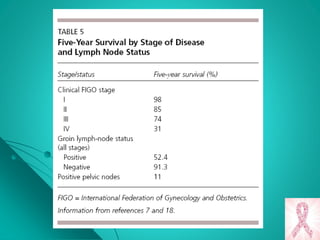
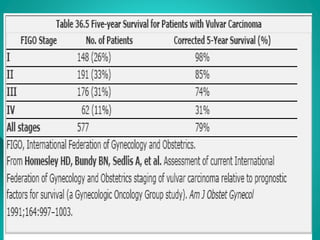
The overall 5 years survival rate for vulval
cancer is 70% for all operable cases,
This depends on:
1. L.N Involvement:
This is the most prognostic factor
Metstatic involvement of groin nodes
decreases the 5 years survival rate to below
50% as opposed to the 90% when L.N are
not involved.
Once pelvic nodes are involved the 5 years
survival rate is 15%.
2. The number of groin nodes involvement:
microscopical involvement of N.regardless
of stage has a good prognosis.
2 or more positive nodes have a worse
prognosis.
3. Stage:
The 5 years survival rate decreases with
advancing stage from >90% in stage 1 to <
10% in stage 4.
4. Differentiation:
A well diff.tumor has a better prognosis
than poor diff.
5.Depth of Invasion:
A-invasion of 1 mm no risk of nodal metastases.
B-invasion of 1-3 mm 6-8% incidence of metastases.
C-invasion of 5 mm 22-37% incidence of
metastases.
6.Surgical Margin:
Surgical excision margin of more than 1 cm in
all diameters results in a low local recurrence
rate.
Prophylaxis…A high index of suspicion
 Detection and management of VIN.
 Proper management of all cases with
pruiritus vulvae.
 All vulval lesions should be diagnosed
accurately especially those arising after
menopause.
 All pigmented vulvar lesions should be
removed for biopsy.
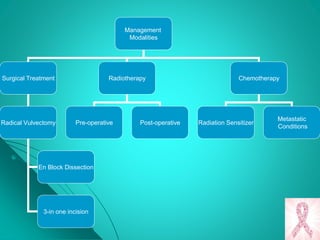
Management
Modalities
Surgical Treatment Radiotherapy Chemotherapy
Radical Vulvectomy
En Block Dissection
3-in one incision
Pre-operative Post-operative Radiation Sensitizer
Metastatic
Conditions
Advances in managment of
vulvar ca
 Individualization of treatment for all patients
with invasive disease
 Vulvar conservation for patients with unifocal
tumor and an otherwise normal vula
 Omission of groin dissection for patients with
microinvasive tumor(t1a<2cm diameter and
<1mm stromal invasion
 Elimination of routine pelvic lymphedenectomy
 Investigation of role of sentinal ln procedure to
eliminate complete inguinofemoral
lyphedenectomy
 Use of separate incision for groin dissection
to improve wound healing
 Omission of contralateral groin dissection in
pts with lateral t1 lesion and negative
ipsilateral lnodes
 Use of preoperative radiotherapy to obviate
the need for exenteration in pts with
advanced disease
 Use of post operative rt to decrese the
incidence of groin recurrence with multiple
groin nodes
SURGURY:
The standard surgery is enblock radical
vulvectomy and bilateral groin nodes
dissection as described by Taussing and way
(three separate incision). This associated
with:
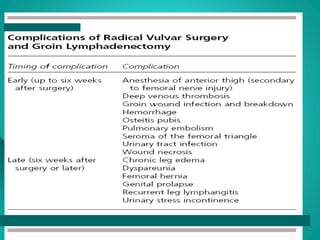
High incidence of morbidity (wound
infection, necrosis and break down , pul.
Embolism, and lymphoedema).
Problems with body image and sexual
function.
The recent trend in management is not to
cure patients but to preserve body image
and sexual function by performing less
radical surgery .The individualization of the
treatment depends on:
Size and position of tumor.
Depth of invasion.
The age and performance status of the
patient.
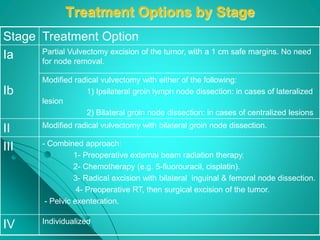
Treatment Options by Stage
Treatment OptionStage
Partial Vulvectomy excision of the tumor, with a 1 cm safe margins. No need
for node removal.
Ia
Ib
Modified radical vulvectomy with either of the following:
1) Ipsilateral groin lymph node dissection: in cases of lateralized
lesion
2) Bilateral groin node dissection: in cases of centralized lesions
Modified radical vulvectomy with bilateral groin node dissection.
II
- Combined approach:
1- Preoperative external beam radiation therapy.
2- Chemotherapy (e.g. 5-fluorouracil, cisplatin).
3- Radical excision with bilateral inguinal & femoral node dissection.
4- Preoperative RT, then surgical excision of the tumor.
- Pelvic exenteration.
III
Individualized
IV
HISTORICAL.
 The surgical treatment, back in the early
1900s Basset from France who adopted
a Hallstedian concept to the treatment
of vulvar cancer very similar what Dr.
Hallstead had adopted for breast cancer,
felt that wide surgical excision was the
best.
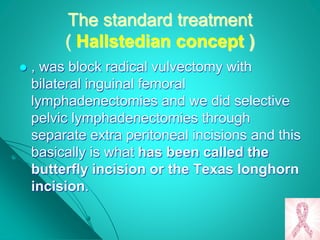
The standard treatment
( Hallstedian concept )
 , was block radical vulvectomy with
bilateral inguinal femoral
lymphadenectomies and we did selective
pelvic lymphadenectomies through
separate extra peritoneal incisions and this
basically is what has been called the
butterfly incision or the Texas longhorn
incision.
Why conservative surgery?
 The rationale for conservative surgery
is that most of the metastases occur by
embolization and the early advocates of
the more conservative procedures in
their series found no metastatic lesions
in the skin bridge between the vulva
and the groin,
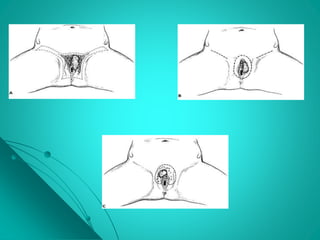
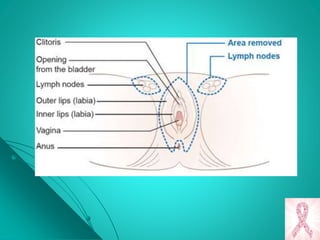
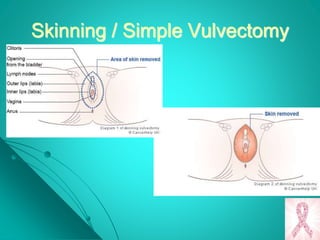
Vulvectomy
 There are several operations in which part of the
vulva or all of the vulva is removed:
 A skinning vulvectomy means only the top layer of skin
affected by the cancer is removed. Although this is an
option for treating extensive VIN3, this operation is rarely
done.
 Simple vulvectomy, the entire vulva is removed.
 Radical vulvectomy can be complete or partial.
 When part of the vulva, including the deep tissue, is removed,
the operation is called a partial vulvectomy.
 In a complete radical vulvectomy, the entire vulva and deep
tissues, including the clitoris, are removed.
 An operation to remove the lymph nodes near the vulva
is called a en block dissection. It is important to
remove these lymph nodes if they contain cancer.
Skinning / Simple Vulvectomy
Radiotherapy
 Malignant diseases of the vulva are not commonly managed
by RT because of the intolerance of surrounding normal
tissues.
 Chemotherapy as radiation sensitizer can improve response of the
malignant tissues.
 Indications of RT in malignant diseases of the vulva:
 Preoperative RT in stage III and IV:
 The lesion shrunk and it limits the need for pelvic exenteration.
 It also improves surgical respectability of tumors.
 Postoperative RT: can reduce regional recurrences and inguinal
lymph node metastases.
 Multiple positive groin nodes: It decreases the incidence of recurrence.
 Positive surgical margins as seen on microscopic examination.
 Multiple focal recurrences.
 When the tumor size is > 4 cm
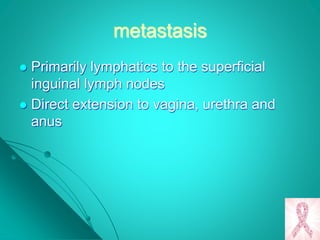
metastasis
 Primarily lymphatics to the superficial
inguinal lymph nodes
 Direct extension to vagina, urethra and
anus
Malignant Melanoma
 Accounts for 5% of vulvar cancers
 most commonly arises in the labia minora
and clitoris
 superficial spread toward the urethra and
vagina
 nonpigmented melanoma may closely
resembles squamous cell carcinoma
 darkly pigmented, raised lesion is a
characteristic finding
Colposcopy images after application of
acetowhite 5% and toluidine blue test
FACT: Current place of pelvic
lymphadenectomy?
 In the past pelvic lymphedenectomy was
routinely done now it has been
established that patients with negative
groin nodes rarely have positive pelvic
nodes.
 pts with >3 positive groin nodes are
prone to pelvic ln involvement
We omitted routine
pelvic lymphadenectomy,
 patient’s who have positive nodes, ,
end up getting radiation therapy to the
whole pelvis anywhay.
Role of adjuvent radiotherapy?
 Review of recurrence studies of in
Homesley,s study suggests that adjuvent
RT is more effective largely because groin
recurrences are reduced.
Should we do separate groin
incisions ?
 Understanding that the mode ofmetastatic
spread is embolic rather than by
contiguous grouth allowed for three-
incision technique..
 Less morbidity.
 No impact on survival.
(54% BREAKDOWN RATE WITH BUTTERFLY TECH.)
Is there a place for unilateral
inguinofemoral lymphadenectomy?
 May be indicated in well lateralised early
tumors.
 No lymph-capillary space involvement.
 Negative groin nodes by frozen section.
What is the place of superficial
inguinal lymphadenectomy?
 Above the cribriform fascia , mainly those
associated with great saphenous and
superficial epigastric veins.
 ONLY with low risk for LN metastasis.
 Tumors confined to labia majora.
 Negative superficial nodes on frozen
section.
Can we omit groin node dissection
in superficial diseases?
 Stage 1a have <1% for groin node
metastasis.
 we do give postoperative radiation for
groin nodal metastases
Is there a place for preoperative
radiotherapy?
 we give preop radiation therapy for
advanced disease.
Conclusions.
Now to run through management,
again
for stage I, it’s pretty much radical local
excision, and try to maintain at least a 1
cm margin and if it’s truly a small
lesion with less than a mm invasion, it
is felt that most of those patient’s do
not need to have lymph nodes removed.
CONCLUSIONS.
For large stage II lesions, again,
depending on where it’s located, we do
a radical vulvectomy and bilateral
inguinal femoral lymphadenectomy, if
there are more than two lymph nodes
positive, the patient’s will get
postoperative whole pelvic radiation.
 For stage III tumors, it depends on what’s
involved, you can do a radical excision which
often times becomes extended and you have
to take the distal vagina and even sometimes
the distal urethra and if you are going to treat
it surgically it needs to be combined with the
bilateral inguinal femoral lymphadenectomy
and again, if there is lymph node
involvement POST OPERATIVE
RADIOTHERAPY.
Conclusions.
 For advanced disease, again you have to
individualize, add up with surgical clearance
for disease sometimes involves the anus,
rectum, proximal urethra and requires an
exenterative procedure with radical vulvectomy
and bilateral groin nodes and that particular
circumstance is very important that patient’s
are evaluated either with MRI, CAT scans and
possibly even a PET scan for metastatic
disease prior to undertaking such a large
procedure. The operative mortality is about 5 to
10%.
Conclusions.
 Survival is also determined whether or
not the nodes are positive or negative,
and by which nodes are involved.
 If patient’s have negative groin nodes,
the five year survival is 90% and that’s
for stage I and stage II.
 If they have positive groin nodes,
survival drops about 57%.
 If they have positive pelvic lymph nodes, it
drops to 20%. Unilateral positive groin
nodes is about 70% five year survival,
bilateral positive groin nodes, however,
drops down to 25% five year survival, and
then the increasing number of positive
nodes.

CONCLUSIONS.
 and also the tumor diameter affects nodal
involvement, lymphatic vascular space
involvement and then overall survival.
Conclusions.
 .
 Less extensive surgery for vulvar cancer appears safe and
limits mutilation
 Vulvar cancer is rare, affecting mainly older women. Until the
1980s, affected women underwent extensive, mutilating surgery.
Groin nodes on both sides as well as all vulvar tissue were

removed. Recently surgeons have carried out a smaller
operation, leaving as much vulvar tissue as possible behind. No
randomized controlled trials have been conducted on the safety
of this reduced surgery, but from the available evidence it
appears to be safe to perform this smaller operation in most
patients.
The Cochrane Database of Systematic Reviews 2006 Issue 1
Copyright Š 2006 The Cochrane Collaboration. Published by John Wiley & Sons, LtdSurgical interventions
for early squamous cell carcinoma of the vulva
Ansink A, van der Velden J, Collingwood M
What is the place of modified
radical vulvectomy?
 main morbidity of radical vulvectomy is
sexual dysfunction and compromised
function of the anus and urethra.
 The main fear of about the modified
operation is the multicentricity of the
tumor.(20-30%).
 So reservethe operation to well localised
tumors,with 2 cm free margin.
How should we treat vulvar
carcinoma with perianal
involvement?
 The main problem in these cases is to do
adequate resection with maintaining
sphincteric function.sometimes
 we may need to do more radical resection
and colostomy or
 preoperative radiotherapy.
what is the place of ultraradical
surgery?
 Only in patients with clearly resectable
lesions and negative or one or two
microscopicaly positive nodes.
what is the place of neoadjuvent
chemotherapy?
Resuts are not encouraging for time being.
CONCLUSION
1.Standard radical vulvectomy and bilateral
lymphadenectomy(Hallstedian concept.)has
compromised the life of many women with
cancer vulva.
2.In many well selected patients wide excision
with 2 cm margin with or without node
selection may suffice.
3.modified radical vulvectomy with bilateral
groin node dissection will give equaly good
results in the majority of cases
4.Pelvic lymphadenectomy should be
abondoned except in a minority of selected
cases.
5.Radiotherapy should be given to the groins
and pelvis postoperatively only if
more than one groin nodesis positive for
metestatic disease.
6.ultraradical surgery selective
7.In situ stage is almost 100% curable.and
FIGO stage 1 disease is 90% curable and 5
year survival rate.
Take home message
Any patient with persistence itching or vulval
lesion not responds to simple treatment , you
should take multiple biopsies from vulva to
exclude malignancy.
In management of cancer vulva, age group,
psychology of patient, and the appearance of
the vulva should be taken in account as this
will change the plan of management of
cancer.
Plastic surgery should play role in the future.
In future infrared , and laser therapy under
microscopy will play role in the management
of premalignant lesions.
Ca Vulva: Recapitulating the facts

Ca Vulva: Recapitulating the facts

  • 1.
    Cancer vulva recapitulatingthe FACTS Dr. Sunaina wadhwa Dr. Pratima mittal Department of obstetrics & gynecology Vmmc & sjh.
  • 2.
    Objectives of thispresentation  To know the out lines of etiology,diagnosis and mangment of cancer vulva.  To understand the importance of early dectection of cancer vulva to improve prognosis and survival rate
  • 3.
    Introduction  Vulval canceris uncommon & accounts for approximately 1-4% of all gynecological cancer  4th most common malignancy of the female genital tract  Incidence : 1.8 /100.000, It is predominantly seen in postmenopausal and old women (mean age 65 years ) ,and only 2% were less than 30 years.  As the 6th , 7th decade of life and does increase with increasing age.
  • 4.
    - The incidenceincreases with age. - Recently there was a rise in the incidence, due to  Longevity (Long standing preinvasive stage)  Increased HPV infections.  Increased smoking habits
  • 5.
    Risk factors forcarcinoma of the vulva 1- Human papillomavirus infection. Genital condylomas: these are detected in 5 % of vulvar cancer. Vulvar intraepithelial neoplasia (VIN) and also CIN. 2- Medical history of: Vulvar dystrophy. Chronic vulvar pruritus. 3- Patients with a history of squamous cell ca of cervix or vagina. 4- Chronic immunosuppression. 5- Smoking
  • 6.
    2 Types /Variants (15%) (85%)
  • 7.
  • 8.
    PATHOLOGY Primary Tumor 90% oflesions are of squamous in origin. 3-5 of lesions are melanoma. 2% of lesions is basal cell carcinoma. Less than 1% is sarcoma. Secondary Tumors It is occasionly found in vulva Most commonly the primary lesion is from the cervix or the endometrium .
  • 9.
    Essentials of Diagnosis Typically occurs in postmenopausal women.  Long history of vulvar irritation with pruritus, local discomfort, and bloody discharge.  Appearance of early lesions like that of chronic vulvar dermatitis.  Appearance of late lesions like that of a large cauliflower, or a hard ulcerated area in the vulva.  Biopsy necessary for diagnosis.
  • 10.
    Clinical Features &Diagnosis Most patients with invasive disease complain of: Irritation or purities in 70% of cases Vulvar mass or ulcer in 55% of cases Bleeding in 28% of cases Discharge in 2-3% of cases
  • 11.
    The major problemin invasive vulvar cancer is delay between the first appearance of the symptoms and referral to the gynecological opinion due to : 1. The doctor fails to recognize the gravity of the lesion and prescribes topical therapy. 2. Older women are often embarrassed and shy.
  • 12.
    Diagnosis 1) Local examinationof the relevant areas: early lesions appears as chronic vulvar dermatitis. 2) Clinical assessment of the lymph nodes is to be performed in the relevant regions. 3) Biopsy: 1- From the suspected lesions: a) Dermal punch biopsy using a local anesthetic: Lesions < 1 cm b) Excisional biopsy under general anesthesia: Lesions > 1 cm: 2- From the lymph nodes in the relevant regions when suspected for metastasis. Differential diagnosis: 1- Venereal diseases: syphilis, chancroid, lymphogranuloma venereum, granuloma inguinale. 2- VIN. An association between invasive and noninvasive lesions is a possibility. 3- Condyloma acuminatum.
  • 13.
    In order tomake a diagnosis  you need to get tissue, and wedge biopsy, excisional biopsies, colposcopy,  It’s very important to remember that you have to examine the remainder of the genital tract looking for vaginal lesions and also for cervical dysplasia or early invasive cancer because often times these can be metastatic from another site,
  • 14.
    Squamous Cell carcinoma 65% arises in labia majora and minora  25% percent in clitoris or perineum  Appearance varies from a large, exophytic, cauliflowerlike lesion to a small ulcer crater superimposed on a dystrophic lesion of the vulvar skin  primary determinant of nodal metastases is tumor size.
  • 15.
    SITES.  The mostfrequent sites are on the labia majus, followed by the labium minorum, and then some patient’s will have combined lesions about 15%.
  • 16.
    SQUAMOUS CELL CARCINOMAAre usuallyseen in the anterior part of the vulva. 2/3 of cases in the labia majora. 1/3 of cases in the clitoris ,labia minora,fourchitte, and perineum. Spread:- 1. LYMPHATIC > 50% 2. Direct spread occurs in 25% to the urethra, vagina and rectum 3. Hematogenous spread to bone or lung is rare The lymph nodes are arranged in 5 groups in each groin:
  • 18.
    Lt sided lesionwill spread to the Lt groin Lymph node. Rt sided lesion will spread to the Rt Groin Lymph node. Bilateral nodes involvement is seen in 14% of cases. Contralateral node involvement without ipsilateral disease is seen in 5% of cases. Never found pelvic nodes to be involved in the absence of inguinal nodes metastases. External Iliac Nodes Common Iliac Nodes Para Aortic L.N Thoracic Duct
  • 19.
    STAGING: FIGO suggest clinicalstaging in 1969 based on TNM (Tumor node metastasis) classification taking into consideration: The size of the local lesion. Groin node involvement. Metastases.
  • 20.
    A new FIGOstaging based on surgical findings in 1988, which underwent revision in 2009 to provide better prognostic discrimination b/w stages and less hetrogeneity The main changes are: While stage 1a remains unchanged as s only group of patients with negligible risk of ln involvment , former stage 1 and 11 have been combined to 1b
  • 21.
     The newstage 11 segregates pts whose tumors involve the lower adjacent perineal structure from those with positive ln  For stages iii and iv the no. and morphology of the involved nodes are taken into account and the bilaterality of lymphnodes is discounted
  • 24.
    T N MSTAGING  T-0 pre-malignant change  T-1  A a cancer less than 2.0cm in diameter and less than 1.0mm in depth of invasion  B a cancer less than 2.0cm in diameter but greater than 1.0mm in invasion  T-2 greater than 2.0 centimeters in diameter  T-3 involves vagina, urethra or anus  T-4 involves bladder, rectum or pelvic bone N-0 no lymph nodes involved  N-1 lymph node metastases to one groin N-2 lymph node metastases to both groins  M-1 any distant metastases  M-0 no distant metastases
  • 25.
    Stage I andII Stage III Stage IV
  • 27.
    PROGNOSIS The overall 5years survival rate for vulval cancer is 70% for all operable cases, This depends on: 1. L.N Involvement: This is the most prognostic factor Metstatic involvement of groin nodes decreases the 5 years survival rate to below 50% as opposed to the 90% when L.N are not involved. Once pelvic nodes are involved the 5 years survival rate is 15%.
  • 28.
    2. The numberof groin nodes involvement: microscopical involvement of N.regardless of stage has a good prognosis. 2 or more positive nodes have a worse prognosis. 3. Stage: The 5 years survival rate decreases with advancing stage from >90% in stage 1 to < 10% in stage 4. 4. Differentiation: A well diff.tumor has a better prognosis than poor diff.
  • 29.
    5.Depth of Invasion: A-invasionof 1 mm no risk of nodal metastases. B-invasion of 1-3 mm 6-8% incidence of metastases. C-invasion of 5 mm 22-37% incidence of metastases. 6.Surgical Margin: Surgical excision margin of more than 1 cm in all diameters results in a low local recurrence rate.
  • 30.
    Prophylaxis…A high indexof suspicion  Detection and management of VIN.  Proper management of all cases with pruiritus vulvae.  All vulval lesions should be diagnosed accurately especially those arising after menopause.  All pigmented vulvar lesions should be removed for biopsy.
  • 31.
    Management Modalities Surgical Treatment RadiotherapyChemotherapy Radical Vulvectomy En Block Dissection 3-in one incision Pre-operative Post-operative Radiation Sensitizer Metastatic Conditions
  • 32.
    Advances in managmentof vulvar ca  Individualization of treatment for all patients with invasive disease  Vulvar conservation for patients with unifocal tumor and an otherwise normal vula  Omission of groin dissection for patients with microinvasive tumor(t1a<2cm diameter and <1mm stromal invasion  Elimination of routine pelvic lymphedenectomy  Investigation of role of sentinal ln procedure to eliminate complete inguinofemoral lyphedenectomy
  • 33.
     Use ofseparate incision for groin dissection to improve wound healing  Omission of contralateral groin dissection in pts with lateral t1 lesion and negative ipsilateral lnodes  Use of preoperative radiotherapy to obviate the need for exenteration in pts with advanced disease  Use of post operative rt to decrese the incidence of groin recurrence with multiple groin nodes
  • 34.
    SURGURY: The standard surgeryis enblock radical vulvectomy and bilateral groin nodes dissection as described by Taussing and way (three separate incision). This associated with: High incidence of morbidity (wound infection, necrosis and break down , pul. Embolism, and lymphoedema). Problems with body image and sexual function.
  • 35.
    The recent trendin management is not to cure patients but to preserve body image and sexual function by performing less radical surgery .The individualization of the treatment depends on: Size and position of tumor. Depth of invasion. The age and performance status of the patient.
  • 36.
    Treatment Options byStage Treatment OptionStage Partial Vulvectomy excision of the tumor, with a 1 cm safe margins. No need for node removal. Ia Ib Modified radical vulvectomy with either of the following: 1) Ipsilateral groin lymph node dissection: in cases of lateralized lesion 2) Bilateral groin node dissection: in cases of centralized lesions Modified radical vulvectomy with bilateral groin node dissection. II - Combined approach: 1- Preoperative external beam radiation therapy. 2- Chemotherapy (e.g. 5-fluorouracil, cisplatin). 3- Radical excision with bilateral inguinal & femoral node dissection. 4- Preoperative RT, then surgical excision of the tumor. - Pelvic exenteration. III Individualized IV
  • 37.
    HISTORICAL.  The surgicaltreatment, back in the early 1900s Basset from France who adopted a Hallstedian concept to the treatment of vulvar cancer very similar what Dr. Hallstead had adopted for breast cancer, felt that wide surgical excision was the best.
  • 38.
    The standard treatment (Hallstedian concept )  , was block radical vulvectomy with bilateral inguinal femoral lymphadenectomies and we did selective pelvic lymphadenectomies through separate extra peritoneal incisions and this basically is what has been called the butterfly incision or the Texas longhorn incision.
  • 39.
    Why conservative surgery? The rationale for conservative surgery is that most of the metastases occur by embolization and the early advocates of the more conservative procedures in their series found no metastatic lesions in the skin bridge between the vulva and the groin,
  • 40.
    Vulvectomy  There areseveral operations in which part of the vulva or all of the vulva is removed:  A skinning vulvectomy means only the top layer of skin affected by the cancer is removed. Although this is an option for treating extensive VIN3, this operation is rarely done.  Simple vulvectomy, the entire vulva is removed.  Radical vulvectomy can be complete or partial.  When part of the vulva, including the deep tissue, is removed, the operation is called a partial vulvectomy.  In a complete radical vulvectomy, the entire vulva and deep tissues, including the clitoris, are removed.  An operation to remove the lymph nodes near the vulva is called a en block dissection. It is important to remove these lymph nodes if they contain cancer.
  • 43.
  • 44.
    Radiotherapy  Malignant diseasesof the vulva are not commonly managed by RT because of the intolerance of surrounding normal tissues.  Chemotherapy as radiation sensitizer can improve response of the malignant tissues.  Indications of RT in malignant diseases of the vulva:  Preoperative RT in stage III and IV:  The lesion shrunk and it limits the need for pelvic exenteration.  It also improves surgical respectability of tumors.  Postoperative RT: can reduce regional recurrences and inguinal lymph node metastases.  Multiple positive groin nodes: It decreases the incidence of recurrence.  Positive surgical margins as seen on microscopic examination.  Multiple focal recurrences.  When the tumor size is > 4 cm
  • 48.
    metastasis  Primarily lymphaticsto the superficial inguinal lymph nodes  Direct extension to vagina, urethra and anus
  • 50.
    Malignant Melanoma  Accountsfor 5% of vulvar cancers  most commonly arises in the labia minora and clitoris  superficial spread toward the urethra and vagina  nonpigmented melanoma may closely resembles squamous cell carcinoma  darkly pigmented, raised lesion is a characteristic finding
  • 51.
    Colposcopy images afterapplication of acetowhite 5% and toluidine blue test
  • 52.
    FACT: Current placeof pelvic lymphadenectomy?  In the past pelvic lymphedenectomy was routinely done now it has been established that patients with negative groin nodes rarely have positive pelvic nodes.  pts with >3 positive groin nodes are prone to pelvic ln involvement
  • 53.
    We omitted routine pelviclymphadenectomy,  patient’s who have positive nodes, , end up getting radiation therapy to the whole pelvis anywhay.
  • 54.
    Role of adjuventradiotherapy?  Review of recurrence studies of in Homesley,s study suggests that adjuvent RT is more effective largely because groin recurrences are reduced.
  • 55.
    Should we doseparate groin incisions ?  Understanding that the mode ofmetastatic spread is embolic rather than by contiguous grouth allowed for three- incision technique..  Less morbidity.  No impact on survival. (54% BREAKDOWN RATE WITH BUTTERFLY TECH.)
  • 56.
    Is there aplace for unilateral inguinofemoral lymphadenectomy?  May be indicated in well lateralised early tumors.  No lymph-capillary space involvement.  Negative groin nodes by frozen section.
  • 57.
    What is theplace of superficial inguinal lymphadenectomy?  Above the cribriform fascia , mainly those associated with great saphenous and superficial epigastric veins.  ONLY with low risk for LN metastasis.  Tumors confined to labia majora.  Negative superficial nodes on frozen section.
  • 58.
    Can we omitgroin node dissection in superficial diseases?  Stage 1a have <1% for groin node metastasis.  we do give postoperative radiation for groin nodal metastases
  • 59.
    Is there aplace for preoperative radiotherapy?  we give preop radiation therapy for advanced disease.
  • 60.
    Conclusions. Now to runthrough management, again for stage I, it’s pretty much radical local excision, and try to maintain at least a 1 cm margin and if it’s truly a small lesion with less than a mm invasion, it is felt that most of those patient’s do not need to have lymph nodes removed.
  • 61.
    CONCLUSIONS. For large stageII lesions, again, depending on where it’s located, we do a radical vulvectomy and bilateral inguinal femoral lymphadenectomy, if there are more than two lymph nodes positive, the patient’s will get postoperative whole pelvic radiation.
  • 62.
     For stageIII tumors, it depends on what’s involved, you can do a radical excision which often times becomes extended and you have to take the distal vagina and even sometimes the distal urethra and if you are going to treat it surgically it needs to be combined with the bilateral inguinal femoral lymphadenectomy and again, if there is lymph node involvement POST OPERATIVE RADIOTHERAPY.
  • 63.
    Conclusions.  For advanceddisease, again you have to individualize, add up with surgical clearance for disease sometimes involves the anus, rectum, proximal urethra and requires an exenterative procedure with radical vulvectomy and bilateral groin nodes and that particular circumstance is very important that patient’s are evaluated either with MRI, CAT scans and possibly even a PET scan for metastatic disease prior to undertaking such a large procedure. The operative mortality is about 5 to 10%.
  • 64.
    Conclusions.  Survival isalso determined whether or not the nodes are positive or negative, and by which nodes are involved.  If patient’s have negative groin nodes, the five year survival is 90% and that’s for stage I and stage II.  If they have positive groin nodes, survival drops about 57%.
  • 65.
     If theyhave positive pelvic lymph nodes, it drops to 20%. Unilateral positive groin nodes is about 70% five year survival, bilateral positive groin nodes, however, drops down to 25% five year survival, and then the increasing number of positive nodes. 
  • 66.
    CONCLUSIONS.  and alsothe tumor diameter affects nodal involvement, lymphatic vascular space involvement and then overall survival.
  • 67.
    Conclusions.  .  Lessextensive surgery for vulvar cancer appears safe and limits mutilation  Vulvar cancer is rare, affecting mainly older women. Until the 1980s, affected women underwent extensive, mutilating surgery. Groin nodes on both sides as well as all vulvar tissue were removed. Recently surgeons have carried out a smaller operation, leaving as much vulvar tissue as possible behind. No randomized controlled trials have been conducted on the safety of this reduced surgery, but from the available evidence it appears to be safe to perform this smaller operation in most patients. The Cochrane Database of Systematic Reviews 2006 Issue 1 Copyright Š 2006 The Cochrane Collaboration. Published by John Wiley & Sons, LtdSurgical interventions for early squamous cell carcinoma of the vulva Ansink A, van der Velden J, Collingwood M
  • 68.
    What is theplace of modified radical vulvectomy?  main morbidity of radical vulvectomy is sexual dysfunction and compromised function of the anus and urethra.  The main fear of about the modified operation is the multicentricity of the tumor.(20-30%).  So reservethe operation to well localised tumors,with 2 cm free margin.
  • 69.
    How should wetreat vulvar carcinoma with perianal involvement?  The main problem in these cases is to do adequate resection with maintaining sphincteric function.sometimes  we may need to do more radical resection and colostomy or  preoperative radiotherapy.
  • 70.
    what is theplace of ultraradical surgery?  Only in patients with clearly resectable lesions and negative or one or two microscopicaly positive nodes.
  • 71.
    what is theplace of neoadjuvent chemotherapy? Resuts are not encouraging for time being.
  • 72.
    CONCLUSION 1.Standard radical vulvectomyand bilateral lymphadenectomy(Hallstedian concept.)has compromised the life of many women with cancer vulva. 2.In many well selected patients wide excision with 2 cm margin with or without node selection may suffice. 3.modified radical vulvectomy with bilateral groin node dissection will give equaly good results in the majority of cases
  • 73.
    4.Pelvic lymphadenectomy shouldbe abondoned except in a minority of selected cases. 5.Radiotherapy should be given to the groins and pelvis postoperatively only if more than one groin nodesis positive for metestatic disease. 6.ultraradical surgery selective 7.In situ stage is almost 100% curable.and FIGO stage 1 disease is 90% curable and 5 year survival rate.
  • 74.
    Take home message Anypatient with persistence itching or vulval lesion not responds to simple treatment , you should take multiple biopsies from vulva to exclude malignancy. In management of cancer vulva, age group, psychology of patient, and the appearance of the vulva should be taken in account as this will change the plan of management of cancer. Plastic surgery should play role in the future. In future infrared , and laser therapy under microscopy will play role in the management of premalignant lesions.