Basics
of
Formal Event and Programme
Ms.Chandni Kayastha
Session Objective
After the end of the session participants will be able
to
● To distinguish the difference in seminar,
conference, symposium and panel discussion
● To organize above mentioned event
● To host the above mentioned event
Session Outline
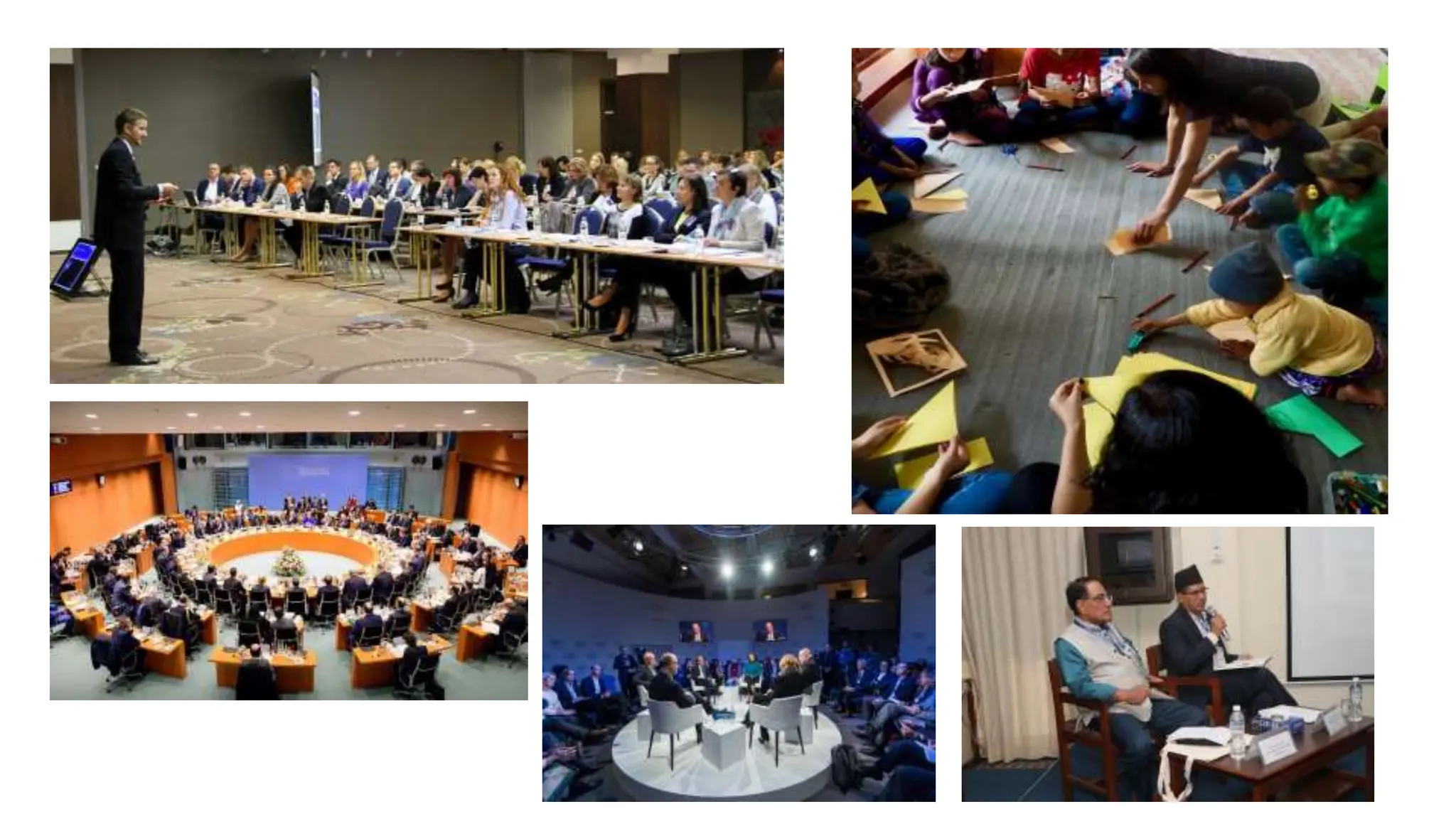
● Workshop
● Conference /Symposium
● Panel Discussion
● Programme Hosting
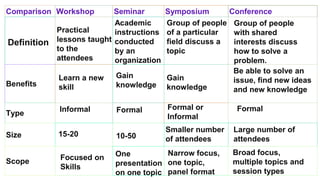
Comparison Workshop Seminar Symposium Conference
Benefits
Type
Size
Scope
Definition
Practical
lessons taught
to the
attendees
Learn a new
skill
Group of people
with shared
interests discuss
how to solve a
problem.
Gain
knowledge
Gain
knowledge
Group of people
of a particular
field discuss a
topic
Academic
instructions
conducted
by an
organization
15-20
One
presentation
on one topic
Narrow focus,
one topic,
panel format
Broad focus,
multiple topics and
session types
10-50
Informal
Be able to solve an
issue, find new ideas
and new knowledge
Formal or
Informal
Formal Formal
Large number of
attendees
Smaller number
of attendees
Focused on
Skills
Conducting a Workshop
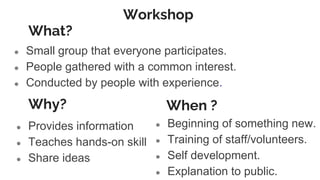
Workshop
● Small group that everyone participates.
● People gathered with a common interest.
● Conducted by people with experience.
Why?
● Provides information
● Teaches hands-on skill
● Share ideas
● Beginning of something new.
● Training of staff/volunteers.
● Self development.
● Explanation to public.
When ?
What?
Workshop Checklist
● Gain the Facilitation Confidence
● Internalize the participants Mindset
● Get to grips with the basic facilitation skills
● Learn the Core Workshop Principles
● Choose the Right Workshop Exercises
● Sequence all discussions
● Visualize all discussions
● Work together
● ALWAYS conclude with a decision
Organizing a Conference, or
Symposium
What is a conference?
● a gathering of people with a common interest or
background
● with the purpose of allowing them to meet one
another
● to learn about and discuss issues, ideas, and work
● that focus on a topic of mutual concern.
Why organize a conference?
‱ There’s an issue that needs examining.
‱ There’s a crisis or opportunity that should be
addressed.
‱ A funder demands it.
‱ Enlist people to advance the field, either through
their work or through advocacy.
‱ A matter of prestige, credibility, or credentials for
you or your organization.
Who might organize a conference?
‱ Professional associations and organizations.
‱ Government agencies.
‱ Coalitions.
‱ Individual organizations.
‱ Educational institutions.
‱ Advocacy or community activist groups.
‱ A group with a stake or interest in the subject of the
conference.
How do you organize a conference?
Plan the conference by:
● Agreeing on the purpose of the
conference.
● Identifying your target audience.
● Setting a length and date.
● Planning the content.
● Addressing logistics.
● Clarifying coordination.
Implement the Conference by:
‱ Publicize the conference.
‱ Register participants.
‱ Recruit presenters.
‱ Run the conference.
‱ Evaluate the conference
Creating an Infrastructure
by:
● Choosing an organizing team or
committee.
● Appointing a coordinator.
● Setting up a communication system.
Actors of Conference
Opening Event
● Organizing Team
● Master of Ceremony
● Chair Person
● Chief Guest
● Guests
● Audiences
Session Period
● MC
● Chair
● Presenter
● Commentator
● Audience
● Time Keeper
Conducting a Panel
Discussion
Panel Discussion
● The word ‘panel’ means a group of experts.
● Exchange insights and views in a certain topic in a
meeting or conference.
● Panel Discussion - Discussion held among these expert
members in front of an audience
● A panel moderator facilitates a panel discussion
● Panelists usually comprise 4-5 industry experts
● A panel talk's ideal length is 45 minutes to one hour
Actors of Panel Discussion
● The panel members who consist of experts in the field
concerned.
● The audience of selected students/trainees/participants
and teachers who ask questions t the panelist.
● The moderator who initiates the discussion, questions,
synthesizes and summarizes the key points.
Things to Do - Pre
● Experts in the field are invited as panelists.
● Audiences are invited
● Questions on the proposed topic are collected in advance
from the audience and handed over to the panelists
● Questions are generally classified according to the sub-
topic/ aspect/ dimension of the proposed theme
● The panelists come prepared to the panel discussion
Things to Do -During
● The moderator introduces the theme of the discussion to
the participants.
● The moderator also initiates the discussion on the issue
under consideration.
● The questions are then addressed to the panelists in a
pre-determined order.
● The panelists are called (in a pre-determined order) to
express their views
Things to Do -During
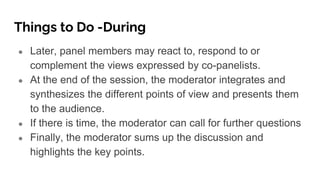
● Later, panel members may react to, respond to or
complement the views expressed by co-panelists.
● At the end of the session, the moderator integrates and
synthesizes the different points of view and presents them
to the audience.
● If there is time, the moderator can call for further questions
● Finally, the moderator sums up the discussion and
highlights the key points.
Hosting an Event - MC
Who is a MC?
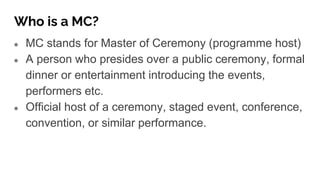
● MC stands for Master of Ceremony (programme host)
● A person who presides over a public ceremony, formal
dinner or entertainment introducing the events,
performers etc.
● Official host of a ceremony, staged event, conference,
convention, or similar performance.
Features of a qualified MC
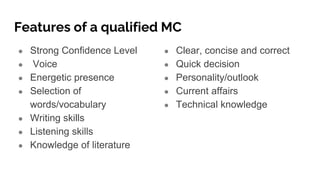
● Strong Confidence Level
● Voice
● Energetic presence
● Selection of
words/vocabulary
● Writing skills
● Listening skills
● Knowledge of literature
● Clear, concise and correct
● Quick decision
● Personality/outlook
● Current affairs
● Technical knowledge
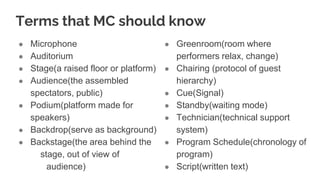
Terms that MC should know
● Microphone
● Auditorium
● Stage(a raised floor or platform)
● Audience(the assembled
spectators, public)
● Podium(platform made for
speakers)
● Backdrop(serve as background)
● Backstage(the area behind the
stage, out of view of
audience)
● Greenroom(room where
performers relax, change)
● Chairing (protocol of guest
hierarchy)
● Cue(Signal)
● Standby(waiting mode)
● Technician(technical support
system)
● Program Schedule(chronology of
program)
● Script(written text)
Elements of Voice
● Volume(loudness)
● Pitch(Rise and Fall)
● Pace(Rate)
● Pause(Silence)
● Enunciation( act of pronouncing words)
● Pronunciation
Elements of Body Posture
● Power pose
● Hand Gesture
● Eye-Contact
● Body Movement
● Mannerism
● Breathing
Format of a formal Nepali Event or
Programme
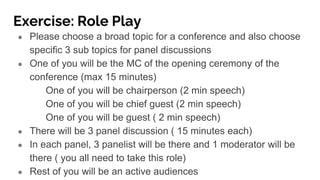
Exercise: Role Play
● Please choose a broad topic for a conference and also choose
specific 3 sub topics for panel discussions
● One of you will be the MC of the opening ceremony of the
conference (max 15 minutes)
One of you will be chairperson (2 min speech)
One of you will be chief guest (2 min speech)
One of you will be guest ( 2 min speech)
● There will be 3 panel discussion ( 15 minutes each)
● In each panel, 3 panelist will be there and 1 moderator will be
there ( you all need to take this role)
● Rest of you will be an active audiences
THANK YOU

Seminars, Symposium, Conference, panel discussion and formal program.pptx

  • 2.
    Basics of Formal Event andProgramme Ms.Chandni Kayastha
  • 3.
    Session Objective After theend of the session participants will be able to ● To distinguish the difference in seminar, conference, symposium and panel discussion ● To organize above mentioned event ● To host the above mentioned event
  • 4.
    Session Outline ● Workshop ●Conference /Symposium ● Panel Discussion ● Programme Hosting
  • 5.
    Comparison Workshop SeminarSymposium Conference Benefits Type Size Scope Definition Practical lessons taught to the attendees Learn a new skill Group of people with shared interests discuss how to solve a problem. Gain knowledge Gain knowledge Group of people of a particular field discuss a topic Academic instructions conducted by an organization 15-20 One presentation on one topic Narrow focus, one topic, panel format Broad focus, multiple topics and session types 10-50 Informal Be able to solve an issue, find new ideas and new knowledge Formal or Informal Formal Formal Large number of attendees Smaller number of attendees Focused on Skills
  • 6.
  • 7.
    Workshop ● Small groupthat everyone participates. ● People gathered with a common interest. ● Conducted by people with experience. Why? ● Provides information ● Teaches hands-on skill ● Share ideas ● Beginning of something new. ● Training of staff/volunteers. ● Self development. ● Explanation to public. When ? What?
  • 8.
    Workshop Checklist ● Gainthe Facilitation Confidence ● Internalize the participants Mindset ● Get to grips with the basic facilitation skills ● Learn the Core Workshop Principles ● Choose the Right Workshop Exercises ● Sequence all discussions ● Visualize all discussions ● Work together ● ALWAYS conclude with a decision
  • 9.
  • 10.
    What is aconference? ● a gathering of people with a common interest or background ● with the purpose of allowing them to meet one another ● to learn about and discuss issues, ideas, and work ● that focus on a topic of mutual concern.
  • 11.
    Why organize aconference? ‱ There’s an issue that needs examining. ‱ There’s a crisis or opportunity that should be addressed. ‱ A funder demands it. ‱ Enlist people to advance the field, either through their work or through advocacy. ‱ A matter of prestige, credibility, or credentials for you or your organization.
  • 12.
    Who might organizea conference? ‱ Professional associations and organizations. ‱ Government agencies. ‱ Coalitions. ‱ Individual organizations. ‱ Educational institutions. ‱ Advocacy or community activist groups. ‱ A group with a stake or interest in the subject of the conference.
  • 13.
    How do youorganize a conference? Plan the conference by: ● Agreeing on the purpose of the conference. ● Identifying your target audience. ● Setting a length and date. ● Planning the content. ● Addressing logistics. ● Clarifying coordination. Implement the Conference by: ‱ Publicize the conference. ‱ Register participants. ‱ Recruit presenters. ‱ Run the conference. ‱ Evaluate the conference Creating an Infrastructure by: ● Choosing an organizing team or committee. ● Appointing a coordinator. ● Setting up a communication system.
  • 14.
    Actors of Conference OpeningEvent ● Organizing Team ● Master of Ceremony ● Chair Person ● Chief Guest ● Guests ● Audiences Session Period ● MC ● Chair ● Presenter ● Commentator ● Audience ● Time Keeper
  • 15.
  • 16.
    Panel Discussion ● Theword ‘panel’ means a group of experts. ● Exchange insights and views in a certain topic in a meeting or conference. ● Panel Discussion - Discussion held among these expert members in front of an audience ● A panel moderator facilitates a panel discussion ● Panelists usually comprise 4-5 industry experts ● A panel talk's ideal length is 45 minutes to one hour
  • 17.
    Actors of PanelDiscussion ● The panel members who consist of experts in the field concerned. ● The audience of selected students/trainees/participants and teachers who ask questions t the panelist. ● The moderator who initiates the discussion, questions, synthesizes and summarizes the key points.
  • 18.
    Things to Do- Pre ● Experts in the field are invited as panelists. ● Audiences are invited ● Questions on the proposed topic are collected in advance from the audience and handed over to the panelists ● Questions are generally classified according to the sub- topic/ aspect/ dimension of the proposed theme ● The panelists come prepared to the panel discussion
  • 19.
    Things to Do-During ● The moderator introduces the theme of the discussion to the participants. ● The moderator also initiates the discussion on the issue under consideration. ● The questions are then addressed to the panelists in a pre-determined order. ● The panelists are called (in a pre-determined order) to express their views
  • 20.
    Things to Do-During ● Later, panel members may react to, respond to or complement the views expressed by co-panelists. ● At the end of the session, the moderator integrates and synthesizes the different points of view and presents them to the audience. ● If there is time, the moderator can call for further questions ● Finally, the moderator sums up the discussion and highlights the key points.
  • 21.
  • 22.
    Who is aMC? ● MC stands for Master of Ceremony (programme host) ● A person who presides over a public ceremony, formal dinner or entertainment introducing the events, performers etc. ● Official host of a ceremony, staged event, conference, convention, or similar performance.
  • 23.
    Features of aqualified MC ● Strong Confidence Level ● Voice ● Energetic presence ● Selection of words/vocabulary ● Writing skills ● Listening skills ● Knowledge of literature ● Clear, concise and correct ● Quick decision ● Personality/outlook ● Current affairs ● Technical knowledge
  • 24.
    Terms that MCshould know ● Microphone ● Auditorium ● Stage(a raised floor or platform) ● Audience(the assembled spectators, public) ● Podium(platform made for speakers) ● Backdrop(serve as background) ● Backstage(the area behind the stage, out of view of audience) ● Greenroom(room where performers relax, change) ● Chairing (protocol of guest hierarchy) ● Cue(Signal) ● Standby(waiting mode) ● Technician(technical support system) ● Program Schedule(chronology of program) ● Script(written text)
  • 25.
    Elements of Voice ●Volume(loudness) ● Pitch(Rise and Fall) ● Pace(Rate) ● Pause(Silence) ● Enunciation( act of pronouncing words) ● Pronunciation
  • 26.
    Elements of BodyPosture ● Power pose ● Hand Gesture ● Eye-Contact ● Body Movement ● Mannerism ● Breathing
  • 27.
    Format of aformal Nepali Event or Programme
  • 28.
    Exercise: Role Play ●Please choose a broad topic for a conference and also choose specific 3 sub topics for panel discussions ● One of you will be the MC of the opening ceremony of the conference (max 15 minutes) One of you will be chairperson (2 min speech) One of you will be chief guest (2 min speech) One of you will be guest ( 2 min speech) ● There will be 3 panel discussion ( 15 minutes each) ● In each panel, 3 panelist will be there and 1 moderator will be there ( you all need to take this role) ● Rest of you will be an active audiences
  • 29.