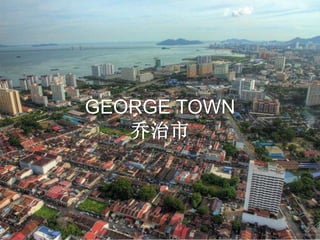
GEORGE TOWN
乔治市
HISTORY OF GEORGE TOWN,
PENANG
Penang stands as
testimony to the
centuries of maritime
trade that shaped this
country and a had a
significant influence
on the region.
The first British port
town along the
Straits of Malacca.
Founded in 1786 by
Francis Light. It
slowly attracted
European and people
from other origin.
In the 19th century,
thriving entreport
activities in George
Town also attracted
settlers from other
parts of the world
including: Armenia,
Arabia, Burma,
Thailand, Philippines,
Japan, Sri Lanka.
Georgetown has been designated by UNESCO as a World Heritage
Site since July 2008. Recognised as having a 'unique architectural
and cultural townscape without parallel anywhere in East and
Southeast Asia‘.
WHY IS IT QUALIFIED TO BE
UNESCO HERITAGE SITE?
• UNESCO World Heritage Criteria
• Criteria (ii): exhibit an important interchange of human values, over
a span of time or within a cultural area of the world, on
developments in architecture or technology, monumental arts,
town-planning or landscape design.
• Criteria (iii): bear a unique or at least exceptional testimony to a
cultural tradition or to a civilization which is living or which has
disappeared.
• Criteria (iv): be an outstanding example of a type of building or
architectural or technological ensemble or landscape which
illustrates (a) significant stage(s) in human history.
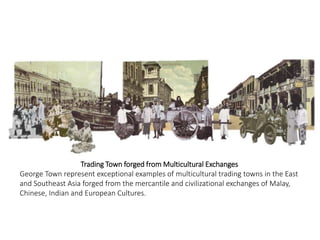
Trading Town forged from Multicultural Exchanges
George Town represent exceptional examples of multicultural trading towns in the East
and Southeast Asia forged from the mercantile and civilizational exchanges of Malay,
Chinese, Indian and European Cultures.
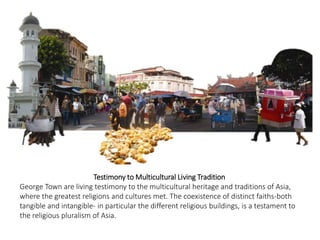
Testimony to Multicultural Living Tradition
George Town are living testimony to the multicultural heritage and traditions of Asia,
where the greatest religions and cultures met. The coexistence of distinct faiths-both
tangible and intangible- in particular the different religious buildings, is a testament to
the religious pluralism of Asia.
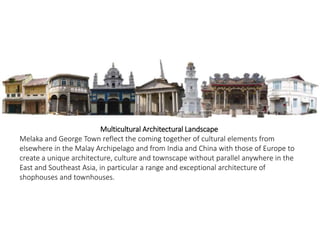
Multicultural Architectural Landscape
Melaka and George Town reflect the coming together of cultural elements from
elsewhere in the Malay Archipelago and from India and China with those of Europe to
create a unique architecture, culture and townscape without parallel anywhere in the
East and Southeast Asia, in particular a range and exceptional architecture of
shophouses and townhouses.
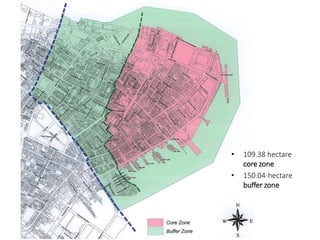
• 109.38 hectare
core zone
• 150.04-hectare
buffer zone
CORE ZONE
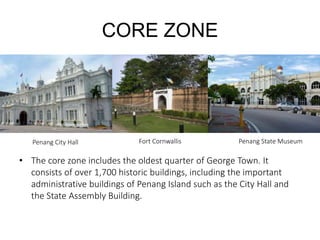
• The core zone includes the oldest quarter of George Town. It
consists of over 1,700 historic buildings, including the important
administrative buildings of Penang Island such as the City Hall and
the State Assembly Building.
Fort Cornwallis Penang State MuseumPenang City Hall
BUFFER ZONE
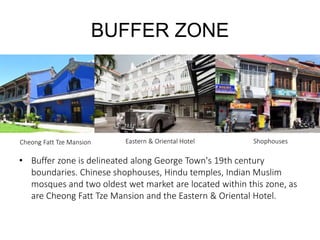
• Buffer zone is delineated along George Town's 19th century
boundaries. Chinese shophouses, Hindu temples, Indian Muslim
mosques and two oldest wet market are located within this zone, as
are Cheong Fatt Tze Mansion and the Eastern & Oriental Hotel.
Eastern & Oriental Hotel ShophousesCheong Fatt Tze Mansion
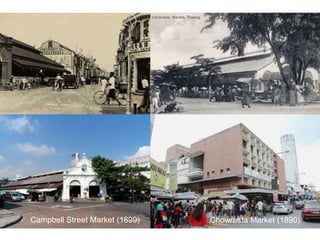
Campbell Street Market (1899) Chowrasta Market (1890)
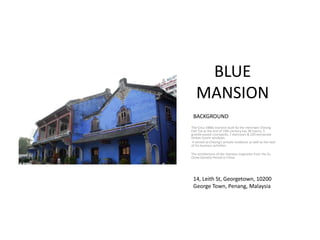
BLUE
MANSION
The Circa 1880s mansion built by the merchant Cheong
Fatt Tze at the end of 19th century has 38 rooms, 5
granite-paved courtyards, 7 staircases & 220 vernacular
timber louvre windows.
It served as Cheong's private residence as well as the seat
of his business activities.
The architecture of the mansion originates from the Su
Chow Dynasty Period in China.
BACKGROUND
14, Leith St, Georgetown, 10200
George Town, Penang, Malaysia
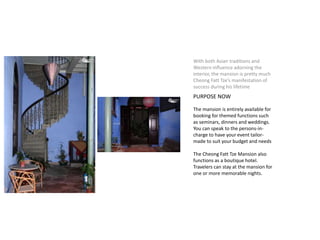
With both Asian traditions and
Western influence adorning the
interior, the mansion is pretty much
Cheong Fatt Tze’s manifestation of
success during his lifetime
PURPOSE NOW
The mansion is entirely available for
booking for themed functions such
as seminars, dinners and weddings.
You can speak to the persons-in-
charge to have your event tailor-
made to suit your budget and needs
The Cheong Fatt Tze Mansion also
functions as a boutique hotel.
Travelers can stay at the mansion for
one or more memorable nights.
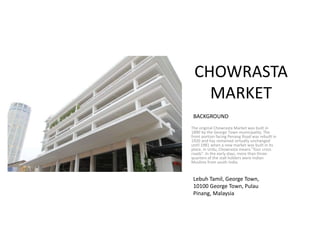
CHOWRASTA
MARKET
The original Chowrasta Market was built in
1890 by the George Town municipality. The
front portion facing Penang Road was rebuilt in
1920 and has remained virtually unchanged
until 1981 when a new market was built in its
place. In Urdu, Chowrasta means "four cross
roads". In the early days, more than three-
quarters of the stall holders were Indian
Muslims from south India.
BACKGROUND
Lebuh Tamil, George Town,
10100 George Town, Pulau
Pinang, Malaysia
With both Asian traditions and
Western influence adorning the
interior, the mansion is pretty much
Cheong Fatt Tze’s manifestation of
success during his lifetime
PURPOSE NOW
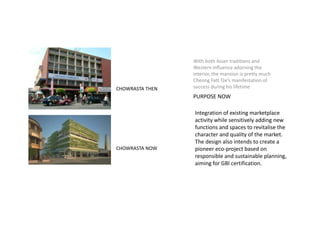
CHOWRASTA THEN
CHOWRASTA NOW
Integration of existing marketplace
activity while sensitively adding new
functions and spaces to revitalise the
character and quality of the market.
The design also intends to create a
pioneer eco-project based on
responsible and sustainable planning,
aiming for GBI certification.
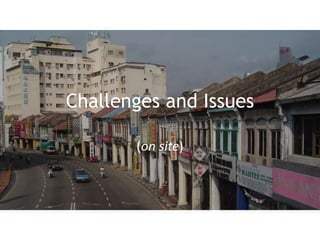
Challenges and Issues
(on site)
Intrusive Features/Factors that threaten Significance
On the whole, the greatest threats to the retention of significance are related to issues of:-
(a) Development Pressure from Infrastructure and Real Estate projects
(b) Non-Compliance with Conservation Plans, Policies and Guidelines
(c) Gentrification and loss of community cohesion
Development Pressure
from Infrastructure and
Real Estate projects
The most significant large-scale pressure comes from high-
impact projects, mainly involving infrastructure development,
which have been directly planned at Federal Government level
such as:
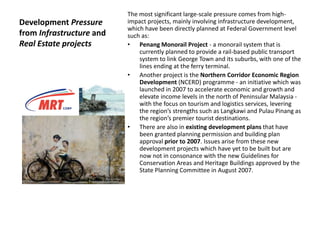
• Penang Monorail Project - a monorail system that is
currently planned to provide a rail-based public transport
system to link George Town and its suburbs, with one of the
lines ending at the ferry terminal.
• Another project is the Northern Corridor Economic Region
Development (NCERD) programme - an initiative which was
launched in 2007 to accelerate economic and growth and
elevate income levels in the north of Peninsular Malaysia -
with the focus on tourism and logistics services, levering
the region’s strengths such as Langkawi and Pulau Pinang as
the region’s premier tourist destinations.
• There are also in existing development plans that have
been granted planning permission and building plan
approval prior to 2007. Issues arise from these new
development projects which have yet to be built but are
now not in consonance with the new Guidelines for
Conservation Areas and Heritage Buildings approved by the
State Planning Committee in August 2007.
Non-Compliance with
Conservation Plans,
Policies and Guidelines
"The present building control system requires all building owners to apply to the Municipal
Council for permits to repair buildings and for building plan approval in the case of
alterations and additions to an existing building or for the erection of a new building"
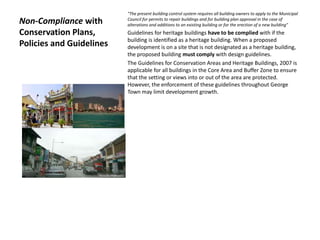
Guidelines for heritage buildings have to be complied with if the
building is identified as a heritage building. When a proposed
development is on a site that is not designated as a heritage building,
the proposed building must comply with design guidelines.
The Guidelines for Conservation Areas and Heritage Buildings, 2007 is
applicable for all buildings in the Core Area and Buffer Zone to ensure
that the setting or views into or out of the area are protected.
However, the enforcement of these guidelines throughout George
Town may limit development growth.
Gentrification and loss of
community cohesion
The Penang Structure Plan 2020 incorporates
specific policies for special areas or places that
have economical, environmental or
development importance; but many of the
heritage buildings in the Site are privately
owned and a large number are poorly
maintained as direct result of the RCA and its
limitation on economic gain.
The lifting of the RCA in 1997 and abolishment
in 2000 resulted in an economic change and
gentrification of areas within the Site. The Site
currently faces threats in the form of
development pressure from local developers to
maximize the development potential on private
lots for economic gains. This has resulted in
possible threats in the form of:-
i) the gentrification of the WHS due to
population demographics
ii) change in character of the Site.
•
"The lifting of the RCA
in 1997 and abolishment
in 2000 resulted in an
economic change and
gentrification of areas
within the Site"
Approaches and Overcoming
The Challenges
1. Adaptive Reuse
• The process of reusing an old site or building for a
purpose other than which it was built or designed
for,
• While conserving resources and historic value.
• Most cases in local- convert historical building to
interpretive centers
• Factors:
1. Societal value- importance to site community
2. Potential- character of proposed reuse
3. Historical importance
4. Environmental conditions
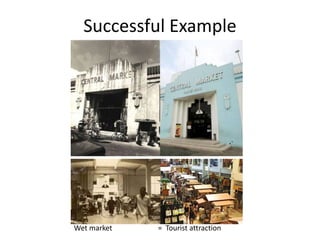
Wet market = Tourist attraction
Successful Example
• The process of accurately revealing, recovering or
representing the state of a historic building, as it
appeared at a particular period in its history,
• While protecting its heritage value.
• To reverse decay, or alterations made to the
building
• Work include:
1. Preservation- leave as much material untouched
2. Reconstruction- replace missing elements
3. Repair work
2. Restoration
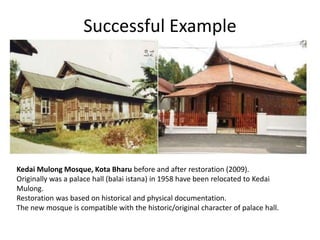
Kedai Mulong Mosque, Kota Bharu before and after restoration (2009).
Originally was a palace hall (balai istana) in 1958 have been relocated to Kedai
Mulong.
Restoration was based on historical and physical documentation.
The new mosque is compatible with the historic/original character of palace hall.
Successful Example
Adaptive Reuse Case 1-
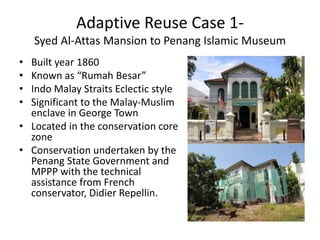
Syed Al-Attas Mansion to Penang Islamic Museum
• Built year 1860
• Known as “Rumah Besar”
• Indo Malay Straits Eclectic style
• Significant to the Malay-Muslim
enclave in George Town
• Located in the conservation core
zone
• Conservation undertaken by the
Penang State Government and
MPPP with the technical
assistance from French
conservator, Didier Repellin.
Historical Background
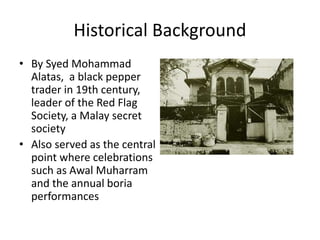
• By Syed Mohammad
Alatas, a black pepper
trader in 19th century,
leader of the Red Flag
Society, a Malay secret
society
• Also served as the central
point where celebrations
such as Awal Muharram
and the annual boria
performances
Overcoming The Challenges
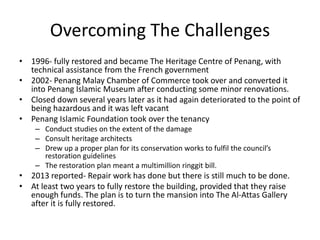
• 1996- fully restored and became The Heritage Centre of Penang, with
technical assistance from the French government
• 2002- Penang Malay Chamber of Commerce took over and converted it
into Penang Islamic Museum after conducting some minor renovations.
• Closed down several years later as it had again deteriorated to the point of
being hazardous and it was left vacant
• Penang Islamic Foundation took over the tenancy
– Conduct studies on the extent of the damage
– Consult heritage architects
– Drew up a proper plan for its conservation works to fulfil the council’s
restoration guidelines
– The restoration plan meant a multimillion ringgit bill.
• 2013 reported- Repair work has done but there is still much to be done.
• At least two years to fully restore the building, provided that they raise
enough funds. The plan is to turn the mansion into The Al-Attas Gallery
after it is fully restored.
Approaches
Repair and Replace Work
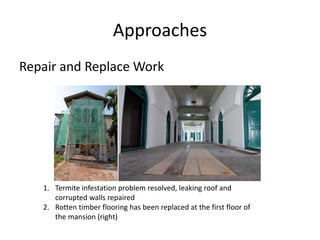
1. Termite infestation problem resolved, leaking roof and
corrupted walls repaired
2. Rotten timber flooring has been replaced at the first floor of
the mansion (right)
Approaches
Repair and Replace Work
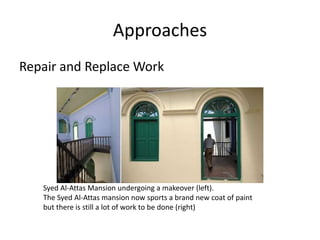
Syed Al-Attas Mansion undergoing a makeover (left).
The Syed Al-Attas mansion now sports a brand new coat of paint
but there is still a lot of work to be done (right)
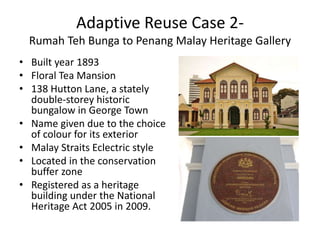
Adaptive Reuse Case 2-
Rumah Teh Bunga to Penang Malay Heritage Gallery
• Built year 1893
• Floral Tea Mansion
• 138 Hutton Lane, a stately
double-storey historic
bungalow in George Town
• Name given due to the choice
of colour for its exterior
• Malay Straits Eclectric style
• Located in the conservation
buffer zone
• Registered as a heritage
building under the National
Heritage Act 2005 in 2009.
Historical Background
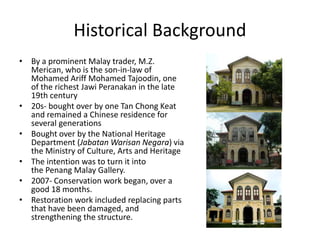
• By a prominent Malay trader, M.Z.
Merican, who is the son-in-law of
Mohamed Ariff Mohamed Tajoodin, one
of the richest Jawi Peranakan in the late
19th century
• 20s- bought over by one Tan Chong Keat
and remained a Chinese residence for
several generations
• Bought over by the National Heritage
Department (Jabatan Warisan Negara) via
the Ministry of Culture, Arts and Heritage
• The intention was to turn it into
the Penang Malay Gallery.
• 2007- Conservation work began, over a
good 18 months.
• Restoration work included replacing parts
that have been damaged, and
strengthening the structure.
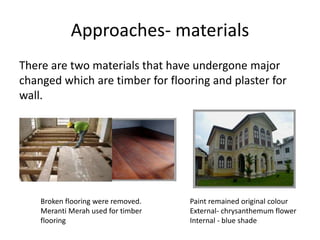
Approaches- materials
There are two materials that have undergone major
changed which are timber for flooring and plaster for
wall.
Broken flooring were removed.
Meranti Merah used for timber
flooring
Paint remained original colour
External- chrysanthemum flower
Internal - blue shade
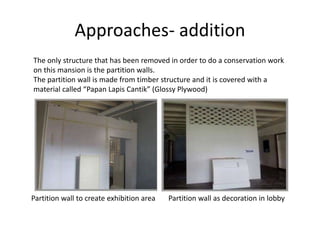
Approaches- addition
The only structure that has been removed in order to do a conservation work
on this mansion is the partition walls.
The partition wall is made from timber structure and it is covered with a
material called “Papan Lapis Cantik” (Glossy Plywood)
Partition wall to create exhibition area Partition wall as decoration in lobby
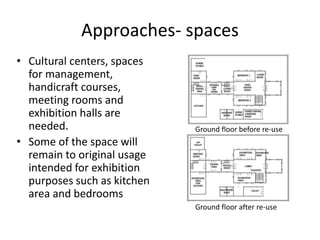
Approaches- spaces
• Cultural centers, spaces
for management,
handicraft courses,
meeting rooms and
exhibition halls are
needed.
• Some of the space will
remain to original usage
intended for exhibition
purposes such as kitchen
area and bedrooms
Ground floor before re-use
Ground floor after re-use
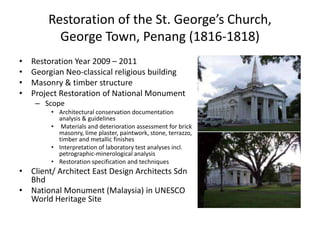
Restoration of the St. George’s Church,
George Town, Penang (1816-1818)
• Restoration Year 2009 – 2011
• Georgian Neo-classical religious building
• Masonry & timber structure
• Project Restoration of National Monument
– Scope
• Architectural conservation documentation
analysis & guidelines
• Materials and deterioration assessment for brick
masonry, lime plaster, paintwork, stone, terrazzo,
timber and metallic finishes
• Interpretation of laboratory test analyses incl.
petrographic-minerological analysis
• Restoration specification and techniques
• Client/ Architect East Design Architects Sdn
Bhd
• National Monument (Malaysia) in UNESCO
World Heritage Site
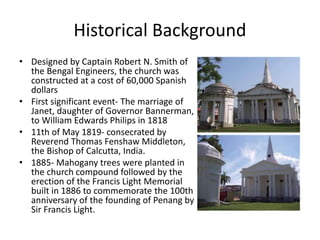
Historical Background
• Designed by Captain Robert N. Smith of
the Bengal Engineers, the church was
constructed at a cost of 60,000 Spanish
dollars
• First significant event- The marriage of
Janet, daughter of Governor Bannerman,
to William Edwards Philips in 1818
• 11th of May 1819- consecrated by
Reverend Thomas Fenshaw Middleton,
the Bishop of Calcutta, India.
• 1885- Mahogany trees were planted in
the church compound followed by the
erection of the Francis Light Memorial
built in 1886 to commemorate the 100th
anniversary of the founding of Penang by
Sir Francis Light.
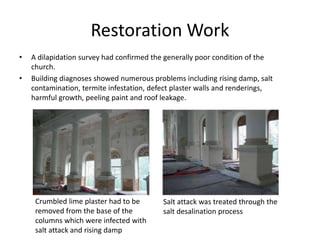
Restoration Work
• A dilapidation survey had confirmed the generally poor condition of the
church.
• Building diagnoses showed numerous problems including rising damp, salt
contamination, termite infestation, defect plaster walls and renderings,
harmful growth, peeling paint and roof leakage.
Salt attack was treated through the
salt desalination process
Crumbled lime plaster had to be
removed from the base of the
columns which were infected with
salt attack and rising damp
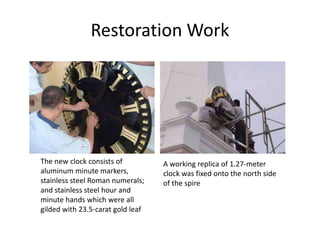
Restoration Work
The new clock consists of
aluminum minute markers,
stainless steel Roman numerals;
and stainless steel hour and
minute hands which were all
gilded with 23.5-carat gold leaf
A working replica of 1.27-meter
clock was fixed onto the north side
of the spire
CONCLUSIONS
• Heritage sites are divided into two different zones, which are
core zone (administrative) and buffer zone (temples,
shophouses).
• Different approaches are being utilized for conservation of
George Town such as adaptive re-use, repair and replace
work, using different materials, spatial function and additions.
• Successful examples includes Blue Mansion, Syed Al-Attas
Mansion (Penang Islamic Museum), Rumah Teh Bunga
(Penang Malay Heritage Gallery)
REFERENCES
• THE CONSERVATION PLAN FOR WORLD HERITAGE SITE: GEORGE TOWN ... (n.d.). Retrieved
October 20, 2016, from
http://www.academia.edu/6035394/THE_CONSERVATION_PLAN_FOR_WORLD_HERITAGE_SIT
E_GEORGE_TOWN_PENANG_AND_MALACCA_MALAYSIA
• UNESCO World Heritage Centre - The Criteria for Selection. (n.d.). Retrieved October 20, 2016,
from http://whc.unesco.org/en/criteria/
• Strategies for urban conservation: A case example of ... (n.d.). Retrieved October 20, 2016,
from http://www.sciencedirect.com/science/article/pii/S0197397507000586
• Penang Fort Cornwallis - The Historic Fort Of Penang. (n.d.). Retrieved October 20, 2016, from
http://www.penang-vacations.com/fort-cornwallis.html
• Cheong Fatt Tze - The Blue Mansion Tour Times, Entrance Fees. (n.d.). Retrieved October 20,
2016, from http://www.cheongfatttzemansion.com/discover/daily-tours/
• Eastern & Oriental Hotel, Penang, Malaysia. (n.d.). Retrieved October 20, 2016, from
http://www.eohotels.com/main.php
• GTWHI Resource Centre. http://penangshophouse.com.my/
REFERENCES• The World Heritage Challenge - WSJ. (n.d.). Retrieved
October 20, 2016, from
http://www.wsj.com/articles/SB100014240527487048
53404575322022762324864
• George Town, Penang as a World Heritage Site: The ...
(n.d.). Retrieved October 20, 2016, from
http://www.sciencedirect.com/science/article/pii/S187
7042813025366
• George Town World Heritage Site - gtwhi.com.my.
(n.d.). Retrieved October 20, 2016, from
http://www.gtwhi.com.my/introduction/george-town-
world-heritage-site.html
References
• A. (2011). The Seventh Regular Report. Malaysia, (Restoration of the St. George’s Church, George
Town, Penang, Malaysia), 15-18. Retrieved October 20, 2016, from
http://www.nara.accu.or.jp/activities/img/dissemination/7th.pdf
• Harun, S. (2011). Heritage Building Conservation in Malaysia: Experience and Challenges. The 2nd
International Building Control Conference 2011. Retrieved October 20, 2016, from http://ac.els-
cdn.com/S1877705811029468/1-s2.0-S1877705811029468-main.pdf?_tid=ff7c184a-9698-11e6-
b2f7-00000aacb35e&acdnat=1476949634_6f5217c807ebb8e73e594c43e8687939
• Jabatan Warisan Negara. (2011). Rumah No 138. Retrieved October 20, 2016, from
http://www.heritage.gov.my/index.php/konservasi/konservasi-bangunan/bangunan-
tradisional/rumah-no-138
• Marhamah, A.H., MD, A.O.M, Noor, F.A. (n.d.) Investigation on Adaptive Re-use of Heritage Building
in George Town, Penang. Retrieved October 20, 2016, from http://anale-ing.uem.ro/2013/313.pdf
• Muhammad, F. (2013). An Evaluation On Adaptive Reuse of Interior Spaces with Reference to the
Guidelines for Rehabilitating Historic Buildings 1977: Case Studies of Syed Al-Attas Mansion and
Rumah Teh Bunga, George Town. Fifth International Conference on Southeast Asia (ICONSEA 2013):
“Southeast Asia Rising”. Retrieved October 20, 2016, from
https://www.academia.edu/19596005/An_Evaluation_on_Adaptive_Reuse_of_Interior_Spaces_wit
h_reference_to_the_Guidelines_for_Rehabilitating_Historic_Buildings_1977_Case_Studies_of_Sye
d_Al-Attas_Mansion_and_Rumah_Teh_Bunga_George_Town.
• Opalyn, M. (2014, March 14). Restoring the grand Syed Al-Attas mansion… again. Retrieved October
20, 2016, from
• http://www.themalaymailonline.com/features/article/restoring-the-grand-syed-al-attas-mansion-
again
• Studio Lapis. (n.d.). Architectural Conservation Portfolio. Retrieved October 20, 2016, from
• http://www.studiolapis.sg/StudioLapisPortfolio201602op.pdf

Seminar Talk on Georgetown Conservation

  • 1.
  • 2.
    HISTORY OF GEORGETOWN, PENANG Penang stands as testimony to the centuries of maritime trade that shaped this country and a had a significant influence on the region. The first British port town along the Straits of Malacca. Founded in 1786 by Francis Light. It slowly attracted European and people from other origin. In the 19th century, thriving entreport activities in George Town also attracted settlers from other parts of the world including: Armenia, Arabia, Burma, Thailand, Philippines, Japan, Sri Lanka.
  • 3.
    Georgetown has beendesignated by UNESCO as a World Heritage Site since July 2008. Recognised as having a 'unique architectural and cultural townscape without parallel anywhere in East and Southeast Asia‘.
  • 4.
    WHY IS ITQUALIFIED TO BE UNESCO HERITAGE SITE? • UNESCO World Heritage Criteria • Criteria (ii): exhibit an important interchange of human values, over a span of time or within a cultural area of the world, on developments in architecture or technology, monumental arts, town-planning or landscape design. • Criteria (iii): bear a unique or at least exceptional testimony to a cultural tradition or to a civilization which is living or which has disappeared. • Criteria (iv): be an outstanding example of a type of building or architectural or technological ensemble or landscape which illustrates (a) significant stage(s) in human history.
  • 5.
    Trading Town forgedfrom Multicultural Exchanges George Town represent exceptional examples of multicultural trading towns in the East and Southeast Asia forged from the mercantile and civilizational exchanges of Malay, Chinese, Indian and European Cultures.
  • 6.
    Testimony to MulticulturalLiving Tradition George Town are living testimony to the multicultural heritage and traditions of Asia, where the greatest religions and cultures met. The coexistence of distinct faiths-both tangible and intangible- in particular the different religious buildings, is a testament to the religious pluralism of Asia.
  • 7.
    Multicultural Architectural Landscape Melakaand George Town reflect the coming together of cultural elements from elsewhere in the Malay Archipelago and from India and China with those of Europe to create a unique architecture, culture and townscape without parallel anywhere in the East and Southeast Asia, in particular a range and exceptional architecture of shophouses and townhouses.
  • 9.
    • 109.38 hectare corezone • 150.04-hectare buffer zone
  • 10.
    CORE ZONE • Thecore zone includes the oldest quarter of George Town. It consists of over 1,700 historic buildings, including the important administrative buildings of Penang Island such as the City Hall and the State Assembly Building. Fort Cornwallis Penang State MuseumPenang City Hall
  • 11.
    BUFFER ZONE • Bufferzone is delineated along George Town's 19th century boundaries. Chinese shophouses, Hindu temples, Indian Muslim mosques and two oldest wet market are located within this zone, as are Cheong Fatt Tze Mansion and the Eastern & Oriental Hotel. Eastern & Oriental Hotel ShophousesCheong Fatt Tze Mansion
  • 12.
    Campbell Street Market(1899) Chowrasta Market (1890)
  • 13.
    BLUE MANSION The Circa 1880smansion built by the merchant Cheong Fatt Tze at the end of 19th century has 38 rooms, 5 granite-paved courtyards, 7 staircases & 220 vernacular timber louvre windows. It served as Cheong's private residence as well as the seat of his business activities. The architecture of the mansion originates from the Su Chow Dynasty Period in China. BACKGROUND 14, Leith St, Georgetown, 10200 George Town, Penang, Malaysia
  • 14.
    With both Asiantraditions and Western influence adorning the interior, the mansion is pretty much Cheong Fatt Tze’s manifestation of success during his lifetime PURPOSE NOW The mansion is entirely available for booking for themed functions such as seminars, dinners and weddings. You can speak to the persons-in- charge to have your event tailor- made to suit your budget and needs The Cheong Fatt Tze Mansion also functions as a boutique hotel. Travelers can stay at the mansion for one or more memorable nights.
  • 15.
    CHOWRASTA MARKET The original ChowrastaMarket was built in 1890 by the George Town municipality. The front portion facing Penang Road was rebuilt in 1920 and has remained virtually unchanged until 1981 when a new market was built in its place. In Urdu, Chowrasta means "four cross roads". In the early days, more than three- quarters of the stall holders were Indian Muslims from south India. BACKGROUND Lebuh Tamil, George Town, 10100 George Town, Pulau Pinang, Malaysia
  • 16.
    With both Asiantraditions and Western influence adorning the interior, the mansion is pretty much Cheong Fatt Tze’s manifestation of success during his lifetime PURPOSE NOW CHOWRASTA THEN CHOWRASTA NOW Integration of existing marketplace activity while sensitively adding new functions and spaces to revitalise the character and quality of the market. The design also intends to create a pioneer eco-project based on responsible and sustainable planning, aiming for GBI certification.
  • 17.
  • 18.
    Intrusive Features/Factors thatthreaten Significance On the whole, the greatest threats to the retention of significance are related to issues of:- (a) Development Pressure from Infrastructure and Real Estate projects (b) Non-Compliance with Conservation Plans, Policies and Guidelines (c) Gentrification and loss of community cohesion
  • 19.
    Development Pressure from Infrastructureand Real Estate projects The most significant large-scale pressure comes from high- impact projects, mainly involving infrastructure development, which have been directly planned at Federal Government level such as: • Penang Monorail Project - a monorail system that is currently planned to provide a rail-based public transport system to link George Town and its suburbs, with one of the lines ending at the ferry terminal. • Another project is the Northern Corridor Economic Region Development (NCERD) programme - an initiative which was launched in 2007 to accelerate economic and growth and elevate income levels in the north of Peninsular Malaysia - with the focus on tourism and logistics services, levering the region’s strengths such as Langkawi and Pulau Pinang as the region’s premier tourist destinations. • There are also in existing development plans that have been granted planning permission and building plan approval prior to 2007. Issues arise from these new development projects which have yet to be built but are now not in consonance with the new Guidelines for Conservation Areas and Heritage Buildings approved by the State Planning Committee in August 2007.
  • 20.
    Non-Compliance with Conservation Plans, Policiesand Guidelines "The present building control system requires all building owners to apply to the Municipal Council for permits to repair buildings and for building plan approval in the case of alterations and additions to an existing building or for the erection of a new building" Guidelines for heritage buildings have to be complied with if the building is identified as a heritage building. When a proposed development is on a site that is not designated as a heritage building, the proposed building must comply with design guidelines. The Guidelines for Conservation Areas and Heritage Buildings, 2007 is applicable for all buildings in the Core Area and Buffer Zone to ensure that the setting or views into or out of the area are protected. However, the enforcement of these guidelines throughout George Town may limit development growth.
  • 21.
    Gentrification and lossof community cohesion The Penang Structure Plan 2020 incorporates specific policies for special areas or places that have economical, environmental or development importance; but many of the heritage buildings in the Site are privately owned and a large number are poorly maintained as direct result of the RCA and its limitation on economic gain. The lifting of the RCA in 1997 and abolishment in 2000 resulted in an economic change and gentrification of areas within the Site. The Site currently faces threats in the form of development pressure from local developers to maximize the development potential on private lots for economic gains. This has resulted in possible threats in the form of:- i) the gentrification of the WHS due to population demographics ii) change in character of the Site. • "The lifting of the RCA in 1997 and abolishment in 2000 resulted in an economic change and gentrification of areas within the Site"
  • 22.
  • 23.
    1. Adaptive Reuse •The process of reusing an old site or building for a purpose other than which it was built or designed for, • While conserving resources and historic value. • Most cases in local- convert historical building to interpretive centers • Factors: 1. Societal value- importance to site community 2. Potential- character of proposed reuse 3. Historical importance 4. Environmental conditions
  • 24.
    Wet market =Tourist attraction Successful Example
  • 25.
    • The processof accurately revealing, recovering or representing the state of a historic building, as it appeared at a particular period in its history, • While protecting its heritage value. • To reverse decay, or alterations made to the building • Work include: 1. Preservation- leave as much material untouched 2. Reconstruction- replace missing elements 3. Repair work 2. Restoration
  • 26.
    Kedai Mulong Mosque,Kota Bharu before and after restoration (2009). Originally was a palace hall (balai istana) in 1958 have been relocated to Kedai Mulong. Restoration was based on historical and physical documentation. The new mosque is compatible with the historic/original character of palace hall. Successful Example
  • 27.
    Adaptive Reuse Case1- Syed Al-Attas Mansion to Penang Islamic Museum • Built year 1860 • Known as “Rumah Besar” • Indo Malay Straits Eclectic style • Significant to the Malay-Muslim enclave in George Town • Located in the conservation core zone • Conservation undertaken by the Penang State Government and MPPP with the technical assistance from French conservator, Didier Repellin.
  • 28.
    Historical Background • BySyed Mohammad Alatas, a black pepper trader in 19th century, leader of the Red Flag Society, a Malay secret society • Also served as the central point where celebrations such as Awal Muharram and the annual boria performances
  • 29.
    Overcoming The Challenges •1996- fully restored and became The Heritage Centre of Penang, with technical assistance from the French government • 2002- Penang Malay Chamber of Commerce took over and converted it into Penang Islamic Museum after conducting some minor renovations. • Closed down several years later as it had again deteriorated to the point of being hazardous and it was left vacant • Penang Islamic Foundation took over the tenancy – Conduct studies on the extent of the damage – Consult heritage architects – Drew up a proper plan for its conservation works to fulfil the council’s restoration guidelines – The restoration plan meant a multimillion ringgit bill. • 2013 reported- Repair work has done but there is still much to be done. • At least two years to fully restore the building, provided that they raise enough funds. The plan is to turn the mansion into The Al-Attas Gallery after it is fully restored.
  • 30.
    Approaches Repair and ReplaceWork 1. Termite infestation problem resolved, leaking roof and corrupted walls repaired 2. Rotten timber flooring has been replaced at the first floor of the mansion (right)
  • 31.
    Approaches Repair and ReplaceWork Syed Al-Attas Mansion undergoing a makeover (left). The Syed Al-Attas mansion now sports a brand new coat of paint but there is still a lot of work to be done (right)
  • 32.
    Adaptive Reuse Case2- Rumah Teh Bunga to Penang Malay Heritage Gallery • Built year 1893 • Floral Tea Mansion • 138 Hutton Lane, a stately double-storey historic bungalow in George Town • Name given due to the choice of colour for its exterior • Malay Straits Eclectric style • Located in the conservation buffer zone • Registered as a heritage building under the National Heritage Act 2005 in 2009.
  • 33.
    Historical Background • Bya prominent Malay trader, M.Z. Merican, who is the son-in-law of Mohamed Ariff Mohamed Tajoodin, one of the richest Jawi Peranakan in the late 19th century • 20s- bought over by one Tan Chong Keat and remained a Chinese residence for several generations • Bought over by the National Heritage Department (Jabatan Warisan Negara) via the Ministry of Culture, Arts and Heritage • The intention was to turn it into the Penang Malay Gallery. • 2007- Conservation work began, over a good 18 months. • Restoration work included replacing parts that have been damaged, and strengthening the structure.
  • 34.
    Approaches- materials There aretwo materials that have undergone major changed which are timber for flooring and plaster for wall. Broken flooring were removed. Meranti Merah used for timber flooring Paint remained original colour External- chrysanthemum flower Internal - blue shade
  • 35.
    Approaches- addition The onlystructure that has been removed in order to do a conservation work on this mansion is the partition walls. The partition wall is made from timber structure and it is covered with a material called “Papan Lapis Cantik” (Glossy Plywood) Partition wall to create exhibition area Partition wall as decoration in lobby
  • 36.
    Approaches- spaces • Culturalcenters, spaces for management, handicraft courses, meeting rooms and exhibition halls are needed. • Some of the space will remain to original usage intended for exhibition purposes such as kitchen area and bedrooms Ground floor before re-use Ground floor after re-use
  • 37.
    Restoration of theSt. George’s Church, George Town, Penang (1816-1818) • Restoration Year 2009 – 2011 • Georgian Neo-classical religious building • Masonry & timber structure • Project Restoration of National Monument – Scope • Architectural conservation documentation analysis & guidelines • Materials and deterioration assessment for brick masonry, lime plaster, paintwork, stone, terrazzo, timber and metallic finishes • Interpretation of laboratory test analyses incl. petrographic-minerological analysis • Restoration specification and techniques • Client/ Architect East Design Architects Sdn Bhd • National Monument (Malaysia) in UNESCO World Heritage Site
  • 38.
    Historical Background • Designedby Captain Robert N. Smith of the Bengal Engineers, the church was constructed at a cost of 60,000 Spanish dollars • First significant event- The marriage of Janet, daughter of Governor Bannerman, to William Edwards Philips in 1818 • 11th of May 1819- consecrated by Reverend Thomas Fenshaw Middleton, the Bishop of Calcutta, India. • 1885- Mahogany trees were planted in the church compound followed by the erection of the Francis Light Memorial built in 1886 to commemorate the 100th anniversary of the founding of Penang by Sir Francis Light.
  • 39.
    Restoration Work • Adilapidation survey had confirmed the generally poor condition of the church. • Building diagnoses showed numerous problems including rising damp, salt contamination, termite infestation, defect plaster walls and renderings, harmful growth, peeling paint and roof leakage. Salt attack was treated through the salt desalination process Crumbled lime plaster had to be removed from the base of the columns which were infected with salt attack and rising damp
  • 40.
    Restoration Work The newclock consists of aluminum minute markers, stainless steel Roman numerals; and stainless steel hour and minute hands which were all gilded with 23.5-carat gold leaf A working replica of 1.27-meter clock was fixed onto the north side of the spire
  • 41.
    CONCLUSIONS • Heritage sitesare divided into two different zones, which are core zone (administrative) and buffer zone (temples, shophouses). • Different approaches are being utilized for conservation of George Town such as adaptive re-use, repair and replace work, using different materials, spatial function and additions. • Successful examples includes Blue Mansion, Syed Al-Attas Mansion (Penang Islamic Museum), Rumah Teh Bunga (Penang Malay Heritage Gallery)
  • 42.
    REFERENCES • THE CONSERVATIONPLAN FOR WORLD HERITAGE SITE: GEORGE TOWN ... (n.d.). Retrieved October 20, 2016, from http://www.academia.edu/6035394/THE_CONSERVATION_PLAN_FOR_WORLD_HERITAGE_SIT E_GEORGE_TOWN_PENANG_AND_MALACCA_MALAYSIA • UNESCO World Heritage Centre - The Criteria for Selection. (n.d.). Retrieved October 20, 2016, from http://whc.unesco.org/en/criteria/ • Strategies for urban conservation: A case example of ... (n.d.). Retrieved October 20, 2016, from http://www.sciencedirect.com/science/article/pii/S0197397507000586 • Penang Fort Cornwallis - The Historic Fort Of Penang. (n.d.). Retrieved October 20, 2016, from http://www.penang-vacations.com/fort-cornwallis.html • Cheong Fatt Tze - The Blue Mansion Tour Times, Entrance Fees. (n.d.). Retrieved October 20, 2016, from http://www.cheongfatttzemansion.com/discover/daily-tours/ • Eastern & Oriental Hotel, Penang, Malaysia. (n.d.). Retrieved October 20, 2016, from http://www.eohotels.com/main.php • GTWHI Resource Centre. http://penangshophouse.com.my/
  • 43.
    REFERENCES• The WorldHeritage Challenge - WSJ. (n.d.). Retrieved October 20, 2016, from http://www.wsj.com/articles/SB100014240527487048 53404575322022762324864 • George Town, Penang as a World Heritage Site: The ... (n.d.). Retrieved October 20, 2016, from http://www.sciencedirect.com/science/article/pii/S187 7042813025366 • George Town World Heritage Site - gtwhi.com.my. (n.d.). Retrieved October 20, 2016, from http://www.gtwhi.com.my/introduction/george-town- world-heritage-site.html
  • 44.
    References • A. (2011).The Seventh Regular Report. Malaysia, (Restoration of the St. George’s Church, George Town, Penang, Malaysia), 15-18. Retrieved October 20, 2016, from http://www.nara.accu.or.jp/activities/img/dissemination/7th.pdf • Harun, S. (2011). Heritage Building Conservation in Malaysia: Experience and Challenges. The 2nd International Building Control Conference 2011. Retrieved October 20, 2016, from http://ac.els- cdn.com/S1877705811029468/1-s2.0-S1877705811029468-main.pdf?_tid=ff7c184a-9698-11e6- b2f7-00000aacb35e&acdnat=1476949634_6f5217c807ebb8e73e594c43e8687939 • Jabatan Warisan Negara. (2011). Rumah No 138. Retrieved October 20, 2016, from http://www.heritage.gov.my/index.php/konservasi/konservasi-bangunan/bangunan- tradisional/rumah-no-138 • Marhamah, A.H., MD, A.O.M, Noor, F.A. (n.d.) Investigation on Adaptive Re-use of Heritage Building in George Town, Penang. Retrieved October 20, 2016, from http://anale-ing.uem.ro/2013/313.pdf • Muhammad, F. (2013). An Evaluation On Adaptive Reuse of Interior Spaces with Reference to the Guidelines for Rehabilitating Historic Buildings 1977: Case Studies of Syed Al-Attas Mansion and Rumah Teh Bunga, George Town. Fifth International Conference on Southeast Asia (ICONSEA 2013): “Southeast Asia Rising”. Retrieved October 20, 2016, from https://www.academia.edu/19596005/An_Evaluation_on_Adaptive_Reuse_of_Interior_Spaces_wit h_reference_to_the_Guidelines_for_Rehabilitating_Historic_Buildings_1977_Case_Studies_of_Sye d_Al-Attas_Mansion_and_Rumah_Teh_Bunga_George_Town. • Opalyn, M. (2014, March 14). Restoring the grand Syed Al-Attas mansion… again. Retrieved October 20, 2016, from • http://www.themalaymailonline.com/features/article/restoring-the-grand-syed-al-attas-mansion- again • Studio Lapis. (n.d.). Architectural Conservation Portfolio. Retrieved October 20, 2016, from • http://www.studiolapis.sg/StudioLapisPortfolio201602op.pdf