Bachelor of Science (Honours) in Architecture
Theories of Architecture and Urbanism
(ARC61303/ARC2224)
Project: Life Between Buildings: Using Public Space
Part 2: Comparative Analysis Essay
Prepared by: Koh Kar Yi (0320567)
Tutored by: Mr. Lam Shen Fei
Introduction
The analysis involves the comparison between Petaling Street in Kuala Lumpur and West Monroe Street in
Chicago. It will be separated into the three sections which are the three fundamental urban structuring
principles that determine the characteristics of urban structure, namely form, activity and movement pattern.
Form is mainly about built form and open spaces which is the key to the design success. Activity is a
contemporary terminology used for functions, also called as land use in urban context. Movement pattern is
traffic flow, pedestrian movement and connectivity to the city’s structure and within the neighborhood. Based
on the book ‘Life Between Building’ by Jan Gehl, analysis will be conducted to study how the three urban
structuring principles can affect pattern of social activity, type of contact point and degree of contact intensity.
Form (five-foot way, open spaces, street furniture, scale and façade rhythm)
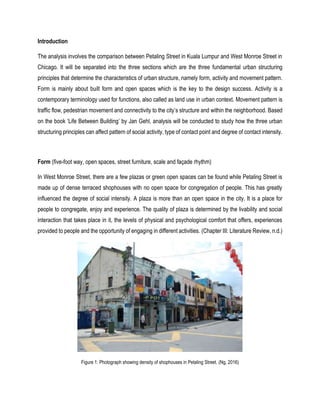
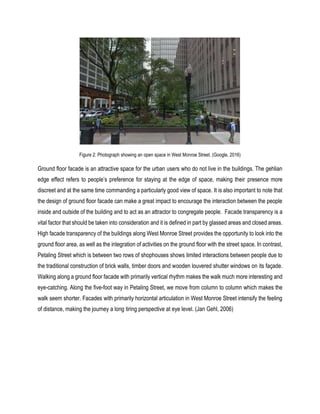
In West Monroe Street, there are a few plazas or green open spaces can be found while Petaling Street is
made up of dense terraced shophouses with no open space for congregation of people. This has greatly
influenced the degree of social intensity. A plaza is more than an open space in the city. It is a place for
people to congregate, enjoy and experience. The quality of plaza is determined by the livability and social
interaction that takes place in it, the levels of physical and psychological comfort that offers, experiences
provided to people and the opportunity of engaging in different activities. (Chapter III: Literature Review, n.d.)
Figure 1: Photograph showing density of shophouses in Petaling Street. (Ng, 2016)
Figure 2: Photograph showing an open space in West Monroe Street. (Google, 2016)
Ground floor facade is an attractive space for the urban users who do not live in the buildings. The gehlian
edge effect refers to people’s preference for staying at the edge of space, making their presence more
discreet and at the same time commanding a particularly good view of space. It is also important to note that
the design of ground floor facade can make a great impact to encourage the interaction between the people
inside and outside of the building and to act as an attractor to congregate people. Facade transparency is a
vital factor that should be taken into consideration and it is defined in part by glassed areas and closed areas.
High facade transparency of the buildings along West Monroe Street provides the opportunity to look into the
ground floor area, as well as the integration of activities on the ground floor with the street space. In contrast,
Petaling Street which is between two rows of shophouses shows limited interactions between people due to
the traditional construction of brick walls, timber doors and wooden louvered shutter windows on its façade.
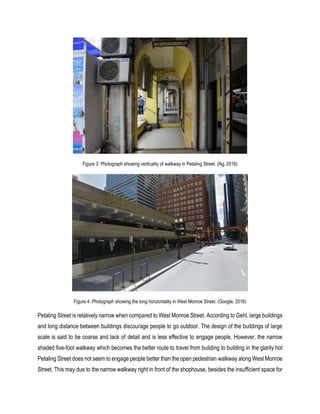
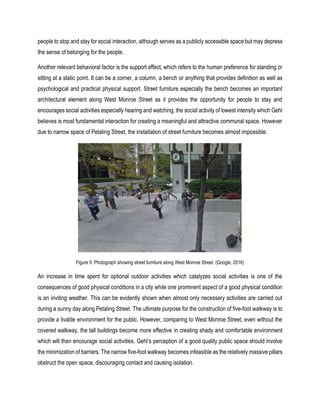
Walking along a ground floor facade with primarily vertical rhythm makes the walk much more interesting and
eye-catching. Along the five-foot way in Petaling Street, we move from column to column which makes the
walk seem shorter. Facades with primarily horizontal articulation in West Monroe Street intensify the feeling
of distance, making the journey a long tiring perspective at eye level. (Jan Gehl, 2006)
Figure 3: Photograph showing verticality of walkway in Petaling Street. (Ng, 2016)
Figure 4: Photograph showing the long horizontality in West Monroe Street. (Google, 2016)
Petaling Street is relatively narrow when compared to West Monroe Street. According to Gehl, large buildings
and long distance between buildings discourage people to go outdoor. The design of the buildings of large
scale is said to be coarse and lack of detail and is less effective to engage people. However, the narrow
shaded five-foot walkway which becomes the better route to travel from building to building in the glarily hot
Petaling Street does not seem to engage people better than the open pedestrian walkway along West Monroe
Street. This may due to the narrow walkway right in front of the shophouse, besides the insufficient space for
people to stop and stay for social interaction, although serves as a publicly accessible space but may depress
the sense of belonging for the people.
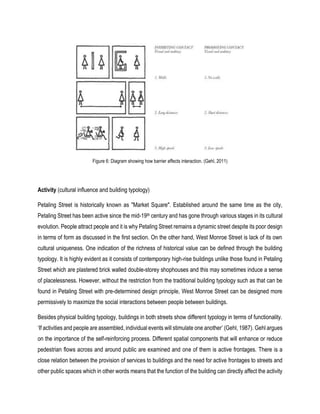
Another relevant behavioral factor is the support effect, which refers to the human preference for standing or
sitting at a static point. It can be a corner, a column, a bench or anything that provides definition as well as
psychological and practical physical support. Street furniture especially the bench becomes an important
architectural element along West Monroe Street as it provides the opportunity for people to stay and
encourages social activities especially hearing and watching, the social activity of lowest intensity which Gehl
believes is most fundamental interaction for creating a meaningful and attractive communal space. However
due to narrow space of Petaling Street, the installation of street furniture becomes almost impossible.
Figure 5: Photograph showing street furniture along West Monroe Street. (Google, 2016)
An increase in time spent for optional outdoor activities which catalyzes social activities is one of the
consequences of good physical conditions in a city while one prominent aspect of a good physical condition
is an inviting weather. This can be evidently shown when almost only necessary activities are carried out
during a sunny day along Petaling Street. The ultimate purpose for the construction of five-foot walkway is to
provide a livable environment for the public. However, comparing to West Monroe Street, even without the
covered walkway, the tall buildings become more effective in creating shady and comfortable environment
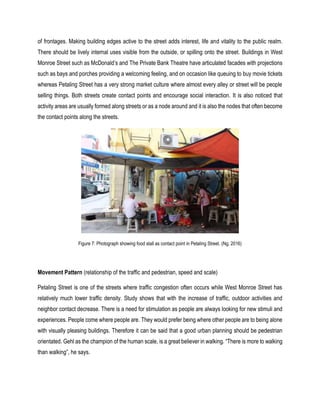
which will then encourage social activities. Gehl’s perception of a good quality public space should involve
the minimization of barriers. The narrow five-foot walkway becomes infeasible as the relatively massive pillars
obstruct the open space, discouraging contact and causing isolation.
Figure 6: Diagram showing how barrier affects interaction. (Gehl, 2011)
Activity (cultural influence and building typology)
Petaling Street is historically known as "Market Square". Established around the same time as the city,
Petaling Street has been active since the mid-19th century and has gone through various stages in its cultural
evolution. People attract people and it is why Petaling Street remains a dynamic street despite its poor design
in terms of form as discussed in the first section. On the other hand, West Monroe Street is lack of its own
cultural uniqueness. One indication of the richness of historical value can be defined through the building
typology. It is highly evident as it consists of contemporary high-rise buildings unlike those found in Petaling
Street which are plastered brick walled double-storey shophouses and this may sometimes induce a sense
of placelessness. However, without the restriction from the traditional building typology such as that can be
found in Petaling Street with pre-determined design principle, West Monroe Street can be designed more
permissively to maximize the social interactions between people between buildings.
Besides physical building typology, buildings in both streets show different typology in terms of functionality.
‘If activities and people are assembled, individual events will stimulate one another’ (Gehl, 1987). Gehl argues
on the importance of the self-reinforcing process. Different spatial components that will enhance or reduce
pedestrian flows across and around public are examined and one of them is active frontages. There is a
close relation between the provision of services to buildings and the need for active frontages to streets and
other public spaces which in other words means that the function of the building can directly affect the activity
of frontages. Making building edges active to the street adds interest, life and vitality to the public realm.
There should be lively internal uses visible from the outside, or spilling onto the street. Buildings in West
Monroe Street such as McDonald’s and The Private Bank Theatre have articulated facades with projections
such as bays and porches providing a welcoming feeling, and on occasion like queuing to buy movie tickets
whereas Petaling Street has a very strong market culture where almost every alley or street will be people
selling things. Both streets create contact points and encourage social interaction. It is also noticed that
activity areas are usually formed along streets or as a node around and it is also the nodes that often become
the contact points along the streets.
Figure 7: Photograph showing food stall as contact point in Petaling Street. (Ng, 2016)
Movement Pattern (relationship of the traffic and pedestrian, speed and scale)
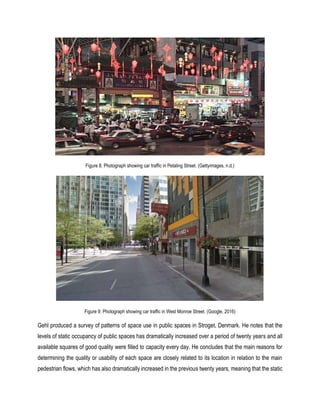
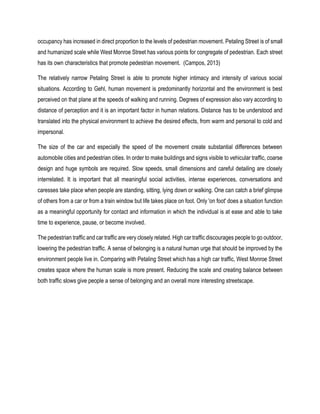
Petaling Street is one of the streets where traffic congestion often occurs while West Monroe Street has
relatively much lower traffic density. Study shows that with the increase of traffic, outdoor activities and
neighbor contact decrease. There is a need for stimulation as people are always looking for new stimuli and
experiences. People come where people are. They would prefer being where other people are to being alone
with visually pleasing buildings. Therefore it can be said that a good urban planning should be pedestrian
orientated. Gehl as the champion of the human scale, is a great believer in walking. “There is more to walking
than walking”, he says.
Figure 8: Photograph showing car traffic in Petaling Street. (Gettyimages, n.d.)
Figure 9: Photograph showing car traffic in West Monroe Street. (Google, 2016)
Gehl produced a survey of patterns of space use in public spaces in Stroget, Denmark. He notes that the
levels of static occupancy of public spaces has dramatically increased over a period of twenty years and all
available squares of good quality were filled to capacity every day. He concludes that the main reasons for
determining the quality or usability of each space are closely related to its location in relation to the main
pedestrian flows, which has also dramatically increased in the previous twenty years, meaning that the static
occupancy has increased in direct proportion to the levels of pedestrian movement. Petaling Street is of small
and humanized scale while West Monroe Street has various points for congregate of pedestrian. Each street
has its own characteristics that promote pedestrian movement. (Campos, 2013)
The relatively narrow Petaling Street is able to promote higher intimacy and intensity of various social
situations. According to Gehl, human movement is predominantly horizontal and the environment is best
perceived on that plane at the speeds of walking and running. Degrees of expression also vary according to
distance of perception and it is an important factor in human relations. Distance has to be understood and
translated into the physical environment to achieve the desired effects, from warm and personal to cold and
impersonal.
The size of the car and especially the speed of the movement create substantial differences between
automobile cities and pedestrian cities. In order to make buildings and signs visible to vehicular traffic, coarse
design and huge symbols are required. Slow speeds, small dimensions and careful detailing are closely
interrelated. It is important that all meaningful social activities, intense experiences, conversations and
caresses take place when people are standing, sitting, lying down or walking. One can catch a brief glimpse
of others from a car or from a train window but life takes place on foot. Only 'on foot' does a situation function
as a meaningful opportunity for contact and information in which the individual is at ease and able to take
time to experience, pause, or become involved.
The pedestrian traffic and car traffic are very closely related. High car traffic discourages people to go outdoor,
lowering the pedestrian traffic. A sense of belonging is a natural human urge that should be improved by the
environment people live in. Comparing with Petaling Street which has a high car traffic, West Monroe Street
creates space where the human scale is more present. Reducing the scale and creating balance between
both traffic slows give people a sense of belonging and an overall more interesting streetscape.
Conclusion
It can be concluded that each street uses different urban structuring principles to alter the patterns of social
activities, type of contact point and degree of contact intensity. It is clearly evident to note the domination of
movement pattern and activity in Petaling Street as compared to West Monroe Street. The existence of
distinction between the streets is perhaps due to the users’ interest, climate, cultural influence etc. in both
regions.
Recently, there are more and more of the shophouses in Petaling Street that undergo refurbishment and
transform into contemporary buildings, in terms of both functionality and scale. Will this adaptation enhance
the life between buildings by creating diverse social activities or destructing the existing architectural typology
that induces profound personal experience?
Bibliography
Campos, B. (2013). Book Review: Life Between Buildings & Cities for People. 125 - 128.
Chapter III: Literature Review. (n.d.). Retrieved from https://theses.lib.vt.edu/theses/available/etd-10292001-
151807/unrestricted/20chaptIIItheories.pdf
Gehl, J. (2011). Life Between Buildings: Using Public Space.
Jan Gehl, L. J. (2006). Close Encounters With Buildings. 29 - 47.
Ng, M. (n.d.). [Photograph taken during site visitation]. Retrieved November 27, 2016.
Google. (2016). [Google Street View]. Retrieved November 27, 2016
Gettyimages. (n.d). [Online Images], Retrieved November 27, 2016 from
http://www.gettyimages.co.uk/detail/video/entrance-gate-of-jalan-petaling-in-chinatown-with-stock-
footage/107516667

Comparative analysis-essay

  • 1.
    Bachelor of Science(Honours) in Architecture Theories of Architecture and Urbanism (ARC61303/ARC2224) Project: Life Between Buildings: Using Public Space Part 2: Comparative Analysis Essay Prepared by: Koh Kar Yi (0320567) Tutored by: Mr. Lam Shen Fei
  • 2.
    Introduction The analysis involvesthe comparison between Petaling Street in Kuala Lumpur and West Monroe Street in Chicago. It will be separated into the three sections which are the three fundamental urban structuring principles that determine the characteristics of urban structure, namely form, activity and movement pattern. Form is mainly about built form and open spaces which is the key to the design success. Activity is a contemporary terminology used for functions, also called as land use in urban context. Movement pattern is traffic flow, pedestrian movement and connectivity to the city’s structure and within the neighborhood. Based on the book ‘Life Between Building’ by Jan Gehl, analysis will be conducted to study how the three urban structuring principles can affect pattern of social activity, type of contact point and degree of contact intensity. Form (five-foot way, open spaces, street furniture, scale and façade rhythm) In West Monroe Street, there are a few plazas or green open spaces can be found while Petaling Street is made up of dense terraced shophouses with no open space for congregation of people. This has greatly influenced the degree of social intensity. A plaza is more than an open space in the city. It is a place for people to congregate, enjoy and experience. The quality of plaza is determined by the livability and social interaction that takes place in it, the levels of physical and psychological comfort that offers, experiences provided to people and the opportunity of engaging in different activities. (Chapter III: Literature Review, n.d.) Figure 1: Photograph showing density of shophouses in Petaling Street. (Ng, 2016)
  • 3.
    Figure 2: Photographshowing an open space in West Monroe Street. (Google, 2016) Ground floor facade is an attractive space for the urban users who do not live in the buildings. The gehlian edge effect refers to people’s preference for staying at the edge of space, making their presence more discreet and at the same time commanding a particularly good view of space. It is also important to note that the design of ground floor facade can make a great impact to encourage the interaction between the people inside and outside of the building and to act as an attractor to congregate people. Facade transparency is a vital factor that should be taken into consideration and it is defined in part by glassed areas and closed areas. High facade transparency of the buildings along West Monroe Street provides the opportunity to look into the ground floor area, as well as the integration of activities on the ground floor with the street space. In contrast, Petaling Street which is between two rows of shophouses shows limited interactions between people due to the traditional construction of brick walls, timber doors and wooden louvered shutter windows on its façade. Walking along a ground floor facade with primarily vertical rhythm makes the walk much more interesting and eye-catching. Along the five-foot way in Petaling Street, we move from column to column which makes the walk seem shorter. Facades with primarily horizontal articulation in West Monroe Street intensify the feeling of distance, making the journey a long tiring perspective at eye level. (Jan Gehl, 2006)
  • 4.
    Figure 3: Photographshowing verticality of walkway in Petaling Street. (Ng, 2016) Figure 4: Photograph showing the long horizontality in West Monroe Street. (Google, 2016) Petaling Street is relatively narrow when compared to West Monroe Street. According to Gehl, large buildings and long distance between buildings discourage people to go outdoor. The design of the buildings of large scale is said to be coarse and lack of detail and is less effective to engage people. However, the narrow shaded five-foot walkway which becomes the better route to travel from building to building in the glarily hot Petaling Street does not seem to engage people better than the open pedestrian walkway along West Monroe Street. This may due to the narrow walkway right in front of the shophouse, besides the insufficient space for
  • 5.
    people to stopand stay for social interaction, although serves as a publicly accessible space but may depress the sense of belonging for the people. Another relevant behavioral factor is the support effect, which refers to the human preference for standing or sitting at a static point. It can be a corner, a column, a bench or anything that provides definition as well as psychological and practical physical support. Street furniture especially the bench becomes an important architectural element along West Monroe Street as it provides the opportunity for people to stay and encourages social activities especially hearing and watching, the social activity of lowest intensity which Gehl believes is most fundamental interaction for creating a meaningful and attractive communal space. However due to narrow space of Petaling Street, the installation of street furniture becomes almost impossible. Figure 5: Photograph showing street furniture along West Monroe Street. (Google, 2016) An increase in time spent for optional outdoor activities which catalyzes social activities is one of the consequences of good physical conditions in a city while one prominent aspect of a good physical condition is an inviting weather. This can be evidently shown when almost only necessary activities are carried out during a sunny day along Petaling Street. The ultimate purpose for the construction of five-foot walkway is to provide a livable environment for the public. However, comparing to West Monroe Street, even without the covered walkway, the tall buildings become more effective in creating shady and comfortable environment which will then encourage social activities. Gehl’s perception of a good quality public space should involve the minimization of barriers. The narrow five-foot walkway becomes infeasible as the relatively massive pillars obstruct the open space, discouraging contact and causing isolation.
  • 6.
    Figure 6: Diagramshowing how barrier affects interaction. (Gehl, 2011) Activity (cultural influence and building typology) Petaling Street is historically known as "Market Square". Established around the same time as the city, Petaling Street has been active since the mid-19th century and has gone through various stages in its cultural evolution. People attract people and it is why Petaling Street remains a dynamic street despite its poor design in terms of form as discussed in the first section. On the other hand, West Monroe Street is lack of its own cultural uniqueness. One indication of the richness of historical value can be defined through the building typology. It is highly evident as it consists of contemporary high-rise buildings unlike those found in Petaling Street which are plastered brick walled double-storey shophouses and this may sometimes induce a sense of placelessness. However, without the restriction from the traditional building typology such as that can be found in Petaling Street with pre-determined design principle, West Monroe Street can be designed more permissively to maximize the social interactions between people between buildings. Besides physical building typology, buildings in both streets show different typology in terms of functionality. ‘If activities and people are assembled, individual events will stimulate one another’ (Gehl, 1987). Gehl argues on the importance of the self-reinforcing process. Different spatial components that will enhance or reduce pedestrian flows across and around public are examined and one of them is active frontages. There is a close relation between the provision of services to buildings and the need for active frontages to streets and other public spaces which in other words means that the function of the building can directly affect the activity
  • 7.
    of frontages. Makingbuilding edges active to the street adds interest, life and vitality to the public realm. There should be lively internal uses visible from the outside, or spilling onto the street. Buildings in West Monroe Street such as McDonald’s and The Private Bank Theatre have articulated facades with projections such as bays and porches providing a welcoming feeling, and on occasion like queuing to buy movie tickets whereas Petaling Street has a very strong market culture where almost every alley or street will be people selling things. Both streets create contact points and encourage social interaction. It is also noticed that activity areas are usually formed along streets or as a node around and it is also the nodes that often become the contact points along the streets. Figure 7: Photograph showing food stall as contact point in Petaling Street. (Ng, 2016) Movement Pattern (relationship of the traffic and pedestrian, speed and scale) Petaling Street is one of the streets where traffic congestion often occurs while West Monroe Street has relatively much lower traffic density. Study shows that with the increase of traffic, outdoor activities and neighbor contact decrease. There is a need for stimulation as people are always looking for new stimuli and experiences. People come where people are. They would prefer being where other people are to being alone with visually pleasing buildings. Therefore it can be said that a good urban planning should be pedestrian orientated. Gehl as the champion of the human scale, is a great believer in walking. “There is more to walking than walking”, he says.
  • 8.
    Figure 8: Photographshowing car traffic in Petaling Street. (Gettyimages, n.d.) Figure 9: Photograph showing car traffic in West Monroe Street. (Google, 2016) Gehl produced a survey of patterns of space use in public spaces in Stroget, Denmark. He notes that the levels of static occupancy of public spaces has dramatically increased over a period of twenty years and all available squares of good quality were filled to capacity every day. He concludes that the main reasons for determining the quality or usability of each space are closely related to its location in relation to the main pedestrian flows, which has also dramatically increased in the previous twenty years, meaning that the static
  • 9.
    occupancy has increasedin direct proportion to the levels of pedestrian movement. Petaling Street is of small and humanized scale while West Monroe Street has various points for congregate of pedestrian. Each street has its own characteristics that promote pedestrian movement. (Campos, 2013) The relatively narrow Petaling Street is able to promote higher intimacy and intensity of various social situations. According to Gehl, human movement is predominantly horizontal and the environment is best perceived on that plane at the speeds of walking and running. Degrees of expression also vary according to distance of perception and it is an important factor in human relations. Distance has to be understood and translated into the physical environment to achieve the desired effects, from warm and personal to cold and impersonal. The size of the car and especially the speed of the movement create substantial differences between automobile cities and pedestrian cities. In order to make buildings and signs visible to vehicular traffic, coarse design and huge symbols are required. Slow speeds, small dimensions and careful detailing are closely interrelated. It is important that all meaningful social activities, intense experiences, conversations and caresses take place when people are standing, sitting, lying down or walking. One can catch a brief glimpse of others from a car or from a train window but life takes place on foot. Only 'on foot' does a situation function as a meaningful opportunity for contact and information in which the individual is at ease and able to take time to experience, pause, or become involved. The pedestrian traffic and car traffic are very closely related. High car traffic discourages people to go outdoor, lowering the pedestrian traffic. A sense of belonging is a natural human urge that should be improved by the environment people live in. Comparing with Petaling Street which has a high car traffic, West Monroe Street creates space where the human scale is more present. Reducing the scale and creating balance between both traffic slows give people a sense of belonging and an overall more interesting streetscape.
  • 10.
    Conclusion It can beconcluded that each street uses different urban structuring principles to alter the patterns of social activities, type of contact point and degree of contact intensity. It is clearly evident to note the domination of movement pattern and activity in Petaling Street as compared to West Monroe Street. The existence of distinction between the streets is perhaps due to the users’ interest, climate, cultural influence etc. in both regions. Recently, there are more and more of the shophouses in Petaling Street that undergo refurbishment and transform into contemporary buildings, in terms of both functionality and scale. Will this adaptation enhance the life between buildings by creating diverse social activities or destructing the existing architectural typology that induces profound personal experience?
  • 11.
    Bibliography Campos, B. (2013).Book Review: Life Between Buildings & Cities for People. 125 - 128. Chapter III: Literature Review. (n.d.). Retrieved from https://theses.lib.vt.edu/theses/available/etd-10292001- 151807/unrestricted/20chaptIIItheories.pdf Gehl, J. (2011). Life Between Buildings: Using Public Space. Jan Gehl, L. J. (2006). Close Encounters With Buildings. 29 - 47. Ng, M. (n.d.). [Photograph taken during site visitation]. Retrieved November 27, 2016. Google. (2016). [Google Street View]. Retrieved November 27, 2016 Gettyimages. (n.d). [Online Images], Retrieved November 27, 2016 from http://www.gettyimages.co.uk/detail/video/entrance-gate-of-jalan-petaling-in-chinatown-with-stock- footage/107516667