Seminar on
Molecular studies and
breeding approaches of salt
tolerance in rice (Oryza
sativa)
Presented by:
Nushrat Jahan Moon
Reg no: 05-01837
Department of Genetics & Plant Breeding
What is soil salinity?
Soil containing enough soluble salts to
reduce its fertility and interfere with
crop growth.
These soils are two types:
Saline soil and Sodic soil(or alkali)
Introduction
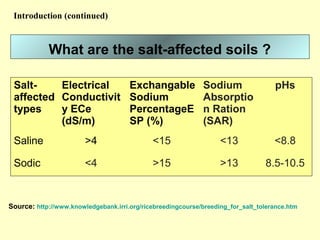
What are the salt-affected soils ?
Salt-
affected
types
Electrical
Conductivit
y ECe
(dS/m)
Exchangable
Sodium
PercentageE
SP (%)
Sodium
Absorptio
n Ration
(SAR)
pHs
Saline >4 <15 <13 <8.8
Sodic <4 >15 >13 8.5-10.5
Introduction (continued)
Source: http://www.knowledgebank.irri.org/ricebreedingcourse/breeding_for_salt_tolerance.htm
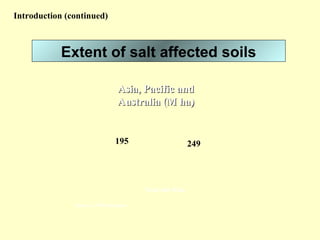
Extent of salt affected soils
Asia, Pacific andAsia, Pacific and
Australia (M ha)Australia (M ha)
Source : FAO database
195 249
Total 444 M ha
Introduction (continued)
Objectives
To get an idea about advanced research
works on salt tolerance of rice.
To exploit different molecular breeding
strategies for the development of salt
tolerant rice varieties.
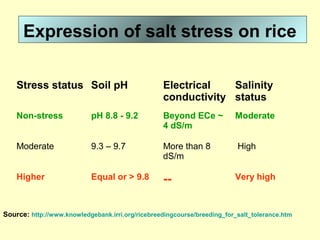
Expression of salt stress on rice
Stress status Soil pH Electrical
conductivity
Salinity
status
Non-stress pH 8.8 - 9.2 Beyond ECe ~
4 dS/m
Moderate
Moderate 9.3 – 9.7 More than 8
dS/m
High
Higher Equal or > 9.8 -- Very high
Source: http://www.knowledgebank.irri.org/ricebreedingcourse/breeding_for_salt_tolerance.htm
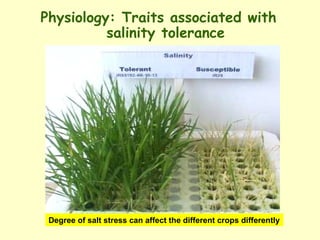
Physiology: Traits associated with
salinity tolerance
Degree of salt stress can affect the different crops differently
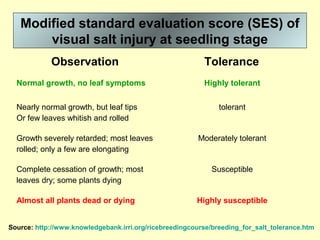
Modified standard evaluation score (SES) of
visual salt injury at seedling stage
Observation Tolerance
Normal growth, no leaf symptoms Highly tolerant
Nearly normal growth, but leaf tips
Or few leaves whitish and rolled
tolerant
Growth severely retarded; most leaves
rolled; only a few are elongating
Moderately tolerant
Complete cessation of growth; most
leaves dry; some plants dying
Susceptible
Almost all plants dead or dying Highly susceptible
Source: http://www.knowledgebank.irri.org/ricebreedingcourse/breeding_for_salt_tolerance.htm
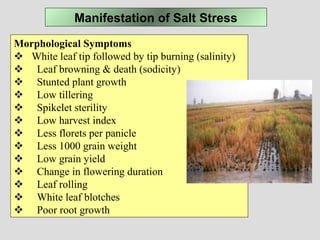
Manifestation of Salt Stress
Morphological Symptoms
   White leaf tip followed by tip burning (salinity)
     Leaf browning & death (sodicity)
     Stunted plant growth
     Low tillering
     Spikelet sterility
     Low harvest index
     Less florets per panicle
     Less 1000 grain weight
     Low grain yield
     Change in flowering duration 
     Leaf rolling
     White leaf blotches
     Poor root growth
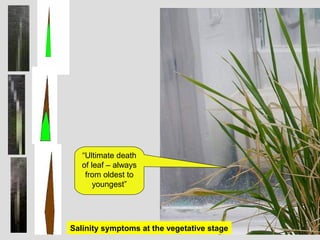
“Ultimate death
of leaf – always
from oldest to
youngest”
Salinity symptoms at the vegetative stage
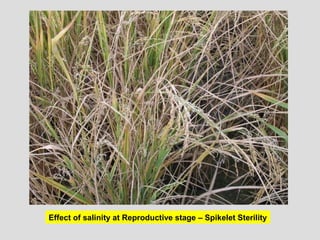
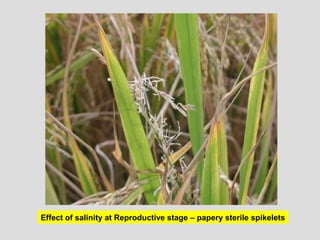
Effect of salinity at Reproductive stage – Spikelet Sterility
Effect of salinity at Reproductive stage – papery sterile spikelets
          Manifestation of Salt Stress
Physiological & Biochemical
v High Na+
transport to shoot
v Preferential accumulation of Na in older leaves
v High Cl-
uptake
v Lower K+
uptake
v Lower fresh and dry weight of shoot and roots
v Low P and Zn uptake
v Increase of non-toxic organic compatible solutes
v Increase in Polyamine levels
Basic Concepts – Genotype vs. phenotype
Plant breeding is based upon most basic yet most
important genotype and phenotype relationship (William
Johannsen, 1903) 
 Genes cannot push a trait to develop unless
appropriate environment is provided
 No amount of manipulation can cause a phenotype to
develop unless necessary genes(s) are present
Breeding Strategy
Conventional
breeding
• Introduction
• Selection
• Hybridization
• Pedigree
• Bulk
• SSD method
Molecular breeding
• MAS
• QTLs
• Somaclonal
approach
• Anther culture
• Genetic
transformation
What is MAS?
Marker assisted selection  (MAS) 
is a process whereby a marker is 
used for selection of a genetic 
determinant or determinants of a 
trait of interest.
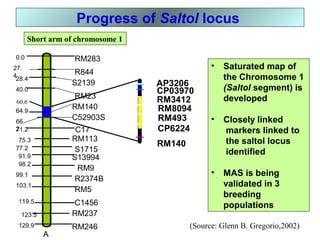
Progress of Saltol locus
• Saturated map of
the Chromosome 1
(Saltol segment) is
developed
• Closely linked
markers linked to
the saltol locus
identified
• MAS is being
validated in 3
breeding
populations
AP3206
RM3412
CP03970
RM8094
RM493
CP6224
RM140
(Source: Glenn B. Gregorio,2002)
RM283
R844
S2139
RM246
RM237
RM23
RM140
C17
RM113
S1715
S13994
RM9
R2374B
RM5
C1456
0.0
27.
4
129.9
60.6
123.5
119.5
103.1
99.1
98.2
91.9
40.0
28.4
64.9
66.
271.2
75.3
77.2
Short arm of chromosome 1
C52903S
A
What is QTLs?
Quantitative Trait Loci (QTLs) is a
location on a chromosome
which regulate phenotype for
quantitative trait and is determined by a
number of genes.
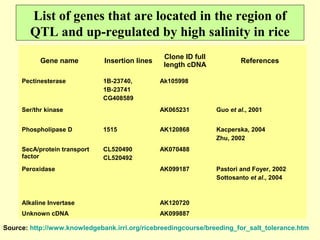
List of genes that are located in the region of
QTL and up-regulated by high salinity in rice
Gene name Insertion lines
Clone ID full
length cDNA
References
Pectinesterase 1B-23740,
1B-23741
CG408589
Ak105998
Ser/thr kinase AK065231 Guo et al., 2001
Phospholipase D 1515 AK120868 Kacperska, 2004
Zhu, 2002
SecA/protein transport
factor
CL520490
CL520492
AK070488
Peroxidase AK099187 Pastori and Foyer, 2002
Sottosanto et al., 2004
Alkaline Invertase AK120720
Unknown cDNA AK099887
Source: http://www.knowledgebank.irri.org/ricebreedingcourse/breeding_for_salt_tolerance.htm
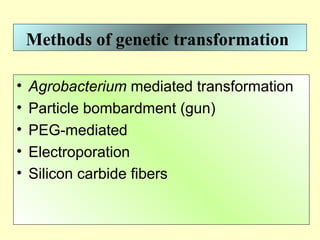
• Agrobacterium mediated transformation
• Particle bombardment (gun)
• PEG-mediated
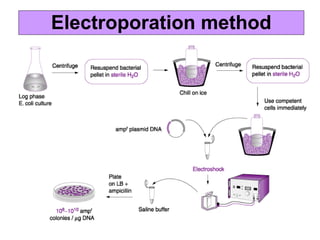
• Electroporation
• Silicon carbide fibers
Methods of genetic transformation
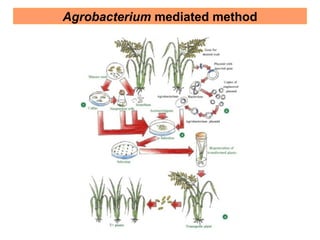
Agrobacterium mediated method
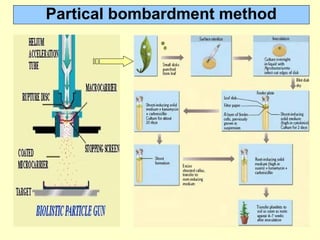
Partical bombardment method
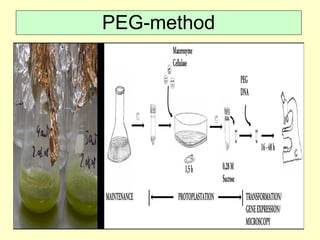
PEG-method
Electroporation method
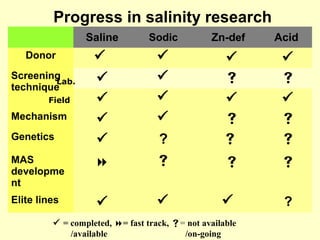
Progress in salinity research
Saline Sodic Zn-def Acid
Donor    
Screening
technique
   
   
Mechanism    
Genetics  ?  
MAS
developme
nt
   
Elite lines    ?
 = completed, = fast track, = not available
/available /on-going
Lab.
Field
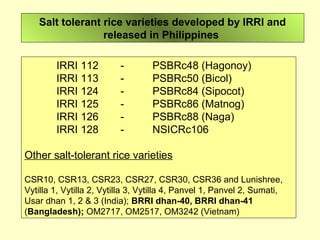
Salt tolerant rice varieties developed by IRRI and
released in Philippines
IRRI 112 - PSBRc48 (Hagonoy)
IRRI 113 - PSBRc50 (Bicol)
IRRI 124 - PSBRc84 (Sipocot)
IRRI 125 - PSBRc86 (Matnog)
IRRI 126 - PSBRc88 (Naga)
IRRI 128 - NSICRc106
Other salt-tolerant rice varieties
CSR10, CSR13, CSR23, CSR27, CSR30, CSR36 and Lunishree,
Vytilla 1, Vytilla 2, Vytilla 3, Vytilla 4, Panvel 1, Panvel 2, Sumati,
Usar dhan 1, 2 & 3 (India); BRRI dhan-40, BRRI dhan-41
(Bangladesh); OM2717, OM2517, OM3242 (Vietnam)
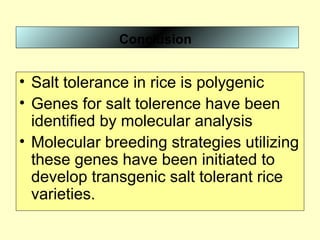
• Salt tolerance in rice is polygenic
• Genes for salt tolerence have been
identified by molecular analysis
• Molecular breeding strategies utilizing
these genes have been initiated to
develop transgenic salt tolerant rice
varieties.
Conclusion
Thank you all for your
Kind attention

Seminar Presentation-Moon

  • 1.
    Seminar on Molecular studiesand breeding approaches of salt tolerance in rice (Oryza sativa) Presented by: Nushrat Jahan Moon Reg no: 05-01837 Department of Genetics & Plant Breeding
  • 2.
    What is soilsalinity? Soil containing enough soluble salts to reduce its fertility and interfere with crop growth. These soils are two types: Saline soil and Sodic soil(or alkali) Introduction
  • 3.
    What are thesalt-affected soils ? Salt- affected types Electrical Conductivit y ECe (dS/m) Exchangable Sodium PercentageE SP (%) Sodium Absorptio n Ration (SAR) pHs Saline >4 <15 <13 <8.8 Sodic <4 >15 >13 8.5-10.5 Introduction (continued) Source: http://www.knowledgebank.irri.org/ricebreedingcourse/breeding_for_salt_tolerance.htm
  • 4.
    Extent of saltaffected soils Asia, Pacific andAsia, Pacific and Australia (M ha)Australia (M ha) Source : FAO database 195 249 Total 444 M ha Introduction (continued)
  • 5.
    Objectives To get anidea about advanced research works on salt tolerance of rice. To exploit different molecular breeding strategies for the development of salt tolerant rice varieties.
  • 6.
    Expression of saltstress on rice Stress status Soil pH Electrical conductivity Salinity status Non-stress pH 8.8 - 9.2 Beyond ECe ~ 4 dS/m Moderate Moderate 9.3 – 9.7 More than 8 dS/m High Higher Equal or > 9.8 -- Very high Source: http://www.knowledgebank.irri.org/ricebreedingcourse/breeding_for_salt_tolerance.htm
  • 7.
    Physiology: Traits associatedwith salinity tolerance Degree of salt stress can affect the different crops differently
  • 8.
    Modified standard evaluationscore (SES) of visual salt injury at seedling stage Observation Tolerance Normal growth, no leaf symptoms Highly tolerant Nearly normal growth, but leaf tips Or few leaves whitish and rolled tolerant Growth severely retarded; most leaves rolled; only a few are elongating Moderately tolerant Complete cessation of growth; most leaves dry; some plants dying Susceptible Almost all plants dead or dying Highly susceptible Source: http://www.knowledgebank.irri.org/ricebreedingcourse/breeding_for_salt_tolerance.htm
  • 9.
    Manifestation of SaltStress Morphological Symptoms    White leaf tip followed by tip burning (salinity)      Leaf browning & death (sodicity)      Stunted plant growth      Low tillering      Spikelet sterility      Low harvest index      Less florets per panicle      Less 1000 grain weight      Low grain yield      Change in flowering duration       Leaf rolling      White leaf blotches      Poor root growth
  • 10.
    “Ultimate death of leaf– always from oldest to youngest” Salinity symptoms at the vegetative stage
  • 11.
    Effect of salinityat Reproductive stage – Spikelet Sterility
  • 12.
    Effect of salinityat Reproductive stage – papery sterile spikelets
  • 13.
              Manifestation of SaltStress Physiological & Biochemical v High Na+ transport to shoot v Preferential accumulation of Na in older leaves v High Cl- uptake v Lower K+ uptake v Lower fresh and dry weight of shoot and roots v Low P and Zn uptake v Increase of non-toxic organic compatible solutes v Increase in Polyamine levels
  • 14.
    Basic Concepts –Genotype vs. phenotype Plant breeding is based upon most basic yet most important genotype and phenotype relationship (William Johannsen, 1903)   Genes cannot push a trait to develop unless appropriate environment is provided  No amount of manipulation can cause a phenotype to develop unless necessary genes(s) are present
  • 15.
    Breeding Strategy Conventional breeding • Introduction •Selection • Hybridization • Pedigree • Bulk • SSD method Molecular breeding • MAS • QTLs • Somaclonal approach • Anther culture • Genetic transformation
  • 16.
    What is MAS? Markerassisted selection  (MAS)  is a process whereby a marker is  used for selection of a genetic  determinant or determinants of a  trait of interest.
  • 17.
    Progress of Saltollocus • Saturated map of the Chromosome 1 (Saltol segment) is developed • Closely linked markers linked to the saltol locus identified • MAS is being validated in 3 breeding populations AP3206 RM3412 CP03970 RM8094 RM493 CP6224 RM140 (Source: Glenn B. Gregorio,2002) RM283 R844 S2139 RM246 RM237 RM23 RM140 C17 RM113 S1715 S13994 RM9 R2374B RM5 C1456 0.0 27. 4 129.9 60.6 123.5 119.5 103.1 99.1 98.2 91.9 40.0 28.4 64.9 66. 271.2 75.3 77.2 Short arm of chromosome 1 C52903S A
  • 18.
    What is QTLs? QuantitativeTrait Loci (QTLs) is a location on a chromosome which regulate phenotype for quantitative trait and is determined by a number of genes.
  • 19.
    List of genesthat are located in the region of QTL and up-regulated by high salinity in rice Gene name Insertion lines Clone ID full length cDNA References Pectinesterase 1B-23740, 1B-23741 CG408589 Ak105998 Ser/thr kinase AK065231 Guo et al., 2001 Phospholipase D 1515 AK120868 Kacperska, 2004 Zhu, 2002 SecA/protein transport factor CL520490 CL520492 AK070488 Peroxidase AK099187 Pastori and Foyer, 2002 Sottosanto et al., 2004 Alkaline Invertase AK120720 Unknown cDNA AK099887 Source: http://www.knowledgebank.irri.org/ricebreedingcourse/breeding_for_salt_tolerance.htm
  • 20.
    • Agrobacterium mediatedtransformation • Particle bombardment (gun) • PEG-mediated • Electroporation • Silicon carbide fibers Methods of genetic transformation
  • 21.
  • 22.
  • 23.
  • 24.
  • 25.
    Progress in salinityresearch Saline Sodic Zn-def Acid Donor     Screening technique         Mechanism     Genetics  ?   MAS developme nt     Elite lines    ?  = completed, = fast track, = not available /available /on-going Lab. Field
  • 26.
    Salt tolerant ricevarieties developed by IRRI and released in Philippines IRRI 112 - PSBRc48 (Hagonoy) IRRI 113 - PSBRc50 (Bicol) IRRI 124 - PSBRc84 (Sipocot) IRRI 125 - PSBRc86 (Matnog) IRRI 126 - PSBRc88 (Naga) IRRI 128 - NSICRc106 Other salt-tolerant rice varieties CSR10, CSR13, CSR23, CSR27, CSR30, CSR36 and Lunishree, Vytilla 1, Vytilla 2, Vytilla 3, Vytilla 4, Panvel 1, Panvel 2, Sumati, Usar dhan 1, 2 & 3 (India); BRRI dhan-40, BRRI dhan-41 (Bangladesh); OM2717, OM2517, OM3242 (Vietnam)
  • 27.
    • Salt tolerancein rice is polygenic • Genes for salt tolerence have been identified by molecular analysis • Molecular breeding strategies utilizing these genes have been initiated to develop transgenic salt tolerant rice varieties. Conclusion
  • 28.
    Thank you allfor your Kind attention