1
Name – Manish Kumar Choudhary
2
Breeding for Salinity
tolerance
3
• Salinity is one of the most serious factor, limiting the
productivity of agricultural crops, with adverse effects on
germination, plant vigour and crop yield (R Munns & Tester,
2008).
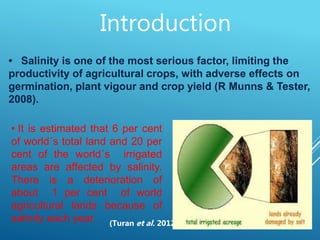
• It is estimated that 6 per cent
of world´s total land and 20 per
cent of the world´s irrigated
areas are affected by salinity.
There is a deterioration of
about 1 per cent of world
agricultural lands because of
salinity each year. (Turan et al. 2012)
Introduction
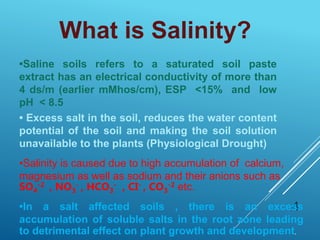
•Saline soils refers to a saturated soil paste
extract has an electrical conductivity of more than
4 ds/m (earlier mMhos/cm), ESP <15% and low
pH < 8.5
4
• Excess salt in the soil, reduces the water content
potential of the soil and making the soil solution
unavailable to the plants (Physiological Drought)
What is Salinity?
•Salinity is caused due to high accumulation of calcium,
magnesium as well as sodium and their anions such as
SO4
-2 , NO3
- , HCO3
- , CI- , CO3
-2 etc.
•In a salt affected soils , there is an excess
accumulation of soluble salts in the root zone leading
to detrimental effect on plant growth and development.
5
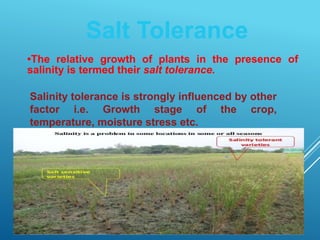
Salinity tolerance is strongly influenced by other
factor i.e. Growth stage of the crop,
temperature, moisture stress etc.
Salt Tolerance
•The relative growth of plants in the presence of
salinity is termed their salt tolerance.
6
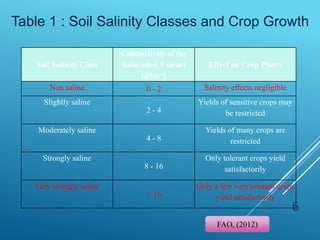
Soil Salinity Class
Conductivity of the
Saturation Extract
(dSm-¹)
Effect on Crop Plants
Non saline 0 - 2 Salinity effects negligible
Slightly saline
2 - 4
Yields of sensitive crops may
be restricted
Moderately saline
4 - 8
Yields of many crops are
restricted
Strongly saline
8 - 16
Only tolerant crops yield
satisfactorily
Very strongly saline
> 16
Only a few very tolerant crops
yield satisfactorily
FAO, (2012)
Table 1 : Soil Salinity Classes and Crop Growth
7
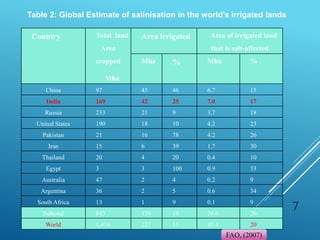
Country Total land
Area
cropped
Mha
Area irrigated Area of irrigated land
that is salt-affected
Mha % Mha %
China 97 45 46 6.7 15
India 169 42 25 7.0 17
Russia 233 21 9 3.7 18
United States 190 18 10 4.2 23
Pakistan 21 16 78 4.2 26
Iran 15 6 39 1.7 30
Thailand 20 4 20 0.4 10
Egypt 3 3 100 0.9 33
Australia 47 2 4 0.2 9
Argentina 36 2 5 0.6 34
South Africa 13 1 9 0.1 9
Subtotal 843 159 19 29.6 20
World 1,474 227 15 45.4 20
FAO, (2007)
Table 2: Global Estimate of salinisation in the world’s irrigated lands
8
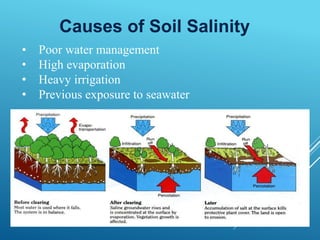
• Poor water management
• High evaporation
• Heavy irrigation
• Previous exposure to seawater
Causes of Soil Salinity
9
Adverse effects of salt stress
•Interferes with plant growth and development.
• Leads to physiological drought conditions and ion toxicity.
• Nutritional Disorder
• High salt deposition - Leads to formation of low water potential
zone in the soil.
• Higher concentrations of Na+ (above 100 mM)
 Toxic to cell metabolism
 Can inhibit the activity of many essential enzymes, cell
division and expansion and osmotic imbalance which leads to
growth inhibition.
10
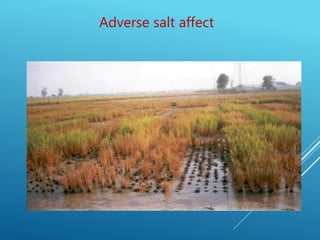
Adverse salt affect
11
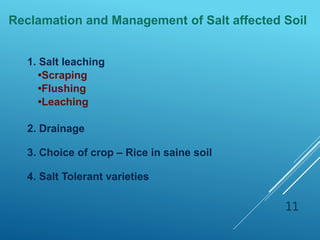
Reclamation and Management of Salt affected Soil
1. Salt leaching
•Scraping
•Flushing
•Leaching
2. Drainage
3. Choice of crop – Rice in saine soil
4. Salt Tolerant varieties
12
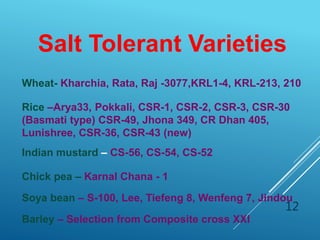
Rice –Arya33, Pokkali, CSR-1, CSR-2, CSR-3, CSR-30
(Basmati type) CSR-49, Jhona 349, CR Dhan 405,
Lunishree, CSR-36, CSR-43 (new)
Wheat- Kharchia, Rata, Raj -3077,KRL1-4, KRL-213, 210
Salt Tolerant Varieties
Indian mustard – CS-56, CS-54, CS-52
Chick pea – Karnal Chana - 1
Soya bean – S-100, Lee, Tiefeng 8, Wenfeng 7, Jindou
Barley – Selection from Composite cross XXl
13
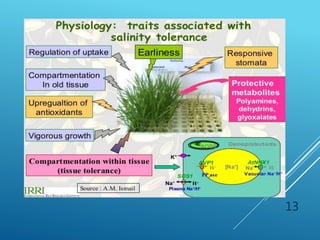
14
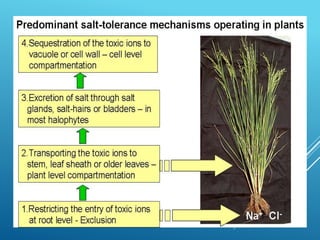
15
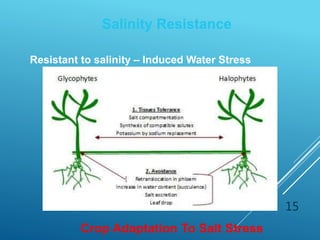
Salinity Resistance
Resistant to salinity – Induced Water Stress
Crop Adaptation To Salt Stress
16
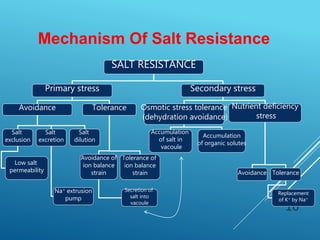
Mechanism Of Salt Resistance
SALT RESISTANCE
Primary stress Secondary stress
Osmotic stress tolerance
(dehydration avoidance)
Nutrient deficiency
stress
Avoidance Tolerance
Salt
exclusion
Salt
excretion
Salt
dilution
Avoidance of
ion balance
strain
Tolerance of
ion balance
strain
Accumulation
of salt in
vacoule
Accumulation
of organic solutes
Avoidance Tolerance
Low salt
permeability
Na+ extrusion
pump
Secretion of
salt into
vacoule
Replacement
of K+ by Na+
17
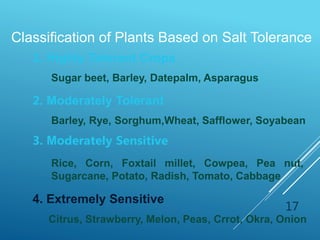
Classification of Plants Based on Salt Tolerance
1. Highly Tolerant Crops
Sugar beet, Barley, Datepalm, Asparagus
2. Moderately Tolerant
Barley, Rye, Sorghum,Wheat, Safflower, Soyabean
3. Moderately Sensitive
Rice, Corn, Foxtail millet, Cowpea, Pea nut,
Sugarcane, Potato, Radish, Tomato, Cabbage
4. Extremely Sensitive
Citrus, Strawberry, Melon, Peas, Crrot, Okra, Onion
18
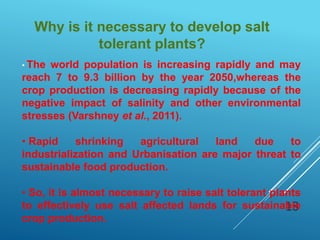
Why is it necessary to develop salt
tolerant plants?
• The world population is increasing rapidly and may
reach 7 to 9.3 billion by the year 2050,whereas the
crop production is decreasing rapidly because of the
negative impact of salinity and other environmental
stresses (Varshney et al., 2011).
• Rapid shrinking agricultural land due to
industrialization and Urbanisation are major threat to
sustainable food production.
• So, it is almost necessary to raise salt tolerant plants
to effectively use salt affected lands for sustainable
crop production.
19
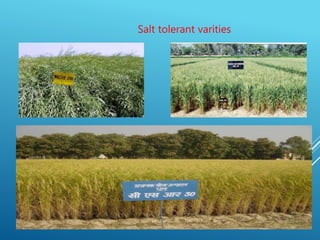
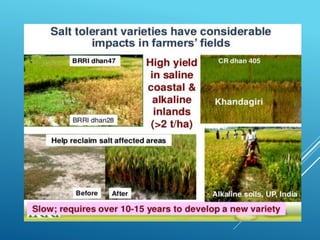
Salt tolerant varities
20
21
Approaches in Salt
Tolerance
Conventional Approach
1.Introduction
2.Selection( Mass selection /Pure selection)
3.Hybridization
• Pedigree
• Bulk method
• SSD method
• Back cross
• Multiple crossing
22
Achievement Through Conventional
Approach
• To improve the crop yield and quality improving the
resistance of crops against abiotic stresses, especially
salinity stress through conventional method develop
salt tolerant variety.
For example,
•Some lines/cultivars of alfalfa (Medicago sativa L.)
such as AZ-Germ Salt II (Dobrenz et al., 1989), AZ-
90NDC-ST (Johnson et al., 1991), AZ- 97MEC and
AZ-97MEC-ST (Al-Doss and Smith,1998), ZS-9491 and
ZS-9592 (Dobrenz, 1999)
•Two salt-tolerant lines/cultivars of bread wheat (Triticum
aestivum L.) such as S24 (Ashraf and O'Leary, 1996) and
KRL1-4 (Hollington, 2000) were evaluated on natural salt-
affected soils.
23
Drawback of Conventional
method
Low magnitude of
genetically based variation
in the gene pools of most
crop species
Reproductive barriers
Time Consuming
24
Non Conventional Approach
 Transgenic Approach
 Molecular Approach (MAS)
 Mutation breeding
 TILLING (Targeting Induced Local Lesions IN
Genomes)
•Transgenic plants for ion transporters
•Transgenic plants for compatible organic solutes
•Transgenic plants for enhanced antioxidant production
•In Tomato fruit crop a vacuolar Na+/H+ antiport
(AtNHX1) from A. thaliana lead to salt
accumulating in the leaves of the plants, but not
in the fruit and allowed them to grow more in
salt solutions than wildtype plant
For example
25
Molecular Approach
•In response to high salinity stress, various genes get
upregulated, the products of which are involved either
directly or indirectly in plant protection against salt stress.
• Some of the genes encoding osmolytes, ion channels,
receptors, components of calcium signaling and some
other regulatory signaling factors or enzymes are able to
confer salt tolerant phenotypes when transferred to
sensitive plants.
Allele mining : finding of superior allele from the natural
population.
Introgression of novel or superior
Allele from wild relatives into Cultivated one
OR
26
Problems In Breeding For Salinity
Resistance
1. There is no simple to score, reliable and
dependable selection criterion for salinity
resistance.
2. Creation of reliable, dependable and controlled
salinity environment for selection work is tedious,
costly and beyond reach of many breeders.
3. The genetic control of salinity resistance is
generally complex and polygenic, which makes
transfers from germplasm lines and especially,
related species a very difficult task.
4. The basis of salinity resistance is poorly
understood, this makes genetic analysis and
breeding efforts considerably difficult.
27
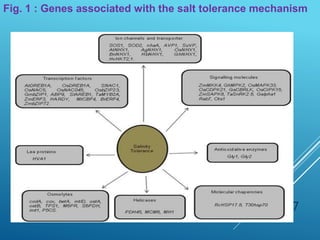
Fig. 1 : Genes associated with the salt tolerance mechanism
28
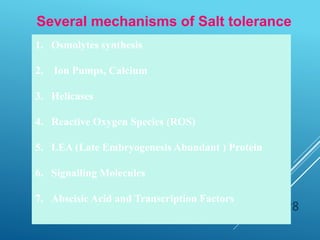
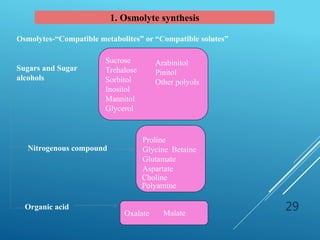
1. Osmolytes synthesis
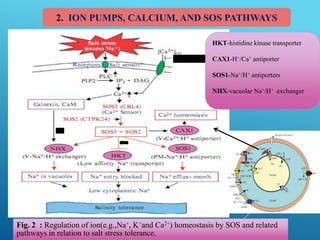
2. Ion Pumps, Calcium
3. Helicases
4. Reactive Oxygen Species (ROS)
5. LEA (Late Embryogenesis Abundant ) Protein
6. Signalling Molecules
7. Abscisic Acid and Transcription Factors
Several mechanisms of Salt tolerance
29
Sugars and Sugar
alcohols
Sucrose
Trehalose
Sorbitol
Inositol
Mannitol
Glycerol
Arabinitol
Pinitol
Other polyols
Nitrogenous compound
Proline
Glycine Betaine
Glutamate
Aspartate
Choline
Polyamine
Organic acid
Oxalate Malate
1. Osmolyte synthesis
Osmolytes-“Compatible metabolites” or “Compatible solutes”
30
2. ION PUMPS, CALCIUM, AND SOS PATHWAYS
Fig. 2 : Regulation of ion(e.g.,Na+, K+and Ca2+) homeostasis by SOS and related
pathways in relation to salt stress tolerance.
HKT-histidine kinase transporter
CAX1-H+/Ca+ antiporter
SOS1-Na+/H+ antiporters
NHX-vacuolar Na+/H+ exchanger
3. HELICASES
• Helicases catalyze the unwinding of energetically stable duplex DNA or duplex
RNA secondary structures.
• Most helicases are members of the protein superfamily that play essential roles in
basic cellular processes regulating plant growth and development.
• RNA helicases are the best candidates for RNA chaperones because these
proteins can actively disrupt misfolded RNA structures in ATP dependent manner.
• There could be two possible sites of action for the helicases:
• At the level of transcription or translation to enhance or stabilize protein
synthesis
• In an association with DNA multisubunit protein complexes to alter gene
expression.
4. Reactive Oxygen Species
• Reactive Oxygen Species produced in response to oxidative stress can
cause permanent damage to the cellular apparatus.
• Reactive oxygen intermediates (ROI) typically result from the excitation
of O2 to form singlet oxygen (1O) or the transfer of one, two, or three
electrons to O2 to form superoxide radical (O2
- ), hydrogen peroxide (H2O2),
or a hydroxyl radical (OH-), respectively.
• The ROIs react spontaneously with organic molecules and cause
membrane lipid peroxidation, protein oxidation, enzyme inhibition, and
DNA and RNA damage.
• The major ROI-scavenging enzymes of plants include superoxide
dismutase (SOD), ascorbate peroxidase, catalase, and Glutathione
reductase.
33
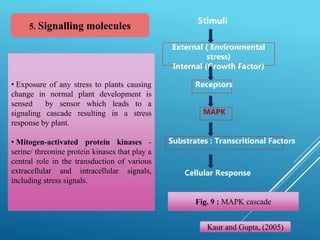
5. Signalling molecules
• Exposure of any stress to plants causing
change in normal plant development is
sensed by sensor which leads to a
signaling cascade resulting in a stress
response by plant.
• Mitogen-activated protein kinases -
serine/ threonine protein kinases that play a
central role in the transduction of various
extracellular and intracellular signals,
including stress signals.
Kaur and Gupta, (2005)
Fig. 9 : MAPK cascade
Stimuli
External ( Environmental
stress)
Internal (Growth Factor)
Receptors
MAPK
Substrates : Transcritional Factors
Cellular Response
34
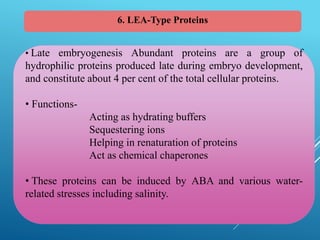
6. LEA-Type Proteins
• Late embryogenesis Abundant proteins are a group of
hydrophilic proteins produced late during embryo development,
and constitute about 4 per cent of the total cellular proteins.
• Functions-
Acting as hydrating buffers
Sequestering ions
Helping in renaturation of proteins
Act as chemical chaperones
• These proteins can be induced by ABA and various water-
related stresses including salinity.
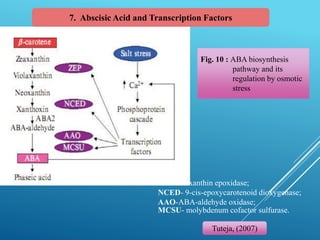
ZEP- zeaxanthin epoxidase;
NCED- 9-cis-epoxycarotenoid dioxygenase;
AAO-ABA-aldehyde oxidase;
MCSU- molybdenum cofactor sulfurase.
7. Abscisic Acid and Transcription Factors
Fig. 10 : ABA biosynthesis
pathway and its
regulation by osmotic
stress
Tuteja, (2007)
36
Screening Techniques For Tolerance to Moderate Salinity
(50 – 150 mM NaCl)
Measurements of growth:
Root elongation
Leaf elongation
Biomass and Yield
Measurements of injury:
Leakage from leaf discs
Chlorophyll content
Chlorophyll fluorescence
 Specific traits:
Na+ exclusion
K+/Na+ discrimination
Cl− exclusion
37
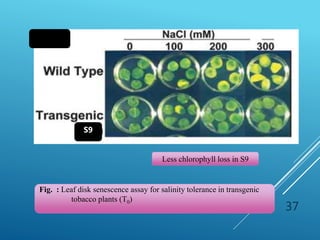
S9
Less chlorophyll loss in S9
Fig. : Leaf disk senescence assay for salinity tolerance in transgenic
tobacco plants (T0)
38
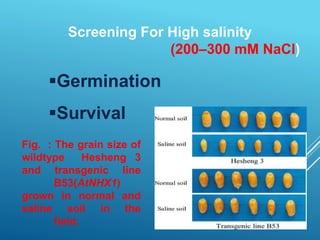
Screening For High salinity
(200–300 mM NaCl)
Germination
Survival
Fig. : The grain size of
wildtype Hesheng 3
and transgenic line
B53(AtNHX1)
grown in normal and
saline soil in the
field.
39
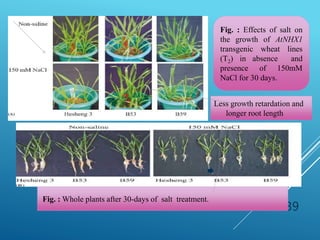
Fig. : Effects of salt on
the growth of AtNHX1
transgenic wheat lines
(T2) in absence and
presence of 150mM
NaCl for 30 days.
Less growth retardation and
longer root length
Fig. : Whole plants after 30-days of salt treatment.
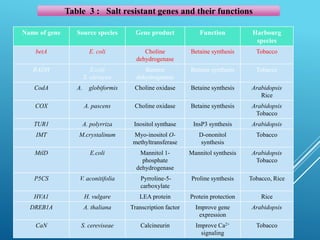
Name of gene Source species Gene product Function Harbourg
species
betA E. coli Choline
dehydrogenase
Betaine synthesis Tobacco
BADH E.coli
S. oleracea
Betaine
dehydrogenase
Betaine synthesis Tobacco
CodA A. globiformis Choline oxidase Betaine synthesis Arabidopsis
Rice
COX A. pascens Choline oxidase Betaine synthesis Arabidopsis
Tobacco
TUR1 A. polyrriza Inositol synthase InsP3 synthesis Arabidopsis
IMT M.crystalinum Myo-inositol O-
methyltransferase
D-ononitol
synthesis
Tobacco
MtlD E.coli Mannitol 1-
phosphate
dehydrogenase
Mannitol synthesis Arabidopsis
Tobacco
P5CS V. aconitifolia Pyrroline-5-
carboxylate
Proline synthesis Tobacco, Rice
HVA1 H. vulgare LEA protein Protein protection Rice
DREB1A A. thaliana Transcription factor Improve gene
expression
Arabidopsis
CaN S. cereviseae Calcineurin Improve Ca2+
signaling
Tobacco
Table 3 : Salt resistant genes and their functions
41
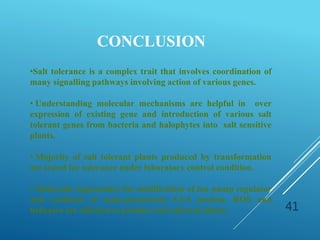
CONCLUSION
•Salt tolerance is a complex trait that involves coordination of
many signalling pathways involving action of various genes.
• Understanding molecular mechanisms are helpful in over
expression of existing gene and introduction of various salt
tolerant genes from bacteria and halophytes into salt sensitive
plants.
• Majority of salt tolerant plants produced by transformation
are tested for tolerance under laboratory control condition.
• Molecular approaches for modification of ion pump regulator
and synthesis of osmo-protectant, LEA protein, ROS and
helicases are efficient to produce salt tolerant plants.
42
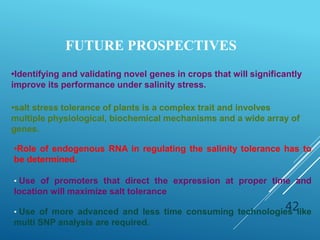
FUTURE PROSPECTIVES
•Role of endogenous RNA in regulating the salinity tolerance has to
be determined.
• Use of promoters that direct the expression at proper time and
location will maximize salt tolerance
• Use of more advanced and less time consuming technologies like
multi SNP analysis are required.
•Identifying and validating novel genes in crops that will significantly
improve its performance under salinity stress.
•salt stress tolerance of plants is a complex trait and involves
multiple physiological, biochemical mechanisms and a wide array of
genes.
43
Thank You

Salinity

  • 1.
    1 Name – ManishKumar Choudhary
  • 2.
  • 3.
    3 • Salinity isone of the most serious factor, limiting the productivity of agricultural crops, with adverse effects on germination, plant vigour and crop yield (R Munns & Tester, 2008). • It is estimated that 6 per cent of world´s total land and 20 per cent of the world´s irrigated areas are affected by salinity. There is a deterioration of about 1 per cent of world agricultural lands because of salinity each year. (Turan et al. 2012) Introduction
  • 4.
    •Saline soils refersto a saturated soil paste extract has an electrical conductivity of more than 4 ds/m (earlier mMhos/cm), ESP <15% and low pH < 8.5 4 • Excess salt in the soil, reduces the water content potential of the soil and making the soil solution unavailable to the plants (Physiological Drought) What is Salinity? •Salinity is caused due to high accumulation of calcium, magnesium as well as sodium and their anions such as SO4 -2 , NO3 - , HCO3 - , CI- , CO3 -2 etc. •In a salt affected soils , there is an excess accumulation of soluble salts in the root zone leading to detrimental effect on plant growth and development.
  • 5.
    5 Salinity tolerance isstrongly influenced by other factor i.e. Growth stage of the crop, temperature, moisture stress etc. Salt Tolerance •The relative growth of plants in the presence of salinity is termed their salt tolerance.
  • 6.
    6 Soil Salinity Class Conductivityof the Saturation Extract (dSm-¹) Effect on Crop Plants Non saline 0 - 2 Salinity effects negligible Slightly saline 2 - 4 Yields of sensitive crops may be restricted Moderately saline 4 - 8 Yields of many crops are restricted Strongly saline 8 - 16 Only tolerant crops yield satisfactorily Very strongly saline > 16 Only a few very tolerant crops yield satisfactorily FAO, (2012) Table 1 : Soil Salinity Classes and Crop Growth
  • 7.
    7 Country Total land Area cropped Mha Areairrigated Area of irrigated land that is salt-affected Mha % Mha % China 97 45 46 6.7 15 India 169 42 25 7.0 17 Russia 233 21 9 3.7 18 United States 190 18 10 4.2 23 Pakistan 21 16 78 4.2 26 Iran 15 6 39 1.7 30 Thailand 20 4 20 0.4 10 Egypt 3 3 100 0.9 33 Australia 47 2 4 0.2 9 Argentina 36 2 5 0.6 34 South Africa 13 1 9 0.1 9 Subtotal 843 159 19 29.6 20 World 1,474 227 15 45.4 20 FAO, (2007) Table 2: Global Estimate of salinisation in the world’s irrigated lands
  • 8.
    8 • Poor watermanagement • High evaporation • Heavy irrigation • Previous exposure to seawater Causes of Soil Salinity
  • 9.
    9 Adverse effects ofsalt stress •Interferes with plant growth and development. • Leads to physiological drought conditions and ion toxicity. • Nutritional Disorder • High salt deposition - Leads to formation of low water potential zone in the soil. • Higher concentrations of Na+ (above 100 mM)  Toxic to cell metabolism  Can inhibit the activity of many essential enzymes, cell division and expansion and osmotic imbalance which leads to growth inhibition.
  • 10.
  • 11.
    11 Reclamation and Managementof Salt affected Soil 1. Salt leaching •Scraping •Flushing •Leaching 2. Drainage 3. Choice of crop – Rice in saine soil 4. Salt Tolerant varieties
  • 12.
    12 Rice –Arya33, Pokkali,CSR-1, CSR-2, CSR-3, CSR-30 (Basmati type) CSR-49, Jhona 349, CR Dhan 405, Lunishree, CSR-36, CSR-43 (new) Wheat- Kharchia, Rata, Raj -3077,KRL1-4, KRL-213, 210 Salt Tolerant Varieties Indian mustard – CS-56, CS-54, CS-52 Chick pea – Karnal Chana - 1 Soya bean – S-100, Lee, Tiefeng 8, Wenfeng 7, Jindou Barley – Selection from Composite cross XXl
  • 13.
  • 14.
  • 15.
    15 Salinity Resistance Resistant tosalinity – Induced Water Stress Crop Adaptation To Salt Stress
  • 16.
    16 Mechanism Of SaltResistance SALT RESISTANCE Primary stress Secondary stress Osmotic stress tolerance (dehydration avoidance) Nutrient deficiency stress Avoidance Tolerance Salt exclusion Salt excretion Salt dilution Avoidance of ion balance strain Tolerance of ion balance strain Accumulation of salt in vacoule Accumulation of organic solutes Avoidance Tolerance Low salt permeability Na+ extrusion pump Secretion of salt into vacoule Replacement of K+ by Na+
  • 17.
    17 Classification of PlantsBased on Salt Tolerance 1. Highly Tolerant Crops Sugar beet, Barley, Datepalm, Asparagus 2. Moderately Tolerant Barley, Rye, Sorghum,Wheat, Safflower, Soyabean 3. Moderately Sensitive Rice, Corn, Foxtail millet, Cowpea, Pea nut, Sugarcane, Potato, Radish, Tomato, Cabbage 4. Extremely Sensitive Citrus, Strawberry, Melon, Peas, Crrot, Okra, Onion
  • 18.
    18 Why is itnecessary to develop salt tolerant plants? • The world population is increasing rapidly and may reach 7 to 9.3 billion by the year 2050,whereas the crop production is decreasing rapidly because of the negative impact of salinity and other environmental stresses (Varshney et al., 2011). • Rapid shrinking agricultural land due to industrialization and Urbanisation are major threat to sustainable food production. • So, it is almost necessary to raise salt tolerant plants to effectively use salt affected lands for sustainable crop production.
  • 19.
  • 20.
  • 21.
    21 Approaches in Salt Tolerance ConventionalApproach 1.Introduction 2.Selection( Mass selection /Pure selection) 3.Hybridization • Pedigree • Bulk method • SSD method • Back cross • Multiple crossing
  • 22.
    22 Achievement Through Conventional Approach •To improve the crop yield and quality improving the resistance of crops against abiotic stresses, especially salinity stress through conventional method develop salt tolerant variety. For example, •Some lines/cultivars of alfalfa (Medicago sativa L.) such as AZ-Germ Salt II (Dobrenz et al., 1989), AZ- 90NDC-ST (Johnson et al., 1991), AZ- 97MEC and AZ-97MEC-ST (Al-Doss and Smith,1998), ZS-9491 and ZS-9592 (Dobrenz, 1999) •Two salt-tolerant lines/cultivars of bread wheat (Triticum aestivum L.) such as S24 (Ashraf and O'Leary, 1996) and KRL1-4 (Hollington, 2000) were evaluated on natural salt- affected soils.
  • 23.
    23 Drawback of Conventional method Lowmagnitude of genetically based variation in the gene pools of most crop species Reproductive barriers Time Consuming
  • 24.
    24 Non Conventional Approach Transgenic Approach  Molecular Approach (MAS)  Mutation breeding  TILLING (Targeting Induced Local Lesions IN Genomes) •Transgenic plants for ion transporters •Transgenic plants for compatible organic solutes •Transgenic plants for enhanced antioxidant production •In Tomato fruit crop a vacuolar Na+/H+ antiport (AtNHX1) from A. thaliana lead to salt accumulating in the leaves of the plants, but not in the fruit and allowed them to grow more in salt solutions than wildtype plant For example
  • 25.
    25 Molecular Approach •In responseto high salinity stress, various genes get upregulated, the products of which are involved either directly or indirectly in plant protection against salt stress. • Some of the genes encoding osmolytes, ion channels, receptors, components of calcium signaling and some other regulatory signaling factors or enzymes are able to confer salt tolerant phenotypes when transferred to sensitive plants. Allele mining : finding of superior allele from the natural population. Introgression of novel or superior Allele from wild relatives into Cultivated one OR
  • 26.
    26 Problems In BreedingFor Salinity Resistance 1. There is no simple to score, reliable and dependable selection criterion for salinity resistance. 2. Creation of reliable, dependable and controlled salinity environment for selection work is tedious, costly and beyond reach of many breeders. 3. The genetic control of salinity resistance is generally complex and polygenic, which makes transfers from germplasm lines and especially, related species a very difficult task. 4. The basis of salinity resistance is poorly understood, this makes genetic analysis and breeding efforts considerably difficult.
  • 27.
    27 Fig. 1 :Genes associated with the salt tolerance mechanism
  • 28.
    28 1. Osmolytes synthesis 2.Ion Pumps, Calcium 3. Helicases 4. Reactive Oxygen Species (ROS) 5. LEA (Late Embryogenesis Abundant ) Protein 6. Signalling Molecules 7. Abscisic Acid and Transcription Factors Several mechanisms of Salt tolerance
  • 29.
    29 Sugars and Sugar alcohols Sucrose Trehalose Sorbitol Inositol Mannitol Glycerol Arabinitol Pinitol Otherpolyols Nitrogenous compound Proline Glycine Betaine Glutamate Aspartate Choline Polyamine Organic acid Oxalate Malate 1. Osmolyte synthesis Osmolytes-“Compatible metabolites” or “Compatible solutes”
  • 30.
    30 2. ION PUMPS,CALCIUM, AND SOS PATHWAYS Fig. 2 : Regulation of ion(e.g.,Na+, K+and Ca2+) homeostasis by SOS and related pathways in relation to salt stress tolerance. HKT-histidine kinase transporter CAX1-H+/Ca+ antiporter SOS1-Na+/H+ antiporters NHX-vacuolar Na+/H+ exchanger
  • 31.
    3. HELICASES • Helicasescatalyze the unwinding of energetically stable duplex DNA or duplex RNA secondary structures. • Most helicases are members of the protein superfamily that play essential roles in basic cellular processes regulating plant growth and development. • RNA helicases are the best candidates for RNA chaperones because these proteins can actively disrupt misfolded RNA structures in ATP dependent manner. • There could be two possible sites of action for the helicases: • At the level of transcription or translation to enhance or stabilize protein synthesis • In an association with DNA multisubunit protein complexes to alter gene expression.
  • 32.
    4. Reactive OxygenSpecies • Reactive Oxygen Species produced in response to oxidative stress can cause permanent damage to the cellular apparatus. • Reactive oxygen intermediates (ROI) typically result from the excitation of O2 to form singlet oxygen (1O) or the transfer of one, two, or three electrons to O2 to form superoxide radical (O2 - ), hydrogen peroxide (H2O2), or a hydroxyl radical (OH-), respectively. • The ROIs react spontaneously with organic molecules and cause membrane lipid peroxidation, protein oxidation, enzyme inhibition, and DNA and RNA damage. • The major ROI-scavenging enzymes of plants include superoxide dismutase (SOD), ascorbate peroxidase, catalase, and Glutathione reductase.
  • 33.
    33 5. Signalling molecules •Exposure of any stress to plants causing change in normal plant development is sensed by sensor which leads to a signaling cascade resulting in a stress response by plant. • Mitogen-activated protein kinases - serine/ threonine protein kinases that play a central role in the transduction of various extracellular and intracellular signals, including stress signals. Kaur and Gupta, (2005) Fig. 9 : MAPK cascade Stimuli External ( Environmental stress) Internal (Growth Factor) Receptors MAPK Substrates : Transcritional Factors Cellular Response
  • 34.
    34 6. LEA-Type Proteins •Late embryogenesis Abundant proteins are a group of hydrophilic proteins produced late during embryo development, and constitute about 4 per cent of the total cellular proteins. • Functions- Acting as hydrating buffers Sequestering ions Helping in renaturation of proteins Act as chemical chaperones • These proteins can be induced by ABA and various water- related stresses including salinity.
  • 35.
    ZEP- zeaxanthin epoxidase; NCED-9-cis-epoxycarotenoid dioxygenase; AAO-ABA-aldehyde oxidase; MCSU- molybdenum cofactor sulfurase. 7. Abscisic Acid and Transcription Factors Fig. 10 : ABA biosynthesis pathway and its regulation by osmotic stress Tuteja, (2007)
  • 36.
    36 Screening Techniques ForTolerance to Moderate Salinity (50 – 150 mM NaCl) Measurements of growth: Root elongation Leaf elongation Biomass and Yield Measurements of injury: Leakage from leaf discs Chlorophyll content Chlorophyll fluorescence  Specific traits: Na+ exclusion K+/Na+ discrimination Cl− exclusion
  • 37.
    37 S9 Less chlorophyll lossin S9 Fig. : Leaf disk senescence assay for salinity tolerance in transgenic tobacco plants (T0)
  • 38.
    38 Screening For Highsalinity (200–300 mM NaCl) Germination Survival Fig. : The grain size of wildtype Hesheng 3 and transgenic line B53(AtNHX1) grown in normal and saline soil in the field.
  • 39.
    39 Fig. : Effectsof salt on the growth of AtNHX1 transgenic wheat lines (T2) in absence and presence of 150mM NaCl for 30 days. Less growth retardation and longer root length Fig. : Whole plants after 30-days of salt treatment.
  • 40.
    Name of geneSource species Gene product Function Harbourg species betA E. coli Choline dehydrogenase Betaine synthesis Tobacco BADH E.coli S. oleracea Betaine dehydrogenase Betaine synthesis Tobacco CodA A. globiformis Choline oxidase Betaine synthesis Arabidopsis Rice COX A. pascens Choline oxidase Betaine synthesis Arabidopsis Tobacco TUR1 A. polyrriza Inositol synthase InsP3 synthesis Arabidopsis IMT M.crystalinum Myo-inositol O- methyltransferase D-ononitol synthesis Tobacco MtlD E.coli Mannitol 1- phosphate dehydrogenase Mannitol synthesis Arabidopsis Tobacco P5CS V. aconitifolia Pyrroline-5- carboxylate Proline synthesis Tobacco, Rice HVA1 H. vulgare LEA protein Protein protection Rice DREB1A A. thaliana Transcription factor Improve gene expression Arabidopsis CaN S. cereviseae Calcineurin Improve Ca2+ signaling Tobacco Table 3 : Salt resistant genes and their functions
  • 41.
    41 CONCLUSION •Salt tolerance isa complex trait that involves coordination of many signalling pathways involving action of various genes. • Understanding molecular mechanisms are helpful in over expression of existing gene and introduction of various salt tolerant genes from bacteria and halophytes into salt sensitive plants. • Majority of salt tolerant plants produced by transformation are tested for tolerance under laboratory control condition. • Molecular approaches for modification of ion pump regulator and synthesis of osmo-protectant, LEA protein, ROS and helicases are efficient to produce salt tolerant plants.
  • 42.
    42 FUTURE PROSPECTIVES •Role ofendogenous RNA in regulating the salinity tolerance has to be determined. • Use of promoters that direct the expression at proper time and location will maximize salt tolerance • Use of more advanced and less time consuming technologies like multi SNP analysis are required. •Identifying and validating novel genes in crops that will significantly improve its performance under salinity stress. •salt stress tolerance of plants is a complex trait and involves multiple physiological, biochemical mechanisms and a wide array of genes.
  • 43.