7. Salt Stress
1.Salt Stress: Meaning of salt stress and its
effect on crop growth
2. Salt stress Injury and Resistance in plants
3. Practical ways to overcome the effect of salt
stress through soil and crop manipulations
Present condition ofsalt affected soils in world
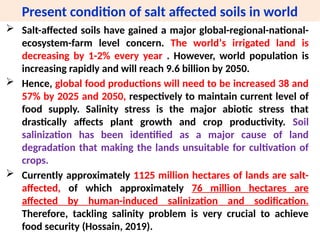
Salt-affected soils have gained a major global-regional-national-
ecosystem-farm level concern. The worldʼs irrigated land is
decreasing by 1-2% every year . However, world population is
increasing rapidly and will reach 9.6 billion by 2050.
Hence, global food productions will need to be increased 38 and
57% by 2025 and 2050, respectively to maintain current level of
food supply. Salinity stress is the major abiotic stress that
drastically affects plant growth and crop productivity. Soil
salinization has been identified as a major cause of land
degradation that making the lands unsuitable for cultivation of
crops.
Currently approximately 1125 million hectares of lands are salt-
affected, of which approximately 76 million hectares are
affected by human-induced salinization and sodification.
Therefore, tackling salinity problem is very crucial to achieve
food security (Hossain, 2019).
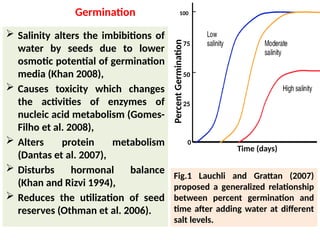
Germination
Salinity altersthe imbibitions of
water by seeds due to lower
osmotic potential of germination
media (Khan 2008),
Causes toxicity which changes
the activities of enzymes of
nucleic acid metabolism (Gomes-
Filho et al. 2008),
Alters protein metabolism
(Dantas et al. 2007),
Disturbs hormonal balance
(Khan and Rizvi 1994),
Reduces the utilization of seed
reserves (Othman et al. 2006).
Time (days)
Percent
Germination
Fig.1 Lauchli and Grattan (2007)
proposed a generalized relationship
between percent germination and
time after adding water at different
salt levels.
0
25
50
75
100
17.
Growth
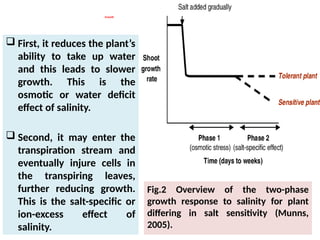
First, itreduces the plant’s
ability to take up water
and this leads to slower
growth. This is the
osmotic or water deficit
effect of salinity.
Second, it may enter the
transpiration stream and
eventually injure cells in
the transpiring leaves,
further reducing growth.
This is the salt-specific or
ion-excess effect of
salinity.
Fig.2 Overview of the two-phase
growth response to salinity for plant
differing in salt sensitivity (Munns,
2005).
18.
Photosynthetic pigments andphotosynthesis
In plants photosynthetic rates are reduced under salt
stress is mainly due to the reduction in water
potential. Photosynthesis is also inhibited due to
high concentrations of Na+
and/or Cl−
accumulated
in the chloroplasts (Zhang et al. 2005).
Decrease of chlorophyll content, these chlorophyll
concentration has been used as a sensitive indicator
of the cellular metabolic state (Chutipaijit et al.
2011).
In one of the studies in cucumber, it has been
shown that total leaf chlorophyll contents
significantly decreased with an increasing NaCl
levels (Khan et al. 2013).
19.
Water relation
Increase ofsalt in the root medium can lead to a
decrease in leaf water potential (Romero-Aranda et
al., 2001).
At very low soil water potentials, this condition
interferes with plant’s ability to extract water from
the soil and maintain turgor.
At low or moderate salt concentration (higher soil
water potential), plants adjust osmotically (accumulate
solutes) and maintain a potential gradient for the
influx of water.
In one of the experiments in Cucumis sativa, it has
been shown that the water potential decreases
linearly with increasing salinity levels (Khan et al.,
2013).
20.
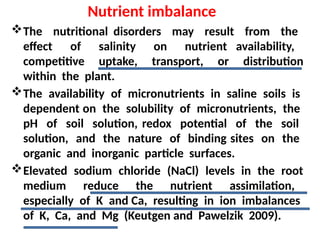
Nutrient imbalance
The nutritionaldisorders may result from the
effect of salinity on nutrient availability,
competitive uptake, transport, or distribution
within the plant.
The availability of micronutrients in saline soils is
dependent on the solubility of micronutrients, the
pH of soil solution, redox potential of the soil
solution, and the nature of binding sites on the
organic and inorganic particle surfaces.
Elevated sodium chloride (NaCl) levels in the root
medium reduce the nutrient assimilation,
especially of K and Ca, resulting in ion imbalances
of K, Ca, and Mg (Keutgen and Pawelzik 2009).
21.
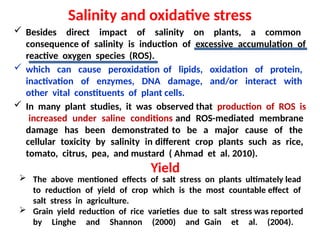
Salinity and oxidativestress
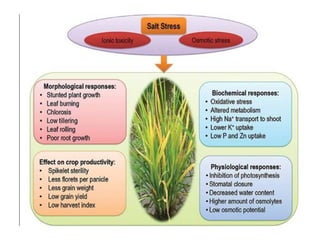
Besides direct impact of salinity on plants, a common
consequence of salinity is induction of excessive accumulation of
reactive oxygen species (ROS).
which can cause peroxidation of lipids, oxidation of protein,
inactivation of enzymes, DNA damage, and/or interact with
other vital constituents of plant cells.
In many plant studies, it was observed that production of ROS is
increased under saline conditions and ROS-mediated membrane
damage has been demonstrated to be a major cause of the
cellular toxicity by salinity in different crop plants such as rice,
tomato, citrus, pea, and mustard ( Ahmad et al. 2010).
Yield
The above mentioned effects of salt stress on plants ultimately lead
to reduction of yield of crop which is the most countable effect of
salt stress in agriculture.
Grain yield reduction of rice varieties due to salt stress was reported
by Linghe and Shannon (2000) and Gain et al. (2004).
• Salt stressInjury and Resistance in plants
• Practical ways to overcome the effect of salt
stress thought soil and crop manipulations
26.
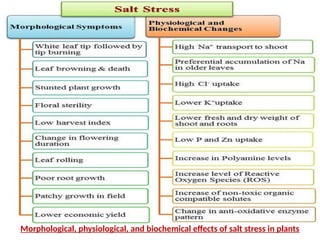
1.Inhibition of Photosynthesis
The stoma of plants is closed under salt stress cause seriously impedes
the diffusion of CO2 from the environment to the chloroplast, which
leads to a decrease in intercellular CO2 concentration and a decrease in
photosynthetic rate.
Long-term moderate salinity, short-term drought, and the combination
of these stressors decreased leaf pigment (Photosynthetic
pigment/chlorophyll) content by 11.4–31.5% in leaves of hybrid
Pennisetum (Li et al.,2020).
Salt stress also damage the ultrastructure of chloroplasts. Under salt
stress, the arrangement of chloroplasts in mesophyll cells is disordered,
the connection between granum is loose, the cavity in the thylakoid is
enlarged, the bilayer of chloroplast is damaged, and the lipid globules
are increased (Barhoumi et al., 2007).
Rubisco is a rate-limiting enzyme in photosynthesis. Salt stress reduces
the activity of Rubisco, and restricts the regeneration of ribulose-1, 5-
bisphosphate (RuBP), thus reducing the absorption and utilization of
CO2 by plants (Shu et al., 2014).
27.
2. Disturbance ofIon Homeostasis
Excessive Na+
is harmful to cell metabolism and some enzymes
(Flowers et al., 2015). A high concentration of Na+
leads to osmotic
imbalance, membrane dysfunction, increased production of ROS,
and thus affects cell division and growth(Yang et al., 2018).
Toxic effect of Na+
shows obvious competitive inhibition to K+
due
to its similar ionic radius and hydration energy to K+
. A large
amount of external Na+
influx will hamper K+
influx, which leads to
plant damage caused by K+
deficiency.
The Ca2+
level in cells is also decreased due to the competitive
inhibition of Na+
. The value of Ca2+
/Na+
reduced as a result of
increasing NaCl concentration in flowering of Japanese catnip
(Schizonepeta tenuifolia ) (Zhou et al., 2018).
The uptake of NH4
+
and NO3
−
by plants would also be inhibited
under salt stress (Song et al., 2006).
In short, salt stress disrupts ion homeostasis in plant cells, thus
affecting plant growth and development.
28.
3. Membrane Damage
Under salt stress, the production of excessive ROS causes
great damage to the membrane, increasing the membrane’s
relative permeability and reducing its fluidity.
It affects the selectivity, flow rate, and transportation of
ions. On the other hand, it also leads to the exosmosis of a
large number of electrolytes, resulting in osmotic stress
(Ganie et al., 2019).
Increased ROS can also destroy the structures of organelles
in cells, such as the expansion of the endoplasmic reticulum,
fragmentation of the vacuole membrane causing oxidative
stress and harming plant growth and development.
The destruction of plant cell structure, the accumulation of
ROS, and the disruption of ion homeostasis lead to the
decrease in protein synthesis rate.
29.
Indicators for SaltStress in Plants
Biomass is an indicator that can thoroughly represent the
growth of plants under salt stress. In general, plant biomass
decreases under salt stress, but the degree of decrease
depends on plants.
In tomato (Debouba et al., 2007) and sunflower (Shahbaz et
al., 2007), the biomass decreased on 50 mM NaCl
application while in wheat, rice, maize (El-Katony et al.,
2019), the decrease of total plant biomass was observed at
100–150 mM NaCl levels.
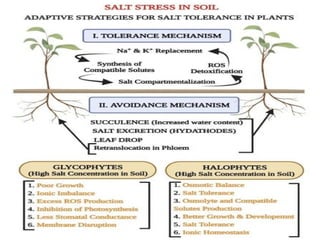
The biomass of halophytes like salicornia does not decrease
until the NaCl level is above 400 mM (Lv et al., 2012).
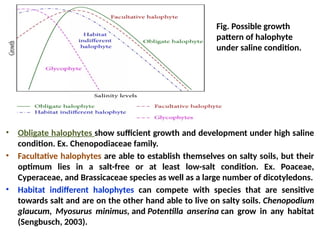
Fig. Possible growth
patternof halophyte
under saline condition.
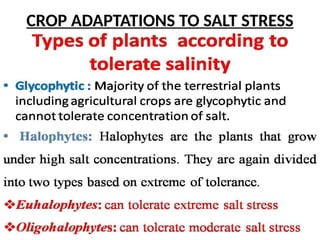
• Obligate halophytes show sufficient growth and development under high saline
condition. Ex. Chenopodiaceae family.
• Facultative halophytes are able to establish themselves on salty soils, but their
optimum lies in a salt-free or at least low-salt condition. Ex. Poaceae,
Cyperaceae, and Brassicaceae species as well as a large number of dicotyledons.
• Habitat indifferent halophytes can compete with species that are sensitive
towards salt and are on the other hand able to live on salty soils. Chenopodium
glaucum, Myosurus minimus, and Potentilla anserina can grow in any habitat
(Sengbusch, 2003).
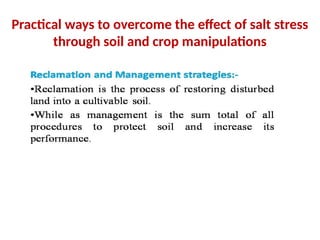
39.
Practical ways toovercome the effect of salt stress
through soil and crop manipulations