
SIGNALING MECHANISMS DUE TO
SALINITY STRESS
Presented by Ayesha Tariq
BS-B-14-33
BZU (Multan)
SALINITY STRESS
 salinity could be defined as the presence of minerals at
high levels (cations: Na, K, Mg, Ca and anions: Cl, NO3,
HCO3, SO4) in water and soil.
 Salinity is a major abiotic stress limiting growth and
productivity of plants in many areas of the world
due to increasing use of poor quality of water for
irrigation and soil salinization.
 High levels of salt in the soil can severely limit plant
growth and productivity.
EFFECT OF SALT STRESS :
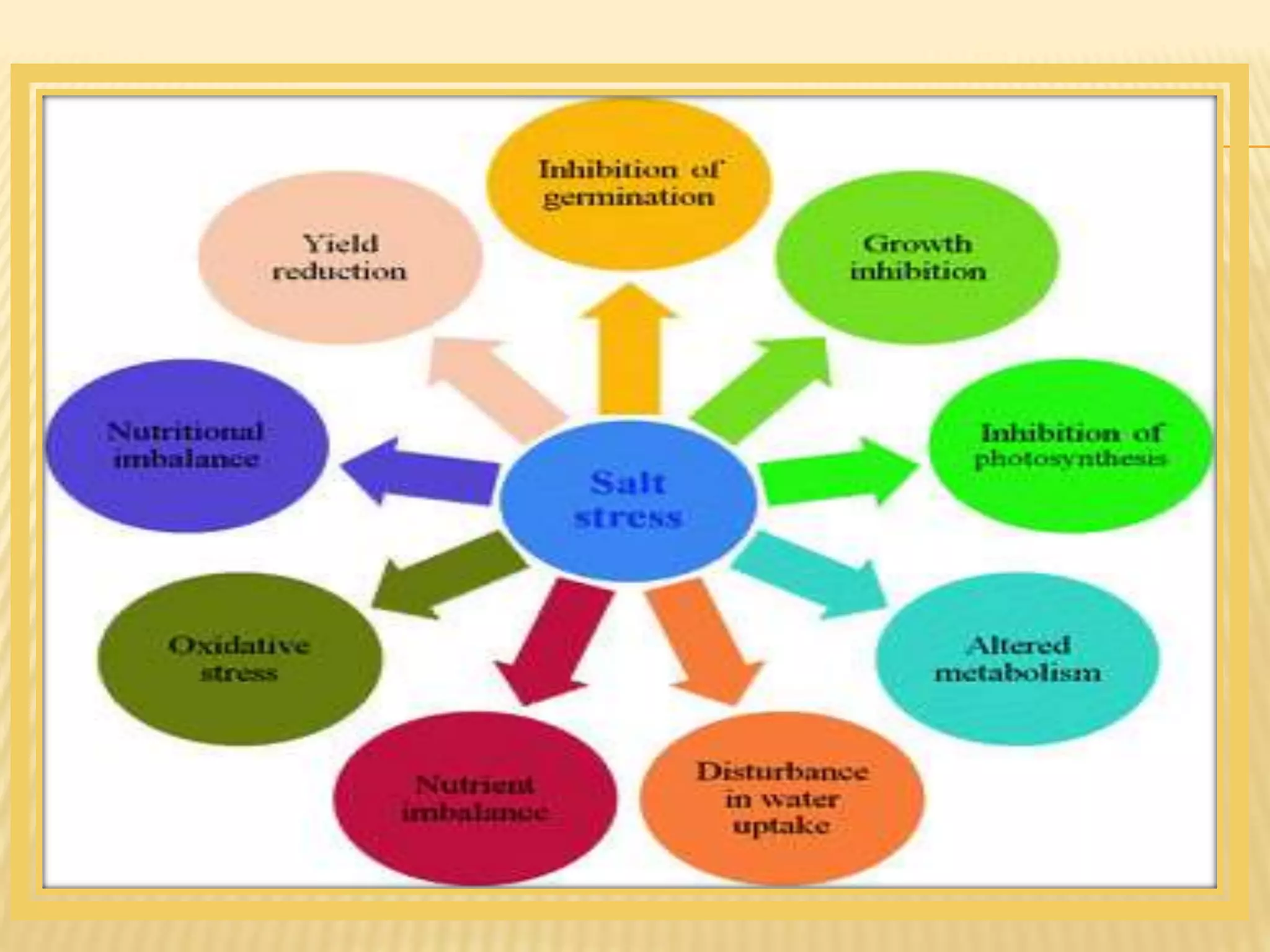
Salinity stress involves changes in various physiological
and metabolic processes depending on severity and
duration of the stress, and ultimately inhibits crop
production
 Osmotic effect
 Ionic effect
 Oxidative stress
PHYSIOLOGICALAND BIOCHEMICAL
MECHANISMS OF SALT TOLERANCE
 Ion homeostasis and compartmentalization
 Ion transport and uptake
 Biosynthesis of osmoprotectants and compatible solutes
 Activation of antioxidant enzyme and synthesis of antioxidant
compounds
 Synthesis of polyamines
 Generation of nitric oxide (NO)
 Hormone modulation
ION HOMEOSTASIS AND SALT TOLERANCE
Maintaining ion homeostasis by ion uptake and
compartmentalization is an essential process for growth during salt
stress Irrespective of their nature, both glycophytes and halophytes
cannot tolerate high salt concentration in their cytoplasm. Hence,
the excess salt is either transported to the vacuole or sequestered in
older tissues which protect the plant from salinity stress
 Major form of salt present in the soil is NaCl, so the main focus of
research is the study about the transport mechanism of Na+ ion and
its compartmentalization.
 The Na+ ion that enters the cytoplasm is then transported to the
vacuole via Na+/H+ antiporter.
 Two types of H+ pumps are present in the vacuolar membrane:
 vacuolar type H+-ATPase (V-ATPase)
 vacuolar pyrophosphatase (V Ppase).
 In hypocotyls of Vigna unguiculata seedlings, it was observed that
the activity of V-ATPase pump increased when exposed to salinity
stress but under similar conditions, activity of V-PPase was
inhibited, whereas in the case of halophyte Suaeda salsa,
 V-ATPase activity was upregulated and V-PPase played a minor
role
SOS SIGNALING PATHWAY
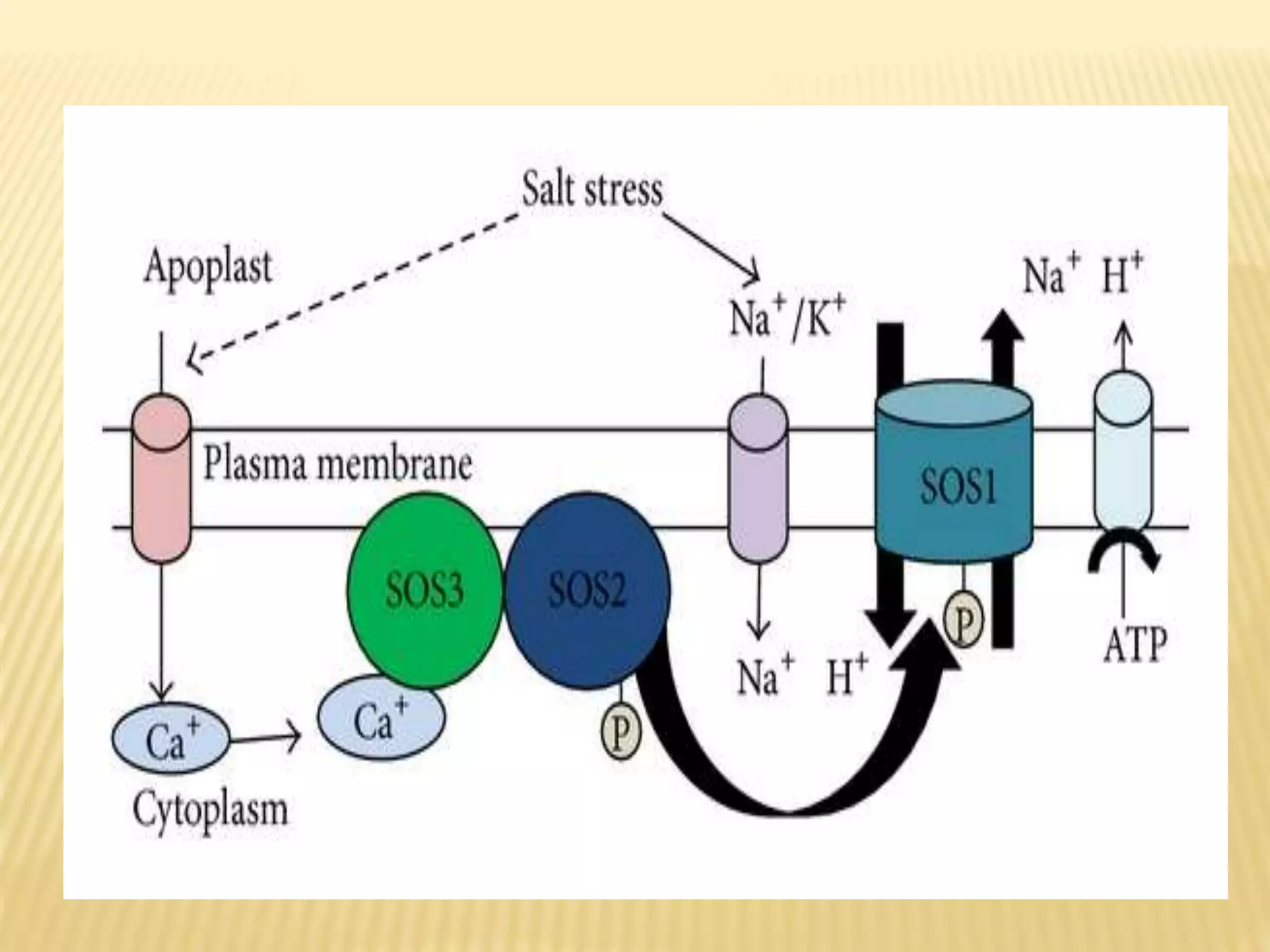
Salt Overly Sensitive (SOS) signaling pathway play important role
in ion homeostasis and salt tolerance. The SOS signaling pathway
consists of three major proteins
SOS1: which encodes a plasma membrane Na+/H+ antiporter, is
essential in regulating Na+ efflux at cellular level.
SOS2: which encodes a serine/threonine kinase, is activated by
salt stress elicited Ca+ signals.
SOS3 : which is a myristoylated Ca+ binding protein and contains
a myristoylation site at its N-terminus
Many plants have developed an efficient method to keep the ion
concentration in the cytoplasm in a low level
Membranes with their associated components maintain
concentration within the cytosol.
The transport phenomenon is carried out by different carrier
proteins, channel proteins, antiporter and symporters.
Arabidopsis NADPH oxidases AtrbohD and AtrbohF function in
ROS-dependent regulation of Na+/K+ homeostasis in Arabidopsis
under salt stress.
A large number of genes and proteins, such as HKT and NHX,
encoding K+ transporters and channels have been identified in
various plant species
COMPATIBLE SOLUTE ACCUMULATION AND
OSMOTIC PROTECTION
 Compatible solutes also known as compatible osmolytes, are a
group of chemically diverse organic compounds that are
uncharged, polar, and soluble in nature and do not interfere with
the cellular metabolism even at high concentration
they mainly include
 proline
 glycine betaine
 sugar
 polyols
the major functions of these osmolytes are to protect the structure
and to maintain osmotic balance within the cell via continuous
water influx
ANTIOXIDANT REGULATION OF SALINITY
TOLERANCE
 Abiotic and biotic stress in living organisms, including plants, can
cause overflow, deregulation, or even disruption of electron
transport chains (ETC) in chloroplasts and mitochondria. Under
these conditions molecular oxygen (O2) acts as an electron
acceptor, giving rise to the accumulation of ROS.
 Antioxidant metabolism, including antioxidant enzymes and non
enzymatic compounds, play critical parts in detoxifying ROS
induced by salinity stress.
Salinity tolerance is regulated by the activity of antioxidant enzymes, such as
superoxide dismutase (SOD),
catalase (CAT),
glutathione peroxidise (GPX),
ascorbate peroxidase (APX),
glutathione reductase (GR)
And nonenzymatic antioxidant compounds .
Gill and Tuteja have recently reported a couple of helicase proteins (e.g.,
DESD-box helicase and OsSUV3 dual helicase) functioning in plant
salinity tolerance by improving/maintaining photosynthesis and antioxidant
machinery.
Si treatments reduced the sodium accumulation resulting in low electrolytic
leakage and lipid peroxidation compared to control plants under salinity
stress
HORMONE REGULATION OF SALINITY
TOLERANCE
 ABA is an important phytohormone which is upregulated due to
soil water deficit around the root. Salinity stress causes osmotic
stress and water deficit, increasing the production of ABA in
shoots and roots.
 The accumulation of ABA can mitigate the inhibitory effect of
salinity on photosynthesis, growth, and translocation of
assimilates
 The positive relationship between ABA accumulation and salinity
tolerance has been at least partially attributed to the accumulation
of K+, Ca2+ and compatible solutes, such as proline and sugars, in
vacuoles of roots, which counteract with the uptake of Na+ and
Cl− .
ABA is a vital cellular signal that modulates the expression of a
number of salt and water deficit-responsive genes.ABA cause the
expression of two genes:
HVP1 andHVP10, for vacuolar H+-inorganic pyrophosphatase,
HvVHA-A, for the catalytic subunit (subunit A) of vacuolar H+-
ATPase in Hordeum vulgare under salinity stress.
ABA treatment in wheat induced the expression of MAPK4-like,
TIP 1, and GLP 1 genes under salinity stress
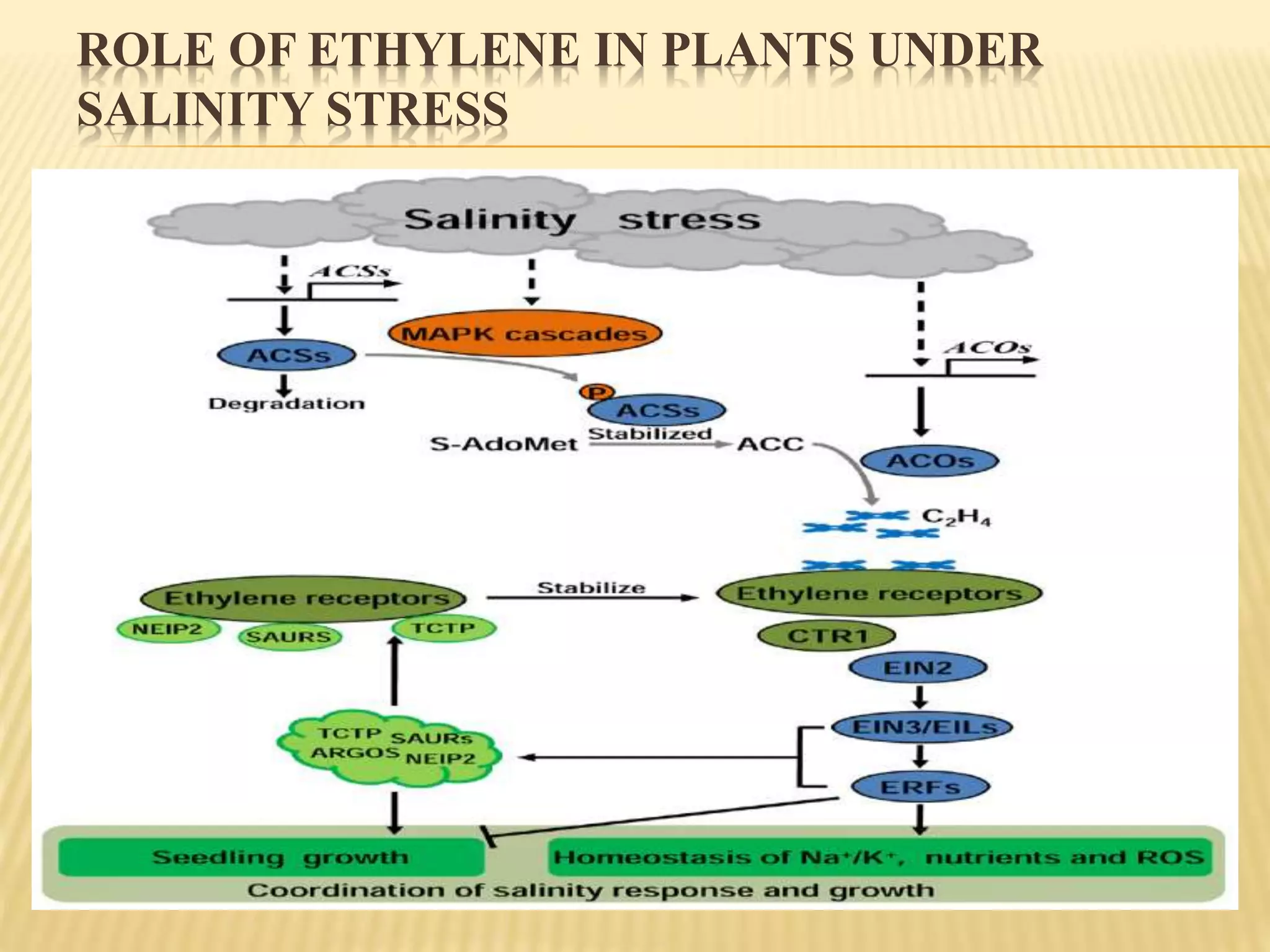
ROLE OF ETHYLENE IN PLANTS UNDER
SALINITY STRESS
ROLES OF POLYAMINES IN SALINITY
TOLERANCE
Polyamines (PA) are small, low molecular weight, ubiquitous,
polycationic aliphatic molecules widely distributed throughout the
plant kingdom.
It plays a crucial role in salinity stress and increases in the level of
polyamines are correlated with stress tolerance in plants
The most common polyamines that are found within the
plant system are
diamine putrescine (PUT),
triamine spermidine (SPD)
tetra-amine spermine (SPM)
when the plant is exposed to salinity stress the
level of endogenous polyamine increases.
Polyamines are oxidatively catabolised by
amine oxidases which include
copper binding diamine oxidases
FAD binding polyamine oxidases.
These enzymes play a significant role in stress
tolerance
APPLICATION OF EXOGENOUS POLYAMINE
 regulation of gene expression for the synthesis of
osmotically-active solutes,
 reduction in ROS production,
 controlling accumulation of Na+ and Cl− ion in
different organs
 the maintenance of membrane integrity,
Signaling mechanisms due to salinity stress

Signaling mechanisms due to salinity stress

  • 1.
    SIGNALING MECHANISMS DUETO SALINITY STRESS Presented by Ayesha Tariq BS-B-14-33 BZU (Multan)
  • 2.
    SALINITY STRESS  salinitycould be defined as the presence of minerals at high levels (cations: Na, K, Mg, Ca and anions: Cl, NO3, HCO3, SO4) in water and soil.  Salinity is a major abiotic stress limiting growth and productivity of plants in many areas of the world due to increasing use of poor quality of water for irrigation and soil salinization.  High levels of salt in the soil can severely limit plant growth and productivity.
  • 4.
    EFFECT OF SALTSTRESS : Salinity stress involves changes in various physiological and metabolic processes depending on severity and duration of the stress, and ultimately inhibits crop production  Osmotic effect  Ionic effect  Oxidative stress
  • 5.
    PHYSIOLOGICALAND BIOCHEMICAL MECHANISMS OFSALT TOLERANCE  Ion homeostasis and compartmentalization  Ion transport and uptake  Biosynthesis of osmoprotectants and compatible solutes  Activation of antioxidant enzyme and synthesis of antioxidant compounds  Synthesis of polyamines  Generation of nitric oxide (NO)  Hormone modulation
  • 6.
    ION HOMEOSTASIS ANDSALT TOLERANCE Maintaining ion homeostasis by ion uptake and compartmentalization is an essential process for growth during salt stress Irrespective of their nature, both glycophytes and halophytes cannot tolerate high salt concentration in their cytoplasm. Hence, the excess salt is either transported to the vacuole or sequestered in older tissues which protect the plant from salinity stress
  • 7.
     Major formof salt present in the soil is NaCl, so the main focus of research is the study about the transport mechanism of Na+ ion and its compartmentalization.  The Na+ ion that enters the cytoplasm is then transported to the vacuole via Na+/H+ antiporter.  Two types of H+ pumps are present in the vacuolar membrane:  vacuolar type H+-ATPase (V-ATPase)  vacuolar pyrophosphatase (V Ppase).  In hypocotyls of Vigna unguiculata seedlings, it was observed that the activity of V-ATPase pump increased when exposed to salinity stress but under similar conditions, activity of V-PPase was inhibited, whereas in the case of halophyte Suaeda salsa,  V-ATPase activity was upregulated and V-PPase played a minor role
  • 8.
    SOS SIGNALING PATHWAY SaltOverly Sensitive (SOS) signaling pathway play important role in ion homeostasis and salt tolerance. The SOS signaling pathway consists of three major proteins SOS1: which encodes a plasma membrane Na+/H+ antiporter, is essential in regulating Na+ efflux at cellular level. SOS2: which encodes a serine/threonine kinase, is activated by salt stress elicited Ca+ signals. SOS3 : which is a myristoylated Ca+ binding protein and contains a myristoylation site at its N-terminus
  • 10.
    Many plants havedeveloped an efficient method to keep the ion concentration in the cytoplasm in a low level Membranes with their associated components maintain concentration within the cytosol. The transport phenomenon is carried out by different carrier proteins, channel proteins, antiporter and symporters. Arabidopsis NADPH oxidases AtrbohD and AtrbohF function in ROS-dependent regulation of Na+/K+ homeostasis in Arabidopsis under salt stress. A large number of genes and proteins, such as HKT and NHX, encoding K+ transporters and channels have been identified in various plant species
  • 11.
    COMPATIBLE SOLUTE ACCUMULATIONAND OSMOTIC PROTECTION  Compatible solutes also known as compatible osmolytes, are a group of chemically diverse organic compounds that are uncharged, polar, and soluble in nature and do not interfere with the cellular metabolism even at high concentration they mainly include  proline  glycine betaine  sugar  polyols the major functions of these osmolytes are to protect the structure and to maintain osmotic balance within the cell via continuous water influx
  • 12.
    ANTIOXIDANT REGULATION OFSALINITY TOLERANCE  Abiotic and biotic stress in living organisms, including plants, can cause overflow, deregulation, or even disruption of electron transport chains (ETC) in chloroplasts and mitochondria. Under these conditions molecular oxygen (O2) acts as an electron acceptor, giving rise to the accumulation of ROS.  Antioxidant metabolism, including antioxidant enzymes and non enzymatic compounds, play critical parts in detoxifying ROS induced by salinity stress.
  • 13.
    Salinity tolerance isregulated by the activity of antioxidant enzymes, such as superoxide dismutase (SOD), catalase (CAT), glutathione peroxidise (GPX), ascorbate peroxidase (APX), glutathione reductase (GR) And nonenzymatic antioxidant compounds . Gill and Tuteja have recently reported a couple of helicase proteins (e.g., DESD-box helicase and OsSUV3 dual helicase) functioning in plant salinity tolerance by improving/maintaining photosynthesis and antioxidant machinery. Si treatments reduced the sodium accumulation resulting in low electrolytic leakage and lipid peroxidation compared to control plants under salinity stress
  • 14.
    HORMONE REGULATION OFSALINITY TOLERANCE  ABA is an important phytohormone which is upregulated due to soil water deficit around the root. Salinity stress causes osmotic stress and water deficit, increasing the production of ABA in shoots and roots.  The accumulation of ABA can mitigate the inhibitory effect of salinity on photosynthesis, growth, and translocation of assimilates  The positive relationship between ABA accumulation and salinity tolerance has been at least partially attributed to the accumulation of K+, Ca2+ and compatible solutes, such as proline and sugars, in vacuoles of roots, which counteract with the uptake of Na+ and Cl− .
  • 15.
    ABA is avital cellular signal that modulates the expression of a number of salt and water deficit-responsive genes.ABA cause the expression of two genes: HVP1 andHVP10, for vacuolar H+-inorganic pyrophosphatase, HvVHA-A, for the catalytic subunit (subunit A) of vacuolar H+- ATPase in Hordeum vulgare under salinity stress. ABA treatment in wheat induced the expression of MAPK4-like, TIP 1, and GLP 1 genes under salinity stress
  • 16.
    ROLE OF ETHYLENEIN PLANTS UNDER SALINITY STRESS
  • 17.
    ROLES OF POLYAMINESIN SALINITY TOLERANCE Polyamines (PA) are small, low molecular weight, ubiquitous, polycationic aliphatic molecules widely distributed throughout the plant kingdom. It plays a crucial role in salinity stress and increases in the level of polyamines are correlated with stress tolerance in plants The most common polyamines that are found within the plant system are diamine putrescine (PUT), triamine spermidine (SPD) tetra-amine spermine (SPM)
  • 18.
    when the plantis exposed to salinity stress the level of endogenous polyamine increases. Polyamines are oxidatively catabolised by amine oxidases which include copper binding diamine oxidases FAD binding polyamine oxidases. These enzymes play a significant role in stress tolerance
  • 19.
    APPLICATION OF EXOGENOUSPOLYAMINE  regulation of gene expression for the synthesis of osmotically-active solutes,  reduction in ROS production,  controlling accumulation of Na+ and Cl− ion in different organs  the maintenance of membrane integrity,