GREEN
MANUFACTURING
Presented by
Milind A. Pelagade
(ME15F11F016)
(ME Production 1st year)
Introduction
• We are consuming natural resources day by day on larger
extent ultimately causing their stocks to cease in the earth’s
crust.
• Larger Consumption causing environmental hazards like water
pollution, air pollution ,depletion of ozone layer.
• Need to find alternate resources to cope with the effects on
environment.
• As far as industries are concerned they consume maximum
amount of natural resources like Coal, Diesel, etc. causing their
stocks to get exhausted in 50-60 years from now.
• Industries has to take some initiatives to lower the effects on
environment.
• Taking Green initiatives will aim to minimize impact of human
activities on environment.
• Green Manufacturing an emerging field in the recent years
taken by industries.
Approaches to Environmental
Issues
• Concept Approach :-
organizations employ environmental protection measures
and think of biodegradable products.
• Compliance Approach :-
organizations comply with the environmental regulations
and also think ahead of continual improvement.
• System Approach :-
handle environmental issues by implementing green
manufacturing as a system.
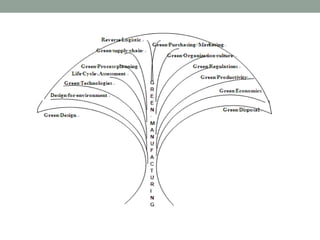
Green Manufacturing
• Creating manufactured product that use processes that are non-
polluting, conserve energy and natural resources and are
economically sound for employee, community and consumer.
• The design, processing and commercial use of materials
processes and products, which are economical and sustainable
while minimizing pollution and risk to human health and the
environment.
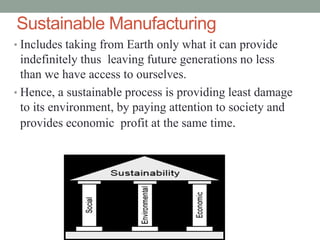
Sustainable Manufacturing
• Includes taking from Earth only what it can provide
indefinitely thus leaving future generations no less
than we have access to ourselves.
• Hence, a sustainable process is providing least damage
to its environment, by paying attention to society and
provides economic profit at the same time.
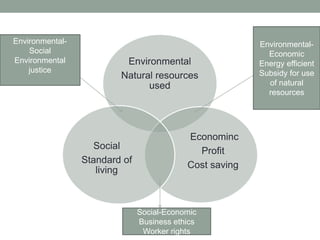
Environmental
Natural resources
used
Econominc
Profit
Cost saving
Social
Standard of
living
Environmental-
Economic
Energy efficient
Subsidy for use
of natural
resources
Environmental-
Social
Environmental
justice
Social-Economic
Business ethics
Worker rights
Necessity
 Customers are environment conscious.
 Environmental protection is a top agenda for everyone.
 Reasons for environmental care
 running out of fossil fuel supply (energy crisis)
global warming
 depletion of the ozone layer
 loss of trees and forest
 Green manufacturing is a challenge for today but as
Business opportunities for tomorrow.
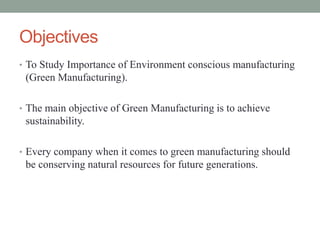
Objectives
• To Study Importance of Environment conscious manufacturing
(Green Manufacturing).
• The main objective of Green Manufacturing is to achieve
sustainability.
• Every company when it comes to green manufacturing should
be conserving natural resources for future generations.
Literature Review
• Perminder Jit Singh et.al.[2], in July 2011 studied
“Management commitment and employee Empowerment in
Environmentally Conscious Manufacturing Implementation”.
• investigated that commitment of management and
empowerment of employees boosts the implementation of
newer manufacturing techniques for attaining sustainability.
• concluded that collective efforts of upper management, middle
management and empowered can lead to implementation of
environmentally conscious manufacturing (ECM).
• Dr. Y. Madhuri Srinivas et.al.[3], in the year 2011 studied
“Initiatives for Green Manufacturing in India”.
• investigated that a conscious strategy is being pursued by Indian
companies to align their businesses to serve a larger societal
purpose.
• concluded that The goal of initiating green manufacturing is to
allow manufacturers to balance environmental concerns with
profitability
• Dr. Devi K. Kalla et.al. [4], in the year 2012 have studied
“Infusing A Sustainable Green Manufacturing Course into
Manufacturing/Mechanical Engineering Technology Program”.
• Sustainable green manufacturing encompasses the concept of
combining technical issues of design and manufacturing with
energy conservation and other things.
• concluded that they had no doubt over Sustainable GM will
continue to be developing being a benefit to the society and
improving environment in many ways.
• David Alan Dornfeld [5], in December, 2013 has studied
“Moving towards green and Sustainable Manufacturing”. ‘
• investigated the pressing need of energy, water and resources
conservation worldwide is a major engineering challenge
• To conclude he said that process, machine factory, system, and
enterprise contributes to bring sustainability to the
manufacturing process.
• Minhaj Ahmed.A.Rehman et.al.[6], in the year 2013 have
studied “Validating Green Manufacturing (GM) framework for
sustainable development in an Indian Steel Industry”.
• have conducted a case study to an industry implementing green
manufacturing and its impact on organizational performance
• concluded that GM approach can be used to benchmark
company’s continuous improvement, self asses their quality
improvement efforts and measure their progress over the time.
• Varinder Kumar Mittal et.al.[7], in the year 2014 studied
“Prioritizing Barriers to Green Manufacturing: Environmental,
Social and Economic Perspectives”.
• Investigated that emerging (Developing) countries having
limited sources has to prioritize barriers that are responsible for
implementing green manufacturing. Three perspective like
environmental, social and economic are prioritized using fuzzy
TOPSIS model.
• Concluded that lack of awareness/information, technological
risk and weak legislation are three most important barriers to
GM
Green Manufacturing Scenario
• Green manufacturing' is successfully operating in countries like
the US and Europe
• USA:-
No of firms doing remanufacturing:- 73000
Employing 3,50,000 people with total sales accounting for
$ 53 billion per year
• Japan:-
auto market recovery is said to be partly stimulated by tax
cuts or rebates for consumers to scrap their old cars and buy
ecological vehicles.
• Germany:-
German government’s stimulus involves paying consumers
2,500 euros for scrapping old cars to buy new, environmentally
cleaner vehicles
• China:-
plans to subsidize purchases of energy efficient cars and
home appliances to replace older models
Green Manufacturing in India
• 1st Green Manufacturing Summit on the 7th of October,2010, at
New Delhi aiming at promoting green manufacturing.
• The Government of India is also considering the setting up of a
National Equity Fund to help green field projects and new
generation entrepreneurs.
• already initiated a number of schemes to encourage
sustainability such as the Indian Renewable Energy
Development Agency (IREDA)
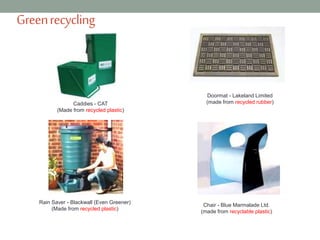
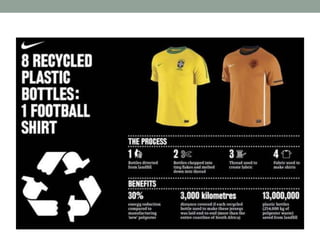
Greenrecycling
Doormat - Lakeland Limited
(made from recycled rubber)Caddies - CAT
(Made from recycled plastic)
Chair - Blue Marmalade Ltd.
(made from recyclable plastic)
Rain Saver - Blackwall (Even Greener)
(Made from recycled plastic)
Emerging Technologies in Green
Manufacturing
• there is a plethora of new and emerging technologies that aid in
both, making the traditional businesses Greener, as well as
creating completely new ones.
• For example, technologies for reducing GHG can be classified
into five broad categories:
• Carbon sinks:-
These technologies enable capturing and storing CO2
in ways such that it does not enter the atmosphere
• Efficient fuels
This category encompasses a class of technologies that use
cleaner fuels for generating power.
• Consumer Green
This involves using clean and efficient fuels at the user end
and solutions covering demand side management.(Solar Water
Heaters)
• Green transportation
Electric vehicles, fuel cells, and bio–diesel are some
examples of this category.
• Industry efficiency
This category refers to the use of Green production
methods and technologies in traditional industries to increase
efficiency.
Framework for Adapting Green
Technology
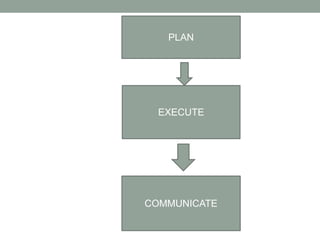
• A simple three–step implementation framework can be
followed covering all three areas of action – Green
energy, Green products and Green processes:-
• Plan
• Execute
• Communicate
PLAN
COMMUNICATE
EXECUTE
FORD FIELD (case study)
Originally constructed in 2002
As part of an aggressive recycling program, they annually
use
50 million bottles to make grill opening reinforcements.
about 1 billion bottle caps to make heating and air conditioning
components.
• Wooden Flooring
bamboo grows very quickly and is therefore an easily renewable
resource.
Bamboo flooring was used in the suites and elevator foyers.
Another environmentally friendly material found underfoot at
Ford Field is Recycled glass was mixed into the terrazzo flooring
that was installed on the club and suite levels
while restroom-stall dividers at the facility are made from
recycled plastic soft drink bottles.
• Playing Field
the most remarkable example of recycled material at Ford
Field.
The Field Turf surface looks and feels like grass, but Field
Turf fibers are actually made from a polyethylene and polypropylene
blend.
The fibers are tufted into a unique porous backing that
provides drainage and are held in place with an infill made of silica
sand and crumb rubber.
Approximately 25,000 recycled tires were converted into
crumb rubber for use at Ford Field
• Electrical Consumption
Electrical consumption at Ford Field is also carefully
regulated by a computer-controlled monitoring system,
and all mechanical motors in the facility feature variable
frequency drives that allow them to be run at their most efficient
setting.
Energy efficient ballasts were used in the fluorescent lights
and many of the fixtures are controlled by motion sensors that
deactivate the lights when a room is no longer occupied.
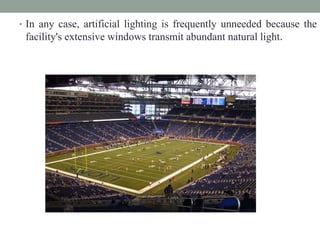
• In any case, artificial lighting is frequently unneeded because the
facility's extensive windows transmit abundant natural light.
Conclusion
• Green manufacturing is not an option, but a necessity for our
well-being and survival.
• Our needs are likely to increase as standard of living and
population increases. Accordingly we’ll have to change our
current practices.
Future Scope
References
1. Arindam Bhattacharya, Rahul Jain, Amar Choudhary, “Report on Green
Manufacturing Energy, Products and Processes” on March 2011,IEEE Journal.
2. Perminder Jit Singh “Management commitment and employee Empowerment in
Environmentally Conscious Manufacturing Implementation” in July 2011.
3. Dr. Y. Madhuri Srinivas, Dr. Mohd. Abbas Ali “Initiatives for Green Manufacturing
in India” CLEAR International Journal of Research in Commerce and Management
Vol-1 No-1 Jan-Jun 2011
4. Tan Lin Sheng, Mohd Zamri bin Shamsudin , Loh Chin Ling “Sustainable
Development with Green Productivity in Manufacturing” IEEE journal, 2011.
5. Dr. Devi k. Kalla, prof. Aaron brown “Infusing a sustainable green manufacturing
Course into manufacturing/mechanical engineering technology Program” American
Society for Engineering Education, 2012.
6. Minhaj Ahemad.A.Rehman, R. R Shrivastava, Rakesh. L Shrivastava “ Validating
Green Manufacturing (GM) Framework for Sustainable Development in an Indian
Steel Industry” Universal Journal of Mechanical Engineering 1(2): 49-61,2013DOI:
10.13189/ujme.2013.010204
7. David Alan Dornfeld “Moving Towards Green and Sustainable Manufacturing”
International Journal of Precision Engineering and Manufacturing-Green
Technology vol. 1, no. 1, pp. 63-66 January 2014 / 63.
8. Varinder Kumar Mittal, Kuldip Singh Sangwan “Prioritizing Barriers to Green
Manufacturing: Environmental, Social and Economic Perspectives” 47th CIRP
Conference on Manufacturing Systems 2212-8271 © 2014 Elsevier B.V.

Seminar on GREEN MANUFACTURING

  • 1.
    GREEN MANUFACTURING Presented by Milind A.Pelagade (ME15F11F016) (ME Production 1st year)
  • 2.
    Introduction • We areconsuming natural resources day by day on larger extent ultimately causing their stocks to cease in the earth’s crust. • Larger Consumption causing environmental hazards like water pollution, air pollution ,depletion of ozone layer. • Need to find alternate resources to cope with the effects on environment. • As far as industries are concerned they consume maximum amount of natural resources like Coal, Diesel, etc. causing their stocks to get exhausted in 50-60 years from now.
  • 3.
    • Industries hasto take some initiatives to lower the effects on environment. • Taking Green initiatives will aim to minimize impact of human activities on environment. • Green Manufacturing an emerging field in the recent years taken by industries.
  • 4.
    Approaches to Environmental Issues •Concept Approach :- organizations employ environmental protection measures and think of biodegradable products. • Compliance Approach :- organizations comply with the environmental regulations and also think ahead of continual improvement. • System Approach :- handle environmental issues by implementing green manufacturing as a system.
  • 5.
    Green Manufacturing • Creatingmanufactured product that use processes that are non- polluting, conserve energy and natural resources and are economically sound for employee, community and consumer. • The design, processing and commercial use of materials processes and products, which are economical and sustainable while minimizing pollution and risk to human health and the environment.
  • 7.
    Sustainable Manufacturing • Includestaking from Earth only what it can provide indefinitely thus leaving future generations no less than we have access to ourselves. • Hence, a sustainable process is providing least damage to its environment, by paying attention to society and provides economic profit at the same time.
  • 8.
    Environmental Natural resources used Econominc Profit Cost saving Social Standardof living Environmental- Economic Energy efficient Subsidy for use of natural resources Environmental- Social Environmental justice Social-Economic Business ethics Worker rights
  • 9.
    Necessity  Customers areenvironment conscious.  Environmental protection is a top agenda for everyone.  Reasons for environmental care  running out of fossil fuel supply (energy crisis) global warming  depletion of the ozone layer  loss of trees and forest  Green manufacturing is a challenge for today but as Business opportunities for tomorrow.
  • 10.
    Objectives • To StudyImportance of Environment conscious manufacturing (Green Manufacturing). • The main objective of Green Manufacturing is to achieve sustainability. • Every company when it comes to green manufacturing should be conserving natural resources for future generations.
  • 11.
    Literature Review • PerminderJit Singh et.al.[2], in July 2011 studied “Management commitment and employee Empowerment in Environmentally Conscious Manufacturing Implementation”. • investigated that commitment of management and empowerment of employees boosts the implementation of newer manufacturing techniques for attaining sustainability. • concluded that collective efforts of upper management, middle management and empowered can lead to implementation of environmentally conscious manufacturing (ECM).
  • 12.
    • Dr. Y.Madhuri Srinivas et.al.[3], in the year 2011 studied “Initiatives for Green Manufacturing in India”. • investigated that a conscious strategy is being pursued by Indian companies to align their businesses to serve a larger societal purpose. • concluded that The goal of initiating green manufacturing is to allow manufacturers to balance environmental concerns with profitability
  • 13.
    • Dr. DeviK. Kalla et.al. [4], in the year 2012 have studied “Infusing A Sustainable Green Manufacturing Course into Manufacturing/Mechanical Engineering Technology Program”. • Sustainable green manufacturing encompasses the concept of combining technical issues of design and manufacturing with energy conservation and other things. • concluded that they had no doubt over Sustainable GM will continue to be developing being a benefit to the society and improving environment in many ways.
  • 14.
    • David AlanDornfeld [5], in December, 2013 has studied “Moving towards green and Sustainable Manufacturing”. ‘ • investigated the pressing need of energy, water and resources conservation worldwide is a major engineering challenge • To conclude he said that process, machine factory, system, and enterprise contributes to bring sustainability to the manufacturing process.
  • 15.
    • Minhaj Ahmed.A.Rehmanet.al.[6], in the year 2013 have studied “Validating Green Manufacturing (GM) framework for sustainable development in an Indian Steel Industry”. • have conducted a case study to an industry implementing green manufacturing and its impact on organizational performance • concluded that GM approach can be used to benchmark company’s continuous improvement, self asses their quality improvement efforts and measure their progress over the time.
  • 16.
    • Varinder KumarMittal et.al.[7], in the year 2014 studied “Prioritizing Barriers to Green Manufacturing: Environmental, Social and Economic Perspectives”. • Investigated that emerging (Developing) countries having limited sources has to prioritize barriers that are responsible for implementing green manufacturing. Three perspective like environmental, social and economic are prioritized using fuzzy TOPSIS model. • Concluded that lack of awareness/information, technological risk and weak legislation are three most important barriers to GM
  • 17.
    Green Manufacturing Scenario •Green manufacturing' is successfully operating in countries like the US and Europe • USA:- No of firms doing remanufacturing:- 73000 Employing 3,50,000 people with total sales accounting for $ 53 billion per year • Japan:- auto market recovery is said to be partly stimulated by tax cuts or rebates for consumers to scrap their old cars and buy ecological vehicles.
  • 18.
    • Germany:- German government’sstimulus involves paying consumers 2,500 euros for scrapping old cars to buy new, environmentally cleaner vehicles • China:- plans to subsidize purchases of energy efficient cars and home appliances to replace older models
  • 19.
    Green Manufacturing inIndia • 1st Green Manufacturing Summit on the 7th of October,2010, at New Delhi aiming at promoting green manufacturing. • The Government of India is also considering the setting up of a National Equity Fund to help green field projects and new generation entrepreneurs. • already initiated a number of schemes to encourage sustainability such as the Indian Renewable Energy Development Agency (IREDA)
  • 20.
    Greenrecycling Doormat - LakelandLimited (made from recycled rubber)Caddies - CAT (Made from recycled plastic) Chair - Blue Marmalade Ltd. (made from recyclable plastic) Rain Saver - Blackwall (Even Greener) (Made from recycled plastic)
  • 22.
    Emerging Technologies inGreen Manufacturing • there is a plethora of new and emerging technologies that aid in both, making the traditional businesses Greener, as well as creating completely new ones. • For example, technologies for reducing GHG can be classified into five broad categories: • Carbon sinks:- These technologies enable capturing and storing CO2 in ways such that it does not enter the atmosphere
  • 23.
    • Efficient fuels Thiscategory encompasses a class of technologies that use cleaner fuels for generating power. • Consumer Green This involves using clean and efficient fuels at the user end and solutions covering demand side management.(Solar Water Heaters) • Green transportation Electric vehicles, fuel cells, and bio–diesel are some examples of this category. • Industry efficiency This category refers to the use of Green production methods and technologies in traditional industries to increase efficiency.
  • 24.
    Framework for AdaptingGreen Technology • A simple three–step implementation framework can be followed covering all three areas of action – Green energy, Green products and Green processes:- • Plan • Execute • Communicate
  • 25.
  • 26.
    FORD FIELD (casestudy) Originally constructed in 2002 As part of an aggressive recycling program, they annually use 50 million bottles to make grill opening reinforcements. about 1 billion bottle caps to make heating and air conditioning components.
  • 27.
    • Wooden Flooring bamboogrows very quickly and is therefore an easily renewable resource. Bamboo flooring was used in the suites and elevator foyers. Another environmentally friendly material found underfoot at Ford Field is Recycled glass was mixed into the terrazzo flooring that was installed on the club and suite levels while restroom-stall dividers at the facility are made from recycled plastic soft drink bottles.
  • 28.
    • Playing Field themost remarkable example of recycled material at Ford Field. The Field Turf surface looks and feels like grass, but Field Turf fibers are actually made from a polyethylene and polypropylene blend. The fibers are tufted into a unique porous backing that provides drainage and are held in place with an infill made of silica sand and crumb rubber. Approximately 25,000 recycled tires were converted into crumb rubber for use at Ford Field
  • 29.
    • Electrical Consumption Electricalconsumption at Ford Field is also carefully regulated by a computer-controlled monitoring system, and all mechanical motors in the facility feature variable frequency drives that allow them to be run at their most efficient setting. Energy efficient ballasts were used in the fluorescent lights and many of the fixtures are controlled by motion sensors that deactivate the lights when a room is no longer occupied.
  • 30.
    • In anycase, artificial lighting is frequently unneeded because the facility's extensive windows transmit abundant natural light.
  • 31.
    Conclusion • Green manufacturingis not an option, but a necessity for our well-being and survival. • Our needs are likely to increase as standard of living and population increases. Accordingly we’ll have to change our current practices.
  • 32.
  • 33.
    References 1. Arindam Bhattacharya,Rahul Jain, Amar Choudhary, “Report on Green Manufacturing Energy, Products and Processes” on March 2011,IEEE Journal. 2. Perminder Jit Singh “Management commitment and employee Empowerment in Environmentally Conscious Manufacturing Implementation” in July 2011. 3. Dr. Y. Madhuri Srinivas, Dr. Mohd. Abbas Ali “Initiatives for Green Manufacturing in India” CLEAR International Journal of Research in Commerce and Management Vol-1 No-1 Jan-Jun 2011 4. Tan Lin Sheng, Mohd Zamri bin Shamsudin , Loh Chin Ling “Sustainable Development with Green Productivity in Manufacturing” IEEE journal, 2011. 5. Dr. Devi k. Kalla, prof. Aaron brown “Infusing a sustainable green manufacturing Course into manufacturing/mechanical engineering technology Program” American Society for Engineering Education, 2012. 6. Minhaj Ahemad.A.Rehman, R. R Shrivastava, Rakesh. L Shrivastava “ Validating Green Manufacturing (GM) Framework for Sustainable Development in an Indian Steel Industry” Universal Journal of Mechanical Engineering 1(2): 49-61,2013DOI: 10.13189/ujme.2013.010204 7. David Alan Dornfeld “Moving Towards Green and Sustainable Manufacturing” International Journal of Precision Engineering and Manufacturing-Green Technology vol. 1, no. 1, pp. 63-66 January 2014 / 63. 8. Varinder Kumar Mittal, Kuldip Singh Sangwan “Prioritizing Barriers to Green Manufacturing: Environmental, Social and Economic Perspectives” 47th CIRP Conference on Manufacturing Systems 2212-8271 © 2014 Elsevier B.V.