Sustainability & Green Engineering
Benefits to Jamaica Urbanism
Keroma Bernard
University of Technology, Jamaica
Industrial Technology Seminar
September 30, 2016
www.bernardsustainable.com
Keroma Bernard
Director & Principal Engineer
Bernard Sustainable Consulting
www.bernardsustainable.com
• A licensed and registered Professional
Engineer/PE with over 12 years of
progressive experience spanning
engineering design, environmental
consulting, auditing, ecological
architecture and master planning
• Served numerous sectors including
commercial, residential, hospitality,
Industrial and agro industrial facilities
through designing, energy auditing,
project management, commissioning
and environmental compliance.
• B. E : Industrial Technology | Construction
M.Eng : Environmental Engineering
Ph.D Candidate: Hydrology & Water
Resource Engineering
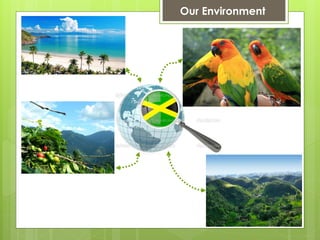
Our Environment
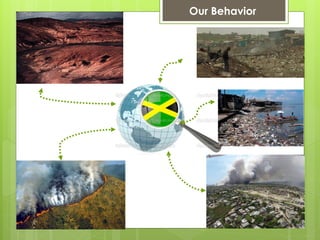
Our Behavior
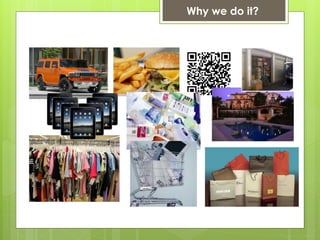
Why we do it?
Today You’ll Learn
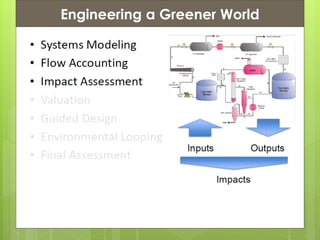
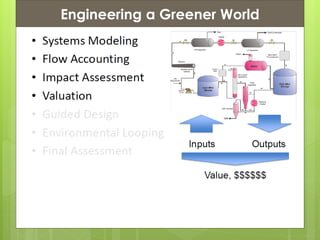
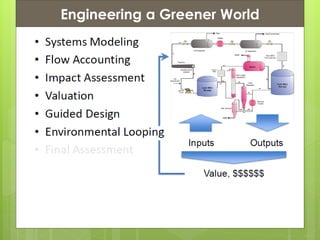
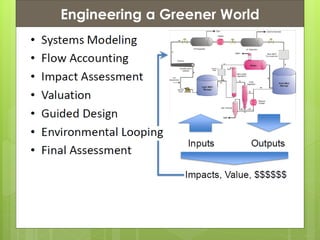
1 Engineering a Greener World
2 Production
3 Lifecycle Modeling
4 Local Context & Applicability
5 Principle of Green Engineering
6 Local Research
7 Methods
8 Analysis
9 Recommendations
10 Conclusions
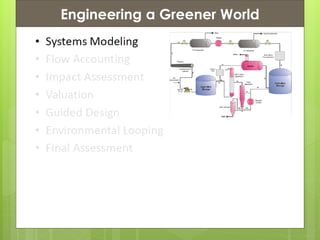
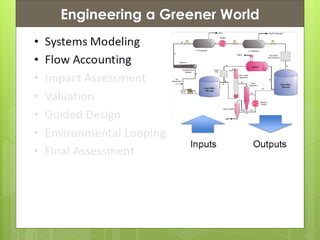
Presentation ContentsEngineering a Greener World
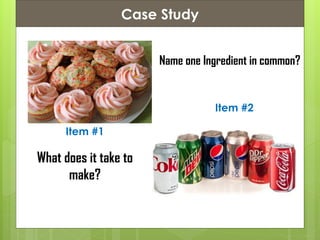
Presentation ContentsCase Study
Item #1
Item #2
What does it take to
make?
Name one Ingredient in common?
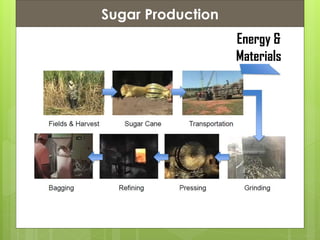
Presentation ContentsSugar Production
Energy &
Materials
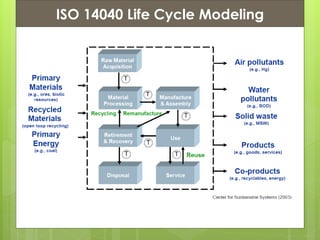
Presentation ContentsISO 14040 Life Cycle Modeling
Presentation ContentsLocal Context and applicability
What is Green engineering…??
It is design, commercialization and use of
process & products that are feasible and
economical. While minimizing:
*Risk to human health and environment.
*Generation of pollution at source.
Presentation ContentsLocal Context and applicability
Why do we need green
engineering..?
Presentation ContentsPrinciples of Green Engineering:
1. Engineer processes and products holistically,
use systems analysis, and integrate
environmental impact assessment tools.
2. Conserve and improve natural ecosystems
while protecting human health and well-being
3. Use life-cycle thinking in all engineering
activities
4. Ensure that all material and energy inputs and
outputs are as inherently safe and benign as
possible
5. Minimize depletion of natural resources
Presentation ContentsPrinciples of Green Engineering:
6. Strive to prevent waste
7. Develop and apply engineering solutions,
while being cognizant of local geography,
aspirations, and cultures
8. Create engineering solutions beyond current
or dominant technologies; improve, innovate
and invent (technologies) to achieve
sustainability
9. Actively engage communities and
stakeholders in development of engineering
solutions
Presentation ContentsLocal Research
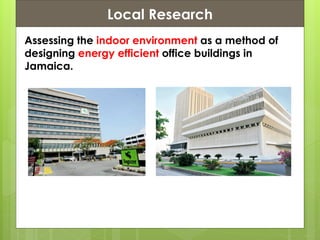
Assessing the indoor environment as a method of
designing energy efficient office buildings in
Jamaica.
Presentation ContentsApproach
1. Phase 1- The outdoor climatic data was
collected from Jamaica Meteorological
Office (MET Office)
2. Phase 2- Drawings and existing energy
profile on both buildings were collected
3. Phase 3- Indoor environment survey of both
buildings conducted
4. Phase 4- Data Analysis
5. Phase 5- Present findings Publication
Presentation ContentsResearch Objectives
The objectives of this research is to:
1. Investigate the occupants comfort level
and the intensity of SBS symptoms of
tropically acclimatized subjects in real
offices.
2. Model and use meteorological data
available to take advantage of the
microclimate.
3. Develop basic guidelines to better the
indoor environment and improve energy
efficiency of the offices been study.
Presentation ContentsBackground and Significance
Global warming is already taking place and
has become the biggest challenge of our
time. The challenge is to find ways for the
world to switch from a path of increasing
emissions to a path of more high advanced
technologies where the majority of the
Green House Gas (GHG) emissions are
eliminated.
Presentation ContentsBackground and Significance
Locally!!! Vision 2030, EE Standards
Sustainable Development
“Sustainable development meets the
needs of the present without compromising
the ability of future generations to achieve
their own needs achieve needs”
Brundtland 1987, UN World Commission on Environment and Development
Presentation ContentsBackground and Significance
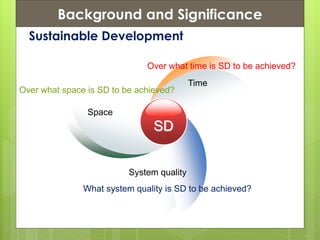
Sustainable Development
SD
Space
Time
System quality
Over what space is SD to be achieved?
Over what time is SD to be achieved?
What system quality is SD to be achieved?
Presentation ContentsBackground and Significance
Major Developments of the 1990’s
1. Globalization and market economy
2. Information technology and
telecommunications
3. World Wide Web and e-commerce
4. Environment and sustainability
5. Science and technology capability as an
instrument of economic competitiveness
Presentation ContentsKey Issues in the Built Environment
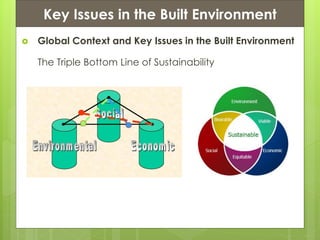
 Global Context and Key Issues in the Built Environment
The Triple Bottom Line of Sustainability
Presentation ContentsKey Issues in the Built Environment
 Environmental objectives
1. maximise energy efficiency
2. conserve resources
3. Minimise pollution/damage to the environment
4. conserve wildlife habitats
 Economic objectives
1. support local economy
2. provide employment opportunities
 Social objectives
1. improve the quality of life
2. promote social equity
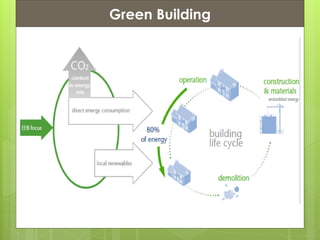
Presentation ContentsGreen Building
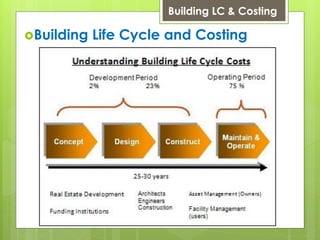
Building Life Cycle and Costing
Building LC & Costing
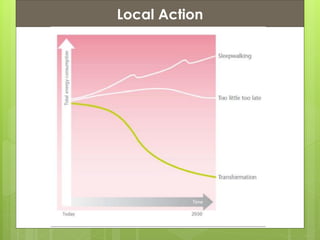
Presentation ContentsLocal Action
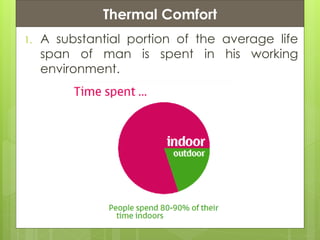
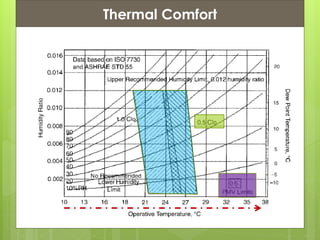
Presentation ContentsThermal Comfort
1. A substantial portion of the average life
span of man is spent in his working
environment.
Presentation ContentsThermal Comfort
1. Thermal comfort is defined as the
condition of mind that expresses
satisfaction with the thermal environment
according to (ASHRAE Standard 55-92). As
such, it will be influenced by personal
differences in mood, culture and other
individual, organizational and social
factors. [Rene Tchinda 2010]
Presentation ContentsThermal Comfort
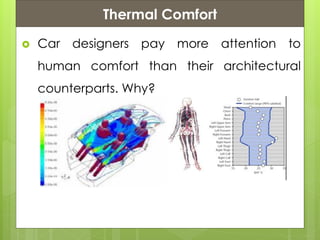
 Car designers pay more attention to
human comfort than their architectural
counterparts. Why?
Presentation ContentsThermal Comfort
Why is thermal comfort important?
Because thermal comfort is
psychological, it may affect our overall
morale. occupants complaints may
increase, productivity may fall and in
some cases people may refuse to
work/function in a particular
environment.
Presentation ContentsAssessment
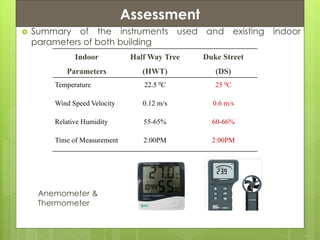
 Summary of the instruments used and existing indoor
parameters of both building
Indoor
Parameters
Half Way Tree
(HWT)
Duke Street
(DS)
Temperature 22.5 0C 25 0C
Wind Speed Velocity 0.12 m/s 0.6 m/s
Relative Humidity 55-65% 60-66%
Time of Measurement 2:00PM 2:00PM
Anemometer &
Thermometer
Presentation ContentsAssessment
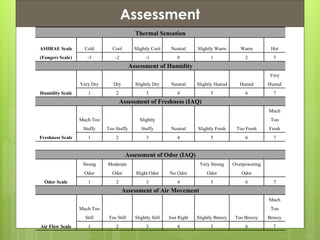
Thermal Sensation
ASHRAE Scale
(Fangers Scale)
Cold Cool Slightly Cool Neutral Slightly Warm Warm Hot
-3 -2 -1 0 1 2 3
Assessment of Humidity
Humidity Scale
Very Dry Dry Slightly Dry Neutral Slightly Humid Humid
Very
Humid
1 2 3 4 5 6 7
Assessment of Freshness (IAQ)
Freshness Scale
Much Too
Stuffy Too Stuffy
Slightly
Stuffy Neutral Slightly Fresh Too Fresh
Much
Too
Fresh
1 2 3 4 5 6 7
Assessment of Odor (IAQ)
Odor Scale
Strong
Odor
Moderate
Odor Slight Odor No Odor
Very Strong
Odor
Overpowering
Odor
1 2 3 4 5 6 7
Assessment of Air Movement
Air Flow Scale
Much Too
Still Too Still Slightly Still Just Right Slightly Breezy Too Breezy
Much
Too
Breezy
1 2 3 4 5 6 7
Presentation ContentsAssessment
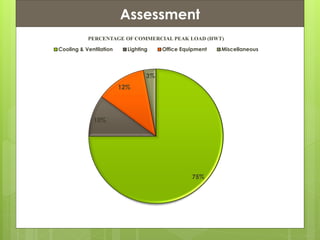
75%
10%
12%
3%
PERCENTAGE OF COMMERCIAL PEAK LOAD (HWT)
Cooling & Ventilation Lighting Office Equipment Miscellaneous
Presentation ContentsSBS & IAQ
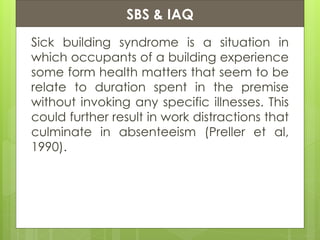
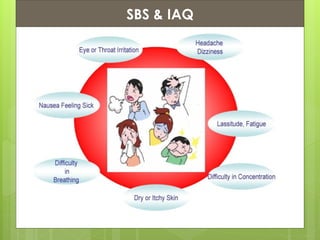
Sick building syndrome is a situation in
which occupants of a building experience
some form health matters that seem to be
relate to duration spent in the premise
without invoking any specific illnesses. This
could further result in work distractions that
culminate in absenteeism (Preller et al,
1990).
Presentation ContentsSBS & IAQ
Presentation ContentsRecommendations
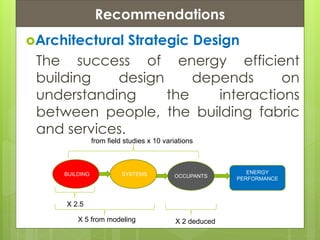
Architectural Strategic Design
The success of energy efficient
building design depends on
understanding the interactions
between people, the building fabric
and services.
BUILDING SYSTEMS OCCUPANTS
ENERGY
PERFORMANCE
from field studies x 10 variations
X 2.5
X 5 from modeling X 2 deduced
Presentation ContentsRecommendations
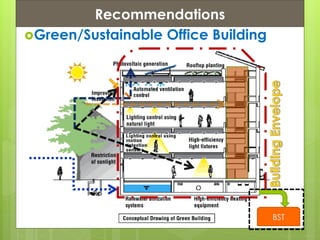
Green/Sustainable Office Building
BST
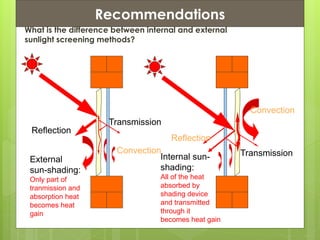
External
sun-shading:
Only part of
tranmission and
absorption heat
becomes heat
gain
Internal sun-
shading:
All of the heat
absorbed by
shading device
and transmitted
through it
becomes heat gain
Convection
Transmission
Reflection
Reflection
Convection
Transmission
What is the difference between internal and external
sunlight screening methods?
Recommendations
Recommendations
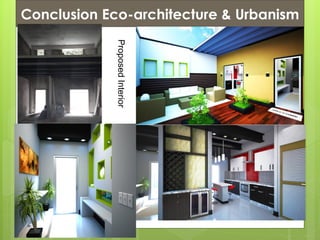
Conclusion Eco-architecture & Urbanism
ProposedInterior
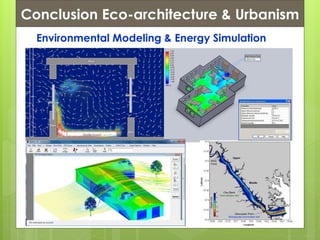
Conclusion Eco-architecture & Urbanism
Environmental Modeling & Energy Simulation
Conclusion Eco-architecture & Urbanism
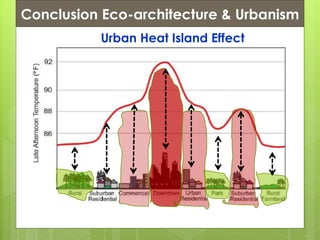
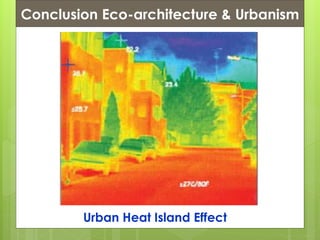
Urban Heat Island Effect
Conclusion Eco-architecture & Urbanism
Urban Heat Island Effect
Conclusion Eco-architecture & Urbanism
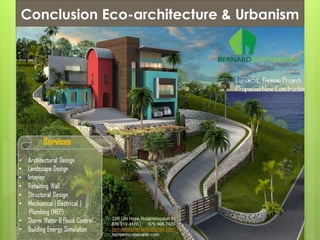
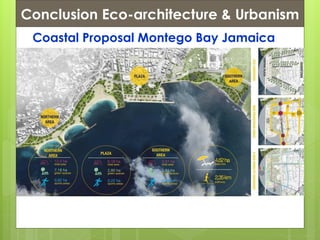
Coastal Proposal Montego Bay Jamaica
Conclusion Eco-architecture & Urbanism
There are some simple and complex
assessment methods, technology and
design approaches to energy savings and
to better urban environment comfort, some
of which has been outlined in this
presentation.
1. Understanding micro-climate
2. The building is there to serve the
occupants and their activities.
3. Reduce the Urban Heat Island Effects
References
(1)The World Commission on Environment and
Development. Our Common Future; Oxford
University Press: New York, 1987.
(2) Graedel, T. E.; Allenby, B. R. Design for
Environment; Prentice Hall: New York, 1997
(3)Allen, D. T.; Shonnard, D. R. Green Engineering:
Environmentally Conscious Design of Chemical
Processes; Prentice Hall: New York, 2001.
bernardsustainable.comwww.bernardsustainable.com

Sustainability and green engineering

  • 1.
    Sustainability & GreenEngineering Benefits to Jamaica Urbanism Keroma Bernard University of Technology, Jamaica Industrial Technology Seminar September 30, 2016 www.bernardsustainable.com
  • 2.
    Keroma Bernard Director &Principal Engineer Bernard Sustainable Consulting www.bernardsustainable.com • A licensed and registered Professional Engineer/PE with over 12 years of progressive experience spanning engineering design, environmental consulting, auditing, ecological architecture and master planning • Served numerous sectors including commercial, residential, hospitality, Industrial and agro industrial facilities through designing, energy auditing, project management, commissioning and environmental compliance. • B. E : Industrial Technology | Construction M.Eng : Environmental Engineering Ph.D Candidate: Hydrology & Water Resource Engineering
  • 3.
  • 4.
  • 5.
  • 6.
    Today You’ll Learn 1Engineering a Greener World 2 Production 3 Lifecycle Modeling 4 Local Context & Applicability 5 Principle of Green Engineering 6 Local Research 7 Methods 8 Analysis 9 Recommendations 10 Conclusions
  • 7.
  • 8.
  • 9.
  • 10.
  • 11.
  • 12.
  • 13.
    Presentation ContentsCase Study Item#1 Item #2 What does it take to make? Name one Ingredient in common?
  • 14.
  • 15.
    Presentation ContentsISO 14040Life Cycle Modeling
  • 16.
    Presentation ContentsLocal Contextand applicability What is Green engineering…?? It is design, commercialization and use of process & products that are feasible and economical. While minimizing: *Risk to human health and environment. *Generation of pollution at source.
  • 17.
    Presentation ContentsLocal Contextand applicability Why do we need green engineering..?
  • 18.
    Presentation ContentsPrinciples ofGreen Engineering: 1. Engineer processes and products holistically, use systems analysis, and integrate environmental impact assessment tools. 2. Conserve and improve natural ecosystems while protecting human health and well-being 3. Use life-cycle thinking in all engineering activities 4. Ensure that all material and energy inputs and outputs are as inherently safe and benign as possible 5. Minimize depletion of natural resources
  • 19.
    Presentation ContentsPrinciples ofGreen Engineering: 6. Strive to prevent waste 7. Develop and apply engineering solutions, while being cognizant of local geography, aspirations, and cultures 8. Create engineering solutions beyond current or dominant technologies; improve, innovate and invent (technologies) to achieve sustainability 9. Actively engage communities and stakeholders in development of engineering solutions
  • 20.
    Presentation ContentsLocal Research Assessingthe indoor environment as a method of designing energy efficient office buildings in Jamaica.
  • 21.
    Presentation ContentsApproach 1. Phase1- The outdoor climatic data was collected from Jamaica Meteorological Office (MET Office) 2. Phase 2- Drawings and existing energy profile on both buildings were collected 3. Phase 3- Indoor environment survey of both buildings conducted 4. Phase 4- Data Analysis 5. Phase 5- Present findings Publication
  • 22.
    Presentation ContentsResearch Objectives Theobjectives of this research is to: 1. Investigate the occupants comfort level and the intensity of SBS symptoms of tropically acclimatized subjects in real offices. 2. Model and use meteorological data available to take advantage of the microclimate. 3. Develop basic guidelines to better the indoor environment and improve energy efficiency of the offices been study.
  • 23.
    Presentation ContentsBackground andSignificance Global warming is already taking place and has become the biggest challenge of our time. The challenge is to find ways for the world to switch from a path of increasing emissions to a path of more high advanced technologies where the majority of the Green House Gas (GHG) emissions are eliminated.
  • 24.
    Presentation ContentsBackground andSignificance Locally!!! Vision 2030, EE Standards Sustainable Development “Sustainable development meets the needs of the present without compromising the ability of future generations to achieve their own needs achieve needs” Brundtland 1987, UN World Commission on Environment and Development
  • 25.
    Presentation ContentsBackground andSignificance Sustainable Development SD Space Time System quality Over what space is SD to be achieved? Over what time is SD to be achieved? What system quality is SD to be achieved?
  • 26.
    Presentation ContentsBackground andSignificance Major Developments of the 1990’s 1. Globalization and market economy 2. Information technology and telecommunications 3. World Wide Web and e-commerce 4. Environment and sustainability 5. Science and technology capability as an instrument of economic competitiveness
  • 27.
    Presentation ContentsKey Issuesin the Built Environment  Global Context and Key Issues in the Built Environment The Triple Bottom Line of Sustainability
  • 28.
    Presentation ContentsKey Issuesin the Built Environment  Environmental objectives 1. maximise energy efficiency 2. conserve resources 3. Minimise pollution/damage to the environment 4. conserve wildlife habitats  Economic objectives 1. support local economy 2. provide employment opportunities  Social objectives 1. improve the quality of life 2. promote social equity
  • 29.
  • 30.
    Building Life Cycleand Costing Building LC & Costing
  • 31.
  • 32.
    Presentation ContentsThermal Comfort 1.A substantial portion of the average life span of man is spent in his working environment.
  • 33.
    Presentation ContentsThermal Comfort 1.Thermal comfort is defined as the condition of mind that expresses satisfaction with the thermal environment according to (ASHRAE Standard 55-92). As such, it will be influenced by personal differences in mood, culture and other individual, organizational and social factors. [Rene Tchinda 2010]
  • 34.
  • 35.
    Presentation ContentsThermal Comfort Car designers pay more attention to human comfort than their architectural counterparts. Why?
  • 36.
    Presentation ContentsThermal Comfort Whyis thermal comfort important? Because thermal comfort is psychological, it may affect our overall morale. occupants complaints may increase, productivity may fall and in some cases people may refuse to work/function in a particular environment.
  • 37.
    Presentation ContentsAssessment  Summaryof the instruments used and existing indoor parameters of both building Indoor Parameters Half Way Tree (HWT) Duke Street (DS) Temperature 22.5 0C 25 0C Wind Speed Velocity 0.12 m/s 0.6 m/s Relative Humidity 55-65% 60-66% Time of Measurement 2:00PM 2:00PM Anemometer & Thermometer
  • 38.
    Presentation ContentsAssessment Thermal Sensation ASHRAEScale (Fangers Scale) Cold Cool Slightly Cool Neutral Slightly Warm Warm Hot -3 -2 -1 0 1 2 3 Assessment of Humidity Humidity Scale Very Dry Dry Slightly Dry Neutral Slightly Humid Humid Very Humid 1 2 3 4 5 6 7 Assessment of Freshness (IAQ) Freshness Scale Much Too Stuffy Too Stuffy Slightly Stuffy Neutral Slightly Fresh Too Fresh Much Too Fresh 1 2 3 4 5 6 7 Assessment of Odor (IAQ) Odor Scale Strong Odor Moderate Odor Slight Odor No Odor Very Strong Odor Overpowering Odor 1 2 3 4 5 6 7 Assessment of Air Movement Air Flow Scale Much Too Still Too Still Slightly Still Just Right Slightly Breezy Too Breezy Much Too Breezy 1 2 3 4 5 6 7
  • 39.
    Presentation ContentsAssessment 75% 10% 12% 3% PERCENTAGE OFCOMMERCIAL PEAK LOAD (HWT) Cooling & Ventilation Lighting Office Equipment Miscellaneous
  • 40.
    Presentation ContentsSBS &IAQ Sick building syndrome is a situation in which occupants of a building experience some form health matters that seem to be relate to duration spent in the premise without invoking any specific illnesses. This could further result in work distractions that culminate in absenteeism (Preller et al, 1990).
  • 41.
  • 42.
    Presentation ContentsRecommendations Architectural StrategicDesign The success of energy efficient building design depends on understanding the interactions between people, the building fabric and services. BUILDING SYSTEMS OCCUPANTS ENERGY PERFORMANCE from field studies x 10 variations X 2.5 X 5 from modeling X 2 deduced
  • 43.
  • 44.
    External sun-shading: Only part of tranmissionand absorption heat becomes heat gain Internal sun- shading: All of the heat absorbed by shading device and transmitted through it becomes heat gain Convection Transmission Reflection Reflection Convection Transmission What is the difference between internal and external sunlight screening methods? Recommendations
  • 45.
  • 46.
    Conclusion Eco-architecture &Urbanism ProposedInterior
  • 47.
    Conclusion Eco-architecture &Urbanism Environmental Modeling & Energy Simulation
  • 48.
  • 49.
    Conclusion Eco-architecture &Urbanism Urban Heat Island Effect
  • 50.
    Conclusion Eco-architecture &Urbanism Urban Heat Island Effect
  • 51.
    Conclusion Eco-architecture &Urbanism Coastal Proposal Montego Bay Jamaica
  • 52.
    Conclusion Eco-architecture &Urbanism There are some simple and complex assessment methods, technology and design approaches to energy savings and to better urban environment comfort, some of which has been outlined in this presentation. 1. Understanding micro-climate 2. The building is there to serve the occupants and their activities. 3. Reduce the Urban Heat Island Effects
  • 53.
    References (1)The World Commissionon Environment and Development. Our Common Future; Oxford University Press: New York, 1987. (2) Graedel, T. E.; Allenby, B. R. Design for Environment; Prentice Hall: New York, 1997 (3)Allen, D. T.; Shonnard, D. R. Green Engineering: Environmentally Conscious Design of Chemical Processes; Prentice Hall: New York, 2001.
  • 54.