1
Innovative Production Technologies
T130M023
Graphene Material for Aerospace
Technology
Presentation
By
Mastan Raja Papanaboina
MASTER’S IN AERONAUTICAL
ENGINEERING
Lecturer: Dr. Antanas Ciuplys
Kaunas University of Technology
2
Introduction
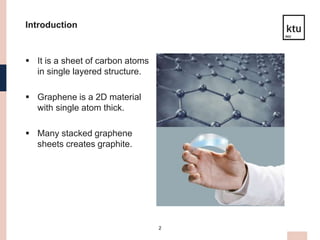
 It is a sheet of carbon atoms
in single layered structure.
 Graphene is a 2D material
with single atom thick.
 Many stacked graphene
sheets creates graphite.
3
Properties
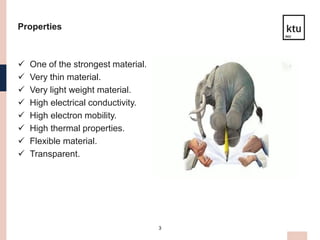
 One of the strongest material.
 Very thin material.
 Very light weight material.
 High electrical conductivity.
 High electron mobility.
 High thermal properties.
 Flexible material.
 Transparent.
4
History
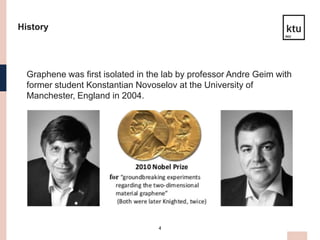
Graphene was first isolated in the lab by professor Andre Geim with
former student Konstantian Novoselov at the University of
Manchester, England in 2004.
5
Production Technologies
 Mechanical Exfoliation
 Chemical Vapor Deposition
 Epitaxial Growth of Graphene on SiC
6
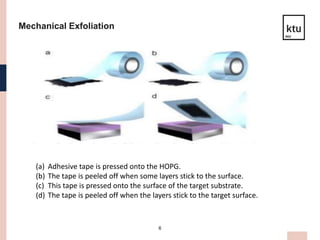
Mechanical Exfoliation
(a) Adhesive tape is pressed onto the HOPG.
(b) The tape is peeled off when some layers stick to the surface.
(c) This tape is pressed onto the surface of the target substrate.
(d) The tape is peeled off when the layers stick to the target surface.
7
Mechanical Exfoliation
Advantages:
 Safe and simple process.
 Few layer graphene can be easily obtained.
 The chances of impurity in the graphene so obtained are less.
 Sample preparation is simplified.
Disadvantages:
• Yield obtained may not meet the requirements.
• Requires skilled manual labour.
• Despite the fact that tape residue does not seriously affect the
quality of the graphene flake samples, it does make those samples
more difficult to find on the substrate
8
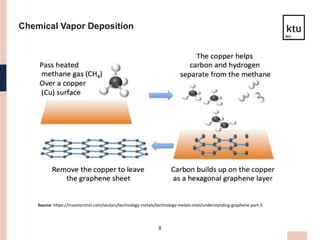
Chemical Vapor Deposition
Source: https://investorintel.com/sectors/technology-metals/technology-metals-intel/understanding-graphene-part-3
9
Advantages
• High quality, impervious, and harder graphene is obtained.
Producing large domains of graphene is easy.
• High growth rates possible.
• Good reproducibility.
Disadvantages
• High temperatures (greater than 900 °C) leads to wrinkled
graphene due to difference in Coefficient of Thermal Expansion.
• Complex process.
• Production of corrosive and toxic gases.
• Difficulty in controlling the thickness in some cases (number of
layers).
10
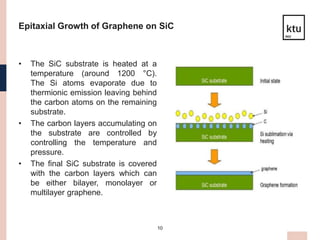
Epitaxial Growth of Graphene on SiC
• The SiC substrate is heated at a
temperature (around 1200 °C).
The Si atoms evaporate due to
thermionic emission leaving behind
the carbon atoms on the remaining
substrate.
• The carbon layers accumulating on
the substrate are controlled by
controlling the temperature and
pressure.
• The final SiC substrate is covered
with the carbon layers which can
be either bilayer, monolayer or
multilayer graphene.
11
Epitaxial Growth of Graphene on SiC
Advantages:
• High quality graphene.
• Easy method for growing single crystals of graphene.
• The layers of graphene can be controlled conveniently.
• Higher temperatures ensure reproducible, clean and ordered
graphene
Disadvantages:
• High temperature.
12
Applications
 Graphene composite materials for aircrafts and satellite systems.
 Graphene coating for aircraft structures.
 Electronic circuits for avionics system.
 Modern sensors for avionics systems.
13
Major Advantages of Graphene
 It is the thinnest material known and with that also the
strongest.
 It consists of a single layer of carbon atoms and is both
pliable and transparent.
 It is a superb conductor of both heat and electricity.
 It is used in the production of high speed electronic devi
ces responsible for fast technological changes.
 Chemical sensors effective at detecting explosives.
 Membranes for more efficient separation of gases.
 Transistors that operate at higher frequency as compared
to others.
14
Major Disadvantages of Graphene
 Being a great conductor of electricity, although
it doesn’t have a band gap (can’t be switched off).
Scientists are working on rectify.
 The main disadvantage of graphene as a catalyst
its susceptibility to oxidative environments.
 Research has proven that graphene exhibits some toxic
qualities.
15
Future Perspectives
 The graphene fuel tank for aerospace application.
 Lightweight crucial part in the spaceship especially for a long
interplanetary odyssey.
 New composite materials for aerospace industry.
 Mass production of Graphene.
16

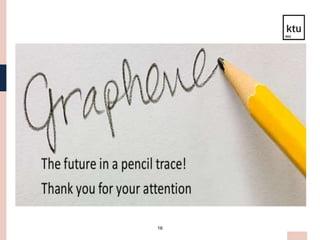
Graphene material for aerospace technology

  • 1.
    1 Innovative Production Technologies T130M023 GrapheneMaterial for Aerospace Technology Presentation By Mastan Raja Papanaboina MASTER’S IN AERONAUTICAL ENGINEERING Lecturer: Dr. Antanas Ciuplys Kaunas University of Technology
  • 2.
    2 Introduction  It isa sheet of carbon atoms in single layered structure.  Graphene is a 2D material with single atom thick.  Many stacked graphene sheets creates graphite.
  • 3.
    3 Properties  One ofthe strongest material.  Very thin material.  Very light weight material.  High electrical conductivity.  High electron mobility.  High thermal properties.  Flexible material.  Transparent.
  • 4.
    4 History Graphene was firstisolated in the lab by professor Andre Geim with former student Konstantian Novoselov at the University of Manchester, England in 2004.
  • 5.
    5 Production Technologies  MechanicalExfoliation  Chemical Vapor Deposition  Epitaxial Growth of Graphene on SiC
  • 6.
    6 Mechanical Exfoliation (a) Adhesivetape is pressed onto the HOPG. (b) The tape is peeled off when some layers stick to the surface. (c) This tape is pressed onto the surface of the target substrate. (d) The tape is peeled off when the layers stick to the target surface.
  • 7.
    7 Mechanical Exfoliation Advantages:  Safeand simple process.  Few layer graphene can be easily obtained.  The chances of impurity in the graphene so obtained are less.  Sample preparation is simplified. Disadvantages: • Yield obtained may not meet the requirements. • Requires skilled manual labour. • Despite the fact that tape residue does not seriously affect the quality of the graphene flake samples, it does make those samples more difficult to find on the substrate
  • 8.
    8 Chemical Vapor Deposition Source:https://investorintel.com/sectors/technology-metals/technology-metals-intel/understanding-graphene-part-3
  • 9.
    9 Advantages • High quality,impervious, and harder graphene is obtained. Producing large domains of graphene is easy. • High growth rates possible. • Good reproducibility. Disadvantages • High temperatures (greater than 900 °C) leads to wrinkled graphene due to difference in Coefficient of Thermal Expansion. • Complex process. • Production of corrosive and toxic gases. • Difficulty in controlling the thickness in some cases (number of layers).
  • 10.
    10 Epitaxial Growth ofGraphene on SiC • The SiC substrate is heated at a temperature (around 1200 °C). The Si atoms evaporate due to thermionic emission leaving behind the carbon atoms on the remaining substrate. • The carbon layers accumulating on the substrate are controlled by controlling the temperature and pressure. • The final SiC substrate is covered with the carbon layers which can be either bilayer, monolayer or multilayer graphene.
  • 11.
    11 Epitaxial Growth ofGraphene on SiC Advantages: • High quality graphene. • Easy method for growing single crystals of graphene. • The layers of graphene can be controlled conveniently. • Higher temperatures ensure reproducible, clean and ordered graphene Disadvantages: • High temperature.
  • 12.
    12 Applications  Graphene compositematerials for aircrafts and satellite systems.  Graphene coating for aircraft structures.  Electronic circuits for avionics system.  Modern sensors for avionics systems.
  • 13.
    13 Major Advantages ofGraphene  It is the thinnest material known and with that also the strongest.  It consists of a single layer of carbon atoms and is both pliable and transparent.  It is a superb conductor of both heat and electricity.  It is used in the production of high speed electronic devi ces responsible for fast technological changes.  Chemical sensors effective at detecting explosives.  Membranes for more efficient separation of gases.  Transistors that operate at higher frequency as compared to others.
  • 14.
    14 Major Disadvantages ofGraphene  Being a great conductor of electricity, although it doesn’t have a band gap (can’t be switched off). Scientists are working on rectify.  The main disadvantage of graphene as a catalyst its susceptibility to oxidative environments.  Research has proven that graphene exhibits some toxic qualities.
  • 15.
    15 Future Perspectives  Thegraphene fuel tank for aerospace application.  Lightweight crucial part in the spaceship especially for a long interplanetary odyssey.  New composite materials for aerospace industry.  Mass production of Graphene.
  • 16.