High flux
• The principle of hemodialysis involves the clearance of solutes
across a semi-permeable membrane through diffusion and
ultrafiltration mechanisms.
• The utilized membranes are classified into two main groups: low-
flux, which is based on using dialyzers with low permeability for
water; and high-flux, non-celluloses membrane with increased
permeability, which is capable of removing moderate-sized
molecules between 10000 to 15000 Dalton, including many of the
inflammatory proteins, ß₂ microglobulin and lipoproteins
• Some studies have suggested that high‐flux membrane improves the
removal of moderate-sized molecules such as lipid profiles or
homocysteine while other studies have concluded it has no
significant impact on these molecules such as homocysteine levels .
• Because of incomplete removal of uremic toxins, 90% of hemodialysis
patients reveal symptoms of pathologic amyloidosis caused by ß₂
microglobulin after five years of dialysis .
• One of the most influential reasons to continue a certain treatment is the
degree of its impact on the targeted disease; while, the inadequacy of
dialysis has been recognized as a major reason for the mortality rate of the
hemodialysis patients.
• If the efficiency of hemodialysis is not adequate, the level of blood toxins
and the clinical symptoms of the patient are not controlled, which lead to
either an increase in the duration of each dialysis session or the frequency
of necessary dialysis per week. This will consequently increase the
mortality and morbidity of the patients and the cost of dialysis.
• There are a number of factors, which influence the adequacy of the
dialysis, such as the time of dialysis, the dialysate flow rate, the surface of
dialyzer, and the blood flow rate.
• High-flux dialysis is defined as a β2-microglobulin clearance of over 20 ml/min .
High flux membranes compared to low flux have larger pores and allow diffusion of
greater amounts of uremic toxins and middle molecules such as β2 microglobuline
and therefore they may decrease the risk of dialysis-related amyloidosis.
• High flux dialyzers are designed to be more efficient than standard dialyzers in
removing waste products, toxins, and excess fluids from the bloodstream.
• High flux dialyzers have several features that distinguish them from standard
dialyzers:
• Larger surface area: High flux dialyzers have more and/or larger hollow fibers or
membranes, which provides a greater surface area for diffusion and filtration to
occur. This increased surface area enhances the efficiency of waste removal.
• Enhanced membrane permeability: The membranes in high flux dialyzers have
larger pores, allowing for better clearance of larger molecules and toxins. This
improved permeability enables the removal of substances that standard dialyzers
might not effectively clear.
• Improved clearance of middImproved clearance of middle molecules: High flux
dialyzers are particularly effective in clearing middle molecules, which are larger
solutes that can accumulate in the blood and contribute to various health issues in
patients with kidney failure.
• Higher dialysate flow rates: The dialysate solution flows through the dialyzer at a
faster rate in high flux dialyzers, facilitating better diffusion of waste products from
the blood to the dialysate.
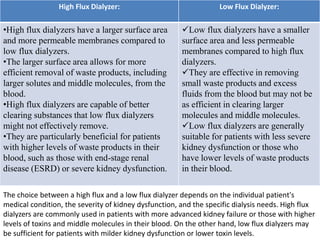
High Flux Dialyzer: Low Flux Dialyzer:
•High flux dialyzers have a larger surface area
and more permeable membranes compared to
low flux dialyzers.
•The larger surface area allows for more
efficient removal of waste products, including
larger solutes and middle molecules, from the
blood.
•High flux dialyzers are capable of better
clearing substances that low flux dialyzers
might not effectively remove.
•They are particularly beneficial for patients
with higher levels of waste products in their
blood, such as those with end-stage renal
disease (ESRD) or severe kidney dysfunction.
Low flux dialyzers have a smaller
surface area and less permeable
membranes compared to high flux
dialyzers.
They are effective in removing
small waste products and excess
fluids from the blood but may not be
as efficient in clearing larger
molecules and middle molecules.
Low flux dialyzers are generally
suitable for patients with less severe
kidney dysfunction or those who
have lower levels of waste products
in their blood.
The choice between a high flux and a low flux dialyzer depends on the individual patient's
medical condition, the severity of kidney dysfunction, and the specific dialysis needs. High flux
dialyzers are commonly used in patients with more advanced kidney failure or those with higher
levels of toxins and middle molecules in their blood. On the other hand, low flux dialyzers may
be sufficient for patients with milder kidney dysfunction or lower toxin levels.
kidney transplant
• A kidney transplant is a surgery done to replace a diseased
kidney with a healthy kidney from a donor. The kidney may
come from a deceased organ donor or from a living donor.
Family members or others who are a good match may be able
to donate one of their kidneys.
• This type of transplant is called a living transplant. People who
donate a kidney can live healthy lives with one healthy kidney.
• A person getting a transplant most often gets just 1 kidney. In
rare situations, he or she may get 2 kidneys from a deceased
donor. The diseased kidneys are usually left in place. The
transplanted kidney is placed in the lower belly on the front
side of the body.
Renal transplantation
• Renal transplantation, also known as kidney transplantation, is a surgical procedure
in which a healthy kidney from a living or deceased donor is transplanted into a
person with end-stage renal disease (ESRD) or significant kidney dysfunction. It is
considered the best treatment option for many patients with advanced kidney
failure, offering a higher quality of life and improved long-term outcomes
compared to dialysis. Here are the basic principles of renal transplantation:
• Indications and Evaluation: Renal transplantation is considered for patients with
end-stage renal disease or irreversible kidney failure. Before transplantation, the
patient undergoes a thorough evaluation to determine their suitability for the
procedure, including medical, psychological, and social assessments. The
evaluation helps ensure the patient is physically fit for surgery and capable of
adhering to post-transplant medication and care requirements.
• Donor Selection: Kidneys for transplantation can be obtained from living or
deceased donors. Living donors are usually healthy individuals, often family
members or close friends, who volunteer to donate one of their kidneys. Deceased
donors are individuals who have passed away, and their kidneys are retrieved for
transplantation. The compatibility between the donor and recipient is determined
by blood and tissue type matching, as well as other factors.
• Transplant Surgery: The transplant surgery involves
removing the healthy kidney from the donor and
implanting it into the recipient. The donor kidney is
usually placed in the lower abdomen, and its blood
vessels are connected to the recipient's blood vessels,
while the ureter is attached to the recipient's bladder.
• Immunosuppression: After transplantation, the
recipient's immune system recognizes the transplanted
kidney as foreign tissue and may attack it. To prevent
rejection, recipients must take immunosuppressive
medications for the rest of their lives. These drugs
suppress the immune response, allowing the body to
accept and tolerate the transplanted kidney.
• Post-Transplant Care: After the transplant, the patient requires ongoing
medical care and monitoring to ensure the kidney continues to function
properly and to manage any potential complications. Regular follow-up
visits, lab tests, and medication adjustments are essential to maintain the
health of the transplanted kidney.
• Risks and Complications: Renal transplantation carries risks, including the
possibility of organ rejection, infection, and side effects from
immunosuppressive medications. Despite these risks, the overall success
rate of kidney transplantation is quite high, and most recipients
experience significant improvement in their quality of life.
• Long-Term Management: Long-term management involves close
collaboration between the patient, transplant team, and other healthcare
providers. Adherence to the prescribed medication regimen, a healthy
lifestyle, and regular check-ups are crucial for the long-term success of the
transplant.

high-flux.pptx

  • 3.
    High flux • Theprinciple of hemodialysis involves the clearance of solutes across a semi-permeable membrane through diffusion and ultrafiltration mechanisms. • The utilized membranes are classified into two main groups: low- flux, which is based on using dialyzers with low permeability for water; and high-flux, non-celluloses membrane with increased permeability, which is capable of removing moderate-sized molecules between 10000 to 15000 Dalton, including many of the inflammatory proteins, ß₂ microglobulin and lipoproteins • Some studies have suggested that high‐flux membrane improves the removal of moderate-sized molecules such as lipid profiles or homocysteine while other studies have concluded it has no significant impact on these molecules such as homocysteine levels .
  • 4.
    • Because ofincomplete removal of uremic toxins, 90% of hemodialysis patients reveal symptoms of pathologic amyloidosis caused by ß₂ microglobulin after five years of dialysis . • One of the most influential reasons to continue a certain treatment is the degree of its impact on the targeted disease; while, the inadequacy of dialysis has been recognized as a major reason for the mortality rate of the hemodialysis patients. • If the efficiency of hemodialysis is not adequate, the level of blood toxins and the clinical symptoms of the patient are not controlled, which lead to either an increase in the duration of each dialysis session or the frequency of necessary dialysis per week. This will consequently increase the mortality and morbidity of the patients and the cost of dialysis. • There are a number of factors, which influence the adequacy of the dialysis, such as the time of dialysis, the dialysate flow rate, the surface of dialyzer, and the blood flow rate.
  • 5.
    • High-flux dialysisis defined as a β2-microglobulin clearance of over 20 ml/min . High flux membranes compared to low flux have larger pores and allow diffusion of greater amounts of uremic toxins and middle molecules such as β2 microglobuline and therefore they may decrease the risk of dialysis-related amyloidosis. • High flux dialyzers are designed to be more efficient than standard dialyzers in removing waste products, toxins, and excess fluids from the bloodstream. • High flux dialyzers have several features that distinguish them from standard dialyzers: • Larger surface area: High flux dialyzers have more and/or larger hollow fibers or membranes, which provides a greater surface area for diffusion and filtration to occur. This increased surface area enhances the efficiency of waste removal. • Enhanced membrane permeability: The membranes in high flux dialyzers have larger pores, allowing for better clearance of larger molecules and toxins. This improved permeability enables the removal of substances that standard dialyzers might not effectively clear. • Improved clearance of middImproved clearance of middle molecules: High flux dialyzers are particularly effective in clearing middle molecules, which are larger solutes that can accumulate in the blood and contribute to various health issues in patients with kidney failure. • Higher dialysate flow rates: The dialysate solution flows through the dialyzer at a faster rate in high flux dialyzers, facilitating better diffusion of waste products from the blood to the dialysate.
  • 6.
    High Flux Dialyzer:Low Flux Dialyzer: •High flux dialyzers have a larger surface area and more permeable membranes compared to low flux dialyzers. •The larger surface area allows for more efficient removal of waste products, including larger solutes and middle molecules, from the blood. •High flux dialyzers are capable of better clearing substances that low flux dialyzers might not effectively remove. •They are particularly beneficial for patients with higher levels of waste products in their blood, such as those with end-stage renal disease (ESRD) or severe kidney dysfunction. Low flux dialyzers have a smaller surface area and less permeable membranes compared to high flux dialyzers. They are effective in removing small waste products and excess fluids from the blood but may not be as efficient in clearing larger molecules and middle molecules. Low flux dialyzers are generally suitable for patients with less severe kidney dysfunction or those who have lower levels of waste products in their blood. The choice between a high flux and a low flux dialyzer depends on the individual patient's medical condition, the severity of kidney dysfunction, and the specific dialysis needs. High flux dialyzers are commonly used in patients with more advanced kidney failure or those with higher levels of toxins and middle molecules in their blood. On the other hand, low flux dialyzers may be sufficient for patients with milder kidney dysfunction or lower toxin levels.
  • 7.
    kidney transplant • Akidney transplant is a surgery done to replace a diseased kidney with a healthy kidney from a donor. The kidney may come from a deceased organ donor or from a living donor. Family members or others who are a good match may be able to donate one of their kidneys. • This type of transplant is called a living transplant. People who donate a kidney can live healthy lives with one healthy kidney. • A person getting a transplant most often gets just 1 kidney. In rare situations, he or she may get 2 kidneys from a deceased donor. The diseased kidneys are usually left in place. The transplanted kidney is placed in the lower belly on the front side of the body.
  • 8.
    Renal transplantation • Renaltransplantation, also known as kidney transplantation, is a surgical procedure in which a healthy kidney from a living or deceased donor is transplanted into a person with end-stage renal disease (ESRD) or significant kidney dysfunction. It is considered the best treatment option for many patients with advanced kidney failure, offering a higher quality of life and improved long-term outcomes compared to dialysis. Here are the basic principles of renal transplantation: • Indications and Evaluation: Renal transplantation is considered for patients with end-stage renal disease or irreversible kidney failure. Before transplantation, the patient undergoes a thorough evaluation to determine their suitability for the procedure, including medical, psychological, and social assessments. The evaluation helps ensure the patient is physically fit for surgery and capable of adhering to post-transplant medication and care requirements. • Donor Selection: Kidneys for transplantation can be obtained from living or deceased donors. Living donors are usually healthy individuals, often family members or close friends, who volunteer to donate one of their kidneys. Deceased donors are individuals who have passed away, and their kidneys are retrieved for transplantation. The compatibility between the donor and recipient is determined by blood and tissue type matching, as well as other factors.
  • 9.
    • Transplant Surgery:The transplant surgery involves removing the healthy kidney from the donor and implanting it into the recipient. The donor kidney is usually placed in the lower abdomen, and its blood vessels are connected to the recipient's blood vessels, while the ureter is attached to the recipient's bladder. • Immunosuppression: After transplantation, the recipient's immune system recognizes the transplanted kidney as foreign tissue and may attack it. To prevent rejection, recipients must take immunosuppressive medications for the rest of their lives. These drugs suppress the immune response, allowing the body to accept and tolerate the transplanted kidney.
  • 10.
    • Post-Transplant Care:After the transplant, the patient requires ongoing medical care and monitoring to ensure the kidney continues to function properly and to manage any potential complications. Regular follow-up visits, lab tests, and medication adjustments are essential to maintain the health of the transplanted kidney. • Risks and Complications: Renal transplantation carries risks, including the possibility of organ rejection, infection, and side effects from immunosuppressive medications. Despite these risks, the overall success rate of kidney transplantation is quite high, and most recipients experience significant improvement in their quality of life. • Long-Term Management: Long-term management involves close collaboration between the patient, transplant team, and other healthcare providers. Adherence to the prescribed medication regimen, a healthy lifestyle, and regular check-ups are crucial for the long-term success of the transplant.