Department of ECE
SSNCE
Shiv Nadar University Chennai
Dr.R.Kalidoss
UNIT-II-BOOLEAN ALGEBRA AND MINIMIZATION TECHNIQUES
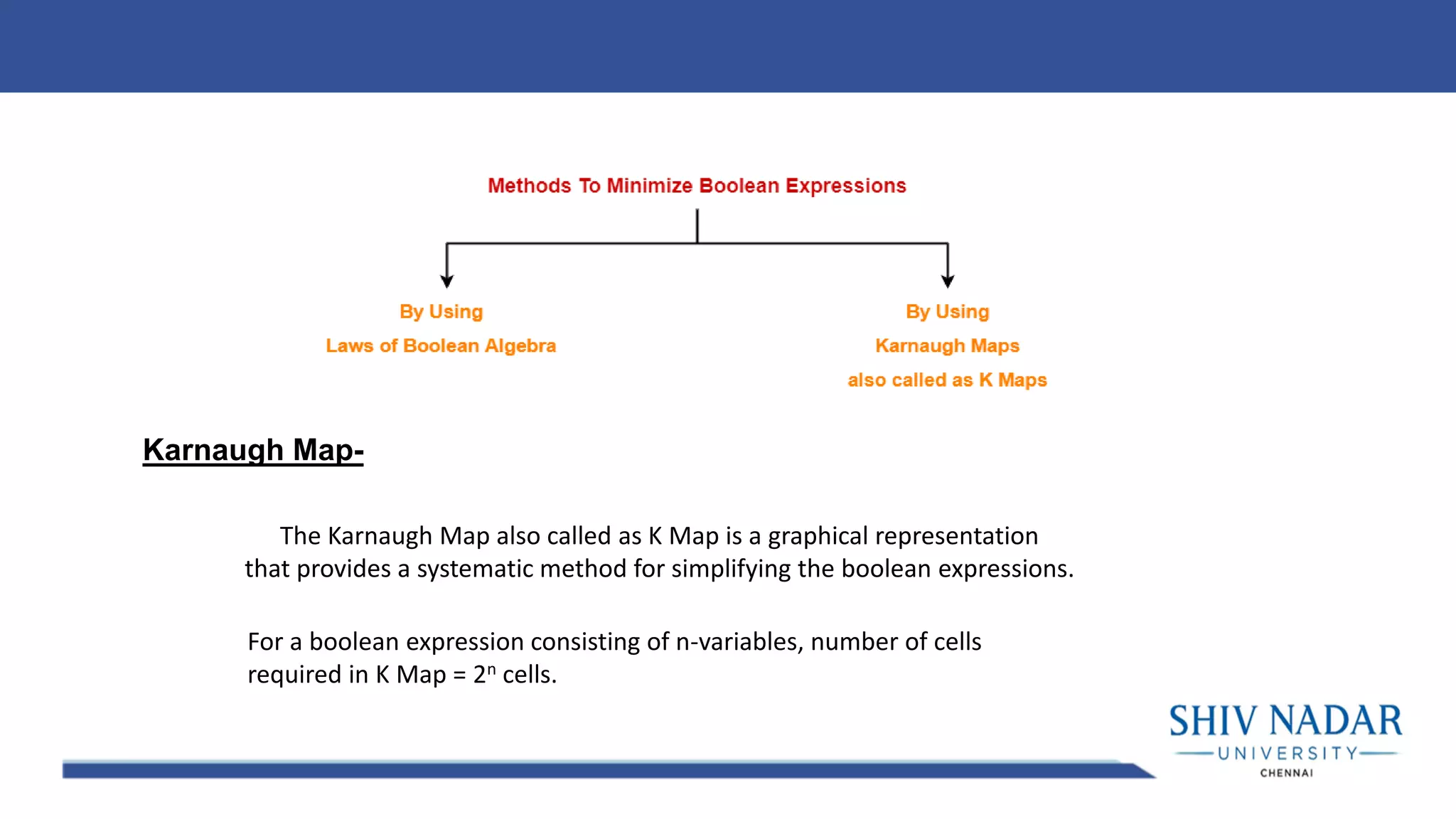
The Karnaugh Map also called as K Map is a graphical representation
that provides a systematic method for simplifying the boolean expressions.
Karnaugh Map-
For a boolean expression consisting of n-variables, number of cells
required in K Map = 2n cells.
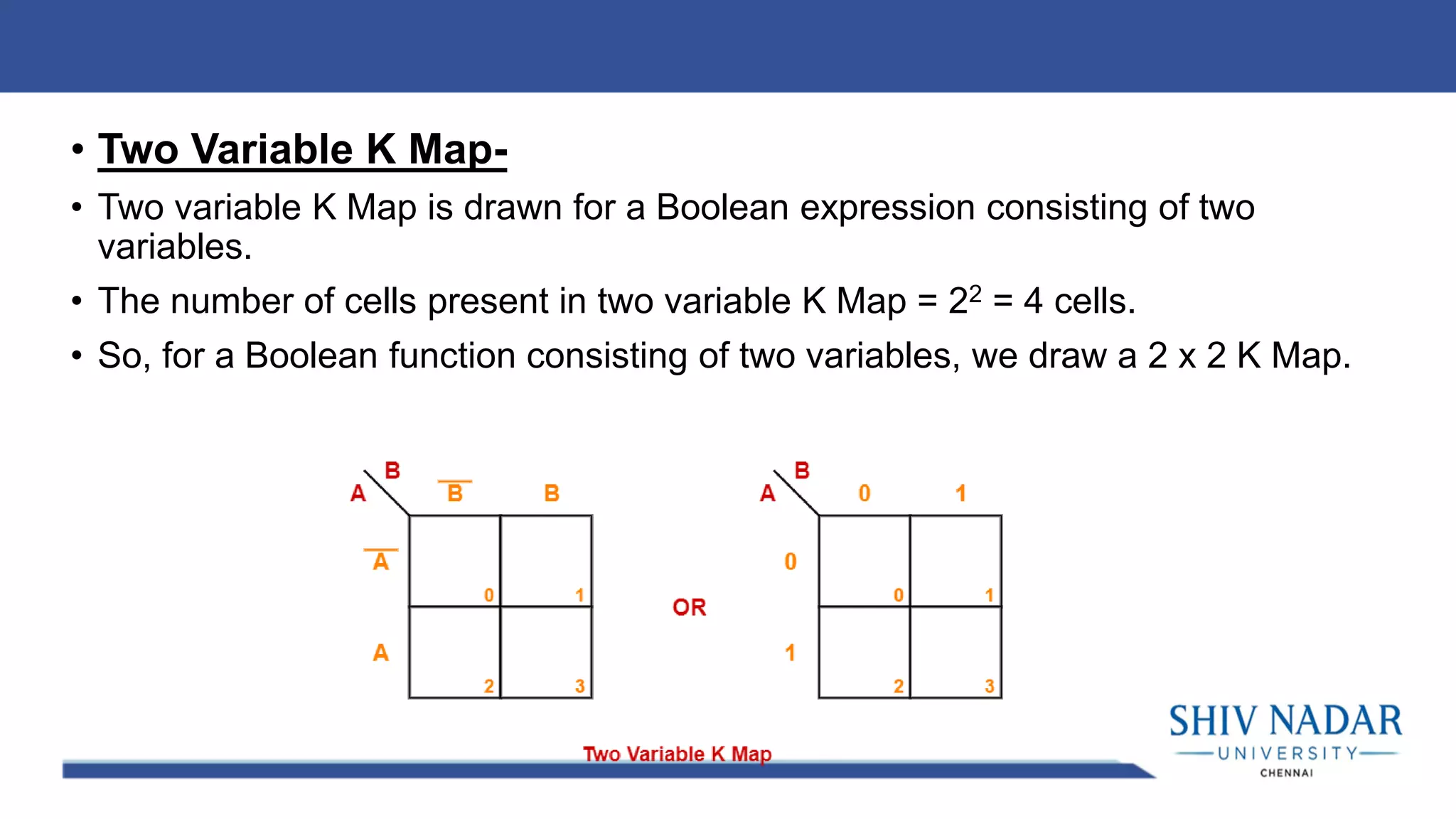
• Two Variable K Map-
• Two variable K Map is drawn for a Boolean expression consisting of two
variables.
• The number of cells present in two variable K Map = 22 = 4 cells.
• So, for a Boolean function consisting of two variables, we draw a 2 x 2 K Map.
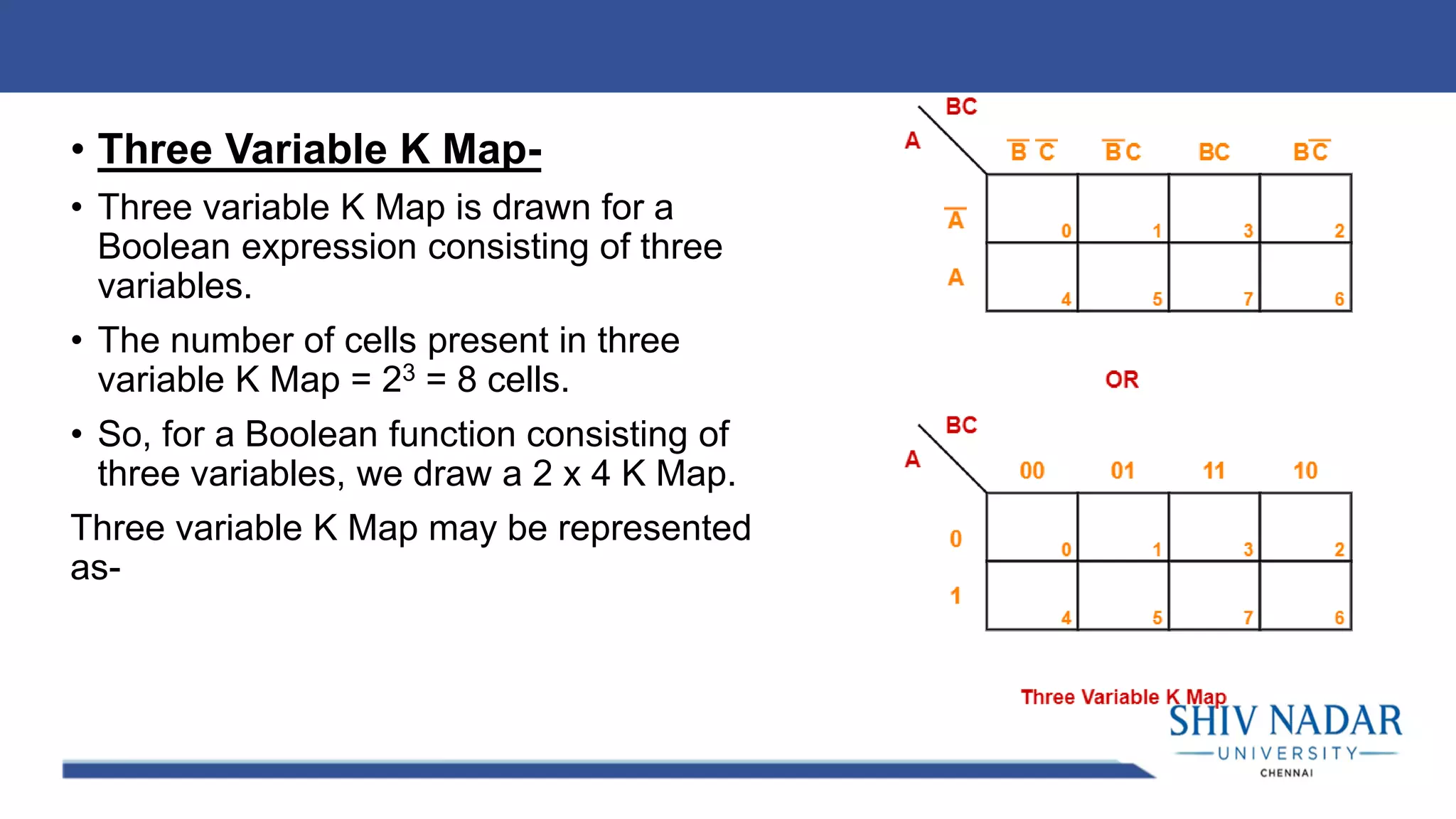
• Three Variable K Map-
• Three variable K Map is drawn for a
Boolean expression consisting of three
variables.
• The number of cells present in three
variable K Map = 23 = 8 cells.
• So, for a Boolean function consisting of
three variables, we draw a 2 x 4 K Map.
Three variable K Map may be represented
as-
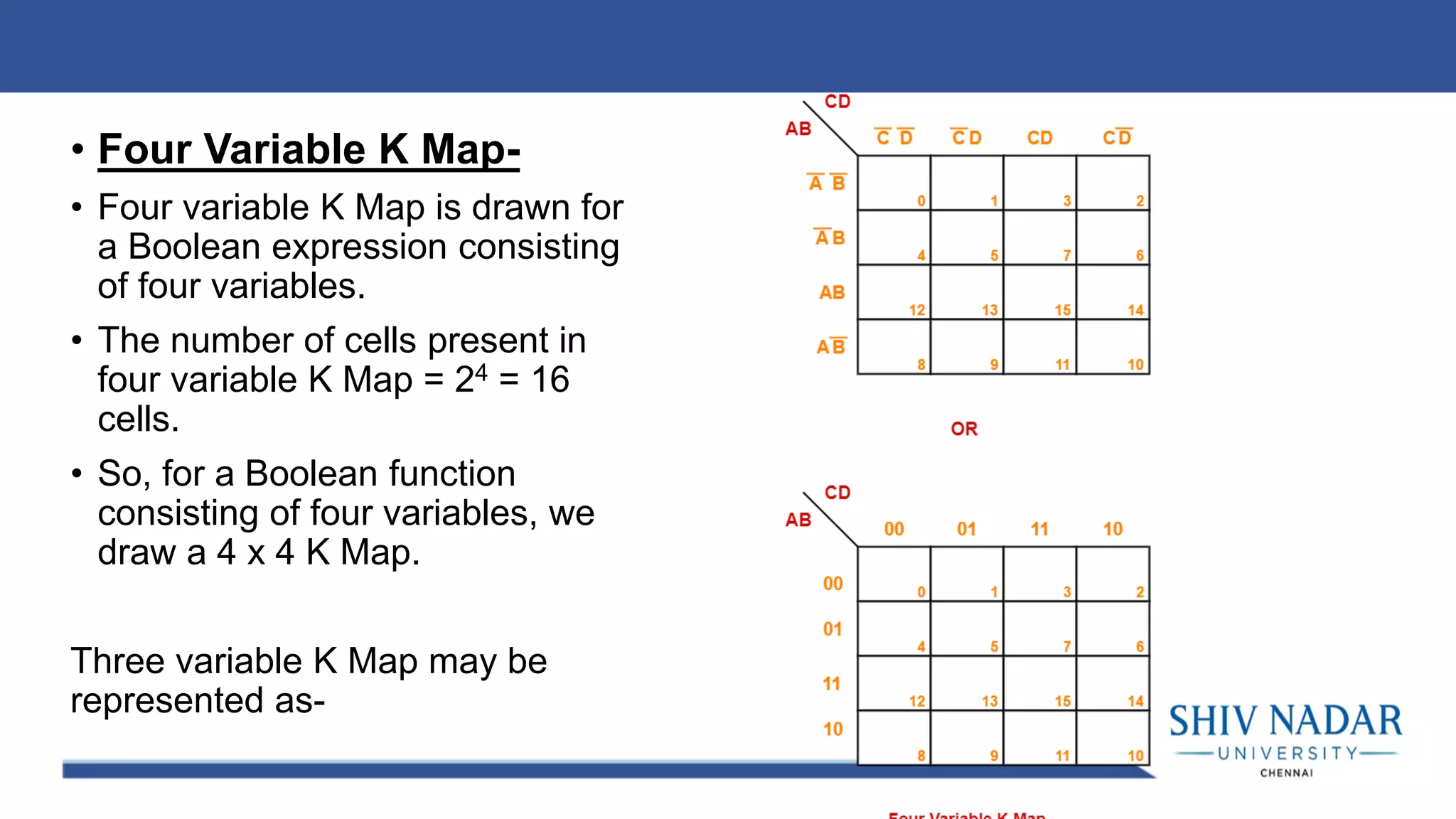
• Four Variable K Map-
• Four variable K Map is drawn for
a Boolean expression consisting
of four variables.
• The number of cells present in
four variable K Map = 24 = 16
cells.
• So, for a Boolean function
consisting of four variables, we
draw a 4 x 4 K Map.
Three variable K Map may be
represented as-
• Karnaugh Map Simplification Rules-
• To minimize the given Boolean function,
• We draw a K Map according to the number of variables it contains.
• We fill the K Map with 0’s and 1’s according to its function.
• Then, we minimize the function in accordance with the following
rules.
• Rule-01:
• We can either group 0’s with 0’s or 1’s with 1’s but we can not group
0’s and 1’s together.
• X representing don’t care can be grouped with 0’s as well as 1’s.
• Rule-02:
• Groups may overlap each other.
• Rule-03:
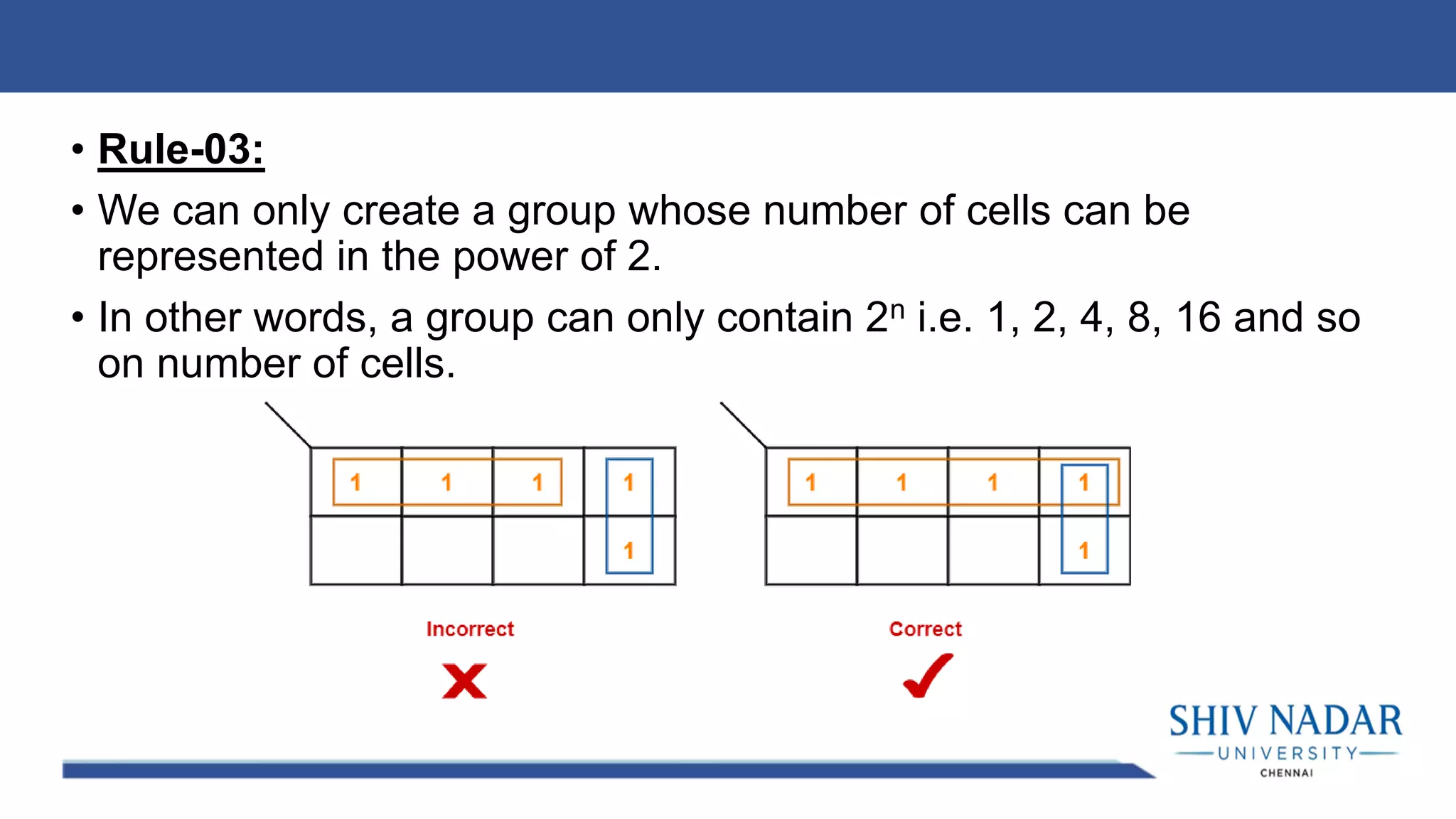
• We can only create a group whose number of cells can be
represented in the power of 2.
• In other words, a group can only contain 2n i.e. 1, 2, 4, 8, 16 and so
on number of cells.
• Rule-04:
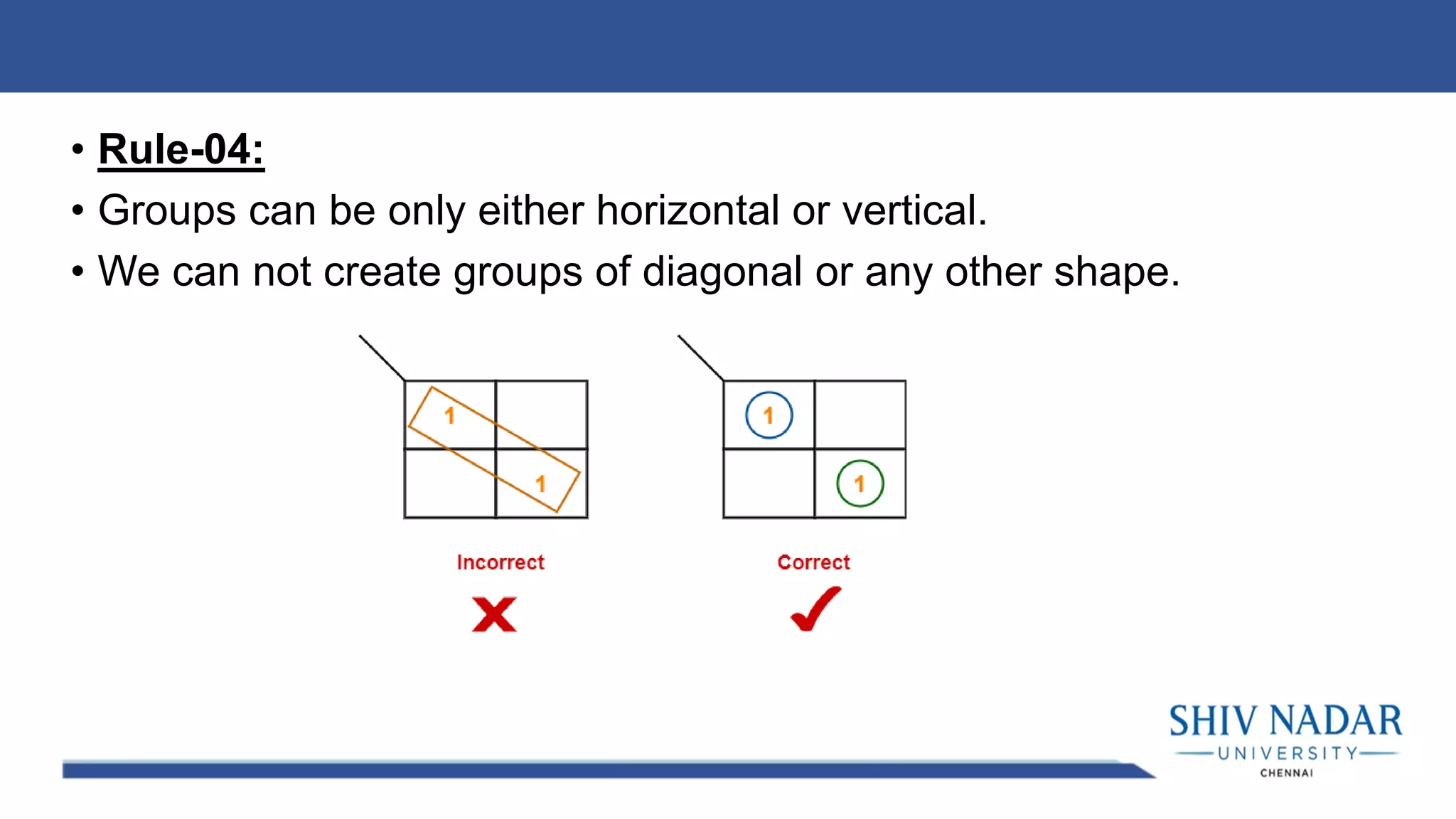
• Groups can be only either horizontal or vertical.
• We can not create groups of diagonal or any other shape.
• Rule-05:
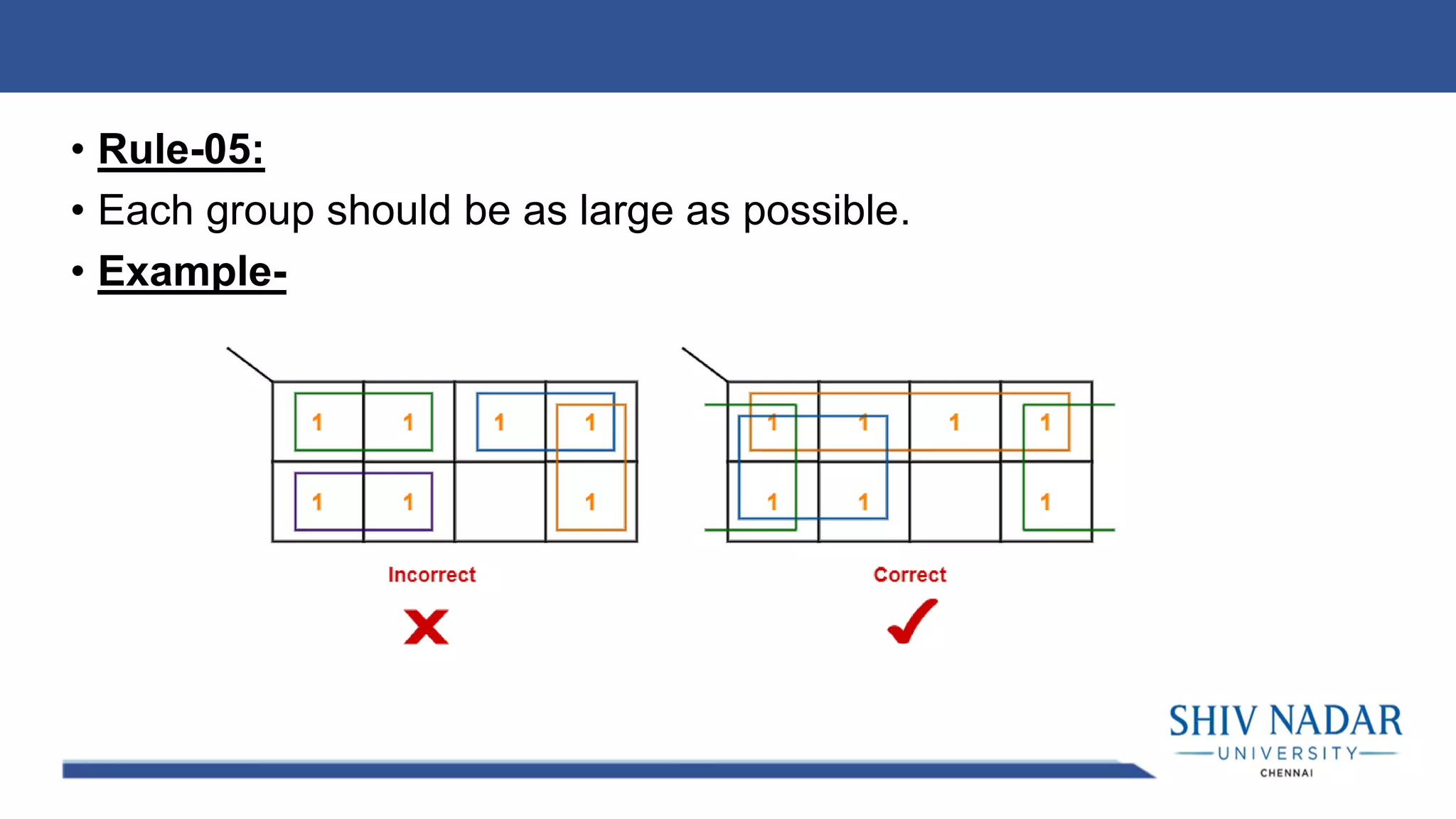
• Each group should be as large as possible.
• Example-
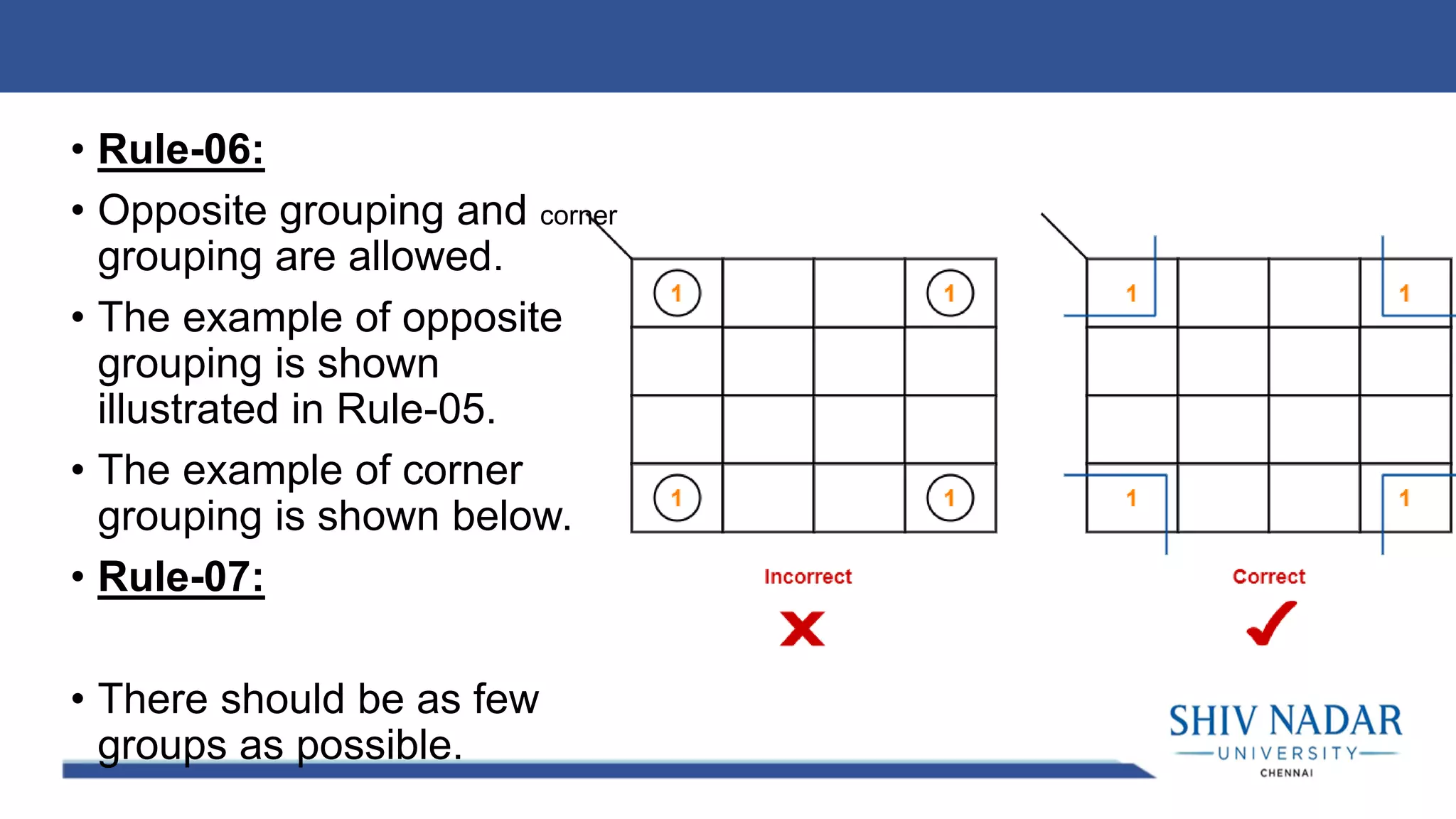
• Rule-06:
• Opposite grouping and corner
grouping are allowed.
• The example of opposite
grouping is shown
illustrated in Rule-05.
• The example of corner
grouping is shown below.
• Rule-07:
• There should be as few
groups as possible.
• Problem-01:
• Minimize the following Boolean function-
F(A, B, C, D) = Σm(0, 1, 2, 5, 7, 8, 9, 10, 13, 15)
• Solution-
• Since the given Boolean expression has 4 variables, so we draw a 4
x 4 K Map.
• We fill the cells of K Map in accordance with the given boolean
function.
• Then, we form the groups in accordance with the above rules.
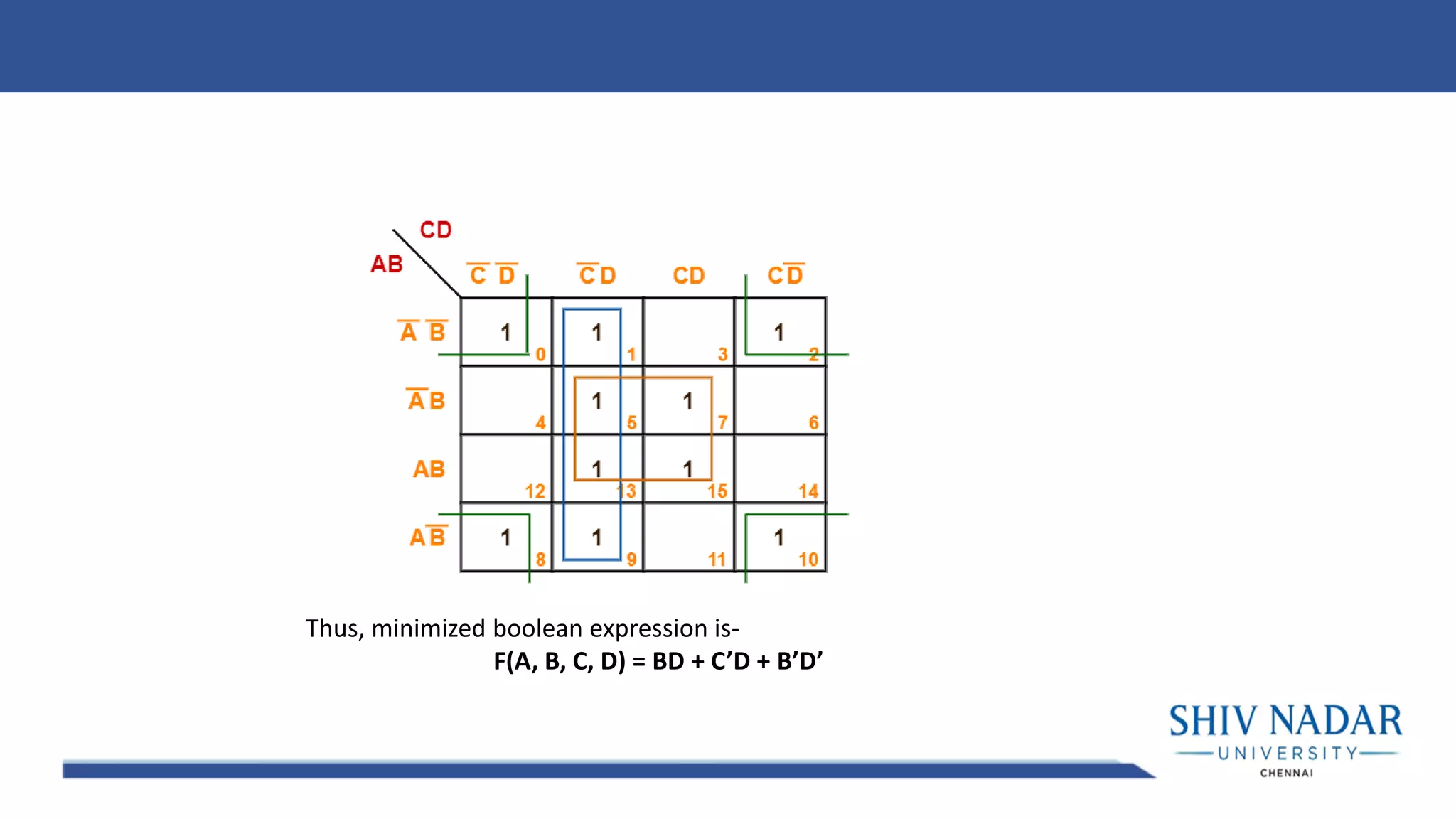
Thus, minimized boolean expression is-
F(A, B, C, D) = BD + C’D + B’D’
• Problem-02:
• Minimize the following Boolean function-
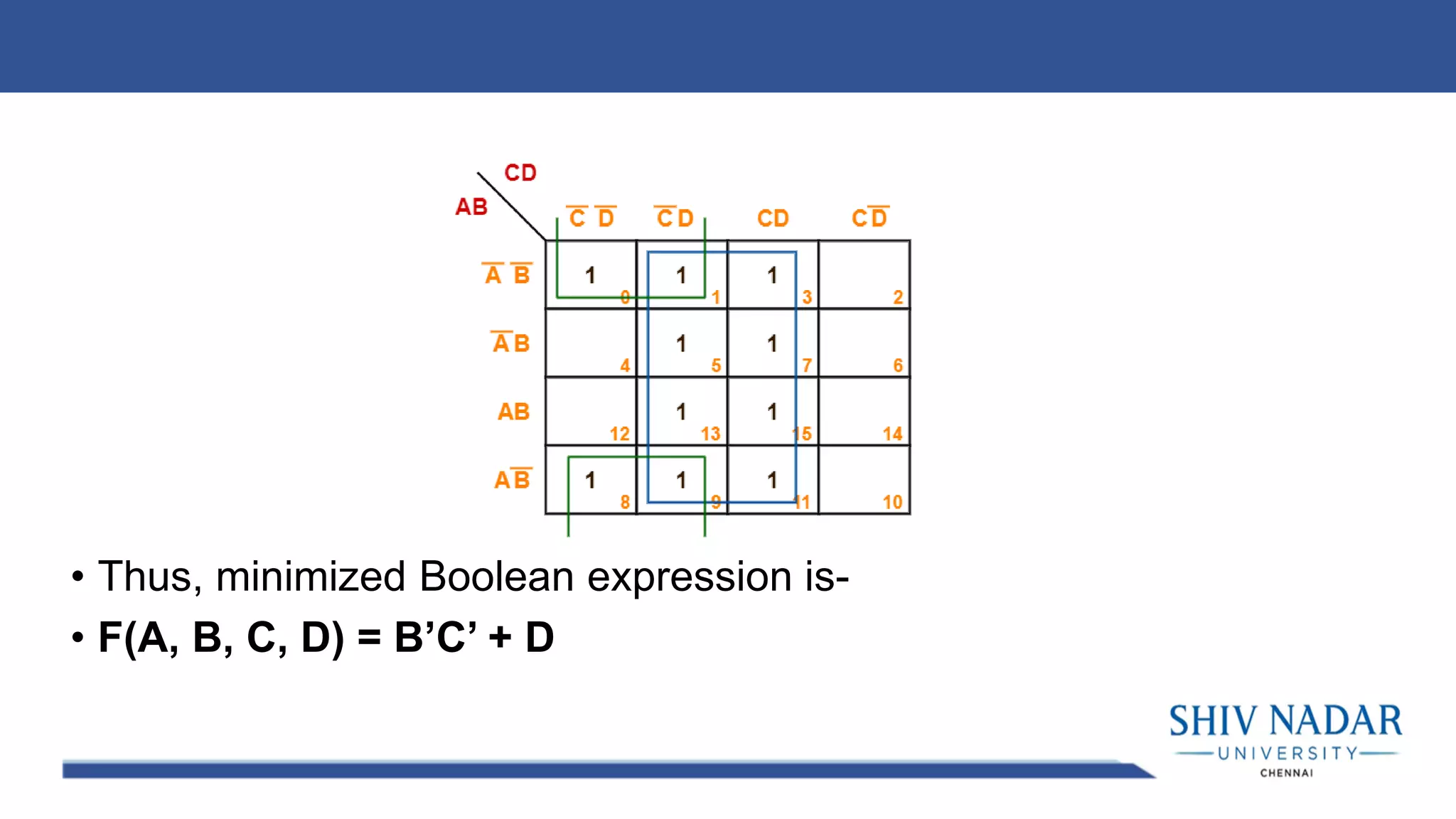
• F(A, B, C, D) = Σm(0, 1, 3, 5, 7, 8, 9, 11, 13, 15)
• Solution-
• Since the given Boolean expression has 4 variables, so we draw a 4
x 4 K Map.
• We fill the cells of K Map in accordance with the given boolean
function.
• Then, we form the groups in accordance with the above rules.
• Thus, minimized Boolean expression is-
• F(A, B, C, D) = B’C’ + D
• Problem-03:
• Minimize the following boolean function-
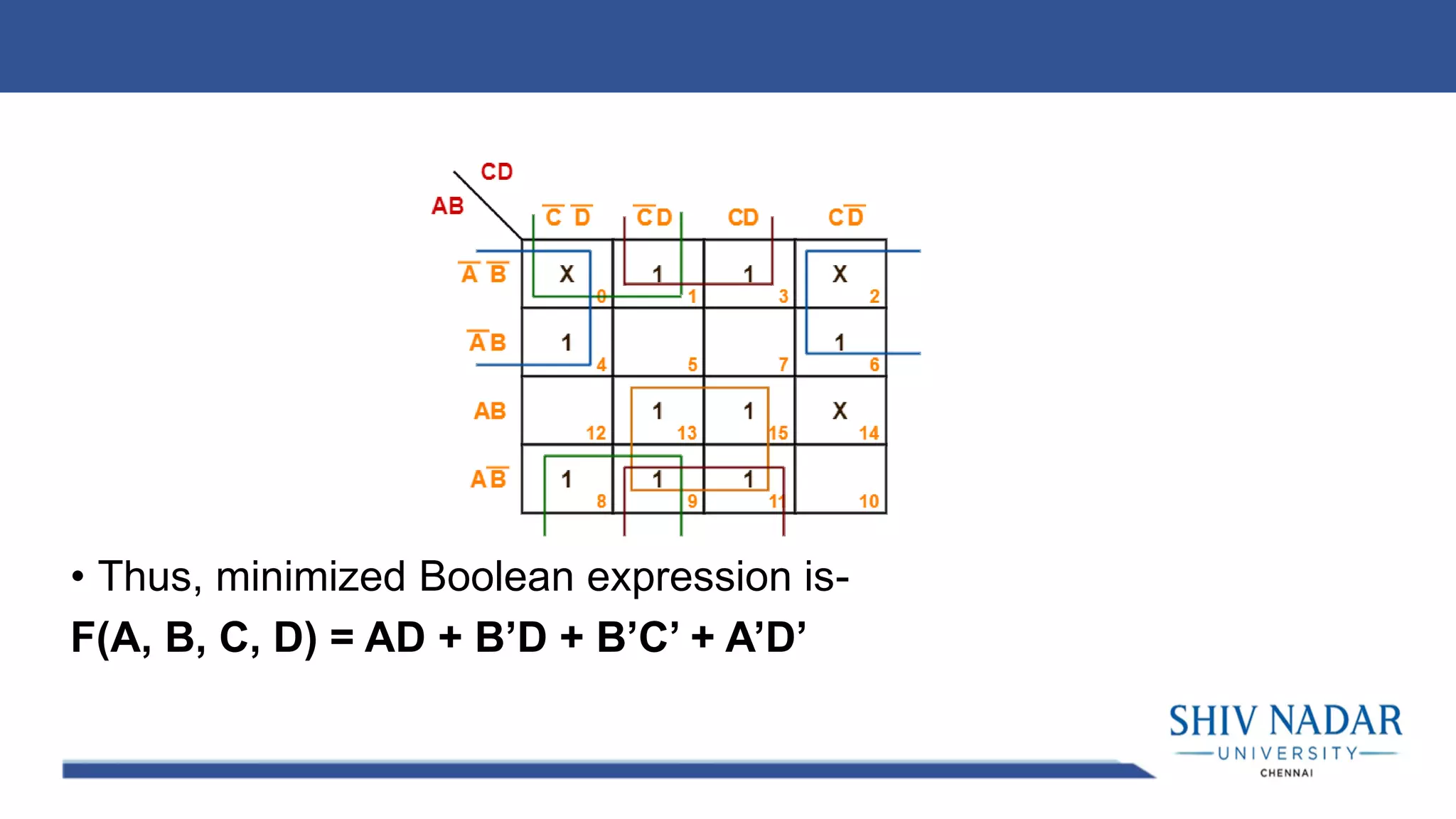
F(A, B, C, D) = Σm(1, 3, 4, 6, 8, 9, 11, 13, 15) + Σd(0, 2, 14)
• Solution-
• Since the given boolean expression has 4 variables, so we draw a 4
x 4 K Map.
• We fill the cells of K Map in accordance with the given boolean
function.
• Then, we form the groups in accordance with the above rules.
• Thus, minimized Boolean expression is-
F(A, B, C, D) = AD + B’D + B’C’ + A’D’
• Problem-04:
• Minimize the following boolean function-
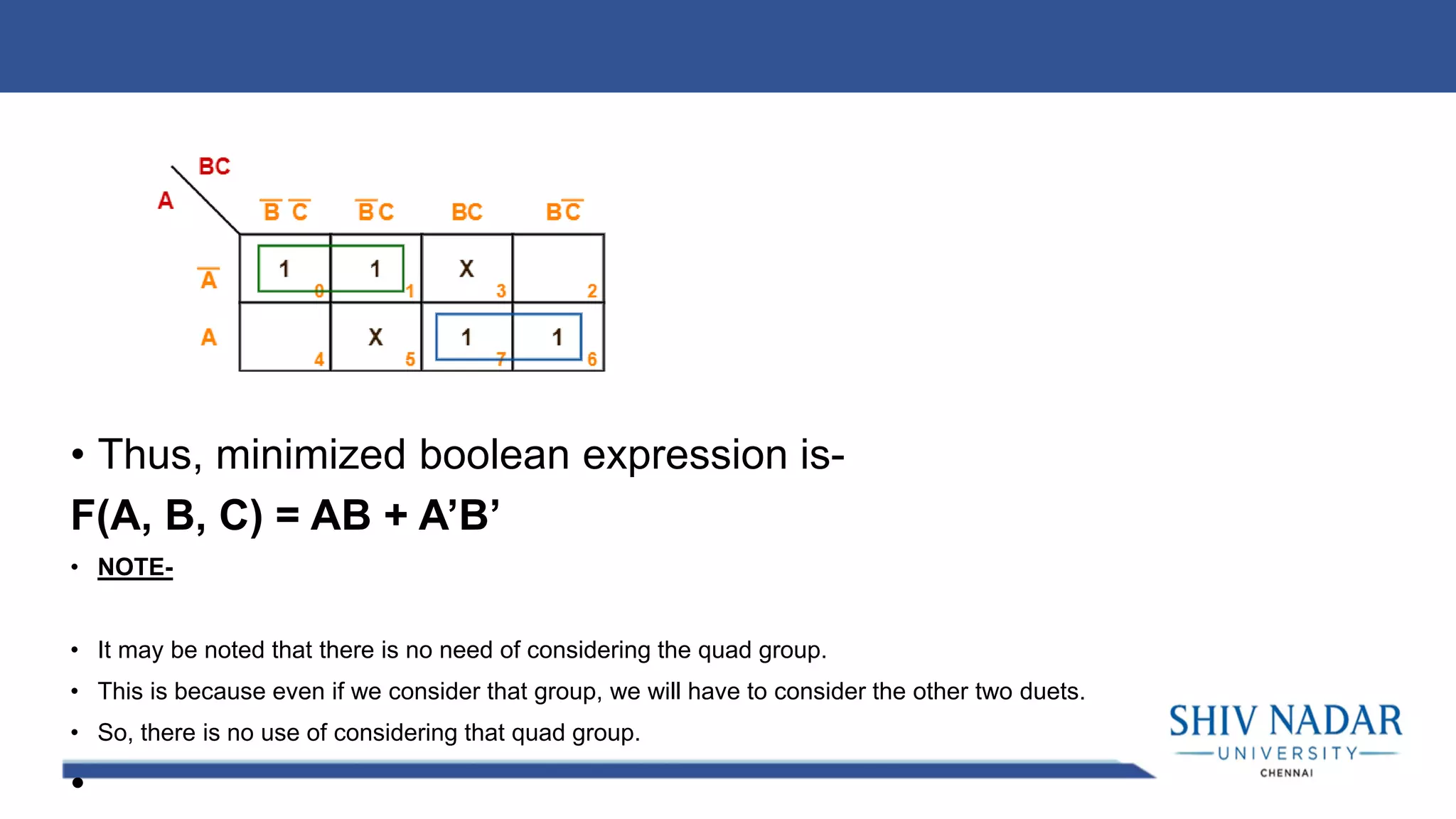
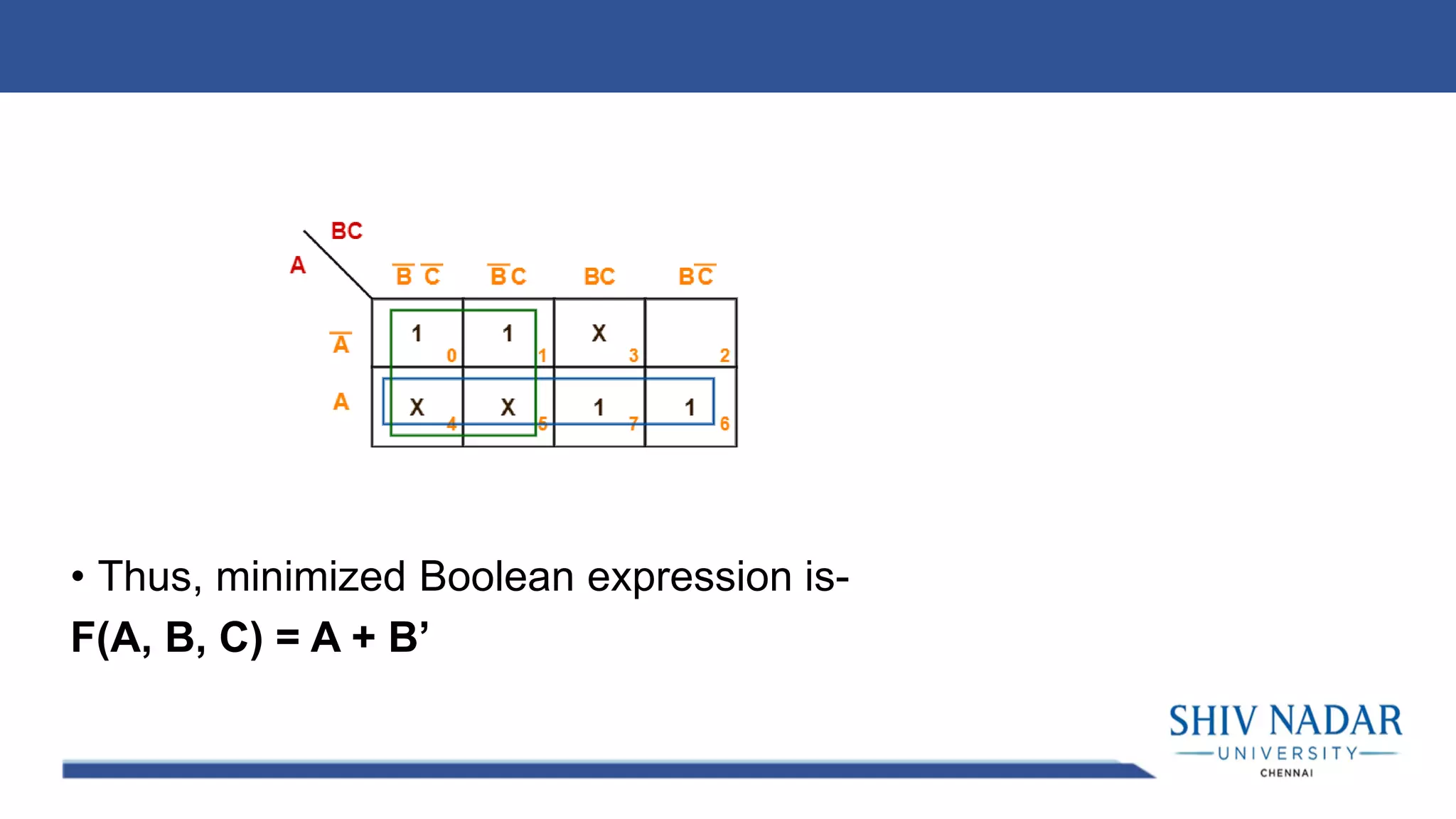
F(A, B, C) = Σm(0, 1, 6, 7) + Σd(3, 5)
• Solution-
• Since the given Boolean expression has 3 variables, so we draw a 2
x 4 K Map.
• We fill the cells of K Map in accordance with the given boolean
function.
• Then, we form the groups in accordance with the above rules.
• Thus, minimized boolean expression is-
F(A, B, C) = AB + A’B’
• NOTE-
• It may be noted that there is no need of considering the quad group.
• This is because even if we consider that group, we will have to consider the other two duets.
• So, there is no use of considering that quad group.
•
• Problem-05:
• Minimize the following boolean function-
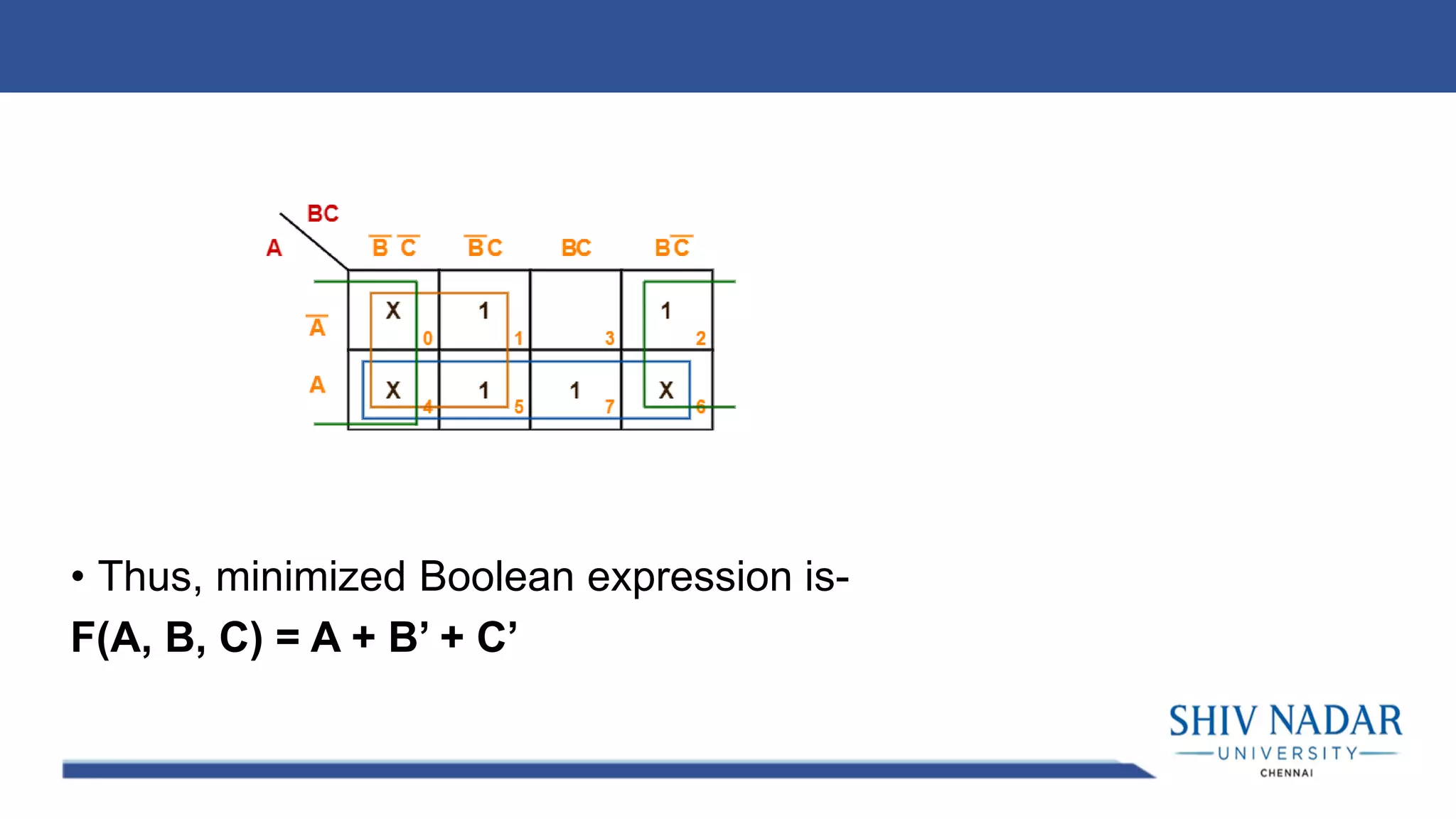
• F(A, B, C) = Σm(1, 2, 5, 7) + Σd(0, 4, 6)
• Solution-
• Since the given Boolean expression has 3 variables, so we draw a 2
x 4 K Map.
• We fill the cells of K Map in accordance with the given boolean
function.
• Then, we form the groups in accordance with the above rules.
• Thus, minimized Boolean expression is-
F(A, B, C) = A + B’ + C’
• Problem-06:
• Minimize the following Boolean function-
• F(A, B, C) = Σm(0, 1, 6, 7) + Σd(3, 4, 5)
• Solution-
• Since the given Boolean expression has 3 variables, so we draw a 2
x 4 K Map.
• We fill the cells of K Map in accordance with the given Boolean
function.
• Then, we form the groups in accordance with the above rules.
• Thus, minimized Boolean expression is-
F(A, B, C) = A + B’
• Problem-07:
• Minimize the following boolean function-
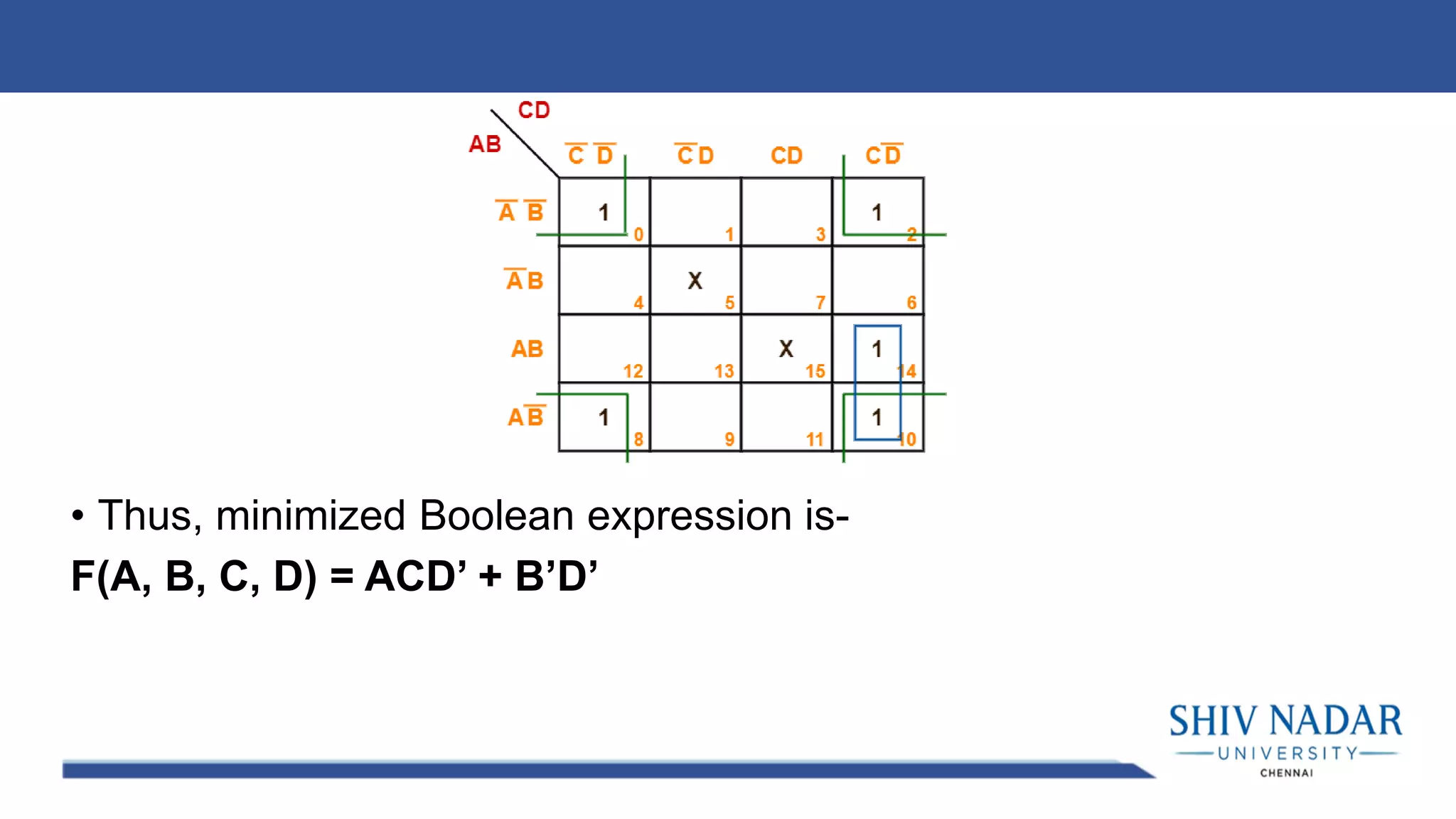
• F(A, B, C, D) = Σm(0, 2, 8, 10, 14) + Σd(5, 15)
• Solution-
• Since the given Boolean expression has 4 variables, so we draw a 4
x 4 K Map.
• We fill the cells of K Map in accordance with the given Boolean
function.
• Then, we form the groups in accordance with the above rules.
•
• Thus, minimized Boolean expression is-
F(A, B, C, D) = ACD’ + B’D’
• Problem-08:
• Minimize the following Boolean function-
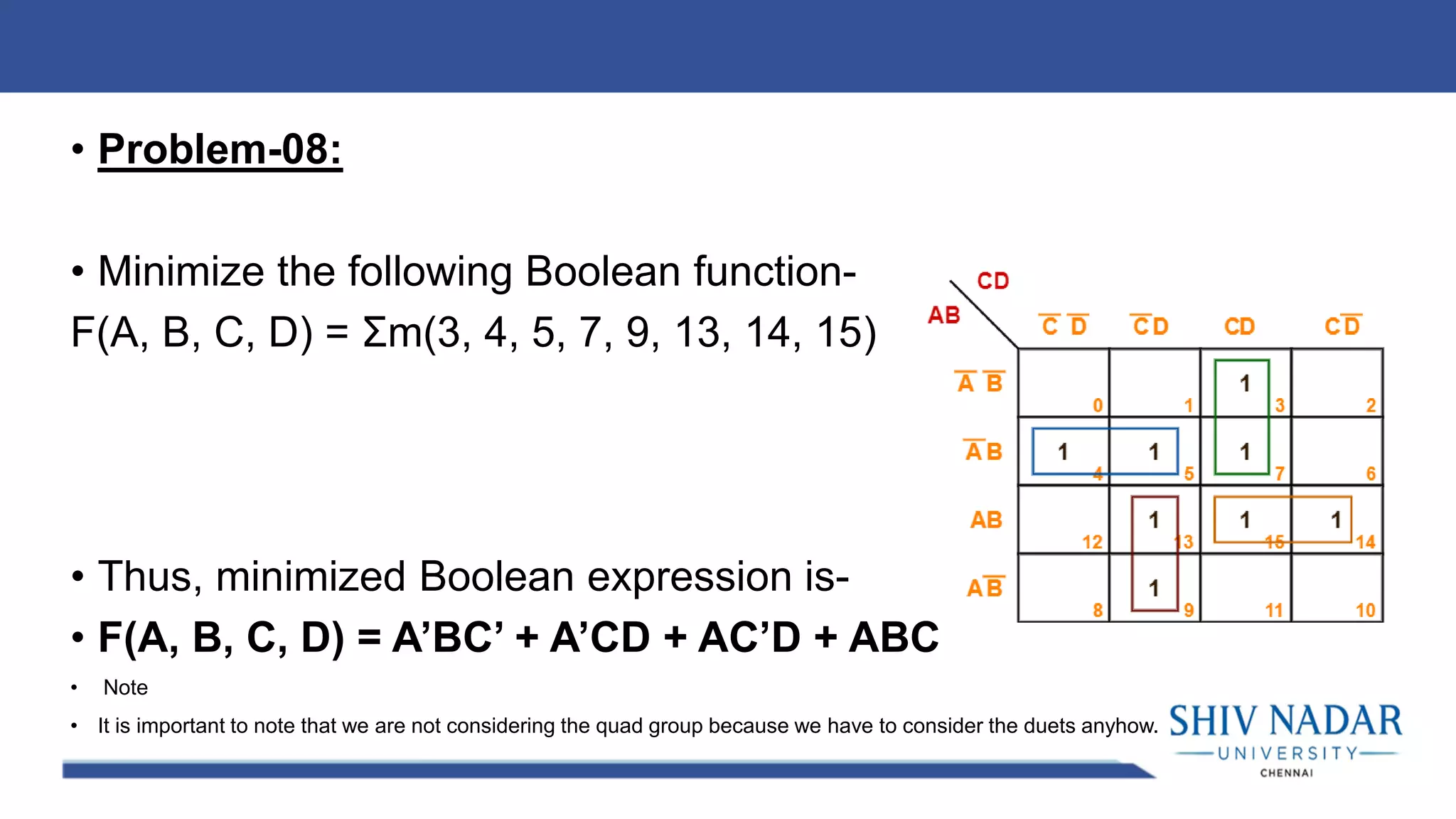
F(A, B, C, D) = Σm(3, 4, 5, 7, 9, 13, 14, 15)
• Thus, minimized Boolean expression is-
• F(A, B, C, D) = A’BC’ + A’CD + AC’D + ABC
• Note
• It is important to note that we are not considering the quad group because we have to consider the duets anyhow.
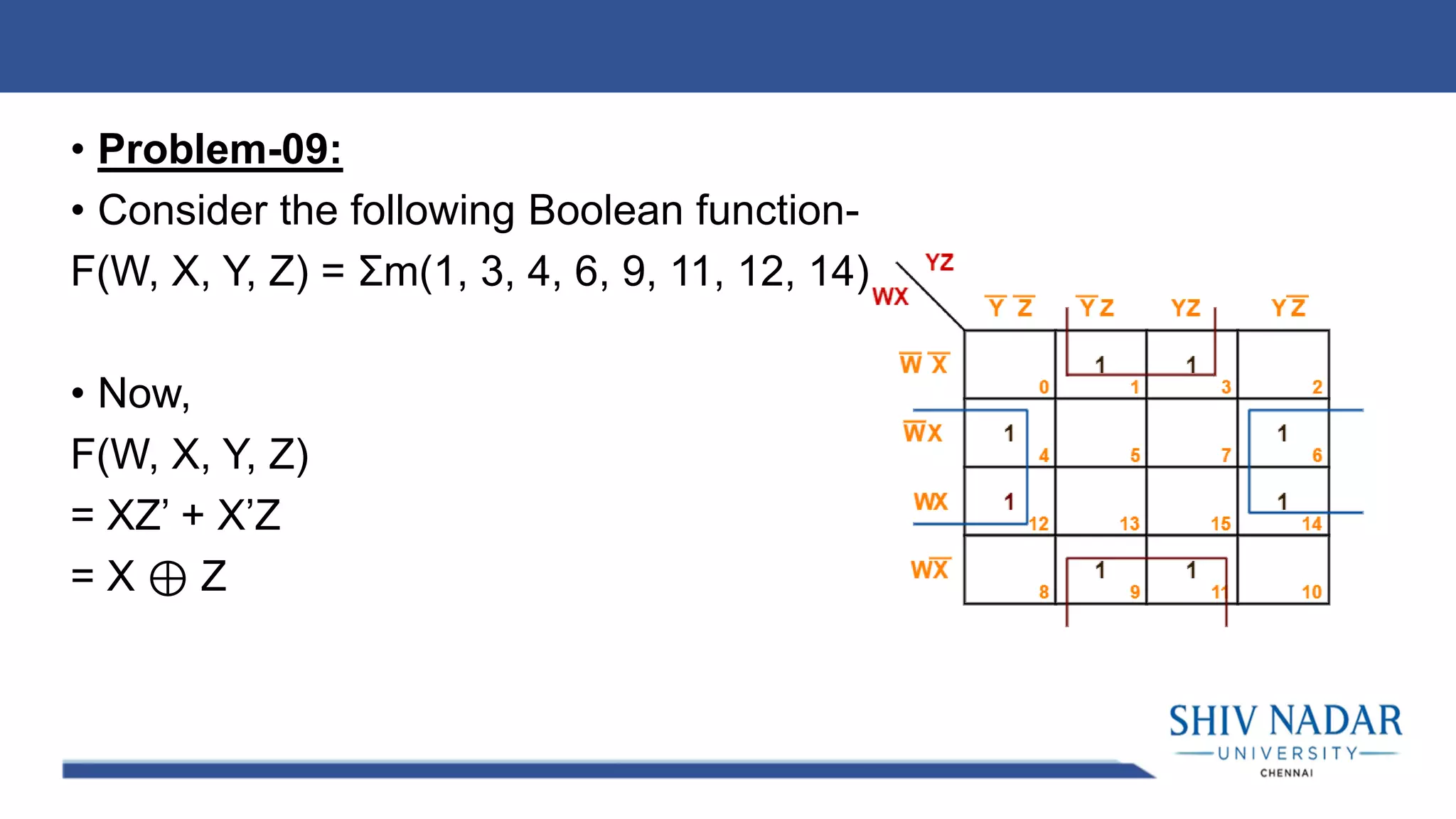
• Problem-09:
• Consider the following Boolean function-
F(W, X, Y, Z) = Σm(1, 3, 4, 6, 9, 11, 12, 14)
• Now,
F(W, X, Y, Z)
= XZ’ + X’Z
= X ⊕ Z

K MAP SIMPLIFICATION.pdf

  • 1.
    Department of ECE SSNCE ShivNadar University Chennai Dr.R.Kalidoss UNIT-II-BOOLEAN ALGEBRA AND MINIMIZATION TECHNIQUES
  • 2.
    The Karnaugh Mapalso called as K Map is a graphical representation that provides a systematic method for simplifying the boolean expressions. Karnaugh Map- For a boolean expression consisting of n-variables, number of cells required in K Map = 2n cells.
  • 3.
    • Two VariableK Map- • Two variable K Map is drawn for a Boolean expression consisting of two variables. • The number of cells present in two variable K Map = 22 = 4 cells. • So, for a Boolean function consisting of two variables, we draw a 2 x 2 K Map.
  • 4.
    • Three VariableK Map- • Three variable K Map is drawn for a Boolean expression consisting of three variables. • The number of cells present in three variable K Map = 23 = 8 cells. • So, for a Boolean function consisting of three variables, we draw a 2 x 4 K Map. Three variable K Map may be represented as-
  • 5.
    • Four VariableK Map- • Four variable K Map is drawn for a Boolean expression consisting of four variables. • The number of cells present in four variable K Map = 24 = 16 cells. • So, for a Boolean function consisting of four variables, we draw a 4 x 4 K Map. Three variable K Map may be represented as-
  • 6.
    • Karnaugh MapSimplification Rules- • To minimize the given Boolean function, • We draw a K Map according to the number of variables it contains. • We fill the K Map with 0’s and 1’s according to its function. • Then, we minimize the function in accordance with the following rules.
  • 7.
    • Rule-01: • Wecan either group 0’s with 0’s or 1’s with 1’s but we can not group 0’s and 1’s together. • X representing don’t care can be grouped with 0’s as well as 1’s. • Rule-02: • Groups may overlap each other.
  • 8.
    • Rule-03: • Wecan only create a group whose number of cells can be represented in the power of 2. • In other words, a group can only contain 2n i.e. 1, 2, 4, 8, 16 and so on number of cells.
  • 9.
    • Rule-04: • Groupscan be only either horizontal or vertical. • We can not create groups of diagonal or any other shape.
  • 10.
    • Rule-05: • Eachgroup should be as large as possible. • Example-
  • 11.
    • Rule-06: • Oppositegrouping and corner grouping are allowed. • The example of opposite grouping is shown illustrated in Rule-05. • The example of corner grouping is shown below. • Rule-07: • There should be as few groups as possible.
  • 12.
    • Problem-01: • Minimizethe following Boolean function- F(A, B, C, D) = Σm(0, 1, 2, 5, 7, 8, 9, 10, 13, 15) • Solution- • Since the given Boolean expression has 4 variables, so we draw a 4 x 4 K Map. • We fill the cells of K Map in accordance with the given boolean function. • Then, we form the groups in accordance with the above rules.
  • 13.
    Thus, minimized booleanexpression is- F(A, B, C, D) = BD + C’D + B’D’
  • 14.
    • Problem-02: • Minimizethe following Boolean function- • F(A, B, C, D) = Σm(0, 1, 3, 5, 7, 8, 9, 11, 13, 15) • Solution- • Since the given Boolean expression has 4 variables, so we draw a 4 x 4 K Map. • We fill the cells of K Map in accordance with the given boolean function. • Then, we form the groups in accordance with the above rules.
  • 15.
    • Thus, minimizedBoolean expression is- • F(A, B, C, D) = B’C’ + D
  • 16.
    • Problem-03: • Minimizethe following boolean function- F(A, B, C, D) = Σm(1, 3, 4, 6, 8, 9, 11, 13, 15) + Σd(0, 2, 14) • Solution- • Since the given boolean expression has 4 variables, so we draw a 4 x 4 K Map. • We fill the cells of K Map in accordance with the given boolean function. • Then, we form the groups in accordance with the above rules.
  • 17.
    • Thus, minimizedBoolean expression is- F(A, B, C, D) = AD + B’D + B’C’ + A’D’
  • 18.
    • Problem-04: • Minimizethe following boolean function- F(A, B, C) = Σm(0, 1, 6, 7) + Σd(3, 5) • Solution- • Since the given Boolean expression has 3 variables, so we draw a 2 x 4 K Map. • We fill the cells of K Map in accordance with the given boolean function. • Then, we form the groups in accordance with the above rules.
  • 19.
    • Thus, minimizedboolean expression is- F(A, B, C) = AB + A’B’ • NOTE- • It may be noted that there is no need of considering the quad group. • This is because even if we consider that group, we will have to consider the other two duets. • So, there is no use of considering that quad group. •
  • 20.
    • Problem-05: • Minimizethe following boolean function- • F(A, B, C) = Σm(1, 2, 5, 7) + Σd(0, 4, 6) • Solution- • Since the given Boolean expression has 3 variables, so we draw a 2 x 4 K Map. • We fill the cells of K Map in accordance with the given boolean function. • Then, we form the groups in accordance with the above rules.
  • 21.
    • Thus, minimizedBoolean expression is- F(A, B, C) = A + B’ + C’
  • 22.
    • Problem-06: • Minimizethe following Boolean function- • F(A, B, C) = Σm(0, 1, 6, 7) + Σd(3, 4, 5) • Solution- • Since the given Boolean expression has 3 variables, so we draw a 2 x 4 K Map. • We fill the cells of K Map in accordance with the given Boolean function. • Then, we form the groups in accordance with the above rules.
  • 23.
    • Thus, minimizedBoolean expression is- F(A, B, C) = A + B’
  • 24.
    • Problem-07: • Minimizethe following boolean function- • F(A, B, C, D) = Σm(0, 2, 8, 10, 14) + Σd(5, 15) • Solution- • Since the given Boolean expression has 4 variables, so we draw a 4 x 4 K Map. • We fill the cells of K Map in accordance with the given Boolean function. • Then, we form the groups in accordance with the above rules. •
  • 25.
    • Thus, minimizedBoolean expression is- F(A, B, C, D) = ACD’ + B’D’
  • 26.
    • Problem-08: • Minimizethe following Boolean function- F(A, B, C, D) = Σm(3, 4, 5, 7, 9, 13, 14, 15) • Thus, minimized Boolean expression is- • F(A, B, C, D) = A’BC’ + A’CD + AC’D + ABC • Note • It is important to note that we are not considering the quad group because we have to consider the duets anyhow.
  • 27.
    • Problem-09: • Considerthe following Boolean function- F(W, X, Y, Z) = Σm(1, 3, 4, 6, 9, 11, 12, 14) • Now, F(W, X, Y, Z) = XZ’ + X’Z = X ⊕ Z