
SEMICONDUCTOR
BASICS
ByBy
ROHIT KUMAR (15EL30)ROHIT KUMAR (15EL30)
Introduction to Semiconductor -Introduction to Semiconductor -
Chapter Outline :Chapter Outline :
1.81.8 Voltage Current Characteristic of a DiodeVoltage Current Characteristic of a Diode
1.91.9 Diode ModelsDiode Models
1.101.10 Testing a DiodeTesting a Diode
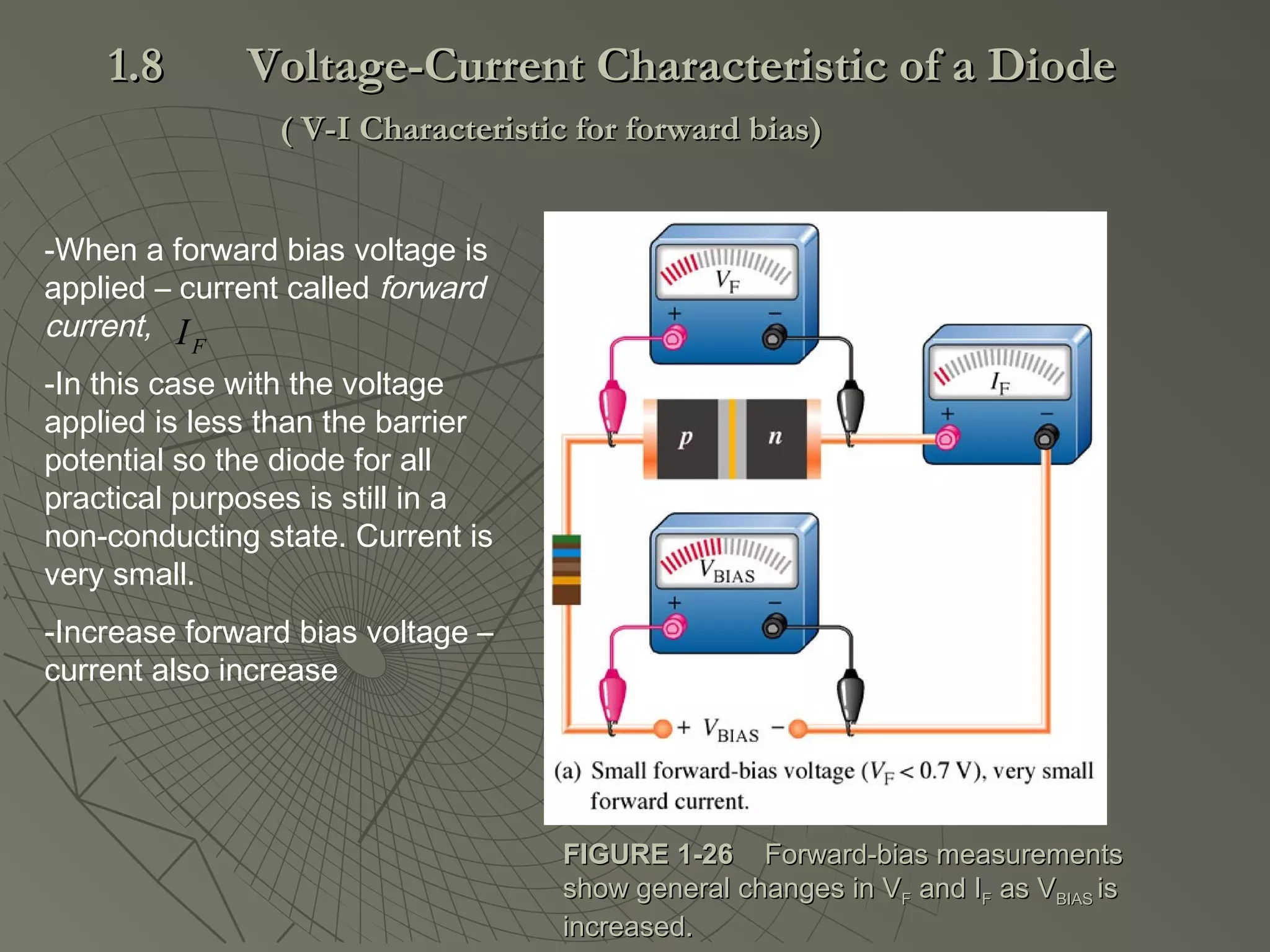
-When a forward bias voltage is
applied – current called forward
current,
-In this case with the voltage
applied is less than the barrier
potential so the diode for all
practical purposes is still in a
non-conducting state. Current is
very small.
-Increase forward bias voltage –
current also increase
FI
FIGURE 1-26FIGURE 1-26 Forward-bias measurementsForward-bias measurements
show general changes in Vshow general changes in VFF and Iand IFF as Vas VBIASBIAS isis
increased.increased.
1.81.8 Voltage-Current Characteristic of a DiodeVoltage-Current Characteristic of a Diode
( V-I Characteristic for forward bias)( V-I Characteristic for forward bias)
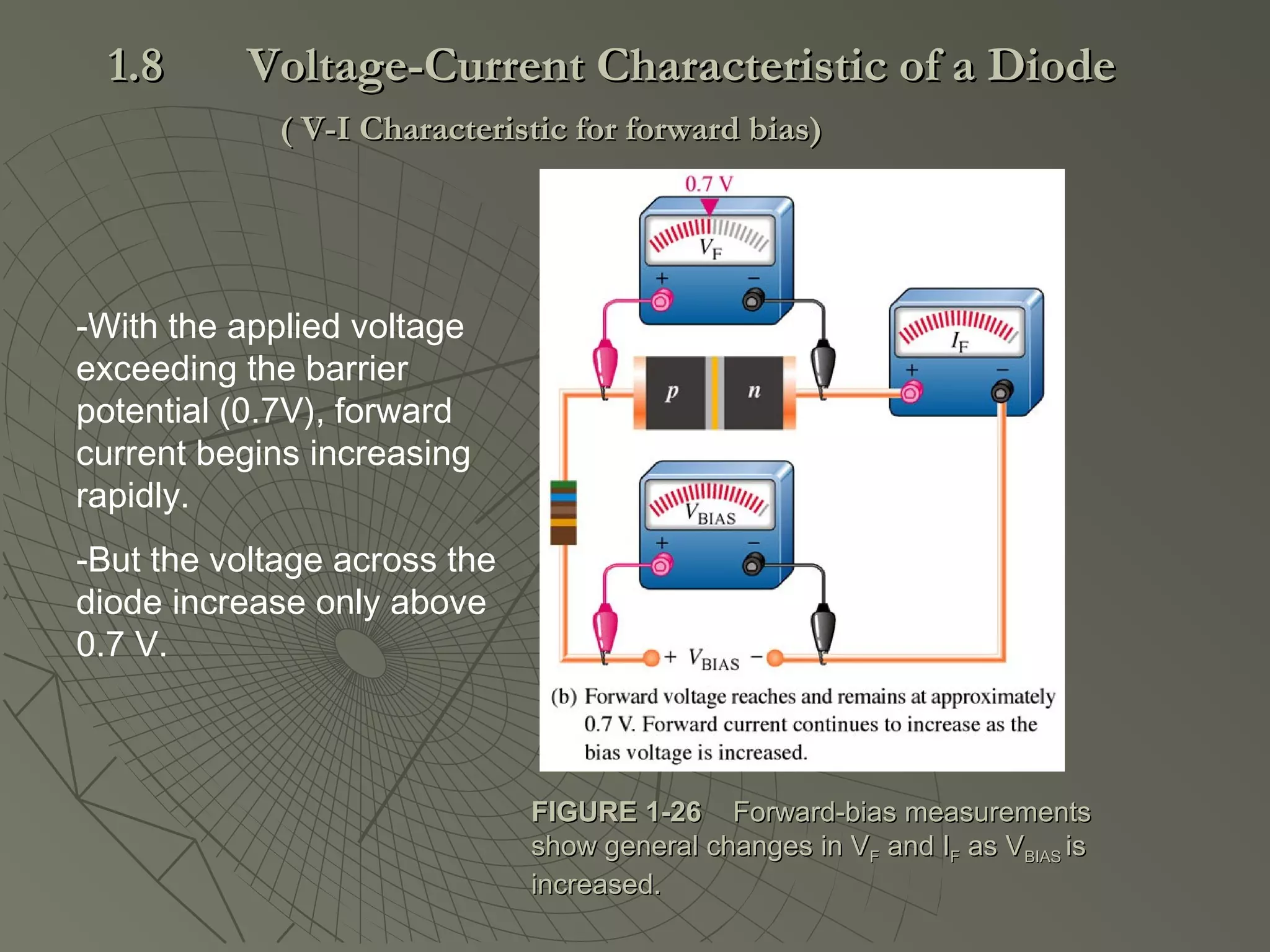
-With the applied voltage
exceeding the barrier
potential (0.7V), forward
current begins increasing
rapidly.
-But the voltage across the
diode increase only above
0.7 V.
FIGURE 1-26FIGURE 1-26 Forward-bias measurementsForward-bias measurements
show general changes in Vshow general changes in VFF and Iand IFF as Vas VBIASBIAS isis
increased.increased.
1.81.8 Voltage-Current Characteristic of a DiodeVoltage-Current Characteristic of a Diode
( V-I Characteristic for forward bias)( V-I Characteristic for forward bias)
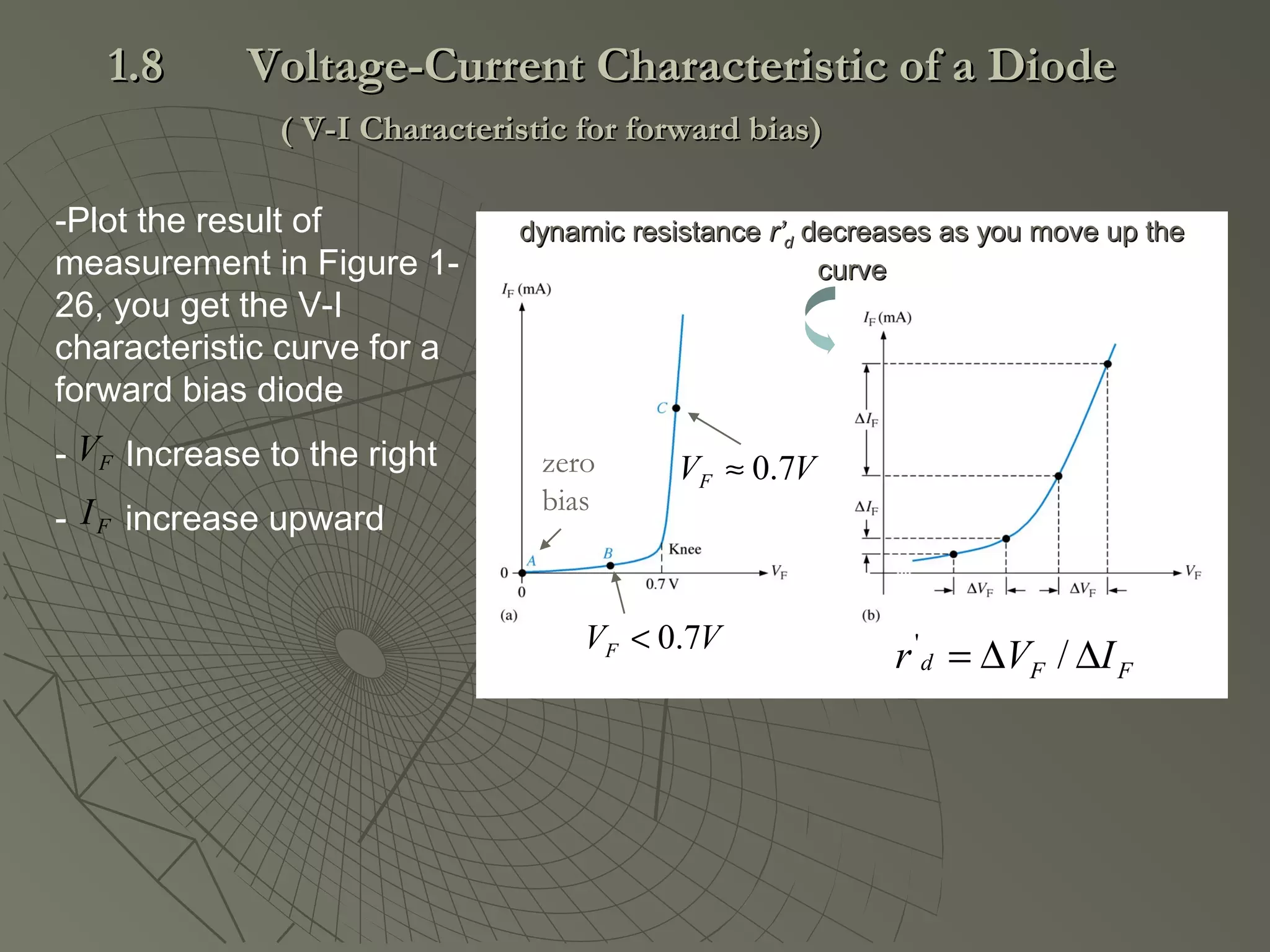
-Plot the result of
measurement in Figure 1-
26, you get the V-I
characteristic curve for a
forward bias diode
- Increase to the right
- increase upward
FFd IVr ∆∆= /'
dynamic resistancedynamic resistance r’r’dd decreases as you move up thedecreases as you move up the
curvecurve
FV
FI
VVF 7.0<
zero
bias
VVF 7.0≈
1.81.8 Voltage-Current Characteristic of a DiodeVoltage-Current Characteristic of a Diode
( V-I Characteristic for forward bias)( V-I Characteristic for forward bias)
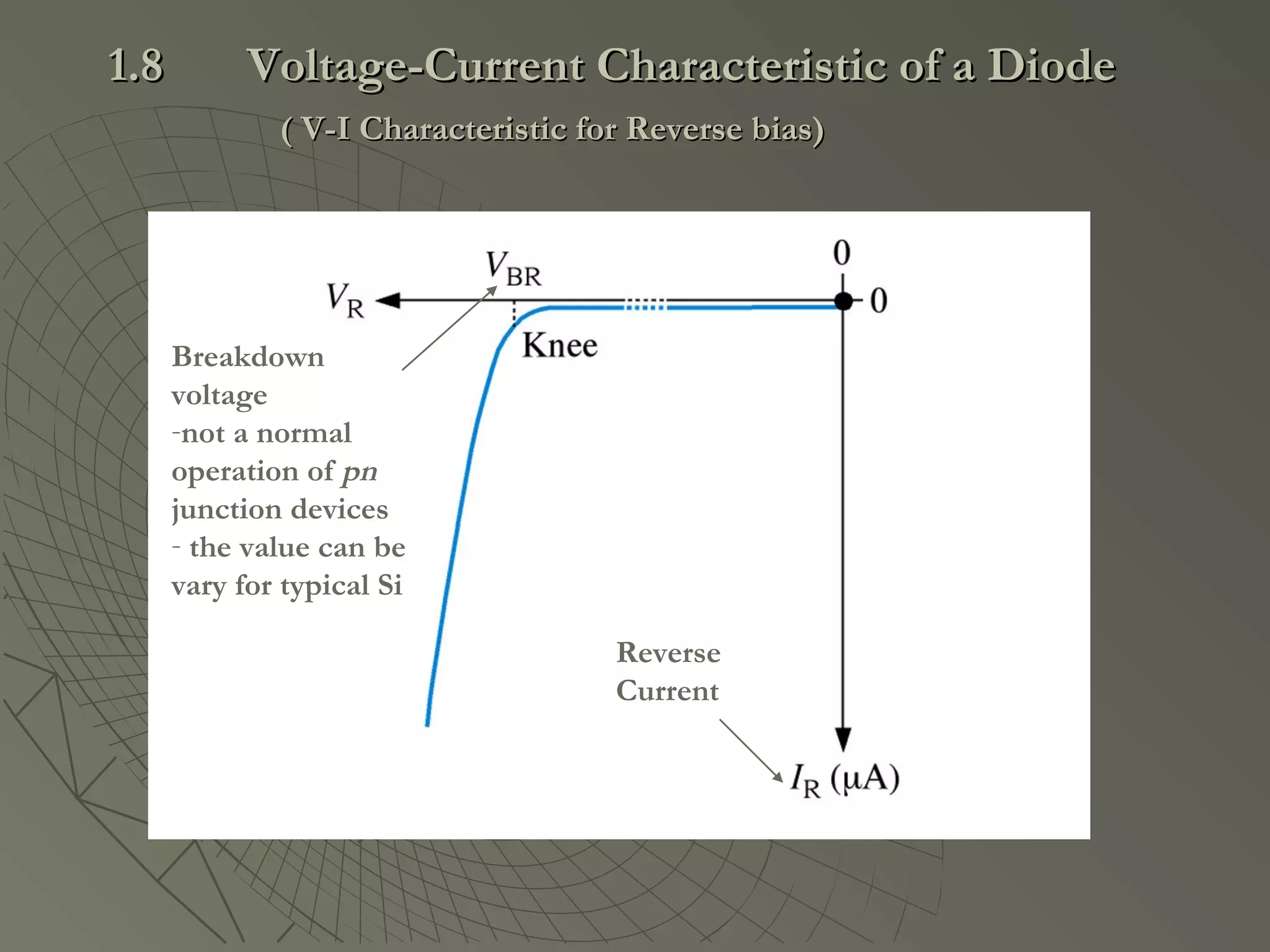
Reverse
Current
Breakdown
voltage
-not a normal
operation of pn
junction devices
- the value can be
vary for typical Si
1.81.8 Voltage-Current Characteristic of a DiodeVoltage-Current Characteristic of a Diode
( V-I Characteristic for Reverse bias)( V-I Characteristic for Reverse bias)
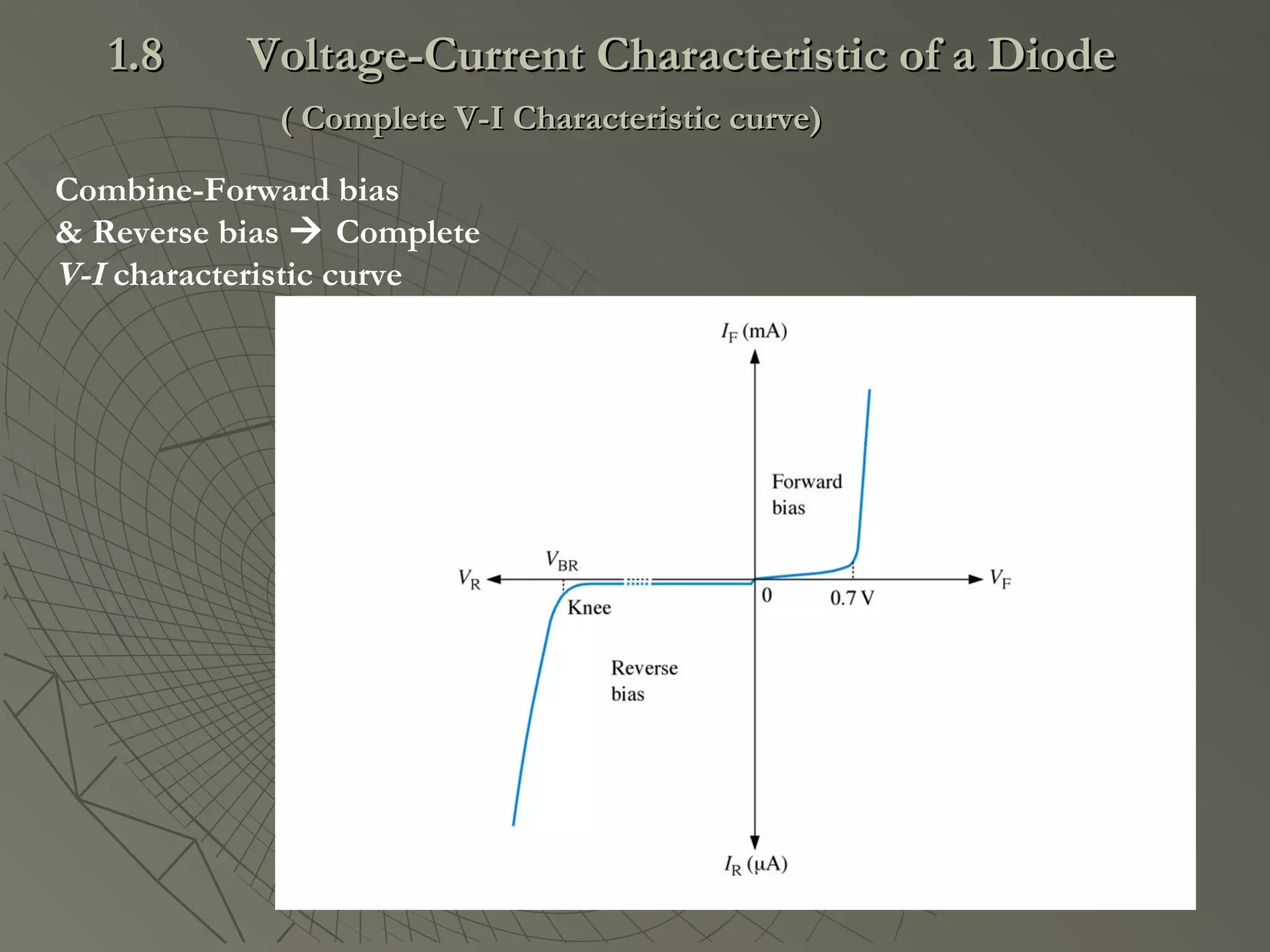
Combine-Forward bias
& Reverse bias  Complete
V-I characteristic curve
1.81.8 Voltage-Current Characteristic of a DiodeVoltage-Current Characteristic of a Diode
( Complete V-I Characteristic curve)( Complete V-I Characteristic curve)
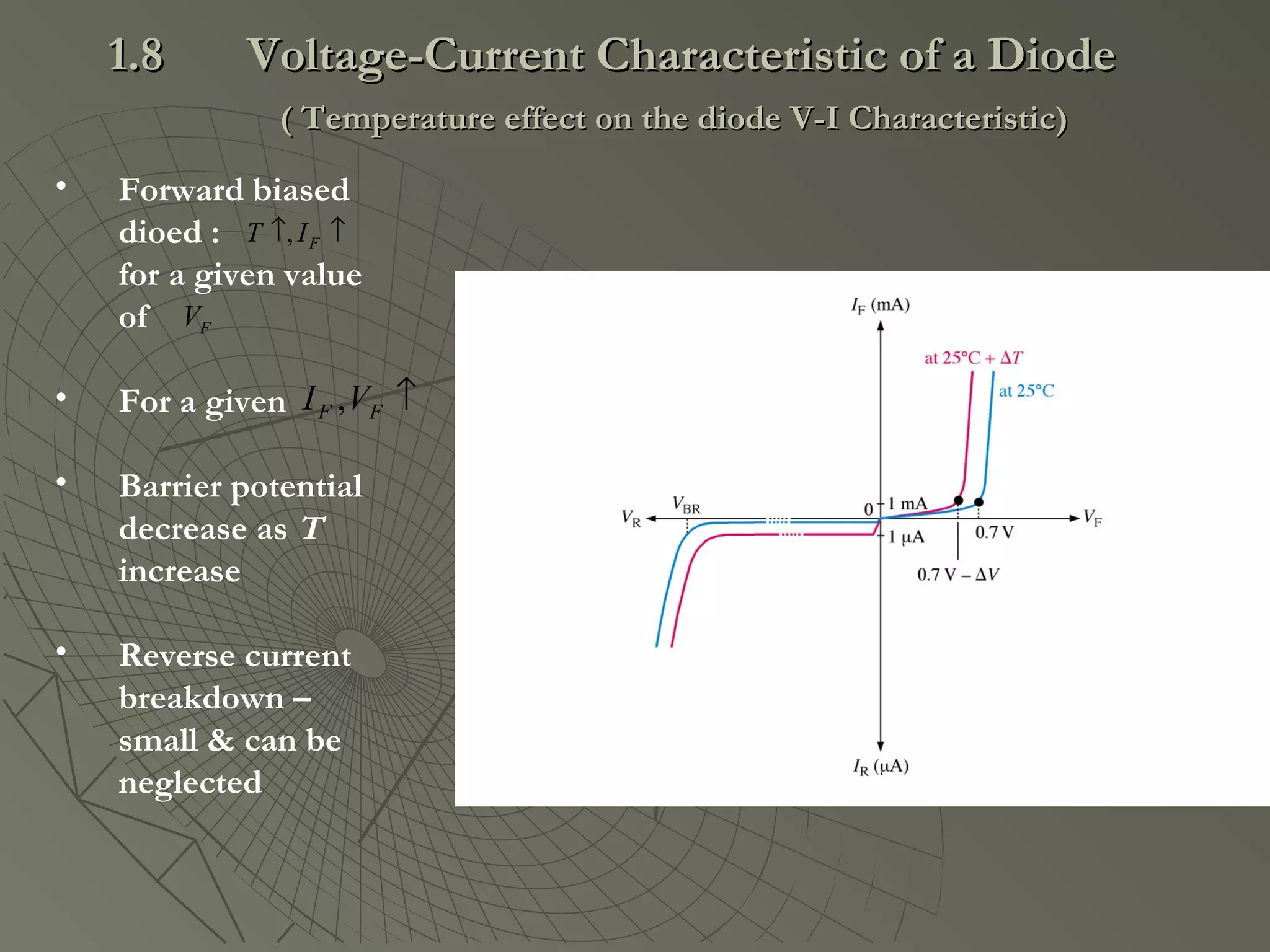
• Forward biased
dioed :
for a given value
of
• For a given
• Barrier potential
decrease as T
increase
• Reverse current
breakdown –
small & can be
neglected
↑↑ FIT ,
FV
↑FF VI ,
1.81.8 Voltage-Current Characteristic of a DiodeVoltage-Current Characteristic of a Diode
( Temperature effect on the diode V-I Characteristic)( Temperature effect on the diode V-I Characteristic)
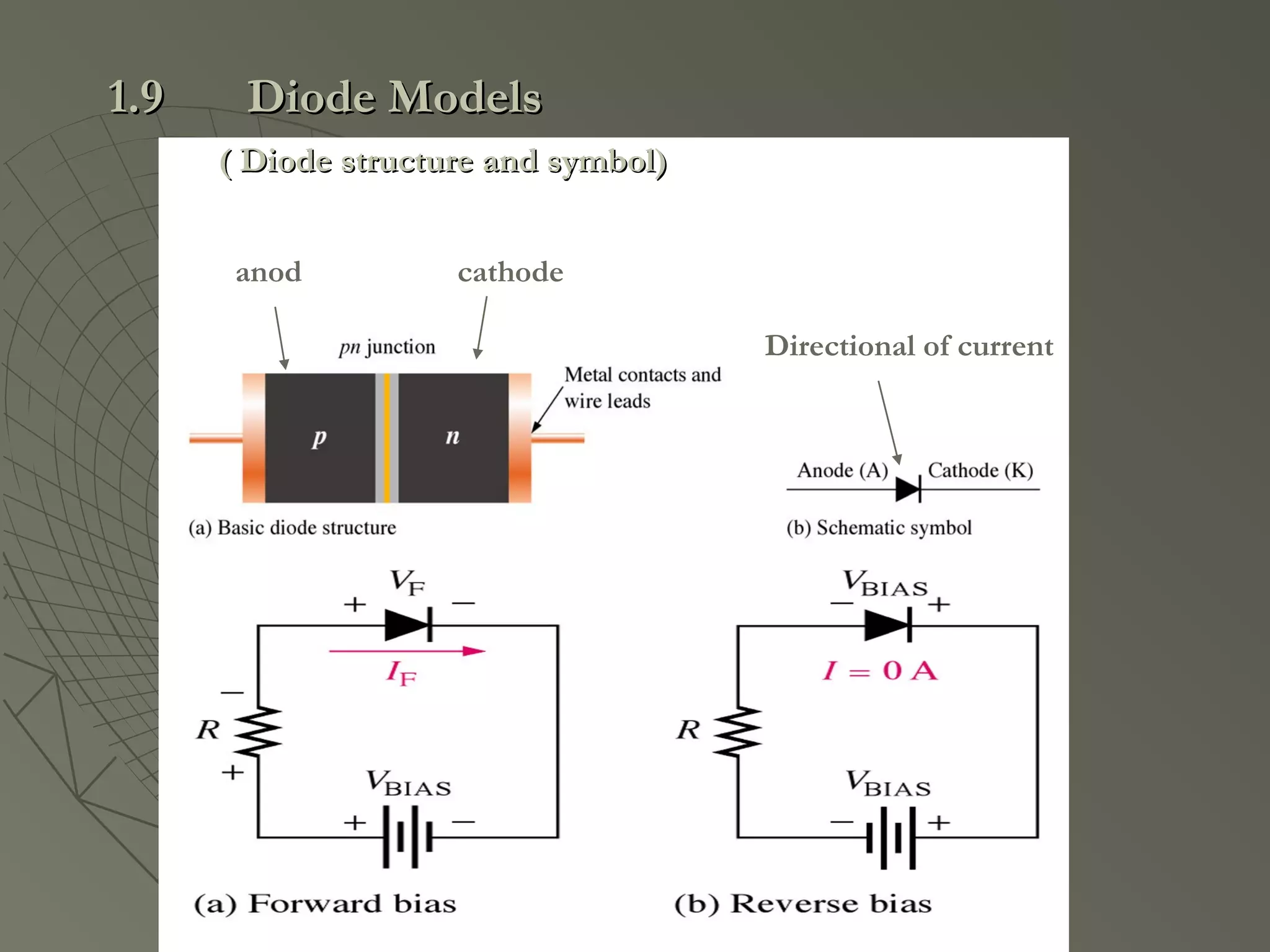
Directional of current
cathodeanod
1.91.9 Diode ModelsDiode Models
( Diode structure and symbol)( Diode structure and symbol)
DIODE
MODEL
The Ideal
Diode Model
The Complete
Diode Model
The Practical
Diode Model
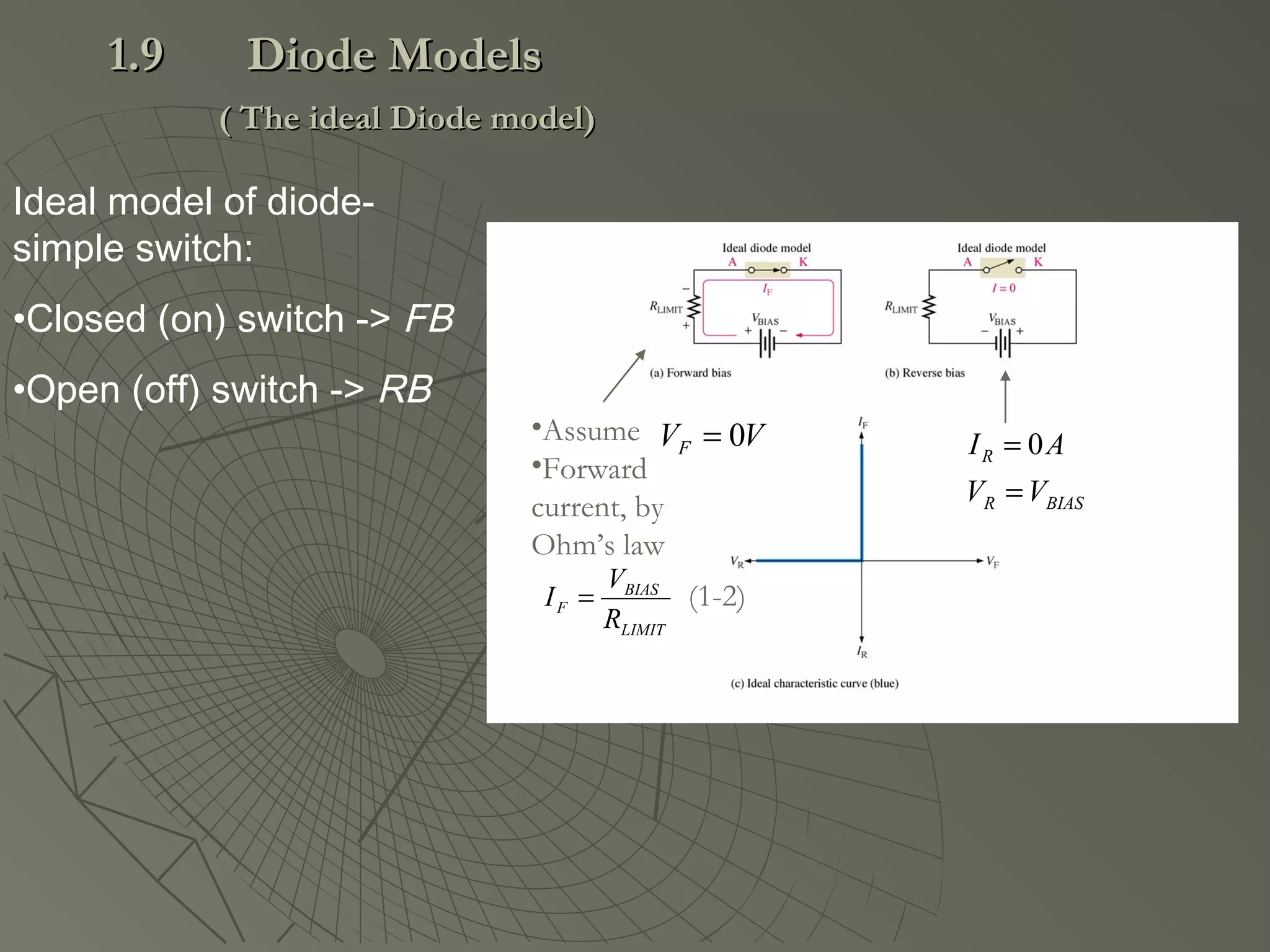
1.91.9 Diode ModelsDiode Models
•Assume
•Forward
current, by
Ohm’s law
Ideal model of diode-
simple switch:
•Closed (on) switch -> FB
•Open (off) switch -> RB
VVF 0=
LIMIT
BIAS
F
R
V
I =
BIASR
R
VV
AI
=
= 0
(1-2)
1.91.9 Diode ModelsDiode Models
( The ideal Diode model)( The ideal Diode model)
•Adds the barrier potential to
the ideal switch model
• ‘ is neglected
•From figure (c):
The forward current [by
applying Kirchhoff’s voltage
low to figure (a)]
Ohm’s Law
dr'
•Equivalent to close
switch in series with a
small equivalent voltage
source equal to the barrier
potential 0.7V
•Represent by
produced across the pn
junction
FV
•Same as ideal diode
model
)(3.0
)(7.0
GeVV
SiVV
F
F
=
=
0=−− LIMITRFBIAS VVV
LIMITFR RIV LIMIT
=
LIMIT
FBIAS
F
R
VV
I
−
=
BIASR
R
VV
AI
=
= 0
(1-3)
1.91.9 Diode ModelsDiode Models ( The Practical Diode model)( The Practical Diode model)
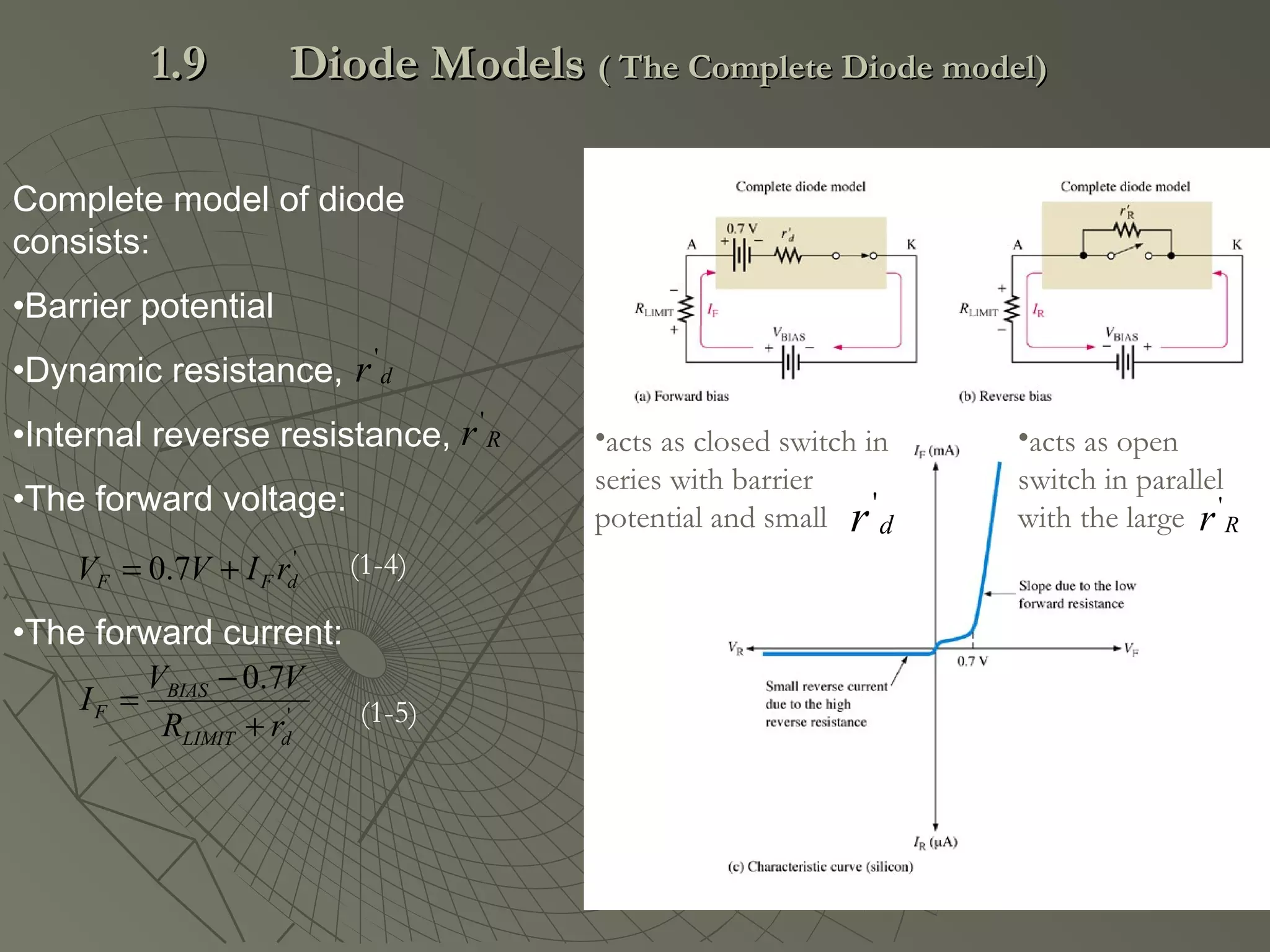
Complete model of diode
consists:
•Barrier potential
•Dynamic resistance,
•Internal reverse resistance,
•The forward voltage:
•The forward current:
dr'
Rr'
•acts as closed switch in
series with barrier
potential and small dr'
Rr'
•acts as open
switch in parallel
with the large
'
7.0 dFF rIVV +=
'
7.0
dLIMIT
BIAS
F
rR
VV
I
+
−
=
(1-4)
(1-5)
1.91.9 Diode ModelsDiode Models ( The Complete Diode model)( The Complete Diode model)
10V10V
1.0kΩ1.0kΩ
5V5V
1.0kΩ1.0kΩ
(1) Determine the forward voltage and forward current
[forward bias] for each of the diode model also find the
voltage across the limiting resistor in each cases.
Assumed rd’ = 10Ω at the determined value of forward
current.
1.91.9 Diode ModelsDiode Models ( Example)( Example)
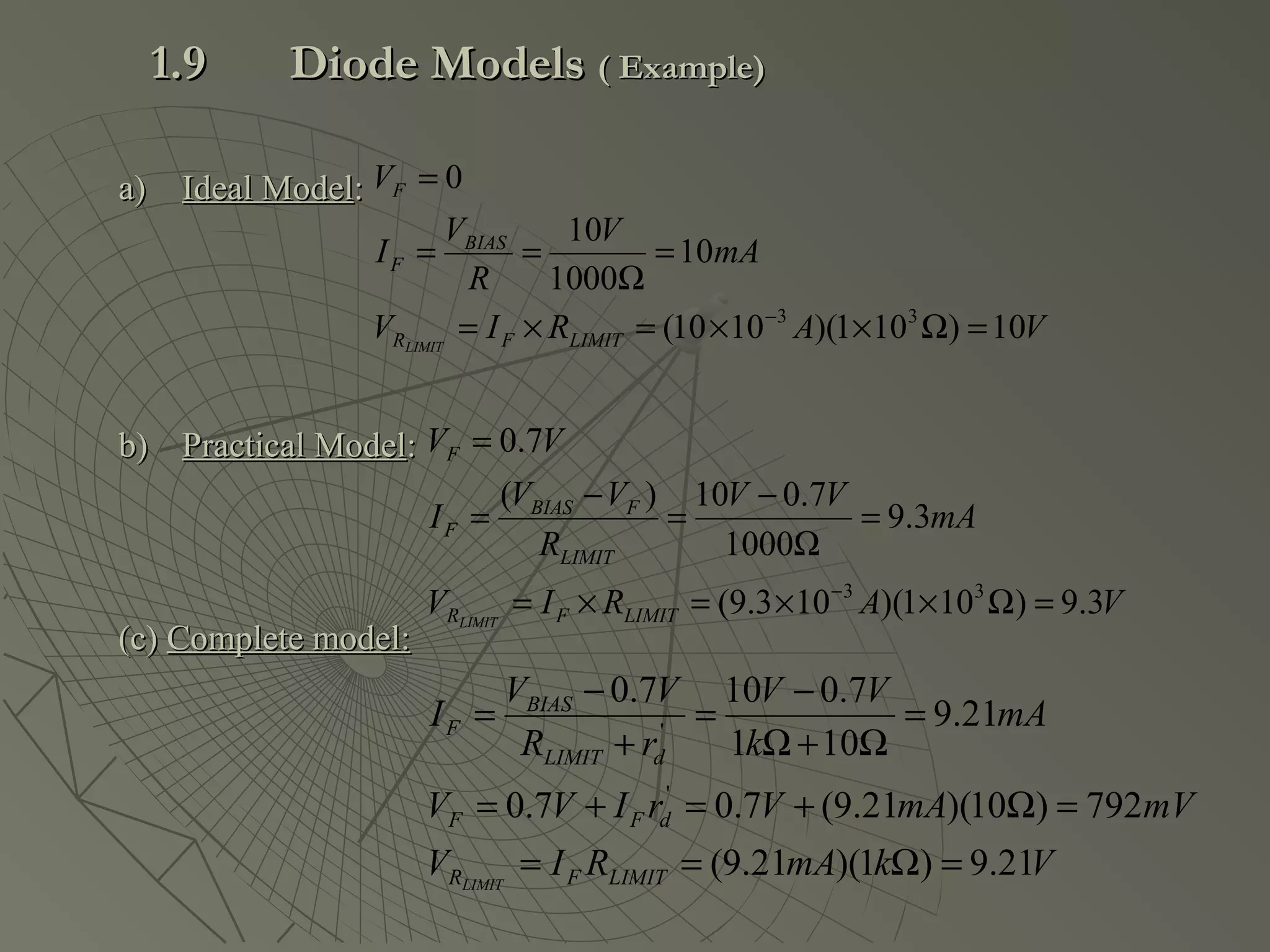
a)a) Ideal ModelIdeal Model::
b)b) Practical ModelPractical Model::
(c)(c) Complete model:Complete model:
VARIV
mA
V
R
V
I
V
LIMITFR
BIAS
F
F
LIMIT
10)101)(1010(
10
1000
10
0
33
=Ω××=×=
=
Ω
==
=
−
VARIV
mA
VV
R
VV
I
VV
LIMITFR
LIMIT
FBIAS
F
F
LIMIT
3.9)101)(103.9(
3.9
1000
7.010)(
7.0
33
=Ω××=×=
=
Ω
−
=
−
=
=
−
VkmARIV
mVmAVrIVV
mA
k
VV
rR
VV
I
LIMITFR
dFF
dLIMIT
BIAS
F
LIMIT
21.9)1)(21.9(
792)10)(21.9(7.07.0
21.9
101
7.0107.0
'
'
=Ω==
=Ω+=+=
=
Ω+Ω
−
=
+
−
=
1.91.9 Diode ModelsDiode Models ( Example)( Example)
Diodes come in a variety of sizes and shapes. The design and structure isDiodes come in a variety of sizes and shapes. The design and structure is
determined by what type of circuit they will be used in.determined by what type of circuit they will be used in.
1.91.9 Diode ModelsDiode Models ( Typical Diodes)( Typical Diodes)
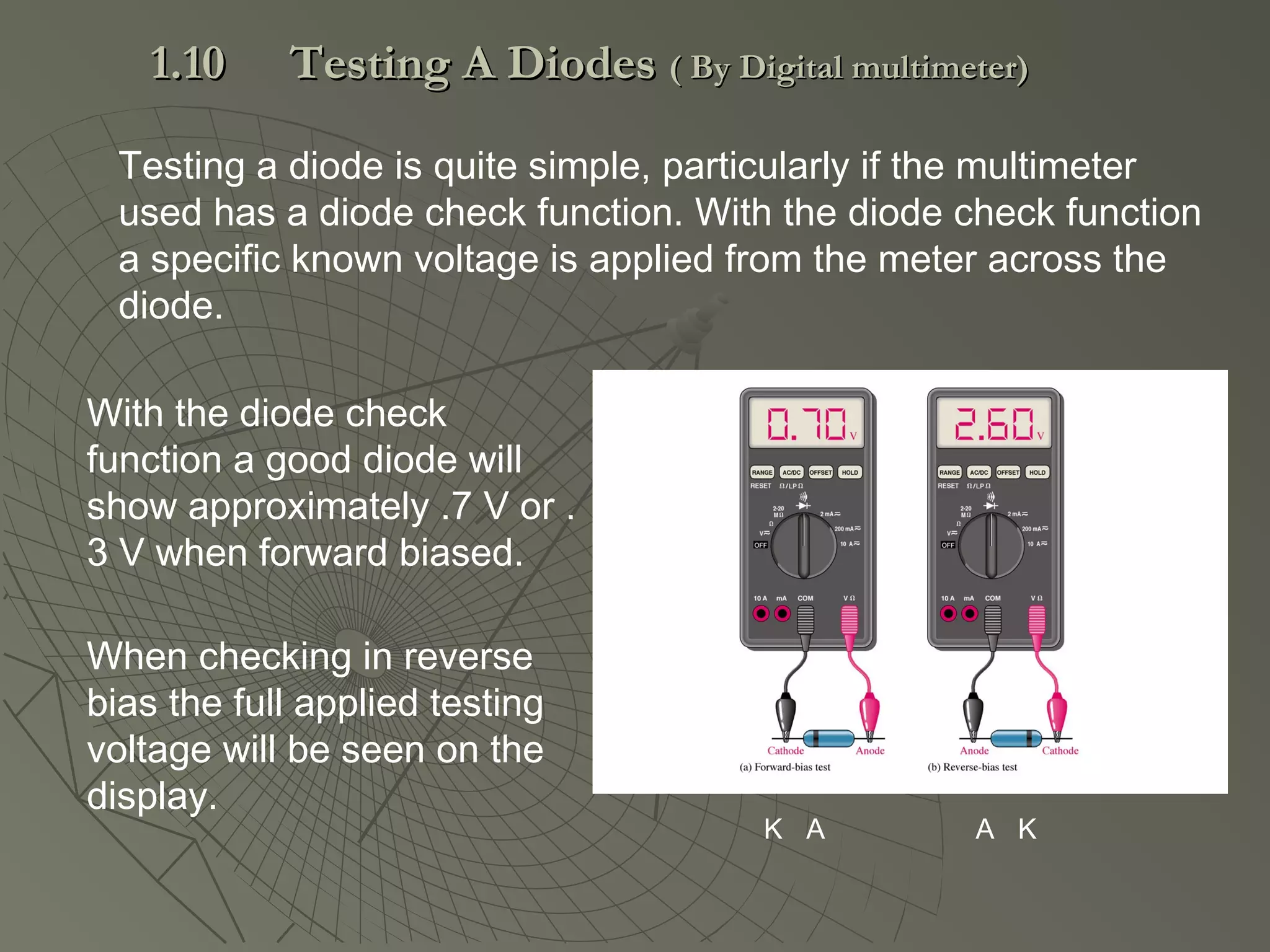
Testing a diode is quite simple, particularly if the multimeter
used has a diode check function. With the diode check function
a specific known voltage is applied from the meter across the
diode.
K A A K
With the diode check
function a good diode will
show approximately .7 V or .
3 V when forward biased.
When checking in reverse
bias the full applied testing
voltage will be seen on the
display.
1.101.10 Testing A DiodesTesting A Diodes ( By Digital multimeter)( By Digital multimeter)
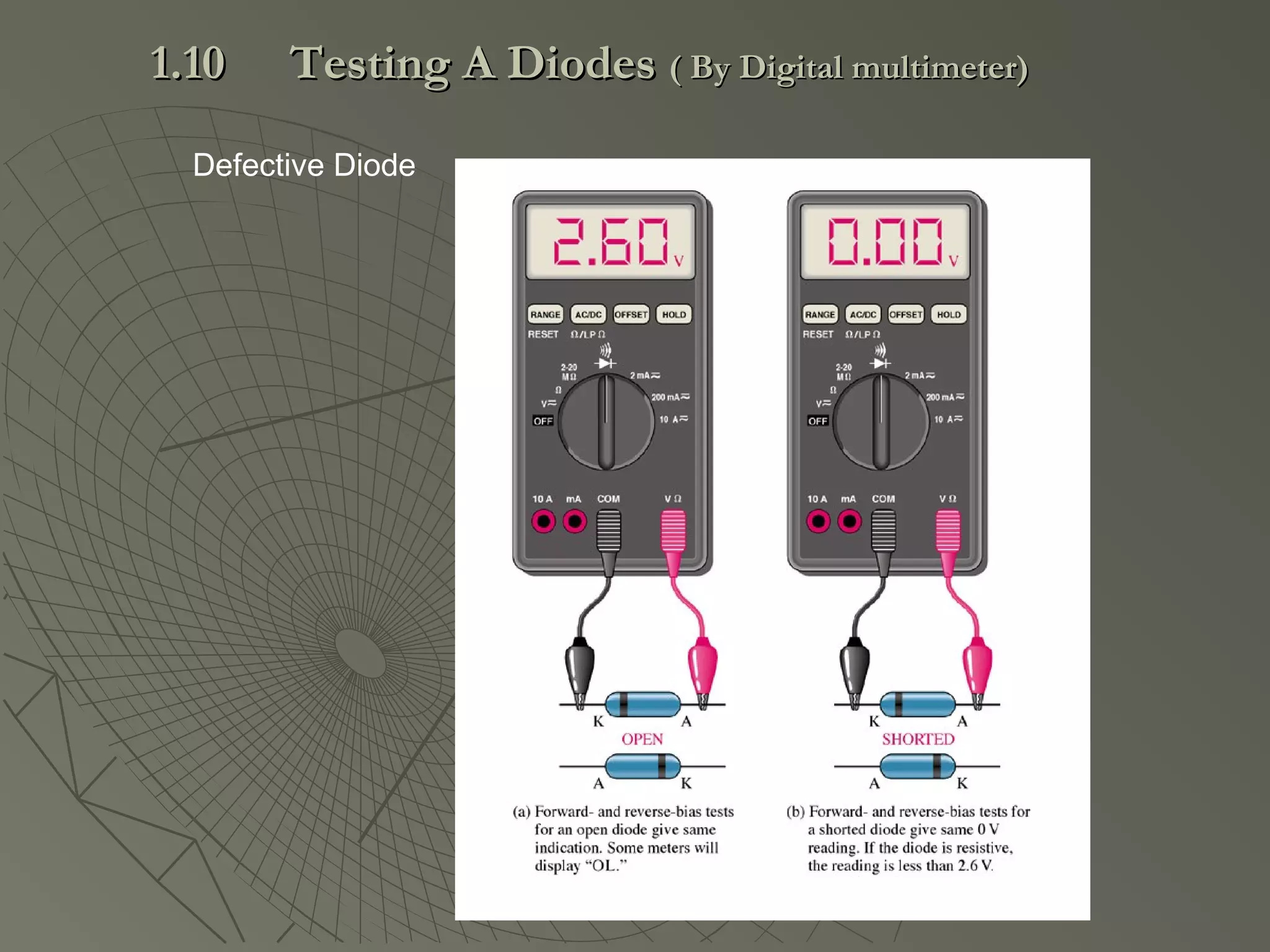
Defective Diode
1.101.10 Testing A DiodesTesting A Diodes ( By Digital multimeter)( By Digital multimeter)
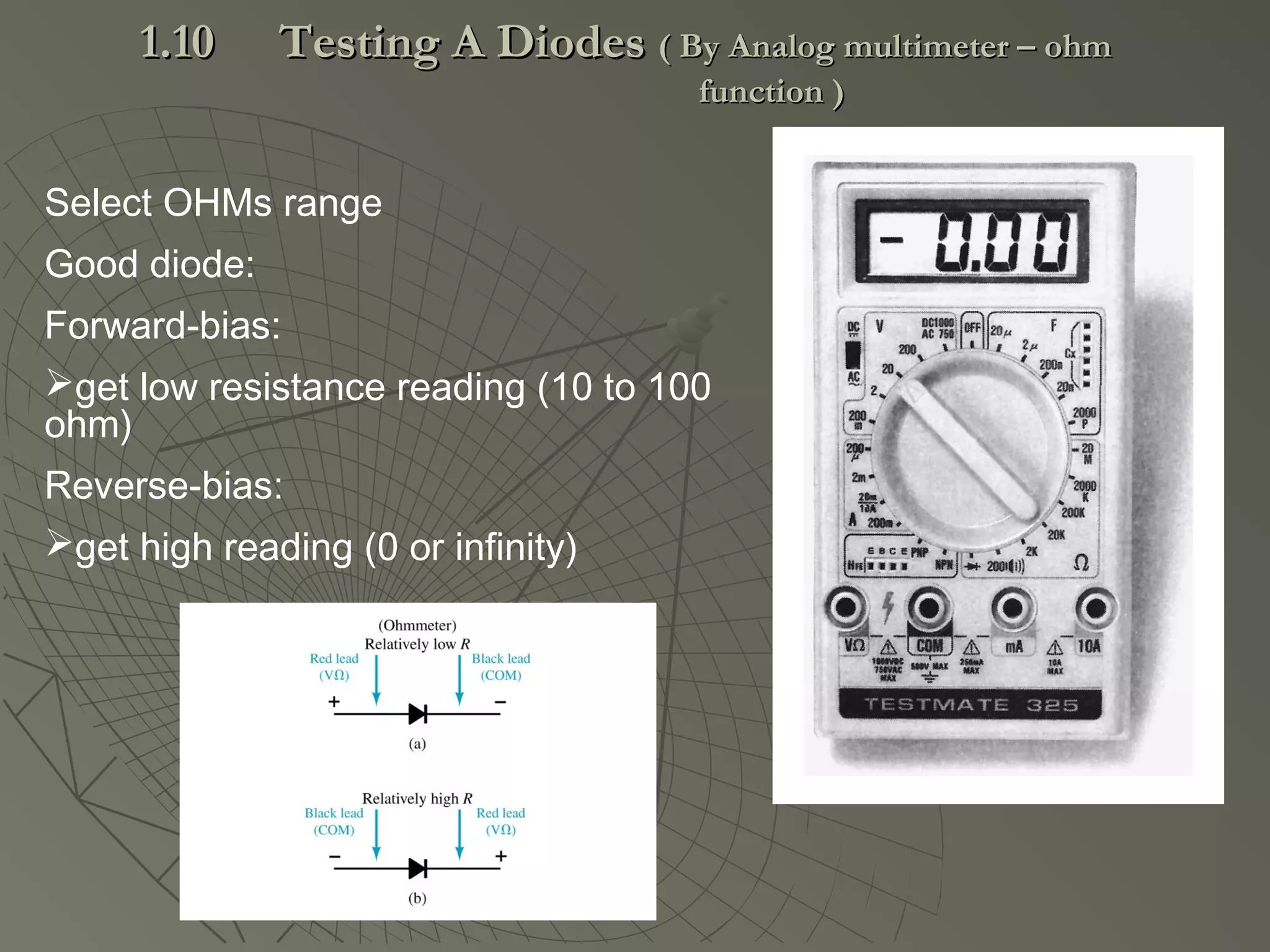
Select OHMs range
Good diode:
Forward-bias:
get low resistance reading (10 to 100
ohm)
Reverse-bias:
get high reading (0 or infinity)
1.101.10 Testing A DiodesTesting A Diodes ( By Analog multimeter – ohm( By Analog multimeter – ohm
function )function )
 P-materials are doped with trivalent impurities
 N-materials are doped with pentavalent impurities
 P and N type materials are joined together to form a
PN junction.
 A diode is nothing more than a PN junction.
 At the junction a depletion region is formed. This
creates barrier which requires approximately .3 V for a
Germanium and .7 V for Silicon for conduction to take
place.
 Diodes, transistors, and integrated circuits are
all made of semiconductor material.
SummarySummary
 When reversed biased a diode can only withstand
so much applied voltage. The voltage at which
avalanche current occurs is called reverse breakdown
voltage.
 There are three ways of analyzing a diode. These
are ideal, practical, and complex. Typically we use a
practical diode model.
 A diode conducts when forward biased and does not
conduct when reverse biased
SummarySummary

Semiconductor basics

  • 1.
  • 2.
    Introduction to Semiconductor-Introduction to Semiconductor - Chapter Outline :Chapter Outline : 1.81.8 Voltage Current Characteristic of a DiodeVoltage Current Characteristic of a Diode 1.91.9 Diode ModelsDiode Models 1.101.10 Testing a DiodeTesting a Diode
  • 3.
    -When a forwardbias voltage is applied – current called forward current, -In this case with the voltage applied is less than the barrier potential so the diode for all practical purposes is still in a non-conducting state. Current is very small. -Increase forward bias voltage – current also increase FI FIGURE 1-26FIGURE 1-26 Forward-bias measurementsForward-bias measurements show general changes in Vshow general changes in VFF and Iand IFF as Vas VBIASBIAS isis increased.increased. 1.81.8 Voltage-Current Characteristic of a DiodeVoltage-Current Characteristic of a Diode ( V-I Characteristic for forward bias)( V-I Characteristic for forward bias)
  • 4.
    -With the appliedvoltage exceeding the barrier potential (0.7V), forward current begins increasing rapidly. -But the voltage across the diode increase only above 0.7 V. FIGURE 1-26FIGURE 1-26 Forward-bias measurementsForward-bias measurements show general changes in Vshow general changes in VFF and Iand IFF as Vas VBIASBIAS isis increased.increased. 1.81.8 Voltage-Current Characteristic of a DiodeVoltage-Current Characteristic of a Diode ( V-I Characteristic for forward bias)( V-I Characteristic for forward bias)
  • 5.
    -Plot the resultof measurement in Figure 1- 26, you get the V-I characteristic curve for a forward bias diode - Increase to the right - increase upward FFd IVr ∆∆= /' dynamic resistancedynamic resistance r’r’dd decreases as you move up thedecreases as you move up the curvecurve FV FI VVF 7.0< zero bias VVF 7.0≈ 1.81.8 Voltage-Current Characteristic of a DiodeVoltage-Current Characteristic of a Diode ( V-I Characteristic for forward bias)( V-I Characteristic for forward bias)
  • 6.
    Reverse Current Breakdown voltage -not a normal operationof pn junction devices - the value can be vary for typical Si 1.81.8 Voltage-Current Characteristic of a DiodeVoltage-Current Characteristic of a Diode ( V-I Characteristic for Reverse bias)( V-I Characteristic for Reverse bias)
  • 7.
    Combine-Forward bias & Reversebias  Complete V-I characteristic curve 1.81.8 Voltage-Current Characteristic of a DiodeVoltage-Current Characteristic of a Diode ( Complete V-I Characteristic curve)( Complete V-I Characteristic curve)
  • 8.
    • Forward biased dioed: for a given value of • For a given • Barrier potential decrease as T increase • Reverse current breakdown – small & can be neglected ↑↑ FIT , FV ↑FF VI , 1.81.8 Voltage-Current Characteristic of a DiodeVoltage-Current Characteristic of a Diode ( Temperature effect on the diode V-I Characteristic)( Temperature effect on the diode V-I Characteristic)
  • 9.
    Directional of current cathodeanod 1.91.9Diode ModelsDiode Models ( Diode structure and symbol)( Diode structure and symbol)
  • 10.
    DIODE MODEL The Ideal Diode Model TheComplete Diode Model The Practical Diode Model 1.91.9 Diode ModelsDiode Models
  • 11.
    •Assume •Forward current, by Ohm’s law Idealmodel of diode- simple switch: •Closed (on) switch -> FB •Open (off) switch -> RB VVF 0= LIMIT BIAS F R V I = BIASR R VV AI = = 0 (1-2) 1.91.9 Diode ModelsDiode Models ( The ideal Diode model)( The ideal Diode model)
  • 12.
    •Adds the barrierpotential to the ideal switch model • ‘ is neglected •From figure (c): The forward current [by applying Kirchhoff’s voltage low to figure (a)] Ohm’s Law dr' •Equivalent to close switch in series with a small equivalent voltage source equal to the barrier potential 0.7V •Represent by produced across the pn junction FV •Same as ideal diode model )(3.0 )(7.0 GeVV SiVV F F = = 0=−− LIMITRFBIAS VVV LIMITFR RIV LIMIT = LIMIT FBIAS F R VV I − = BIASR R VV AI = = 0 (1-3) 1.91.9 Diode ModelsDiode Models ( The Practical Diode model)( The Practical Diode model)
  • 13.
    Complete model ofdiode consists: •Barrier potential •Dynamic resistance, •Internal reverse resistance, •The forward voltage: •The forward current: dr' Rr' •acts as closed switch in series with barrier potential and small dr' Rr' •acts as open switch in parallel with the large ' 7.0 dFF rIVV += ' 7.0 dLIMIT BIAS F rR VV I + − = (1-4) (1-5) 1.91.9 Diode ModelsDiode Models ( The Complete Diode model)( The Complete Diode model)
  • 14.
    10V10V 1.0kΩ1.0kΩ 5V5V 1.0kΩ1.0kΩ (1) Determine theforward voltage and forward current [forward bias] for each of the diode model also find the voltage across the limiting resistor in each cases. Assumed rd’ = 10Ω at the determined value of forward current. 1.91.9 Diode ModelsDiode Models ( Example)( Example)
  • 15.
    a)a) Ideal ModelIdealModel:: b)b) Practical ModelPractical Model:: (c)(c) Complete model:Complete model: VARIV mA V R V I V LIMITFR BIAS F F LIMIT 10)101)(1010( 10 1000 10 0 33 =Ω××=×= = Ω == = − VARIV mA VV R VV I VV LIMITFR LIMIT FBIAS F F LIMIT 3.9)101)(103.9( 3.9 1000 7.010)( 7.0 33 =Ω××=×= = Ω − = − = = − VkmARIV mVmAVrIVV mA k VV rR VV I LIMITFR dFF dLIMIT BIAS F LIMIT 21.9)1)(21.9( 792)10)(21.9(7.07.0 21.9 101 7.0107.0 ' ' =Ω== =Ω+=+= = Ω+Ω − = + − = 1.91.9 Diode ModelsDiode Models ( Example)( Example)
  • 16.
    Diodes come ina variety of sizes and shapes. The design and structure isDiodes come in a variety of sizes and shapes. The design and structure is determined by what type of circuit they will be used in.determined by what type of circuit they will be used in. 1.91.9 Diode ModelsDiode Models ( Typical Diodes)( Typical Diodes)
  • 17.
    Testing a diodeis quite simple, particularly if the multimeter used has a diode check function. With the diode check function a specific known voltage is applied from the meter across the diode. K A A K With the diode check function a good diode will show approximately .7 V or . 3 V when forward biased. When checking in reverse bias the full applied testing voltage will be seen on the display. 1.101.10 Testing A DiodesTesting A Diodes ( By Digital multimeter)( By Digital multimeter)
  • 18.
    Defective Diode 1.101.10 TestingA DiodesTesting A Diodes ( By Digital multimeter)( By Digital multimeter)
  • 19.
    Select OHMs range Gooddiode: Forward-bias: get low resistance reading (10 to 100 ohm) Reverse-bias: get high reading (0 or infinity) 1.101.10 Testing A DiodesTesting A Diodes ( By Analog multimeter – ohm( By Analog multimeter – ohm function )function )
  • 20.
     P-materials aredoped with trivalent impurities  N-materials are doped with pentavalent impurities  P and N type materials are joined together to form a PN junction.  A diode is nothing more than a PN junction.  At the junction a depletion region is formed. This creates barrier which requires approximately .3 V for a Germanium and .7 V for Silicon for conduction to take place.  Diodes, transistors, and integrated circuits are all made of semiconductor material. SummarySummary
  • 21.
     When reversedbiased a diode can only withstand so much applied voltage. The voltage at which avalanche current occurs is called reverse breakdown voltage.  There are three ways of analyzing a diode. These are ideal, practical, and complex. Typically we use a practical diode model.  A diode conducts when forward biased and does not conduct when reverse biased SummarySummary