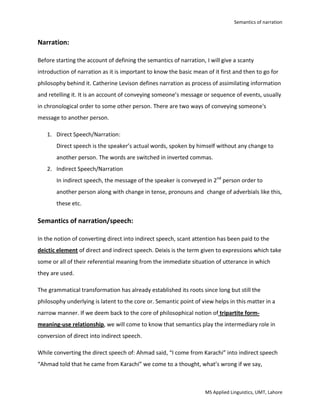

Semantics & PragmaticsSemantics of narrationSubmitted to:Sir Nazir MalikSubmitted by:Hina Javaid100884006<br />Narration:<br />Before starting the account of defining the semantics of narration, I will give a scanty introduction of narration as it is important to know the basic mean of it first and then to go for philosophy behind it. Catherine Levison defines narration as process of assimilating information and retelling it. It is an account of conveying someone’s message or sequence of events, usually in chronological order to some other person. There are two ways of conveying someone's message to another person.<br />Direct Speech/Narration:
Direct speech is the speaker’s actual words, spoken by himself without any change to another person. The words are switched in inverted commas.
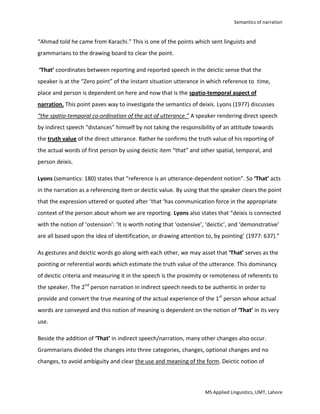
Indirect Speech/NarrationIn indirect speech, the message of the speaker is conveyed in 2nd person order to another person along with change in tense, pronouns and  change of adverbials like this, these etc.Semantics of narration/speech:<br />In the notion of converting direct into indirect speech, scant attention has been paid to the deictic element of direct and indirect speech. Deixis is the term given to expressions which take some or all of their referential meaning from the immediate situation of utterance in which they are used. <br />The grammatical transformation has already established its roots since long but still the philosophy underlying is latent to the core or. Semantic point of view helps in this matter in a narrow manner. If we deem back to the core of philosophical notion of tripartite form-meaning-use relationship, we will come to know that semantics play the intermediary role in conversion of direct into indirect speech.<br />While converting the direct speech of: Ahmad said, “I come from Karachi” into indirect speech “Ahmad told that he came from Karachi” we come to a thought, what’s wrong if we say, “Ahmad told he came from Karachi.” This is one of the points which sent linguists and grammarians to the drawing board to clear the point. <br /> ‘That’ coordinates between reporting and reported speech in the deictic sense that the speaker is at the “Zero point” of the instant situation utterance in which reference to  time, place and person is dependent on here and now that is the spatio-temporal aspect of narration. This point paves way to investigate the semantics of deixis. Lyons (1977) discusses “the spatio-temporal co-ordination of the act of utterance.” A speaker rendering direct speech by indirect speech “distances” himself by not taking the responsibility of an attitude towards the truth value of the direct utterance. Rather he confirms the truth value of his reporting of the actual words of first person by using deictic item “that” and other spatial, temporal, and person deixis. <br />Lyons (semantics: 180) states that “reference is an utterance-dependent notion”. So ‘That’ acts in the narration as a referencing item or deictic value. By using that the speaker clears the point that the expression uttered or quoted after ‘that ‘has communication force in the appropriate context of the person about whom we are reporting. Lyons also states that “deixis is connected with the notion of ‘ostension’: ‘It is worth noting that ‘ostensive’, ‘deictic’, and ‘demonstrative’ are all based upon the idea of identification, or drawing attention to, by pointing’ (1977: 637).” <br />As gestures and deictic words go along with each other, we may asset that ‘That’ serves as the pointing or referential words which estimate the truth value of the utterance. This dominancy of deictic criteria and measuring it in the speech is the proximity or remoteness of referents to the speaker. The 2nd person narration in indirect speech needs to be authentic in order to provide and convert the true meaning of the actual experience of the 1st person whose actual words are conveyed and this notion of meaning is dependent on the notion of ‘That’ in its very use.<br />Beside the addition of ‘That’ in indirect speech/narration, many other changes also occur. Grammarians divided the changes into three categories, changes, optional changes and no changes, to avoid ambiguity and clear the use and meaning of the form. Deictic notion of semantics dominates these areas too as deixis involves person, time and place deixis when we talk about pronouns, locatives, demonstratives, distal and adverbials etc.<br />
Semantics of narration

Semantics of narration

  • 1.
    Semantics & PragmaticsSemanticsof narrationSubmitted to:Sir Nazir MalikSubmitted by:Hina Javaid100884006<br />Narration:<br />Before starting the account of defining the semantics of narration, I will give a scanty introduction of narration as it is important to know the basic mean of it first and then to go for philosophy behind it. Catherine Levison defines narration as process of assimilating information and retelling it. It is an account of conveying someone’s message or sequence of events, usually in chronological order to some other person. There are two ways of conveying someone's message to another person.<br />Direct Speech/Narration:
  • 2.
    Direct speech isthe speaker’s actual words, spoken by himself without any change to another person. The words are switched in inverted commas.
  • 3.
    Indirect Speech/NarrationIn indirectspeech, the message of the speaker is conveyed in 2nd person order to another person along with change in tense, pronouns and change of adverbials like this, these etc.Semantics of narration/speech:<br />In the notion of converting direct into indirect speech, scant attention has been paid to the deictic element of direct and indirect speech. Deixis is the term given to expressions which take some or all of their referential meaning from the immediate situation of utterance in which they are used. <br />The grammatical transformation has already established its roots since long but still the philosophy underlying is latent to the core or. Semantic point of view helps in this matter in a narrow manner. If we deem back to the core of philosophical notion of tripartite form-meaning-use relationship, we will come to know that semantics play the intermediary role in conversion of direct into indirect speech.<br />While converting the direct speech of: Ahmad said, “I come from Karachi” into indirect speech “Ahmad told that he came from Karachi” we come to a thought, what’s wrong if we say, “Ahmad told he came from Karachi.” This is one of the points which sent linguists and grammarians to the drawing board to clear the point. <br /> ‘That’ coordinates between reporting and reported speech in the deictic sense that the speaker is at the “Zero point” of the instant situation utterance in which reference to time, place and person is dependent on here and now that is the spatio-temporal aspect of narration. This point paves way to investigate the semantics of deixis. Lyons (1977) discusses “the spatio-temporal co-ordination of the act of utterance.” A speaker rendering direct speech by indirect speech “distances” himself by not taking the responsibility of an attitude towards the truth value of the direct utterance. Rather he confirms the truth value of his reporting of the actual words of first person by using deictic item “that” and other spatial, temporal, and person deixis. <br />Lyons (semantics: 180) states that “reference is an utterance-dependent notion”. So ‘That’ acts in the narration as a referencing item or deictic value. By using that the speaker clears the point that the expression uttered or quoted after ‘that ‘has communication force in the appropriate context of the person about whom we are reporting. Lyons also states that “deixis is connected with the notion of ‘ostension’: ‘It is worth noting that ‘ostensive’, ‘deictic’, and ‘demonstrative’ are all based upon the idea of identification, or drawing attention to, by pointing’ (1977: 637).” <br />As gestures and deictic words go along with each other, we may asset that ‘That’ serves as the pointing or referential words which estimate the truth value of the utterance. This dominancy of deictic criteria and measuring it in the speech is the proximity or remoteness of referents to the speaker. The 2nd person narration in indirect speech needs to be authentic in order to provide and convert the true meaning of the actual experience of the 1st person whose actual words are conveyed and this notion of meaning is dependent on the notion of ‘That’ in its very use.<br />Beside the addition of ‘That’ in indirect speech/narration, many other changes also occur. Grammarians divided the changes into three categories, changes, optional changes and no changes, to avoid ambiguity and clear the use and meaning of the form. Deictic notion of semantics dominates these areas too as deixis involves person, time and place deixis when we talk about pronouns, locatives, demonstratives, distal and adverbials etc.<br />