Deixis
PRESENTED BY :
FITRIANI
MUHAMMAD HAFIZ
What is Deixis?
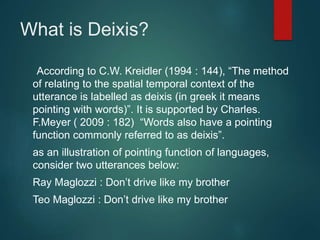
According to C.W. Kreidler (1994 : 144), “The method
of relating to the spatial temporal context of the
utterance is labelled as deixis (in greek it means
pointing with words)”. It is supported by Charles.
F.Meyer ( 2009 : 182) “Words also have a pointing
function commonly referred to as deixis”.
as an illustration of pointing function of languages,
consider two utterances below:
Ray Maglozzi : Don’t drive like my brother
Teo Maglozzi : Don’t drive like my brother
Deixis as Parts of Reference
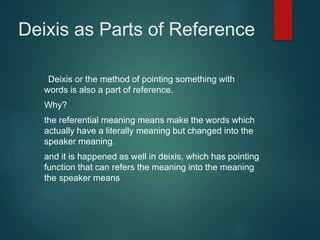
Deixis or the method of pointing something with
words is also a part of reference.
Why?
the referential meaning means make the words which
actually have a literally meaning but changed into the
speaker meaning.
and it is happened as well in deixis, which has pointing
function that can refers the meaning into the meaning
the speaker means
Classification of Deixis
Charles F. Meyer ( 2009 ), there are three classification of deixis
1. Referential Deixis
Referential deixis is the deixis which is used to point a word or
words refer to something.
 The speaker refers to:
Themself : I, me and we and us
The addresse : you (singular and plural)
Other people or third people : he/him, she/her, it, they/them
 Example :
Would you like to have an ice cream cone?
He tried to hurt me but they came to the rescue
2. Spatial Deixis
Spatial deixis is the deixis which is used to point a place
 The speaker’s purpose :
Identify entities : demonstrative pronouns (this/these : that/those)
Inform about location of an entity : adverbs (here/there), prepositions
(above/below)
Acknowledge location of an entity : (come/go)
 Example :
He was sitting over there
We love living here
3. Temporal Deixis
Temporal deixis is the deixis which is used to point the time. It
locates time or points or intervals on the time axis using the moment
of utterance, as a reference point.
 Deictic elements that can be identified:
Time Adverbials: before, yesterday, last year (before utterance),
today, now (moment of utterance), soon, after (after utterance)
“Did you call me last night?
 Tenses
Rachael booked a cake
Rachael is booking a cake
Rachael had booked a cake
Anaphora
According to Charles W. Kreidler (1994 : 145) ,Anaphora is a
kind of secondary reference in which a previous reference is
recalled by use of special function words or equivalent lexemes.
Examples :
Jack and Jill tried to lift the box and push it onto the top shelf.
Referential Ambiguity
Misunderstandings occur when the speaker has one referent in mind but
the listener thinks it is different.
Some referential ambiguity occurs when :
1. An idefinite referring expression may be specific or not
I wanted to buy a newspaper
Here a newspaper may refer to a specific newspaper or some
newspaper,any newspaper.
2. Anaphora is unclear because a personal pronoun, he, she, it or they,
can be linked to either of two referring expressions:
Jack told Ralph that a visitor was waiting for him.
 the pronoun you is used generically or specifically:
If you want to get ahead, you have to work hard
Is you the addressee or is this sentence a general platitude?)
 4. a noun phrase with every can have distributed reference or
collected reference:
35 I’m buying a drink for everybody here.
(One drink for all or one drink for each?)
Deixis

Deixis

  • 1.
  • 2.
    What is Deixis? Accordingto C.W. Kreidler (1994 : 144), “The method of relating to the spatial temporal context of the utterance is labelled as deixis (in greek it means pointing with words)”. It is supported by Charles. F.Meyer ( 2009 : 182) “Words also have a pointing function commonly referred to as deixis”. as an illustration of pointing function of languages, consider two utterances below: Ray Maglozzi : Don’t drive like my brother Teo Maglozzi : Don’t drive like my brother
  • 3.
    Deixis as Partsof Reference Deixis or the method of pointing something with words is also a part of reference. Why? the referential meaning means make the words which actually have a literally meaning but changed into the speaker meaning. and it is happened as well in deixis, which has pointing function that can refers the meaning into the meaning the speaker means
  • 4.
    Classification of Deixis CharlesF. Meyer ( 2009 ), there are three classification of deixis 1. Referential Deixis Referential deixis is the deixis which is used to point a word or words refer to something.  The speaker refers to: Themself : I, me and we and us The addresse : you (singular and plural) Other people or third people : he/him, she/her, it, they/them  Example : Would you like to have an ice cream cone? He tried to hurt me but they came to the rescue
  • 5.
    2. Spatial Deixis Spatialdeixis is the deixis which is used to point a place  The speaker’s purpose : Identify entities : demonstrative pronouns (this/these : that/those) Inform about location of an entity : adverbs (here/there), prepositions (above/below) Acknowledge location of an entity : (come/go)  Example : He was sitting over there We love living here
  • 6.
    3. Temporal Deixis Temporaldeixis is the deixis which is used to point the time. It locates time or points or intervals on the time axis using the moment of utterance, as a reference point.  Deictic elements that can be identified: Time Adverbials: before, yesterday, last year (before utterance), today, now (moment of utterance), soon, after (after utterance) “Did you call me last night?  Tenses Rachael booked a cake Rachael is booking a cake Rachael had booked a cake
  • 7.
    Anaphora According to CharlesW. Kreidler (1994 : 145) ,Anaphora is a kind of secondary reference in which a previous reference is recalled by use of special function words or equivalent lexemes. Examples : Jack and Jill tried to lift the box and push it onto the top shelf.
  • 8.
    Referential Ambiguity Misunderstandings occurwhen the speaker has one referent in mind but the listener thinks it is different. Some referential ambiguity occurs when : 1. An idefinite referring expression may be specific or not I wanted to buy a newspaper Here a newspaper may refer to a specific newspaper or some newspaper,any newspaper. 2. Anaphora is unclear because a personal pronoun, he, she, it or they, can be linked to either of two referring expressions: Jack told Ralph that a visitor was waiting for him.
  • 9.
     the pronounyou is used generically or specifically: If you want to get ahead, you have to work hard Is you the addressee or is this sentence a general platitude?)  4. a noun phrase with every can have distributed reference or collected reference: 35 I’m buying a drink for everybody here. (One drink for all or one drink for each?)