Critical Discourse Analysis (CDA) is introduced as a highly context sensitive approach to analyzing politically or culturally influential texts. CDA differs from other forms of textual analysis in six key ways, such as being highly integrated across text, discourse, and social context levels. Strategies of CDA can be used to analyze various artifacts like advertisements, movies, and websites. Tools of CDA include genre, framing, foregrounding, omission, and backgrounding, which can be applied at the sentence level to identify manipulation. In conclusion, CDA is defined as a democratic approach that examines power relations and aims to improve society through close analysis of influential texts and consideration of real-world contexts.
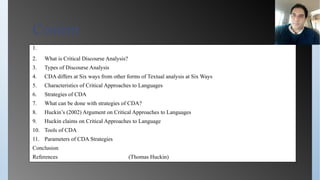
Content
1.
2. What isCritical Discourse Analysis?
3. Types of Discourse Analysis
4. CDA differs at Six ways from other forms of Textual analysis at Six Ways
5. Characteristics of Critical Approaches to Languages
6. Strategies of CDA
7. What can be done with strategies of CDA?
8. Huckin’s (2002) Argument on Critical Approaches to Languages
9. Huckin claims on Critical Approaches to Language
10. Tools of CDA
11. Parameters of CDA Strategies
Conclusion
References (Thomas Huckin)
3.
Critical Discourse Analysis
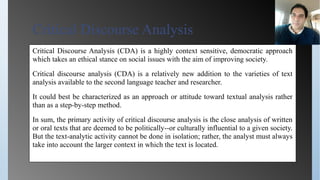
CriticalDiscourse Analysis (CDA) is a highly context sensitive, democratic approach
which takes an ethical stance on social issues with the aim of improving society.
Critical discourse analysis (CDA) is a relatively new addition to the varieties of text
analysis available to the second language teacher and researcher.
It could best be characterized as an approach or attitude toward textual analysis rather
than as a step-by-step method.
In sum, the primary activity of critical discourse analysis is the close analysis of written
or oral texts that are deemed to be politically--or culturally influential to a given society.
But the text-analytic activity cannot be done in isolation; rather, the analyst must always
take into account the larger context in which the text is located.
4.
Thomas Huckin: Typesof Discourse
Analysis
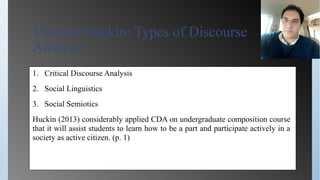
1. Critical Discourse Analysis
2. Social Linguistics
3. Social Semiotics
Huckin (2013) considerably applied CDA on undergraduate composition course
that it will assist students to learn how to be a part and participate actively in a
society as active citizen. (p. 1)
5.
CDA differs atSix ways from other forms
of Textual analysis
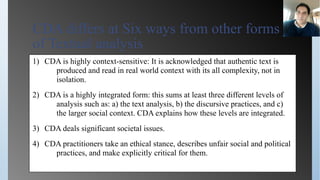
1) CDA is highly context-sensitive: It is acknowledged that authentic text is
produced and read in real world context with its all complexity, not in
isolation.
2) CDA is a highly integrated form: this sums at least three different levels of
analysis such as: a) the text analysis, b) the discursive practices, and c)
the larger social context. CDA explains how these levels are integrated.
3) CDA deals significant societal issues.
4) CDA practitioners take an ethical stance, describes unfair social and political
practices, and make explicitly critical for them.
6.
CDA differs atSix ways from other forms
of Textual analysis
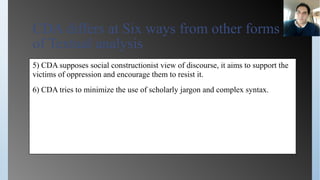
5) CDA supposes social constructionist view of discourse, it aims to support the
victims of oppression and encourage them to resist it.
6) CDA tries to minimize the use of scholarly jargon and complex syntax.
7.
Strategies of CDA:Thomas Huckin
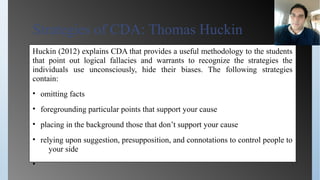
Huckin (2012) explains CDA that provides a useful methodology to the students
that point out logical fallacies and warrants to recognize the strategies the
individuals use unconsciously, hide their biases. The following strategies
contain:
• omitting facts
• foregrounding particular points that support your cause
• placing in the background those that don’t support your cause
• relying upon suggestion, presupposition, and connotations to control people to
your side
•
8.
What can bedone with strategies of CDA?
(Thomas Huckin, 2012)
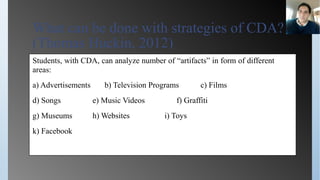
Students, with CDA, can analyze number of “artifacts” in form of different
areas:
a) Advertisements b) Television Programs c) Films
d) Songs e) Music Videos f) Graffiti
g) Museums h) Websites i) Toys
k) Facebook
9.
Huckin’s (2002) Argumenton Critical
Approaches to Languages
Huckin (2002) argues on critical approaches to languages, including
1. Critical discourse analysis
2. Social Linguistics
3. Social Semiotics
These are relevant to real world because these are context-sensitive forms of
discourse Analysis. (p. 2)
Huckin shares characteristics of these approaches ahead.
10.
Characteristics of CriticalApproaches to
Languages
1. They address contemporary societal issues, seeking to show how people are
manipulated by powerful interests through the medium of public discourse.
2. They give special attention to underlying factors of ideology, power, and
resistance.
3. They link together analyses of text, discursive practices, and social context.
4. They combine rhetorical theory and social theory.
5. They see genres as key structural elements.
11.
Characteristics of CriticalApproaches to
Languages
6. They incorporate intertextuality, interdiscursivity, and other post-structural
conceptions of discourse.
7. They take into account omissions, implicatures, presuppositions, ambiguities, and
other covert but powerful aspects of discourse.
8. They take note of interpersonal aspects of discourse such as politeness, identity, and
ethos.
9. Unlike other forms of cultural criticism, they ground their analyses in close, detailed
inspection of texts.
10. To encourage political activism, they try to make their analyses accessible to the
general public by, for example, minimizing the use of technical jargon and belletristic
style.
12.
Huckin claims onCritical Approaches to
Language
He claims that such critical approaches, including CDA, embody the generic
features that share the critical spirit that is held in common among the divergent
perspectives of Horkheimer, Adorno, Habermas, and Foucault, and serve a
demystifying function by demonstrating the different ways in which rhetoric
conceals as much as it reveals through its relationship with power and
knowledge. They are also not detached and impersonal, but rather have as their
object something which they are "against"; and they have “consequences” in the
sense that they “identify the possibilities of future action available to the
participants” (p. 2).
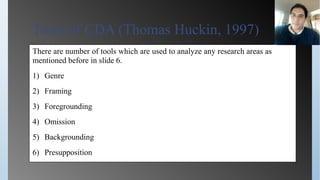
13.
Tools of CDA(Thomas Huckin, 1997)
There are number of tools which are used to analyze any research areas as
mentioned before in slide 6.
1) Genre
2) Framing
3) Foregrounding
4) Omission
5) Backgrounding
6) Presupposition
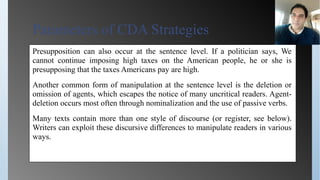
14.
Parameters of CDAStrategies
Presupposition can also occur at the sentence level. If a politician says, We
cannot continue imposing high taxes on the American people, he or she is
presupposing that the taxes Americans pay are high.
Another common form of manipulation at the sentence level is the deletion or
omission of agents, which escapes the notice of many uncritical readers. Agent-
deletion occurs most often through nominalization and the use of passive verbs.
Many texts contain more than one style of discourse (or register, see below).
Writers can exploit these discursive differences to manipulate readers in various
ways.
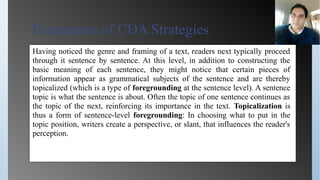
15.
Parameters of CDAStrategies
Having noticed the genre and framing of a text, readers next typically proceed
through it sentence by sentence. At this level, in addition to constructing the
basic meaning of each sentence, they might notice that certain pieces of
information appear as grammatical subjects of the sentence and are thereby
topicalized (which is a type of foregrounding at the sentence level). A sentence
topic is what the sentence is about. Often the topic of one sentence continues as
the topic of the next, reinforcing its importance in the text. Topicalization is
thus a form of sentence-level foregrounding: In choosing what to put in the
topic position, writers create a perspective, or slant, that influences the reader's
perception.
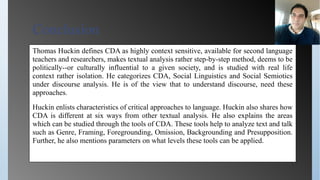
16.
Conclusion
Thomas Huckin definesCDA as highly context sensitive, available for second language
teachers and researchers, makes textual analysis rather step-by-step method, deems to be
politically--or culturally influential to a given society, and is studied with real life
context rather isolation. He categorizes CDA, Social Linguistics and Social Semiotics
under discourse analysis. He is of the view that to understand discourse, need these
approaches.
Huckin enlists characteristics of critical approaches to language. Huckin also shares how
CDA is different at six ways from other textual analysis. He also explains the areas
which can be studied through the tools of CDA. These tools help to analyze text and talk
such as Genre, Framing, Foregrounding, Omission, Backgrounding and Presupposition.
Further, he also mentions parameters on what levels these tools can be applied.
17.
References
Huckin, T., Jennifer,A., & Jennifer, C. L. (2012). Critical Discourse Analysis
and Rhetoric and Composition. College Composition and
Communication 64.1, 107-29. Print.
Huckin, T. (2002). Critical Discourse Analysis and the Discourse of
Condescension in Discourse Studies in Composition, ed. E. Barton and
G. Stygall. Hampton.
Huckin, T. N. (1997). Critical discourse analysis. In T. Miller (Ed.), Functional
approaches to written text (pp. 78-92). Washington, CD: US Department of
State.