Group 8
1. Piya Akter 37th
Batch ()
2. Md. Wasim 37th
Batch ()
3. Nuruzzaman 37th
Batch ()
4. Rajib 37th
Batch ()
Department of Computer Science & Engineering
The Subject of Discussion
Associative Network
Frame
Associative Network
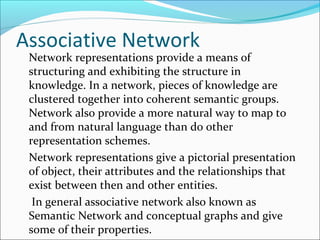
Network representations provide a means of
structuring and exhibiting the structure in
knowledge. In a network, pieces of knowledge are
clustered together into coherent semantic groups.
Network also provide a more natural way to map to
and from natural language than do other
representation schemes.
Network representations give a pictorial presentation
of object, their attributes and the relationships that
exist between then and other entities.
In general associative network also known as
Semantic Network and conceptual graphs and give
some of their properties.
Associative Network
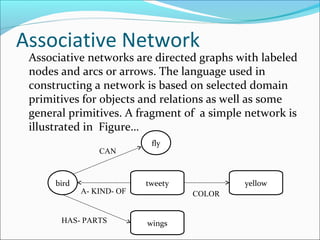
Associative networks are directed graphs with labeled
nodes and arcs or arrows. The language used in
constructing a network is based on selected domain
primitives for objects and relations as well as some
general primitives. A fragment of a simple network is
illustrated in Figure…
fly
bird tweety
wings
yellow
CAN
A- KIND- OF COLOR
HAS- PARTS
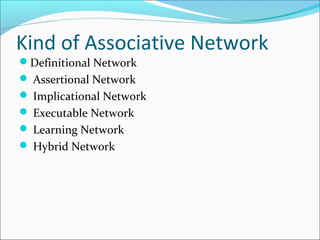
Kind of Associative Network
Definitional Network
 Assertional Network
 Implicational Network
 Executable Network
 Learning Network
 Hybrid Network
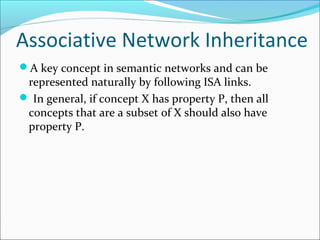
Associative Network Inheritance
A key concept in semantic networks and can be
represented naturally by following ISA links.
 In general, if concept X has property P, then all
concepts that are a subset of X should also have
property P.
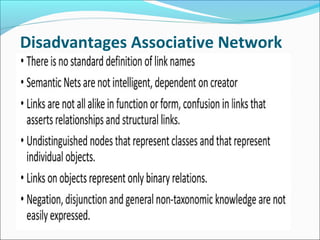
Disadvantages Associative Network
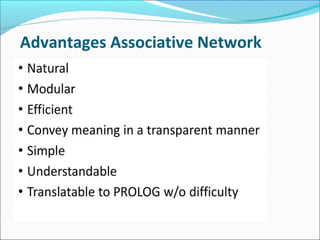
Advantages Associative Network
Frame
A frame is an artificial intelligence data structure used to
divide knowledge into substructures by representing
"stereotyped situations." Frames are the primary data
structure used in artificial intelligence frame language.
Frames are also an extensive part of knowledge
representation and reasoning schemes. Frames were
originally derived from semantic networks and are
therefore part of structure based knowledge
representations.
Frame
A Modern Approach," structural representations
assemble "...facts about particular object and event
types and arrange the types into a large taxonomic
hierarchy analogous to a biological taxonomy.“
Frame Structure
The frame contains information on how to use the
frame, what to expect next, and what to do when
these expectations are not met. Some information in
the frame is generally unchanged while other
information, stored in "terminals," usually change.
Terminals can be considered as variables. Top level
frames carries information, that is always true about
the problem in hand, however, terminals do not have
to be true. Their value might change with the new
information encountered. Different frames may share
the same terminals.
Frame Structure
Each piece of information about a particular frame is
held in a slot. The information can contain:
Facts or Data
Values (called facets)
Procedures (also called procedural attachments)
IF-NEEDED : deferred evaluation
IF-ADDED : updates linked information
Default Values
For Data
For Procedures
Other Frames or Sub frames
Frame Features and
advantages
A frame's terminals are already filled with default
values, which is based on how the human mind
works. For example, when a person is told "a boy
kicks a ball," most people will visualize a particular
ball (such as a familiar soccer ball) rather than
imagining some abstract ball with no attributes.
One particular strength of frame based knowledge
representations is that, unlike semantic networks,
they allow for exceptions in particular instances. This
gives frames an amount of flexibility that allow
representations of real world phenomena to be
reflected more accurately.
Frame Features and
advantages
Like semantic networks, frames can be queried using
spreading activation. Following the rules of inheritance,
any value given to a slot that is inherited by sub frames
will be updated (IF-ADDED) to the corresponding slots
in the sub frames and any new instances of a particular
frame will feature that new value as the default.
Because frames are structurally based, it is possible to
generate a semantic network given a set of frames even
though it lacks explicit arcs. The reference to Minsky's
teacher Noam Chomsky and his generative grammar of
1950 is generally missing in Minsky's publications.
However, the semantic strength is originated by that
concept.
Frame Example
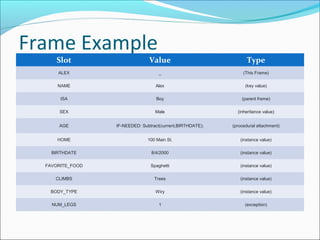
Slot Value Type
ALEX _ (This Frame)
NAME Alex (key value)
ISA Boy (parent frame)
SEX Male (inheritance value)
AGE IF-NEEDED: Subtract(current,BIRTHDATE); (procedural attachment)
HOME 100 Main St. (instance value)
BIRTHDATE 8/4/2000 (instance value)
FAVORITE_FOOD Spaghetti (instance value)
CLIMBS Trees (instance value)
BODY_TYPE Wiry (instance value)
NUM_LEGS 1 (exception)
Frame Example
Also notice that Alex, an instance of a boy, inherits
default values like "Sex" from the more general parent
object Boy, but the boy may also have different
instance values in the form of exceptions such as the
number of legs.
The END

Artificial Intelligence

  • 1.
    Group 8 1. PiyaAkter 37th Batch () 2. Md. Wasim 37th Batch () 3. Nuruzzaman 37th Batch () 4. Rajib 37th Batch () Department of Computer Science & Engineering
  • 2.
    The Subject ofDiscussion Associative Network Frame
  • 3.
    Associative Network Network representationsprovide a means of structuring and exhibiting the structure in knowledge. In a network, pieces of knowledge are clustered together into coherent semantic groups. Network also provide a more natural way to map to and from natural language than do other representation schemes. Network representations give a pictorial presentation of object, their attributes and the relationships that exist between then and other entities. In general associative network also known as Semantic Network and conceptual graphs and give some of their properties.
  • 4.
    Associative Network Associative networksare directed graphs with labeled nodes and arcs or arrows. The language used in constructing a network is based on selected domain primitives for objects and relations as well as some general primitives. A fragment of a simple network is illustrated in Figure… fly bird tweety wings yellow CAN A- KIND- OF COLOR HAS- PARTS
  • 5.
    Kind of AssociativeNetwork Definitional Network  Assertional Network  Implicational Network  Executable Network  Learning Network  Hybrid Network
  • 6.
    Associative Network Inheritance Akey concept in semantic networks and can be represented naturally by following ISA links.  In general, if concept X has property P, then all concepts that are a subset of X should also have property P.
  • 7.
  • 8.
  • 9.
    Frame A frame isan artificial intelligence data structure used to divide knowledge into substructures by representing "stereotyped situations." Frames are the primary data structure used in artificial intelligence frame language. Frames are also an extensive part of knowledge representation and reasoning schemes. Frames were originally derived from semantic networks and are therefore part of structure based knowledge representations.
  • 10.
    Frame A Modern Approach,"structural representations assemble "...facts about particular object and event types and arrange the types into a large taxonomic hierarchy analogous to a biological taxonomy.“
  • 11.
    Frame Structure The framecontains information on how to use the frame, what to expect next, and what to do when these expectations are not met. Some information in the frame is generally unchanged while other information, stored in "terminals," usually change. Terminals can be considered as variables. Top level frames carries information, that is always true about the problem in hand, however, terminals do not have to be true. Their value might change with the new information encountered. Different frames may share the same terminals.
  • 12.
    Frame Structure Each pieceof information about a particular frame is held in a slot. The information can contain: Facts or Data Values (called facets) Procedures (also called procedural attachments) IF-NEEDED : deferred evaluation IF-ADDED : updates linked information Default Values For Data For Procedures Other Frames or Sub frames
  • 13.
    Frame Features and advantages Aframe's terminals are already filled with default values, which is based on how the human mind works. For example, when a person is told "a boy kicks a ball," most people will visualize a particular ball (such as a familiar soccer ball) rather than imagining some abstract ball with no attributes. One particular strength of frame based knowledge representations is that, unlike semantic networks, they allow for exceptions in particular instances. This gives frames an amount of flexibility that allow representations of real world phenomena to be reflected more accurately.
  • 14.
    Frame Features and advantages Likesemantic networks, frames can be queried using spreading activation. Following the rules of inheritance, any value given to a slot that is inherited by sub frames will be updated (IF-ADDED) to the corresponding slots in the sub frames and any new instances of a particular frame will feature that new value as the default. Because frames are structurally based, it is possible to generate a semantic network given a set of frames even though it lacks explicit arcs. The reference to Minsky's teacher Noam Chomsky and his generative grammar of 1950 is generally missing in Minsky's publications. However, the semantic strength is originated by that concept.
  • 15.
    Frame Example Slot ValueType ALEX _ (This Frame) NAME Alex (key value) ISA Boy (parent frame) SEX Male (inheritance value) AGE IF-NEEDED: Subtract(current,BIRTHDATE); (procedural attachment) HOME 100 Main St. (instance value) BIRTHDATE 8/4/2000 (instance value) FAVORITE_FOOD Spaghetti (instance value) CLIMBS Trees (instance value) BODY_TYPE Wiry (instance value) NUM_LEGS 1 (exception)
  • 16.
    Frame Example Also noticethat Alex, an instance of a boy, inherits default values like "Sex" from the more general parent object Boy, but the boy may also have different instance values in the form of exceptions such as the number of legs.
  • 17.