Pyramid vector quantization
A. D. Patel Institute of Technology
Data compression and data retrieval(2161603) : A.Y. 2018-19
Guided By:
Prof. Keyur sir
(Dept of IT, ADIT)
Prepared by:
Kunal Kathe
E.r.No.:160010116021
Shah Dhruv
E.R No.:160010116053
Rahul jadeja
E.r.No.:160010116018
B.E. (IT) Sem - VI
Department of Information Technology
A D Patel Institute of Technology (ADIT)
New Vallabh Vidyanagar, Anand, Gujarat
2
What is PVQ?
The geometric properties of a memoryless Laplacian source are presented and used to
establish a source coding theorem. Motivated by this geometric structure, a pyramid vector
quantizer (PVQ) is developed for arbitrary vector dimension. The PVQ is based on the cubic
lattice points that lie on the surface of anL-dimensional pyramid and has simple encoding and
decoding algorithms. A product code version of the PVQ is developed and generalized to
apply to a variety of sources. Analytical expressions are derived for the PVQ mean square
error (mse), and simulation results are presented for PVQ encoding of several memoryless
sources. For large rate and dimension, PVQ encoding of memoryless Laplacian, gamma, and
Gaussian sources provides rose improvements of5.64, 8.40, and2.39dB, respectively, over the
corresponding optimum scalar quantizer. Although suboptimum in a rate-distortion sense,
because the PVQ can encode large-dimensional vectors, it offers significant reduction in rose
distortion compared with the optimum Lloyd-Max scalar quantizer, and provides an attractive
alternative to currently available vector quantizers.
Why Vector Quantization?
3
● 3 classic advantages (Lookabaugh et al. 1989):
– Space filling advantage: VQ codepoints tile space
more efficiently
●
● Example: 2-D, squares vs. hexagons
Maximum possible gain for large dimension: 1.53 dB
– Shape advantage: VQ can use more points where
PDF is higher
● 1.14 dB gain for 2-D Gaussian, 2.81 for high dimension
– Memory advantage: exploit statistical dependence
between vector components
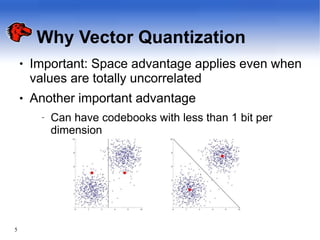
Why Vector Quantization?
4
● 3 classic advantages (Lookabaugh et al. 1989):
– Space filling advantage: VQ codepoints tile
space more efficiently
●
● Example: 2-D, squares vs. hexagons
Maximum possible gain for large dimension: 1.53 dB
– Shape advantage: VQ can use more points where
PDF is higher
● Can be mitigated with entropy coding
– Memory advantage: exploit statistical dependence
between vector components
● Transform coefficients are not strongly correlated
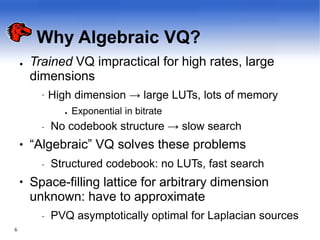
Why Vector Quantization
●
●
Important: Space advantage applies even when
values are totally uncorrelated
Another important advantage
– Can have codebooks with less than 1 bit per
dimension
5
Why Algebraic VQ?
6
● Trained VQ impractical for high rates, large
dimensions
– High dimension → large LUTs, lots of memory
●
●
● Exponential in bitrate
– No codebook structure → slow search
“Algebraic” VQ solves these problems
– Structured codebook: no LUTs, fast search
Space-filling lattice for arbitrary dimension
unknown: have to approximate
– PVQ asymptotically optimal for Laplacian sources
Why Gain-Shape
Quantization?
7
●
●
Separate “gain” (energy) from “shape” (spectrum)
– Vector = Magnitude × Unit Vector (point on sphere)
Potential advantages
– Can give each piece different rate allocations
●
● Preserve energy (contrast) instead of low-passing
Scalar can only add energy by coding ±1’s
– Implicit activity masking
● Can derive quantization resolution from the
explicitly coded energy
– Better representation of coefficients
How it Works (High-Level)
8
Simple Case: PVQ without a
Predictor
●
●
Scalar quantize gain
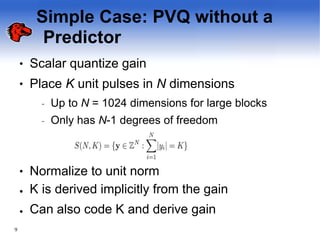
Place K unit pulses in N dimensions
– Up to N = 1024 dimensions for large blocks
– Only has N-1 degrees of freedom
●
●
●
Normalize to unit norm
K is derived implicitly from the gain
Can also code K and derive gain
9
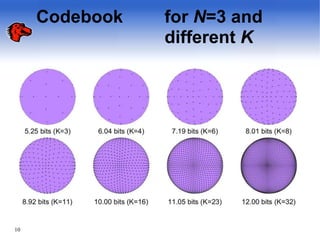
Codebook for N=3 and
different K
10
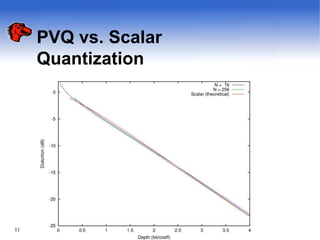
PVQ vs. Scalar
Quantization
11
PVQ with a Predictor
12
●
●
●
●
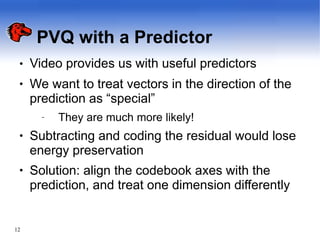
Video provides us with useful predictors
We want to treat vectors in the direction of the
prediction as “special”
– They are much more likely!
Subtracting and coding the residual would lose
energy preservation
Solution: align the codebook axes with the
prediction, and treat one dimension differently
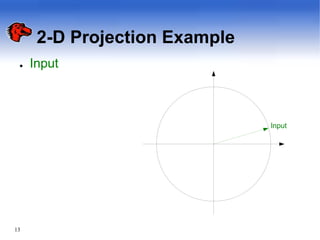
2-D Projection Example
Input
13
● Input
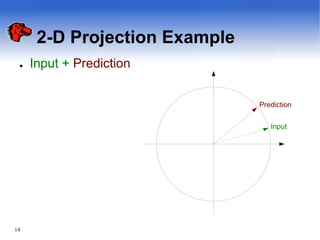
2-D Projection Example
Prediction
Input
14
● Input + Prediction
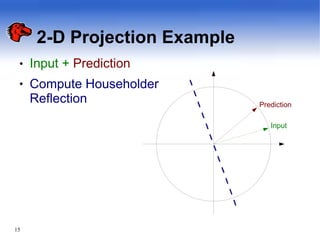
2-D Projection Example
Prediction
Input
15
●
●
Input + Prediction
Compute Householder
Reflection
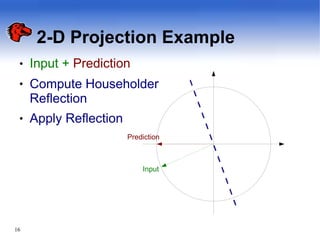
2-D Projection Example
Input
●
16
●
●
Input + Prediction
Compute Householder
Reflection
Apply Reflection
Prediction
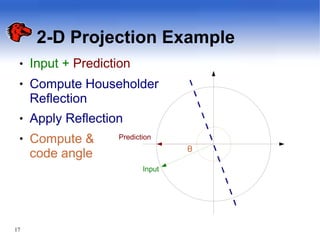
2-D Projection Example
θ
Prediction
Input
●
17
●
●
Input + Prediction
Compute Householder
Reflection
Apply Reflection
● Compute &
code angle
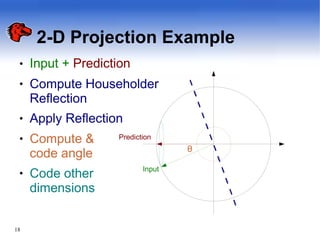
2-D Projection Example
●
●
●
Input + Prediction
Compute Householder
Reflection
Apply Reflection
●
●
Compute &
code angle
Code other
dimensions
Prediction
Input
θ
18
Pyramid Vector Quantization

Pyramid Vector Quantization

  • 1.
    Pyramid vector quantization A.D. Patel Institute of Technology Data compression and data retrieval(2161603) : A.Y. 2018-19 Guided By: Prof. Keyur sir (Dept of IT, ADIT) Prepared by: Kunal Kathe E.r.No.:160010116021 Shah Dhruv E.R No.:160010116053 Rahul jadeja E.r.No.:160010116018 B.E. (IT) Sem - VI Department of Information Technology A D Patel Institute of Technology (ADIT) New Vallabh Vidyanagar, Anand, Gujarat
  • 2.
    2 What is PVQ? Thegeometric properties of a memoryless Laplacian source are presented and used to establish a source coding theorem. Motivated by this geometric structure, a pyramid vector quantizer (PVQ) is developed for arbitrary vector dimension. The PVQ is based on the cubic lattice points that lie on the surface of anL-dimensional pyramid and has simple encoding and decoding algorithms. A product code version of the PVQ is developed and generalized to apply to a variety of sources. Analytical expressions are derived for the PVQ mean square error (mse), and simulation results are presented for PVQ encoding of several memoryless sources. For large rate and dimension, PVQ encoding of memoryless Laplacian, gamma, and Gaussian sources provides rose improvements of5.64, 8.40, and2.39dB, respectively, over the corresponding optimum scalar quantizer. Although suboptimum in a rate-distortion sense, because the PVQ can encode large-dimensional vectors, it offers significant reduction in rose distortion compared with the optimum Lloyd-Max scalar quantizer, and provides an attractive alternative to currently available vector quantizers.
  • 3.
    Why Vector Quantization? 3 ●3 classic advantages (Lookabaugh et al. 1989): – Space filling advantage: VQ codepoints tile space more efficiently ● ● Example: 2-D, squares vs. hexagons Maximum possible gain for large dimension: 1.53 dB – Shape advantage: VQ can use more points where PDF is higher ● 1.14 dB gain for 2-D Gaussian, 2.81 for high dimension – Memory advantage: exploit statistical dependence between vector components
  • 4.
    Why Vector Quantization? 4 ●3 classic advantages (Lookabaugh et al. 1989): – Space filling advantage: VQ codepoints tile space more efficiently ● ● Example: 2-D, squares vs. hexagons Maximum possible gain for large dimension: 1.53 dB – Shape advantage: VQ can use more points where PDF is higher ● Can be mitigated with entropy coding – Memory advantage: exploit statistical dependence between vector components ● Transform coefficients are not strongly correlated
  • 5.
    Why Vector Quantization ● ● Important:Space advantage applies even when values are totally uncorrelated Another important advantage – Can have codebooks with less than 1 bit per dimension 5
  • 6.
    Why Algebraic VQ? 6 ●Trained VQ impractical for high rates, large dimensions – High dimension → large LUTs, lots of memory ● ● ● Exponential in bitrate – No codebook structure → slow search “Algebraic” VQ solves these problems – Structured codebook: no LUTs, fast search Space-filling lattice for arbitrary dimension unknown: have to approximate – PVQ asymptotically optimal for Laplacian sources
  • 7.
    Why Gain-Shape Quantization? 7 ● ● Separate “gain”(energy) from “shape” (spectrum) – Vector = Magnitude × Unit Vector (point on sphere) Potential advantages – Can give each piece different rate allocations ● ● Preserve energy (contrast) instead of low-passing Scalar can only add energy by coding ±1’s – Implicit activity masking ● Can derive quantization resolution from the explicitly coded energy – Better representation of coefficients
  • 8.
    How it Works(High-Level) 8
  • 9.
    Simple Case: PVQwithout a Predictor ● ● Scalar quantize gain Place K unit pulses in N dimensions – Up to N = 1024 dimensions for large blocks – Only has N-1 degrees of freedom ● ● ● Normalize to unit norm K is derived implicitly from the gain Can also code K and derive gain 9
  • 10.
    Codebook for N=3and different K 10
  • 11.
  • 12.
    PVQ with aPredictor 12 ● ● ● ● Video provides us with useful predictors We want to treat vectors in the direction of the prediction as “special” – They are much more likely! Subtracting and coding the residual would lose energy preservation Solution: align the codebook axes with the prediction, and treat one dimension differently
  • 13.
  • 14.
  • 15.
    2-D Projection Example Prediction Input 15 ● ● Input+ Prediction Compute Householder Reflection
  • 16.
    2-D Projection Example Input ● 16 ● ● Input+ Prediction Compute Householder Reflection Apply Reflection Prediction
  • 17.
    2-D Projection Example θ Prediction Input ● 17 ● ● Input+ Prediction Compute Householder Reflection Apply Reflection ● Compute & code angle
  • 18.
    2-D Projection Example ● ● ● Input+ Prediction Compute Householder Reflection Apply Reflection ● ● Compute & code angle Code other dimensions Prediction Input θ 18