Project Guide:
Dr. Vasudev Verma
Priya Radhakrishnan
Participants:
Rashi Shrishrimal 201301203
Naman Singhal 201330072
K S Chandra Reddy 201505544
Semantic Annotation of
Documents
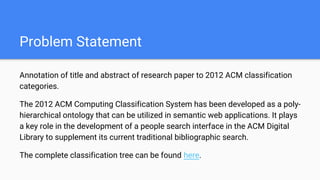
Problem Statement
Annotation of title and abstract of research paper to 2012 ACM classification
categories.
The 2012 ACM Computing Classification System has been developed as a poly-
hierarchical ontology that can be utilized in semantic web applications. It plays
a key role in the development of a people search interface in the ACM Digital
Library to supplement its current traditional bibliographic search.
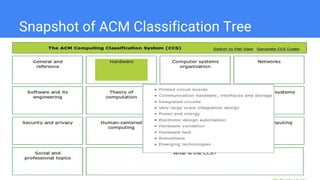
The complete classification tree can be found here.
Snapshot of ACM Classification Tree
Dataset Overview
1. A private dataset of the SIEL lab of IIIT-Hyderabad. Fields:
a. Title
b. Author
c. Country of authors
d. Year of publication
e. Conference
f. Categories
g. Abstract (For few research papers)
2. Wiki Dataset : For all the acm categories a dataset was build having the summary of the wikipedia page (The First
section of the wikipedia document).
3. Dblp dataset : For initial tasks, this dataset was used to train the lda model. Though this was not used for the final
proposition of the model.
Technical Approach and Models
Multiple approaches were tried for the given problem
1) Cosine similarity
2) Latent Dirichlet Allocation
3) Labeled LDA + Doc2vec
Approach 1 : Cosine
Similarity
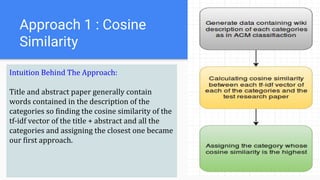
Intuition Behind The Approach:
Title and abstract paper generally contain
words contained in the description of the
categories so finding the cosine similarity of the
tf-idf vector of the title + abstract and all the
categories and assigning the closest one became
our first approach.
Approach 2 : Latent Dirichlet
Allocation
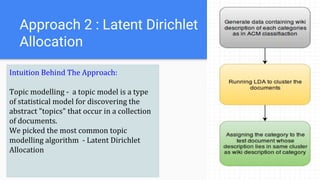
Intuition Behind The Approach:
Topic modelling - a topic model is a type
of statistical model for discovering the
abstract "topics" that occur in a collection
of documents.
We picked the most common topic
modelling algorithm - Latent Dirichlet
Allocation
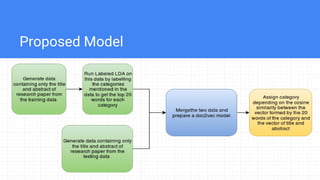
Proposed Model : Labeled LDA + Doc2Vec
Intuition :
Accuracy can only be improved by supervised topic modelling i.e. by labelling the
documents with topics and taking care of the semantic distance between the
research paper and the categories.
References :
Labeled LDA: A supervised topic model for credit attribution in multi-labeled corpora -
Stanford University (2009)
Distributed Representations of Sentences and Document - Google Inc. (2014)
Labeled LDA is a probabilistic graphical model that describes a process for
generating a labeled document collection. Like Latent Dirichlet Allocation, Labeled
LDA models each document as a mixture of underlying topics and generates each
word from one topic. Unlike LDA, L-LDA incorporates supervision by simply
constraining the topic model to use only those topics that correspond to a
document’s (observed) label set.
Labeled Latent Dirichlet Allocation
Doc2Vec
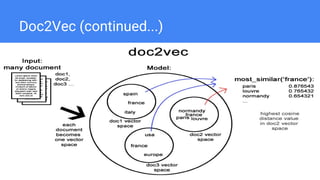
Doc2Vec is a tool provided by gensim that maps each sentences to a paragraph
vector. Paragraph vector is an unsupervised framework that learns continuous
distributed vector representations for pieces of texts. The texts can be of variable-
length, ranging from sentences to documents. The name Paragraph Vector is to
emphasize the fact that the method can be applied to variable-length pieces of
texts, anything from a phrase or sentence to a large document.
Doc2Vec (continued...)
Proposed Model
Mean Average Precision
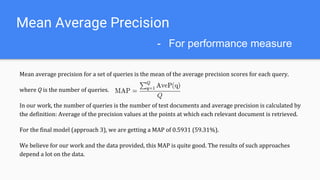
Mean average precision for a set of queries is the mean of the average precision scores for each query.
where Q is the number of queries.
In our work, the number of queries is the number of test documents and average precision is calculated by
the definition: Average of the precision values at the points at which each relevant document is retrieved.
For only Doc2Vec model, MAP = (0.2518) 25.18%
For the final model (approach 3), we are getting a MAP of 0.5931 (59.31%).
We believe for our work and the data provided, this MAP is quite good. The results of such approaches
depend a lot on the data.
- For performance measure
NDCG (Normalized Discounted Cumulative
Gain)
For only Doc2Vec NDCG = 35.26%
For the final approach, Doc2Vec + labeled LDA, NDCG = 45.03%
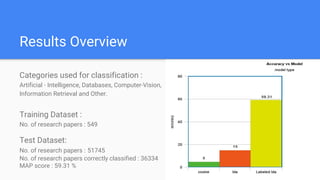
Results Overview
Categories used for classification :
Artificial - Intelligence, Databases, Computer-Vision,
Information Retrieval and Other.
Training Dataset :
No. of research papers : 549
Test Dataset:
No. of research papers : 51745
No. of research papers correctly classified : 36334
MAP score : 59.31 %
NDCG score : 45.03%

Semantic Annotation of Documents

  • 1.
    Project Guide: Dr. VasudevVerma Priya Radhakrishnan Participants: Rashi Shrishrimal 201301203 Naman Singhal 201330072 K S Chandra Reddy 201505544 Semantic Annotation of Documents
  • 2.
    Problem Statement Annotation oftitle and abstract of research paper to 2012 ACM classification categories. The 2012 ACM Computing Classification System has been developed as a poly- hierarchical ontology that can be utilized in semantic web applications. It plays a key role in the development of a people search interface in the ACM Digital Library to supplement its current traditional bibliographic search. The complete classification tree can be found here.
  • 3.
    Snapshot of ACMClassification Tree
  • 4.
    Dataset Overview 1. Aprivate dataset of the SIEL lab of IIIT-Hyderabad. Fields: a. Title b. Author c. Country of authors d. Year of publication e. Conference f. Categories g. Abstract (For few research papers) 2. Wiki Dataset : For all the acm categories a dataset was build having the summary of the wikipedia page (The First section of the wikipedia document). 3. Dblp dataset : For initial tasks, this dataset was used to train the lda model. Though this was not used for the final proposition of the model.
  • 5.
    Technical Approach andModels Multiple approaches were tried for the given problem 1) Cosine similarity 2) Latent Dirichlet Allocation 3) Labeled LDA + Doc2vec
  • 6.
    Approach 1 :Cosine Similarity Intuition Behind The Approach: Title and abstract paper generally contain words contained in the description of the categories so finding the cosine similarity of the tf-idf vector of the title + abstract and all the categories and assigning the closest one became our first approach.
  • 7.
    Approach 2 :Latent Dirichlet Allocation Intuition Behind The Approach: Topic modelling - a topic model is a type of statistical model for discovering the abstract "topics" that occur in a collection of documents. We picked the most common topic modelling algorithm - Latent Dirichlet Allocation
  • 8.
    Proposed Model :Labeled LDA + Doc2Vec Intuition : Accuracy can only be improved by supervised topic modelling i.e. by labelling the documents with topics and taking care of the semantic distance between the research paper and the categories. References : Labeled LDA: A supervised topic model for credit attribution in multi-labeled corpora - Stanford University (2009) Distributed Representations of Sentences and Document - Google Inc. (2014)
  • 9.
    Labeled LDA isa probabilistic graphical model that describes a process for generating a labeled document collection. Like Latent Dirichlet Allocation, Labeled LDA models each document as a mixture of underlying topics and generates each word from one topic. Unlike LDA, L-LDA incorporates supervision by simply constraining the topic model to use only those topics that correspond to a document’s (observed) label set. Labeled Latent Dirichlet Allocation
  • 10.
    Doc2Vec Doc2Vec is atool provided by gensim that maps each sentences to a paragraph vector. Paragraph vector is an unsupervised framework that learns continuous distributed vector representations for pieces of texts. The texts can be of variable- length, ranging from sentences to documents. The name Paragraph Vector is to emphasize the fact that the method can be applied to variable-length pieces of texts, anything from a phrase or sentence to a large document.
  • 11.
  • 12.
  • 13.
    Mean Average Precision Meanaverage precision for a set of queries is the mean of the average precision scores for each query. where Q is the number of queries. In our work, the number of queries is the number of test documents and average precision is calculated by the definition: Average of the precision values at the points at which each relevant document is retrieved. For only Doc2Vec model, MAP = (0.2518) 25.18% For the final model (approach 3), we are getting a MAP of 0.5931 (59.31%). We believe for our work and the data provided, this MAP is quite good. The results of such approaches depend a lot on the data. - For performance measure
  • 14.
    NDCG (Normalized DiscountedCumulative Gain) For only Doc2Vec NDCG = 35.26% For the final approach, Doc2Vec + labeled LDA, NDCG = 45.03%
  • 15.
    Results Overview Categories usedfor classification : Artificial - Intelligence, Databases, Computer-Vision, Information Retrieval and Other. Training Dataset : No. of research papers : 549 Test Dataset: No. of research papers : 51745 No. of research papers correctly classified : 36334 MAP score : 59.31 % NDCG score : 45.03%