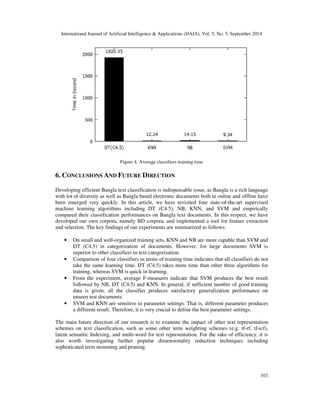
This paper investigates four supervised learning methods—decision tree (C4.5), k-nearest neighbour (KNN), naïve Bayes (NB), and support vector machine (SVM)—for the categorization of Bangla web documents. The authors develop a Bangla corpus and evaluate the performance of these methods, finding that all are effective, with SVM demonstrating the highest accuracy. The study highlights the growing need for efficient categorization of digital Bangla content due to an increase in its online presence.
![International Journal of Artificial Intelligence & Applications (IJAIA), Vol. 5, No. 5, September 2014
SUPERVISED LEARNING METHODS FOR BANGLA
WEB DOCUMENT CATEGORIZATION
Ashis Kumar Mandal1and Rikta Sen2
1University Malaysia Pahang, Pahang, Malaysia; Hajee Mohammad Danesh Science and
Technology University, Dinajpur, Bangladesh
2Rajshai University of Engineering and Technology, Bangladesh
ABSTRACT
This paper explores the use of machine learning approaches, or more specifically, four supervised learning
Methods, namely Decision Tree(C 4.5), K-Nearest Neighbour (KNN), Naïve Bays (NB), and Support Vector
Machine (SVM) for categorization of Bangla web documents. This is a task of automatically sorting a set of
documents into categories from a predefined set. Whereas a wide range of methods have been applied to
English text categorization, relatively few studies have been conducted on Bangla language text
categorization. Hence, we attempt to analyze the efficiency of those four methods for categorization of
Bangla documents. In order to validate, Bangla corpus from various websites has been developed and used
as examples for the experiment. For Bangla, empirical results support that all four methods produce
satisfactory performance with SVM attaining good result in terms of high dimensional and relatively noisy
document feature vectors.
KEYWORDS
Bangla articles corpus, Machine learning, Supervised learning, Text categorization
1. INTRODUCTION
Text categorization is an active research area of text mining where the documents are classified
with supervised, unsupervised or semi-supervised knowledge. Traditionally, this task was solved
manually, but such manual classification was expensive to scale and also labour intensive.
Therefore, researchers have explored the use of machine learning approach to automatic
classification of text documents[1]. Among various machine learning approaches in document
categorization, most popular is supervised learning where underlying input-output relation is
learned by small number of training data and then output values for unseen input points are
predicted[2]. Various number of supervised learning techniques ,such as association rules[3],
Neural Network[1], K-Nearest Neighbour[4], Decision Tree[5], Naïve Bays[6], Support Vector
Machine[7], and N-grams[8], has been used for text document categorization.
With the popularity of Unicode system and growing use of Internet, Bangla text documents in
digital domain have increased for the last decade. Besides, Bangla is spoken by about 245 million
people of Bangladesh and two states of India, with being 7th most spoken language[9]. In such a
trend, it has created a need to organize Bangla documents intelligently so that users can easily
identify required or related documents. To address this type of problem, text categorization
process can be used successfully, such as text categorization conducted on English language for
automated text retrieval [10, 11 ]. Although text categorization is well studies in other languages,
few works have been done on language Bangla due to lack of resources, annotated corpora, name
DOI : 10.5121/ijaia.2014.5508 93](https://image.slidesharecdn.com/5514ijaia08-141008022526-conversion-gate01/85/SUPERVISED-LEARNING-METHODS-FOR-BANGLA-WEB-DOCUMENT-CATEGORIZATION-1-320.jpg)
![International Journal of Artificial Intelligence & Applications (IJAIA), Vol. 5, No. 5, September 2014
dictionaries, morphological analyzer. One of the works in Bangla document categorization is
applying N-gram technique to categorize Bangla newspaper corpus [12].
In this paper, we study how information from Bangla online text documents can be categorized
using four supervised learning algorithm, namely DT (C4.5), KNN, NB, and SVM. These
classification algorithms are chosen due to the fact that their success rate in text classification of
various languages is promising. News corpus from various Bangla websites is employed to
evaluate the capabilities of these methods in categorization of high dimensional, sparse and
relatively noisy document features. In this paper categorization task is processed into three
phases:
• Pre-processing phase: This phase includes tokenization, digit removal, punctuation
94
removal, stop words removal and stemming.
• Feature extraction phase: It consist of statistical approach to extract relevant features
from the documents.
• Processing steps: This last phase applies text classification algorithms to the extracted
features to classify the documents into classes
The rest of the paper is organized in following orders: section 2 discusses about some
related works in the field of text classifications, section 3 discusses four classification
algorithms, section 4 presents our approaches of classifying Bangla documents. Test setup,
solution, discussion and analysis of the experiments appear in section 5 and finally, section
6 concludes the paper.
2. RELATED WORKS
Literacy review indicates that considerable works have been done in text categorization of the
English documents[1, 13]. In addition to English language, there are many studies have
conducted in European languages, such as French, German, Spanish [14] and in Asian languages,
such as Arabic, Chinese and Japanese[15 . For some Southern Indian Languages Naïve Bayes ,
Neural networks have been applied to news articles to automatically categorized predefine classes
[17, 18].
NB is the most frequently used approaches for text classification .It works by calculating the
probability that document D is belongs to class C. It is easy for implementation and computation.
In [19], authors use simple NB approach for the automatic classification of web sites based on
content of home pages. They got approximately 80% accuracy for text classification .In [20] ,
Jiang et al. Introduced locally weighted NB text classifiers and showed that this version
significantly outperforms original NB text classifiers in terms of classification accuracy. Besides,
authors in [21] proposed various smoothing methods for enhancing Bayesian leaning and used
it for short text classification.
KNN is also popular in terms of text classification for its effectiveness in classification. In paper
[22], authors successfully classified text document with KNN and result shows that performance
of their method is better than Naïve Bays and Term-Graph .Li et al. In [23], propose a improved
KNN model which combine constrained one pass clustering algorithm and KNN text
categorization. Similarly, in [24] ,authors proposed another improved version of KNN based on
genetic algorithm.
Recently considerable amount of attention has been given on SVM due to its better performance
in various text classifications. In [25] ,authors explained the appropriateness of applying SVMs to
text classification primarily from a theoretical perspective. In paper [26], authors developed a](https://image.slidesharecdn.com/5514ijaia08-141008022526-conversion-gate01/85/SUPERVISED-LEARNING-METHODS-FOR-BANGLA-WEB-DOCUMENT-CATEGORIZATION-2-320.jpg)
![International Journal of Artificial Intelligence & Applications (IJAIA), Vol. 5, No. 5, September 2014
classification model for categorization of cricket sports news .They used SVM which was based
on LibSVM and got best performance. In [27], Zhijie et al. compared SVM with other two
classification technique NB and KNN , and observed that SVM outperformed than those two
classifiers.
Decision Tree, Neural Networks, and N-gram are also potential techniques in text classification.
Authors in [28] compared Neural network approach to N-gram approach for text classification
and demonstrated that classification rate of Neural networks is similar to the corresponding N-gram
approach but former is five time faster than latter. Vens et al. in paper [29] consider
Decision Tree for hierarchical text classification problem. In [30] ,authors proposed hybrid
system based on N-gram analysis and dynamic artificial neural network for Twitter brand
sentiment analysis.
(2)
95
3. CLASSIFICATION ALGORITHMS
In this section, we briefly describe C 4.5, KNN, NB, and SVM classification methods used in our
study.
3.1 Naïve Bays (NB)
A Naïve Bays (NB) classifier is a simple probabilistic classifier based on applying Bayes'
theorem [6]. Depending on the precise nature of the probability model, this classifier can be
trained very efficiently in a supervised learning setting.
For classification of text documents using Bayes’ classifier, it is assumed that the document
belongs to one class. Then probabilities of document features w in all categories C is calculated
using the formula (1).
,,…. .](https://image.slidesharecdn.com/5514ijaia08-141008022526-conversion-gate01/85/SUPERVISED-LEARNING-METHODS-FOR-BANGLA-WEB-DOCUMENT-CATEGORIZATION-3-320.jpg)


![International Journal of Artificial Intelligence Applications (IJAIA), Vol. 5, No. 5, September 2014
96
3.2. K-Nearest Neighbours (KNN)
KNN is a statistical pattern reorganization algorithm which has been studied extensively for text
categorization applications [31]. It is a method for classifying objects based on closest training
examples in the feature space. The summery of the algorithm is as follows: given a test document
x, find the K nearest neighbours of x among all the training documents, and score the category
candidates based the category of K neighbours. The similarity of x and each neighbour document
is the score of the category of the neighbour document. If several of the K nearest neighbour
documents belong to the same category, then the sum of the score of that category is the
similarity score of the category in regard to the test document x. By sorting the scores of the
candidate categories, system assigns the candidate category with the highest score to the test
document x. The decision rule of KNN can be written as:
#$](https://image.slidesharecdn.com/5514ijaia08-141008022526-conversion-gate01/85/SUPERVISED-LEARNING-METHODS-FOR-BANGLA-WEB-DOCUMENT-CATEGORIZATION-9-320.jpg)