V.Leela Prasad, B.Simmi Cintre / International Journal of Engineering Research and Applications
                         (IJERA) ISSN: 2248-9622 www.ijera.com
                        Vol. 2, Issue 4, July-August 2012, pp.409-420
              Analysis of Novel Multi-Viewpoint Similarity Measures
                                   V.Leela Prasad*, B.Simmi Cintre**
 *(Student Scholar (MTech), Department of CSE, Adams Engineering College, JNTUH, Khammam,AP-507115, India)
  ** (Associate professor, Department of CSE, Adams Engineering College, JNTUH, Khammam, AP-507115, India)


Abstract—                                                      algorithms in many domains. In spite of that, its
         All clustering methods have to assume                 simplicity, understandability and scalability are the
some cluster relationship among the data objects               reasons for its tremendous popularity. An algorithm with
that they are applied on. Similarity between a pair            adequate performance and usability in most of application
of objects can be defined either explicitly or                 scenarios could be preferable to one with better
implicitly. In this paper, we introduce a novel                performance in some cases but limited usage due to high
multi-viewpoint based similarity measure and two               complexity. While offering reasonable results, k-means is
related clustering methods. The major difference               fast and easy to combine with other methods in larger
between a traditional dissimilarity/similarity                 systems.
measure and ours is that the former uses only a                               Our study of similarity of clustering was
single viewpoint, which is the origin, while the               initially motivated by a research on automated text
latter utilizes many different viewpoints, which are           categorization of foreign language texts, as explained
objects assumed to not be in the same cluster with             below. As the amount of digital documents has been
the two objects being measured. Using multiple                 increasing dramatically over the years as the Internet
viewpoints, more informative assessment of                     grows, information management, search, and retrieval,
similarity could be achieved. Theoretical analysis             etc., have become practically important problems.
and empirical study are conducted to support this              Developing methods to organize large amounts of
claim. Two criterion functions for document                    unstructured text documents into a smaller number of
clustering are proposed based on this new measure.             meaningful clusters would be very helpful as document
We compare them with several well-known                        clustering is vital to such tasks as indexing, filtering,
clustering algorithms that use other popular                   automated       metadata      generation,     word      sense
similarity measures on various document                        disambiguation, population of hierarchical catalogues of
collections to verify the advantages of our proposal.          web resources and, in general, any application requiring
                                                               document organization .
Key Terms—Document clustering, text mining,                                  Document clustering is also useful for topics
similarity measure, Clustering methods                         such as Gene Ontology in biomedicine where hierarchical
                                                               catalogues are needed. To deal with the large amounts of
I. INTRODUCTION                                                data, machine learning approaches have been applied to
               Clustering is one of the most interesting       perform Automated Text Clustering (ATC). Given an
and important topics in data mining. The aim of                unlabeled dataset, this ATC system builds clusters of
clustering is to find intrinsic structures in data, and        documents that are hopefully similar to clustering
organize them into meaningful subgroups for further            (classification, categorization, or labeling) performed by
study and analysis. There have been many clustering            human experts. To identify a suitable tool and algorithm
algorithms published every year. They can be proposed          for clustering that produces the best clustering solutions, it
for very distinct research fields, and developed using         becomes necessary to have a method for comparing the
totally different techniques and approaches.                   results of different clustering algorithms. Though
Nevertheless, according to a recent study [1], more than       considerable work has been done in designing clustering
half a century after it was introduced, the simple             algorithms, not much research has been done on
algorithm k-means still remains as one of the top 10           formulating a measure for the similarity of two different
data mining algorithms nowadays. It is the most                clustering algorithms. Thus, the main goal of this paper is
frequently used partitional clustering algorithm in            to: First, propose an algorithm for performing similarity
practice. Another recent scientific discussion [2] states      analysis among different clustering algorithms; second,
that k-means is the favourite algorithm that practitioners     apply the algorithm to calculate similarity of various pairs
in the related fields choose to use. Needless to mention,      of clustering methods applied to a Portuguese corpus and
k-means has more than a few basic drawbacks, such as           the Iris dataset; finally, to cross validate the results of
sensitiveness to initialization and to cluster size, and its   similarity analysis with the Euclidean (centroids) distances
performance can be worse than other state-of-the-art
                                                                                                                     409 | P a g e
V.Leela Prasad, B.Simmi Cintre / International Journal of Engineering Research and Applications
                           (IJERA) ISSN: 2248-9622 www.ijera.com
                          Vol. 2, Issue 4, July-August 2012, pp.409-420
and Pearson correlation coefficient, using the same              k
datasets. Possible applications are discussed.              min∑ ∑ || di – Cr ||2
                                                               r=1 di Є Sr

            The work in this paper is motivated by                    However, for data in a sparse and high-
investigations from the above and similar research          dimensional space, such as that in document clustering,
findings. It appears to us that the nature of similarity    cosine similarity is more widely used. It is also a popular
measure plays a very important role in the success or       similarity score in text mining and information retrieval
failure of a clustering method. Our first objective is to   [12]. Particularly, similarity of two document vectors d i
derive a novel method for measuring similarity between      and dj , Sim(di, dj), is defined as the cosine of the angle
data objects in sparse and high-dimensional domain,         between them. For unit vectors, this equals to their inner
particularly text documents. From the proposed              product:
similarity measure, we then formulate new clustering        Sim(di,dj ) = cos(di,dj) = ditdj
criterion functions and introduce their respective                    Cosine measure is used in a variant of k-means
clustering algorithms, which are fast and scalable like     called spherical k-means [3]. While k-means aims to
k-means, but are also capable of providing high-quality     minimize Euclidean distance, spherical k-means intends
and consistent performance.                                 to maximize the cosine similarity between documents in
                                                            a cluster and that cluster’s centroid:
             The remaining of this paper is organized as          k        dtiCr
follows. In Section 2, we review related literature on       max∑ ∑        ——
similarity and clustering of documents. We then present          r=1 diЄSr || Cr||
our proposal for document similarity measure in Section
3.It is followed by two criterion functions for document              The major difference between Euclidean
clustering and their optimization algorithms in Section     distance and cosine similarity, and therefore between k-
4. Extensive experiments on real-world benchmark            means and spherical k-means, is that the former focuses
datasets are presented and discussed in Sections 5          on vector magnitudes, while the latter emphasizes on
.Finally, conclusions and potential future work are         vector directions. Besides direct application in spherical
given in Section 6.                                         k-means, cosine of document vectors is also widely used
                                                            in many other document clustering methods as a core
2 RELATED WORKS                                             similarity measurement. The min-max cut graph-based
          Each document in a corpus corresponds to an       spectral method is an example [13]. In graph partitioning
m-dimensional vector d, where m is the total number         approach, document corpus is consider as a graph G
of terms that the document corpus has. Document             =(V,E), where each document is a vertex in V and each
vectors are often subjected to some weighting               edge in E has a weight equal to the similarity between a
schemes, such as the standard Term Frequency-               pair of vertices. Min-max cut algorithm tries to minimize
Inverse Document Frequency (TF-IDF), and                    the criterion function.
normalized to have unit length.
          The principle definition of clustering is to                In nearest-neighbor graph clustering methods,
arrange data objects into separate clusters such that the   such as the CLUTO’s graph method above, the concept
intra-cluster similarity as well as the inter-cluster       of similarity is somewhat different from the previously
dissimilarity is maximized. The problem formulation         discussed methods. Two documents may have a certain
itself implies that some forms of measurement are           value of cosine similarity, but if neither of them is in the
needed to determine such similarity or dissimilarity.       other one’s neighborhood, they have no connection
There are many state-of-threat clustering approaches        between them. In such a case, some context-based
that do not employ any specific form of measurement,        knowledge or relativeness property is already taken into
for instance, probabilistic model based method , non-       account when considering similarity. Recently, Ahmad
negative matrix factorization , information theoretic       and Dey [21] proposed a method to compute distance
co-clustering and so on. In this paper, though, we          between two categorical values of an attribute based on
primarily focus on methods that indeed do utilize a         their relationship with all other attributes. Subsequently,
specific measure. In the literature, Euclidean distance     Ienco et al. [22] introduced a similar context-based
is one of the most popular measures:                        distance learning method for categorical data. However,
Dist (di, dj) = | |di − dj ||                               for a given attribute, they only selected a relevant subset
          It is used in the traditional k-means             of attributes from the whole attribute set to use as the
algorithm. The objective of k-means is to minimize the      context for calculating distance between its two values.
Euclidean distance between objects of a cluster and         More related to text data, there are phrase-based and
that cluster’s centroid:                                    concept-based document similarities. Lakkaraju et al.
                                                            [23] employed a conceptual tree-similarity measure to

                                                                                                       410 | P a g e
V.Leela Prasad, B.Simmi Cintre / International Journal of Engineering Research and Applications
                          (IJERA) ISSN: 2248-9622 www.ijera.com
                         Vol. 2, Issue 4, July-August 2012, pp.409-420
identify similar documents. This method requires           research, we include all the measures that were tested in
representing documents as concept trees with the help      [17] and add another one—the averaged Kullback-
of a classifier. For clustering, Chim and Deng [24]        Leibler divergence. These five measures are discussed
proposed a phrase-based document similarity by             below. Different measure not only results in different
combining suffix tree model and vector space model.        final partitions, but also imposes different requirements
They then used Hierarchical Agglomerative Clustering       for the same clustering algorithm, as we will see in
algorithm to perform the clustering task. However, a       Section 4.
drawback of this approach is the high computational
complexity due to the needs of building the suffix tree    3.1 Metric
and calculating pairwise similarities explicitly before    Not every distance measure is a metric. To qualify as a
clustering. There are also measures designed               metric, a measure d must satisfy the following four
specifically for capturing structural similarity among     conditions.
XML documents [25]. They are essentially different         Let x and y be any two objects in a set and d(x, y) be the
from the document-content measures that are                distance between x and y.
discussed in this paper.                                   1. The distance between any two points must be
          In general, cosine similarity still remains as   nonnegative,
the most popular measure because of its simple             that is, d(x, y) ≥0.
interpretation and easy computation, though its            2. The distance between two objects must be zero if and
effectiveness is yet fairly limited. In the following      only if the two objects are identical, that is, d(x, y) = 0
sections, we propose a novel way to evaluate               if and only if x = y.
similarity between documents, and consequently             3. Distance must be symmetric, that is, distance from
formulate new criterion functions for document             x to y is the same as the distance from y to x, ie.
clustering.                                                d(x, y) = d(y, x).
                                                           4. The measure must satisfy the triangle inequality,
3. SIMILARITY MEASURES                                     which
Before clustering, a similarity/distance measure must      is d(x, z) ≤ d(x, y) + d(y, z).
be determined.The measure reflects the degree of
closeness or separation of the target objects and should   3.2 Euclidean Distance
correspond to the characteristics that are believed to     Euclidean distance is a standard metric for geometrical
distinguish the clusters embedded in the data. In many     problems. It is the ordinary distance between two points
cases, these characteristics are dependent on the data     and can be easily measured with a ruler in two- or three-
or the problem context at hand, and there is no            dimensional space. Euclidean distance is widely used in
measure that is universally best for all kinds of          clustering problems, including clustering text. It satisfies
clustering problems.                                       all the above four conditions and therefore is a true
Moreover, choosing an appropriate similarity measure       metric. It is also the default distance measure used with
is also crucial for cluster analysis, especially for a     the K-means algorithm.
particular type of clustering algorithms. For example,     Measuring distance between text documents, given two
the density-based clustering algorithms, such as           documents da and db represented by their
DBScan [4], rely heavily on the similarity                                  →        →
computation. Density-based clustering finds clusters        term vectors ta and tb respectively, the Euclidean
as dense areas in the data set, and the density of a       distance of the two documents is defined as
given point is in turn estimated as the closeness of the
corresponding data object to its neighboring objects.         →→            m
Recalling that closeness is quantified as the              DE( ta , tb) =( ∑ | wt,a – wt,b|2)1/2 ,
distance/similarity value, we can see that large number                    t=1
of distance/similarity computations are required for
finding dense areas and estimate cluster assignment of     where the term set is T = {t1, . . . , tm}. As mentioned
new data objects. Therefore, understanding the             previously, we use the tfidf value as term weights, that is
effectiveness of different measures is of great            wt,a = tfidf(da, t).
importance in helping to choose the best one.
In general, similarity/distance measures map the           3.3 Cosine Similarity
distance or similarity between the symbolic                When documents are represented as term vectors, the
description of two objects into a single numeric value,    similarity of two documents corresponds to the
which depends on two factors— the properties of the        correlation between the vectors. This is quantified as the
two objects and the measure itself. In order to make       cosine of the angle between vectors, that is, the so-called
the results of this study comparable to previous           cosine similarity. Cosine similarity is one of the most

                                                                                                      411 | P a g e
V.Leela Prasad, B.Simmi Cintre / International Journal of Engineering Research and Applications
                           (IJERA) ISSN: 2248-9622 www.ijera.com
                          Vol. 2, Issue 4, July-August 2012, pp.409-420
popular similarity measure applied to text documents,         The Jaccard coefficient is a similarity measure and
such as in numerous information retrieval applications        ranges between 0 and 1. It is 1 when the
[21] and clustering too [9].                                  → →
                                                              ta = tb and 0 when ta and tb are disjoint, where 1 means
                                                              the two objects are the same and 0 means they are
                          →           →                       completely different. The corresponding distance
Given two documents ta and            tb , their cosine       measure is DJ = 1 − SIMJ and we will use DJ instead in
similarity is                                                 subsequent experiments.
                   → →
       →→          ta . tb                                    3.5 Averaged Kullback-Leibler Divergence
SIMC (ta, tb) = —————                                         In information theory based clustering, a document is
                  →       →                                   considered as a probability distribution of terms. The
                | ta | × | tb |                               similarity of two documents is measured as the distance
                                                              between the two corresponding probability distributions.
        →       →                                             The Kullback- Leibler divergence (KL divergence), also
Where ta and tb are m-dimensional vectors over the            called the relative entropy, is a widely applied measure
term set T = {t1, . . . , tm}. Each dimension represents      for evaluating the differences between two probability
a term with its weight in the document, which is non-         distributions.
negative. As a result, the cosine similarity is non-
negative and bounded between [0,1].                           Given two distributions P and Q, the KL divergence
                                                              from distribution P to distribution Q is defined as
An important property of the cosine similarity is its                             P
independence of document length. For example,                 DKL(P||Q) = Plog( —)
combining two identical copies of a document d to get                            Q
a new pseudo document d1, the cosine similarity               In the document scenario, the divergence between two
between d and d1 is 1, which means that these two             distribution of words is:
documents are regarded to be identical. Meanwhile,                 →→                    w t,a
given another document l, d and d1 will have the same         DKL(ta||tb) = ∑ wt,a × log ( — )
similarity value to l,                                                                    wt,b
              → →             → →
that is, sim(td , tl ) = sim( td1 , tl ). In other words,     However, unlike the previous measures, the KL
documents with the same composition but different             divergence is not symmetric, ie.
totals will be treated identically. Strictly speaking, this   DKL(P||Q) ≠ DKL(Q||P). Therefore it is not a true metric.
does not satisfy the second condition of a metric,            As a result, we use the averaged KL divergence instead,
because after all the combination of two copies is a          which is defined as
different object from the original document. However,         DAvgKL(P||Q) = π1DKL(P||M) + π2DKL(Q||M),
in practice, when the term vectors are normalized to a                        P          Q
unit length such as 1, and in this case the                   where π1 = —— π2 = —— and M = π1P + π2Q.
representation of d and d1 is the same.                                     P+Q ,       P+Q ,

3.4 Jaccard Coefficient                                       The average weighting between two vectors ensures
The Jaccard coefficient, which is sometimes referred          symmetry, that is, the divergence from document i to
to as the Tanimoto coefficient, measures similarity as        document j is the same as the divergence from document
the intersection divided by the union of the objects.         j to document i. The averaged KL divergence has
For text document, the Jaccard coefficient compares           recently been applied to clustering text documents, such
the sum weight of shared terms to the sum weight of           as in the family of the Information Bottleneck clustering
terms that are present in either of the two document          algorithms [18], to good effect.
but are not the shared terms. The formal definition is:
                         → →                                  3.6 novel similarity measure
       →→                ta . tb                              The cosine similarity can be expressed in the following
SIMJ (ta, tb) = ————————                                      form without changing its meaning:
                   →        →       →→                        Sim(di, dj) = cos(di−0, dj−0) = (di−0)t (dj−0)
                 | ta |2× | tb |2 - ta . tb                   where 0 is vector 0 that represents the origin point.
                                                              According to this formula, the measure takes 0 as one
                                                              and only reference point. The similarity between two
                                                              documents di and dj is determined w.r.t. the angle

                                                                                                       412 | P a g e
V.Leela Prasad, B.Simmi Cintre / International Journal of Engineering Research and Applications
                           (IJERA) ISSN: 2248-9622 www.ijera.com
                          Vol. 2, Issue 4, July-August 2012, pp.409-420
between the two points when looking from the origin.          these distances, also provides a measure of intercluster
To construct a new concept of similarity, it is possible      dissimilarity, given that points di and dj belong to cluster
to use more than just one point of reference. We may          Sr, whereas dh belongs to another cluster. The overall
have a more accurate assessment of how close or               similarity between di and dj is determined by taking
distant a pair of points is, if we look at them from          average over all the viewpoints not belonging to cluster
many different viewpoints. From a third point dh, the         Sr. It is possible to argue that while most of these
directions and distances to di and dj are indicated           viewpoints are useful, there may be some of them giving
respectively by the difference vectors (d i − dh) and (dj     misleading information just like it may happen with the
− dh). By standing at various reference points dh to          origin point. However, given a large enough number of
view di, dj and working on their difference vectors, we       viewpoints and their variety, it is reasonable to assume
define similarity between                                     that the majority of them will be useful. Hence, the effect
the two documents as:                                         of misleading viewpoints is constrained and reduced by
               1                                              the averaging step. It can be seen that this method offers
Sim(di,dj) = —— ∑ Sim(di – dh, dj - dh)                       more informative assessment of similarity than the single
 di,dj Є sr    n-nr dhЄssr                                   origin point based similarity measure.
                                                              3.7 Analysis and practical examples of MVS
As described by the above equation, similarity of two         In this section, we present analytical study to show that
documents di and dj - given that they are in the same         the proposed MVS could be a very effective similarity
cluster - is defined as the average of similarities           measure for data clustering. In order to demonstrate its
measured relatively from the views of all other               advantages, MVS is compared with cosine similarity
documents outside that cluster. What is interesting is        (CS) on how well they reflect the true group structure
that the similarity here is defined in a close relation to    in document collections.
the clustering problem. A presumption of cluster              1: procedure BUILDMVSMATRIX(A)
memberships has been made prior to the measure. The            2: for r ← 1 : c do
two objects to be measured must be in the same                 3:        DSSr ← ∑di ¢ Sr di
cluster, while the points from where to establish this         4:       nSSr ← | S  Sr |
measurement must be outside of the cluster. We call            5: end for
this proposal the Multi-Viewpoint based Similarity, or         6: for i ← 1 :n do
MVS. From this point onwards, we will denote the               7:     r ← class of di
proposed similarity measure between two document               8:    for j ← 1 : n do
vectors di and dj by MVS(di, dj | di, dj Є Sr), or             9:       if dj Є Sr then
occasionally MVS(di, dj) for short.                                                               DSSrDSSr
The final form of MVS in Eq. depends on particular            10:             aij ← dtidj – dti —— - dtj —— + 1
formulation of the individual similarities within the                                           nSSr        nSSr
sum. If the relative similarity is defined by dot-product     11:        else
of the difference vectors, we have:                                                               DSSrDSSr
MVS(di, dj |di, dj Є Sr)                                      12:             aij ← dtidj – dti —— - dtj —— + 1
     1                                                                                          nSSr        nSSr
= —— ∑             (di,dh)t(dj-dh)                            13:       end if
    n-nr dh Є SSr                                            14: end for
                                                              15: end for
    1                                                         16: return A={aij }n×n
= —— ∑ cos(di-dh,dj-dh)||di – dh || ||dj – dh ||              17: end procedure
  n-nr dh
                                                              Fig. 1. Procedure: Build MVS similarity matrix.
The similarity between two points di and dj inside
cluster Sr, viewed from a point dh outside this cluster,      From this condition, it is seen that even when dl is
is equal to the product of the cosine of the angle            considered ―closer‖ to di in terms of CS, i.e.
between di and dj looking from dh and the Euclidean           cos(di, dj)≤cos(di, dl), dl can still possibly be regarded as
distances from dh to these two points. This definition        less similar to di based on MVS if, on the contrary, it is
is based on the assumption that dh is not in the same         ―closer‖ enough to the outer centroid CSSr than dj is. This
cluster with di and dj. The smaller the distances             is intuitively reasonable, since the ―closer‖ dl is to CSSr ,
||di−dh|| and ||dj −dh|| are, the higher the chance that dh   the greater the chance it actually belongs to another
is in fact in the same cluster with di and dj , and the       cluster rather than Sr and is, therefore, less similar to di.
similarity based on dh should also be small to reflect        For this reason, MVS brings to the table an additional
this potential. Therefore, through                            useful measure compared with CS.

                                                                                                          413 | P a g e
V.Leela Prasad, B.Simmi Cintre / International Journal of Engineering Research and Applications
                           (IJERA) ISSN: 2248-9622 www.ijera.com
                          Vol. 2, Issue 4, July-August 2012, pp.409-420
To further justify the above proposal and analysis, we              Two real-world document datasets are used as examples
carried out a validity test for MVS and CS. The                     in this validity test. The first is reuters7, a subset of the
purpose of this test is to check how much a similarity              famous collection, Reuters-21578 Distribution 1.0, of
measure coincides with the true class labels. It is based           Reuter’s newswire articles1. Reuters-21578 is one of the
on one principle: if a similarity measure is appropriate            most widely used test collection for text categorization.
for the clustering problem, for any of a document in                In our validity test, we selected 2,500 documents from
the corpus, the documents that are closest to it based              the largest 7 categories: ―acq‖, ―crude‖, ―interest‖,
on this measure should be in the same cluster with                  ―earn‖, ―money-fx‖, ―ship‖ and ―trade‖ to form reuters7.
it.The validity test is designed as following. For each             Some of the documents may appear in more than one
type of similarity measure, a similarity matrix A                   category. The second dataset is k1b, a collection of 2,340
={aij}n×n is created. For CS, this is simple, as aij = dti          web pages from the Yahoo! subject hierarchy, including
dj .The procedure for building MVS matrix is                        6 topics: ―health‖, ―entertainment‖, ―sport‖, ―politics‖,
described in Fig. 1. Firstly, the outer composite w.r.t.            ―tech‖ and ―business‖. It was created from a past study
each class is determined. Then, for each row ai of A, i             in information retrieval called WebAce [26], and is now
= 1, . . . , n, if the pair of documents d i and dj, j = 1, . . .   available with the CLUTO toolkit [19].
, n are in the same class, aij is calculated as in line 10,         The two datasets were preprocessed by stop-word
Fig. 1. Otherwise, dj is assumed to be in d i’s class, and          removal and stemming. Moreover, we removed words
aij is calculated as in line 12, Fig. 1. After matrix A is          that appear in less than two documents or more than
formed, the procedure in Fig. 2 is used to get its                  99.5% of the total number of documents. Finally, the
validity score. For each document d i corresponding to              documents were weighted by TF-IDF and normalized to
row ai of A, we select qr documents closest to di. The              unit vectors.
value of qr is chosen relatively as percentage of the               For example, with k1b dataset at percentage = 1.0, MVS’
size of the class r that contains di, where percentage ∈            validity score is 0.80, while that of CS is only 0.67. This
(0, 1]. Then, validity w.r.t. di is calculated by the               indicates that, on average, when we pick up any
fraction of these qr documents having the same class                document and consider its neighborhood of size equal to
label with di, as in line 12, Fig. 2. The final validity is         its true class size, only 67% of that document’s
determined by averaging                                             neighbors based on CS actually belong to its class. If
 Require: 0 < percentage ≤ 1                                        based on MVS, the number of valid neighbors increases
1: procedure GETVALIDITY(validity,A, percentage)                    to 80%. The validity test has illustrated the potential
2: for r ← 1 : c do                                                 advantage of the new multi-viewpoint based similarity
3:       qr ← [percentage × nr]                                     measure compared to the cosine measure.
4:      if qr = 0 then
5:          qr ← 1
6:      end if                                                      4.MULTI-VIEWPOINT BASED
7: end for                                                          CLUSTERING
8: for i ← 1 : n do                                                           Having defined our similarity measure, we now
9:        {aiv[1], . . . , aiv[n] } ←Sort {ai1, . . . , ain}        formulate our clustering criterion functions. The first
10:        s.t. aiv[1] ≥ aiv[2] ≥ . . . ≥ aiv[n]                    function, called IR, is the cluster size-weighted sum of
            {v[1], . . . , v[n]} ← permute {1, . . . , n}           average pairwise similarities of documents in the same
11: r ← class of di                                                 cluster. Firstly, let us express this sum in a general form
12: validity(di) ←|{dv[1], . . . , dv[qr]} ∩ Sr|                    by function F:
                       ——————————                                        k
                              qr                                    F= ∑ nr [ 1 / n2r ∑ Sim(di,dj) ]
13: end for                                                                            di,djЄ Sr
14: validity ←∑ni←1 validity(di)                                    We would like to transform this objective function into
                    ——————                                          some suitable form such that it could facilitate the
                         n                                          optimization procedure to be performed in a simple, fast
15: return validity                                                 and effective way. Let us use a parameter α called the
16: end procedure                                                   regulating factor, which has some constant value
                                                                    (α Є [0, 1]), and let λr = n αr in Eq. the final form of our
Fig. 2. Procedure: Get validity score                               criterion function IR is:

over all the rows of A, as in line 14, Fig. 2. It is clear
that validity score is bounded within 0 and 1. The
higher validity score a similarity measure has, the
more suitable it should be for the clustering task.

                                                                                                                414 | P a g e
V.Leela Prasad, B.Simmi Cintre / International Journal of Engineering Research and Applications
                           (IJERA) ISSN: 2248-9622 www.ijera.com
                          Vol. 2, Issue 4, July-August 2012, pp.409-420
                                                            completes without any documents being moved to new
                                                            clusters. Unlike the traditional k-means, this algorithm is
                                                            a stepwise optimal procedure. While kmeans only
     k 1      n+nr        n+nr                              updates after all n documents have been reassigned, the
IR = ∑ —— [—— || Dr||2 – (—— - 1) DtrD]                     incremental clustering algorithm updates immediately
    r=1 nr1-ά n-nr         n-nr                             whenever each document is moved to new cluster. Since
                                                            every move when happens increases the objective
In the empirical study of Section 5.4, it appears that      function value, convergence to a local optimum is
IR’s performance dependency on the value of α is not        guaranteed.
very critical. The criterion function yields relatively     During the optimization procedure, in each iteration, the
good clustering results for α Є (0, 1).                     main sources of computational cost are:
In the formulation of IR, a cluster quality is measured     • Searching for optimum clusters to move individual
by the average pairwise similarity between documents        documents to: O(nz · k).
within that cluster. However, such an approach can          • Updating composite vectors as a result of such moves:
lead to sensitiveness to the size and tightness of the      O(m · k).
clusters. With CS, for example, pairwise similarity of      where nz is the total number of non-zero entries in all
documents in a sparse cluster is usually smaller than       document vectors. Our clustering approach is partitional
those in a dense cluster. Though not as clear as with       and incremental; therefore, computing similarity matrix
CS, it is still                                             is absolutely not needed. If τ denotes the number of
possible that the same effect may hinder MVS-based          iterations the algorithm takes, since nz is often several
clustering if using pairwise similarity. To prevent this,   tens times larger than m for document domain, the
an alternative approach is to consider similarity           computational complexity required for clustering with
between each document vector and its cluster’s              IR and IV is O(nz · k · τ).
centroid instead.
4.1 Optimization algorithm and complexity                   5 PERFORMANCE EVALUATION OF MVSC
          We denote our clustering framework by                       To verify the advantages of our proposed
MVSC, meaning Clustering with Multi-Viewpoint               methods, we evaluate their performance in experiments
based Similarity. Subsequently, we have MVSC-IR             on document data. The objective of this section is to
and MVSC-IV , which are MVSC with criterion                 compare MVSC- IR and MVSC-IV with the existing
function IR and IV respectively. The main goal is to        algorithms that also use specific similarity measures and
perform document clustering by optimizing                   criterion functions for document clustering. The
IR in Eq. and IV in Eq.. For this purpose, the              similarity measures to be compared includes Euclidean
incremental k-way algorithm [18], [29] - a sequential       distance, cosine similarity and extended Jaccard
version of k-means - is employed. Considering that the      coefficient.
expression of IV depends only on nr and Dr, r = 1, . . .    5.1 Document collections
, k, IV can be written in a general form:                             The data corpora that we used for experiments
      k                                                     consist of twenty benchmark document datasets. Besides
IV =∑Ir (nr,Dr)                                             reuters7 and k1b, which have been described in details
     r=1                                                    earlier, we included another eighteen text collections so
                                                            that the examination of the clustering methods is more
where Ir (nr,Dr) corresponds to the objective value of      thorough and exhaustive. Similar to k1b, these datasets
cluster r. The same is applied to IR. With this general     are provided together with CLUTO by the toolkit’s
form, the incremental optimization algorithm, which         authors [19]. They had been used for experimental
has two major steps Initialization and Refinement, is       testing in previous papers, and their source and origin
described in Fig. 5. At Initialization, k arbitrary         had also been described in details [30], [31]. Table 2
documents are selected to be the seeds from which           summarizes their characteristics. The corpora present a
initial    partitions are formed. Refinement is a           diversity of size, number of classes and class balance.
procedure that consists of a number of iterations.          They were all preprocessed by standard procedures,
During each iteration, the n documents are visited one      including stopword removal, stemming, removal of too
by one in a totally random order. Each document is          rare as well as too frequent words, TF-IDF weighting
checked if its move to another cluster results in           and normalization.
improvement of the objective function. If yes, the
document is moved to the cluster that leads to the
highest improvement. If no clusters are better than the
current cluster, the document is not moved. The
clustering process terminates when an iteration

                                                                                                      415 | P a g e
V.Leela Prasad, B.Simmi Cintre / International Journal of Engineering Research and Applications
                           (IJERA) ISSN: 2248-9622 www.ijera.com
                          Vol. 2, Issue 4, July-August 2012, pp.409-420

                                                                        After a test run, clustering solution is evaluated
                                                              by comparing the documents’ assigned labels with their
                                                              true labels provided by the corpus. Three types of
                                                              external evaluation metric are used to assess clustering
                        TABLE 2                               performance. They are the FScore, Normalized Mutual
                     Document datasets                        Information (NMI) and Accuracy. FScore is an equally
                                                              weighted combination of the ―precision‖ (P) and
Data     Source       c     n        m         Balance        ―recall‖(R) values used in information retrieval. Given a
                                                              clustering solution, FScore is determined as:
fbis      TREC         17 2,463 2,000         0.075                      k ni
hitech TREC            6     2,301 13,170 0.192               FScore= ∑ — max (Fi,j)
k1a       WebACE 20 2,340 13,859 0.018                                i=1 nj
k1b       WebACE 6           2,340 13,859 0.043
la1       TREC         6     3,204 17,273 0.290                          where ni denotes the number of documents in
la2       TREC         6     3,075 15,211 0.274               class i, nj the number of documents assigned to cluster j,
re0       Reuters      13 1,504 2,886         0.018           and ni,j the number of documents shared by class i and
re1       Reuters      25 1,657 3,758         0.027           cluster j. From another aspect, NMI measures the
tr31      TREC         7     927    10,127 0.006              information the true class partition and the cluster
c: # of classes, n: # of documents, m: # of words             assignment share.It measures how much knowing about
Balance= (smallest class size)/(largest class size)           the clusters helps us know about the classes.
                                                              Finally, Accuracy measures the fraction of documents
5.2 Experimental setup and evaluation                         that     are correctly labels, assuming a one-to-one
                                                              correspondence between true classes and assigned
        To demonstrate how well MVSCs can                     clusters. Let q denote any possible permutation of index
perform, we compare them with five other clustering           set {1, . . . , k}, Accuracy is calculated by:
methods on the twenty datasets in Table 2. In
summary, the seven clustering algorithms are:                             1    k
• MVSC-IR: MVSC using criterion function IR                   Accuracy = — max ∑ ni,q(i)
• MVSC-IV : MVSC using criterion function IV                             nq   i=1
• k-means: standard k-means with Euclidean distance
• Spkmeans: spherical k-means with CS                                  The best mapping q to determine Accuracy
• graphCS: CLUTO’s graph method with CS                       could be found by the Hungarian algorithm2. For all
• graphEJ: CLUTO’s graph with extended Jaccard                three metrics, their range is from 0 to 1, and a greater
• MMC: Spectral Min-Max Cut algorithm [13]                    value indicates a better clustering solution.

          Our MVSC-IR and MVSC-IV programs are                5.3 Results
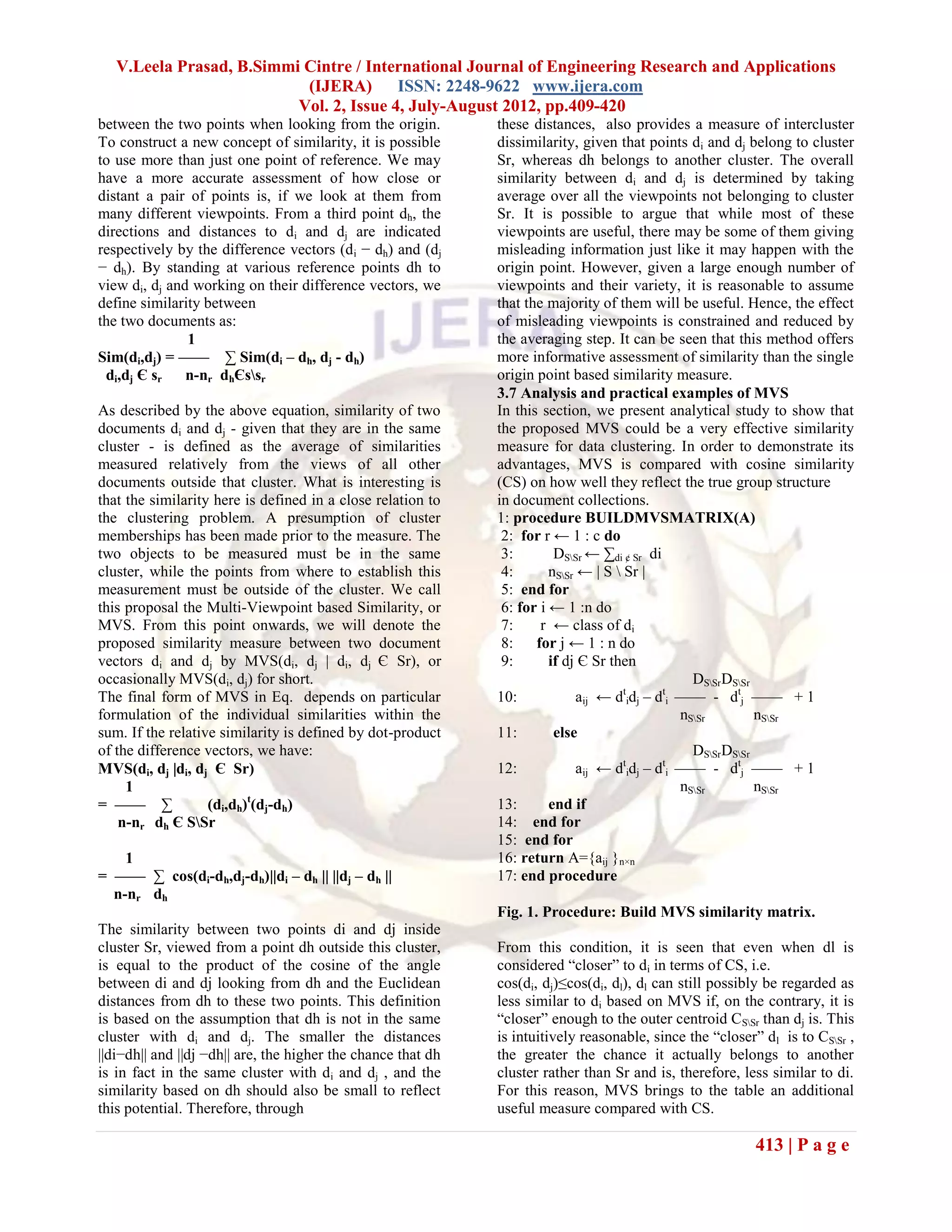
implemented in Java. The regulating factor α in IR is                   Fig. 6 shows the Accuracy of the seven
always set at 0.3 during the experiments. We                  clustering algorithms on the twenty text collections.
observed that this is one of the most appropriate             Presented in a different way, clustering results based on
values. A study on MVSC-IR’s performance relative             FScore and NMI are reported in Table 3 and Table 4
to different α values is presented in a later section. The    respectively. For each dataset in a row, the value in bold
other algorithms are provided by the C library                and underlined is the best result, while the value in bold
interface which is available freely with the CLUTO            only is the second to best. It can be observed that
toolkit [19]. For each dataset, cluster number is             MVSC-IR and MVSC-IV perform consistently well. In
predefined equal to the number of true class, i.e. k = c.     Fig. 6, 19 out of 20 datasets, except reviews, either both
None of the above algorithms are guaranteed to find           or one of MVSC approaches are in the top two
global      optimum,     and     all   of     them      are   algorithms. The next consistent performer is Spkmeans.
initializationdependent. Hence, for each method, we           The other algorithms might work well on certain dataset.
performed clustering                                          For example, graphEJ yields
a few times with randomly initialized values, and             outstanding result on classic; graphCS and MMC are
chose the best trial in terms of the corresponding            good on reviews. But they do not fare very well on the
objective function value. In all the experiments, each        rest of the collections.
test run consisted of 10 trials. Moreover, the result                   To have a statistical justification of the
reported here on each dataset by a particular clustering      clustering performance comparisons, we also carried out
method is the average of 10 test runs.                        statistical significance tests. Each of MVSC-IR and

                                                                                                         416 | P a g e
V.Leela Prasad, B.Simmi Cintre / International Journal of Engineering Research and Applications
                          (IJERA) ISSN: 2248-9622 www.ijera.com
                         Vol. 2, Issue 4, July-August 2012, pp.409-420
MVSC-IV was paired up with one of the remaining            show, the advantage of MVSCIR and MVSC-IV over
algorithms for a paired t-test [32]. Given two paired      the other methods is statistically significant. A special
sets X and Y of N measured values, the null                case is the graphEJ algorithm. On the one hand, MVSC-
hypothesis of the test is that the differences between     IR is not significantly better than graphEJ if based on
X and Y come from a population with mean 0. The            FScore or NMI. On the other hand,
alternative hypothesis is that the paired sets differ      when MVSC-IR and MVSC-IV are tested obviously
from each other in a significant          way. In our      better than graphEJ, the p-values can still be considered
experiment, these tests were done based on the             relatively large, although they are smaller than 0.05. The
evaluation values obtained on the twenty datasets.         reason is that, as observed before, graphEJ’s results on
The typical 5% significance level was used. For            classic dataset are very different from those of the other
example, considering the pair (MVSC-IR, k-means),          algorithms. While interesting, these values can be
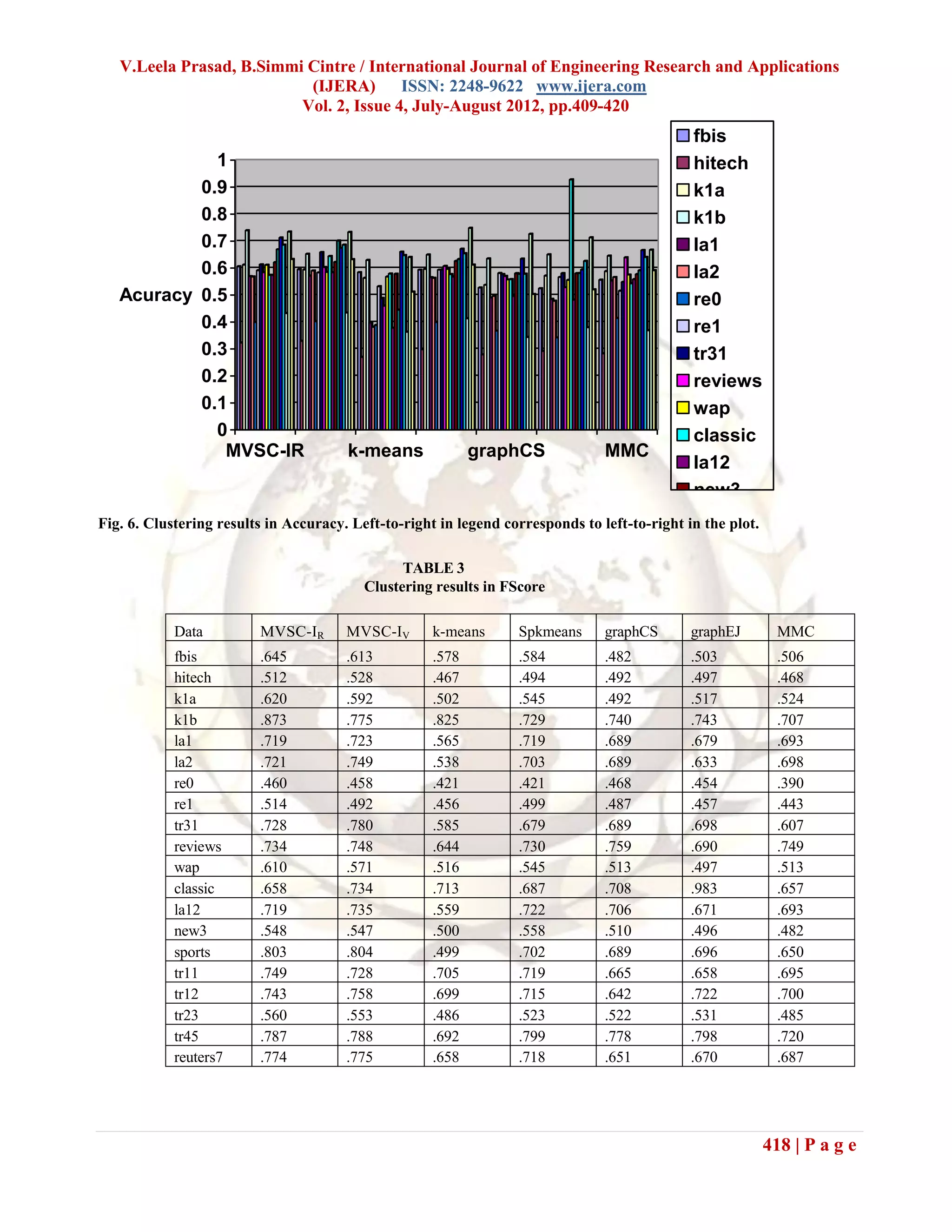
from Table 3, it is seen that MVSC-IR dominates k-         considered as outliers, and including them in the
means w.r.t. FScore. If the paired t-test returns a p-     statistical tests would affect the outcomes greatly.
value smaller than 0.05, we reject the null hypothesis     Hence, w e also report in Table 5 the tests where classic
and say that the dominance is significant. Otherwise,      was excluded and only results on the other 19 datasets
the null hypothesis is true and the comparison is          were used.
considered insignificant. The outcomes of the paired t-
tests are presented in Table 5. As the paired t-tests


                                                                                              fbis
           1                                                                                  hitech
         0.9
                                                                                              k1a
         0.8
                                                                                              k1b
         0.7
                                                                                              la1
         0.6
 Acuracy 0.5                                                                                  la2
         0.4                                                                                  re0
         0.3                                                                                  re1
         0.2                                                                                  tr31
         0.1                                                                                  reviews
           0                                                                                  wap
                  MVSC-IR              k-means            graphCS              MMC            classic
                                                                                              la12
                                                                                              new3


                                                                                                    417 | P a g e
V.Leela Prasad, B.Simmi Cintre / International Journal of Engineering Research and Applications
                           (IJERA) ISSN: 2248-9622 www.ijera.com
                          Vol. 2, Issue 4, July-August 2012, pp.409-420
                                                                                              fbis
                   1                                                                          hitech
                 0.9                                                                          k1a
                 0.8                                                                          k1b
                 0.7                                                                          la1
                 0.6                                                                          la2
   Acuracy 0.5                                                                                re0
                 0.4                                                                          re1
                 0.3                                                                          tr31
                 0.2                                                                          reviews
                 0.1                                                                          wap
                   0                                                                          classic
                    MVSC-IR            k-means             graphCS             MMC
                                                                                              la12
                                                                                              new3
                                                                                              sports
Fig. 6. Clustering results in Accuracy. Left-to-right in legend corresponds to left-to-right in the plot.

                                                TABLE 3
                                          Clustering results in FScore

            Data         MVSC-IR       MVSC-IV      k-means       Spkmeans      graphCS      graphEJ         MMC
            fbis         .645          .613         .578          .584          .482         .503            .506
            hitech       .512          .528         .467          .494          .492         .497            .468
            k1a          .620          .592         .502          .545          .492         .517            .524
            k1b          .873          .775         .825          .729          .740         .743            .707
            la1          .719          .723         .565          .719          .689         .679            .693
            la2          .721          .749         .538          .703          .689         .633            .698
            re0          .460          .458         .421          .421          .468         .454            .390
            re1          .514          .492         .456          .499          .487         .457            .443
            tr31         .728          .780         .585          .679          .689         .698            .607
            reviews      .734          .748         .644          .730          .759         .690            .749
            wap          .610          .571         .516          .545          .513         .497            .513
            classic      .658          .734         .713          .687          .708         .983            .657
            la12         .719          .735         .559          .722          .706         .671            .693
            new3         .548          .547         .500          .558          .510         .496            .482
            sports       .803          .804         .499          .702          .689         .696            .650
            tr11         .749          .728         .705          .719          .665         .658            .695
            tr12         .743          .758         .699          .715          .642         .722            .700
            tr23         .560          .553         .486          .523          .522         .531            .485
            tr45         .787          .788         .692          .799          .778         .798            .720
            reuters7     .774          .775         .658          .718          .651         .670            .687


                                                                                                            418 | P a g e
V.Leela Prasad, B.Simmi Cintre / International Journal of Engineering Research and Applications
                           (IJERA) ISSN: 2248-9622 www.ijera.com
                          Vol. 2, Issue 4, July-August 2012, pp.409-420
                                                  TABLE 4
                                            Clustering results in NMI
                Data        MVSC-        MVSC-       k-means   Spkmeans    graphCS      graphEJ     MMC
                            IR           IV
                fbis        .606         .595        .584      .593        .527         .524        .556
                hitech      .323         .329        .270      .298        .279         .292        .283
                k1a         .612         .594        .563      .596        .537         .571        .588
                k1b         .739         .652        .629      .649        .635         .650        .645
                la1         .569         .571        .397      .565        .490         .485        .553
                la2         .568         .590        .381      .563        .496         .478        .566
                re0         .399         .402        .388      .399        .367         .342        .414
                re1         .591         .583        .532      .593        .581         .566        .515
                tr31        .613         .658        .488      .594        .577         .580        .548
                reviews     .584         .603        .460      .607        .570         .528        .639
                wap         .611         .585        .568      .596        .557         .555        .575
                classic     .574         .644        .579      .577        .558         .928        .543
                la12        .574         .584        .378      .568        .496         .482        .558
                new3        .621         .622        .578      .626        .580         .580        .577
                sports      .669         .701        .445      .633        .578         .581        .591
                tr11        .712         .674        .660      .671        .634         .594        .666
                tr12        .686         .686        .647      .654        .578         .626        .640
                tr23        .432         .434        .363      .413        .344         .380        .369
                tr45        .734         .733        .640      .748        .726         .713        .667
                reuters7    .633         .632        .512      .612        .503         .520        .591

Under this circumstance, both MVSC-IR and MVSC-IV outperform graphEJ significantly with good p-values.

5.4 Effect of α on MVSC-IR’s performance                        with α = αi. The same transformation was applied to NMI
          It has been known that criterion function based       and Accuracy to yield relative NMI and relative Accuracy
partitional clustering methods can be sensitive to cluster      respectively. MVSC-IR performs the best with an αi if its
size and balance. In the formulation of I R , there exists      relative measure has a value of 1. Otherwise its relative
parameter α which is called the regulating factor, α Є [0,      measure is greater than 1; the larger this value is, the
1]. To examine how the determination of α could affect          worse MVSC-IR with αi performs in comparison with
MVSC-IR’s performance, we evaluated MVSC-IR with                other settings of α. Finally, the average relative measures
different values of α from 0 to 1, with 0.1 incremental         were calculated over all the datasets to present the overall
interval. The assessment was done based on the                  performance.
clustering results in NMI, FScore and Accuracy, each
averaged over all the twenty given datasets. Since the          6. CONCLUSIONS AND FUTURE WORK
evaluation metrics for different datasets could be very                  In this paper, we analyses a Multi-Viewpoint
different from each other, simply taking the average over       based Similarity measuring method, named MVS.
all the datasets would not be very meaningful. Hence, we        Theoretical analysis and empirical examples show that
employed the method used in [18] to transform the               MVS is potentially more suitable for text documents than
metrics into relative metrics before averaging. On a            the popular cosine similarity. Based on MVS, two
particular document collection S, the relative FScore           criterion functions, IR and IV , and their respective
measure of MVSC-IR with α = αi is determined as                 clustering algorithms, MVSC-IR and MVSC-IV , have
following                                                       been introduced. Compared with other state-of-the-art
                              maxαj{FScore(IR; S, αj)}          clustering methods that use different types of similarity
relative FScore (IR; S, αi) =     —————————                     measure, on a large number of document datasets and
                                   FScore(IR; S, αi)            under     different evaluation metrics, the proposed
                                                                algorithms show that they could provide significantly
where αi, αj ∈ {0.0, 0.1, . . . , 1.0}, FScore(IR; S, αi) is    improved clustering performance.
the FScore result on dataset S obtained by MVSC-IR
                                                                                                           419 | P a g e
V.Leela Prasad, B.Simmi Cintre / International Journal of Engineering Research and Applications
                              (IJERA) ISSN: 2248-9622 www.ijera.com
                             Vol. 2, Issue 4, July-August 2012, pp.409-420
The key contribution of this paper is the fundamental          [13]   C. Ding, X. He, H. Zha, M. Gu, and H. Simon, ―A
concept of similarity measure from multiple viewpoints.               min-max cut algorithm for graph partitioning and
Future methods could make use of the same principle,                  data clustering,‖ in IEEE ICDM, 2001, pp. 107–
but define alternative forms or the relative similarity , or          114.
do not use average but have other methods to combine           [14] H. Zha, X. He, C. H. Q. Ding, M. Gu, and H. D.
the relative similarities according to the different                  Simon, ―Spectral relaxation for k-means
viewpoints. Besides, this paper focuses on partitional                clustering,‖ in NIPS, 2001, pp. 1057–1064.
clustering of documents. In the future, it would also be       [15] J. Shi and J. Malik, ―Normalized cuts and image
possible to apply the proposed criterion functions for                segmentation,‖ IEEE Trans. Pattern Anal. Mach.
hierarchical clustering algorithms. Finally, we have                  Intell., vol. 22, pp. 888–905, 2000.
shown the application of MVS and its clustering                [16] I. S. Dhillon, ―Co-clustering documents and words
algorithms for text data. It would be interesting to                  using bipartite spectral graph partitioning,‖ in
explore how they work on other types of sparse and                    KDD, 2001, pp. 269–274.
high-dimensional.                                              [17] Y. Gong and W. Xu, Machine Learning for
                                                                      Multimedia Content Analysis. Springer-Verlag
REFERENCES                                                            New York, Inc., 2007.
[1]     D. Arthur and S. Vassilvitskii. k-means++ the          [18] Y. Zhao and G. Karypis, ―Empirical and theoretical
        advantages of careful seeding. In Symposium on                comparisons of selected criterion functions for
        Discrete Algorithms, 2007.                                    document clustering,‖ Mach. Learn., vol. 55, no.
[2]     M. Craven, D. DiPasquo, A. McCallum, T.                       3, pp. 311–331, Jun 2004.
        Mitchell, K. Nigam, and S. Slattery. Learning to       [19] G. Karypis, ―CLUTO a clustering toolkit,‖ Dept. of
        extract symbolic knowledge from the world wide                Computer Science, Uni. of Minnesota, Tech. Rep.,
        web. In AAAI-98, 1998.                                        2003,
[3]     D. R. Cutting, J. O. Pedersen, D. R. Karger, and J.           http://glaros.dtc.umn.edu/gkhome/views/cluto.
        W. Tukey. Scatter/gather: A cluster-based              [20] A. Strehl, J. Ghosh, and R. Mooney, ―Impact of
        approach to browsing large document collections.              similarity measures on web-page clustering,‖ in
        In Proceedings of the ACM SIGIR, 1992.                        Proc. of the 17th National Conf. on Artif. Intell.:
[4]     M. Ester, H.-P. Kriegel, J. Sander, and X. Xu. A              Workshop of Artif. Intell. for Web Search. AAAI,
        density-based algorithm for discovering clusters              Jul. 2000, pp. 58–64.
        in large spatial databases with noise. In              [21] A. Ahmad and L. Dey, ―A method to compute
        Proceedings of 2nd International Conference on                distance between two categorical values of same
        KDD, 1996.                                                    attribute in unsupervised learning for categorical
[5]     N. Friburger and D. Maurel. Textual similarity                data set,‖ Pattern Recognit. Lett., vol. 28, no. 1, pp.
        based on proper names. In Proceedings of                      110 – 118, 2007.
        Workshop on Mathematical Formal Methods in             [22] D. Ienco, R. G. Pensa, and R. Meo, ―Context-based
        Information Retrieval at th 25th ACM SIGIR                    distance learning for categorical data clustering,‖ in
        Conference, 2002.                                             Proc. of the 8th Int. Symp. IDA, 2009, pp. 83–94.
[7]     M. Pelillo, ―What is a cluster? Perspectives from      [23] P. Lakkaraju, S. Gauch, and M. Speretta,
        game theory,‖ in Proc. of the NIPS Workshop on                ―Document similarity based on concept tree
        Clustering Theory, 2009.                                      distance,‖ in Proc. of the 19th ACM conf. on
[8]     D. Lee and J. Lee, ―Dynamic dissimilarity                     Hypertext and hypermedia, 2008, pp. 127–132.
        measure for support based clustering,‖ IEEE            [24] H. Chim and X. Deng, ―Efficient phrase-based
        Trans. on Knowl. and Data Eng., vol. 22, no. 6,               document similarity for clustering,‖ IEEE Trans.
        pp. 900–905, 2010.                                            on Knowl. and Data Eng., vol. 20, no. 9, pp. 1217–
[9]     A. Banerjee, I. Dhillon, J. Ghosh, and S. Sra,                1229, 2008.
        ―Clustering on the unit hypersphere using von          [25] S. Flesca, G. Manco, E. Masciari, L. Pontieri, and
        Mises-Fisher distributions,‖ J. Mach. Learn. Res.,            A. Pugliese, ―Fast detection of xml structural
        vol. 6, pp. 1345–1382, Sep 2005.                              similarity,‖ IEEE Trans. on Knowl. And Data Eng.,
[10]    W. Xu, X. Liu, and Y. Gong, ―Document                         vol. 17, no. 2, pp. 160–175, 2005.
        clustering based on nonnegative matrix                 [26] E.-H. Han, D. Boley, M. Gini, R. Gross, K. Hastings,
        factorization,‖ in SIGIR, 2003, pp. 267–273.                  G. Karypis, V. Kumar, B. Mobasher, and J.
[11]    I. S. Dhillon, S. Mallela, and D. S. Modha,                   Moore, ―Webace: a web agent for document
        ―Information-theoretic co-clustering,‖ in KDD,                categorization and exploration,‖ in AGENTS ’98:
        2003, pp. 89–98.                                              Proc. of the 2nd ICAA, 1998, pp. 408–415.
[12]    C. D. Manning, P. Raghavan, and H. Sch ¨ utze,
        An Introduction to Information Retrieval. Press,
        Cambridge U., 2009.

                                                                                                            420 | P a g e

Bl24409420

  • 1.
    V.Leela Prasad, B.SimmiCintre / International Journal of Engineering Research and Applications (IJERA) ISSN: 2248-9622 www.ijera.com Vol. 2, Issue 4, July-August 2012, pp.409-420 Analysis of Novel Multi-Viewpoint Similarity Measures V.Leela Prasad*, B.Simmi Cintre** *(Student Scholar (MTech), Department of CSE, Adams Engineering College, JNTUH, Khammam,AP-507115, India) ** (Associate professor, Department of CSE, Adams Engineering College, JNTUH, Khammam, AP-507115, India) Abstract— algorithms in many domains. In spite of that, its All clustering methods have to assume simplicity, understandability and scalability are the some cluster relationship among the data objects reasons for its tremendous popularity. An algorithm with that they are applied on. Similarity between a pair adequate performance and usability in most of application of objects can be defined either explicitly or scenarios could be preferable to one with better implicitly. In this paper, we introduce a novel performance in some cases but limited usage due to high multi-viewpoint based similarity measure and two complexity. While offering reasonable results, k-means is related clustering methods. The major difference fast and easy to combine with other methods in larger between a traditional dissimilarity/similarity systems. measure and ours is that the former uses only a Our study of similarity of clustering was single viewpoint, which is the origin, while the initially motivated by a research on automated text latter utilizes many different viewpoints, which are categorization of foreign language texts, as explained objects assumed to not be in the same cluster with below. As the amount of digital documents has been the two objects being measured. Using multiple increasing dramatically over the years as the Internet viewpoints, more informative assessment of grows, information management, search, and retrieval, similarity could be achieved. Theoretical analysis etc., have become practically important problems. and empirical study are conducted to support this Developing methods to organize large amounts of claim. Two criterion functions for document unstructured text documents into a smaller number of clustering are proposed based on this new measure. meaningful clusters would be very helpful as document We compare them with several well-known clustering is vital to such tasks as indexing, filtering, clustering algorithms that use other popular automated metadata generation, word sense similarity measures on various document disambiguation, population of hierarchical catalogues of collections to verify the advantages of our proposal. web resources and, in general, any application requiring document organization . Key Terms—Document clustering, text mining, Document clustering is also useful for topics similarity measure, Clustering methods such as Gene Ontology in biomedicine where hierarchical catalogues are needed. To deal with the large amounts of I. INTRODUCTION data, machine learning approaches have been applied to Clustering is one of the most interesting perform Automated Text Clustering (ATC). Given an and important topics in data mining. The aim of unlabeled dataset, this ATC system builds clusters of clustering is to find intrinsic structures in data, and documents that are hopefully similar to clustering organize them into meaningful subgroups for further (classification, categorization, or labeling) performed by study and analysis. There have been many clustering human experts. To identify a suitable tool and algorithm algorithms published every year. They can be proposed for clustering that produces the best clustering solutions, it for very distinct research fields, and developed using becomes necessary to have a method for comparing the totally different techniques and approaches. results of different clustering algorithms. Though Nevertheless, according to a recent study [1], more than considerable work has been done in designing clustering half a century after it was introduced, the simple algorithms, not much research has been done on algorithm k-means still remains as one of the top 10 formulating a measure for the similarity of two different data mining algorithms nowadays. It is the most clustering algorithms. Thus, the main goal of this paper is frequently used partitional clustering algorithm in to: First, propose an algorithm for performing similarity practice. Another recent scientific discussion [2] states analysis among different clustering algorithms; second, that k-means is the favourite algorithm that practitioners apply the algorithm to calculate similarity of various pairs in the related fields choose to use. Needless to mention, of clustering methods applied to a Portuguese corpus and k-means has more than a few basic drawbacks, such as the Iris dataset; finally, to cross validate the results of sensitiveness to initialization and to cluster size, and its similarity analysis with the Euclidean (centroids) distances performance can be worse than other state-of-the-art 409 | P a g e
  • 2.
    V.Leela Prasad, B.SimmiCintre / International Journal of Engineering Research and Applications (IJERA) ISSN: 2248-9622 www.ijera.com Vol. 2, Issue 4, July-August 2012, pp.409-420 and Pearson correlation coefficient, using the same k datasets. Possible applications are discussed. min∑ ∑ || di – Cr ||2 r=1 di Є Sr The work in this paper is motivated by However, for data in a sparse and high- investigations from the above and similar research dimensional space, such as that in document clustering, findings. It appears to us that the nature of similarity cosine similarity is more widely used. It is also a popular measure plays a very important role in the success or similarity score in text mining and information retrieval failure of a clustering method. Our first objective is to [12]. Particularly, similarity of two document vectors d i derive a novel method for measuring similarity between and dj , Sim(di, dj), is defined as the cosine of the angle data objects in sparse and high-dimensional domain, between them. For unit vectors, this equals to their inner particularly text documents. From the proposed product: similarity measure, we then formulate new clustering Sim(di,dj ) = cos(di,dj) = ditdj criterion functions and introduce their respective Cosine measure is used in a variant of k-means clustering algorithms, which are fast and scalable like called spherical k-means [3]. While k-means aims to k-means, but are also capable of providing high-quality minimize Euclidean distance, spherical k-means intends and consistent performance. to maximize the cosine similarity between documents in a cluster and that cluster’s centroid: The remaining of this paper is organized as k dtiCr follows. In Section 2, we review related literature on max∑ ∑ —— similarity and clustering of documents. We then present r=1 diЄSr || Cr|| our proposal for document similarity measure in Section 3.It is followed by two criterion functions for document The major difference between Euclidean clustering and their optimization algorithms in Section distance and cosine similarity, and therefore between k- 4. Extensive experiments on real-world benchmark means and spherical k-means, is that the former focuses datasets are presented and discussed in Sections 5 on vector magnitudes, while the latter emphasizes on .Finally, conclusions and potential future work are vector directions. Besides direct application in spherical given in Section 6. k-means, cosine of document vectors is also widely used in many other document clustering methods as a core 2 RELATED WORKS similarity measurement. The min-max cut graph-based Each document in a corpus corresponds to an spectral method is an example [13]. In graph partitioning m-dimensional vector d, where m is the total number approach, document corpus is consider as a graph G of terms that the document corpus has. Document =(V,E), where each document is a vertex in V and each vectors are often subjected to some weighting edge in E has a weight equal to the similarity between a schemes, such as the standard Term Frequency- pair of vertices. Min-max cut algorithm tries to minimize Inverse Document Frequency (TF-IDF), and the criterion function. normalized to have unit length. The principle definition of clustering is to In nearest-neighbor graph clustering methods, arrange data objects into separate clusters such that the such as the CLUTO’s graph method above, the concept intra-cluster similarity as well as the inter-cluster of similarity is somewhat different from the previously dissimilarity is maximized. The problem formulation discussed methods. Two documents may have a certain itself implies that some forms of measurement are value of cosine similarity, but if neither of them is in the needed to determine such similarity or dissimilarity. other one’s neighborhood, they have no connection There are many state-of-threat clustering approaches between them. In such a case, some context-based that do not employ any specific form of measurement, knowledge or relativeness property is already taken into for instance, probabilistic model based method , non- account when considering similarity. Recently, Ahmad negative matrix factorization , information theoretic and Dey [21] proposed a method to compute distance co-clustering and so on. In this paper, though, we between two categorical values of an attribute based on primarily focus on methods that indeed do utilize a their relationship with all other attributes. Subsequently, specific measure. In the literature, Euclidean distance Ienco et al. [22] introduced a similar context-based is one of the most popular measures: distance learning method for categorical data. However, Dist (di, dj) = | |di − dj || for a given attribute, they only selected a relevant subset It is used in the traditional k-means of attributes from the whole attribute set to use as the algorithm. The objective of k-means is to minimize the context for calculating distance between its two values. Euclidean distance between objects of a cluster and More related to text data, there are phrase-based and that cluster’s centroid: concept-based document similarities. Lakkaraju et al. [23] employed a conceptual tree-similarity measure to 410 | P a g e
  • 3.
    V.Leela Prasad, B.SimmiCintre / International Journal of Engineering Research and Applications (IJERA) ISSN: 2248-9622 www.ijera.com Vol. 2, Issue 4, July-August 2012, pp.409-420 identify similar documents. This method requires research, we include all the measures that were tested in representing documents as concept trees with the help [17] and add another one—the averaged Kullback- of a classifier. For clustering, Chim and Deng [24] Leibler divergence. These five measures are discussed proposed a phrase-based document similarity by below. Different measure not only results in different combining suffix tree model and vector space model. final partitions, but also imposes different requirements They then used Hierarchical Agglomerative Clustering for the same clustering algorithm, as we will see in algorithm to perform the clustering task. However, a Section 4. drawback of this approach is the high computational complexity due to the needs of building the suffix tree 3.1 Metric and calculating pairwise similarities explicitly before Not every distance measure is a metric. To qualify as a clustering. There are also measures designed metric, a measure d must satisfy the following four specifically for capturing structural similarity among conditions. XML documents [25]. They are essentially different Let x and y be any two objects in a set and d(x, y) be the from the document-content measures that are distance between x and y. discussed in this paper. 1. The distance between any two points must be In general, cosine similarity still remains as nonnegative, the most popular measure because of its simple that is, d(x, y) ≥0. interpretation and easy computation, though its 2. The distance between two objects must be zero if and effectiveness is yet fairly limited. In the following only if the two objects are identical, that is, d(x, y) = 0 sections, we propose a novel way to evaluate if and only if x = y. similarity between documents, and consequently 3. Distance must be symmetric, that is, distance from formulate new criterion functions for document x to y is the same as the distance from y to x, ie. clustering. d(x, y) = d(y, x). 4. The measure must satisfy the triangle inequality, 3. SIMILARITY MEASURES which Before clustering, a similarity/distance measure must is d(x, z) ≤ d(x, y) + d(y, z). be determined.The measure reflects the degree of closeness or separation of the target objects and should 3.2 Euclidean Distance correspond to the characteristics that are believed to Euclidean distance is a standard metric for geometrical distinguish the clusters embedded in the data. In many problems. It is the ordinary distance between two points cases, these characteristics are dependent on the data and can be easily measured with a ruler in two- or three- or the problem context at hand, and there is no dimensional space. Euclidean distance is widely used in measure that is universally best for all kinds of clustering problems, including clustering text. It satisfies clustering problems. all the above four conditions and therefore is a true Moreover, choosing an appropriate similarity measure metric. It is also the default distance measure used with is also crucial for cluster analysis, especially for a the K-means algorithm. particular type of clustering algorithms. For example, Measuring distance between text documents, given two the density-based clustering algorithms, such as documents da and db represented by their DBScan [4], rely heavily on the similarity → → computation. Density-based clustering finds clusters term vectors ta and tb respectively, the Euclidean as dense areas in the data set, and the density of a distance of the two documents is defined as given point is in turn estimated as the closeness of the corresponding data object to its neighboring objects. →→ m Recalling that closeness is quantified as the DE( ta , tb) =( ∑ | wt,a – wt,b|2)1/2 , distance/similarity value, we can see that large number t=1 of distance/similarity computations are required for finding dense areas and estimate cluster assignment of where the term set is T = {t1, . . . , tm}. As mentioned new data objects. Therefore, understanding the previously, we use the tfidf value as term weights, that is effectiveness of different measures is of great wt,a = tfidf(da, t). importance in helping to choose the best one. In general, similarity/distance measures map the 3.3 Cosine Similarity distance or similarity between the symbolic When documents are represented as term vectors, the description of two objects into a single numeric value, similarity of two documents corresponds to the which depends on two factors— the properties of the correlation between the vectors. This is quantified as the two objects and the measure itself. In order to make cosine of the angle between vectors, that is, the so-called the results of this study comparable to previous cosine similarity. Cosine similarity is one of the most 411 | P a g e
  • 4.
    V.Leela Prasad, B.SimmiCintre / International Journal of Engineering Research and Applications (IJERA) ISSN: 2248-9622 www.ijera.com Vol. 2, Issue 4, July-August 2012, pp.409-420 popular similarity measure applied to text documents, The Jaccard coefficient is a similarity measure and such as in numerous information retrieval applications ranges between 0 and 1. It is 1 when the [21] and clustering too [9]. → → ta = tb and 0 when ta and tb are disjoint, where 1 means the two objects are the same and 0 means they are → → completely different. The corresponding distance Given two documents ta and tb , their cosine measure is DJ = 1 − SIMJ and we will use DJ instead in similarity is subsequent experiments. → → →→ ta . tb 3.5 Averaged Kullback-Leibler Divergence SIMC (ta, tb) = ————— In information theory based clustering, a document is → → considered as a probability distribution of terms. The | ta | × | tb | similarity of two documents is measured as the distance between the two corresponding probability distributions. → → The Kullback- Leibler divergence (KL divergence), also Where ta and tb are m-dimensional vectors over the called the relative entropy, is a widely applied measure term set T = {t1, . . . , tm}. Each dimension represents for evaluating the differences between two probability a term with its weight in the document, which is non- distributions. negative. As a result, the cosine similarity is non- negative and bounded between [0,1]. Given two distributions P and Q, the KL divergence from distribution P to distribution Q is defined as An important property of the cosine similarity is its P independence of document length. For example, DKL(P||Q) = Plog( —) combining two identical copies of a document d to get Q a new pseudo document d1, the cosine similarity In the document scenario, the divergence between two between d and d1 is 1, which means that these two distribution of words is: documents are regarded to be identical. Meanwhile, →→ w t,a given another document l, d and d1 will have the same DKL(ta||tb) = ∑ wt,a × log ( — ) similarity value to l, wt,b → → → → that is, sim(td , tl ) = sim( td1 , tl ). In other words, However, unlike the previous measures, the KL documents with the same composition but different divergence is not symmetric, ie. totals will be treated identically. Strictly speaking, this DKL(P||Q) ≠ DKL(Q||P). Therefore it is not a true metric. does not satisfy the second condition of a metric, As a result, we use the averaged KL divergence instead, because after all the combination of two copies is a which is defined as different object from the original document. However, DAvgKL(P||Q) = π1DKL(P||M) + π2DKL(Q||M), in practice, when the term vectors are normalized to a P Q unit length such as 1, and in this case the where π1 = —— π2 = —— and M = π1P + π2Q. representation of d and d1 is the same. P+Q , P+Q , 3.4 Jaccard Coefficient The average weighting between two vectors ensures The Jaccard coefficient, which is sometimes referred symmetry, that is, the divergence from document i to to as the Tanimoto coefficient, measures similarity as document j is the same as the divergence from document the intersection divided by the union of the objects. j to document i. The averaged KL divergence has For text document, the Jaccard coefficient compares recently been applied to clustering text documents, such the sum weight of shared terms to the sum weight of as in the family of the Information Bottleneck clustering terms that are present in either of the two document algorithms [18], to good effect. but are not the shared terms. The formal definition is: → → 3.6 novel similarity measure →→ ta . tb The cosine similarity can be expressed in the following SIMJ (ta, tb) = ———————— form without changing its meaning: → → →→ Sim(di, dj) = cos(di−0, dj−0) = (di−0)t (dj−0) | ta |2× | tb |2 - ta . tb where 0 is vector 0 that represents the origin point. According to this formula, the measure takes 0 as one and only reference point. The similarity between two documents di and dj is determined w.r.t. the angle 412 | P a g e
  • 5.
    V.Leela Prasad, B.SimmiCintre / International Journal of Engineering Research and Applications (IJERA) ISSN: 2248-9622 www.ijera.com Vol. 2, Issue 4, July-August 2012, pp.409-420 between the two points when looking from the origin. these distances, also provides a measure of intercluster To construct a new concept of similarity, it is possible dissimilarity, given that points di and dj belong to cluster to use more than just one point of reference. We may Sr, whereas dh belongs to another cluster. The overall have a more accurate assessment of how close or similarity between di and dj is determined by taking distant a pair of points is, if we look at them from average over all the viewpoints not belonging to cluster many different viewpoints. From a third point dh, the Sr. It is possible to argue that while most of these directions and distances to di and dj are indicated viewpoints are useful, there may be some of them giving respectively by the difference vectors (d i − dh) and (dj misleading information just like it may happen with the − dh). By standing at various reference points dh to origin point. However, given a large enough number of view di, dj and working on their difference vectors, we viewpoints and their variety, it is reasonable to assume define similarity between that the majority of them will be useful. Hence, the effect the two documents as: of misleading viewpoints is constrained and reduced by 1 the averaging step. It can be seen that this method offers Sim(di,dj) = —— ∑ Sim(di – dh, dj - dh) more informative assessment of similarity than the single di,dj Є sr n-nr dhЄssr origin point based similarity measure. 3.7 Analysis and practical examples of MVS As described by the above equation, similarity of two In this section, we present analytical study to show that documents di and dj - given that they are in the same the proposed MVS could be a very effective similarity cluster - is defined as the average of similarities measure for data clustering. In order to demonstrate its measured relatively from the views of all other advantages, MVS is compared with cosine similarity documents outside that cluster. What is interesting is (CS) on how well they reflect the true group structure that the similarity here is defined in a close relation to in document collections. the clustering problem. A presumption of cluster 1: procedure BUILDMVSMATRIX(A) memberships has been made prior to the measure. The 2: for r ← 1 : c do two objects to be measured must be in the same 3: DSSr ← ∑di ¢ Sr di cluster, while the points from where to establish this 4: nSSr ← | S Sr | measurement must be outside of the cluster. We call 5: end for this proposal the Multi-Viewpoint based Similarity, or 6: for i ← 1 :n do MVS. From this point onwards, we will denote the 7: r ← class of di proposed similarity measure between two document 8: for j ← 1 : n do vectors di and dj by MVS(di, dj | di, dj Є Sr), or 9: if dj Є Sr then occasionally MVS(di, dj) for short. DSSrDSSr The final form of MVS in Eq. depends on particular 10: aij ← dtidj – dti —— - dtj —— + 1 formulation of the individual similarities within the nSSr nSSr sum. If the relative similarity is defined by dot-product 11: else of the difference vectors, we have: DSSrDSSr MVS(di, dj |di, dj Є Sr) 12: aij ← dtidj – dti —— - dtj —— + 1 1 nSSr nSSr = —— ∑ (di,dh)t(dj-dh) 13: end if n-nr dh Є SSr 14: end for 15: end for 1 16: return A={aij }n×n = —— ∑ cos(di-dh,dj-dh)||di – dh || ||dj – dh || 17: end procedure n-nr dh Fig. 1. Procedure: Build MVS similarity matrix. The similarity between two points di and dj inside cluster Sr, viewed from a point dh outside this cluster, From this condition, it is seen that even when dl is is equal to the product of the cosine of the angle considered ―closer‖ to di in terms of CS, i.e. between di and dj looking from dh and the Euclidean cos(di, dj)≤cos(di, dl), dl can still possibly be regarded as distances from dh to these two points. This definition less similar to di based on MVS if, on the contrary, it is is based on the assumption that dh is not in the same ―closer‖ enough to the outer centroid CSSr than dj is. This cluster with di and dj. The smaller the distances is intuitively reasonable, since the ―closer‖ dl is to CSSr , ||di−dh|| and ||dj −dh|| are, the higher the chance that dh the greater the chance it actually belongs to another is in fact in the same cluster with di and dj , and the cluster rather than Sr and is, therefore, less similar to di. similarity based on dh should also be small to reflect For this reason, MVS brings to the table an additional this potential. Therefore, through useful measure compared with CS. 413 | P a g e
  • 6.
    V.Leela Prasad, B.SimmiCintre / International Journal of Engineering Research and Applications (IJERA) ISSN: 2248-9622 www.ijera.com Vol. 2, Issue 4, July-August 2012, pp.409-420 To further justify the above proposal and analysis, we Two real-world document datasets are used as examples carried out a validity test for MVS and CS. The in this validity test. The first is reuters7, a subset of the purpose of this test is to check how much a similarity famous collection, Reuters-21578 Distribution 1.0, of measure coincides with the true class labels. It is based Reuter’s newswire articles1. Reuters-21578 is one of the on one principle: if a similarity measure is appropriate most widely used test collection for text categorization. for the clustering problem, for any of a document in In our validity test, we selected 2,500 documents from the corpus, the documents that are closest to it based the largest 7 categories: ―acq‖, ―crude‖, ―interest‖, on this measure should be in the same cluster with ―earn‖, ―money-fx‖, ―ship‖ and ―trade‖ to form reuters7. it.The validity test is designed as following. For each Some of the documents may appear in more than one type of similarity measure, a similarity matrix A category. The second dataset is k1b, a collection of 2,340 ={aij}n×n is created. For CS, this is simple, as aij = dti web pages from the Yahoo! subject hierarchy, including dj .The procedure for building MVS matrix is 6 topics: ―health‖, ―entertainment‖, ―sport‖, ―politics‖, described in Fig. 1. Firstly, the outer composite w.r.t. ―tech‖ and ―business‖. It was created from a past study each class is determined. Then, for each row ai of A, i in information retrieval called WebAce [26], and is now = 1, . . . , n, if the pair of documents d i and dj, j = 1, . . . available with the CLUTO toolkit [19]. , n are in the same class, aij is calculated as in line 10, The two datasets were preprocessed by stop-word Fig. 1. Otherwise, dj is assumed to be in d i’s class, and removal and stemming. Moreover, we removed words aij is calculated as in line 12, Fig. 1. After matrix A is that appear in less than two documents or more than formed, the procedure in Fig. 2 is used to get its 99.5% of the total number of documents. Finally, the validity score. For each document d i corresponding to documents were weighted by TF-IDF and normalized to row ai of A, we select qr documents closest to di. The unit vectors. value of qr is chosen relatively as percentage of the For example, with k1b dataset at percentage = 1.0, MVS’ size of the class r that contains di, where percentage ∈ validity score is 0.80, while that of CS is only 0.67. This (0, 1]. Then, validity w.r.t. di is calculated by the indicates that, on average, when we pick up any fraction of these qr documents having the same class document and consider its neighborhood of size equal to label with di, as in line 12, Fig. 2. The final validity is its true class size, only 67% of that document’s determined by averaging neighbors based on CS actually belong to its class. If Require: 0 < percentage ≤ 1 based on MVS, the number of valid neighbors increases 1: procedure GETVALIDITY(validity,A, percentage) to 80%. The validity test has illustrated the potential 2: for r ← 1 : c do advantage of the new multi-viewpoint based similarity 3: qr ← [percentage × nr] measure compared to the cosine measure. 4: if qr = 0 then 5: qr ← 1 6: end if 4.MULTI-VIEWPOINT BASED 7: end for CLUSTERING 8: for i ← 1 : n do Having defined our similarity measure, we now 9: {aiv[1], . . . , aiv[n] } ←Sort {ai1, . . . , ain} formulate our clustering criterion functions. The first 10: s.t. aiv[1] ≥ aiv[2] ≥ . . . ≥ aiv[n] function, called IR, is the cluster size-weighted sum of {v[1], . . . , v[n]} ← permute {1, . . . , n} average pairwise similarities of documents in the same 11: r ← class of di cluster. Firstly, let us express this sum in a general form 12: validity(di) ←|{dv[1], . . . , dv[qr]} ∩ Sr| by function F: —————————— k qr F= ∑ nr [ 1 / n2r ∑ Sim(di,dj) ] 13: end for di,djЄ Sr 14: validity ←∑ni←1 validity(di) We would like to transform this objective function into —————— some suitable form such that it could facilitate the n optimization procedure to be performed in a simple, fast 15: return validity and effective way. Let us use a parameter α called the 16: end procedure regulating factor, which has some constant value (α Є [0, 1]), and let λr = n αr in Eq. the final form of our Fig. 2. Procedure: Get validity score criterion function IR is: over all the rows of A, as in line 14, Fig. 2. It is clear that validity score is bounded within 0 and 1. The higher validity score a similarity measure has, the more suitable it should be for the clustering task. 414 | P a g e
  • 7.
    V.Leela Prasad, B.SimmiCintre / International Journal of Engineering Research and Applications (IJERA) ISSN: 2248-9622 www.ijera.com Vol. 2, Issue 4, July-August 2012, pp.409-420 completes without any documents being moved to new clusters. Unlike the traditional k-means, this algorithm is a stepwise optimal procedure. While kmeans only k 1 n+nr n+nr updates after all n documents have been reassigned, the IR = ∑ —— [—— || Dr||2 – (—— - 1) DtrD] incremental clustering algorithm updates immediately r=1 nr1-ά n-nr n-nr whenever each document is moved to new cluster. Since every move when happens increases the objective In the empirical study of Section 5.4, it appears that function value, convergence to a local optimum is IR’s performance dependency on the value of α is not guaranteed. very critical. The criterion function yields relatively During the optimization procedure, in each iteration, the good clustering results for α Є (0, 1). main sources of computational cost are: In the formulation of IR, a cluster quality is measured • Searching for optimum clusters to move individual by the average pairwise similarity between documents documents to: O(nz · k). within that cluster. However, such an approach can • Updating composite vectors as a result of such moves: lead to sensitiveness to the size and tightness of the O(m · k). clusters. With CS, for example, pairwise similarity of where nz is the total number of non-zero entries in all documents in a sparse cluster is usually smaller than document vectors. Our clustering approach is partitional those in a dense cluster. Though not as clear as with and incremental; therefore, computing similarity matrix CS, it is still is absolutely not needed. If τ denotes the number of possible that the same effect may hinder MVS-based iterations the algorithm takes, since nz is often several clustering if using pairwise similarity. To prevent this, tens times larger than m for document domain, the an alternative approach is to consider similarity computational complexity required for clustering with between each document vector and its cluster’s IR and IV is O(nz · k · τ). centroid instead. 4.1 Optimization algorithm and complexity 5 PERFORMANCE EVALUATION OF MVSC We denote our clustering framework by To verify the advantages of our proposed MVSC, meaning Clustering with Multi-Viewpoint methods, we evaluate their performance in experiments based Similarity. Subsequently, we have MVSC-IR on document data. The objective of this section is to and MVSC-IV , which are MVSC with criterion compare MVSC- IR and MVSC-IV with the existing function IR and IV respectively. The main goal is to algorithms that also use specific similarity measures and perform document clustering by optimizing criterion functions for document clustering. The IR in Eq. and IV in Eq.. For this purpose, the similarity measures to be compared includes Euclidean incremental k-way algorithm [18], [29] - a sequential distance, cosine similarity and extended Jaccard version of k-means - is employed. Considering that the coefficient. expression of IV depends only on nr and Dr, r = 1, . . . 5.1 Document collections , k, IV can be written in a general form: The data corpora that we used for experiments k consist of twenty benchmark document datasets. Besides IV =∑Ir (nr,Dr) reuters7 and k1b, which have been described in details r=1 earlier, we included another eighteen text collections so that the examination of the clustering methods is more where Ir (nr,Dr) corresponds to the objective value of thorough and exhaustive. Similar to k1b, these datasets cluster r. The same is applied to IR. With this general are provided together with CLUTO by the toolkit’s form, the incremental optimization algorithm, which authors [19]. They had been used for experimental has two major steps Initialization and Refinement, is testing in previous papers, and their source and origin described in Fig. 5. At Initialization, k arbitrary had also been described in details [30], [31]. Table 2 documents are selected to be the seeds from which summarizes their characteristics. The corpora present a initial partitions are formed. Refinement is a diversity of size, number of classes and class balance. procedure that consists of a number of iterations. They were all preprocessed by standard procedures, During each iteration, the n documents are visited one including stopword removal, stemming, removal of too by one in a totally random order. Each document is rare as well as too frequent words, TF-IDF weighting checked if its move to another cluster results in and normalization. improvement of the objective function. If yes, the document is moved to the cluster that leads to the highest improvement. If no clusters are better than the current cluster, the document is not moved. The clustering process terminates when an iteration 415 | P a g e
  • 8.
    V.Leela Prasad, B.SimmiCintre / International Journal of Engineering Research and Applications (IJERA) ISSN: 2248-9622 www.ijera.com Vol. 2, Issue 4, July-August 2012, pp.409-420 After a test run, clustering solution is evaluated by comparing the documents’ assigned labels with their true labels provided by the corpus. Three types of external evaluation metric are used to assess clustering TABLE 2 performance. They are the FScore, Normalized Mutual Document datasets Information (NMI) and Accuracy. FScore is an equally weighted combination of the ―precision‖ (P) and Data Source c n m Balance ―recall‖(R) values used in information retrieval. Given a clustering solution, FScore is determined as: fbis TREC 17 2,463 2,000 0.075 k ni hitech TREC 6 2,301 13,170 0.192 FScore= ∑ — max (Fi,j) k1a WebACE 20 2,340 13,859 0.018 i=1 nj k1b WebACE 6 2,340 13,859 0.043 la1 TREC 6 3,204 17,273 0.290 where ni denotes the number of documents in la2 TREC 6 3,075 15,211 0.274 class i, nj the number of documents assigned to cluster j, re0 Reuters 13 1,504 2,886 0.018 and ni,j the number of documents shared by class i and re1 Reuters 25 1,657 3,758 0.027 cluster j. From another aspect, NMI measures the tr31 TREC 7 927 10,127 0.006 information the true class partition and the cluster c: # of classes, n: # of documents, m: # of words assignment share.It measures how much knowing about Balance= (smallest class size)/(largest class size) the clusters helps us know about the classes. Finally, Accuracy measures the fraction of documents 5.2 Experimental setup and evaluation that are correctly labels, assuming a one-to-one correspondence between true classes and assigned To demonstrate how well MVSCs can clusters. Let q denote any possible permutation of index perform, we compare them with five other clustering set {1, . . . , k}, Accuracy is calculated by: methods on the twenty datasets in Table 2. In summary, the seven clustering algorithms are: 1 k • MVSC-IR: MVSC using criterion function IR Accuracy = — max ∑ ni,q(i) • MVSC-IV : MVSC using criterion function IV nq i=1 • k-means: standard k-means with Euclidean distance • Spkmeans: spherical k-means with CS The best mapping q to determine Accuracy • graphCS: CLUTO’s graph method with CS could be found by the Hungarian algorithm2. For all • graphEJ: CLUTO’s graph with extended Jaccard three metrics, their range is from 0 to 1, and a greater • MMC: Spectral Min-Max Cut algorithm [13] value indicates a better clustering solution. Our MVSC-IR and MVSC-IV programs are 5.3 Results implemented in Java. The regulating factor α in IR is Fig. 6 shows the Accuracy of the seven always set at 0.3 during the experiments. We clustering algorithms on the twenty text collections. observed that this is one of the most appropriate Presented in a different way, clustering results based on values. A study on MVSC-IR’s performance relative FScore and NMI are reported in Table 3 and Table 4 to different α values is presented in a later section. The respectively. For each dataset in a row, the value in bold other algorithms are provided by the C library and underlined is the best result, while the value in bold interface which is available freely with the CLUTO only is the second to best. It can be observed that toolkit [19]. For each dataset, cluster number is MVSC-IR and MVSC-IV perform consistently well. In predefined equal to the number of true class, i.e. k = c. Fig. 6, 19 out of 20 datasets, except reviews, either both None of the above algorithms are guaranteed to find or one of MVSC approaches are in the top two global optimum, and all of them are algorithms. The next consistent performer is Spkmeans. initializationdependent. Hence, for each method, we The other algorithms might work well on certain dataset. performed clustering For example, graphEJ yields a few times with randomly initialized values, and outstanding result on classic; graphCS and MMC are chose the best trial in terms of the corresponding good on reviews. But they do not fare very well on the objective function value. In all the experiments, each rest of the collections. test run consisted of 10 trials. Moreover, the result To have a statistical justification of the reported here on each dataset by a particular clustering clustering performance comparisons, we also carried out method is the average of 10 test runs. statistical significance tests. Each of MVSC-IR and 416 | P a g e
  • 9.
    V.Leela Prasad, B.SimmiCintre / International Journal of Engineering Research and Applications (IJERA) ISSN: 2248-9622 www.ijera.com Vol. 2, Issue 4, July-August 2012, pp.409-420 MVSC-IV was paired up with one of the remaining show, the advantage of MVSCIR and MVSC-IV over algorithms for a paired t-test [32]. Given two paired the other methods is statistically significant. A special sets X and Y of N measured values, the null case is the graphEJ algorithm. On the one hand, MVSC- hypothesis of the test is that the differences between IR is not significantly better than graphEJ if based on X and Y come from a population with mean 0. The FScore or NMI. On the other hand, alternative hypothesis is that the paired sets differ when MVSC-IR and MVSC-IV are tested obviously from each other in a significant way. In our better than graphEJ, the p-values can still be considered experiment, these tests were done based on the relatively large, although they are smaller than 0.05. The evaluation values obtained on the twenty datasets. reason is that, as observed before, graphEJ’s results on The typical 5% significance level was used. For classic dataset are very different from those of the other example, considering the pair (MVSC-IR, k-means), algorithms. While interesting, these values can be from Table 3, it is seen that MVSC-IR dominates k- considered as outliers, and including them in the means w.r.t. FScore. If the paired t-test returns a p- statistical tests would affect the outcomes greatly. value smaller than 0.05, we reject the null hypothesis Hence, w e also report in Table 5 the tests where classic and say that the dominance is significant. Otherwise, was excluded and only results on the other 19 datasets the null hypothesis is true and the comparison is were used. considered insignificant. The outcomes of the paired t- tests are presented in Table 5. As the paired t-tests fbis 1 hitech 0.9 k1a 0.8 k1b 0.7 la1 0.6 Acuracy 0.5 la2 0.4 re0 0.3 re1 0.2 tr31 0.1 reviews 0 wap MVSC-IR k-means graphCS MMC classic la12 new3 417 | P a g e
  • 10.
    V.Leela Prasad, B.SimmiCintre / International Journal of Engineering Research and Applications (IJERA) ISSN: 2248-9622 www.ijera.com Vol. 2, Issue 4, July-August 2012, pp.409-420 fbis 1 hitech 0.9 k1a 0.8 k1b 0.7 la1 0.6 la2 Acuracy 0.5 re0 0.4 re1 0.3 tr31 0.2 reviews 0.1 wap 0 classic MVSC-IR k-means graphCS MMC la12 new3 sports Fig. 6. Clustering results in Accuracy. Left-to-right in legend corresponds to left-to-right in the plot. TABLE 3 Clustering results in FScore Data MVSC-IR MVSC-IV k-means Spkmeans graphCS graphEJ MMC fbis .645 .613 .578 .584 .482 .503 .506 hitech .512 .528 .467 .494 .492 .497 .468 k1a .620 .592 .502 .545 .492 .517 .524 k1b .873 .775 .825 .729 .740 .743 .707 la1 .719 .723 .565 .719 .689 .679 .693 la2 .721 .749 .538 .703 .689 .633 .698 re0 .460 .458 .421 .421 .468 .454 .390 re1 .514 .492 .456 .499 .487 .457 .443 tr31 .728 .780 .585 .679 .689 .698 .607 reviews .734 .748 .644 .730 .759 .690 .749 wap .610 .571 .516 .545 .513 .497 .513 classic .658 .734 .713 .687 .708 .983 .657 la12 .719 .735 .559 .722 .706 .671 .693 new3 .548 .547 .500 .558 .510 .496 .482 sports .803 .804 .499 .702 .689 .696 .650 tr11 .749 .728 .705 .719 .665 .658 .695 tr12 .743 .758 .699 .715 .642 .722 .700 tr23 .560 .553 .486 .523 .522 .531 .485 tr45 .787 .788 .692 .799 .778 .798 .720 reuters7 .774 .775 .658 .718 .651 .670 .687 418 | P a g e
  • 11.
    V.Leela Prasad, B.SimmiCintre / International Journal of Engineering Research and Applications (IJERA) ISSN: 2248-9622 www.ijera.com Vol. 2, Issue 4, July-August 2012, pp.409-420 TABLE 4 Clustering results in NMI Data MVSC- MVSC- k-means Spkmeans graphCS graphEJ MMC IR IV fbis .606 .595 .584 .593 .527 .524 .556 hitech .323 .329 .270 .298 .279 .292 .283 k1a .612 .594 .563 .596 .537 .571 .588 k1b .739 .652 .629 .649 .635 .650 .645 la1 .569 .571 .397 .565 .490 .485 .553 la2 .568 .590 .381 .563 .496 .478 .566 re0 .399 .402 .388 .399 .367 .342 .414 re1 .591 .583 .532 .593 .581 .566 .515 tr31 .613 .658 .488 .594 .577 .580 .548 reviews .584 .603 .460 .607 .570 .528 .639 wap .611 .585 .568 .596 .557 .555 .575 classic .574 .644 .579 .577 .558 .928 .543 la12 .574 .584 .378 .568 .496 .482 .558 new3 .621 .622 .578 .626 .580 .580 .577 sports .669 .701 .445 .633 .578 .581 .591 tr11 .712 .674 .660 .671 .634 .594 .666 tr12 .686 .686 .647 .654 .578 .626 .640 tr23 .432 .434 .363 .413 .344 .380 .369 tr45 .734 .733 .640 .748 .726 .713 .667 reuters7 .633 .632 .512 .612 .503 .520 .591 Under this circumstance, both MVSC-IR and MVSC-IV outperform graphEJ significantly with good p-values. 5.4 Effect of α on MVSC-IR’s performance with α = αi. The same transformation was applied to NMI It has been known that criterion function based and Accuracy to yield relative NMI and relative Accuracy partitional clustering methods can be sensitive to cluster respectively. MVSC-IR performs the best with an αi if its size and balance. In the formulation of I R , there exists relative measure has a value of 1. Otherwise its relative parameter α which is called the regulating factor, α Є [0, measure is greater than 1; the larger this value is, the 1]. To examine how the determination of α could affect worse MVSC-IR with αi performs in comparison with MVSC-IR’s performance, we evaluated MVSC-IR with other settings of α. Finally, the average relative measures different values of α from 0 to 1, with 0.1 incremental were calculated over all the datasets to present the overall interval. The assessment was done based on the performance. clustering results in NMI, FScore and Accuracy, each averaged over all the twenty given datasets. Since the 6. CONCLUSIONS AND FUTURE WORK evaluation metrics for different datasets could be very In this paper, we analyses a Multi-Viewpoint different from each other, simply taking the average over based Similarity measuring method, named MVS. all the datasets would not be very meaningful. Hence, we Theoretical analysis and empirical examples show that employed the method used in [18] to transform the MVS is potentially more suitable for text documents than metrics into relative metrics before averaging. On a the popular cosine similarity. Based on MVS, two particular document collection S, the relative FScore criterion functions, IR and IV , and their respective measure of MVSC-IR with α = αi is determined as clustering algorithms, MVSC-IR and MVSC-IV , have following been introduced. Compared with other state-of-the-art maxαj{FScore(IR; S, αj)} clustering methods that use different types of similarity relative FScore (IR; S, αi) = ————————— measure, on a large number of document datasets and FScore(IR; S, αi) under different evaluation metrics, the proposed algorithms show that they could provide significantly where αi, αj ∈ {0.0, 0.1, . . . , 1.0}, FScore(IR; S, αi) is improved clustering performance. the FScore result on dataset S obtained by MVSC-IR 419 | P a g e
  • 12.
    V.Leela Prasad, B.SimmiCintre / International Journal of Engineering Research and Applications (IJERA) ISSN: 2248-9622 www.ijera.com Vol. 2, Issue 4, July-August 2012, pp.409-420 The key contribution of this paper is the fundamental [13] C. Ding, X. He, H. Zha, M. Gu, and H. Simon, ―A concept of similarity measure from multiple viewpoints. min-max cut algorithm for graph partitioning and Future methods could make use of the same principle, data clustering,‖ in IEEE ICDM, 2001, pp. 107– but define alternative forms or the relative similarity , or 114. do not use average but have other methods to combine [14] H. Zha, X. He, C. H. Q. Ding, M. Gu, and H. D. the relative similarities according to the different Simon, ―Spectral relaxation for k-means viewpoints. Besides, this paper focuses on partitional clustering,‖ in NIPS, 2001, pp. 1057–1064. clustering of documents. In the future, it would also be [15] J. Shi and J. Malik, ―Normalized cuts and image possible to apply the proposed criterion functions for segmentation,‖ IEEE Trans. Pattern Anal. Mach. hierarchical clustering algorithms. Finally, we have Intell., vol. 22, pp. 888–905, 2000. shown the application of MVS and its clustering [16] I. S. Dhillon, ―Co-clustering documents and words algorithms for text data. It would be interesting to using bipartite spectral graph partitioning,‖ in explore how they work on other types of sparse and KDD, 2001, pp. 269–274. high-dimensional. [17] Y. Gong and W. Xu, Machine Learning for Multimedia Content Analysis. Springer-Verlag REFERENCES New York, Inc., 2007. [1] D. Arthur and S. Vassilvitskii. k-means++ the [18] Y. Zhao and G. Karypis, ―Empirical and theoretical advantages of careful seeding. In Symposium on comparisons of selected criterion functions for Discrete Algorithms, 2007. document clustering,‖ Mach. Learn., vol. 55, no. [2] M. Craven, D. DiPasquo, A. McCallum, T. 3, pp. 311–331, Jun 2004. Mitchell, K. Nigam, and S. Slattery. Learning to [19] G. Karypis, ―CLUTO a clustering toolkit,‖ Dept. of extract symbolic knowledge from the world wide Computer Science, Uni. of Minnesota, Tech. Rep., web. In AAAI-98, 1998. 2003, [3] D. R. Cutting, J. O. Pedersen, D. R. Karger, and J. http://glaros.dtc.umn.edu/gkhome/views/cluto. W. Tukey. Scatter/gather: A cluster-based [20] A. Strehl, J. Ghosh, and R. Mooney, ―Impact of approach to browsing large document collections. similarity measures on web-page clustering,‖ in In Proceedings of the ACM SIGIR, 1992. Proc. of the 17th National Conf. on Artif. Intell.: [4] M. Ester, H.-P. Kriegel, J. Sander, and X. Xu. A Workshop of Artif. Intell. for Web Search. AAAI, density-based algorithm for discovering clusters Jul. 2000, pp. 58–64. in large spatial databases with noise. In [21] A. Ahmad and L. Dey, ―A method to compute Proceedings of 2nd International Conference on distance between two categorical values of same KDD, 1996. attribute in unsupervised learning for categorical [5] N. Friburger and D. Maurel. Textual similarity data set,‖ Pattern Recognit. Lett., vol. 28, no. 1, pp. based on proper names. In Proceedings of 110 – 118, 2007. Workshop on Mathematical Formal Methods in [22] D. Ienco, R. G. Pensa, and R. Meo, ―Context-based Information Retrieval at th 25th ACM SIGIR distance learning for categorical data clustering,‖ in Conference, 2002. Proc. of the 8th Int. Symp. IDA, 2009, pp. 83–94. [7] M. Pelillo, ―What is a cluster? Perspectives from [23] P. Lakkaraju, S. Gauch, and M. Speretta, game theory,‖ in Proc. of the NIPS Workshop on ―Document similarity based on concept tree Clustering Theory, 2009. distance,‖ in Proc. of the 19th ACM conf. on [8] D. Lee and J. Lee, ―Dynamic dissimilarity Hypertext and hypermedia, 2008, pp. 127–132. measure for support based clustering,‖ IEEE [24] H. Chim and X. Deng, ―Efficient phrase-based Trans. on Knowl. and Data Eng., vol. 22, no. 6, document similarity for clustering,‖ IEEE Trans. pp. 900–905, 2010. on Knowl. and Data Eng., vol. 20, no. 9, pp. 1217– [9] A. Banerjee, I. Dhillon, J. Ghosh, and S. Sra, 1229, 2008. ―Clustering on the unit hypersphere using von [25] S. Flesca, G. Manco, E. Masciari, L. Pontieri, and Mises-Fisher distributions,‖ J. Mach. Learn. Res., A. Pugliese, ―Fast detection of xml structural vol. 6, pp. 1345–1382, Sep 2005. similarity,‖ IEEE Trans. on Knowl. And Data Eng., [10] W. Xu, X. Liu, and Y. Gong, ―Document vol. 17, no. 2, pp. 160–175, 2005. clustering based on nonnegative matrix [26] E.-H. Han, D. Boley, M. Gini, R. Gross, K. Hastings, factorization,‖ in SIGIR, 2003, pp. 267–273. G. Karypis, V. Kumar, B. Mobasher, and J. [11] I. S. Dhillon, S. Mallela, and D. S. Modha, Moore, ―Webace: a web agent for document ―Information-theoretic co-clustering,‖ in KDD, categorization and exploration,‖ in AGENTS ’98: 2003, pp. 89–98. Proc. of the 2nd ICAA, 1998, pp. 408–415. [12] C. D. Manning, P. Raghavan, and H. Sch ¨ utze, An Introduction to Information Retrieval. Press, Cambridge U., 2009. 420 | P a g e