How to Sell Your Ideas!
“ One of the biggest complaints I hear from employees is that no one is listening to their ideas. In large part, this is not because the ideas are bad, but because most employees don’t sell their ideas to the organization properly.”  -- Elaine Birkinshaw, Assistant Director, St. Petersburg Public Library
Purpose of this Session Develop and garner support for your ideas Sell your ideas to the decision makers
Why Does Your Library Need Ideas? To solve a problem To make a situation more fun To fix something that is or isn’t broken To keep employees and the library from becoming complacent/getting in a rut To spur the change needed to meet the needs of the customer or library To keep current with trends, technology
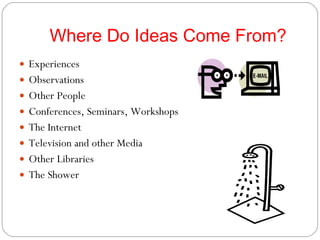
Where Do Ideas Come From? Experiences Observations Other People Conferences, Seminars, Workshops The Internet Television and other Media Other Libraries The Shower
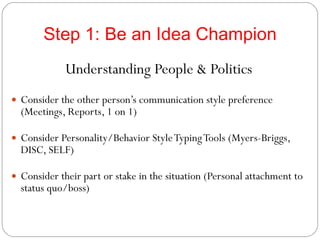
Step 1: Be an Idea Champion Understanding People & Politics Consider the other person’s communication style preference (Meetings, Reports, 1 on 1) Consider Personality/Behavior Style Typing Tools (Myers-Briggs, DISC, SELF) Consider their part or stake in the situation (Personal attachment to status quo/boss)
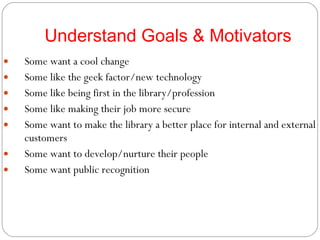
Understand Goals & Motivators Some want a cool change Some like the geek factor/new technology Some like being first in the library/profession Some like making their job more secure Some want to make the library a better place for internal and external customers Some want to develop/nurture their people Some want public recognition
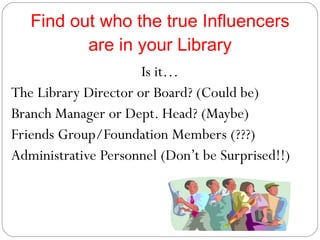
Find out who the true Influencers are in your Library Is it… The Library Director or Board? (Could be) Branch Manager or Dept. Head? (Maybe) Friends Group/Foundation Members (???) Administrative Personnel (Don’t be Surprised!!)
“ Selling an idea to an organization requires you to understand how the decision makers operate, then you cater your idea to the decision making process. So stop complaining about office politics and start leveraging them to sell your ideas.” -- Victoria Ashford, Director, Washington County Library, Alabama
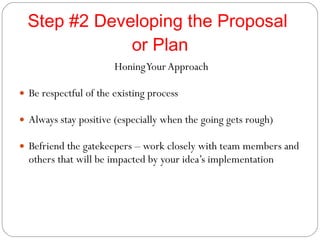
Step #2 Developing the Proposal  or Plan Honing Your Approach Be respectful of the existing process Always stay positive (especially when the going gets rough) Befriend the gatekeepers – work closely with team members and others that will be impacted by your idea’s implementation
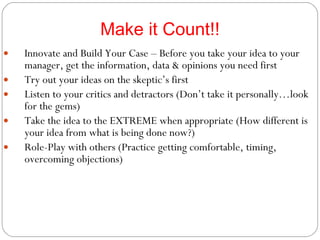
Make it Count!! Innovate and Build Your Case – Before you take your idea to your manager, get the information, data & opinions you need first Try out your ideas on the skeptic’s first Listen to your critics and detractors (Don’t take it personally…look for the gems) Take the idea to the EXTREME when appropriate (How different is your idea from what is being done now?) Role-Play with others (Practice getting comfortable, timing, overcoming objections)
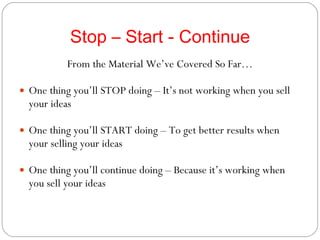
Stop – Start - Continue From the Material We’ve Covered So Far… One thing you’ll STOP doing – It’s not working when you sell your ideas One thing you’ll START doing – To get better results when your selling your ideas One thing you’ll continue doing – Because it’s working when you sell your ideas
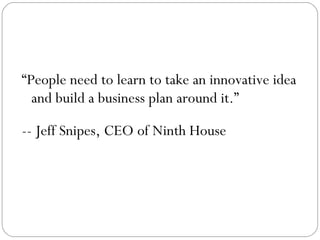
“ People need to learn to take an innovative idea and build a business plan around it.” -- Jeff Snipes, CEO of Ninth House
Developing Your Presentation Realize that selling is what you are doing! And that you already do it everyday! Focus on Benefits, not Features!! (In selling your idea, focus more on how everyone benefits and less on how it works) Be persuasive (Cultivate a “Can Do” Attitude) “ Can Do” instead of “I Think I Can” “ Consider it Done” instead of “I’ll try” “ You Can Count on Me” vs. “If I have to”
Speak Their Language Identify the needs of the decision maker Figure out how you will be helping him/her with a problem or situation Example/Idea Customers are complaining about long lines at the Circulation Desk Self Checkout Machines Web/Library 2.0 Applications (Wowbrary or Library Elf - Less expensive compared to the machines)
Speak Their Language Align with Strategic Plan or Vision of Your Organization Know what problems or issues are currently being focused on in the Strategic Plan or Vision Tie your idea and plan into a specific area of organizational focus
Speak Their Language Communicate in their preferred learning style Auditory – Uses words like: hear, listen, in tune, resonate, expression Visual – Uses words like: see, look, picture, focus, visualize, watch, colorful Kinesthetic – Uses words like: feel, touch, sense, emotion, sensitive, smooth sailing  Tip: Your presentation should touch all 3 styles!!
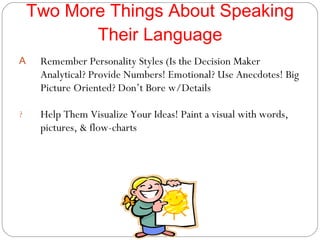
Two More Things About Speaking Their Language Remember Personality Styles (Is the Decision Maker Analytical? Provide Numbers! Emotional? Use Anecdotes! Big Picture Oriented? Don’t Bore w/Details Help Them Visualize Your Ideas! Paint a visual with words, pictures, & flow-charts
Giving Your Presentation Be Confident!! Fear ------------------------- Excitement Be Passionate!! Let Your Passion Energize Them Remember the Goal!! The goal is to go through the necessary steps for your colleagues to believe that your idea will work!
Critical Points KISS – Keep it Simple Sweetie Schedule a short formal meeting Watch for non-verbal issues/clues
Important Considerations Acknowledge the Manager Honor their time Show excitement! Listen for feedback and questions Seize the moment! Go for the close! Accumulating “Yes’s”
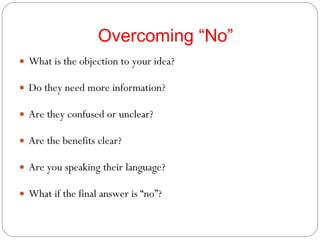
Overcoming “No”  What is the objection to your idea? Do they need more information? Are they confused or unclear? Are the benefits clear? Are you speaking their language? What if the final answer is “no”?
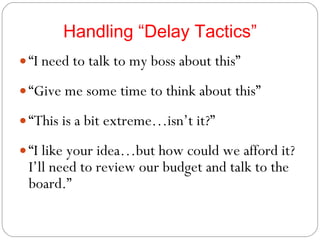
Handling “Delay Tactics” “ I need to talk to my boss about this” “ Give me some time to think about this” “ This is a bit extreme…isn’t it?” “ I like your idea…but how could we afford it? I’ll need to review our budget and talk to the board.”
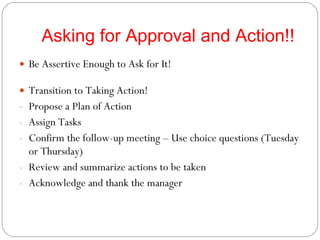
Asking for Approval and Action!! Be Assertive Enough to Ask for It! Transition to Taking Action! Propose a Plan of Action Assign Tasks Confirm the follow-up meeting – Use choice questions (Tuesday or Thursday) Review and summarize actions to be taken Acknowledge and thank the manager
Questions and Answers SAJID
Action Plan What three ideas are most relevant to me? What two actions will I take as a result of this session? When will I do them? Who will I ask to support and encourage me?
Thank You For Attending!! MD SHAFIQUL AZAM SAJID IIUC BBA

Selling yourideas

  • 1.
    How to SellYour Ideas!
  • 2.
    “ One ofthe biggest complaints I hear from employees is that no one is listening to their ideas. In large part, this is not because the ideas are bad, but because most employees don’t sell their ideas to the organization properly.” -- Elaine Birkinshaw, Assistant Director, St. Petersburg Public Library
  • 3.
    Purpose of thisSession Develop and garner support for your ideas Sell your ideas to the decision makers
  • 4.
    Why Does YourLibrary Need Ideas? To solve a problem To make a situation more fun To fix something that is or isn’t broken To keep employees and the library from becoming complacent/getting in a rut To spur the change needed to meet the needs of the customer or library To keep current with trends, technology
  • 5.
    Where Do IdeasCome From? Experiences Observations Other People Conferences, Seminars, Workshops The Internet Television and other Media Other Libraries The Shower
  • 6.
    Step 1: Bean Idea Champion Understanding People & Politics Consider the other person’s communication style preference (Meetings, Reports, 1 on 1) Consider Personality/Behavior Style Typing Tools (Myers-Briggs, DISC, SELF) Consider their part or stake in the situation (Personal attachment to status quo/boss)
  • 7.
    Understand Goals &Motivators Some want a cool change Some like the geek factor/new technology Some like being first in the library/profession Some like making their job more secure Some want to make the library a better place for internal and external customers Some want to develop/nurture their people Some want public recognition
  • 8.
    Find out whothe true Influencers are in your Library Is it… The Library Director or Board? (Could be) Branch Manager or Dept. Head? (Maybe) Friends Group/Foundation Members (???) Administrative Personnel (Don’t be Surprised!!)
  • 9.
    “ Selling anidea to an organization requires you to understand how the decision makers operate, then you cater your idea to the decision making process. So stop complaining about office politics and start leveraging them to sell your ideas.” -- Victoria Ashford, Director, Washington County Library, Alabama
  • 10.
    Step #2 Developingthe Proposal or Plan Honing Your Approach Be respectful of the existing process Always stay positive (especially when the going gets rough) Befriend the gatekeepers – work closely with team members and others that will be impacted by your idea’s implementation
  • 11.
    Make it Count!!Innovate and Build Your Case – Before you take your idea to your manager, get the information, data & opinions you need first Try out your ideas on the skeptic’s first Listen to your critics and detractors (Don’t take it personally…look for the gems) Take the idea to the EXTREME when appropriate (How different is your idea from what is being done now?) Role-Play with others (Practice getting comfortable, timing, overcoming objections)
  • 12.
    Stop – Start- Continue From the Material We’ve Covered So Far… One thing you’ll STOP doing – It’s not working when you sell your ideas One thing you’ll START doing – To get better results when your selling your ideas One thing you’ll continue doing – Because it’s working when you sell your ideas
  • 13.
    “ People needto learn to take an innovative idea and build a business plan around it.” -- Jeff Snipes, CEO of Ninth House
  • 14.
    Developing Your PresentationRealize that selling is what you are doing! And that you already do it everyday! Focus on Benefits, not Features!! (In selling your idea, focus more on how everyone benefits and less on how it works) Be persuasive (Cultivate a “Can Do” Attitude) “ Can Do” instead of “I Think I Can” “ Consider it Done” instead of “I’ll try” “ You Can Count on Me” vs. “If I have to”
  • 15.
    Speak Their LanguageIdentify the needs of the decision maker Figure out how you will be helping him/her with a problem or situation Example/Idea Customers are complaining about long lines at the Circulation Desk Self Checkout Machines Web/Library 2.0 Applications (Wowbrary or Library Elf - Less expensive compared to the machines)
  • 16.
    Speak Their LanguageAlign with Strategic Plan or Vision of Your Organization Know what problems or issues are currently being focused on in the Strategic Plan or Vision Tie your idea and plan into a specific area of organizational focus
  • 17.
    Speak Their LanguageCommunicate in their preferred learning style Auditory – Uses words like: hear, listen, in tune, resonate, expression Visual – Uses words like: see, look, picture, focus, visualize, watch, colorful Kinesthetic – Uses words like: feel, touch, sense, emotion, sensitive, smooth sailing Tip: Your presentation should touch all 3 styles!!
  • 18.
    Two More ThingsAbout Speaking Their Language Remember Personality Styles (Is the Decision Maker Analytical? Provide Numbers! Emotional? Use Anecdotes! Big Picture Oriented? Don’t Bore w/Details Help Them Visualize Your Ideas! Paint a visual with words, pictures, & flow-charts
  • 19.
    Giving Your PresentationBe Confident!! Fear ------------------------- Excitement Be Passionate!! Let Your Passion Energize Them Remember the Goal!! The goal is to go through the necessary steps for your colleagues to believe that your idea will work!
  • 20.
    Critical Points KISS– Keep it Simple Sweetie Schedule a short formal meeting Watch for non-verbal issues/clues
  • 21.
    Important Considerations Acknowledgethe Manager Honor their time Show excitement! Listen for feedback and questions Seize the moment! Go for the close! Accumulating “Yes’s”
  • 22.
    Overcoming “No” What is the objection to your idea? Do they need more information? Are they confused or unclear? Are the benefits clear? Are you speaking their language? What if the final answer is “no”?
  • 23.
    Handling “Delay Tactics”“ I need to talk to my boss about this” “ Give me some time to think about this” “ This is a bit extreme…isn’t it?” “ I like your idea…but how could we afford it? I’ll need to review our budget and talk to the board.”
  • 24.
    Asking for Approvaland Action!! Be Assertive Enough to Ask for It! Transition to Taking Action! Propose a Plan of Action Assign Tasks Confirm the follow-up meeting – Use choice questions (Tuesday or Thursday) Review and summarize actions to be taken Acknowledge and thank the manager
  • 25.
  • 26.
    Action Plan Whatthree ideas are most relevant to me? What two actions will I take as a result of this session? When will I do them? Who will I ask to support and encourage me?
  • 27.
    Thank You ForAttending!! MD SHAFIQUL AZAM SAJID IIUC BBA

Editor's Notes

  • #17 Example Our library’s strategic mission is to create a customer service environment where customer’s are served in an efficient manner with minimal waiting online, on the phone or in person. (Decreasing wait times at the Circulation Desk ties into the organizational mission)