

New Mindset “ Rethinking your business”
Sales
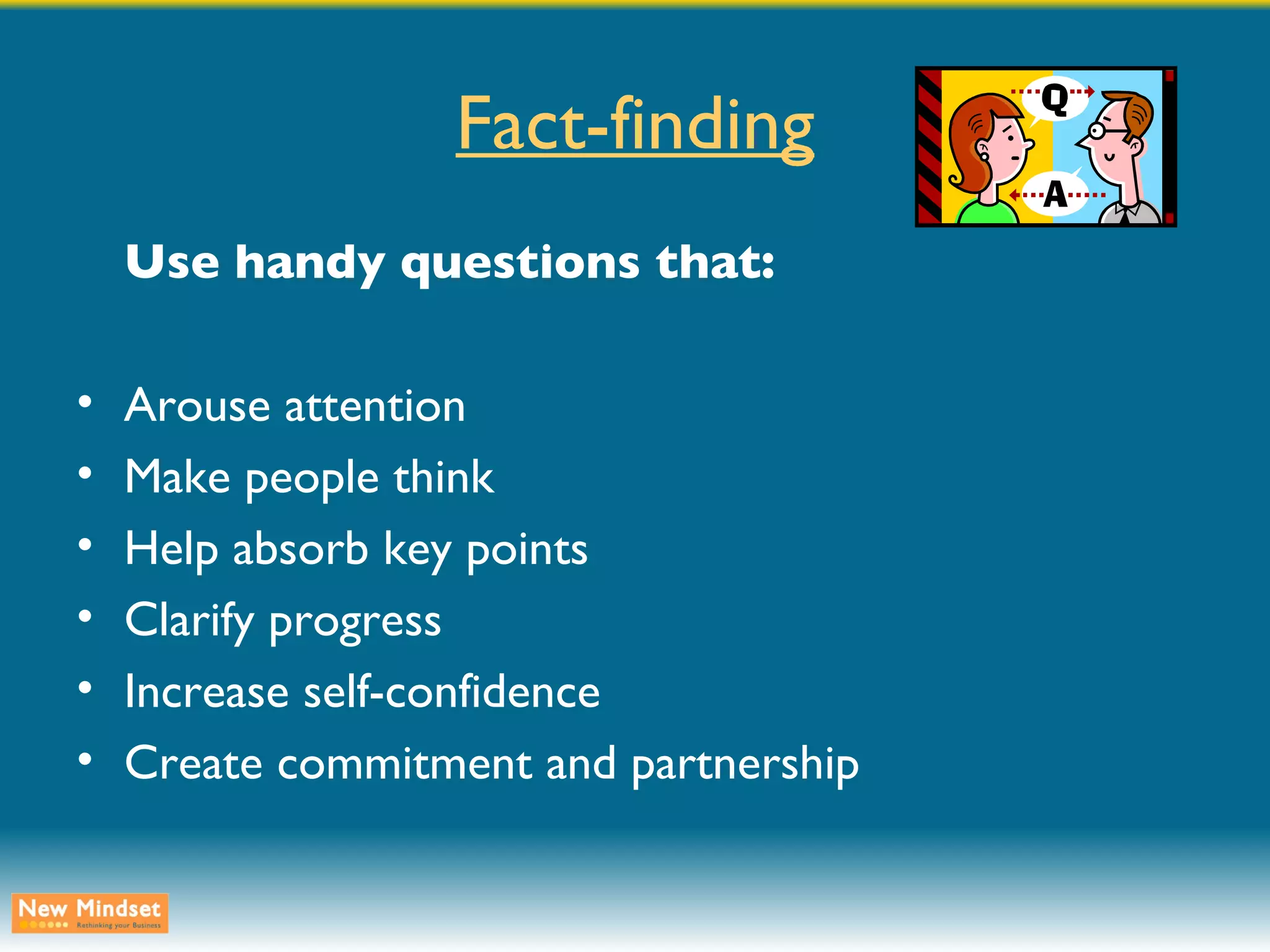
Fact-finding Use handy questions that: Arouse attention Make people think Help absorb key points Clarify progress Increase self-confidence Create commitment and partnership
Keeping control Control the speed and pace of the discussion Use open questions to probe Use closed questions
Questions – Go on a spree S  ummarise P  rioritise R  eflect E  xtend E  xplore
Key questions - WANTS W ants What would you like to improve most? A uthority Who else is involved in evaluating and approving? N eeds What are your key goals? T imescale When will you complete the evaluation and installation? S pend How much money has been allocated?
When they reply to your questions: Pause Check back Prioritise Build up Clarify Understand their issue as real and unique Don’t GAG: G ive unsolicited advice A ssume G eneralise
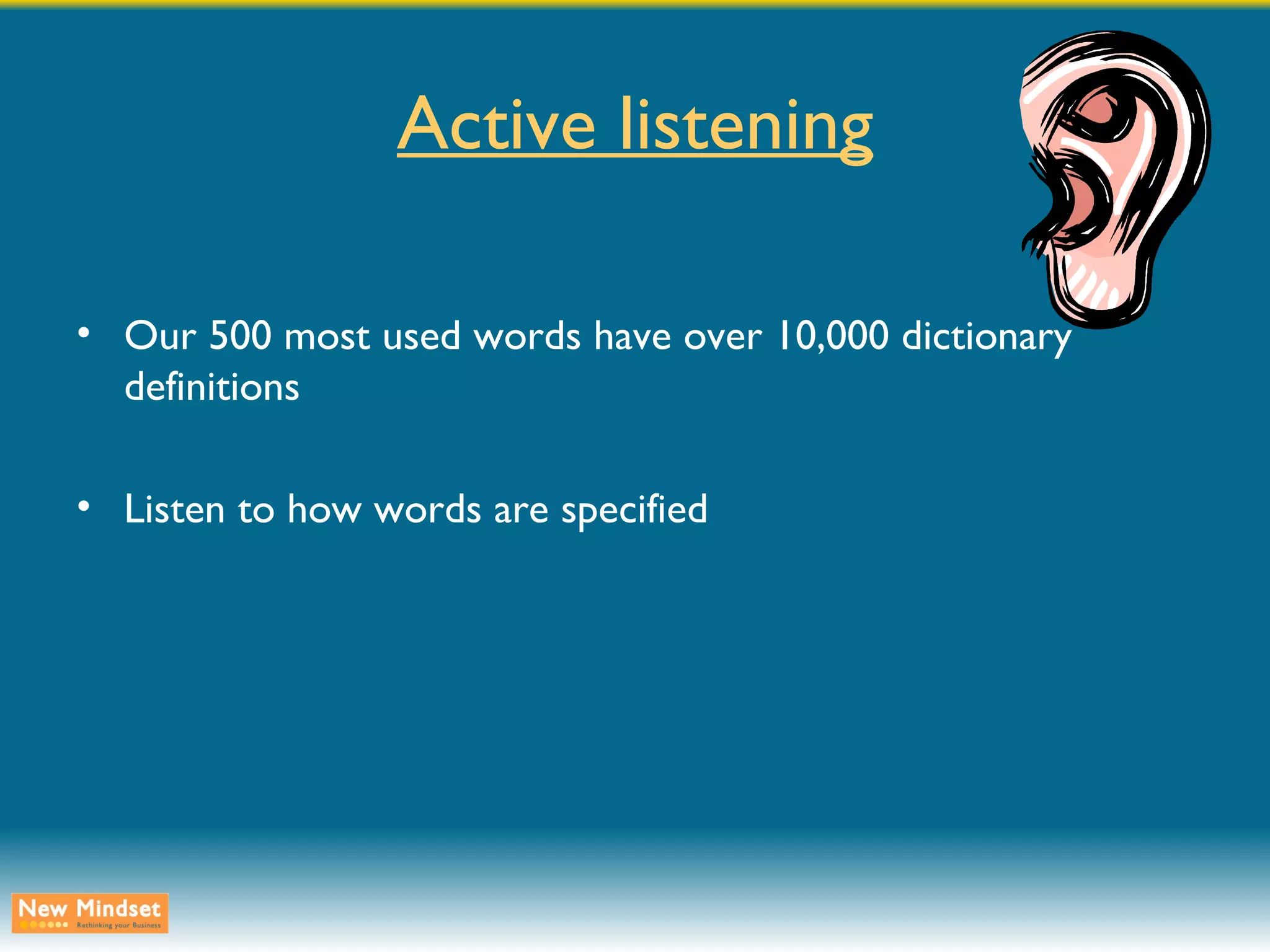
Active listening Our 500 most used words have over 10,000 dictionary definitions Listen to how words are specified
Active listening – do: Watch their eyes Suppress your feelings Check understanding Use notes
Active listening – don’t: Be distracted Interrupt Miss implied needs Queue up your next question
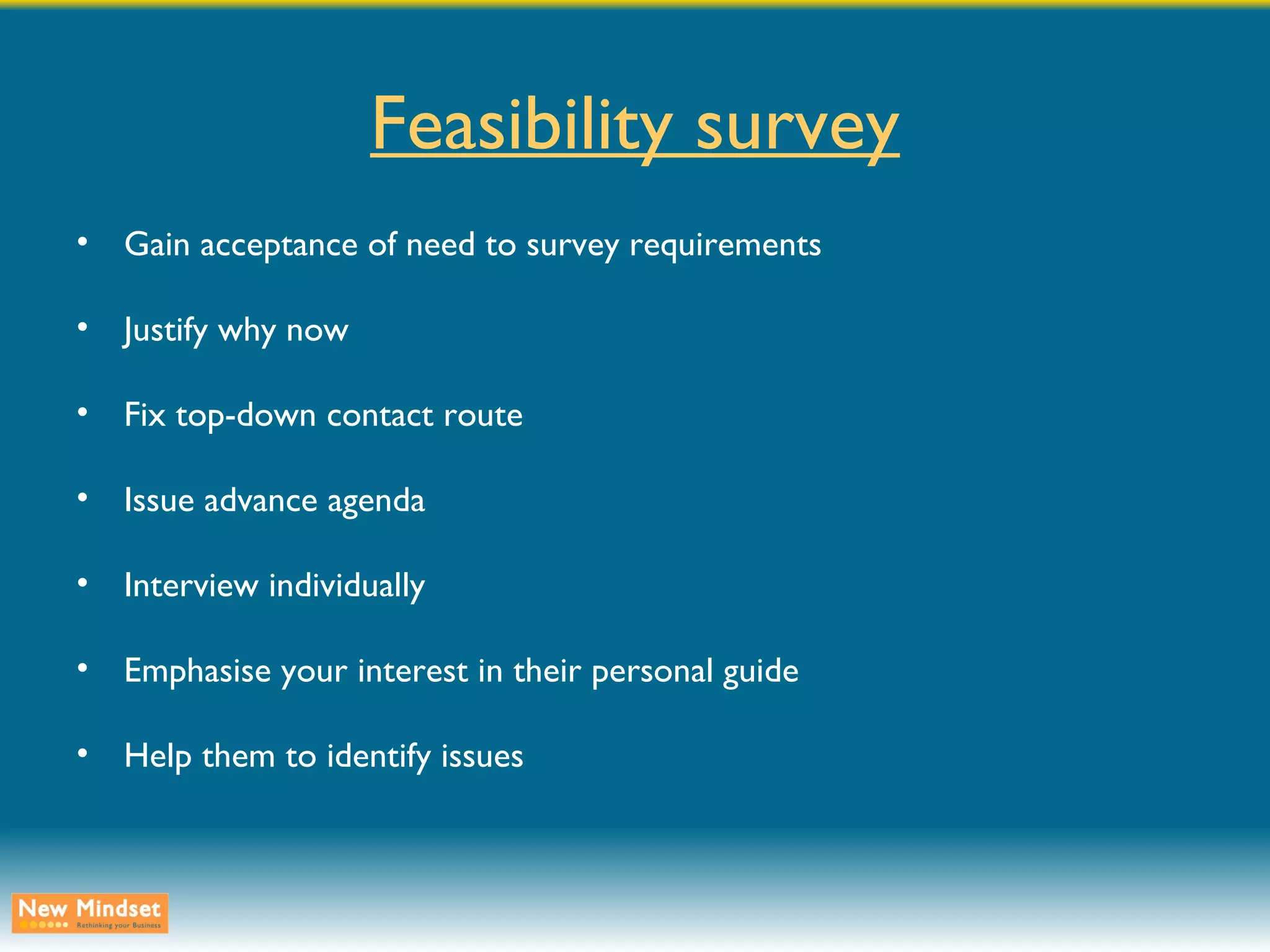
Feasibility survey Gain acceptance of need to survey requirements Justify why now Fix top-down contact route Issue advance agenda Interview individually Emphasise your interest in their personal guide Help them to identify issues
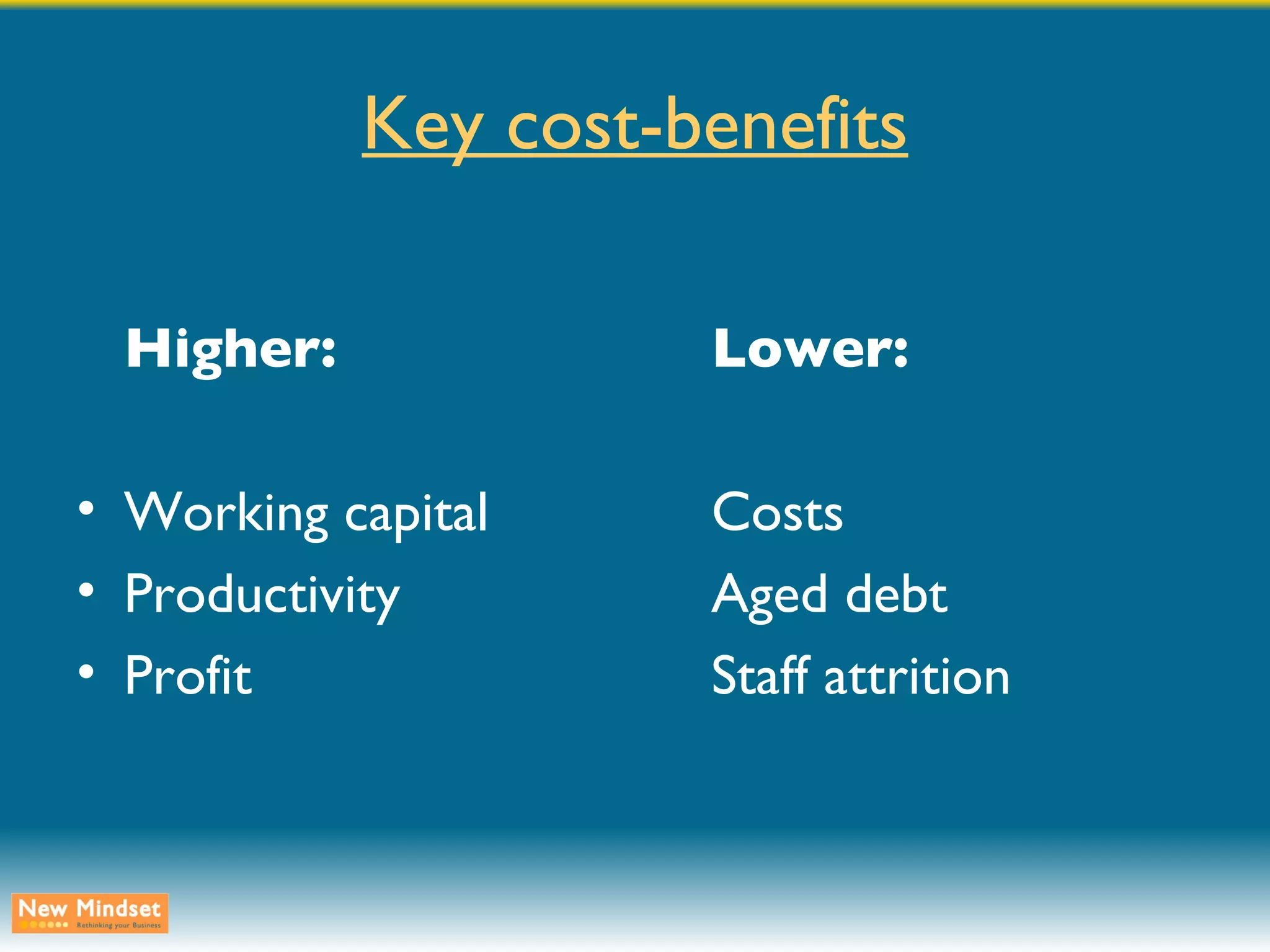
Key cost-benefits Higher: Lower: Working capital Costs Productivity Aged debt Profit Staff attrition
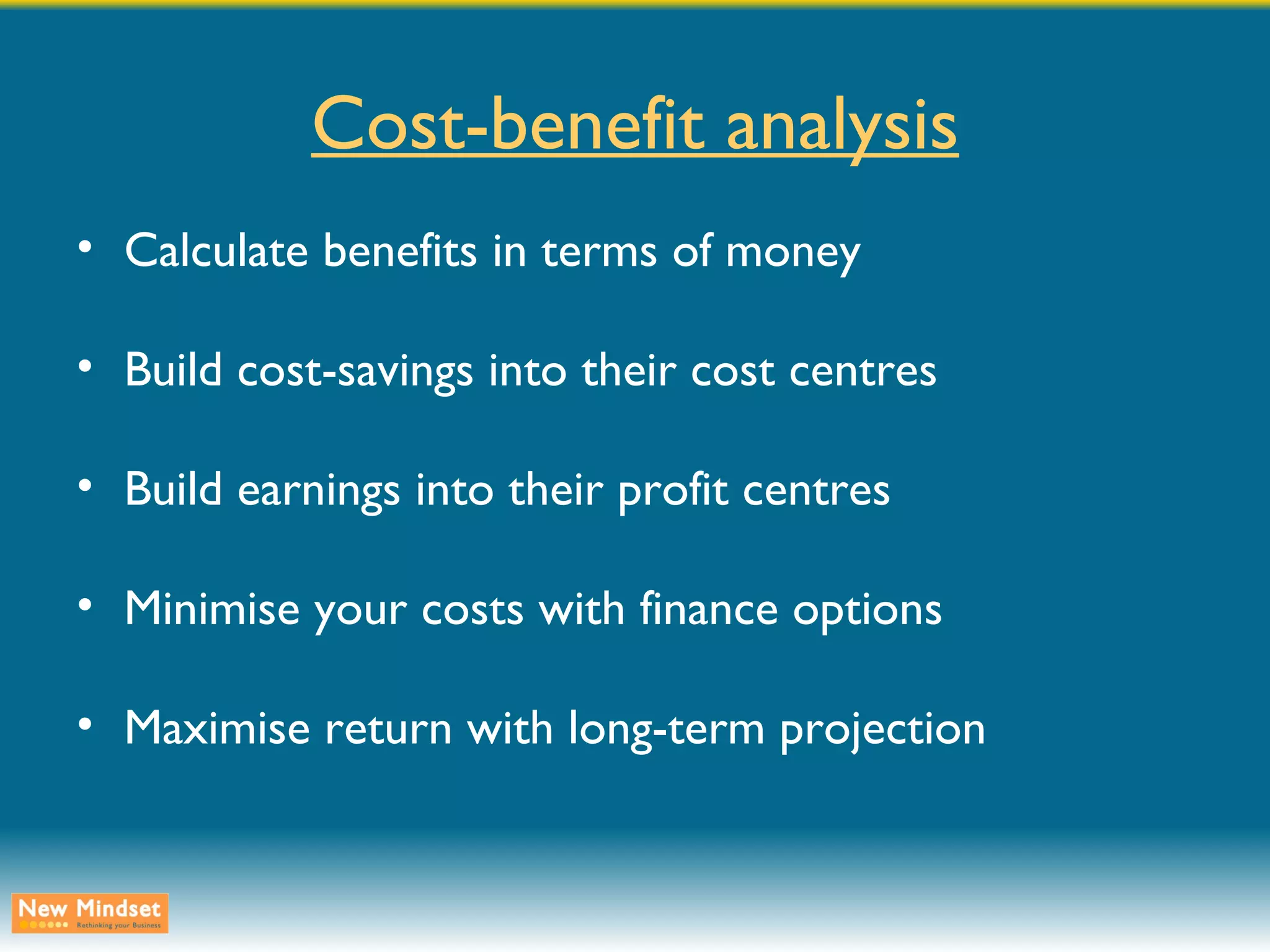
Cost-benefit analysis Calculate benefits in terms of money Build cost-savings into their cost centres Build earnings into their profit centres Minimise your costs with finance options Maximise return with long-term projection
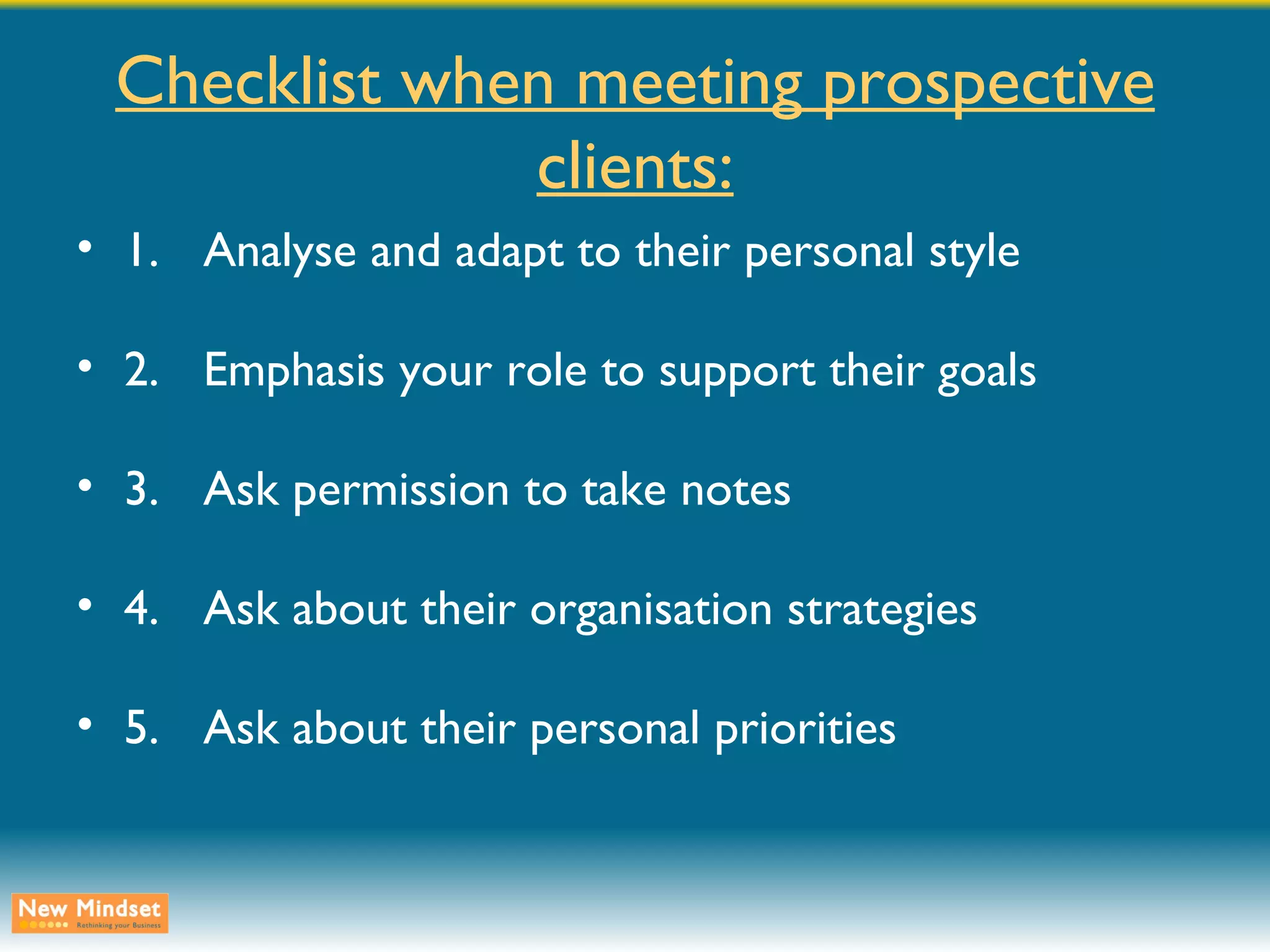
Checklist when meeting prospective clients: 1. Analyse and adapt to their personal style 2. Emphasis your role to support their goals 3. Ask permission to take notes 4. Ask about their organisation strategies 5. Ask about their personal priorities
Checklist when meeting prospective clients: (continued) 6. Ask them about the ripple effect of issues 7. Ask them to estimate impact on cost/revenue 8. Counter-balance their costs with your cost-benefits 9. Build your uniqueness into their purchasing criteria 10. Reinforce your case studies and proof statements
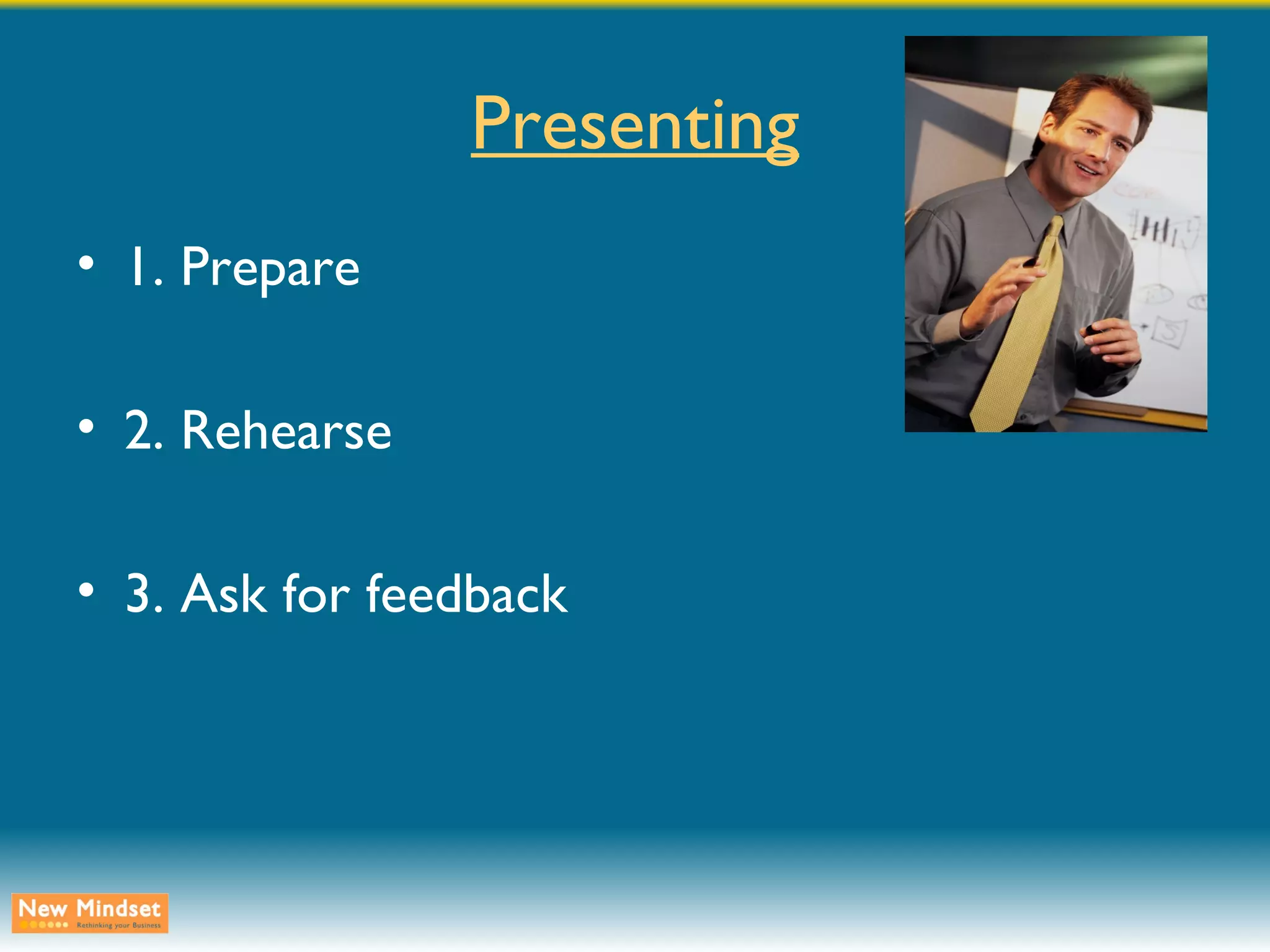
Presenting 1. Prepare 2. Rehearse 3. Ask for feedback
Visual display Lettering should be: Max 8 times of 8 words Max 30 numerals Don’t: Have numbers in columns Use a kaleidoscope of colours
PowerPoint Check system compatibility Outline content summary Rehearse with notes Animate with coloured pictures
Aims of presentation Decide if your purpose is to: Convey information - To tell Purpose - To sell Motivate - To impel
Content C onsider time-frame O rganise theme N ame all possible points T ake essential points E nter links and illustrate N ote key points on cards T est understanding
Timing There is a dramatic tailing-off of information retention over time.  Keep it short and to the point.
Pre-delivery Check room and facilities Note names and seating plan Map agenda and time Glow enthusiasm Deep breath Beam round Stand up, head up, speak up
Delivery – beginning and ending Examples: Question Prop Anecdote Speech drama Action Surprise Audio-visual gimmick
Delivery Pause often Accentuate Vary tone, pitch, speed Repeat key phrases Open hands in front Take short simple words Talk eye to eye
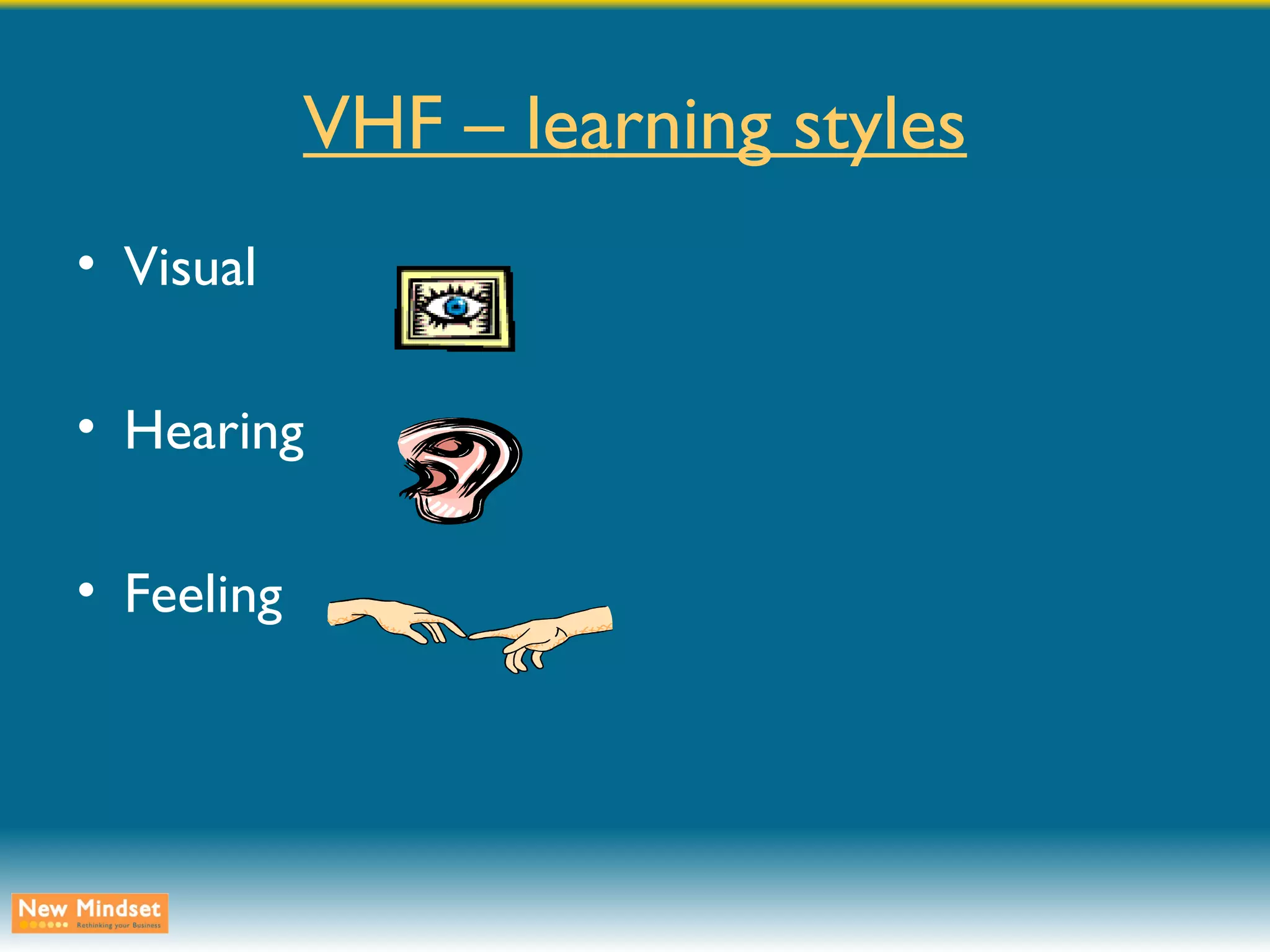
VHF – learning styles Visual Hearing Feeling
We recall: 10% of what we read 20% of what we hear 30% of what we see 70% of what we take in through all three channels
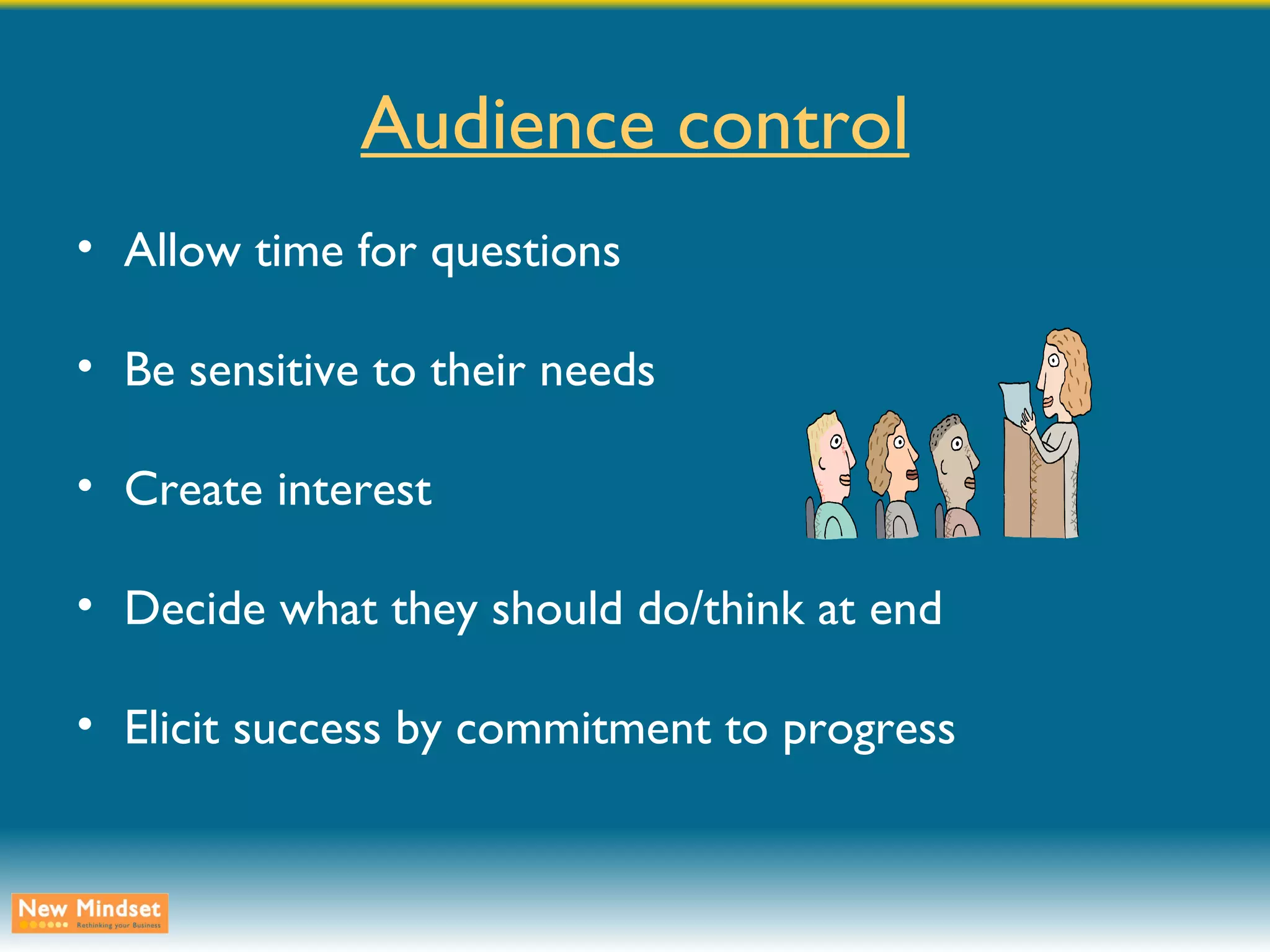
Audience control Allow time for questions Be sensitive to their needs Create interest Decide what they should do/think at end Elicit success by commitment to progress
Audience questions Pre-empt Allow time Leave questions and handouts until end Summarise and answer straight
Difficult questions If faced with a difficult question: Relay - To group Ricochet - To expert Reverse - To asker
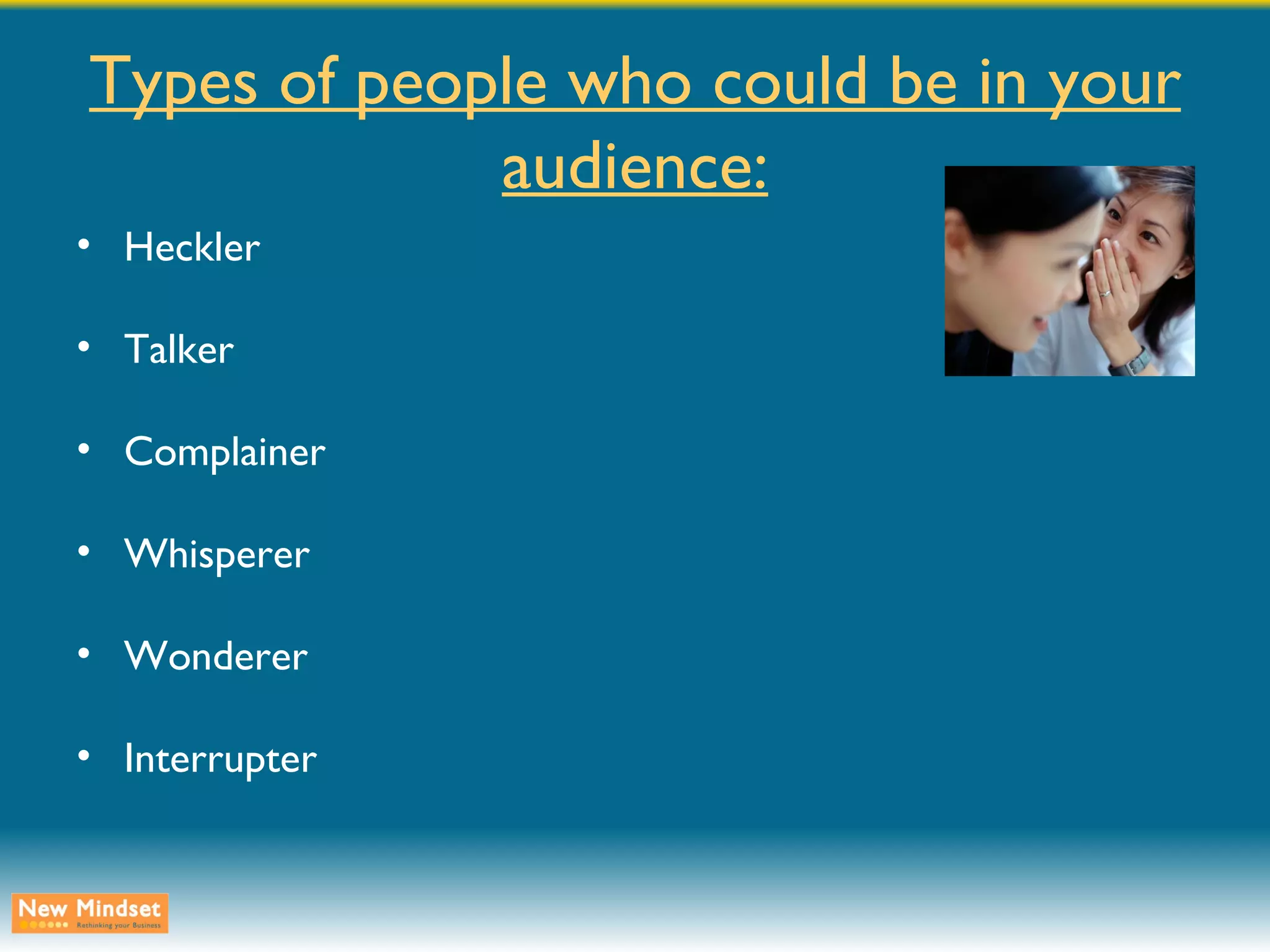
Types of people who could be in your audience: Heckler Talker Complainer Whisperer Wonderer Interrupter
Written proposals - structure 1. Covering letter 2. Management summary 3. Client aims and objectives 4. Current methods and costs 5. Requirements
Written proposals – structure (continued) 6. Proposed improvements 7. Implementation plan 8. Supplier’s unique benefits 9. Cost-benefits and return on investment 10. Appendices
Tipping the balance Test acceptability of draft costings in advance Number each page Use graphics Proof-read it yourself
Tipping the balance (continued) Make a copy for each decision-maker Tailor to the reader Submit it in person If competing, submit it last
Covering letter Personalise to each decision-maker Thank them for assistance to date Put a deadline on the quote Confirm next action
Submitting your proposal via third parties Avoid if possible Do their work for them Offer to be available when they submit Include case studies and testimonials Track its route
Exhibitions Objective - Qualify and sell to new prospects Opportunities - New leads and visibility Preparation - Send a mail shot and follow up by phone During - Qualify quickly Ask them their WANTS: Wants Authority Needs Timescale Spending power
Exhibitions - Don’t: Say ‘Can I help you?’ Pounce Line up Cluster Hover
Exhibitions - Do Smile invitingly Keep the stand tidy Use enquiry forms Follow up quickly

Basic New Mindset Sales Training course Part 4

  • 1.
    New Mindset “Rethinking your business”
  • 2.
  • 3.
    Fact-finding Use handyquestions that: Arouse attention Make people think Help absorb key points Clarify progress Increase self-confidence Create commitment and partnership
  • 4.
    Keeping control Controlthe speed and pace of the discussion Use open questions to probe Use closed questions
  • 5.
    Questions – Goon a spree S ummarise P rioritise R eflect E xtend E xplore
  • 6.
    Key questions -WANTS W ants What would you like to improve most? A uthority Who else is involved in evaluating and approving? N eeds What are your key goals? T imescale When will you complete the evaluation and installation? S pend How much money has been allocated?
  • 7.
    When they replyto your questions: Pause Check back Prioritise Build up Clarify Understand their issue as real and unique Don’t GAG: G ive unsolicited advice A ssume G eneralise
  • 8.
    Active listening Our500 most used words have over 10,000 dictionary definitions Listen to how words are specified
  • 9.
    Active listening –do: Watch their eyes Suppress your feelings Check understanding Use notes
  • 10.
    Active listening –don’t: Be distracted Interrupt Miss implied needs Queue up your next question
  • 11.
    Feasibility survey Gainacceptance of need to survey requirements Justify why now Fix top-down contact route Issue advance agenda Interview individually Emphasise your interest in their personal guide Help them to identify issues
  • 12.
    Key cost-benefits Higher:Lower: Working capital Costs Productivity Aged debt Profit Staff attrition
  • 13.
    Cost-benefit analysis Calculatebenefits in terms of money Build cost-savings into their cost centres Build earnings into their profit centres Minimise your costs with finance options Maximise return with long-term projection
  • 14.
    Checklist when meetingprospective clients: 1. Analyse and adapt to their personal style 2. Emphasis your role to support their goals 3. Ask permission to take notes 4. Ask about their organisation strategies 5. Ask about their personal priorities
  • 15.
    Checklist when meetingprospective clients: (continued) 6. Ask them about the ripple effect of issues 7. Ask them to estimate impact on cost/revenue 8. Counter-balance their costs with your cost-benefits 9. Build your uniqueness into their purchasing criteria 10. Reinforce your case studies and proof statements
  • 16.
    Presenting 1. Prepare2. Rehearse 3. Ask for feedback
  • 17.
    Visual display Letteringshould be: Max 8 times of 8 words Max 30 numerals Don’t: Have numbers in columns Use a kaleidoscope of colours
  • 18.
    PowerPoint Check systemcompatibility Outline content summary Rehearse with notes Animate with coloured pictures
  • 19.
    Aims of presentationDecide if your purpose is to: Convey information - To tell Purpose - To sell Motivate - To impel
  • 20.
    Content C onsidertime-frame O rganise theme N ame all possible points T ake essential points E nter links and illustrate N ote key points on cards T est understanding
  • 21.
    Timing There isa dramatic tailing-off of information retention over time. Keep it short and to the point.
  • 22.
    Pre-delivery Check roomand facilities Note names and seating plan Map agenda and time Glow enthusiasm Deep breath Beam round Stand up, head up, speak up
  • 23.
    Delivery – beginningand ending Examples: Question Prop Anecdote Speech drama Action Surprise Audio-visual gimmick
  • 24.
    Delivery Pause oftenAccentuate Vary tone, pitch, speed Repeat key phrases Open hands in front Take short simple words Talk eye to eye
  • 25.
    VHF – learningstyles Visual Hearing Feeling
  • 26.
    We recall: 10%of what we read 20% of what we hear 30% of what we see 70% of what we take in through all three channels
  • 27.
    Audience control Allowtime for questions Be sensitive to their needs Create interest Decide what they should do/think at end Elicit success by commitment to progress
  • 28.
    Audience questions Pre-emptAllow time Leave questions and handouts until end Summarise and answer straight
  • 29.
    Difficult questions Iffaced with a difficult question: Relay - To group Ricochet - To expert Reverse - To asker
  • 30.
    Types of peoplewho could be in your audience: Heckler Talker Complainer Whisperer Wonderer Interrupter
  • 31.
    Written proposals -structure 1. Covering letter 2. Management summary 3. Client aims and objectives 4. Current methods and costs 5. Requirements
  • 32.
    Written proposals –structure (continued) 6. Proposed improvements 7. Implementation plan 8. Supplier’s unique benefits 9. Cost-benefits and return on investment 10. Appendices
  • 33.
    Tipping the balanceTest acceptability of draft costings in advance Number each page Use graphics Proof-read it yourself
  • 34.
    Tipping the balance(continued) Make a copy for each decision-maker Tailor to the reader Submit it in person If competing, submit it last
  • 35.
    Covering letter Personaliseto each decision-maker Thank them for assistance to date Put a deadline on the quote Confirm next action
  • 36.
    Submitting your proposalvia third parties Avoid if possible Do their work for them Offer to be available when they submit Include case studies and testimonials Track its route
  • 37.
    Exhibitions Objective -Qualify and sell to new prospects Opportunities - New leads and visibility Preparation - Send a mail shot and follow up by phone During - Qualify quickly Ask them their WANTS: Wants Authority Needs Timescale Spending power
  • 38.
    Exhibitions - Don’t:Say ‘Can I help you?’ Pounce Line up Cluster Hover
  • 39.
    Exhibitions - DoSmile invitingly Keep the stand tidy Use enquiry forms Follow up quickly