




DEVM 712—PHILOSOPHICAL &
PSYCHOLOGICAL THEORIES OF
TEACHING & LEARNING:
SELF-WORTH THEORY
Ateneo de Zamboanga University
Graduate School
School of Education
QUESTION
 How do you look at or evaluate the value of
your students?
2
WHAT IS SELF-WORTH THEORY?
• The self-worth theory of achievement motivation
(Covington & Beery, 1976; Covington, 1984)—assumes
that the highest human priority is the search for self-
acceptance and that “one’s worth often comes to
depend on the ability to achieve competitively”
(Covington, 1998, p. 78).
• Self-worth theory—argues that fundamentally all
individuals are motivated to establish and maintain a
sense of personal growth, approval by others, and
acceptance of oneself, a goal that in turn depends of
being perceived as competent.
3
QUESTION
 Is grade a measure of one’s intelligence and
totality?
4
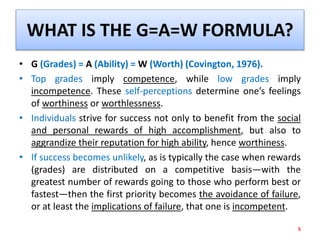
WHAT IS THE G=A=W FORMULA?
• G (Grades) = A (Ability) = W (Worth) (Covington, 1976).
• Top grades imply competence, while low grades imply
incompetence. These self-perceptions determine one’s feelings
of worthiness or worthlessness.
• Individuals strive for success not only to benefit from the social
and personal rewards of high accomplishment, but also to
aggrandize their reputation for high ability, hence worthiness.
• If success becomes unlikely, as is typically the case when rewards
(grades) are distributed on a competitive basis—with the
greatest number of rewards going to those who perform best or
fastest—then the first priority becomes the avoidance of failure,
or at least the implications of failure, that one is incompetent.
5
QUESTION
 What excuses do you commonly observe
from your students if they have low
performance in your class?
6
WHAT IS SELF-HANDICAPPING
STRATEGIES?
• Self-handicapping (Thompson, 1993, 1994)—in the
process of establishing excuses, individuals set up the
very failures that they are attempting to avoid, but at
least they are “failures with honor”—readily explained
failures if not always excused.
• Example is Procrastination (McGown & Johnson,
1991). By postponing study for a test until it is virtually
too late, or by starting work on a term paper at the last
minute, individuals can argue that any subsequent
failures are not reflective of what they could really
have achieved had they not run out of time.
7
WHAT IS SELF-HANDICAPPING
STRATEGIES?
• Self-handicapping—ploy not only allows
students to score big points for being
energetic. Being busy also makes one feel
important despite the mediocre performances
that are certain to result, but mediocrity that
can be attributed to being too busy, not to
incompetence.
8
WHAT IS DEFENSIVE PESSIMISM
STRATEGIES?
• Defensive pessimism (Cantor, 1980)—
basically involves the establishment of low
goals and low expectations towards the tasks
for which one’s ability will be evaluated.
• Establishing lower, thus safer, goals, which is
achieved by lowering the standard of
satisfactory performance, can help individuals
to feel more satisfied with the outcome.
9
QUESTION
 Do you practice OBE (Outcomes Based
Education) curriculum in your class?
10
GRADE GOAL vs. LEARNING GOAL
• Grades must always
follow learning.
• Grades must not eclipse
learning.
• Learning must be for the
sake of self-improvement.
• Learning must be for the
sake of helping others.
• Learning must be for the
sake of satisfaction of
curiosity.
11
• Grades are indubitably important. But their
importance is sharply limited. Example: GPA is
worthless as a predictor of lifetime income
compared to predictions based on simply tallying the
number of years one spends in school.
QUESTION
 What are the difficulties that you have
encountered with the performance of your
students in the class?
12
ISSUES AND CONCERNS ON
SELF-WORTH THEORY
• Grade grubbing—grades can take on a disproportional,
distorted meaning and become pursued with an unnatural
urgency. When combined with fear of failure (the fear one
may be judged incompetent, hence unworthy), then the
pursuit of grades becomes an ordeal and the virtually
assured result is defensiveness and excuse making.
• Passivity—can mask a highly motivated state. Example,
being motivated for the wrong reasons—as a means to
avoid a threatening implications of expending effort in a
potentially failing enterprise.
• Fear—drives many students desperately at times to
simplify and curtail the demands of learning, reducing the
task of learning to its simplest denominator and narrowest,
most manageable scope.
13
ISSUES AND CONCERNS ON
SELF-WORTH THEORY
• Climate of Passivity—Teachers already expect students to
be active, self-monitoring, inquisitive learners, yet without
guidance as to the kinds of skills needed for independent
inquiry.
• Self-worth in Hard work (Weiner, 1974)—to try hard and
do poorly leads to feeling of shame driven by self-
perceptions of low ability; but not trying leads to feelings
of guilt and teacher punishment for not trying.
• Overstrivers—learners who are sensitive on the problem of
failing as they have doubts about their status of ability and
failure might result in confirmation of their lack of ability.
They are known to be bright, meticulous and hard-working.
14
QUESTION
 What were the remedies/solutions/steps you
have taken to address those difficulties?
15
COPING MECHANISIMS FOR TEACHERS IN MOTIVATING
STUDENTS IN SELF-WORTH THEORY
• POSITIVE GOALS & SAFETY—emphasize learning goals, not
competitive goals. Utilize merit-based system or absolute
grading system by providing students specific, clearly
defined requirements for students to satisfy quality
workmanship. In the event of falling short gradewise, the
presence of well-defined standards of performance tends
to motivate students to try harder the next time.
• INTEREST & INTRIGUE—organize learning around student
interests or issues that arouse an intrinsic curiosity. When
interest is high, the importance of grades as a goal to
perform is substantially diminished. They believe that the
presence of grades actually inspires them to do their best.
16
• Covington, M.V. (2004). Self-worth theory goes to
college: Or do our motivation theories motivate? In D.
Mclnerney & S. Van Etten (Eds.). Big Theories Revisited,
Vol. 4 Research on Sociocultural Influences on
Motivation and Learning. USA: Information Age
Publishing.
• Weibell, C. J. (2011). Principles of learning: 7 principles
to guide personalized, student-centered learning in the
technology-enhanced, blended learning
environment. Retrieved August 11, 2019 from
[https://principlesoflearning.wordpress.com].

Self-Worth Theory

  • 1.
    DEVM 712—PHILOSOPHICAL & PSYCHOLOGICALTHEORIES OF TEACHING & LEARNING: SELF-WORTH THEORY Ateneo de Zamboanga University Graduate School School of Education
  • 2.
    QUESTION  How doyou look at or evaluate the value of your students? 2
  • 3.
    WHAT IS SELF-WORTHTHEORY? • The self-worth theory of achievement motivation (Covington & Beery, 1976; Covington, 1984)—assumes that the highest human priority is the search for self- acceptance and that “one’s worth often comes to depend on the ability to achieve competitively” (Covington, 1998, p. 78). • Self-worth theory—argues that fundamentally all individuals are motivated to establish and maintain a sense of personal growth, approval by others, and acceptance of oneself, a goal that in turn depends of being perceived as competent. 3
  • 4.
    QUESTION  Is gradea measure of one’s intelligence and totality? 4
  • 5.
    WHAT IS THEG=A=W FORMULA? • G (Grades) = A (Ability) = W (Worth) (Covington, 1976). • Top grades imply competence, while low grades imply incompetence. These self-perceptions determine one’s feelings of worthiness or worthlessness. • Individuals strive for success not only to benefit from the social and personal rewards of high accomplishment, but also to aggrandize their reputation for high ability, hence worthiness. • If success becomes unlikely, as is typically the case when rewards (grades) are distributed on a competitive basis—with the greatest number of rewards going to those who perform best or fastest—then the first priority becomes the avoidance of failure, or at least the implications of failure, that one is incompetent. 5
  • 6.
    QUESTION  What excusesdo you commonly observe from your students if they have low performance in your class? 6
  • 7.
    WHAT IS SELF-HANDICAPPING STRATEGIES? •Self-handicapping (Thompson, 1993, 1994)—in the process of establishing excuses, individuals set up the very failures that they are attempting to avoid, but at least they are “failures with honor”—readily explained failures if not always excused. • Example is Procrastination (McGown & Johnson, 1991). By postponing study for a test until it is virtually too late, or by starting work on a term paper at the last minute, individuals can argue that any subsequent failures are not reflective of what they could really have achieved had they not run out of time. 7
  • 8.
    WHAT IS SELF-HANDICAPPING STRATEGIES? •Self-handicapping—ploy not only allows students to score big points for being energetic. Being busy also makes one feel important despite the mediocre performances that are certain to result, but mediocrity that can be attributed to being too busy, not to incompetence. 8
  • 9.
    WHAT IS DEFENSIVEPESSIMISM STRATEGIES? • Defensive pessimism (Cantor, 1980)— basically involves the establishment of low goals and low expectations towards the tasks for which one’s ability will be evaluated. • Establishing lower, thus safer, goals, which is achieved by lowering the standard of satisfactory performance, can help individuals to feel more satisfied with the outcome. 9
  • 10.
    QUESTION  Do youpractice OBE (Outcomes Based Education) curriculum in your class? 10
  • 11.
    GRADE GOAL vs.LEARNING GOAL • Grades must always follow learning. • Grades must not eclipse learning. • Learning must be for the sake of self-improvement. • Learning must be for the sake of helping others. • Learning must be for the sake of satisfaction of curiosity. 11 • Grades are indubitably important. But their importance is sharply limited. Example: GPA is worthless as a predictor of lifetime income compared to predictions based on simply tallying the number of years one spends in school.
  • 12.
    QUESTION  What arethe difficulties that you have encountered with the performance of your students in the class? 12
  • 13.
    ISSUES AND CONCERNSON SELF-WORTH THEORY • Grade grubbing—grades can take on a disproportional, distorted meaning and become pursued with an unnatural urgency. When combined with fear of failure (the fear one may be judged incompetent, hence unworthy), then the pursuit of grades becomes an ordeal and the virtually assured result is defensiveness and excuse making. • Passivity—can mask a highly motivated state. Example, being motivated for the wrong reasons—as a means to avoid a threatening implications of expending effort in a potentially failing enterprise. • Fear—drives many students desperately at times to simplify and curtail the demands of learning, reducing the task of learning to its simplest denominator and narrowest, most manageable scope. 13
  • 14.
    ISSUES AND CONCERNSON SELF-WORTH THEORY • Climate of Passivity—Teachers already expect students to be active, self-monitoring, inquisitive learners, yet without guidance as to the kinds of skills needed for independent inquiry. • Self-worth in Hard work (Weiner, 1974)—to try hard and do poorly leads to feeling of shame driven by self- perceptions of low ability; but not trying leads to feelings of guilt and teacher punishment for not trying. • Overstrivers—learners who are sensitive on the problem of failing as they have doubts about their status of ability and failure might result in confirmation of their lack of ability. They are known to be bright, meticulous and hard-working. 14
  • 15.
    QUESTION  What werethe remedies/solutions/steps you have taken to address those difficulties? 15
  • 16.
    COPING MECHANISIMS FORTEACHERS IN MOTIVATING STUDENTS IN SELF-WORTH THEORY • POSITIVE GOALS & SAFETY—emphasize learning goals, not competitive goals. Utilize merit-based system or absolute grading system by providing students specific, clearly defined requirements for students to satisfy quality workmanship. In the event of falling short gradewise, the presence of well-defined standards of performance tends to motivate students to try harder the next time. • INTEREST & INTRIGUE—organize learning around student interests or issues that arouse an intrinsic curiosity. When interest is high, the importance of grades as a goal to perform is substantially diminished. They believe that the presence of grades actually inspires them to do their best. 16
  • 18.
    • Covington, M.V.(2004). Self-worth theory goes to college: Or do our motivation theories motivate? In D. Mclnerney & S. Van Etten (Eds.). Big Theories Revisited, Vol. 4 Research on Sociocultural Influences on Motivation and Learning. USA: Information Age Publishing. • Weibell, C. J. (2011). Principles of learning: 7 principles to guide personalized, student-centered learning in the technology-enhanced, blended learning environment. Retrieved August 11, 2019 from [https://principlesoflearning.wordpress.com].

Editor's Notes

  • #2 Presented on 24 August 2019 @ FWS Room 210, Ateneo de Zamboanga University.