Motivating Students
to Learn
Melinda Barnett
Region 5 ESC
Summer 2012
The Motivation Breakthrough
6 Secrets to Turning On
the Tuned-Out Child
By Richard Lavoie
Student Motivation:
What It Is and What It Isn’t
Motivation is the key to learning
Who was your favorite high school teacher?
Myths and Misconceptions about
Student Motivation
“Do Something. If it works, do
more of it. If it doesn’t . . . Do
something else.”
- Franklin Delano Roosevelt
Myth #1 – “That Danny ... NOTHING
motivates him!”
FALSE – All human behavior is motivated!
• The trick is to motivate the student to do that which you
wish him to do!
• Students who refuse to do their work or appear to half try
are usually extremely motivated. They are motivated to
avoid embarrassment, avoid failure at attempting the
task, etc.
Motivation Myth #2
“That kid! One day he is motivated, the next
day he is not!”
FALSE – The field of psychology recognizes motivation as
a relative constant. That is, if a child is motivated to
learn math, he is motivated to learn math all the time. If
he is NOT motivated to learn math, he is not motivated
to learn math – ALL of the time.
Performance Inconsistency: Children with
Learning Disorders
• They have bursts of forward movement wherein they
make observable, measurable progress for a period of
time, then through no fault of their own, they hit an
invisible wall.
• Parents and Educators view this as a motivational
problem rather than a neurological problem.
One approach – file folders individualized with the
struggling students name. Inside the folder a worksheet
with or concept the particular student struggles with. On
“good days,” give them the folder. That may be the day
he learns “i before e, except after c!”
Overcoming Learned Helplessness
• Members of the animal kingdom (that would include us)
can be taught to be helpless or taught that they can help
themselves.
• We all have areas of learned helplessness.
• Adults can usually avoid these areas and still function.
Children cannot avoid theirs.
• Chronic academic struggles and failures creates a
mindset of Learned Helplessness.
3 Steps to Assist Children with Learned
Helplessness
1. You must come to fully understand and embrace the
nature of learned helplessness. It is credible and
treatable.
2. It is necessary to change a child’s thought processes
and adjusting his belief that failure is inevitable. You
must replace his expectation of failure with a more
positive and effective thought process.
- Make the child aware of his automatic, negative
thoughts and replace them with positive ones.
-Provide the child with concrete, measurable evidence
that contradicts and refutes his negative thoughts.
Step Three in Assisting Children with
Learned Helplessness
3. Ask the student what he would do if he were falsely
accused of something. (He’d probably say he would
defend himself…..) Tell him that in essence, his
negative thought patterns are accusing him falsely.
- Provide a supportive, non-threatening learning
environment
- Teach them that mistakes are inevitable, but useful.
- Utilize corrective techniques that keep the student’s
self-esteem in tact.
- Eliminate the word “wrong” from your vocabulary as
much as possible.
A Different Approach to LH
1.Do It For Him
2.Do It With Him
3.Watch Him Do It
4.Have Him Do It
Motivation Myth #3
“Give him something; that will motivate him.”
Extrinsic rewards (stickers, money, etc.) have little impact
on motivation. They will do little to improve or enhance
motivation.
It may temporarily modify behavior, but it does little to
modify motivation.
Motivation Myth #4
Competition: The Great Motivator … NOT!
Classes that incorporate special needs students do NOT
need to utilize competition in their teaching strategies.
As educators and parents, we must downplay competition
and emphasize the concept of “personal best.”
Cooperative Education, YES
Competitive Education, NO
• Cooperative classroom – active learners working busily
in small groups, sharing ideas, initiating discussions,
reinforcing one another.
• Competition is replaced by collaboration and every
student’s active participation is assured. Positive
feedback, support, praise and affirmations are
encouraged.
• All small group work does not qualify as cooperative
learning. (Teacher-directed remedial groupings are not
cooperative learning groups.)
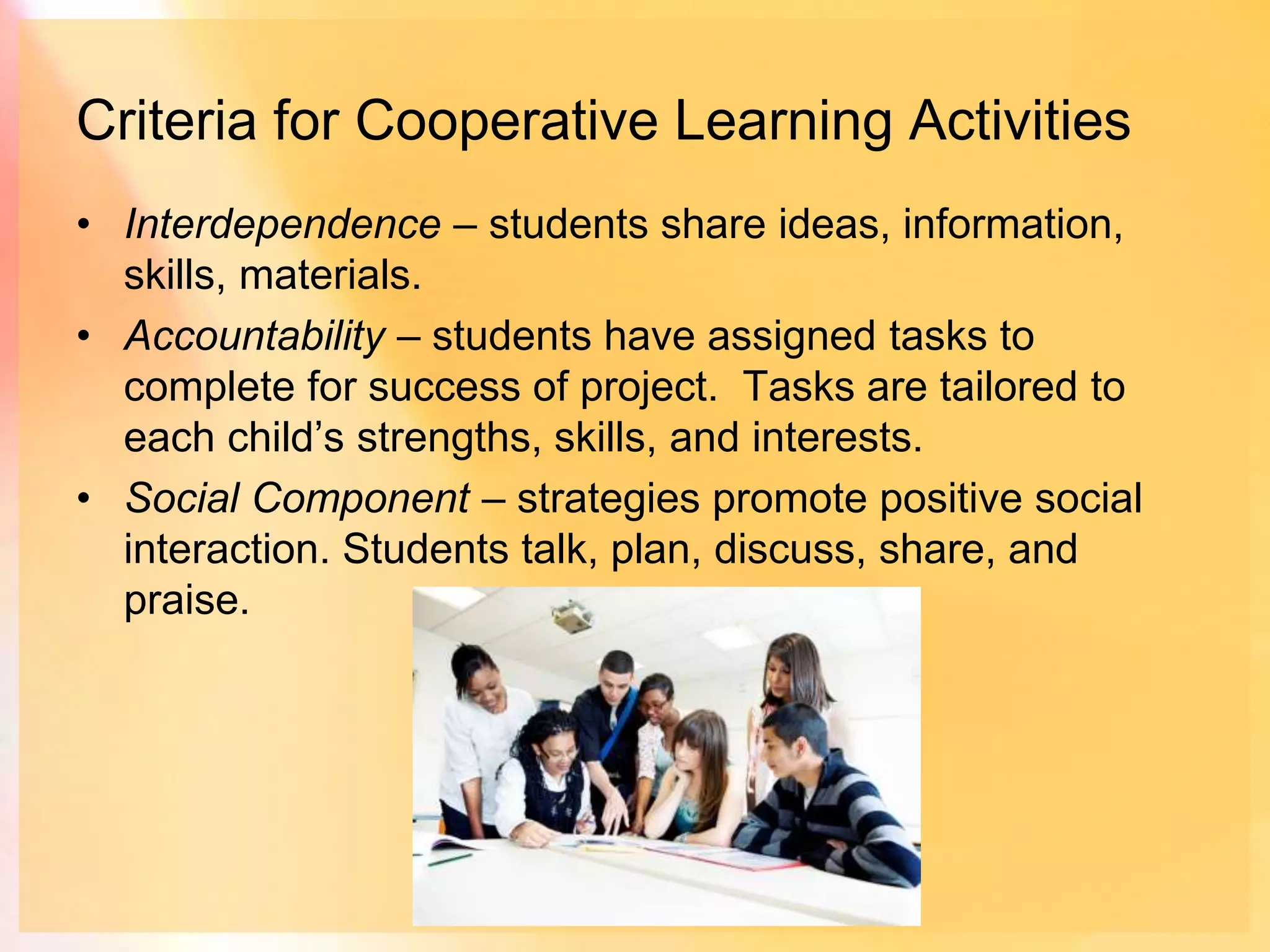
Criteria for Cooperative Learning Activities
• Interdependence – students share ideas, information,
skills, materials.
• Accountability – students have assigned tasks to
complete for success of project. Tasks are tailored to
each child’s strengths, skills, and interests.
• Social Component – strategies promote positive social
interaction. Students talk, plan, discuss, share, and
praise.
Motivation Myth #5
Punishment is an effective motivator.
• Desensitizes kids
eventually
• Behavior changes only
while punishment is given.
• Children associate the
punishment with the
punisher, not with the offending behavior.
Motivating the Child With Attention Deficit
Disorder
• The ADD child is searching for stimulation. That is his
oxygen and he cannot function without it.
• Current research by the Council for Exceptional Children
indicates that nearly 10 percent of school-aged children
struggle with ADD. (failure rate 250% higher than peers)
• They are often exceedingly bright, and they are well
aware of the discrepancy between their potential and
their performance. Add to this mix the fact that they get
in trouble, continually blamed, … anger, frustration,
resentment emerge.
Current Research on ADD
• In the 1980s – 3 basic symptoms (hyperactivity,
distractibility, and impulsivity)
• Current research – Those three symptoms are only the
tip of the iceberg. There are numerous traits and
symptoms that affect their academic and social
performance.
The Key To Motivating the ADD Child
• Modify and adjust the learning environment (Spend time
and energy trying to change procedures or practices
rather than trying to change the child.)
• 3 factors influence performance and motivation: 1)
degree of interest in activity; 2) difficulty of activity; 3)
duration of the task.
• Curriculum should be stimulating and relevant to the
child’s life experiences. (Good for all students!)
• Challenge and support ADD children
The Motivating Classroom
Global Strategies – Incorporating the 6 C’s
1. Creativity
2. Community
3. Clarity
4. Coaching
5. Conferencing
6. Control
Creativity
• Inject variety and creativity into lesson planning
• Capitalize on visuals – Use drawings, pictures, charts,
graphs, etc.
• Think outside the box (enhance
curriculum with real world items
or ideas)
Community
• Students and parents must know we care
• Your classroom is a community with its own culture,
values, and standards of behavior
• Each child must feel valued, accepted, included, and
safe.
• Classroom culture must be inclusive – Teachers must
foster this especially for new students. Cliques and
special groups should be avoided.
Ways to Show You Care
• Greet students at your door, smile, make eye contact,
and call them by their preferred name.
• Attend school plays, games, activities of your students
• Be attentive and actively listen to your students when
they talk to you
• Criticize in private; praise in public!
• Circulate around the room in a natural, nonthreatening
manner, … walk and talk.
• Acknowledge student progress, accomplishments,
efforts, and birthdays
• Inquire about health after an absence
Clarity
• Class Rules, Procedures, Consequences must be clear
and visible
• Incorporate the Classroom Philosophy into Rules
• Don’t refer to the rules only when they are broken. Also
acknowledge the rules when they are followed.
• Give clear, concise directions and instructions. When
there are multiple steps, give one at a time, pausing and
checking for understanding before moving to the next
step.
Coaching
“A good coach will make his players see
what they can be rather than what they are.”
- Ara Parseghian
A Good Coach-
- wants all of his players to win.
- knows all his players.
- designs individual goals and group goals.
- uses the players’ strengths.
- Consistently works on each player’s weaknesses.
A Good Coach-
- Knows the opponent (ADD,
dyslexia, etc.)
- Considers existing conditions
(be sensitive to “bad” days)
- Applies and practices new skills
- Constantly evaluates and
assesses
Conferencing
• One-on-one student/teacher
conferences should not be reserved
for scolding or bad behavior.
• Conferencing enables the teacher to
develop meaningful relationships with
students.
• Actively listen to the student
(it’s attitude not technique)
Control
“The beauty of empowering others is that your own
power is not diminished.”
- Barbara Coloroso
• Students usually don’t want to snatch our power,
they just want to exercise a bit of his or her
power.
Control
• Allow students to make a few of their own
choices.
• Allow each student to enjoy success, realize
progress, and be recognized and celebrated
for his strengths and interests.
• Avoid power struggles.
• Always use a calm voice, be respectful, be considerate,
and be mindful of preserving dignity and integrity when
confrontations arise.
The Eight Forces of Motivation
The 8 Basic Motivational Forces that inspire
human beings to action and sustained effort:
1. Gregariousness 5. Aggression
2. Autonomy 6. Power
3. Status 7. Recognition
4. Inquisitiveness 8. Affiliation
Gregariousness: The Need To Belong
• Happiest with crowds
• Has many, many friends and enjoys these relationships
• Prefers committees to work instead of solitary projects
• Both a joiner and a leader
• Puts much effort in establishing and maintaining his
relationships
• Can be positive (popular, friendly) or negative (gang
member, hostile leader in classroom, challenging
authority)
YOUR SCORE?
Autonomy: The Need for
Independence
• Relishes opportunities to work independently on projects
• Dislikes committee work
• Inspired by solitary projects where results depend upon
his performance
• Decision-makers
• Highly committed to making those decisions work well
• Chooses to run things themselves
• These type of students will take over group work if it isn’t
done to their level of achievement.
Status: The Need To Be Important
• This individual’s self-esteem is tied to the opinions of
others
• Greatly concerned with viewpoints others hold regarding
this person’s performance and progress
• Eager to please others
• Can be extremely sensitive to criticism
• Is greatly concerned about disappointing or upsetting
other people
Inquisitiveness: The Need To
Know
• Has a need to learn and know
• Extremely curious, hungry for new information
• Not limited to one or two areas of expertise, rather
enjoys learning about nearly any topic
• Wants and values information
• Feels uncomfortable if they believe information is being
withheld
• Interested in gaining social, personal, and professional
information about others in their environment
• These students want to know the how and why of
everything, including rules, procedures, etc.
Aggression: The Need to Assert
• Can be positive (leadership positions, assertive
personality) or negative (bully, intimidator)
• Confrontational
• Stands up for personal injustices or unfairness
• Interested in expanding their sphere of influence
• They want their feelings and opinions to be recognized
and responded to
Power: The Need for Control
• Greatly concerned with control and influence
• This person could have very strong or very weak self-
esteem (need for power may be rooted in feelings of
confidence and superiority or it may be rooted in feeling
of helplessness and inferiority)
• Relish responsibility and authority
• Enjoys autonomy, dislikes being micromanaged
• Students often times want the last word and are
argumentative.
Recognition: The Need for
Acknowledgment
• Highly motivated by their achievement recognition
• Not necessarily braggarts, just driven to be recognized
by their accomplishments
• Will work hard for the goal
• Are not always competitive, quite often it is an intrinsic
drive that motivates them to achieve
Affiliation: The Need to Associate and
Belong
• Strong need to be connected with others and with
organizations, movements, and institutions
• Great strength is gathered from these associations
• They identify and feel a sense of belonging with the
group, organization, etc.
• Children who are driven by affiliation often seek the
approval of and association with teachers.
• School logos, official sports clothing, social clubs, etc.
are important to the person driven by affiliation.
How to Motivate All Students
• Utilize a wide variety of approaches, strategies, and
techniques
• Try to determine the child’s unique motivational type and
tailor instructional lessons or activities toward that
• Incorporate the Six P’s: Projects, People, Praise, Prizes,
Prestige, and Power
The Six P’s – Motivational Teaching
Strategies
Projects – motivate the autonomous or inquisitive child
People – motivate the gregarious or affiliation-driven child
Praise – motivates the status-driven or recognition-driven
or affiliation-driven child
Prizes – motivates the status-driven or recognition-driven
or affiliation-driven or power-driven child
Prestige – motivates the autonomous or status-driven or
aggressive or power-driven child
Power – motivates the power-driven or autonomous or
aggressive-driven child
Remember…
If the child cannot learn
the way that we teach, we
must teach the way that
he learns.
-Richard Lavoie
Melinda Barnett
TCP Director, Region 5
melinda@esc5.net

Motivating Students II.pptx

  • 1.
    Motivating Students to Learn MelindaBarnett Region 5 ESC Summer 2012
  • 2.
    The Motivation Breakthrough 6Secrets to Turning On the Tuned-Out Child By Richard Lavoie
  • 3.
    Student Motivation: What ItIs and What It Isn’t
  • 4.
    Motivation is thekey to learning Who was your favorite high school teacher?
  • 5.
    Myths and Misconceptionsabout Student Motivation “Do Something. If it works, do more of it. If it doesn’t . . . Do something else.” - Franklin Delano Roosevelt
  • 6.
    Myth #1 –“That Danny ... NOTHING motivates him!” FALSE – All human behavior is motivated! • The trick is to motivate the student to do that which you wish him to do! • Students who refuse to do their work or appear to half try are usually extremely motivated. They are motivated to avoid embarrassment, avoid failure at attempting the task, etc.
  • 7.
    Motivation Myth #2 “Thatkid! One day he is motivated, the next day he is not!” FALSE – The field of psychology recognizes motivation as a relative constant. That is, if a child is motivated to learn math, he is motivated to learn math all the time. If he is NOT motivated to learn math, he is not motivated to learn math – ALL of the time.
  • 8.
    Performance Inconsistency: Childrenwith Learning Disorders • They have bursts of forward movement wherein they make observable, measurable progress for a period of time, then through no fault of their own, they hit an invisible wall. • Parents and Educators view this as a motivational problem rather than a neurological problem. One approach – file folders individualized with the struggling students name. Inside the folder a worksheet with or concept the particular student struggles with. On “good days,” give them the folder. That may be the day he learns “i before e, except after c!”
  • 9.
    Overcoming Learned Helplessness •Members of the animal kingdom (that would include us) can be taught to be helpless or taught that they can help themselves. • We all have areas of learned helplessness. • Adults can usually avoid these areas and still function. Children cannot avoid theirs. • Chronic academic struggles and failures creates a mindset of Learned Helplessness.
  • 10.
    3 Steps toAssist Children with Learned Helplessness 1. You must come to fully understand and embrace the nature of learned helplessness. It is credible and treatable. 2. It is necessary to change a child’s thought processes and adjusting his belief that failure is inevitable. You must replace his expectation of failure with a more positive and effective thought process. - Make the child aware of his automatic, negative thoughts and replace them with positive ones. -Provide the child with concrete, measurable evidence that contradicts and refutes his negative thoughts.
  • 11.
    Step Three inAssisting Children with Learned Helplessness 3. Ask the student what he would do if he were falsely accused of something. (He’d probably say he would defend himself…..) Tell him that in essence, his negative thought patterns are accusing him falsely. - Provide a supportive, non-threatening learning environment - Teach them that mistakes are inevitable, but useful. - Utilize corrective techniques that keep the student’s self-esteem in tact. - Eliminate the word “wrong” from your vocabulary as much as possible.
  • 12.
    A Different Approachto LH 1.Do It For Him 2.Do It With Him 3.Watch Him Do It 4.Have Him Do It
  • 13.
    Motivation Myth #3 “Givehim something; that will motivate him.” Extrinsic rewards (stickers, money, etc.) have little impact on motivation. They will do little to improve or enhance motivation. It may temporarily modify behavior, but it does little to modify motivation.
  • 14.
    Motivation Myth #4 Competition:The Great Motivator … NOT! Classes that incorporate special needs students do NOT need to utilize competition in their teaching strategies. As educators and parents, we must downplay competition and emphasize the concept of “personal best.”
  • 15.
    Cooperative Education, YES CompetitiveEducation, NO • Cooperative classroom – active learners working busily in small groups, sharing ideas, initiating discussions, reinforcing one another. • Competition is replaced by collaboration and every student’s active participation is assured. Positive feedback, support, praise and affirmations are encouraged. • All small group work does not qualify as cooperative learning. (Teacher-directed remedial groupings are not cooperative learning groups.)
  • 16.
    Criteria for CooperativeLearning Activities • Interdependence – students share ideas, information, skills, materials. • Accountability – students have assigned tasks to complete for success of project. Tasks are tailored to each child’s strengths, skills, and interests. • Social Component – strategies promote positive social interaction. Students talk, plan, discuss, share, and praise.
  • 17.
    Motivation Myth #5 Punishmentis an effective motivator. • Desensitizes kids eventually • Behavior changes only while punishment is given. • Children associate the punishment with the punisher, not with the offending behavior.
  • 18.
    Motivating the ChildWith Attention Deficit Disorder • The ADD child is searching for stimulation. That is his oxygen and he cannot function without it. • Current research by the Council for Exceptional Children indicates that nearly 10 percent of school-aged children struggle with ADD. (failure rate 250% higher than peers) • They are often exceedingly bright, and they are well aware of the discrepancy between their potential and their performance. Add to this mix the fact that they get in trouble, continually blamed, … anger, frustration, resentment emerge.
  • 19.
    Current Research onADD • In the 1980s – 3 basic symptoms (hyperactivity, distractibility, and impulsivity) • Current research – Those three symptoms are only the tip of the iceberg. There are numerous traits and symptoms that affect their academic and social performance.
  • 20.
    The Key ToMotivating the ADD Child • Modify and adjust the learning environment (Spend time and energy trying to change procedures or practices rather than trying to change the child.) • 3 factors influence performance and motivation: 1) degree of interest in activity; 2) difficulty of activity; 3) duration of the task. • Curriculum should be stimulating and relevant to the child’s life experiences. (Good for all students!) • Challenge and support ADD children
  • 21.
    The Motivating Classroom GlobalStrategies – Incorporating the 6 C’s 1. Creativity 2. Community 3. Clarity 4. Coaching 5. Conferencing 6. Control
  • 22.
    Creativity • Inject varietyand creativity into lesson planning • Capitalize on visuals – Use drawings, pictures, charts, graphs, etc. • Think outside the box (enhance curriculum with real world items or ideas)
  • 23.
    Community • Students andparents must know we care • Your classroom is a community with its own culture, values, and standards of behavior • Each child must feel valued, accepted, included, and safe. • Classroom culture must be inclusive – Teachers must foster this especially for new students. Cliques and special groups should be avoided.
  • 24.
    Ways to ShowYou Care • Greet students at your door, smile, make eye contact, and call them by their preferred name. • Attend school plays, games, activities of your students • Be attentive and actively listen to your students when they talk to you • Criticize in private; praise in public! • Circulate around the room in a natural, nonthreatening manner, … walk and talk. • Acknowledge student progress, accomplishments, efforts, and birthdays • Inquire about health after an absence
  • 25.
    Clarity • Class Rules,Procedures, Consequences must be clear and visible • Incorporate the Classroom Philosophy into Rules • Don’t refer to the rules only when they are broken. Also acknowledge the rules when they are followed. • Give clear, concise directions and instructions. When there are multiple steps, give one at a time, pausing and checking for understanding before moving to the next step.
  • 26.
    Coaching “A good coachwill make his players see what they can be rather than what they are.” - Ara Parseghian A Good Coach- - wants all of his players to win. - knows all his players. - designs individual goals and group goals. - uses the players’ strengths. - Consistently works on each player’s weaknesses.
  • 27.
    A Good Coach- -Knows the opponent (ADD, dyslexia, etc.) - Considers existing conditions (be sensitive to “bad” days) - Applies and practices new skills - Constantly evaluates and assesses
  • 28.
    Conferencing • One-on-one student/teacher conferencesshould not be reserved for scolding or bad behavior. • Conferencing enables the teacher to develop meaningful relationships with students. • Actively listen to the student (it’s attitude not technique)
  • 29.
    Control “The beauty ofempowering others is that your own power is not diminished.” - Barbara Coloroso • Students usually don’t want to snatch our power, they just want to exercise a bit of his or her power.
  • 30.
    Control • Allow studentsto make a few of their own choices. • Allow each student to enjoy success, realize progress, and be recognized and celebrated for his strengths and interests. • Avoid power struggles. • Always use a calm voice, be respectful, be considerate, and be mindful of preserving dignity and integrity when confrontations arise.
  • 31.
    The Eight Forcesof Motivation The 8 Basic Motivational Forces that inspire human beings to action and sustained effort: 1. Gregariousness 5. Aggression 2. Autonomy 6. Power 3. Status 7. Recognition 4. Inquisitiveness 8. Affiliation
  • 32.
    Gregariousness: The NeedTo Belong • Happiest with crowds • Has many, many friends and enjoys these relationships • Prefers committees to work instead of solitary projects • Both a joiner and a leader • Puts much effort in establishing and maintaining his relationships • Can be positive (popular, friendly) or negative (gang member, hostile leader in classroom, challenging authority) YOUR SCORE?
  • 33.
    Autonomy: The Needfor Independence • Relishes opportunities to work independently on projects • Dislikes committee work • Inspired by solitary projects where results depend upon his performance • Decision-makers • Highly committed to making those decisions work well • Chooses to run things themselves • These type of students will take over group work if it isn’t done to their level of achievement.
  • 34.
    Status: The NeedTo Be Important • This individual’s self-esteem is tied to the opinions of others • Greatly concerned with viewpoints others hold regarding this person’s performance and progress • Eager to please others • Can be extremely sensitive to criticism • Is greatly concerned about disappointing or upsetting other people
  • 35.
    Inquisitiveness: The NeedTo Know • Has a need to learn and know • Extremely curious, hungry for new information • Not limited to one or two areas of expertise, rather enjoys learning about nearly any topic • Wants and values information • Feels uncomfortable if they believe information is being withheld • Interested in gaining social, personal, and professional information about others in their environment • These students want to know the how and why of everything, including rules, procedures, etc.
  • 36.
    Aggression: The Needto Assert • Can be positive (leadership positions, assertive personality) or negative (bully, intimidator) • Confrontational • Stands up for personal injustices or unfairness • Interested in expanding their sphere of influence • They want their feelings and opinions to be recognized and responded to
  • 37.
    Power: The Needfor Control • Greatly concerned with control and influence • This person could have very strong or very weak self- esteem (need for power may be rooted in feelings of confidence and superiority or it may be rooted in feeling of helplessness and inferiority) • Relish responsibility and authority • Enjoys autonomy, dislikes being micromanaged • Students often times want the last word and are argumentative.
  • 38.
    Recognition: The Needfor Acknowledgment • Highly motivated by their achievement recognition • Not necessarily braggarts, just driven to be recognized by their accomplishments • Will work hard for the goal • Are not always competitive, quite often it is an intrinsic drive that motivates them to achieve
  • 39.
    Affiliation: The Needto Associate and Belong • Strong need to be connected with others and with organizations, movements, and institutions • Great strength is gathered from these associations • They identify and feel a sense of belonging with the group, organization, etc. • Children who are driven by affiliation often seek the approval of and association with teachers. • School logos, official sports clothing, social clubs, etc. are important to the person driven by affiliation.
  • 40.
    How to MotivateAll Students • Utilize a wide variety of approaches, strategies, and techniques • Try to determine the child’s unique motivational type and tailor instructional lessons or activities toward that • Incorporate the Six P’s: Projects, People, Praise, Prizes, Prestige, and Power
  • 41.
    The Six P’s– Motivational Teaching Strategies Projects – motivate the autonomous or inquisitive child People – motivate the gregarious or affiliation-driven child Praise – motivates the status-driven or recognition-driven or affiliation-driven child Prizes – motivates the status-driven or recognition-driven or affiliation-driven or power-driven child Prestige – motivates the autonomous or status-driven or aggressive or power-driven child Power – motivates the power-driven or autonomous or aggressive-driven child
  • 42.
    Remember… If the childcannot learn the way that we teach, we must teach the way that he learns. -Richard Lavoie Melinda Barnett TCP Director, Region 5 melinda@esc5.net

Editor's Notes

  • #5 Reflect for a moment on your favorite teacher in high school. The chances are that he was an effective motivator. He inspired you. He was not merely a teacher, he was also a leader. He did not necessarily make learning fun, but he made learning attainable and purposeful. Whether you serve children as a teacher, parent, coach, or instructor, you will multiply your effectiveness immeasurably if you learn how to motivate your charges and maintain that motivation throughout the learning process.
  • #6 Be open and willing to try something else if what you are attempting to use with “Little Johnny” isn’t working.
  • #7 Start reading on page 8
  • #8 An analogy may be helpful. Let’s substitute “love” for “motivation.” You love your husband. That love is a constant in your life and his. Now, as in any marriage, some days are better than others. On any given day you may be angry or upset with him as a result of an argument or disagreement, but despite these temporary feelings, you still love him. Annoyance is temporary; love is permanent. Poor school performance and productivity are temporary; motivation is permanent. It is important to understand and embrace this concept because it provides insight into the frustration that children often feel when they have difficulty mastering information and skills despite their motivation to learn.
  • #9 If we aren’t careful, we as educators will label these kids “lazy” or unmotivated. Doctors receive intensive training in differential diagnosis and utilize the concept on a daily basis. Two men come in with headaches – one has a cerebral tumor, the other seasonal allergies. One gets radiation and the other an antihistamine. As educators, we tend to view all children with similar symptoms as alike. One problem, one remedy but it isn’t that simple. Page 29 – file folder explanation
  • #10 My area of learned helplessness is computer technological issues, car troubles, etc.
  • #11 Consider the elephant who is taken to his open-air pen, with a chain around one ankle attached to a stake that is driven only about 6 inches into the ground. As a baby elephant, his trainers put a chain around his ankle and attached it to a stake in the ground. He was too small and weak to budge the stake. He struggled and struggled for awhile until he realized he could not alter his situation. He learned he was helpless against the chain, and even as an adult he will not attempt to break free of the chain. #2 – Adults need to continually foster the idea that the child can control his progress and performance to a degree and that intensive and consistent effort will eventually, result in academic progress. If there is no adult intervention, his feelings of failure at reading will expand into his feelings that he is a total loser. The child’s teacher and parent must work closely together to provide the student with consistent reassurance and support. Your encouragement must be at least as strong as the child’s self-discouragement.
  • #12 Role Play the scene on page 37
  • #14 Grandma’s Rule: If you eat your vegetables, you will get dessert.
  • #15 If Special Needs children are going to be placed in general education classes, teachers need to downplay and decrease the use of inherently unfair competitive activities. Recent surveys conducted by the University of Massachusetts in suburban American school systems indicate that competitive classroom activities (games, quizzes, test, bees) occupy nearly 80 percent of the on-task time in elementary schools. It is, by far, the most widely used classroom approach. Teachers utilize competition in the belief that it motivates children to do their best. However, the most important and profound reality regarding the link between motivation and competition is this: The only person motivated by competition is the person who believes that he has a chance of winning. Think about the Boston Marathon. Twenty thousand runners participate in a grueling twenty-six mile course. They exhaustingly train for a year if not multiple years to run the race which gives only two prizes, one for the man who finishes first and another for the first woman to complete the course. How many think they will actually win that race? Probably only twenty or thirty world-class runners go to Boston expecting to win. The rest compete against themselves, pushing themselves to do his or her personal best. That’s when we do our best … when competing against ourselves.
  • #17 Interdependence – Each student’s success and progress is largely dependent upon the performance of his learning partners. Accountability – Each student has assigned tasks that he must complete in order to ensure the success of the project. These tasks are tailored to each child’s strengths, skills, and affinities. This ensures that each child is an active participant in the process. Social Component – Cooperative strategies promote positive social interaction among children. The children talk, plan, discuss, share, and praise.
  • #18 Punishment is a temporary fix. Many kids, particularly those who have a history of academic difficulty, have been punished so much that they are immune or desensitized by it. By fifth grade, he’s lost countless recesses, sat in the principal’s office, written sentences, and so on, and his behavior hasn’t changed. It’s time for a new approach. Analogy of speeding until you see a police cruiser. You hit the brakes, slow down only until the policeman is out of sight. Associating the punishment with the punisher … (“Mr. Stewart took away my recess today.” Not “I cursed in class today and lost my recess.”) Constant punishment has a negative impact upon your relationship with a child, and a positive teacher-pupil relationship is fundamental to enhancing motivation.
  • #19 The ADD child needs stimulation to the same degree that you need oxygen. He simply can’t function without it. In fact, if the child is not provided with stimulation, he will create stimulation by acting out or disrupting his environment in some way. It is not done for any negative reason. He is creating excitement because he needs it. The majority of these students also have some sort of academic learning disability, so their inability to sit still in class is complicated by their difficulty in mastering the content of the curriculum. These children tend to fail at a rate 250 percent higher than their peers without ADD, and nearly half of them will be required to repeat a grade in elementary or middle school.
  • #20 Success in school requires children to pay attention to assigned tasks and expectations. Children with ADD have significant difficulty sustaining attention, particularly during rote, repetitious, or prolonged tasks that are not particularly novel, entertaining, or stimulating. Success in social situations requires children to complete three basic tasks consistently: listen, follow directions, and wait their turn. ADD children have great difficulty accomplishing these skills.
  • #21 Consider alternate assignments rather than multiple worksheets or long worksheet packets, independent work, long-term assignments, extended silent reading, and multistep tasks. Research has shown that a curriculum that is irrelevant to the student’s social and economic interests generally results in disruptive behavior, poor academic performance, limited progress, and dropping out. Teachers and parents should remember the two most important words when dealing with these special children: challenge and support. The adult should continually challenge the child by presenting him with activities designed to improve his behavior and his learning, while simultaneously providing him with the support that he requires to meet these goals. Support without challenge is meaningless. Challenge without support is equally ineffective.
  • #22 Global strategies do not focus on changing or modifying the child in any way. Rather, they are designed to make adjustments to the learning environment, whether it is a classroom, playing field, club meeting or household. These techniques are sound, field-tested procedures and policies that will provide the student with the drive and impetus to learn. If these strategies are absent, the child will have little desire – or reason – to apply himself.
  • #23 In order to foster motivation, teachers must inject variety and creativity into their lesson planning. This not only insures increased motivation from the students, but also stimulates and energizes the teacher! The author received an emergency call from 3 of his interns on their first day of school teaching 4th graders. He got there and they were almost hysterical that the language arts textbooks they were supposed to use was different than what they’d used in their methods class. The author saw a box of cereal, grabbed it, and said “I will bet that we can construct ten language skills assignments from this box. I’ll do the first three: List the vitamins and ingredients in alphabetical order. Divide your paper into three columns and list all of the one-, two-, and three-syllable words that you can find on the back of the box. How many words can you make using the letters in the words Froot Loops?” Sometimes we have to give ourselves permission to think outside the box.
  • #24 If a child is to be consistently and effectively motivated, she must feel that she is part of an accepting and caring “community of learners.” She must feel safe, welcome, and a deep sense of belonging. The classroom culture may be comforting or cruel, accepting or exclusive, hospitable or hostile, welcoming or wary. What is yours? If bullying is contradictory to the culture of your classroom, children will be far less likely to bully others and will have little tolerance for a classmate who bullies.
  • #26 The classroom should have a philosophy: a basic belief system that reflects the class values and goals. You also need policies: the regulations that allow community members to carry out the philosophy. Procedures: the specific practices and activities that support the philosophy and allow the policies to work.
  • #29 Conferences can be used to prevent problems from occurring by enabling the child and the teacher to gain a deeper understanding of each other’s viewpoints, needs, and opinions. These conversations can also be a valuable motivational tool by providing the child with ongoing and meaningful positive reinforcement.
  • #32 Motivation is one of the few psychological aspects that remain consistent throughout the life span. As an adult, you are doubtless inspired by the same motivators that inspired you as a child.