
BY-HARIOM GANGWAR
MSC NSG Ist YEAR
PSYCHIATRY DEPARTMENT
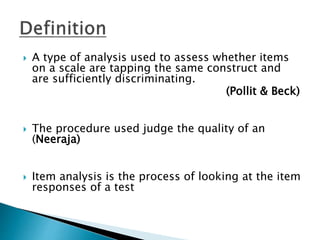
 A type of analysis used to assess whether items
on a scale are tapping the same construct and
are sufficiently discriminating.
(Pollit & Beck)
 The procedure used judge the quality of an
(Neeraja)
 Item analysis is the process of looking at the item
responses of a test
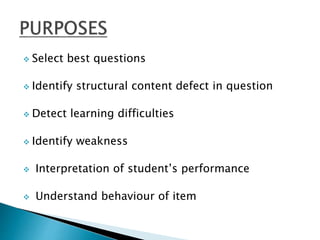
 Select best questions
 Identify structural content defect in question
 Detect learning difficulties
 Identify weakness
 Interpretation of student’s performance
 Understand behaviour of item
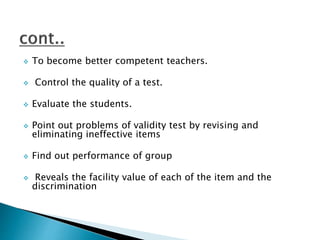
 To become better competent teachers.
 Control the quality of a test.
 Evaluate the students.
 Point out problems of validity test by revising and
eliminating ineffective items
 Find out performance of group
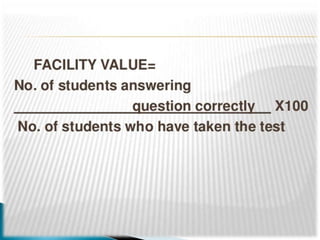
 Reveals the facility value of each of the item and the
discrimination
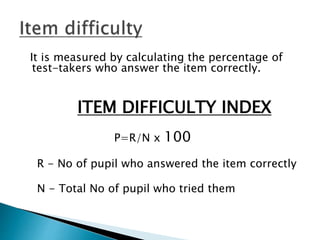
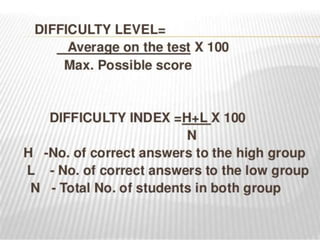
It is measured by calculating the percentage of
test-takers who answer the item correctly.
ITEM DIFFICULTY INDEX
P=R/N x 100
R - No of pupil who answered the item correctly
N - Total No of pupil who tried them
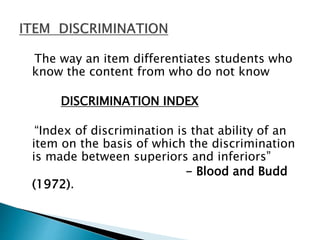
The way an item differentiates students who
know the content from who do not know
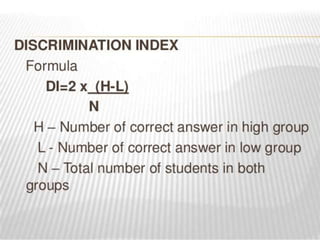
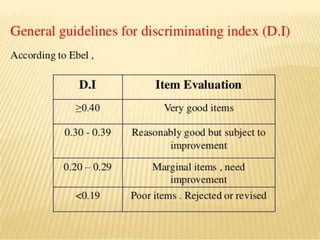
DISCRIMINATION INDEX
“Index of discrimination is that ability of an
item on the basis of which the discrimination
is made between superiors and inferiors”
- Blood and Budd
(1972).
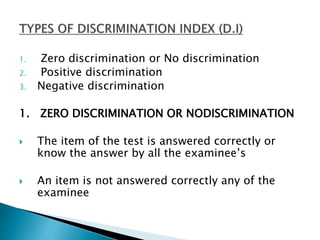
1. Zero discrimination or No discrimination
2. Positive discrimination
3. Negative discrimination
1. ZERO DISCRIMINATION OR NODISCRIMINATION
 The item of the test is answered correctly or
know the answer by all the examinee’s
 An item is not answered correctly any of the
examinee
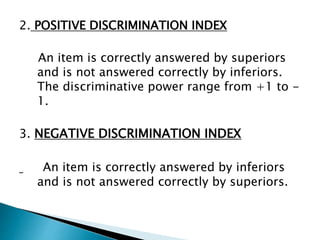
2. POSITIVE DISCRIMINATION INDEX
An item is correctly answered by superiors
and is not answered correctly by inferiors.
The discriminative power range from +1 to -
1.
3. NEGATIVE DISCRIMINATION INDEX
An item is correctly answered by inferiors
and is not answered correctly by superiors.
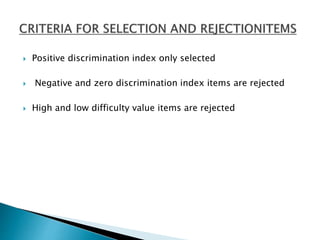
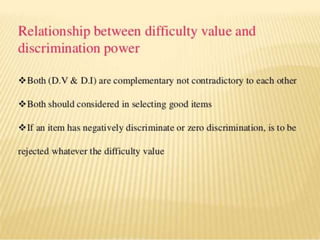
 Positive discrimination index only selected
 Negative and zero discrimination index items are rejected
 High and low difficulty value items are rejected
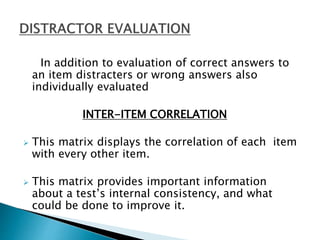
In addition to evaluation of correct answers to
an item distracters or wrong answers also
individually evaluated
INTER-ITEM CORRELATION
 This matrix displays the correlation of each item
with every other item.
 This matrix provides important information
about a test’s internal consistency, and what
could be done to improve it.
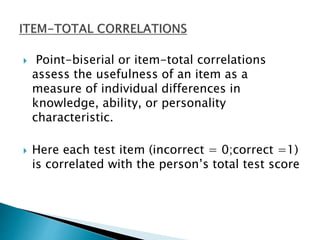
 Point-biserial or item-total correlations
assess the usefulness of an item as a
measure of individual differences in
knowledge, ability, or personality
characteristic.
 Here each test item (incorrect = 0;correct =1)
is correlated with the person’s total test score
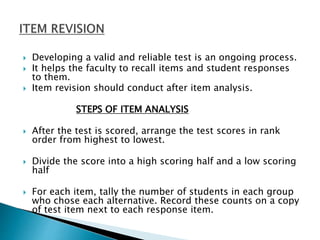
 Developing a valid and reliable test is an ongoing process.
 It helps the faculty to recall items and student responses
to them.
 Item revision should conduct after item analysis.
STEPS OF ITEM ANALYSIS
 After the test is scored, arrange the test scores in rank
order from highest to lowest.
 Divide the score into a high scoring half and a low scoring
half
 For each item, tally the number of students in each group
who chose each alternative. Record these counts on a copy
of test item next to each response item.
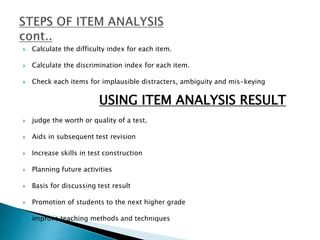
 Calculate the difficulty index for each item.
 Calculate the discrimination index for each item.
 Check each items for implausible distracters, ambiguity and mis-keying
USING ITEM ANALYSIS RESULT
 judge the worth or quality of a test.
 Aids in subsequent test revision
 Increase skills in test construction
 Planning future activities
 Basis for discussing test result
 Promotion of students to the next higher grade
 improve teaching methods and techniques
Item analysis.pptx du

Item analysis.pptx du

  • 1.
    BY-HARIOM GANGWAR MSC NSGIst YEAR PSYCHIATRY DEPARTMENT
  • 2.
     A typeof analysis used to assess whether items on a scale are tapping the same construct and are sufficiently discriminating. (Pollit & Beck)  The procedure used judge the quality of an (Neeraja)  Item analysis is the process of looking at the item responses of a test
  • 3.
     Select bestquestions  Identify structural content defect in question  Detect learning difficulties  Identify weakness  Interpretation of student’s performance  Understand behaviour of item
  • 4.
     To becomebetter competent teachers.  Control the quality of a test.  Evaluate the students.  Point out problems of validity test by revising and eliminating ineffective items  Find out performance of group  Reveals the facility value of each of the item and the discrimination
  • 5.
    It is measuredby calculating the percentage of test-takers who answer the item correctly. ITEM DIFFICULTY INDEX P=R/N x 100 R - No of pupil who answered the item correctly N - Total No of pupil who tried them
  • 8.
    The way anitem differentiates students who know the content from who do not know DISCRIMINATION INDEX “Index of discrimination is that ability of an item on the basis of which the discrimination is made between superiors and inferiors” - Blood and Budd (1972).
  • 9.
    1. Zero discriminationor No discrimination 2. Positive discrimination 3. Negative discrimination 1. ZERO DISCRIMINATION OR NODISCRIMINATION  The item of the test is answered correctly or know the answer by all the examinee’s  An item is not answered correctly any of the examinee
  • 10.
    2. POSITIVE DISCRIMINATIONINDEX An item is correctly answered by superiors and is not answered correctly by inferiors. The discriminative power range from +1 to - 1. 3. NEGATIVE DISCRIMINATION INDEX An item is correctly answered by inferiors and is not answered correctly by superiors.
  • 11.
     Positive discriminationindex only selected  Negative and zero discrimination index items are rejected  High and low difficulty value items are rejected
  • 15.
    In addition toevaluation of correct answers to an item distracters or wrong answers also individually evaluated INTER-ITEM CORRELATION  This matrix displays the correlation of each item with every other item.  This matrix provides important information about a test’s internal consistency, and what could be done to improve it.
  • 16.
     Point-biserial oritem-total correlations assess the usefulness of an item as a measure of individual differences in knowledge, ability, or personality characteristic.  Here each test item (incorrect = 0;correct =1) is correlated with the person’s total test score
  • 17.
     Developing avalid and reliable test is an ongoing process.  It helps the faculty to recall items and student responses to them.  Item revision should conduct after item analysis. STEPS OF ITEM ANALYSIS  After the test is scored, arrange the test scores in rank order from highest to lowest.  Divide the score into a high scoring half and a low scoring half  For each item, tally the number of students in each group who chose each alternative. Record these counts on a copy of test item next to each response item.
  • 18.
     Calculate thedifficulty index for each item.  Calculate the discrimination index for each item.  Check each items for implausible distracters, ambiguity and mis-keying USING ITEM ANALYSIS RESULT  judge the worth or quality of a test.  Aids in subsequent test revision  Increase skills in test construction  Planning future activities  Basis for discussing test result  Promotion of students to the next higher grade  improve teaching methods and techniques