Self Healing Concrete
Prepared by Muhammad Bilal
CED,UET Peshawar
What is self healing concrete?
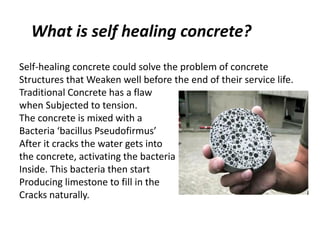
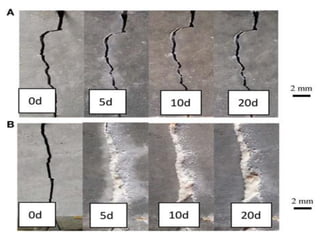
Self-healing concrete could solve the problem of concrete
Structures that Weaken well before the end of their service life.
Traditional Concrete has a flaw
when Subjected to tension.
The concrete is mixed with a
Bacteria ‘bacillus Pseudofirmus’
After it cracks the water gets into
the concrete, activating the bacteria
Inside. This bacteria then start
Producing limestone to fill in the
Cracks naturally.
How does bio
concrete work?
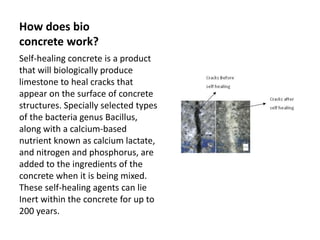
Self-healing concrete is a product
that will biologically produce
limestone to heal cracks that
appear on the surface of concrete
structures. Specially selected types
of the bacteria genus Bacillus,
along with a calcium-based
nutrient known as calcium lactate,
and nitrogen and phosphorus, are
added to the ingredients of the
concrete when it is being mixed.
These self-healing agents can lie
Inert within the concrete for up to
200 years.
Why the Need?
Concrete will continue to be the most important
building material for infrastructure but most concrete
structures can suffer from cracking. Tiny cracks on the
surface of the concrete make the whole structure
unsafe because water seeps in to degrade the concrete
and corrode the steel reinforcement, greatly reducing
the lifespan of a structure.
Repairs can be particularly time consuming and
expensive because it is often very difficult to gain
access to the structure to make repairs, especially if
they are underground or at a great height.
Some disadvantages
There are two key obstacles that need to be overcome
if self healing concrete is to transform concrete
construction in the next decade.
• The First disadvantage is the cost of self-healing
concrete is about double that of conventional
concrete, which is presently about €80 euros per
cubic meter. If the life of the structure can be
extended by 30%, the doubling in the cost of the
actual concrete would still save a lot of money in the
longer term.
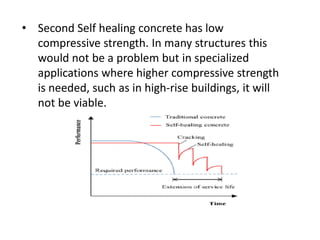
• Second Self healing concrete has low
compressive strength. In many structures this
would not be a problem but in specialized
applications where higher compressive strength
is needed, such as in high-rise buildings, it will
not be viable.
Finding the right bacteria
The starting point of the research was to find bacteria
capable of surviving in an extreme alkaline
environment. Cement and water have a pH value of up
to 13 when mixed together.
Samples of endolithic bacteria (bacteria that can live
inside stones) were collected along with bacteria found
in sediments in the lakes. Strains of the bacteria genus
Bacillus were found to thrive in this high-alkaline
environment. A suitable food source for bacteria so
they can survive for long time in concrete as calcium
lactate.
Interest from industry
The researchers are also developing a liquid to fix
cracks in conventional concrete. The bio concrete can
save billions and will be a major break through in the
field of civil engineering.
It is not practically used yet but there will be full scale
testing of self healing concrete to determine how well
and fast they heal over time.
Research is under process on bio concrete mark II to
reduce the cost of the concrete.
Self healing concrete

Self healing concrete

  • 1.
    Self Healing Concrete Preparedby Muhammad Bilal CED,UET Peshawar
  • 2.
    What is selfhealing concrete? Self-healing concrete could solve the problem of concrete Structures that Weaken well before the end of their service life. Traditional Concrete has a flaw when Subjected to tension. The concrete is mixed with a Bacteria ‘bacillus Pseudofirmus’ After it cracks the water gets into the concrete, activating the bacteria Inside. This bacteria then start Producing limestone to fill in the Cracks naturally.
  • 3.
    How does bio concretework? Self-healing concrete is a product that will biologically produce limestone to heal cracks that appear on the surface of concrete structures. Specially selected types of the bacteria genus Bacillus, along with a calcium-based nutrient known as calcium lactate, and nitrogen and phosphorus, are added to the ingredients of the concrete when it is being mixed. These self-healing agents can lie Inert within the concrete for up to 200 years.
  • 4.
    Why the Need? Concretewill continue to be the most important building material for infrastructure but most concrete structures can suffer from cracking. Tiny cracks on the surface of the concrete make the whole structure unsafe because water seeps in to degrade the concrete and corrode the steel reinforcement, greatly reducing the lifespan of a structure. Repairs can be particularly time consuming and expensive because it is often very difficult to gain access to the structure to make repairs, especially if they are underground or at a great height.
  • 6.
    Some disadvantages There aretwo key obstacles that need to be overcome if self healing concrete is to transform concrete construction in the next decade. • The First disadvantage is the cost of self-healing concrete is about double that of conventional concrete, which is presently about €80 euros per cubic meter. If the life of the structure can be extended by 30%, the doubling in the cost of the actual concrete would still save a lot of money in the longer term.
  • 7.
    • Second Selfhealing concrete has low compressive strength. In many structures this would not be a problem but in specialized applications where higher compressive strength is needed, such as in high-rise buildings, it will not be viable.
  • 8.
    Finding the rightbacteria The starting point of the research was to find bacteria capable of surviving in an extreme alkaline environment. Cement and water have a pH value of up to 13 when mixed together. Samples of endolithic bacteria (bacteria that can live inside stones) were collected along with bacteria found in sediments in the lakes. Strains of the bacteria genus Bacillus were found to thrive in this high-alkaline environment. A suitable food source for bacteria so they can survive for long time in concrete as calcium lactate.
  • 9.
    Interest from industry Theresearchers are also developing a liquid to fix cracks in conventional concrete. The bio concrete can save billions and will be a major break through in the field of civil engineering. It is not practically used yet but there will be full scale testing of self healing concrete to determine how well and fast they heal over time. Research is under process on bio concrete mark II to reduce the cost of the concrete.