Table of content
• Introduction
• Which Bacteria used in concrete and types?
• Self healing concrete Procedure
• Mechanism of bacteria in concrete
• Advantages and disadvantages
• Conclusion
INTRODUCTION
"The name suggests that it is a self healed concrete "
• Definition: Self healing of cracks or self-filling of cracks by the
help of bacterial process after hardening is known as self healing
concrete, It is also known as bacterial concrete.
• It can be observed that small cracks that occur in a structure of
width in the range of 0.05 to 0.1mm gets completely sealed in
repetitive dry and wet cycles.
• These types of bacteria can be in dormant cell and be viable for
over 200 years under dry conditions. These bacteria acts as a
catalyst in the cracks healing process.
Which Bacteria used in concrete and types?
There are various types of bacteria were used in bacterial concrete
construction are:
✓ Bacillus pasteurizing
✓ Bacillus sphaericus
✓ Escherichia coli
✓ Bacillus subtilis
• Bacillus cohnii
• Bacillus balodurans
✓ Bacillus pseudofirmus
• Any of bacillus is rod-shaped, gram-positive, aerobic or (under some
conditions) anaerobic bacteria widely found in soil and water.
Self healing concrete Preparation
• @civilogy
• Bacterial concrete can be prepared in two ways,
• By direct application
• By encapsulation in lightweight concrete
In the direct application method, bacterial spores and calcium lactate is
added into concrete directly when mixing of concrete is done.
• Bacterial spores
• Organics
• ▸ By encapsulation method the bacteria and its food i.e. calcium lactate,
are placed inside treated clay pellets and concrete is prepared. About 6% of
the clay pellets are added for making bacterial concrete.
Mechanism of bacteria in concrete
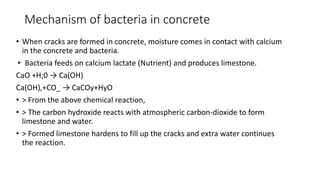
• When cracks are formed in concrete, moisture comes in contact with calcium
in the concrete and bacteria.
▸ Bacteria feeds on calcium lactate (Nutrient) and produces limestone.
CaO +H;0 → Ca(OH)
Ca(OH),+CO_ → CaCOy+HyO
• > From the above chemical reaction,
• > The carbon hydroxide reacts with atmospheric carbon-dioxide to form
limestone and water.
• > Formed limestone hardens to fill up the cracks and extra water continues
the reaction.
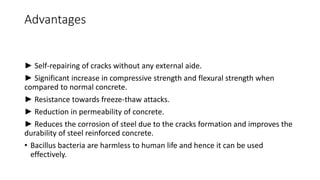
Advantages
► Self-repairing of cracks without any external aide.
► Significant increase in compressive strength and flexural strength when
compared to normal concrete.
► Resistance towards freeze-thaw attacks.
► Reduction in permeability of concrete.
► Reduces the corrosion of steel due to the cracks formation and improves the
durability of steel reinforced concrete.
• Bacillus bacteria are harmless to human life and hence it can be used
effectively.
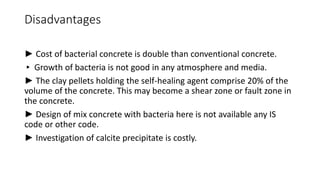
Disadvantages
► Cost of bacterial concrete is double than conventional concrete.
▸ Growth of bacteria is not good in any atmosphere and media.
► The clay pellets holding the self-healing agent comprise 20% of the
volume of the concrete. This may become a shear zone or fault zone in
the concrete.
► Design of mix concrete with bacteria here is not available any IS
code or other code.
► Investigation of calcite precipitate is costly.
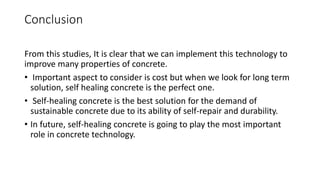
Conclusion
From this studies, It is clear that we can implement this technology to
improve many properties of concrete.
• Important aspect to consider is cost but when we look for long term
solution, self healing concrete is the perfect one.
• Self-healing concrete is the best solution for the demand of
sustainable concrete due to its ability of self-repair and durability.
• In future, self-healing concrete is going to play the most important
role in concrete technology.
SELF HEALING.pptx

SELF HEALING.pptx

  • 2.
    Table of content •Introduction • Which Bacteria used in concrete and types? • Self healing concrete Procedure • Mechanism of bacteria in concrete • Advantages and disadvantages • Conclusion
  • 3.
    INTRODUCTION "The name suggeststhat it is a self healed concrete " • Definition: Self healing of cracks or self-filling of cracks by the help of bacterial process after hardening is known as self healing concrete, It is also known as bacterial concrete. • It can be observed that small cracks that occur in a structure of width in the range of 0.05 to 0.1mm gets completely sealed in repetitive dry and wet cycles. • These types of bacteria can be in dormant cell and be viable for over 200 years under dry conditions. These bacteria acts as a catalyst in the cracks healing process.
  • 4.
    Which Bacteria usedin concrete and types? There are various types of bacteria were used in bacterial concrete construction are: ✓ Bacillus pasteurizing ✓ Bacillus sphaericus ✓ Escherichia coli ✓ Bacillus subtilis • Bacillus cohnii • Bacillus balodurans ✓ Bacillus pseudofirmus • Any of bacillus is rod-shaped, gram-positive, aerobic or (under some conditions) anaerobic bacteria widely found in soil and water.
  • 5.
    Self healing concretePreparation • @civilogy • Bacterial concrete can be prepared in two ways, • By direct application • By encapsulation in lightweight concrete In the direct application method, bacterial spores and calcium lactate is added into concrete directly when mixing of concrete is done. • Bacterial spores • Organics • ▸ By encapsulation method the bacteria and its food i.e. calcium lactate, are placed inside treated clay pellets and concrete is prepared. About 6% of the clay pellets are added for making bacterial concrete.
  • 6.
    Mechanism of bacteriain concrete • When cracks are formed in concrete, moisture comes in contact with calcium in the concrete and bacteria. ▸ Bacteria feeds on calcium lactate (Nutrient) and produces limestone. CaO +H;0 → Ca(OH) Ca(OH),+CO_ → CaCOy+HyO • > From the above chemical reaction, • > The carbon hydroxide reacts with atmospheric carbon-dioxide to form limestone and water. • > Formed limestone hardens to fill up the cracks and extra water continues the reaction.
  • 7.
    Advantages ► Self-repairing ofcracks without any external aide. ► Significant increase in compressive strength and flexural strength when compared to normal concrete. ► Resistance towards freeze-thaw attacks. ► Reduction in permeability of concrete. ► Reduces the corrosion of steel due to the cracks formation and improves the durability of steel reinforced concrete. • Bacillus bacteria are harmless to human life and hence it can be used effectively.
  • 8.
    Disadvantages ► Cost ofbacterial concrete is double than conventional concrete. ▸ Growth of bacteria is not good in any atmosphere and media. ► The clay pellets holding the self-healing agent comprise 20% of the volume of the concrete. This may become a shear zone or fault zone in the concrete. ► Design of mix concrete with bacteria here is not available any IS code or other code. ► Investigation of calcite precipitate is costly.
  • 9.
    Conclusion From this studies,It is clear that we can implement this technology to improve many properties of concrete. • Important aspect to consider is cost but when we look for long term solution, self healing concrete is the perfect one. • Self-healing concrete is the best solution for the demand of sustainable concrete due to its ability of self-repair and durability. • In future, self-healing concrete is going to play the most important role in concrete technology.