SELF HEALING CONCRETE
ABHIK ADAK
JAGANNATH UNIVERSITY
Chaksu,Jaipur
DECEMBER 2, 2015
1 | P a g e
Abstract
Crack formation in concrete is common, but a typical phenomenon related
to durability. Percolation from cracks may lead to leakage problems or ingress of
deleterious materials, causing deterioration ofthe concrete matrix or corrosionof
embedded steel reinforcement. Durability can be enhanced by preventing further
ingress of water and other substances. In recent years a bacteria-based self-
healing concrete is being developed to extend the service life. A two component
healing agent is added to the concretemixture. The agent consists of bacteria and
an organic mineral precursor compound. Whenever cracks occur and water is
present the bacteria become active and convert the incorporated organic
compounds into calcium carbonate, which precipitates and is able to seal and
block cracks. This paper aims to review the development of bacteria-based self-
healing concrete, introducing the proposed healing system. Different stages in the
development are discussed, and some recommendations for further research are
given.
Introduction
Concrete in most structures is designed to crack in order to let embedded
steel reinforcement take over tensile stresses. Crack formation is also a typical
phenomenon related to durability. Percolated cracks may lead to leakage
problems or ingress of harmful materials, which can cause deterioration of the
concrete matrix or reinforcement corrosion. Durability can be enhanced by
preventing further ingress of water and other substances.
Self-healing is characterized by regaining performance after a defect
occurs. Damage targeted in bacteria-based self-healing concrete particularly
relates to increased durability and leakage prevention and extending service life
of concretestructures. Jonkers (2007) introduced a two-component healing agent
to be added to the concretemixture, consisting ofbacteria and a mineral precursor
compound. Upon cracking the system is activated by ingress water. Bacteria
convert the mineral precursor compound into the mineral calcium carbonate,
better known as limestone. Precipitation of the limestone on the crack surface
enables sealing and plugging of the cracks, making the matrix less accessible to
water and other deleterious materials.
In the laboratory a fully functional bacteria-based self-healing system
exists, which will be introduced in this paper. New studies will focus on further
development of the system in order to make practical application of the material
feasible.
2 | P a g e
Concept
1. Self-healing
Current material design in engineering follows the concept of damage
prevention. An alternative design principle is that of self-healing materials,
accordingto the conceptofdamage management as introduced byVan derZwaag
(2007). Damage formation does not necessarily cause problems, if it is
subsequently healed in an autonomous process. Self-healing materials have to
serve some roles and meet several properties. Damages should be sensed,
followed by transportation of healing agent to the damage site, triggering repair
of the damage. In the ideal case self-healing materials are cheap and have
properties equal or superior to currently used materials, with the ability to heal
defects of any size, multiple times, completely and autonomously. In case of
concretedurability performance is mainly considered for damage to be healed, in
order to reduce costs of repair and maintenance. An overview of characteristics
for self-healing concrete is given by Jonkers (2007). Target for self-healing
concrete is to reduce matrix permeability by sealing or blocking cracks.
Healing agent is incorporated in the concrete matrix and acts without human
intervention.
Preference lies in agents working as a catalyst, enabling multiple healing
events. To make the material technically and economically competitive, healing
agent should be cheap in relation to the low price of concrete, remain potentially
active for long periods oftime and be concretecompatible to not negatively affect
material characteristics.
2. Microbial healing
Concrete already has a built-in healing mechanism due to on-going
chemical, physical and mechanical processes.Mostsignificant is precipitation of
calcium carbonate (Edvardsen 1999). Average limit for which healing can still
occur is a crack width of 0.2 mm. Carbonation reaction lies at the base of the
calcium carbonate production, where diffused carbon dioxide reacts with the
hydration product calcium hydroxide as can be seen in Equation 1.
CO2 + Ca(OH)2 → CaCO3 + H2O (1)
The principle of microbial healing also lies in the precipitation of calcium
carbonate (Jonkers et al. 2010). Ingress water activates dormant bacteria. Dense
layers of calcium carbonate are produced by bacterial conversion of an
incorporated mineral precursorcompound. Incase of calcium lactate the reaction
is as given in Equation 2, where bacteria only act as a catalyst.
Ca(C3H5O2 ) + 7O2 → CaCO3 + 5CO2 + 5H2O (2)
3 | P a g e
From the metabolic conversion of calcium lactate carbon dioxide is
produced, which further reacts with the calcium hydroxide from the concrete
matrix according to the chemical reaction in Equation 1, producing additional
calcium carbonate. Massive production of large, over 100 μm sized (Van der
Zwaag et al. 2009), crystalline calcium carbonate precipitates seal and block
cracks, preventing further ingress of water and possibleother substances that may
attack the concrete matrix or embedded reinforcement, see Figure 1.
Metabolic pathways for bacterial influenced carbonate production are
diverse. Several researchers selected hydrolysis of urea as a suitable pathway for
bio cementation (e.g. de Belie and de Muynck 2008, Ramachandran et al. 2001).
During the ureolytic induced carbonate formation the surroundings are
alkalinized, favouring the precipitation ofcalcium carbonatein the form ofcalcite
(Dick et al. 2006). In the overall reaction one mole of urea is hydrolysed into one
mole of carbonate and two moles of ammonium ions. Jonkers (2007) deliberately
chose a metabolic pathway based on organic calcium salts utilization instead of
hydrolysis of urea to prevent possible detrimental effects on the concrete matrix
or embedded reinforcement when produced ammonia is further oxidized to nitric
acid by bacteria.
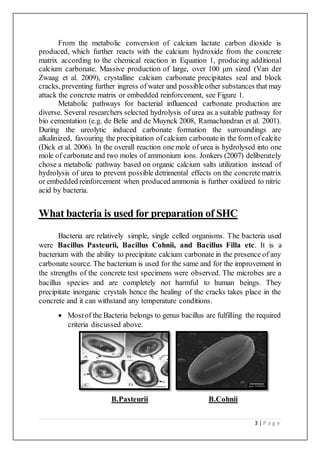
What bacteria is used for preparation of SHC
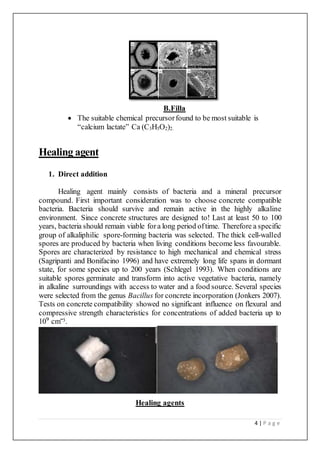
Bacteria are relatively simple, single celled organisms. The bacteria used
were Bacillus Pasteurii, Bacillus Cohnii, and Bacillus Filla etc. It is a
bacterium with the ability to precipitate calcium carbonate in the presence of any
carbonate source. The bacterium is used for the same and for the improvement in
the strengths of the concrete test specimens were observed. The microbes are a
bacillus species and are completely not harmful to human beings. They
precipitate inorganic crystals hence the healing of the cracks takes place in the
concrete and it can withstand any temperature conditions.
 Mostof the Bacteria belongs to genus bacillus are fulfilling the required
criteria discussed above.
B.Pasteurii B.Cohnii
4 | P a g e
B.Filla
 The suitable chemical precursorfound to be most suitable is
“calcium lactate” Ca (C3H5O2)2.
Healing agent
1. Direct addition
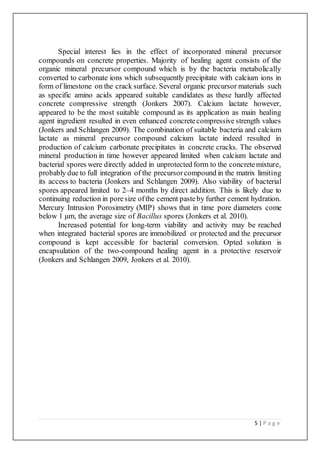
Healing agent mainly consists of bacteria and a mineral precursor
compound. First important consideration was to choose concrete compatible
bacteria. Bacteria should survive and remain active in the highly alkaline
environment. Since concrete structures are designed to! Last at least 50 to 100
years, bacteria should remain viable fora long period oftime. Therefore a specific
group of alkaliphilic spore-forming bacteria was selected. The thick cell-walled
spores are produced by bacteria when living conditions become less favourable.
Spores are characterized by resistance to high mechanical and chemical stress
(Sagripanti and Bonifacino 1996) and have extremely long life spans in dormant
state, for some species up to 200 years (Schlegel 1993). When conditions are
suitable spores germinate and transform into active vegetative bacteria, namely
in alkaline surroundings with access to water and a food source. Several species
were selected from the genus Bacillus for concrete incorporation (Jonkers 2007).
Tests on concrete compatibility showed no significant influence on flexural and
compressive strength characteristics for concentrations of added bacteria up to
10⁹ cm‾3.
Healing agents
5 | P a g e
Special interest lies in the effect of incorporated mineral precursor
compounds on concrete properties. Majority of healing agent consists of the
organic mineral precursor compound which is by the bacteria metabolically
converted to carbonate ions which subsequently precipitate with calcium ions in
form of limestone on the crack surface. Several organic precursor materials such
as specific amino acids appeared suitable candidates as these hardly affected
concrete compressive strength (Jonkers 2007). Calcium lactate however,
appeared to be the most suitable compound as its application as main healing
agent ingredient resulted in even enhanced concretecompressive strength values
(Jonkers and Schlangen 2009). The combination of suitable bacteria and calcium
lactate as mineral precursor compound calcium lactate indeed resulted in
production of calcium carbonate precipitates in concrete cracks. The observed
mineral production in time however appeared limited when calcium lactate and
bacterial spores were directly added in unprotected form to the concretemixture,
probably due to full integration of the precursorcompound in the matrix limiting
its access to bacteria (Jonkers and Schlangen 2009). Also viability of bacterial
spores appeared limited to 2–4 months by direct addition. This is likely due to
continuing reduction in poresize ofthe cement pasteby further cement hydration.
Mercury Intrusion Porosimetry (MIP) shows that in time pore diameters come
below 1 μm, the average size of Bacillus spores (Jonkers et al. 2010).
Increased potential for long-term viability and activity may be reached
when integrated bacterial spores are immobilized or protected and the precursor
compound is kept accessible for bacterial conversion. Opted solution is
encapsulation of the two-compound healing agent in a protective reservoir
(Jonkers and Schlangen 2009, Jonkers et al. 2010).
6 | P a g e
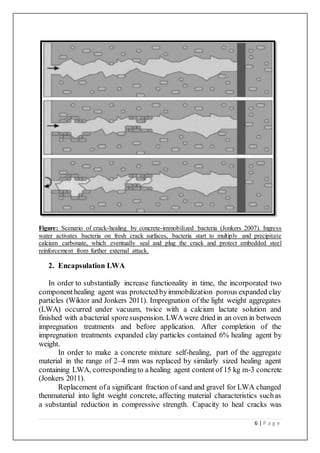
Figure: Scenario of crack-healing by concrete-immobilized bacteria (Jonkers 2007). Ingress
water activates bacteria on fresh crack surfaces, bacteria start to multiply and precipitate
calcium carbonate, which eventually seal and plug the crack and protect embedded steel
reinforcement from further external attack.
2. Encapsulation LWA
In order to substantially increase functionality in time, the incorporated two
component healing agent was protected byimmobilization porous expanded clay
particles (Wiktor and Jonkers 2011). Impregnation of the light weight aggregates
(LWA) occurred under vacuum, twice with a calcium lactate solution and
finished with abacterial sporesuspension. LWAwere dried in an oven in between
impregnation treatments and before application. After completion of the
impregnation treatments expanded clay particles contained 6% healing agent by
weight.
In order to make a concrete mixture self-healing, part of the aggregate
material in the range of 2–4 mm was replaced by similarly sized healing agent
containing LWA, correspondingto a healing agent content of 15 kg m-3 concrete
(Jonkers 2011).
Replacement ofa significant fraction of sand and gravel for LWA changed
thenmaterial into light weight concrete, affecting material characteristics suchas
a substantial reduction in compressive strength. Capacity to heal cracks was
7 | P a g e
substantially improved for concrete containing in LWA encapsulated healing
agent (Jonkers 2011, Wiktor and Jonkers 2011). Viability of incorporated
bacterial spores increased to 6 months, with experiments on-going.
Preparationof Bacterial Solution
Primarily 12.5g ofNutrient broth (media) is added to a 500ml conical flask
containing distilled water. It is then covered with a thick cottonplug and is made
air tight with paper and rubber band. It is then sterilized using a cookerfor about
10-20 minutes. Now the solution is free from any contaminants and the solution
is clear orange in color before the addition of the bacteria.
Fig -1: Solution without bacteria (only media)
Later the flasks are opened up and an exactly 1ml of the bacterium is added
to the sterilized flask and is kept in a shaker at a speed of 150-200 rpm overnight.
After 24 hours the bacterial solution was found to be whitish yellow turbid
solution.
Fig – 2: Solution with Bacteria
8 | P a g e
Compression Strength Test
The cubical Molds of size 150mm x 150mm x 150mm were cleaned and
checked against the joint movement. A coatofoil was applied onthe inner surface
of the Molds and kept ready forthe concreting operation. Meanwhile the required
quantities if cement, fine aggregate and coarse aggregate (passing through IS
sieve of 20 mm size and retained on 4.75 mm) for the particular mix are weighed
accurately for concreting. Fine aggregate and cement were mixed thoroughly in
a hand mixer suchthat the colorofthe mixture is uniform. Then, weighed quantity
of coarse aggregate is added to the mixer and then it rotated till uniform dry
mixture is obtained. Then, calculated quantity of bacterial solution and water was
added and mixing was continued for about 3 to 5 minutes to get a uniform mix.
The wet concrete is now poured into the Molds and for every 2 to 3 layers and
compacted manually. After concreting operations, the upper surface is leveled
and finished with a mason’s trowel. The correspondingidentification marks were
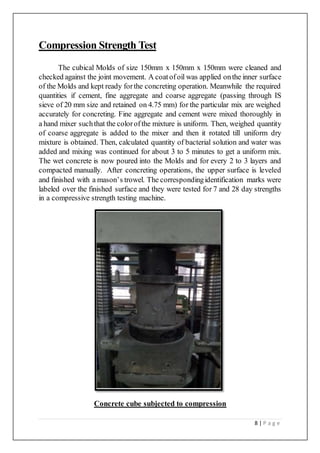
labeled over the finished surface and they were tested for 7 and 28 day strengths
in a compressive strength testing machine.
Concrete cube subjected to compression
9 | P a g e
How the healing agents are applied
 By direct application
The bacteria and the chemical precursor(calcium lactate) are
added directly while making the concrete.
 Encapsulation LAW
 The part of the coarse aggregate is replaced by the light
weight aggregate (LWA), which is impregnated with twice
the calcium lactate solution and the spores of bacteria.
 After impregnation the clay particles with 6% healing
agents and the concrete is made.
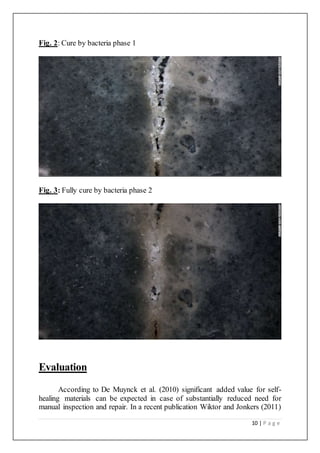
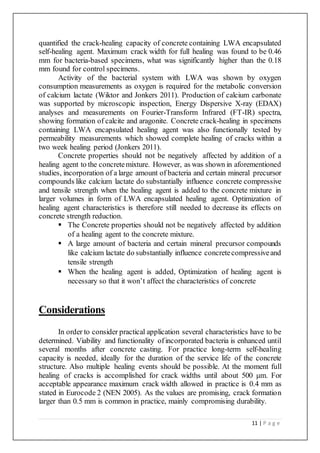
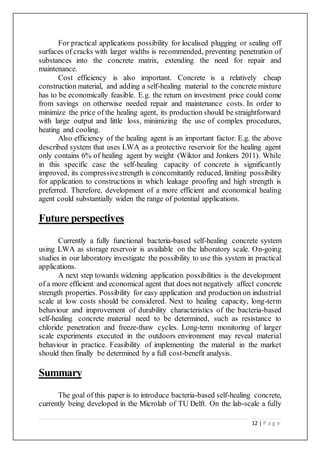
The following Figures shows how the crack has been fulfil
Fig. 1: Crack develop in concrete
10 | P a g e
Fig. 2: Cure by bacteria phase 1
Fig. 3: Fully cure by bacteria phase 2
Evaluation
According to De Muynck et al. (2010) significant added value for self-
healing materials can be expected in case of substantially reduced need for
manual inspection and repair. In a recent publication Wiktor and Jonkers (2011)
11 | P a g e
quantified the crack-healing capacity of concrete containing LWA encapsulated
self-healing agent. Maximum crack width for full healing was found to be 0.46
mm for bacteria-based specimens, what was significantly higher than the 0.18
mm found for control specimens.
Activity of the bacterial system with LWA was shown by oxygen
consumption measurements as oxygen is required for the metabolic conversion
of calcium lactate (Wiktor and Jonkers 2011). Production of calcium carbonate
was supported by microscopic inspection, Energy Dispersive X-ray (EDAX)
analyses and measurements on Fourier-Transform Infrared (FT-IR) spectra,
showing formation of calcite and aragonite. Concrete crack-healing in specimens
containing LWA encapsulated healing agent was also functionally tested by
permeability measurements which showed complete healing of cracks within a
two week healing period (Jonkers 2011).
Concrete properties should not be negatively affected by addition of a
healing agent to the concretemixture. However, as was shown in aforementioned
studies, incorporation of a large amount of bacteria and certain mineral precursor
compounds like calcium lactate do substantially influence concrete compressive
and tensile strength when the healing agent is added to the concrete mixture in
larger volumes in form of LWA encapsulated healing agent. Optimization of
healing agent characteristics is therefore still needed to decrease its effects on
concrete strength reduction.
 The Concrete properties should not be negatively affected by addition
of a healing agent to the concrete mixture.
 A large amount of bacteria and certain mineral precursor compounds
like calcium lactate do substantially influence concretecompressiveand
tensile strength
 When the healing agent is added, Optimization of healing agent is
necessary so that it won’t affect the characteristics of concrete
Considerations
In order to consider practical application several characteristics have to be
determined. Viability and functionality ofincorporated bacteria is enhanced until
several months after concrete casting. For practice long-term self-healing
capacity is needed, ideally for the duration of the service life of the concrete
structure. Also multiple healing events should be possible. At the moment full
healing of cracks is accomplished for crack widths until about 500 μm. For
acceptable appearance maximum crack width allowed in practice is 0.4 mm as
stated in Eurocode 2 (NEN 2005). As the values are promising, crack formation
larger than 0.5 mm is common in practice, mainly compromising durability.
12 | P a g e
For practical applications possibility for localised plugging or sealing off
surfaces of cracks with larger widths is recommended, preventing penetration of
substances into the concrete matrix, extending the need for repair and
maintenance.
Cost efficiency is also important. Concrete is a relatively cheap
construction material, and adding a self-healing material to the concrete mixture
has to be economically feasible. E.g. the return on investment price could come
from savings on otherwise needed repair and maintenance costs. In order to
minimize the price of the healing agent, its production should be straightforward
with large output and little loss, minimizing the use of complex procedures,
heating and cooling.
Also efficiency of the healing agent is an important factor. E.g. the above
described system that uses LWA as a protective reservoir for the healing agent
only contains 6% of healing agent by weight (Wiktor and Jonkers 2011). While
in this specific case the self-healing capacity of concrete is significantly
improved, its compressivestrength is concomitantly reduced, limiting possibility
for application to constructions in which leakage proofing and high strength is
preferred. Therefore, development of a more efficient and economical healing
agent could substantially widen the range of potential applications.
Future perspectives
Currently a fully functional bacteria-based self-healing concrete system
using LWA as storage reservoir is available on the laboratory scale. On-going
studies in our laboratory investigate the possibility to use this system in practical
applications.
A next step towards widening application possibilities is the development
of a more efficient and economical agent that does not negatively affect concrete
strength properties. Possibility for easy application and production on industrial
scale at low costs should be considered. Next to healing capacity, long-term
behaviour and improvement of durability characteristics of the bacteria-based
self-healing concrete material need to be determined, such as resistance to
chloride penetration and freeze-thaw cycles. Long-term monitoring of larger
scale experiments executed in the outdoors environment may reveal material
behaviour in practice. Feasibility of implementing the material in the market
should then finally be determined by a full cost-benefit analysis.
Summary
The goal of this paper is to introduce bacteria-based self-healing concrete,
currently being developed in the Microlab of TU Delft. On the lab-scale a fully
13 | P a g e
functional system exists. To the concrete mixture a healing agent is added,
consisting of two components immobilized in expanded clay particles. Due to
bacterial activity a calcium carbonate layer is deposited on the crack surface,
sealing and blocking entrance to deteriorating substances. Further research and
development is needed in order to make the material ready for application in
practice. The system currently available may limit the field of application.
Addition of a substantial quantity of light weight aggregates not only affects
material properties, it can also impose economic restraints. Since potential
advantages are mainly anticipated in reduction of costs for maintenance and
repair and service life extension of concrete structures, the self-healing material
needs to be cost efficient and durable.
References
1. De Belie, N. and de Muuynck, W. 2009. Crack repair in concrete using
biodeposition. In: M.G. Alexander et al. (Eds.). Concrete Repair,
Rehabilitation and Retrofitting II; Proc. Intern. Conf., Cape Town, 24–26
November, London. Taylor & Francis Group. Pp. 777–781.
2. De Muynck, W. et al. 2010. Microbial carbonate precipitation in
construction materials: A review. Ecological Engineering 36(2), pp. 118–
136.
3. Dick, J. et al. 2006. Bio-deposition of a calcium carbonate layer on
degraded limestone by Bacillus species. Biodegradation 17(4), pp. 357–
367.
4. Edvardsen, C. 1999. Water permeability and autogenously healing of
cracks in concrete. ACI Materials Journal 96(4), pp. 448–454.
5. Jonkers, H. 2007. Self-healing concrete: a biological approach. In: S. van
der Zwaag (Ed.). Self-Healing Materials: An alternative approach to 20
centuries of materials science. Pp. 195–204. The Netherlands: Springer.
6. Jonkers, H. 2011. Bacteria-based self-healing concrete. HERON 56(1), pp.
1–12.
7. Jonkers, H.M. and Schlangen, H.E.J.G. 2009. Bacteria-based self-healing
concrete. Restoration of Buildings and Monuments 15(4), pp. 255–266.
8. Jonkers, H.M. et al. 2010. Application of bacteria as self-healing agent for
the development of sustainable concrete. Ecological Engineering 36(2), pp.
230–235.
9. NEN 2005. Eurocode 2: Design of concrete structures – Part 1-1: General
rules and rules for buildings. NEN-EN 1992-1-1:2005. The Netherlands:
Nederlands Normalisatie-instituut.
10.Ramachandran, S.K. et al. 2001. Remediation of concrete using micro-
organisms. ACI Materials Journal 98(1), pp. 3–9.
14 | P a g e
11.Sagripanti, J.L. and Bonifacino, A. 1996. Comparative sporicidal effects
of liquid chemical agents. Applied and environmental microbiology 62(2),
pp. 545–551.
12.Schlegel, H.G. 1993. General microbiology. England: Cambridge
University Press.
13.Van der Zwaag, S. 2007. Self-healing materials: an alternative approachto
20 Centuries of materials science. The Netherlands: Springer.
14.Van der Zwaag, S. et al. 2009. Self-healing behaviour in man-made
engineering Materials: bioinspired but taking into account their intrinsic
character. Philosophical Transactions of the Royal Society A:
Mathematical, Physical and Engineering Sciences 367(1894), pp. 1689–
1704.
15.Wiktor, V. and Jonkers, H.M. 2011. Quantification of crack-healing in
novel bacteria based self-healing concrete. Cement and Concrete
Composites. 33(7), pp. 763–770.

Self Healing Concrete

  • 1.
    SELF HEALING CONCRETE ABHIKADAK JAGANNATH UNIVERSITY Chaksu,Jaipur DECEMBER 2, 2015
  • 2.
    1 | Pa g e Abstract Crack formation in concrete is common, but a typical phenomenon related to durability. Percolation from cracks may lead to leakage problems or ingress of deleterious materials, causing deterioration ofthe concrete matrix or corrosionof embedded steel reinforcement. Durability can be enhanced by preventing further ingress of water and other substances. In recent years a bacteria-based self- healing concrete is being developed to extend the service life. A two component healing agent is added to the concretemixture. The agent consists of bacteria and an organic mineral precursor compound. Whenever cracks occur and water is present the bacteria become active and convert the incorporated organic compounds into calcium carbonate, which precipitates and is able to seal and block cracks. This paper aims to review the development of bacteria-based self- healing concrete, introducing the proposed healing system. Different stages in the development are discussed, and some recommendations for further research are given. Introduction Concrete in most structures is designed to crack in order to let embedded steel reinforcement take over tensile stresses. Crack formation is also a typical phenomenon related to durability. Percolated cracks may lead to leakage problems or ingress of harmful materials, which can cause deterioration of the concrete matrix or reinforcement corrosion. Durability can be enhanced by preventing further ingress of water and other substances. Self-healing is characterized by regaining performance after a defect occurs. Damage targeted in bacteria-based self-healing concrete particularly relates to increased durability and leakage prevention and extending service life of concretestructures. Jonkers (2007) introduced a two-component healing agent to be added to the concretemixture, consisting ofbacteria and a mineral precursor compound. Upon cracking the system is activated by ingress water. Bacteria convert the mineral precursor compound into the mineral calcium carbonate, better known as limestone. Precipitation of the limestone on the crack surface enables sealing and plugging of the cracks, making the matrix less accessible to water and other deleterious materials. In the laboratory a fully functional bacteria-based self-healing system exists, which will be introduced in this paper. New studies will focus on further development of the system in order to make practical application of the material feasible.
  • 3.
    2 | Pa g e Concept 1. Self-healing Current material design in engineering follows the concept of damage prevention. An alternative design principle is that of self-healing materials, accordingto the conceptofdamage management as introduced byVan derZwaag (2007). Damage formation does not necessarily cause problems, if it is subsequently healed in an autonomous process. Self-healing materials have to serve some roles and meet several properties. Damages should be sensed, followed by transportation of healing agent to the damage site, triggering repair of the damage. In the ideal case self-healing materials are cheap and have properties equal or superior to currently used materials, with the ability to heal defects of any size, multiple times, completely and autonomously. In case of concretedurability performance is mainly considered for damage to be healed, in order to reduce costs of repair and maintenance. An overview of characteristics for self-healing concrete is given by Jonkers (2007). Target for self-healing concrete is to reduce matrix permeability by sealing or blocking cracks. Healing agent is incorporated in the concrete matrix and acts without human intervention. Preference lies in agents working as a catalyst, enabling multiple healing events. To make the material technically and economically competitive, healing agent should be cheap in relation to the low price of concrete, remain potentially active for long periods oftime and be concretecompatible to not negatively affect material characteristics. 2. Microbial healing Concrete already has a built-in healing mechanism due to on-going chemical, physical and mechanical processes.Mostsignificant is precipitation of calcium carbonate (Edvardsen 1999). Average limit for which healing can still occur is a crack width of 0.2 mm. Carbonation reaction lies at the base of the calcium carbonate production, where diffused carbon dioxide reacts with the hydration product calcium hydroxide as can be seen in Equation 1. CO2 + Ca(OH)2 → CaCO3 + H2O (1) The principle of microbial healing also lies in the precipitation of calcium carbonate (Jonkers et al. 2010). Ingress water activates dormant bacteria. Dense layers of calcium carbonate are produced by bacterial conversion of an incorporated mineral precursorcompound. Incase of calcium lactate the reaction is as given in Equation 2, where bacteria only act as a catalyst. Ca(C3H5O2 ) + 7O2 → CaCO3 + 5CO2 + 5H2O (2)
  • 4.
    3 | Pa g e From the metabolic conversion of calcium lactate carbon dioxide is produced, which further reacts with the calcium hydroxide from the concrete matrix according to the chemical reaction in Equation 1, producing additional calcium carbonate. Massive production of large, over 100 μm sized (Van der Zwaag et al. 2009), crystalline calcium carbonate precipitates seal and block cracks, preventing further ingress of water and possibleother substances that may attack the concrete matrix or embedded reinforcement, see Figure 1. Metabolic pathways for bacterial influenced carbonate production are diverse. Several researchers selected hydrolysis of urea as a suitable pathway for bio cementation (e.g. de Belie and de Muynck 2008, Ramachandran et al. 2001). During the ureolytic induced carbonate formation the surroundings are alkalinized, favouring the precipitation ofcalcium carbonatein the form ofcalcite (Dick et al. 2006). In the overall reaction one mole of urea is hydrolysed into one mole of carbonate and two moles of ammonium ions. Jonkers (2007) deliberately chose a metabolic pathway based on organic calcium salts utilization instead of hydrolysis of urea to prevent possible detrimental effects on the concrete matrix or embedded reinforcement when produced ammonia is further oxidized to nitric acid by bacteria. What bacteria is used for preparation of SHC Bacteria are relatively simple, single celled organisms. The bacteria used were Bacillus Pasteurii, Bacillus Cohnii, and Bacillus Filla etc. It is a bacterium with the ability to precipitate calcium carbonate in the presence of any carbonate source. The bacterium is used for the same and for the improvement in the strengths of the concrete test specimens were observed. The microbes are a bacillus species and are completely not harmful to human beings. They precipitate inorganic crystals hence the healing of the cracks takes place in the concrete and it can withstand any temperature conditions.  Mostof the Bacteria belongs to genus bacillus are fulfilling the required criteria discussed above. B.Pasteurii B.Cohnii
  • 5.
    4 | Pa g e B.Filla  The suitable chemical precursorfound to be most suitable is “calcium lactate” Ca (C3H5O2)2. Healing agent 1. Direct addition Healing agent mainly consists of bacteria and a mineral precursor compound. First important consideration was to choose concrete compatible bacteria. Bacteria should survive and remain active in the highly alkaline environment. Since concrete structures are designed to! Last at least 50 to 100 years, bacteria should remain viable fora long period oftime. Therefore a specific group of alkaliphilic spore-forming bacteria was selected. The thick cell-walled spores are produced by bacteria when living conditions become less favourable. Spores are characterized by resistance to high mechanical and chemical stress (Sagripanti and Bonifacino 1996) and have extremely long life spans in dormant state, for some species up to 200 years (Schlegel 1993). When conditions are suitable spores germinate and transform into active vegetative bacteria, namely in alkaline surroundings with access to water and a food source. Several species were selected from the genus Bacillus for concrete incorporation (Jonkers 2007). Tests on concrete compatibility showed no significant influence on flexural and compressive strength characteristics for concentrations of added bacteria up to 10⁹ cm‾3. Healing agents
  • 6.
    5 | Pa g e Special interest lies in the effect of incorporated mineral precursor compounds on concrete properties. Majority of healing agent consists of the organic mineral precursor compound which is by the bacteria metabolically converted to carbonate ions which subsequently precipitate with calcium ions in form of limestone on the crack surface. Several organic precursor materials such as specific amino acids appeared suitable candidates as these hardly affected concrete compressive strength (Jonkers 2007). Calcium lactate however, appeared to be the most suitable compound as its application as main healing agent ingredient resulted in even enhanced concretecompressive strength values (Jonkers and Schlangen 2009). The combination of suitable bacteria and calcium lactate as mineral precursor compound calcium lactate indeed resulted in production of calcium carbonate precipitates in concrete cracks. The observed mineral production in time however appeared limited when calcium lactate and bacterial spores were directly added in unprotected form to the concretemixture, probably due to full integration of the precursorcompound in the matrix limiting its access to bacteria (Jonkers and Schlangen 2009). Also viability of bacterial spores appeared limited to 2–4 months by direct addition. This is likely due to continuing reduction in poresize ofthe cement pasteby further cement hydration. Mercury Intrusion Porosimetry (MIP) shows that in time pore diameters come below 1 μm, the average size of Bacillus spores (Jonkers et al. 2010). Increased potential for long-term viability and activity may be reached when integrated bacterial spores are immobilized or protected and the precursor compound is kept accessible for bacterial conversion. Opted solution is encapsulation of the two-compound healing agent in a protective reservoir (Jonkers and Schlangen 2009, Jonkers et al. 2010).
  • 7.
    6 | Pa g e Figure: Scenario of crack-healing by concrete-immobilized bacteria (Jonkers 2007). Ingress water activates bacteria on fresh crack surfaces, bacteria start to multiply and precipitate calcium carbonate, which eventually seal and plug the crack and protect embedded steel reinforcement from further external attack. 2. Encapsulation LWA In order to substantially increase functionality in time, the incorporated two component healing agent was protected byimmobilization porous expanded clay particles (Wiktor and Jonkers 2011). Impregnation of the light weight aggregates (LWA) occurred under vacuum, twice with a calcium lactate solution and finished with abacterial sporesuspension. LWAwere dried in an oven in between impregnation treatments and before application. After completion of the impregnation treatments expanded clay particles contained 6% healing agent by weight. In order to make a concrete mixture self-healing, part of the aggregate material in the range of 2–4 mm was replaced by similarly sized healing agent containing LWA, correspondingto a healing agent content of 15 kg m-3 concrete (Jonkers 2011). Replacement ofa significant fraction of sand and gravel for LWA changed thenmaterial into light weight concrete, affecting material characteristics suchas a substantial reduction in compressive strength. Capacity to heal cracks was
  • 8.
    7 | Pa g e substantially improved for concrete containing in LWA encapsulated healing agent (Jonkers 2011, Wiktor and Jonkers 2011). Viability of incorporated bacterial spores increased to 6 months, with experiments on-going. Preparationof Bacterial Solution Primarily 12.5g ofNutrient broth (media) is added to a 500ml conical flask containing distilled water. It is then covered with a thick cottonplug and is made air tight with paper and rubber band. It is then sterilized using a cookerfor about 10-20 minutes. Now the solution is free from any contaminants and the solution is clear orange in color before the addition of the bacteria. Fig -1: Solution without bacteria (only media) Later the flasks are opened up and an exactly 1ml of the bacterium is added to the sterilized flask and is kept in a shaker at a speed of 150-200 rpm overnight. After 24 hours the bacterial solution was found to be whitish yellow turbid solution. Fig – 2: Solution with Bacteria
  • 9.
    8 | Pa g e Compression Strength Test The cubical Molds of size 150mm x 150mm x 150mm were cleaned and checked against the joint movement. A coatofoil was applied onthe inner surface of the Molds and kept ready forthe concreting operation. Meanwhile the required quantities if cement, fine aggregate and coarse aggregate (passing through IS sieve of 20 mm size and retained on 4.75 mm) for the particular mix are weighed accurately for concreting. Fine aggregate and cement were mixed thoroughly in a hand mixer suchthat the colorofthe mixture is uniform. Then, weighed quantity of coarse aggregate is added to the mixer and then it rotated till uniform dry mixture is obtained. Then, calculated quantity of bacterial solution and water was added and mixing was continued for about 3 to 5 minutes to get a uniform mix. The wet concrete is now poured into the Molds and for every 2 to 3 layers and compacted manually. After concreting operations, the upper surface is leveled and finished with a mason’s trowel. The correspondingidentification marks were labeled over the finished surface and they were tested for 7 and 28 day strengths in a compressive strength testing machine. Concrete cube subjected to compression
  • 10.
    9 | Pa g e How the healing agents are applied  By direct application The bacteria and the chemical precursor(calcium lactate) are added directly while making the concrete.  Encapsulation LAW  The part of the coarse aggregate is replaced by the light weight aggregate (LWA), which is impregnated with twice the calcium lactate solution and the spores of bacteria.  After impregnation the clay particles with 6% healing agents and the concrete is made. The following Figures shows how the crack has been fulfil Fig. 1: Crack develop in concrete
  • 11.
    10 | Pa g e Fig. 2: Cure by bacteria phase 1 Fig. 3: Fully cure by bacteria phase 2 Evaluation According to De Muynck et al. (2010) significant added value for self- healing materials can be expected in case of substantially reduced need for manual inspection and repair. In a recent publication Wiktor and Jonkers (2011)
  • 12.
    11 | Pa g e quantified the crack-healing capacity of concrete containing LWA encapsulated self-healing agent. Maximum crack width for full healing was found to be 0.46 mm for bacteria-based specimens, what was significantly higher than the 0.18 mm found for control specimens. Activity of the bacterial system with LWA was shown by oxygen consumption measurements as oxygen is required for the metabolic conversion of calcium lactate (Wiktor and Jonkers 2011). Production of calcium carbonate was supported by microscopic inspection, Energy Dispersive X-ray (EDAX) analyses and measurements on Fourier-Transform Infrared (FT-IR) spectra, showing formation of calcite and aragonite. Concrete crack-healing in specimens containing LWA encapsulated healing agent was also functionally tested by permeability measurements which showed complete healing of cracks within a two week healing period (Jonkers 2011). Concrete properties should not be negatively affected by addition of a healing agent to the concretemixture. However, as was shown in aforementioned studies, incorporation of a large amount of bacteria and certain mineral precursor compounds like calcium lactate do substantially influence concrete compressive and tensile strength when the healing agent is added to the concrete mixture in larger volumes in form of LWA encapsulated healing agent. Optimization of healing agent characteristics is therefore still needed to decrease its effects on concrete strength reduction.  The Concrete properties should not be negatively affected by addition of a healing agent to the concrete mixture.  A large amount of bacteria and certain mineral precursor compounds like calcium lactate do substantially influence concretecompressiveand tensile strength  When the healing agent is added, Optimization of healing agent is necessary so that it won’t affect the characteristics of concrete Considerations In order to consider practical application several characteristics have to be determined. Viability and functionality ofincorporated bacteria is enhanced until several months after concrete casting. For practice long-term self-healing capacity is needed, ideally for the duration of the service life of the concrete structure. Also multiple healing events should be possible. At the moment full healing of cracks is accomplished for crack widths until about 500 μm. For acceptable appearance maximum crack width allowed in practice is 0.4 mm as stated in Eurocode 2 (NEN 2005). As the values are promising, crack formation larger than 0.5 mm is common in practice, mainly compromising durability.
  • 13.
    12 | Pa g e For practical applications possibility for localised plugging or sealing off surfaces of cracks with larger widths is recommended, preventing penetration of substances into the concrete matrix, extending the need for repair and maintenance. Cost efficiency is also important. Concrete is a relatively cheap construction material, and adding a self-healing material to the concrete mixture has to be economically feasible. E.g. the return on investment price could come from savings on otherwise needed repair and maintenance costs. In order to minimize the price of the healing agent, its production should be straightforward with large output and little loss, minimizing the use of complex procedures, heating and cooling. Also efficiency of the healing agent is an important factor. E.g. the above described system that uses LWA as a protective reservoir for the healing agent only contains 6% of healing agent by weight (Wiktor and Jonkers 2011). While in this specific case the self-healing capacity of concrete is significantly improved, its compressivestrength is concomitantly reduced, limiting possibility for application to constructions in which leakage proofing and high strength is preferred. Therefore, development of a more efficient and economical healing agent could substantially widen the range of potential applications. Future perspectives Currently a fully functional bacteria-based self-healing concrete system using LWA as storage reservoir is available on the laboratory scale. On-going studies in our laboratory investigate the possibility to use this system in practical applications. A next step towards widening application possibilities is the development of a more efficient and economical agent that does not negatively affect concrete strength properties. Possibility for easy application and production on industrial scale at low costs should be considered. Next to healing capacity, long-term behaviour and improvement of durability characteristics of the bacteria-based self-healing concrete material need to be determined, such as resistance to chloride penetration and freeze-thaw cycles. Long-term monitoring of larger scale experiments executed in the outdoors environment may reveal material behaviour in practice. Feasibility of implementing the material in the market should then finally be determined by a full cost-benefit analysis. Summary The goal of this paper is to introduce bacteria-based self-healing concrete, currently being developed in the Microlab of TU Delft. On the lab-scale a fully
  • 14.
    13 | Pa g e functional system exists. To the concrete mixture a healing agent is added, consisting of two components immobilized in expanded clay particles. Due to bacterial activity a calcium carbonate layer is deposited on the crack surface, sealing and blocking entrance to deteriorating substances. Further research and development is needed in order to make the material ready for application in practice. The system currently available may limit the field of application. Addition of a substantial quantity of light weight aggregates not only affects material properties, it can also impose economic restraints. Since potential advantages are mainly anticipated in reduction of costs for maintenance and repair and service life extension of concrete structures, the self-healing material needs to be cost efficient and durable. References 1. De Belie, N. and de Muuynck, W. 2009. Crack repair in concrete using biodeposition. In: M.G. Alexander et al. (Eds.). Concrete Repair, Rehabilitation and Retrofitting II; Proc. Intern. Conf., Cape Town, 24–26 November, London. Taylor & Francis Group. Pp. 777–781. 2. De Muynck, W. et al. 2010. Microbial carbonate precipitation in construction materials: A review. Ecological Engineering 36(2), pp. 118– 136. 3. Dick, J. et al. 2006. Bio-deposition of a calcium carbonate layer on degraded limestone by Bacillus species. Biodegradation 17(4), pp. 357– 367. 4. Edvardsen, C. 1999. Water permeability and autogenously healing of cracks in concrete. ACI Materials Journal 96(4), pp. 448–454. 5. Jonkers, H. 2007. Self-healing concrete: a biological approach. In: S. van der Zwaag (Ed.). Self-Healing Materials: An alternative approach to 20 centuries of materials science. Pp. 195–204. The Netherlands: Springer. 6. Jonkers, H. 2011. Bacteria-based self-healing concrete. HERON 56(1), pp. 1–12. 7. Jonkers, H.M. and Schlangen, H.E.J.G. 2009. Bacteria-based self-healing concrete. Restoration of Buildings and Monuments 15(4), pp. 255–266. 8. Jonkers, H.M. et al. 2010. Application of bacteria as self-healing agent for the development of sustainable concrete. Ecological Engineering 36(2), pp. 230–235. 9. NEN 2005. Eurocode 2: Design of concrete structures – Part 1-1: General rules and rules for buildings. NEN-EN 1992-1-1:2005. The Netherlands: Nederlands Normalisatie-instituut. 10.Ramachandran, S.K. et al. 2001. Remediation of concrete using micro- organisms. ACI Materials Journal 98(1), pp. 3–9.
  • 15.
    14 | Pa g e 11.Sagripanti, J.L. and Bonifacino, A. 1996. Comparative sporicidal effects of liquid chemical agents. Applied and environmental microbiology 62(2), pp. 545–551. 12.Schlegel, H.G. 1993. General microbiology. England: Cambridge University Press. 13.Van der Zwaag, S. 2007. Self-healing materials: an alternative approachto 20 Centuries of materials science. The Netherlands: Springer. 14.Van der Zwaag, S. et al. 2009. Self-healing behaviour in man-made engineering Materials: bioinspired but taking into account their intrinsic character. Philosophical Transactions of the Royal Society A: Mathematical, Physical and Engineering Sciences 367(1894), pp. 1689– 1704. 15.Wiktor, V. and Jonkers, H.M. 2011. Quantification of crack-healing in novel bacteria based self-healing concrete. Cement and Concrete Composites. 33(7), pp. 763–770.