LANGUAGE & ARTS
ENGLISH “B”
SILVIA SELENE VALDEZ. ENGLISH “B”
ENGLISH “B” LEVEL
WHAT IS IT?
Language arts is a broad term and includes
all fields of study involved in communicating
with a language. It includes subjects such as:
phonics, reading, handwriting, writing
(composition), reading comprehension,
vocabulary, spelling, grammar, speech,
among others.
HOW DO TEACHERS PRESENT AND GUIDE THEIR
TEACHING AND LEARNING FOR THE STUDENTS?
1. Teacher Clarity
When a teacher begins a new unit of study or
project with students, she clarifies the purpose
and learning goals, and provides explicit
criteria on how students can be successful. It's
ideal to also present models or examples to
students so they can see what the end product
looks like.

2. CLASSROOM DISCUSSION
Teachers need a frequently step offstage and
facilitate entire class discussion. This allows
students to learn from each other. It's also a great
opportunity for teachers to formatively assess
(through observation) how well students are
grasping new content and concepts.
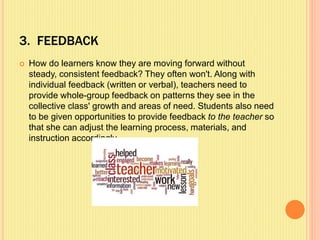
3. FEEDBACK
 How do learners know they are moving forward without
steady, consistent feedback? They often won't. Along with
individual feedback (written or verbal), teachers need to
provide whole-group feedback on patterns they see in the
collective class' growth and areas of need. Students also need
to be given opportunities to provide feedback to the teacher so
that she can adjust the learning process, materials, and
instruction accordingly.
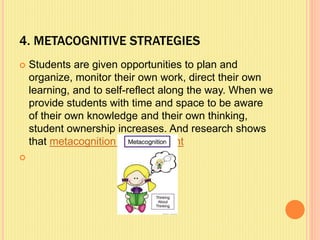
4. METACOGNITIVE STRATEGIES
 Students are given opportunities to plan and
organize, monitor their own work, direct their own
learning, and to self-reflect along the way. When we
provide students with time and space to be aware
of their own knowledge and their own thinking,
student ownership increases. And research shows
that metacognition can be taught

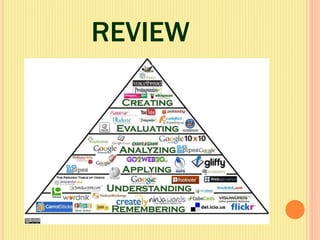
REVIEW
5. FORMATIVE ASSESSMENT
 In order to provide students with effective
and accurate feedback, teachers need to
assess frequently and routinely where
students are in relation to the unit of study's
learning goals or end product (summative
assessment). So is important that teachers
spend the same amount of time on
formative evaluation as they do on
summative assessment.
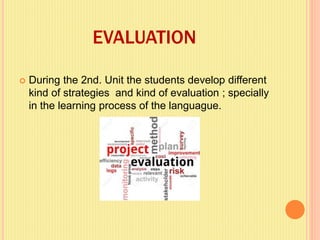
EVALUATION
 During the 2nd. Unit the students develop different
kind of strategies and kind of evaluation ; specially
in the learning process of the languague.
ENGLISH TEACHER’S PROFESSIONAL
DEVELOPMENT IN LANGUAGE
 During the 2nd. Unit the students and I have
appplied different techniques of learning in the
different strategies that belong to the subject.
 Part of the work was applied to improve different
kind of subjects as: Reading, Writing, Grammar,
Spelling.
PLAN OF THE CLASS
 A plan should be presented every week.
 It’s important to be ready so that means to make a
plan before teaching.
 Every assignment should be completed during the
unit learning.
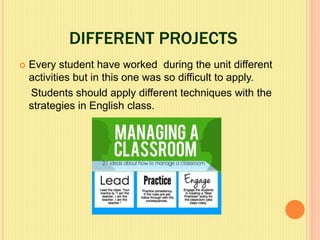
DIFFERENT PROJECTS
 Every student have worked during the unit different
activities but in this one was so difficult to apply.
Students should apply different techniques with the
strategies in English class.
BIOGRAPHY PROJECT
VOCABULARY WORKSHOP
COOPERATIVE WORK
FINAL REFLECTION OF ENGLISH B
LEVEL CLASS
 A way to sort out questions students might ask
themselves to face the responsability of improving
their performance in the learning of English as a
foreign language is presented.
 We have also tried to provide some questions and
some answers to guide the language learning.

Selene portfolio 2.

Selene portfolio 2.

  • 1.
  • 2.
    SILVIA SELENE VALDEZ.ENGLISH “B”
  • 3.
  • 4.
    WHAT IS IT? Languagearts is a broad term and includes all fields of study involved in communicating with a language. It includes subjects such as: phonics, reading, handwriting, writing (composition), reading comprehension, vocabulary, spelling, grammar, speech, among others.
  • 5.
    HOW DO TEACHERSPRESENT AND GUIDE THEIR TEACHING AND LEARNING FOR THE STUDENTS? 1. Teacher Clarity When a teacher begins a new unit of study or project with students, she clarifies the purpose and learning goals, and provides explicit criteria on how students can be successful. It's ideal to also present models or examples to students so they can see what the end product looks like. 
  • 6.
    2. CLASSROOM DISCUSSION Teachersneed a frequently step offstage and facilitate entire class discussion. This allows students to learn from each other. It's also a great opportunity for teachers to formatively assess (through observation) how well students are grasping new content and concepts.
  • 7.
    3. FEEDBACK  Howdo learners know they are moving forward without steady, consistent feedback? They often won't. Along with individual feedback (written or verbal), teachers need to provide whole-group feedback on patterns they see in the collective class' growth and areas of need. Students also need to be given opportunities to provide feedback to the teacher so that she can adjust the learning process, materials, and instruction accordingly.
  • 8.
    4. METACOGNITIVE STRATEGIES Students are given opportunities to plan and organize, monitor their own work, direct their own learning, and to self-reflect along the way. When we provide students with time and space to be aware of their own knowledge and their own thinking, student ownership increases. And research shows that metacognition can be taught 
  • 9.
  • 10.
    5. FORMATIVE ASSESSMENT In order to provide students with effective and accurate feedback, teachers need to assess frequently and routinely where students are in relation to the unit of study's learning goals or end product (summative assessment). So is important that teachers spend the same amount of time on formative evaluation as they do on summative assessment.
  • 11.
    EVALUATION  During the2nd. Unit the students develop different kind of strategies and kind of evaluation ; specially in the learning process of the languague.
  • 12.
    ENGLISH TEACHER’S PROFESSIONAL DEVELOPMENTIN LANGUAGE  During the 2nd. Unit the students and I have appplied different techniques of learning in the different strategies that belong to the subject.  Part of the work was applied to improve different kind of subjects as: Reading, Writing, Grammar, Spelling.
  • 13.
    PLAN OF THECLASS  A plan should be presented every week.  It’s important to be ready so that means to make a plan before teaching.  Every assignment should be completed during the unit learning.
  • 14.
    DIFFERENT PROJECTS  Everystudent have worked during the unit different activities but in this one was so difficult to apply. Students should apply different techniques with the strategies in English class.
  • 15.
  • 17.
  • 18.
  • 20.
    FINAL REFLECTION OFENGLISH B LEVEL CLASS  A way to sort out questions students might ask themselves to face the responsability of improving their performance in the learning of English as a foreign language is presented.  We have also tried to provide some questions and some answers to guide the language learning.