REVISION RECOMMENDATIONS OF AN ESL CURRICULUM:
ESL-(English as a Second Language) Curriculum for Adult
Learners
Course Code: EDU-5350; CURRICULUM DEVELOPMENT
Group Presenters : Mina Bidaie,
Javaria Fauzan & Nurul Fitriah
M.Ed - Curriculum & Instruction,
Faculty of Educational Studies, UPM
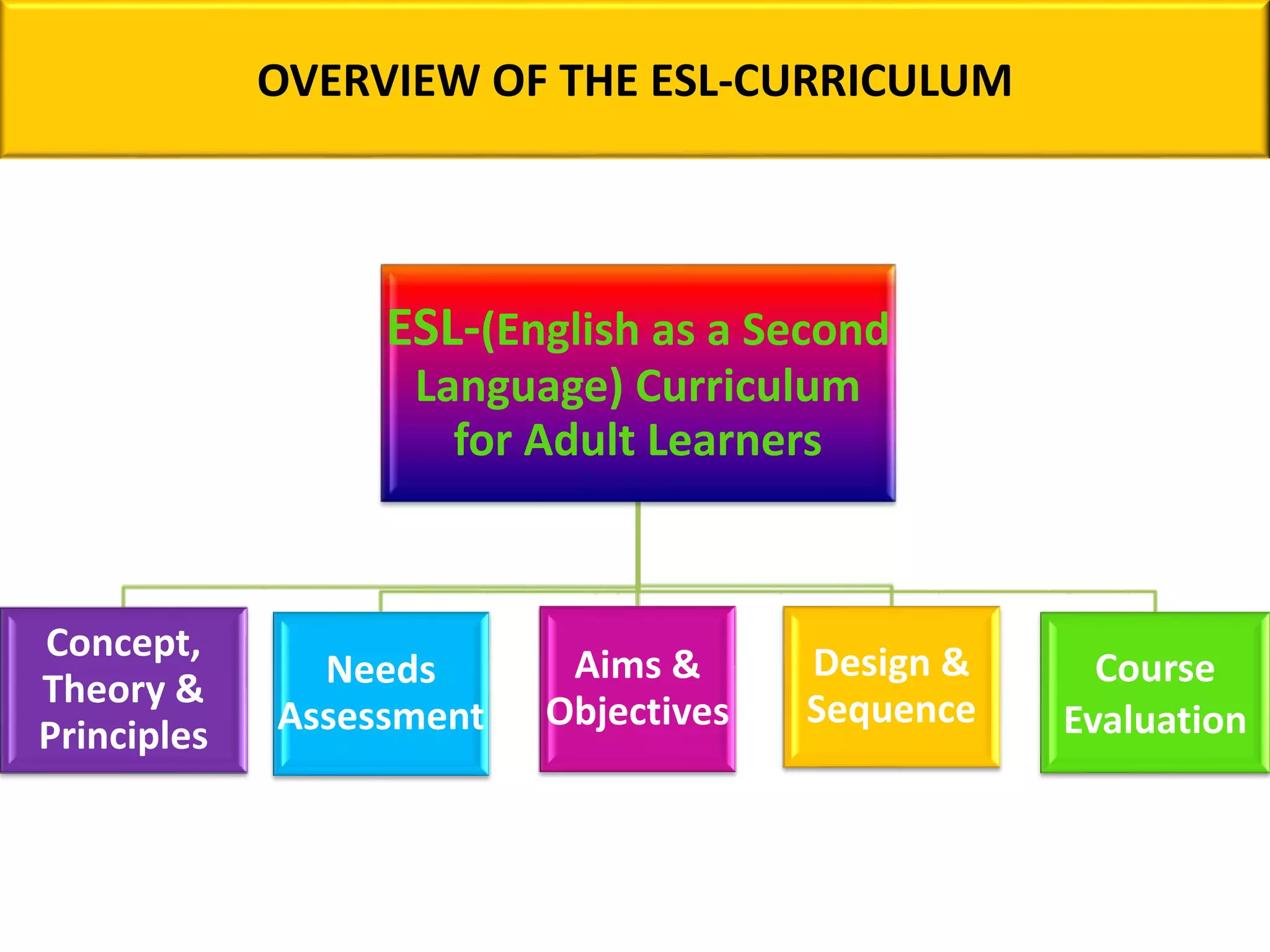
OVERVIEW OF THE ESL-CURRICULUM
ESL-(English as a Second
Language) Curriculum
for Adult Learners
Concept,
Theory &
Principles
Needs
Assessment
Aims &
Objectives
Design &
Sequence
Course
Evaluation
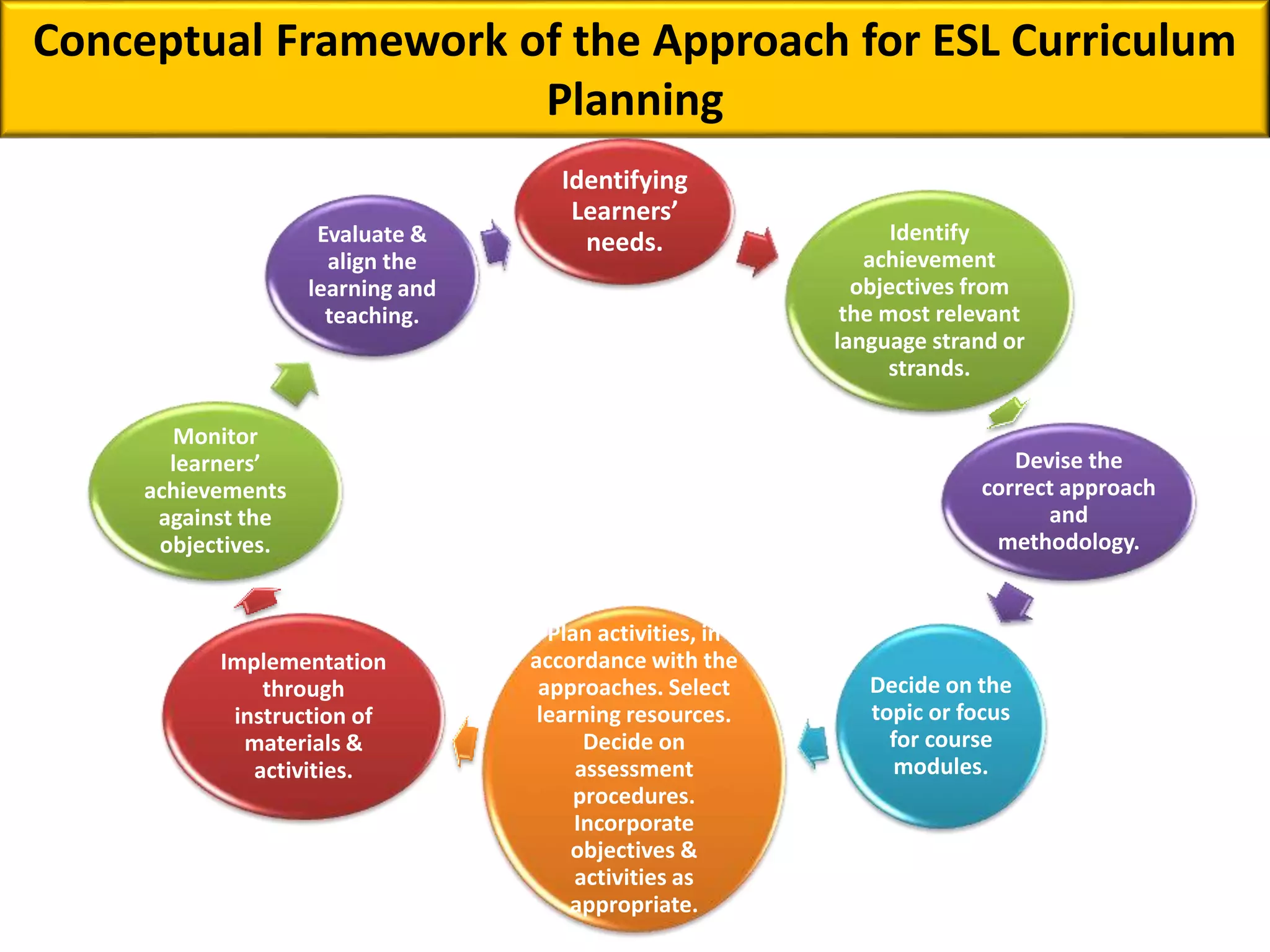
Conceptual Framework of the Approach for ESL Curriculum
Planning
Identifying
Learners’
needs. Identify
achievement
objectives from
the most relevant
language strand or
strands.
Devise the
correct approach
and
methodology.
Decide on the
topic or focus
for course
modules.
Plan activities, in
accordance with the
approaches. Select
learning resources.
Decide on
assessment
procedures.
Incorporate
objectives &
activities as
appropriate.
Implementation
through
instruction of
materials &
activities.
Monitor
learners’
achievements
against the
objectives.
Evaluate &
align the
learning and
teaching.
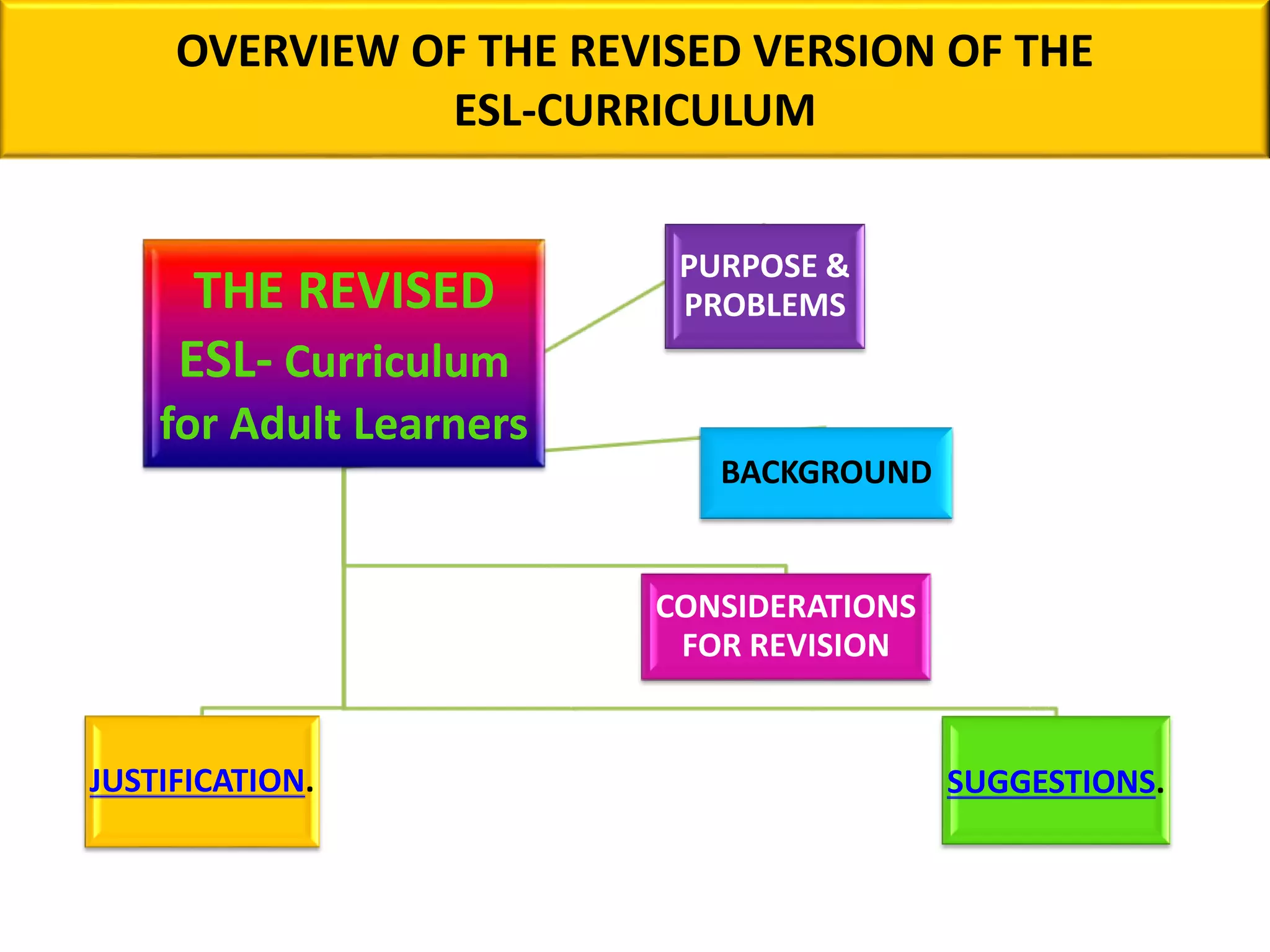
OVERVIEW OF THE REVISED VERSION OF THE
ESL-CURRICULUM
THE REVISED
ESL- Curriculum
for Adult Learners
PURPOSE &
PROBLEMS
BACKGROUND
CONSIDERATIONS
FOR REVISION
JUSTIFICATION. SUGGESTIONS.
THE PURPOSE & PROBLEMS TO FOCUS UPON IN ESL-
CURRICULA
This curriculum addresses the learning needs
of adults English as a Second Language ESL
learner who have limited or interrupted
formal education in English language.
Teaching English as second language to
adult learners has been always an issue with
several problems which some of them could
be solve by implementing useful strategies,
or even be the result of inappropriate
strategies implementation.
Purpose
An ESL -Curriculum Revision & further development must ensure that reading and
writing activity are well integrated around meaning-making tasks with texts and that it
focuses on fluency before accuracy is preferable to a skill-based curriculum. Also that it
highlights the importance of individual needs and interests of students simultaneously.
To bring together the cognitive, emotional, environmental influences and experiences
for acquiring, enhancing, or making changes in learner’s knowledge, skills, values and
world views. And carefully scrutinize to make sure that the entire content of the
curriculum is in alignment with the general & specific objectives and that learners are
going to develop their knowledge of English by actively using it inside and outside the
classroom in order to communicate.
To check that the Tasks are sequenced in a coherent manner and that all activities,
instruction & incorporated are in alignment with the prescribed standards of adult
ELL’s. Also checking for language proficiency levels of written materials and
authenticity of texts. Major and minor considerations and questions are put up
which address the application & usage of English language for practical purposes in
real-life situations.
Problems
Students Teachers Strategies
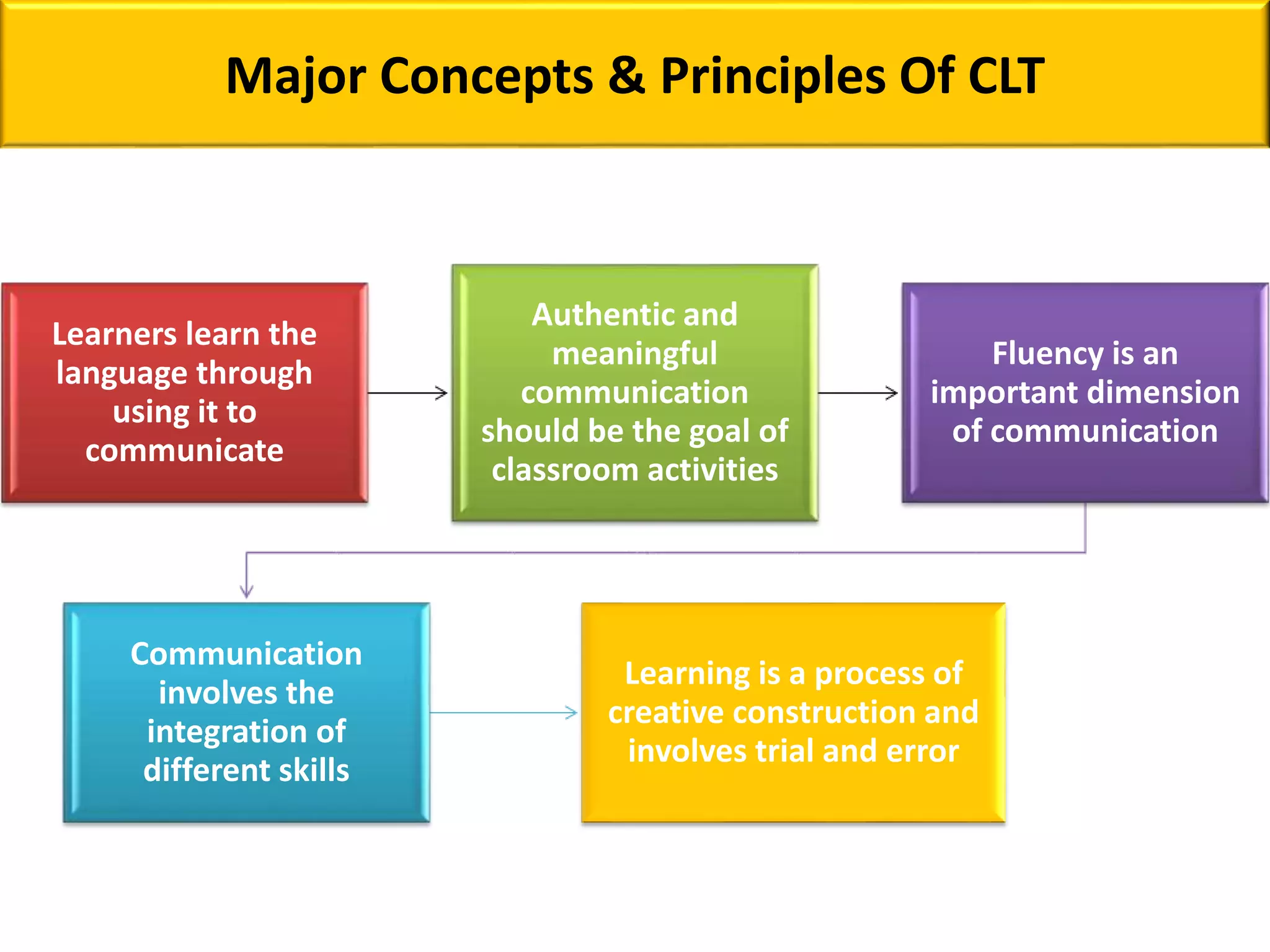
Major Concepts & Principles Of CLT
Learners learn the
language through
using it to
communicate
Authentic and
meaningful
communication
should be the goal of
classroom activities
Fluency is an
important dimension
of communication
Communication
involves the
integration of
different skills
Learning is a process of
creative construction and
involves trial and error
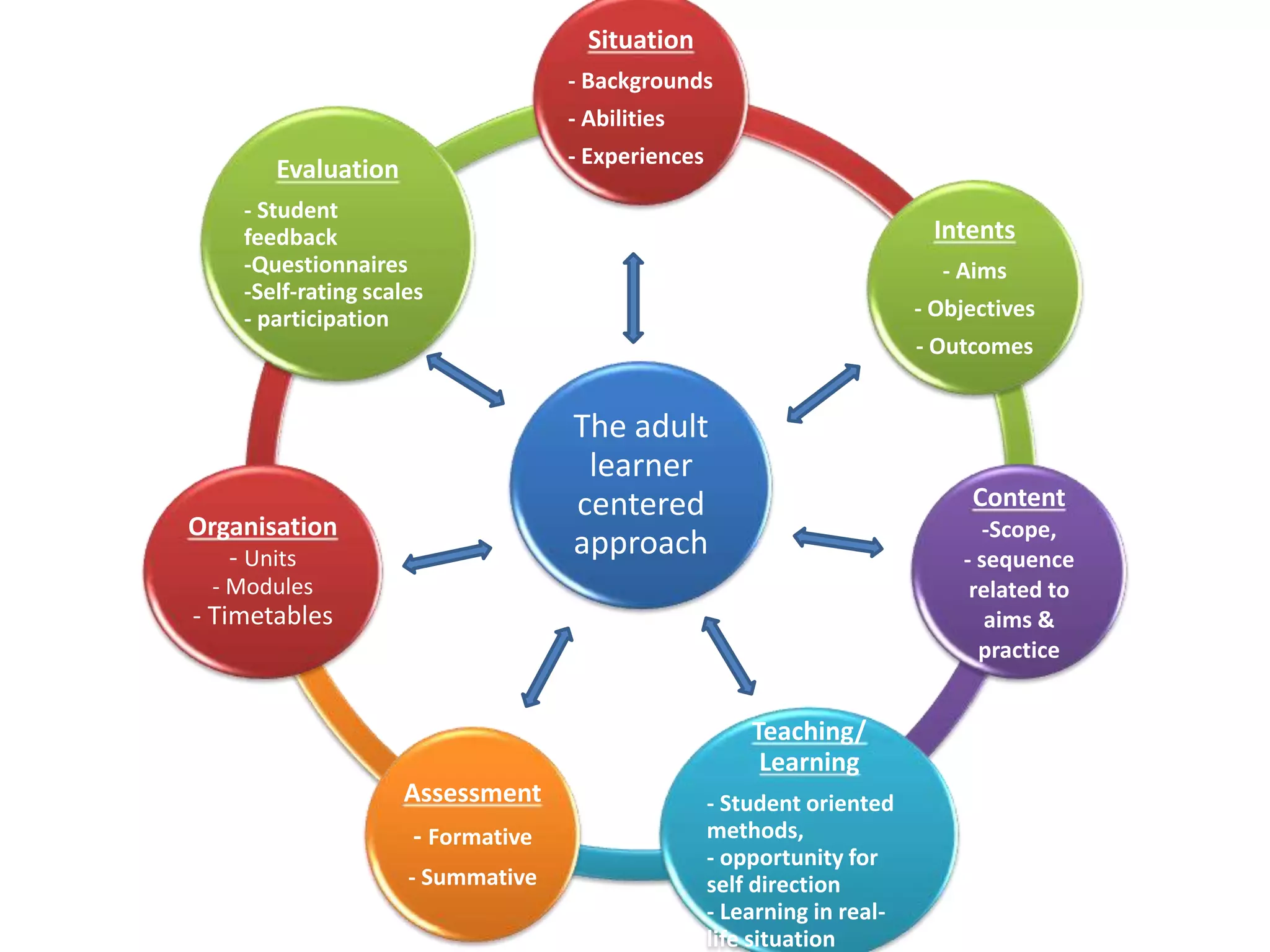
The adult
learner
centered
approach
Situation
- Backgrounds
- Abilities
- Experiences
Intents
- Aims
- Objectives
- Outcomes
Content
-Scope,
- sequence
related to
aims &
practice
Teaching/
Learning
- Student oriented
methods,
- opportunity for
self direction
- Learning in real-
life situation
Assessment
- Formative
- Summative
Organisation
- Units
- Modules
- Timetables
Evaluation
- Student
feedback
-Questionnaires
-Self-rating scales
- participation
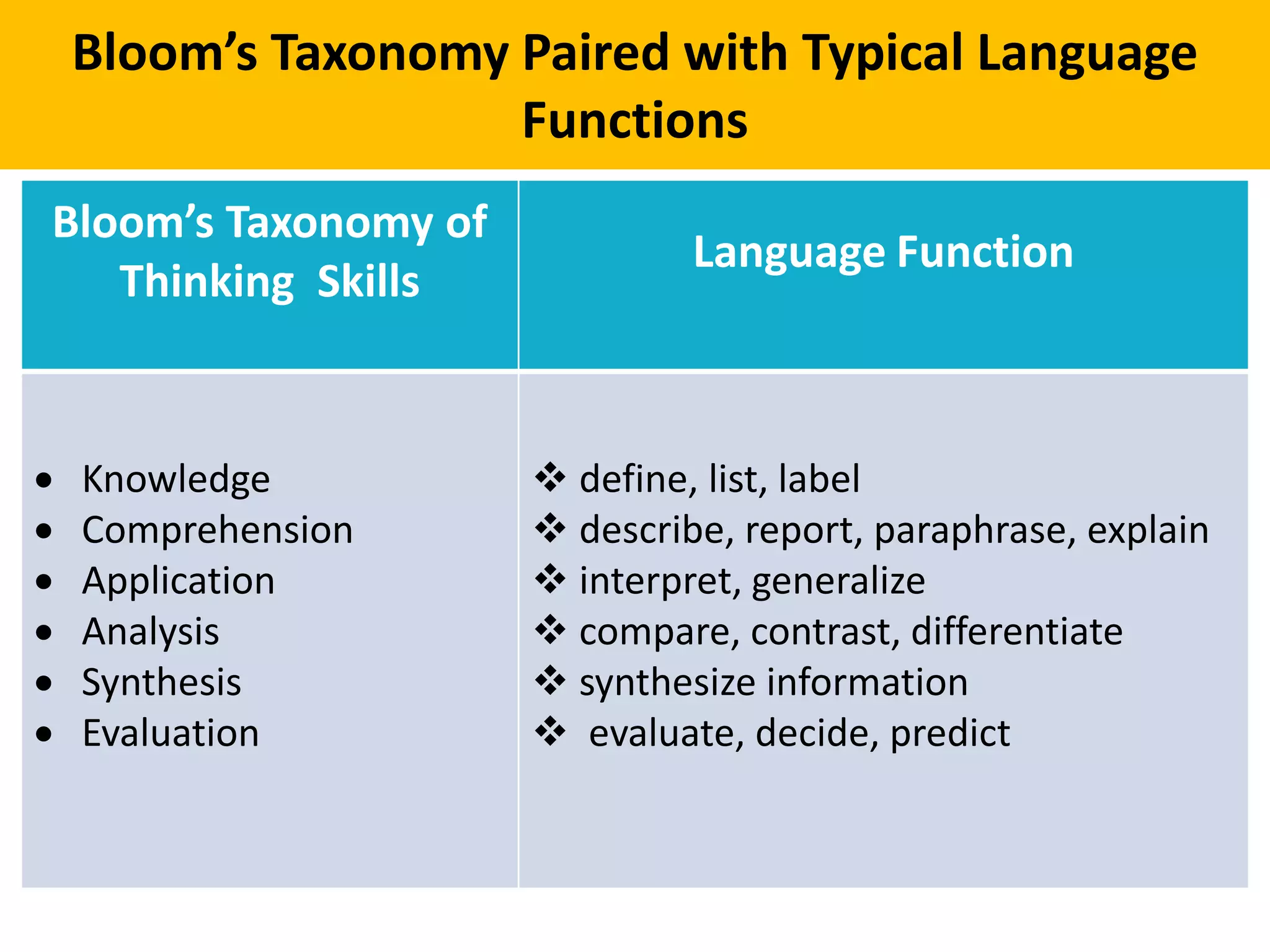
Bloom’s Taxonomy Paired with Typical Language
Functions
Bloom’s Taxonomy of
Thinking Skills
Language Function
 Knowledge
 Comprehension
 Application
 Analysis
 Synthesis
 Evaluation
 define, list, label
 describe, report, paraphrase, explain
 interpret, generalize
 compare, contrast, differentiate
 synthesize information
 evaluate, decide, predict
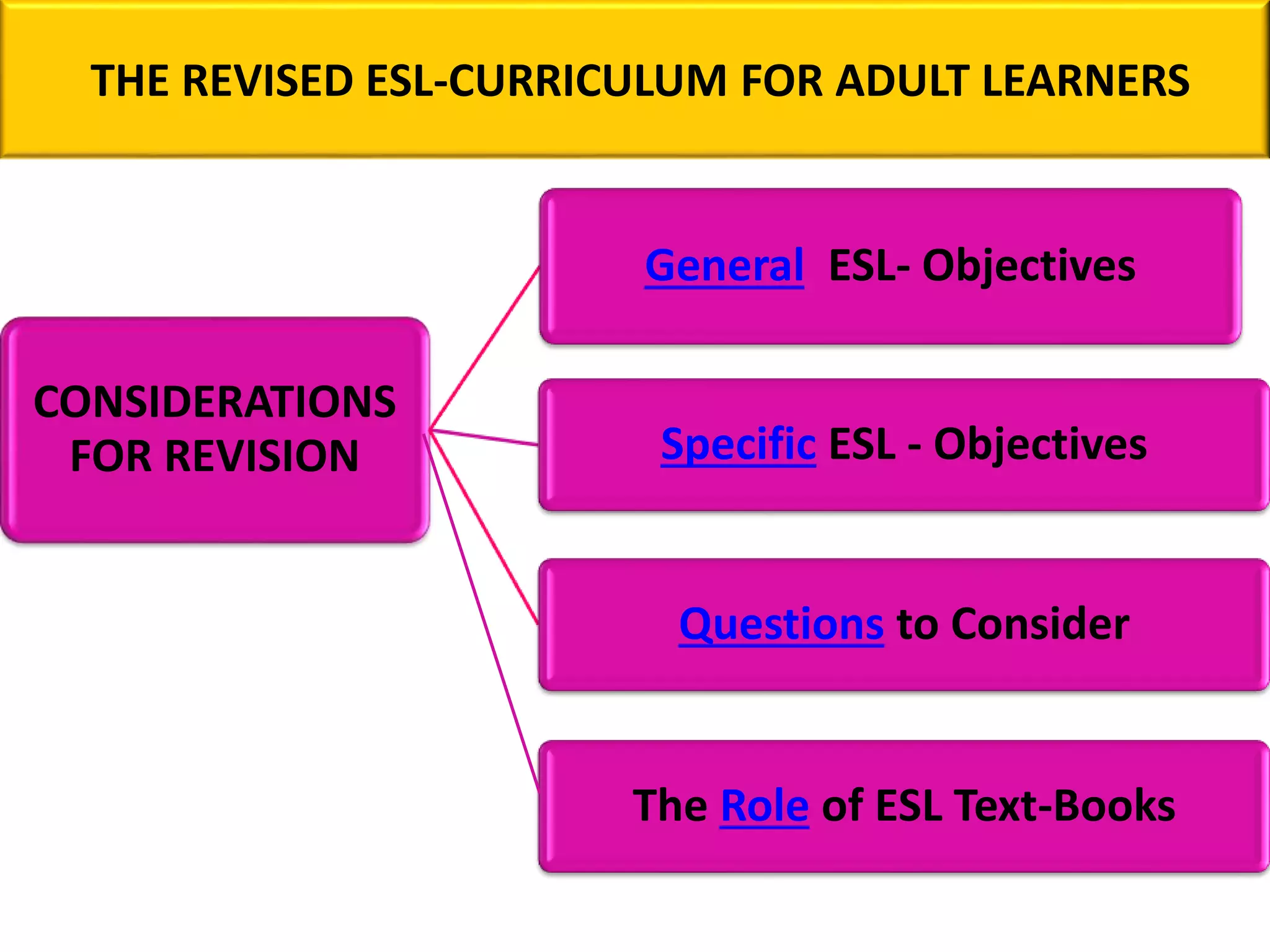
THE REVISED ESL-CURRICULUM FOR ADULT LEARNERS
CONSIDERATIONS
FOR REVISION
General ESL- Objectives
Specific ESL - Objectives
Questions to Consider
The Role of ESL Text-Books
REFERENCES:
Ansary, H., & Babaii, E. (2006). Universal characteristics of EFL/ESL textbooks: A step towards systematic
textbook evaluation. ITESL. Retrieved 11/08/2006 from http://iteslj.org/Articles/Ansary-Textbooks/.
Berube, B. (2000). Managing ESL programs in rural and small urban schools. Alexandria, VA: Teachers of
English to Speakers of Other Languages.
ATESL Adult ESL Curriculum Framework : http://www.atesldocuments.com/cf/demonstrating
Byrd, P. (2001). “Textbooks: Evaluation for selection and analysis for implementation.” In M. Celce-Murcia
(Ed.), Teaching English as a second or foreign language. Boston, MA: Heinle & Heinle.
Collier, V. (1989). How long? A synthesis of research on academic achievement in a second language. TESOL
Quarterly, 23(3), 509-531.
Cooper, J. (2000). Literacy: Helping children construct meaning (4th ed). New York: Houghton Mifflin.
Echevarria, J., Vogt, M., & Short, D. J. (2004). Making content comprehensible for English language learners:
The SIOP model. Boston: Allyn and Bacon.
Fountas, I., & Pinnell, G. (1996). Guided reading: Good first teaching for all children. Portsmouth, NH:
Heinemann.
Garinger, D. (2002). Textbook selection for the ESL classroom. Online Resources: Digests.
http://www.cal.org/resources/Digest/0210garinger.html
REFERENCES:
Gibbons, P. (2002). Scaffolding language, scaffolding learning. Portsmouth, NH: Heinemann.
Graves, K. (2000). Designing language courses: A guide for teachers. Boston, MA: Heinle & Heinle.
Kessler, C. (1997). Authenticity in K-12 ESL textbooks. Paper presented at the Annual Meeting of the
Teachers of English to Speakers of Other Languages, Orlando, FL.
Marzano, R. (2004). Building background knowledge for academic achievement: Research on what works in
schools. Arlington, VA: Association for Supervision and Curriculum Development.
Peregoy, S., & Boyle, O. (2005). Reading, writing and learning in ESL: A resource book for K-12 teachers (4th
ed). Boston: Pearson.
Readance, J., Bean, T., & Baldwin, R. (1989). Content area reading: An integrated approach, 3rd ed. Dubuque,
IA: Kendall/Hunt.
Richards, J. C. (2001). Curriculum development in language teaching. New York: Cambridge University Press.
Routman, R. (1991). Invitations: Changing as teachers and learners K-12. Portsmouth, NH: Heinemann.
Sleeter, C., & Grant, C. (2003). Making choices for multicultural education: Five approaches to race, class,
and gender. New York: John Wiley & Sons.
Snow, M. S., Met, M., & Genesee, F. (1989). A conceptual framework for the integration of language and
content in second/foreign language instruction. TESOL Quarterly, 23, 201-217.
REFERENCES:
Stiggins, R. (2002). The assessment crisis: The absence of assessment for learning. Phi Delta Kappan, 83(10).
758-764.
Tomlinson, C. A. (2001). How to differentiate instruction in mixed-ability classrooms. (2nd Ed.) Alexandria,
VA: ASCD.
Tompkins, G. (2003). Literacy for the 21st century (3rd ed). Upper Saddle River, NJ: Merrill.
Gharbavi, A. and S. A. Mousavi (2012). "Do Language Proficiency Levels Correspond to Language Learning
Strategy Adoption?" English Language Teaching 5(7): p110.
Graham, C. and M. M. Walsh (1983). "Adult Education ESL Teacher's Guide."
Nisbett, R. E. and T. Masuda (2003). "Culture and point of view." Proceedings of the National Academy of
Sciences 100(19): 11163-11170.
Rybold, G. "Speaking and Thinking: Understanding Oral Problem Solving Efficacy in Second Language
Learners."

ESL Curriculum.development presentation

  • 1.
    REVISION RECOMMENDATIONS OFAN ESL CURRICULUM: ESL-(English as a Second Language) Curriculum for Adult Learners Course Code: EDU-5350; CURRICULUM DEVELOPMENT Group Presenters : Mina Bidaie, Javaria Fauzan & Nurul Fitriah M.Ed - Curriculum & Instruction, Faculty of Educational Studies, UPM
  • 2.
    OVERVIEW OF THEESL-CURRICULUM ESL-(English as a Second Language) Curriculum for Adult Learners Concept, Theory & Principles Needs Assessment Aims & Objectives Design & Sequence Course Evaluation
  • 3.
    Conceptual Framework ofthe Approach for ESL Curriculum Planning Identifying Learners’ needs. Identify achievement objectives from the most relevant language strand or strands. Devise the correct approach and methodology. Decide on the topic or focus for course modules. Plan activities, in accordance with the approaches. Select learning resources. Decide on assessment procedures. Incorporate objectives & activities as appropriate. Implementation through instruction of materials & activities. Monitor learners’ achievements against the objectives. Evaluate & align the learning and teaching.
  • 4.
    OVERVIEW OF THEREVISED VERSION OF THE ESL-CURRICULUM THE REVISED ESL- Curriculum for Adult Learners PURPOSE & PROBLEMS BACKGROUND CONSIDERATIONS FOR REVISION JUSTIFICATION. SUGGESTIONS.
  • 5.
    THE PURPOSE &PROBLEMS TO FOCUS UPON IN ESL- CURRICULA This curriculum addresses the learning needs of adults English as a Second Language ESL learner who have limited or interrupted formal education in English language. Teaching English as second language to adult learners has been always an issue with several problems which some of them could be solve by implementing useful strategies, or even be the result of inappropriate strategies implementation.
  • 6.
    Purpose An ESL -CurriculumRevision & further development must ensure that reading and writing activity are well integrated around meaning-making tasks with texts and that it focuses on fluency before accuracy is preferable to a skill-based curriculum. Also that it highlights the importance of individual needs and interests of students simultaneously. To bring together the cognitive, emotional, environmental influences and experiences for acquiring, enhancing, or making changes in learner’s knowledge, skills, values and world views. And carefully scrutinize to make sure that the entire content of the curriculum is in alignment with the general & specific objectives and that learners are going to develop their knowledge of English by actively using it inside and outside the classroom in order to communicate. To check that the Tasks are sequenced in a coherent manner and that all activities, instruction & incorporated are in alignment with the prescribed standards of adult ELL’s. Also checking for language proficiency levels of written materials and authenticity of texts. Major and minor considerations and questions are put up which address the application & usage of English language for practical purposes in real-life situations.
  • 7.
  • 8.
    Major Concepts &Principles Of CLT Learners learn the language through using it to communicate Authentic and meaningful communication should be the goal of classroom activities Fluency is an important dimension of communication Communication involves the integration of different skills Learning is a process of creative construction and involves trial and error
  • 9.
    The adult learner centered approach Situation - Backgrounds -Abilities - Experiences Intents - Aims - Objectives - Outcomes Content -Scope, - sequence related to aims & practice Teaching/ Learning - Student oriented methods, - opportunity for self direction - Learning in real- life situation Assessment - Formative - Summative Organisation - Units - Modules - Timetables Evaluation - Student feedback -Questionnaires -Self-rating scales - participation
  • 10.
    Bloom’s Taxonomy Pairedwith Typical Language Functions Bloom’s Taxonomy of Thinking Skills Language Function  Knowledge  Comprehension  Application  Analysis  Synthesis  Evaluation  define, list, label  describe, report, paraphrase, explain  interpret, generalize  compare, contrast, differentiate  synthesize information  evaluate, decide, predict
  • 11.
    THE REVISED ESL-CURRICULUMFOR ADULT LEARNERS CONSIDERATIONS FOR REVISION General ESL- Objectives Specific ESL - Objectives Questions to Consider The Role of ESL Text-Books
  • 12.
    REFERENCES: Ansary, H., &Babaii, E. (2006). Universal characteristics of EFL/ESL textbooks: A step towards systematic textbook evaluation. ITESL. Retrieved 11/08/2006 from http://iteslj.org/Articles/Ansary-Textbooks/. Berube, B. (2000). Managing ESL programs in rural and small urban schools. Alexandria, VA: Teachers of English to Speakers of Other Languages. ATESL Adult ESL Curriculum Framework : http://www.atesldocuments.com/cf/demonstrating Byrd, P. (2001). “Textbooks: Evaluation for selection and analysis for implementation.” In M. Celce-Murcia (Ed.), Teaching English as a second or foreign language. Boston, MA: Heinle & Heinle. Collier, V. (1989). How long? A synthesis of research on academic achievement in a second language. TESOL Quarterly, 23(3), 509-531. Cooper, J. (2000). Literacy: Helping children construct meaning (4th ed). New York: Houghton Mifflin. Echevarria, J., Vogt, M., & Short, D. J. (2004). Making content comprehensible for English language learners: The SIOP model. Boston: Allyn and Bacon. Fountas, I., & Pinnell, G. (1996). Guided reading: Good first teaching for all children. Portsmouth, NH: Heinemann. Garinger, D. (2002). Textbook selection for the ESL classroom. Online Resources: Digests. http://www.cal.org/resources/Digest/0210garinger.html
  • 13.
    REFERENCES: Gibbons, P. (2002).Scaffolding language, scaffolding learning. Portsmouth, NH: Heinemann. Graves, K. (2000). Designing language courses: A guide for teachers. Boston, MA: Heinle & Heinle. Kessler, C. (1997). Authenticity in K-12 ESL textbooks. Paper presented at the Annual Meeting of the Teachers of English to Speakers of Other Languages, Orlando, FL. Marzano, R. (2004). Building background knowledge for academic achievement: Research on what works in schools. Arlington, VA: Association for Supervision and Curriculum Development. Peregoy, S., & Boyle, O. (2005). Reading, writing and learning in ESL: A resource book for K-12 teachers (4th ed). Boston: Pearson. Readance, J., Bean, T., & Baldwin, R. (1989). Content area reading: An integrated approach, 3rd ed. Dubuque, IA: Kendall/Hunt. Richards, J. C. (2001). Curriculum development in language teaching. New York: Cambridge University Press. Routman, R. (1991). Invitations: Changing as teachers and learners K-12. Portsmouth, NH: Heinemann. Sleeter, C., & Grant, C. (2003). Making choices for multicultural education: Five approaches to race, class, and gender. New York: John Wiley & Sons. Snow, M. S., Met, M., & Genesee, F. (1989). A conceptual framework for the integration of language and content in second/foreign language instruction. TESOL Quarterly, 23, 201-217.
  • 14.
    REFERENCES: Stiggins, R. (2002).The assessment crisis: The absence of assessment for learning. Phi Delta Kappan, 83(10). 758-764. Tomlinson, C. A. (2001). How to differentiate instruction in mixed-ability classrooms. (2nd Ed.) Alexandria, VA: ASCD. Tompkins, G. (2003). Literacy for the 21st century (3rd ed). Upper Saddle River, NJ: Merrill. Gharbavi, A. and S. A. Mousavi (2012). "Do Language Proficiency Levels Correspond to Language Learning Strategy Adoption?" English Language Teaching 5(7): p110. Graham, C. and M. M. Walsh (1983). "Adult Education ESL Teacher's Guide." Nisbett, R. E. and T. Masuda (2003). "Culture and point of view." Proceedings of the National Academy of Sciences 100(19): 11163-11170. Rybold, G. "Speaking and Thinking: Understanding Oral Problem Solving Efficacy in Second Language Learners."