NOx
Sources and Control Methods
CE/AE 524B
Air Pollution
J. (Hans) van Leeuwen
Specific sources of NOx
Combustion sources
• Automobiles
• Boilers
• Incinerators
High-temperature industrial operations
• Metallurgical furnaces
• Blast furnaces
• Plasma furnaces
• Kilns
Other sources
• Nitric acid plants
• Industrial processes that use nitric acid
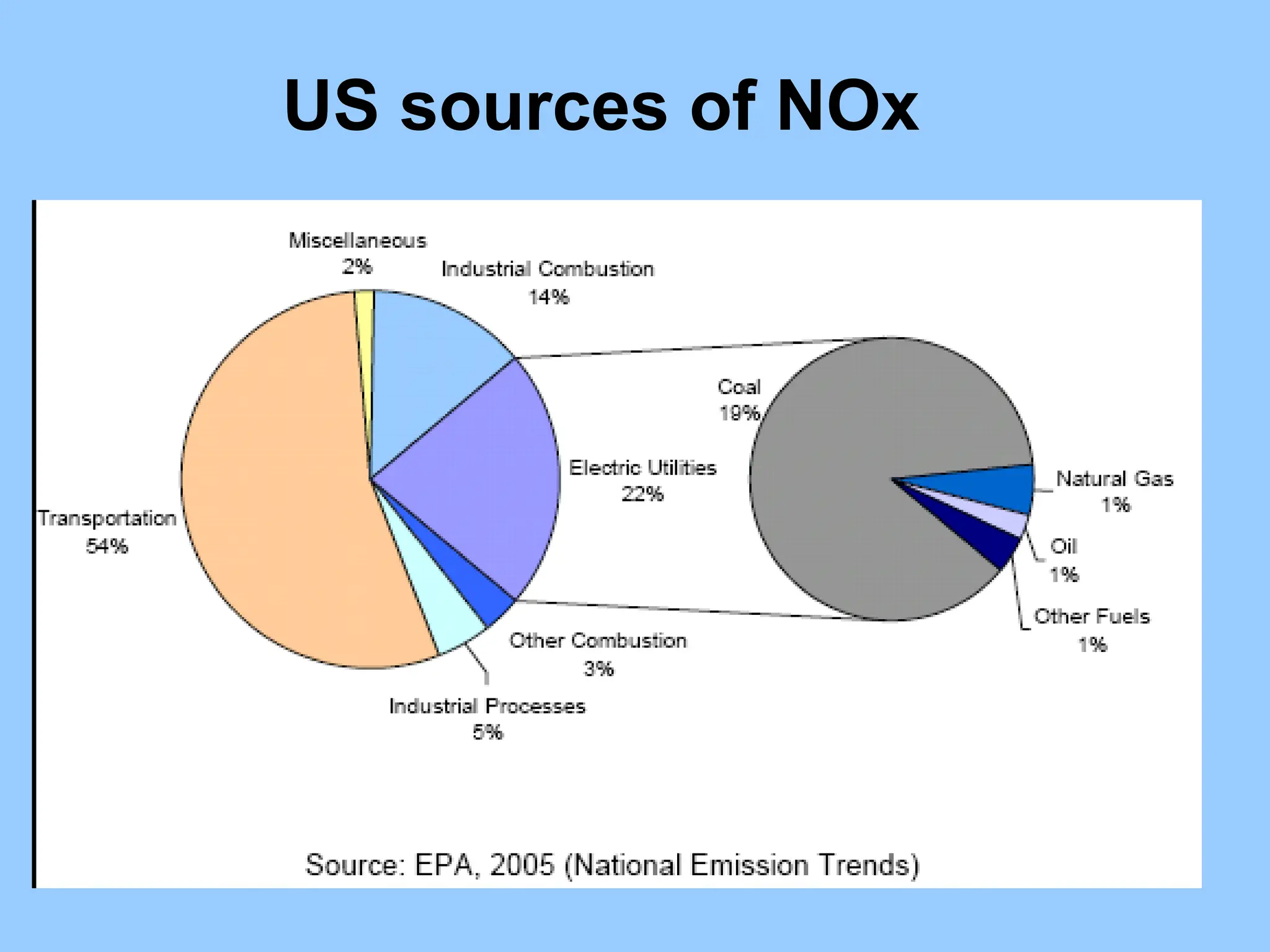
US sources of NOx
• NOx is a main ingredient in the formation of ground-level ozone,
triggering serious respiratory problems
• reacts to form nitrate particles, acid aerosols, as well as NO2
,
which also cause respiratory problems
• contributes to formation of acid rain
• contributes to nutrient overload that deteriorates water quality
• contributes to atmospheric particles that cause visibility
impairment most noticeable in national parks
• reacts to form toxic chemicals
NOx effects (taken from EPA)
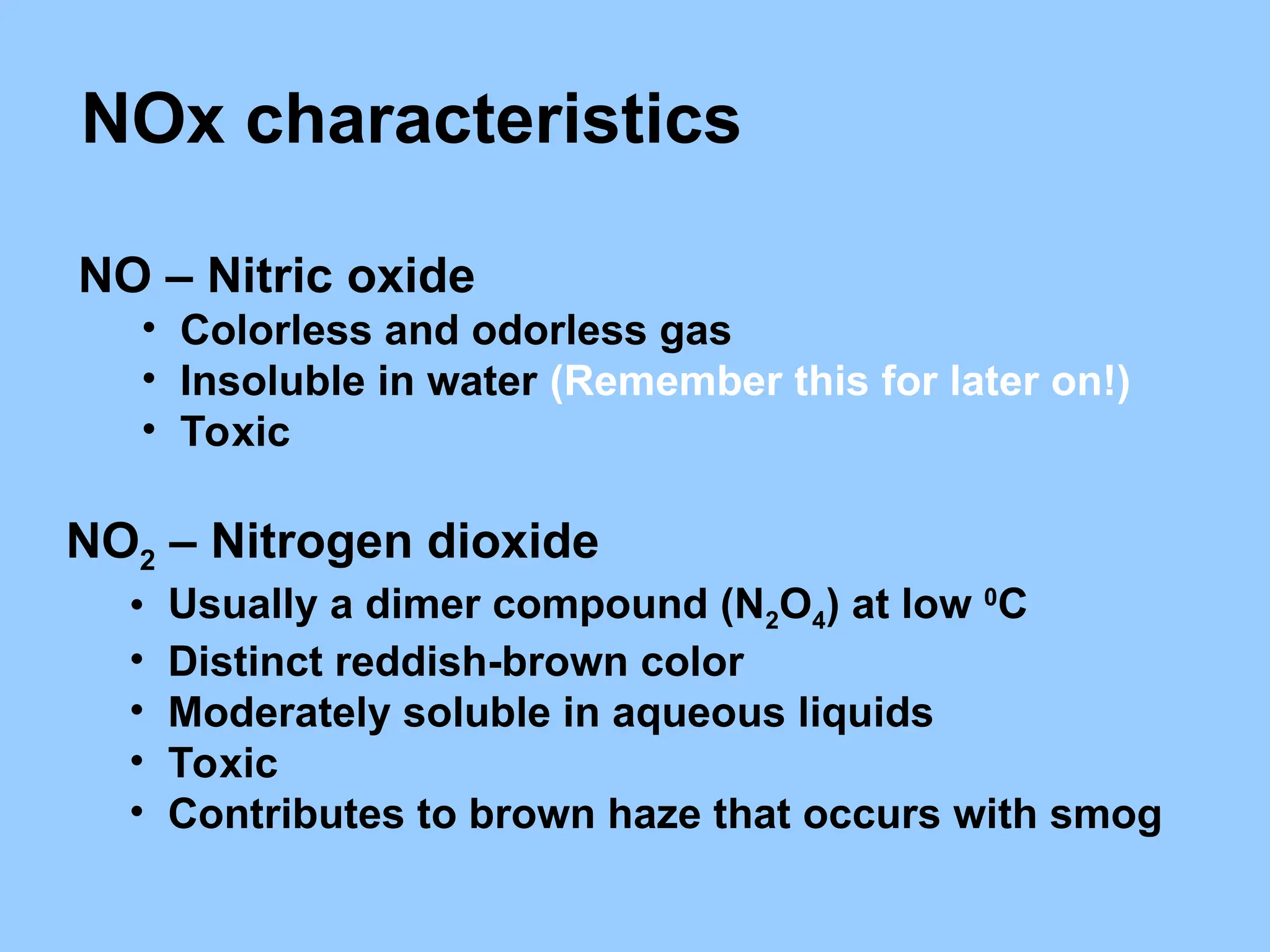
NOx characteristics
NO – Nitric oxide
• Colorless and odorless gas
• Insoluble in water (Remember this for later on!)
• Toxic
NO2 – Nitrogen dioxide
• Usually a dimer compound (N2O4) at low 0
C
• Distinct reddish-brown color
• Moderately soluble in aqueous liquids
• Toxic
• Contributes to brown haze that occurs with smog
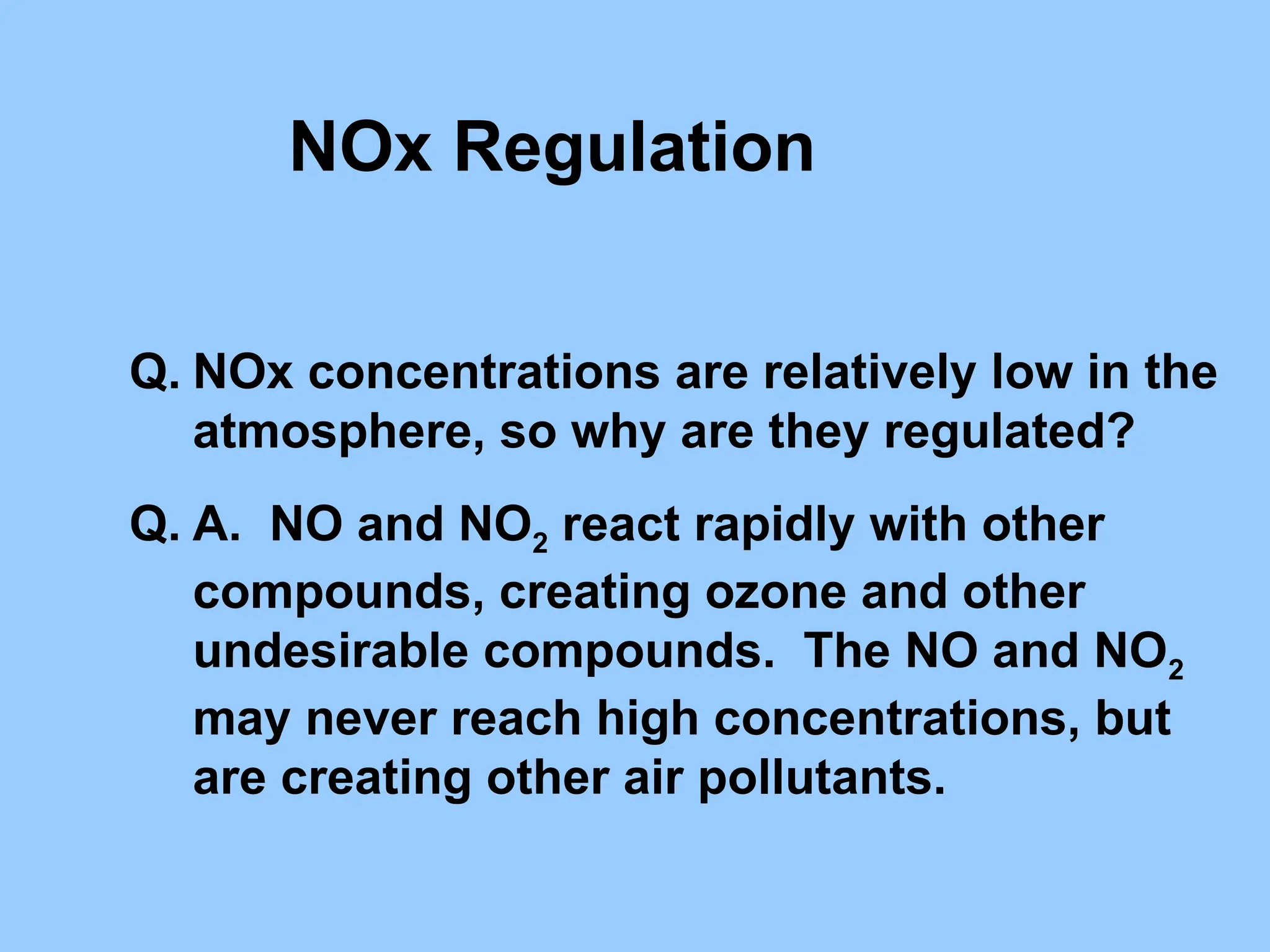
NOx Regulation
Q. NOx concentrations are relatively low in the
atmosphere, so why are they regulated?
Q. A. NO and NO2 react rapidly with other
compounds, creating ozone and other
undesirable compounds. The NO and NO2
may never reach high concentrations, but
are creating other air pollutants.
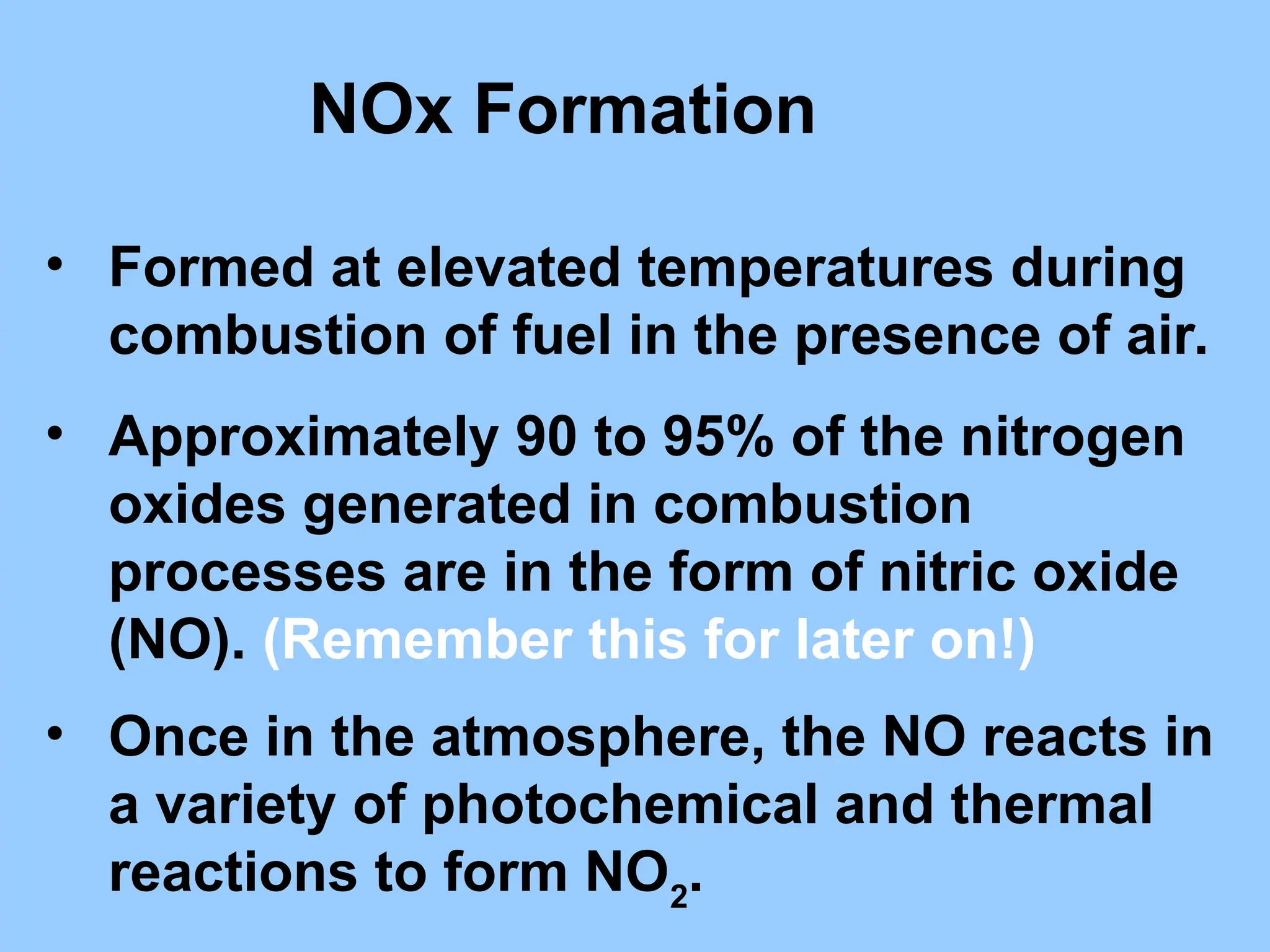
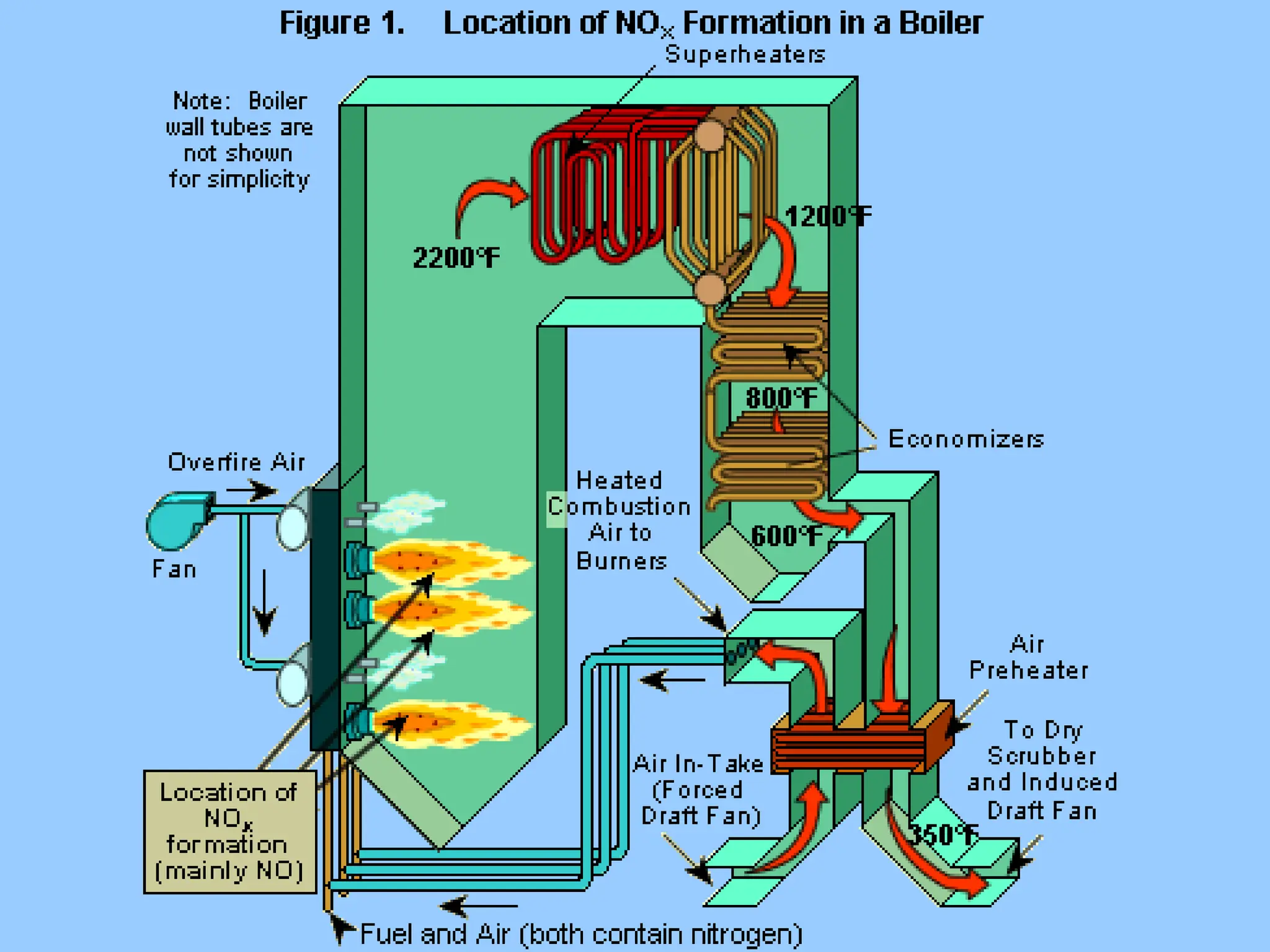
NOx Formation
• Formed at elevated temperatures during
combustion of fuel in the presence of air.
• Approximately 90 to 95% of the nitrogen
oxides generated in combustion
processes are in the form of nitric oxide
(NO). (Remember this for later on!)
• Once in the atmosphere, the NO reacts in
a variety of photochemical and thermal
reactions to form NO2
.
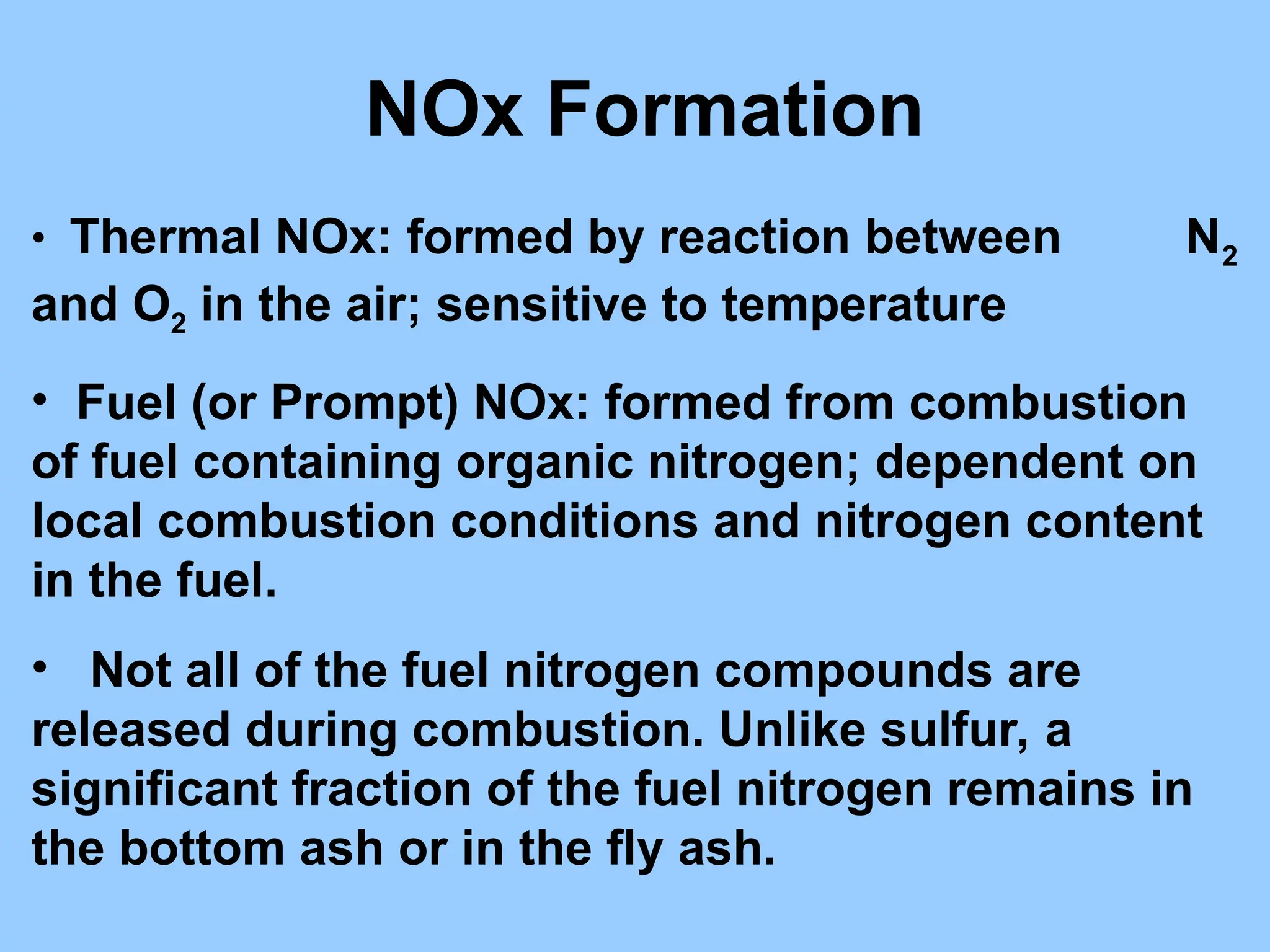
• Thermal NOx: formed by reaction between N2
and O2 in the air; sensitive to temperature
• Fuel (or Prompt) NOx: formed from combustion
of fuel containing organic nitrogen; dependent on
local combustion conditions and nitrogen content
in the fuel.
• Not all of the fuel nitrogen compounds are
released during combustion. Unlike sulfur, a
significant fraction of the fuel nitrogen remains in
the bottom ash or in the fly ash.
NOx Formation
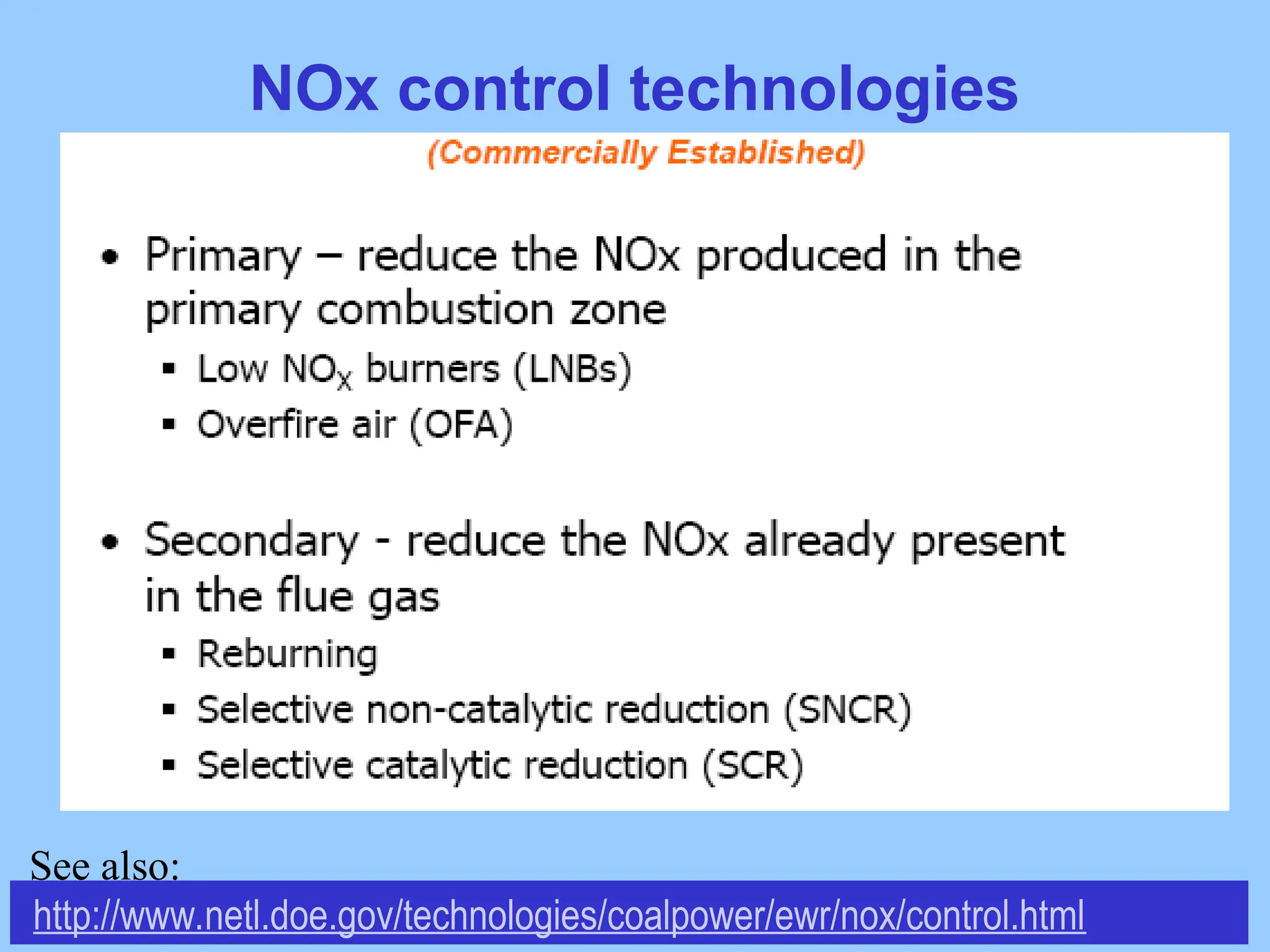
NOx control technologies
http://www.netl.doe.gov/technologies/coalpower/ewr/nox/control.html
See also:
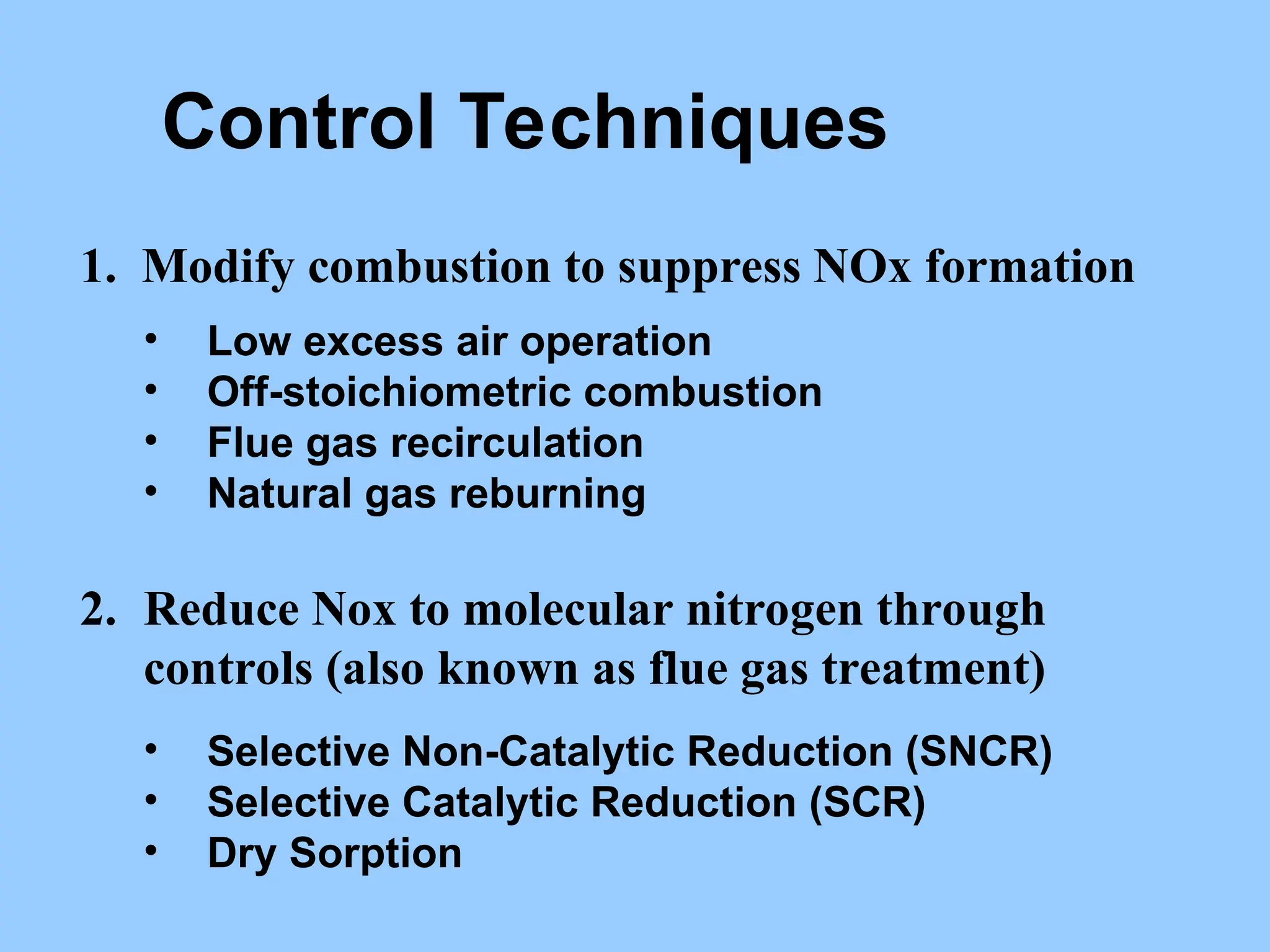
Control Techniques
1. Modify combustion to suppress NOx formation
• Low excess air operation
• Off-stoichiometric combustion
• Flue gas recirculation
• Natural gas reburning
2. Reduce Nox to molecular nitrogen through
controls (also known as flue gas treatment)
• Selective Non-Catalytic Reduction (SNCR)
• Selective Catalytic Reduction (SCR)
• Dry Sorption
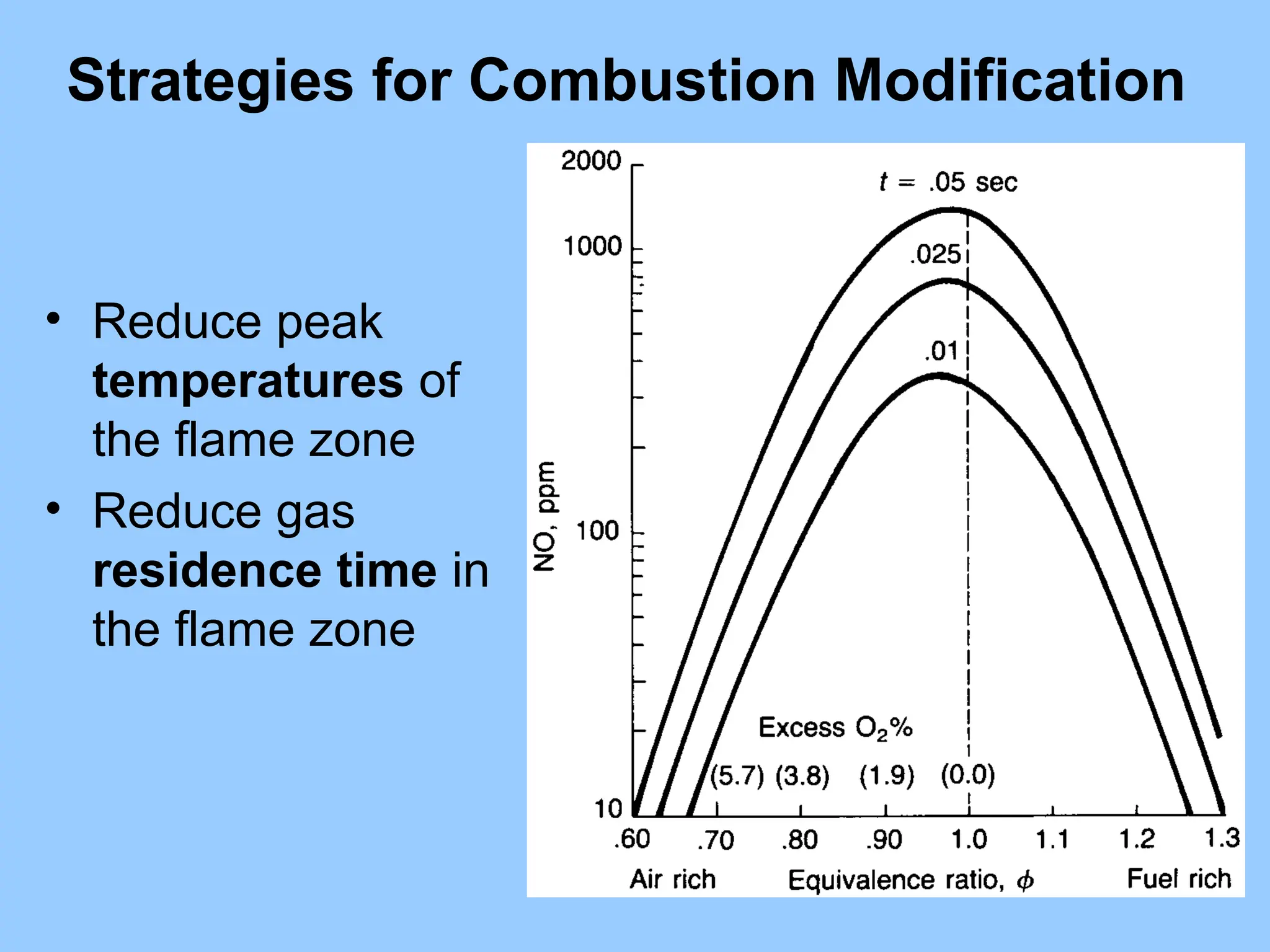
Strategies for Combustion Modification
• Reduce peak
temperatures of
the flame zone
• Reduce gas
residence time in
the flame zone
Combustion Modifications
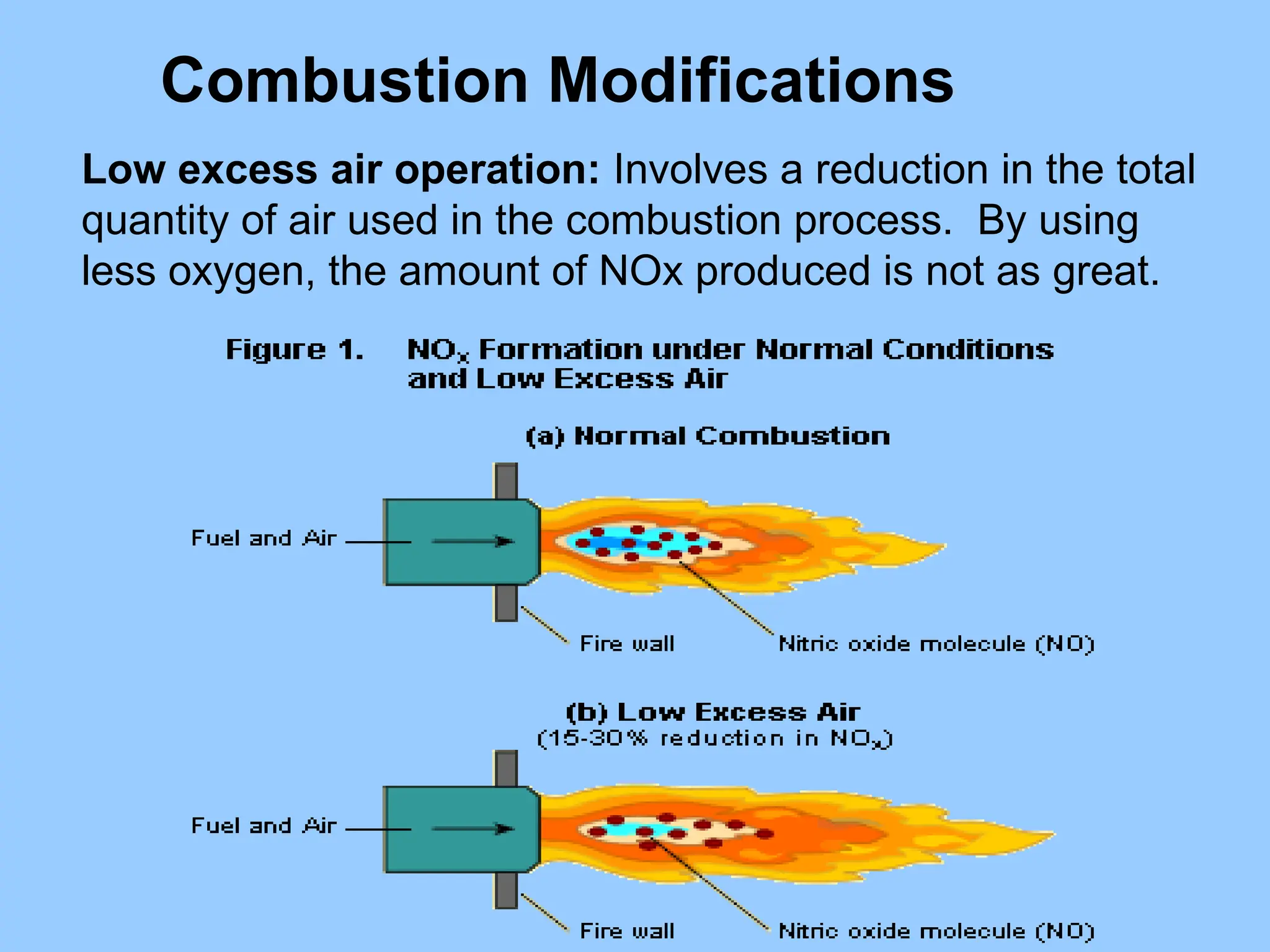
Low excess air operation: Involves a reduction in the total
quantity of air used in the combustion process. By using
less oxygen, the amount of NOx produced is not as great.
Combustion Modifications
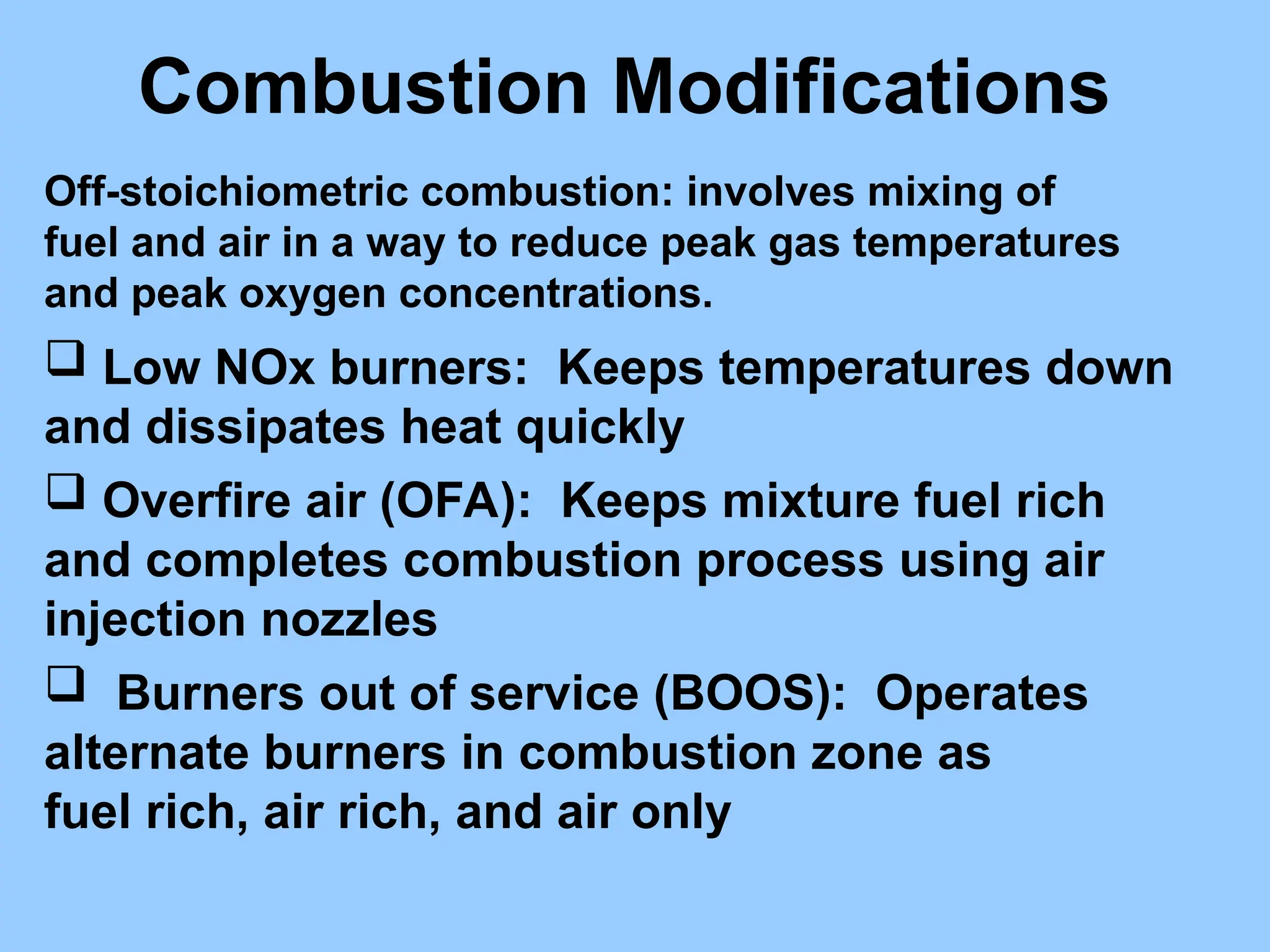
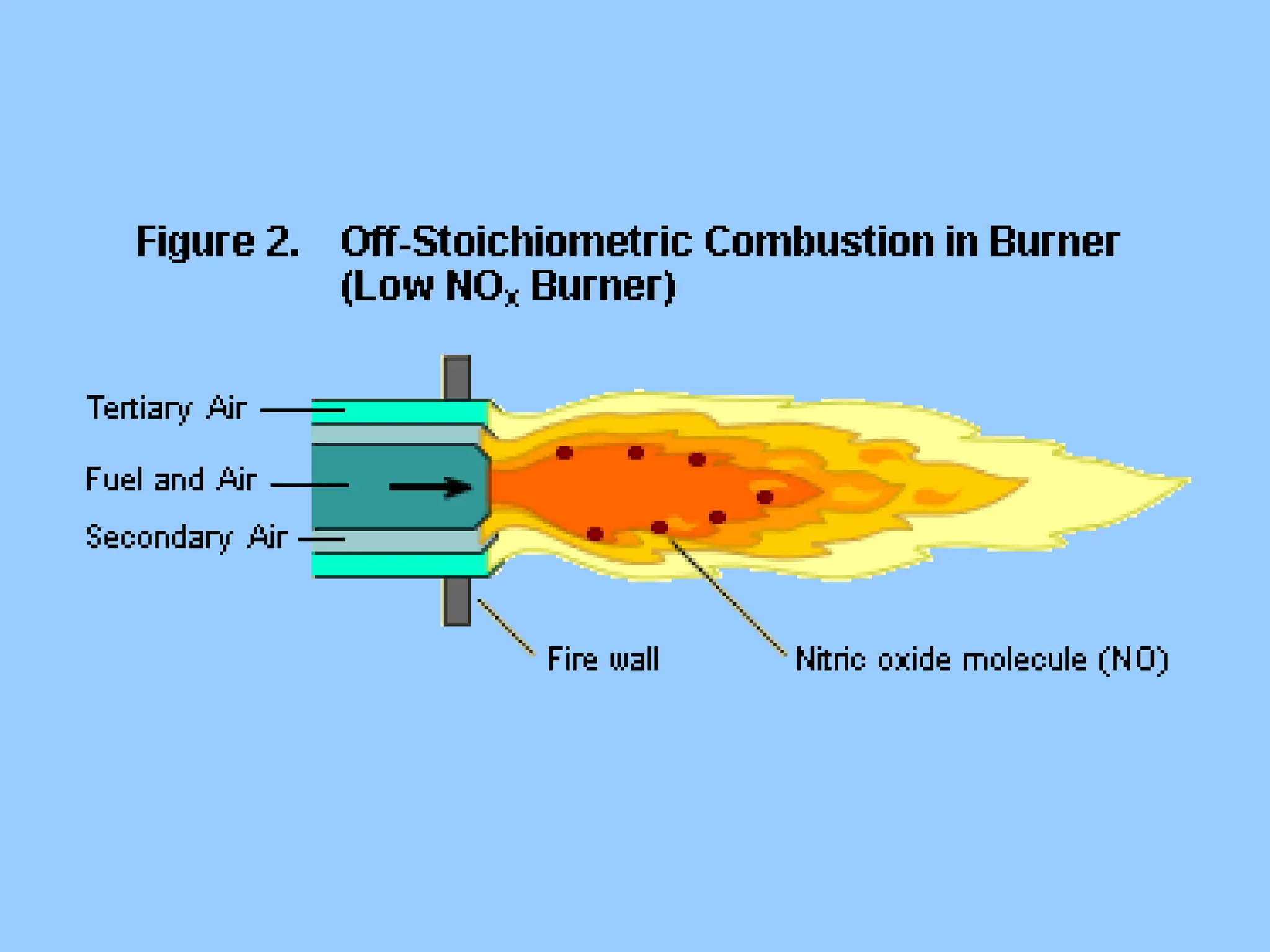
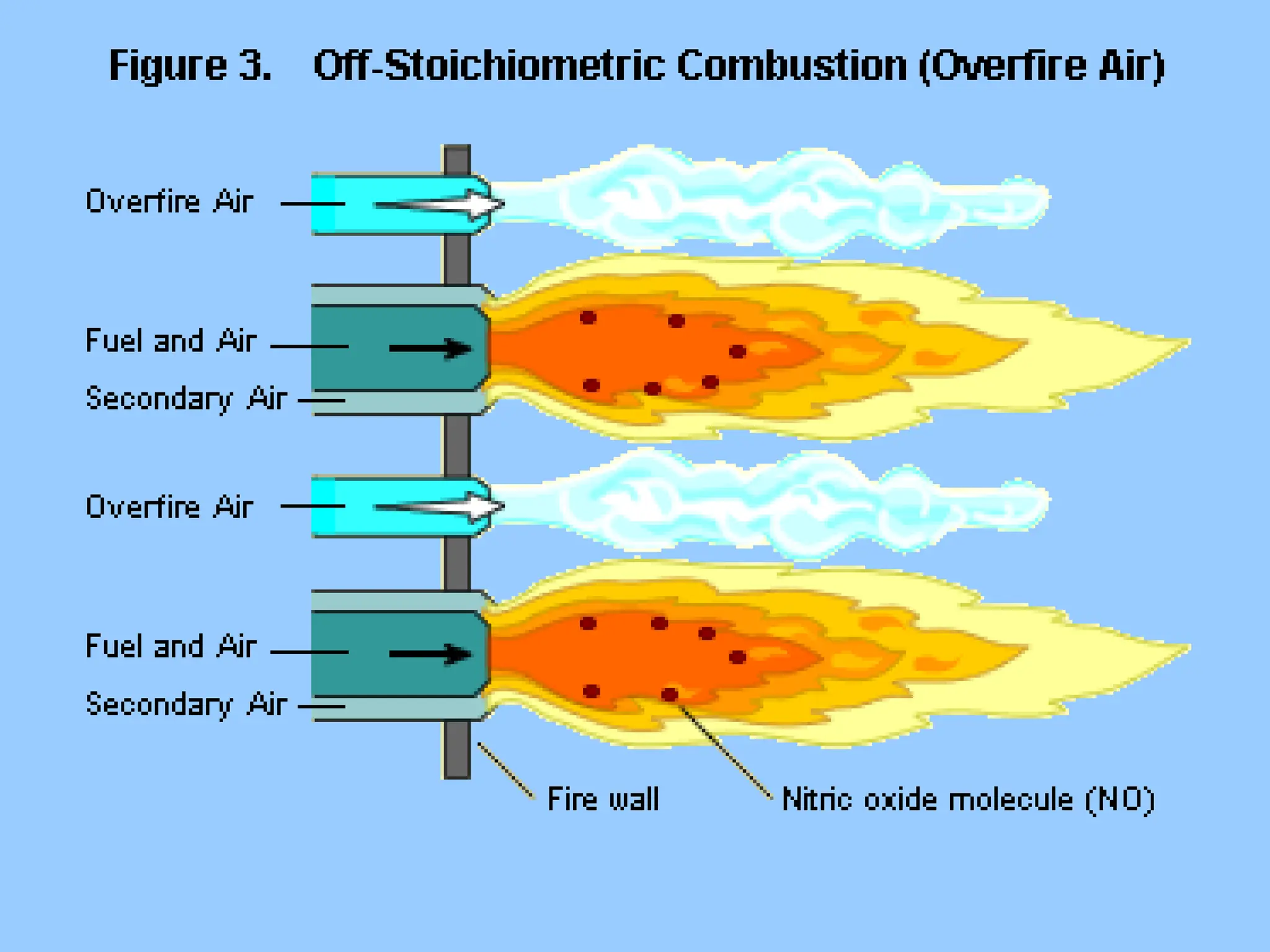
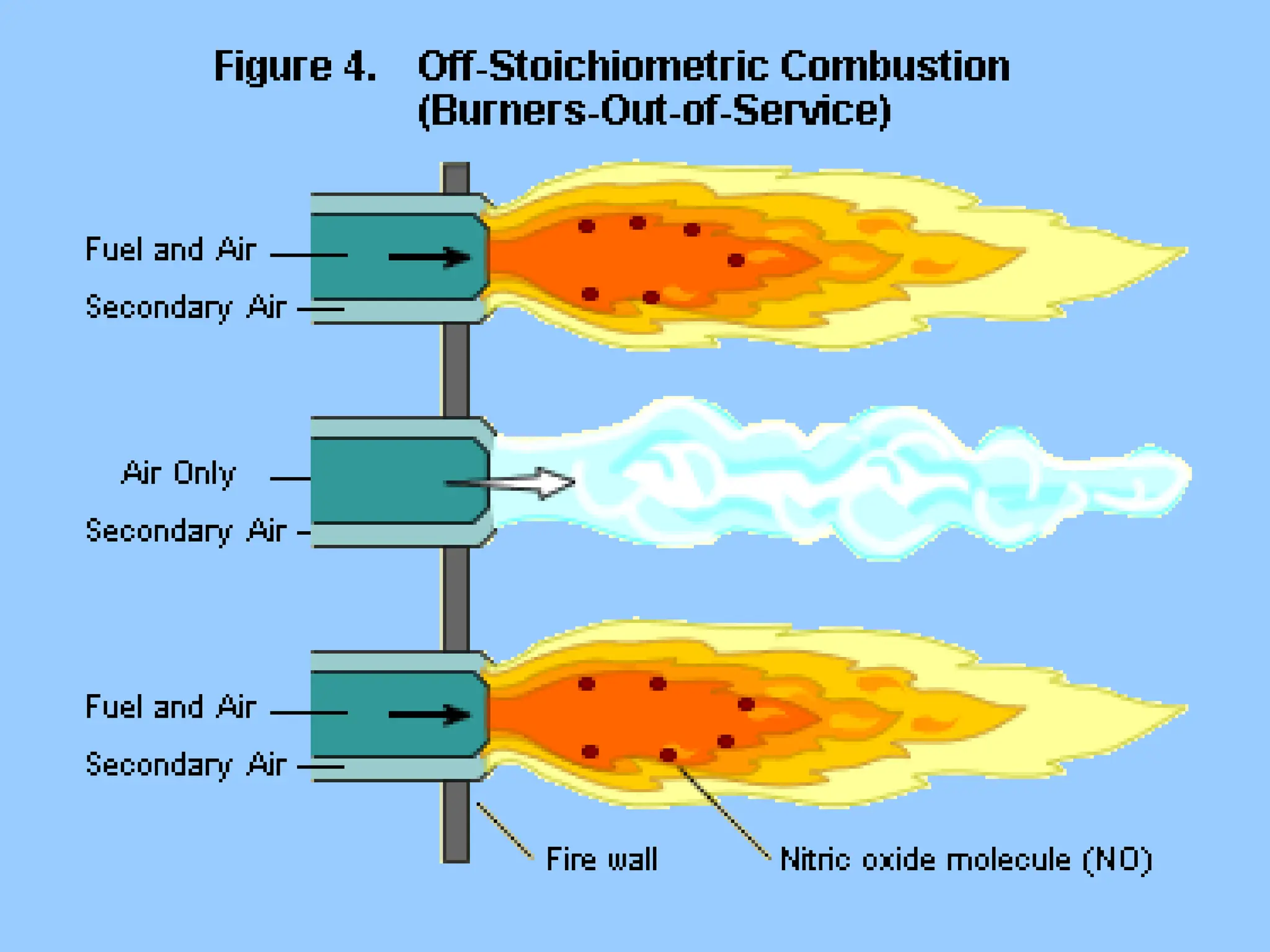
Off-stoichiometric combustion: involves mixing of
fuel and air in a way to reduce peak gas temperatures
and peak oxygen concentrations.
 Low NOx burners: Keeps temperatures down
and dissipates heat quickly
 Overfire air (OFA): Keeps mixture fuel rich
and completes combustion process using air
injection nozzles
 Burners out of service (BOOS): Operates
alternate burners in combustion zone as
fuel rich, air rich, and air only
Flue gas recirculation
Involves the return of cooled
combustion gases to the burner
area of the boiler. Reduced
temperatures produce less NOx.
The process requires a
recirculation fan and duct system.
Combustion Modifications
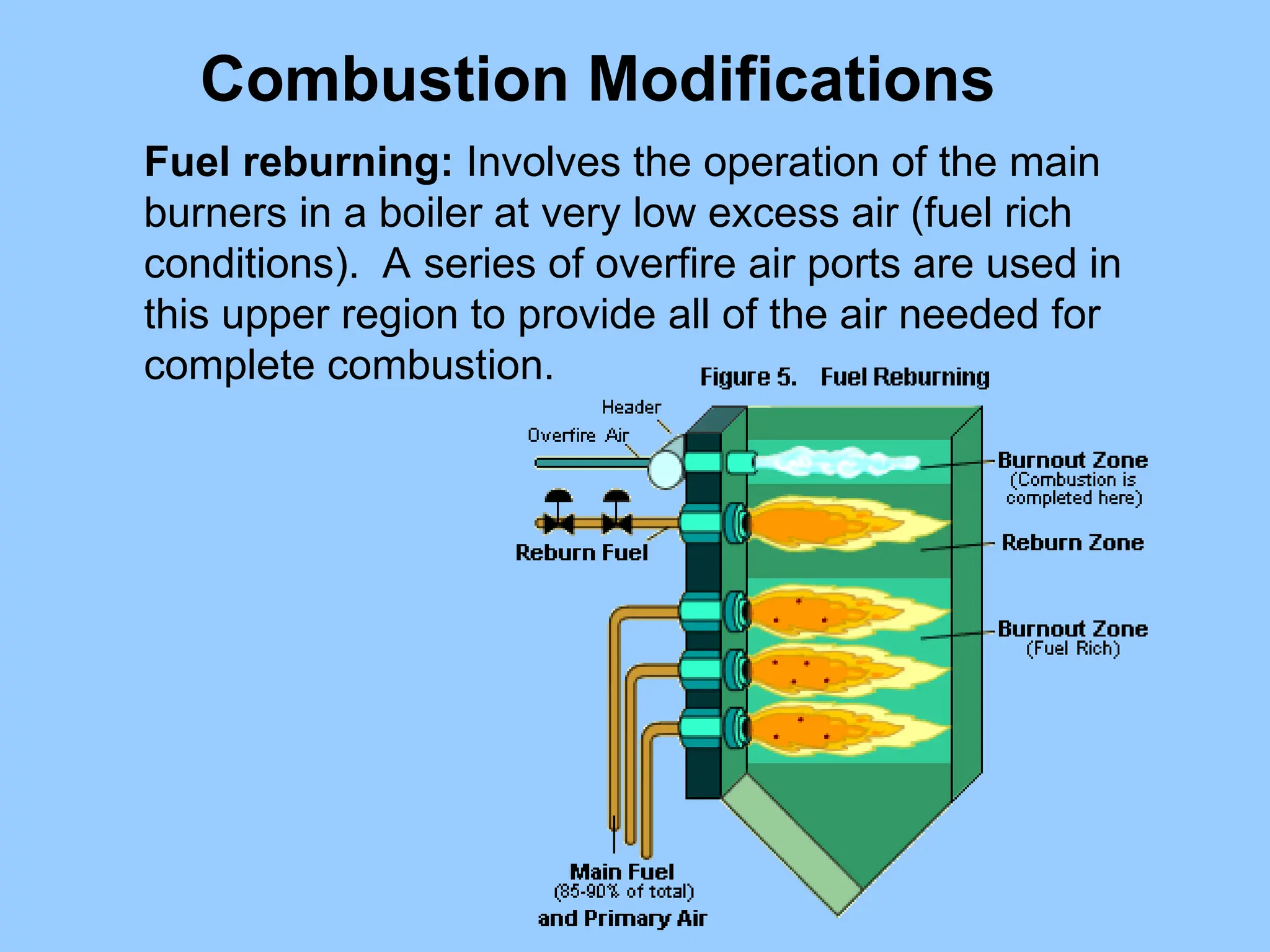
Fuel reburning: Involves the operation of the main
burners in a boiler at very low excess air (fuel rich
conditions). A series of overfire air ports are used in
this upper region to provide all of the air needed for
complete combustion.
Add-On Controls
(Flue Gas Treatment )
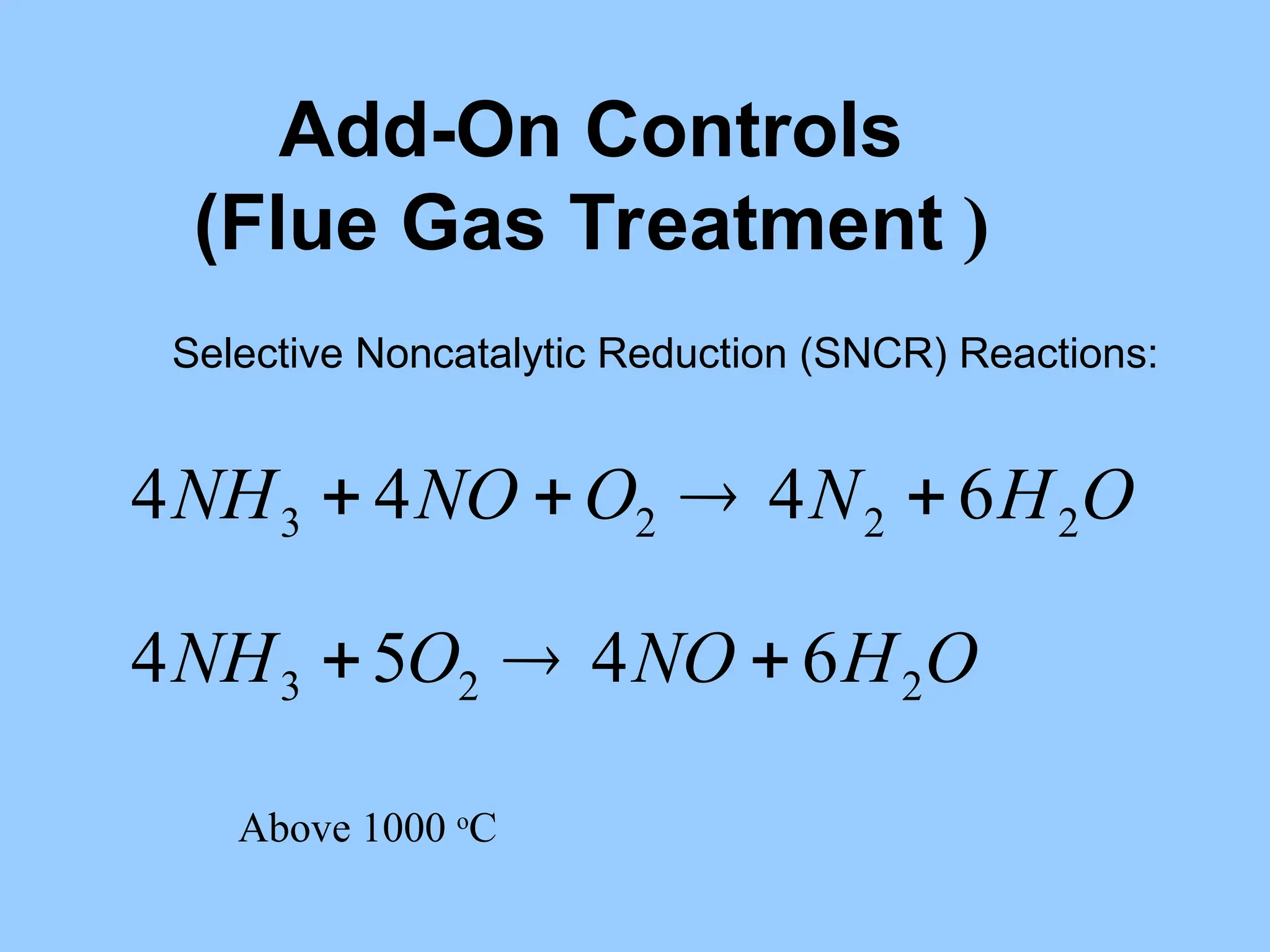
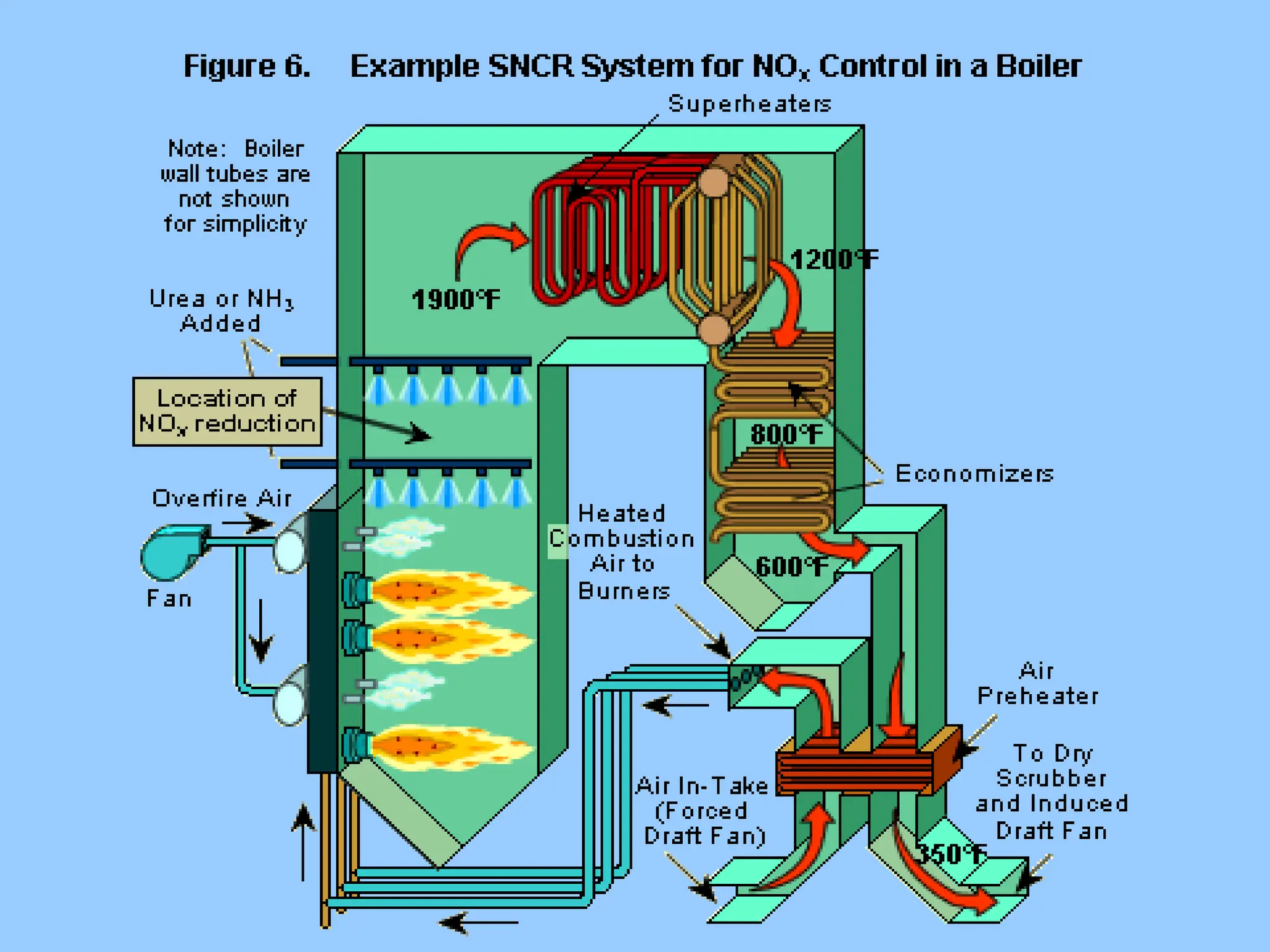
Selective non-catalytic reduction systems (SNCR)
Involves the injection of ammonia (NH3
) or urea
into the hot gas zone where reactions leading to
reduction of nitrogen oxides can occur. The
reactions are completed within the boiler, and no
waste products are generated. There is a risk of
ammonia (NH3
) being emitted into the atmosphere
if temperatures are too low, however. SCNR
systems are capable of reducing nitrogen oxides
from 20 to 60%.
Selective Noncatalytic Reduction (SNCR) Reactions:
O
H
NO
O
NH
O
H
N
O
NO
NH
2
2
3
2
2
2
3
6
4
5
4
6
4
4
4







Add-On Controls
(Flue Gas Treatment )
Above 1000 o
C
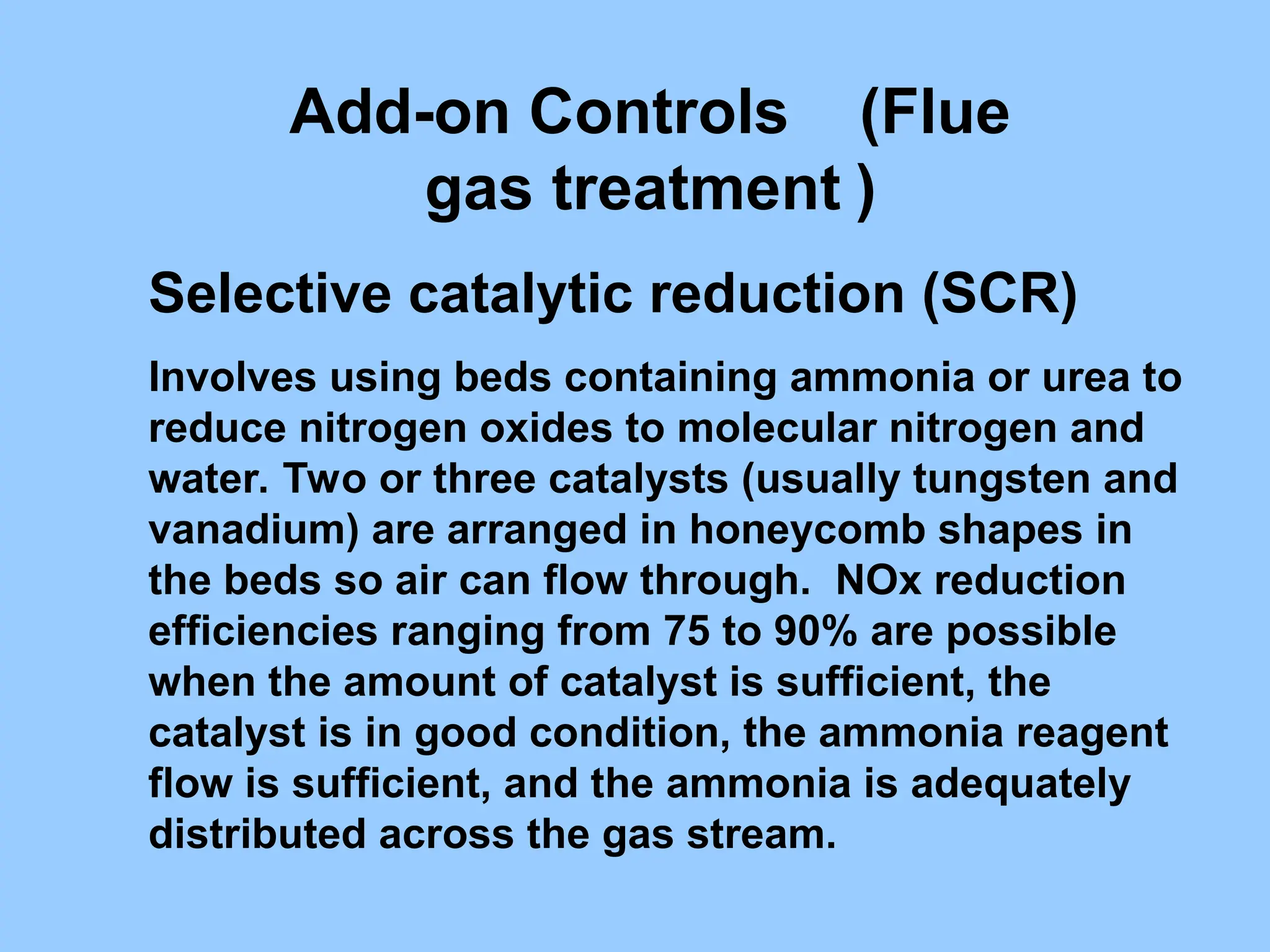
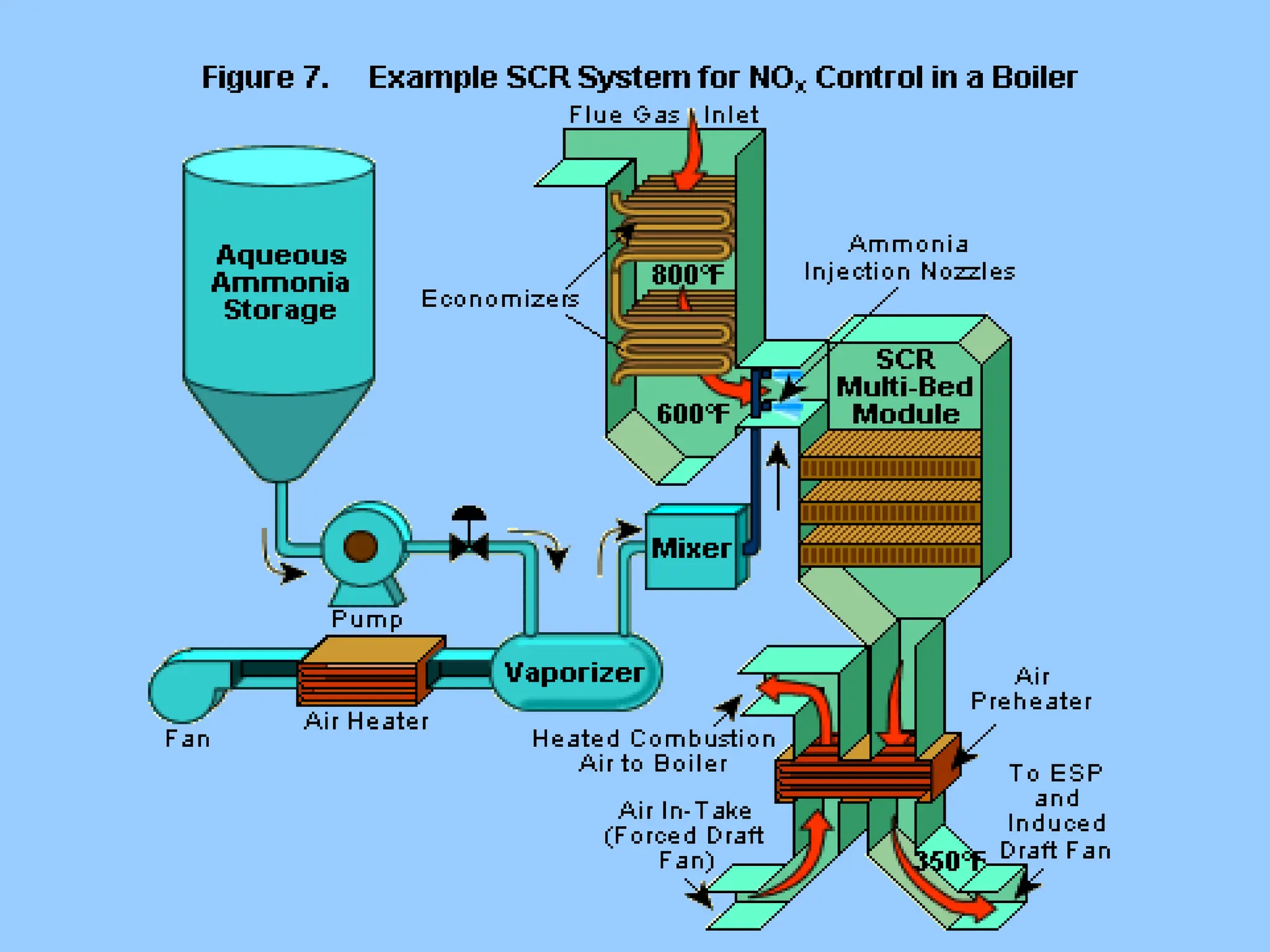
Selective catalytic reduction (SCR)
Involves using beds containing ammonia or urea to
reduce nitrogen oxides to molecular nitrogen and
water. Two or three catalysts (usually tungsten and
vanadium) are arranged in honeycomb shapes in
the beds so air can flow through. NOx reduction
efficiencies ranging from 75 to 90% are possible
when the amount of catalyst is sufficient, the
catalyst is in good condition, the ammonia reagent
flow is sufficient, and the ammonia is adequately
distributed across the gas stream.
Add-on Controls (Flue
gas treatment )
Add-On Controls
(Flue Gas Treatment )
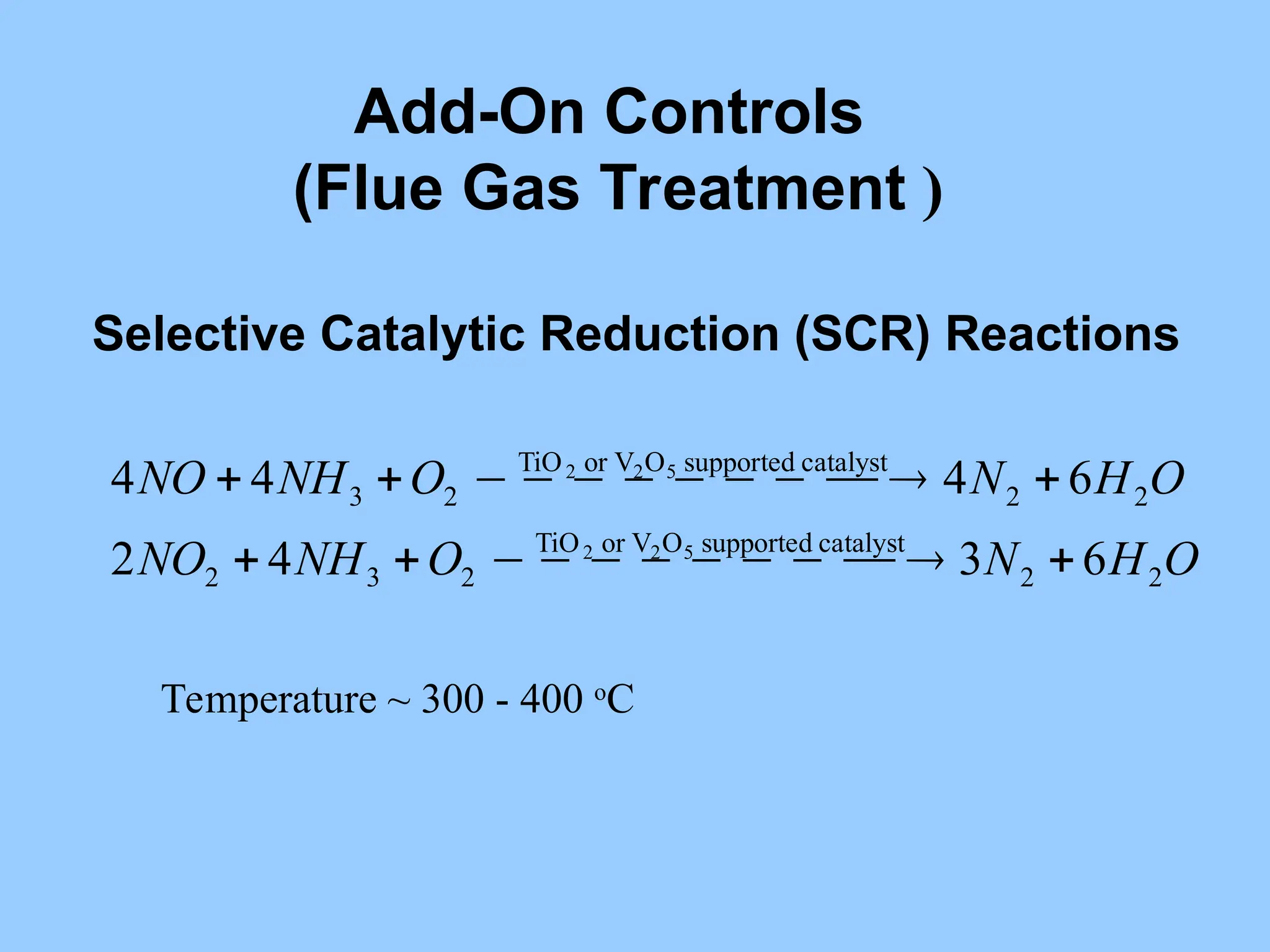
Selective Catalytic Reduction (SCR) Reactions
O
H
N
O
NH
NO
O
H
N
O
NH
NO
2
2
catalyst
supported
O
V
or
TiO
2
3
2
2
2
catalyst
supported
O
V
or
TiO
2
3
6
3
4
2
6
4
4
4
5
2
2
5
2
2








 











 



Temperature ~ 300 - 400 o
C
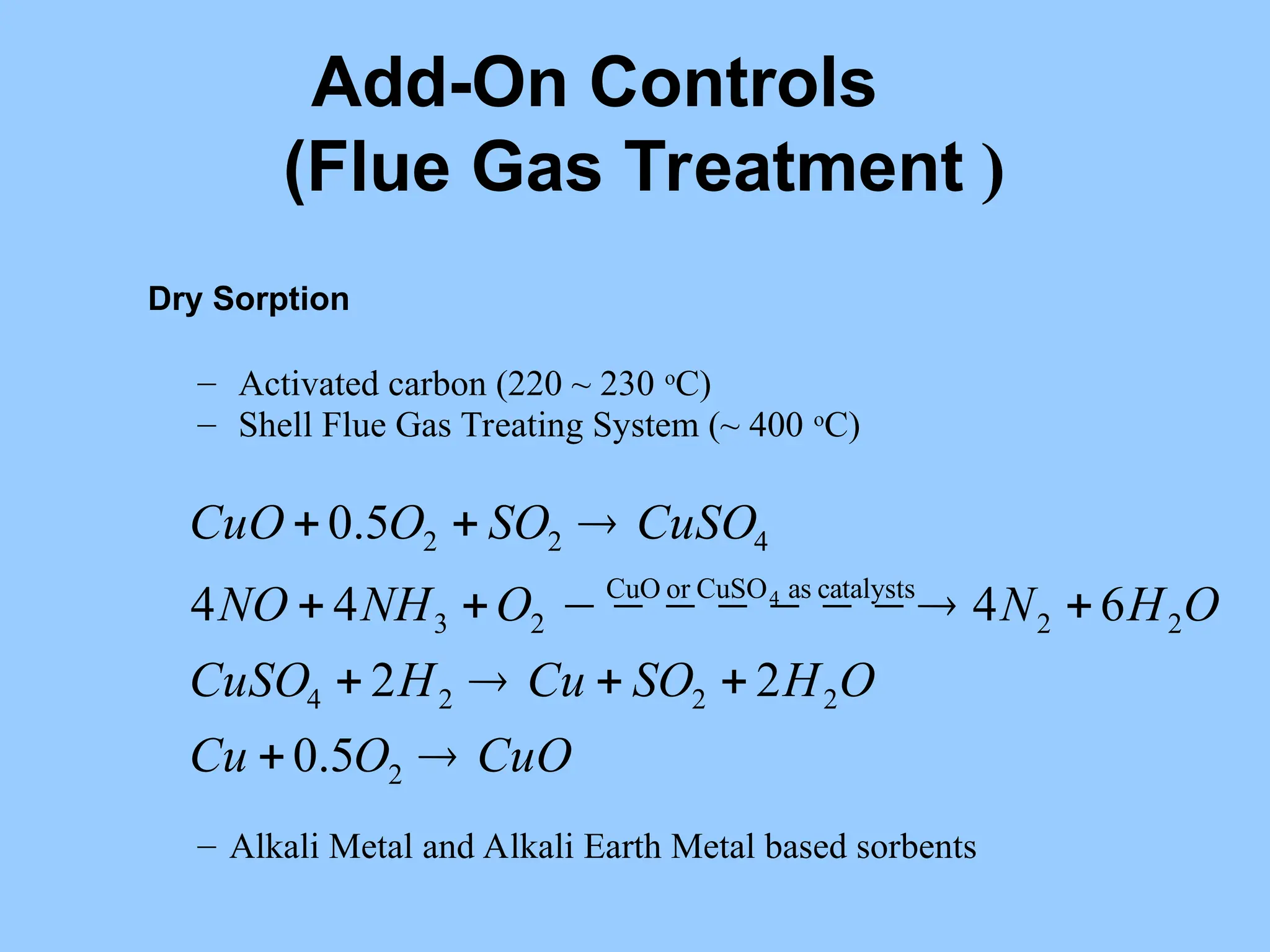
Dry Sorption
– Activated carbon (220 ~ 230 o
C)
– Shell Flue Gas Treating System (~ 400 o
C)
– Alkali Metal and Alkali Earth Metal based sorbents
CuO
O
Cu
O
H
SO
Cu
H
CuSO
O
H
N
O
NH
NO
CuSO
SO
O
CuO












 






2
2
2
2
4
2
2
catalysts
as
CuSO
or
CuO
2
3
4
2
2
5
.
0
2
2
6
4
4
4
5
.
0
4
Add-On Controls
(Flue Gas Treatment )
Would wet scrubbers be a good control
technique for NOx
emissions?
Insight question
Wet scrubbers would not be a good
control technique for NOx
emissions.
Why? Remember, NO is mainly formed
during the combustion process and NO2
is formed in the atmosphere.
Since NO is insoluble in water, wet
scrubbing would not work very well!
Answer

NOx, Sources and Control Methods, Combustion

  • 1.
    NOx Sources and ControlMethods CE/AE 524B Air Pollution J. (Hans) van Leeuwen
  • 2.
    Specific sources ofNOx Combustion sources • Automobiles • Boilers • Incinerators High-temperature industrial operations • Metallurgical furnaces • Blast furnaces • Plasma furnaces • Kilns Other sources • Nitric acid plants • Industrial processes that use nitric acid
  • 3.
  • 4.
    • NOx isa main ingredient in the formation of ground-level ozone, triggering serious respiratory problems • reacts to form nitrate particles, acid aerosols, as well as NO2 , which also cause respiratory problems • contributes to formation of acid rain • contributes to nutrient overload that deteriorates water quality • contributes to atmospheric particles that cause visibility impairment most noticeable in national parks • reacts to form toxic chemicals NOx effects (taken from EPA)
  • 5.
    NOx characteristics NO –Nitric oxide • Colorless and odorless gas • Insoluble in water (Remember this for later on!) • Toxic NO2 – Nitrogen dioxide • Usually a dimer compound (N2O4) at low 0 C • Distinct reddish-brown color • Moderately soluble in aqueous liquids • Toxic • Contributes to brown haze that occurs with smog
  • 6.
    NOx Regulation Q. NOxconcentrations are relatively low in the atmosphere, so why are they regulated? Q. A. NO and NO2 react rapidly with other compounds, creating ozone and other undesirable compounds. The NO and NO2 may never reach high concentrations, but are creating other air pollutants.
  • 7.
    NOx Formation • Formedat elevated temperatures during combustion of fuel in the presence of air. • Approximately 90 to 95% of the nitrogen oxides generated in combustion processes are in the form of nitric oxide (NO). (Remember this for later on!) • Once in the atmosphere, the NO reacts in a variety of photochemical and thermal reactions to form NO2 .
  • 8.
    • Thermal NOx:formed by reaction between N2 and O2 in the air; sensitive to temperature • Fuel (or Prompt) NOx: formed from combustion of fuel containing organic nitrogen; dependent on local combustion conditions and nitrogen content in the fuel. • Not all of the fuel nitrogen compounds are released during combustion. Unlike sulfur, a significant fraction of the fuel nitrogen remains in the bottom ash or in the fly ash. NOx Formation
  • 10.
  • 11.
    Control Techniques 1. Modifycombustion to suppress NOx formation • Low excess air operation • Off-stoichiometric combustion • Flue gas recirculation • Natural gas reburning 2. Reduce Nox to molecular nitrogen through controls (also known as flue gas treatment) • Selective Non-Catalytic Reduction (SNCR) • Selective Catalytic Reduction (SCR) • Dry Sorption
  • 12.
    Strategies for CombustionModification • Reduce peak temperatures of the flame zone • Reduce gas residence time in the flame zone
  • 13.
    Combustion Modifications Low excessair operation: Involves a reduction in the total quantity of air used in the combustion process. By using less oxygen, the amount of NOx produced is not as great.
  • 14.
    Combustion Modifications Off-stoichiometric combustion:involves mixing of fuel and air in a way to reduce peak gas temperatures and peak oxygen concentrations.  Low NOx burners: Keeps temperatures down and dissipates heat quickly  Overfire air (OFA): Keeps mixture fuel rich and completes combustion process using air injection nozzles  Burners out of service (BOOS): Operates alternate burners in combustion zone as fuel rich, air rich, and air only
  • 18.
    Flue gas recirculation Involvesthe return of cooled combustion gases to the burner area of the boiler. Reduced temperatures produce less NOx. The process requires a recirculation fan and duct system. Combustion Modifications
  • 19.
    Combustion Modifications Fuel reburning:Involves the operation of the main burners in a boiler at very low excess air (fuel rich conditions). A series of overfire air ports are used in this upper region to provide all of the air needed for complete combustion.
  • 20.
    Add-On Controls (Flue GasTreatment ) Selective non-catalytic reduction systems (SNCR) Involves the injection of ammonia (NH3 ) or urea into the hot gas zone where reactions leading to reduction of nitrogen oxides can occur. The reactions are completed within the boiler, and no waste products are generated. There is a risk of ammonia (NH3 ) being emitted into the atmosphere if temperatures are too low, however. SCNR systems are capable of reducing nitrogen oxides from 20 to 60%.
  • 21.
    Selective Noncatalytic Reduction(SNCR) Reactions: O H NO O NH O H N O NO NH 2 2 3 2 2 2 3 6 4 5 4 6 4 4 4        Add-On Controls (Flue Gas Treatment ) Above 1000 o C
  • 23.
    Selective catalytic reduction(SCR) Involves using beds containing ammonia or urea to reduce nitrogen oxides to molecular nitrogen and water. Two or three catalysts (usually tungsten and vanadium) are arranged in honeycomb shapes in the beds so air can flow through. NOx reduction efficiencies ranging from 75 to 90% are possible when the amount of catalyst is sufficient, the catalyst is in good condition, the ammonia reagent flow is sufficient, and the ammonia is adequately distributed across the gas stream. Add-on Controls (Flue gas treatment )
  • 24.
    Add-On Controls (Flue GasTreatment ) Selective Catalytic Reduction (SCR) Reactions O H N O NH NO O H N O NH NO 2 2 catalyst supported O V or TiO 2 3 2 2 2 catalyst supported O V or TiO 2 3 6 3 4 2 6 4 4 4 5 2 2 5 2 2                           Temperature ~ 300 - 400 o C
  • 26.
    Dry Sorption – Activatedcarbon (220 ~ 230 o C) – Shell Flue Gas Treating System (~ 400 o C) – Alkali Metal and Alkali Earth Metal based sorbents CuO O Cu O H SO Cu H CuSO O H N O NH NO CuSO SO O CuO                     2 2 2 2 4 2 2 catalysts as CuSO or CuO 2 3 4 2 2 5 . 0 2 2 6 4 4 4 5 . 0 4 Add-On Controls (Flue Gas Treatment )
  • 27.
    Would wet scrubbersbe a good control technique for NOx emissions? Insight question
  • 28.
    Wet scrubbers wouldnot be a good control technique for NOx emissions. Why? Remember, NO is mainly formed during the combustion process and NO2 is formed in the atmosphere. Since NO is insoluble in water, wet scrubbing would not work very well! Answer