HUMAN RESOURCE MANAGEMENT
Dr. Nadia Nasir
Department of Management Sciences
CHAPTER 5 : TESTING & SELECTION
Why Careful Selection is
Important
The importance of selecting the right employees
 Organizational performance always depends in part on
subordinates having the right skills and attributes.
 Recruiting and hiring employees is costly.
 The legal implications of incompetent hiring
 EEO laws and court decisions related to nondiscriminatory
selection procedures
 The liability of negligent hiring of workers with questionable
backgrounds
Avoiding Negligent Hiring Claims
1. Carefully scrutinize information supplied by the applicant on his
or her employment application.
2. Get the applicant’s written authorization for reference checks,
and carefully check references.
3. Save all records and information you obtain about the
applicant.
4. Reject applicants who make false statements of material facts
or who have conviction records for offenses directly related and
important to the job in question.
5. Balance the applicant’s privacy rights with others’ “need to
know,” especially when you discover damaging information.
6. Take immediate disciplinary action if problems arise.
Basic Testing Concepts
 Reliability
 The consistency of scores obtained by the same person when
retested with the identical or equivalent tests.
 Are the test results stable over time?
 Test validity
 The accuracy with which a test, interview, and so on
measures what it purports to measure or fulfills the function
it was designed to fill.
 Does the test actually measure what we need for it to
measure?
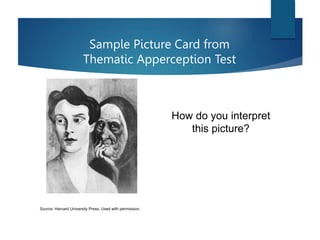
Sample Picture Card from
Thematic Apperception Test
How do you interpret
this picture?
Source: Harvard University Press. Used with permission.
Examples of Web Sites Offering
Information on Tests or Testing
Programs
 www.hr-guide.com/data/G371.htm
 Provides general information and sources for all types of employment
tests.
 http://buros.unl.edu/buros/jsp/search.jsp
 Provides technical information on all types of employment and
nonemployment tests.
 www.ets.org/testcoll/index.html
 Provides information on over 20,000 tests.
 www.kaplan.com/
 Information from Kaplan test preparation on how various admissions tests
work.
 www.assessments.biz/default.asp?source=GW-emptest
 One of many firms offering employment tests.
6
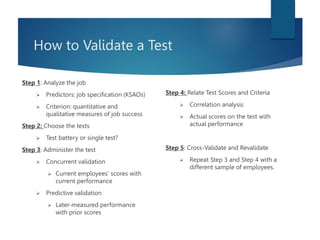
How to Validate a Test
Step 1: Analyze the job
 Predictors: job specification (KSAOs)
 Criterion: quantitative and
qualitative measures of job success
Step 2: Choose the tests
 Test battery or single test?
Step 3: Administer the test
 Concurrent validation
 Current employees’ scores with
current performance
 Predictive validation
 Later-measured performance
with prior scores
Step 4: Relate Test Scores and Criteria
 Correlation analysis
 Actual scores on the test with
actual performance
Step 5: Cross-Validate and Revalidate
 Repeat Step 3 and Step 4 with a
different sample of employees.
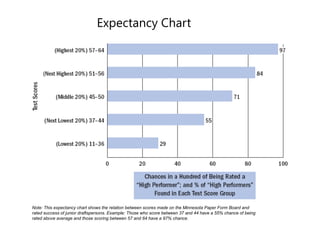
Expectancy Chart 6–8
Note: This expectancy chart shows the relation between scores made on the Minnesota Paper Form Board and
rated success of junior draftspersons. Example: Those who score between 37 and 44 have a 55% chance of being
rated above average and those scoring between 57 and 64 have a 97% chance.
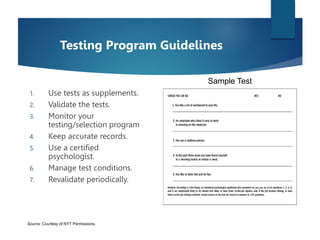
Testing Program Guidelines
1. Use tests as supplements.
2. Validate the tests.
3. Monitor your
testing/selection program
4. Keep accurate records.
5. Use a certified
psychologist.
6. Manage test conditions.
7. Revalidate periodically.
Sample Test
Source: Courtesy of NYT Permissions.
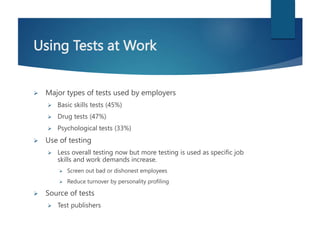
Using Tests at Work
 Major types of tests used by employers
 Basic skills tests (45%)
 Drug tests (47%)
 Psychological tests (33%)
 Use of testing
 Less overall testing now but more testing is used as specific job
skills and work demands increase.
 Screen out bad or dishonest employees
 Reduce turnover by personality profiling
 Source of tests
 Test publishers
Computer-Interactive Testing
 Types of tests
 Specialized work sample tests
 Numerical ability tests
 Reading comprehension tests
 Clerical comparing and checking tests
 Online tests
 Telephone prescreening
 Offline computer tests
 Virtual “inbox” tests
 Online problem solving tests
Types of Tests
 Tests of cognitive abilities
 Intelligence Tests
 Tests of general intellectual abilities that measure a range of abilities,
including memory, vocabulary, verbal fluency, and numerical ability.
 Aptitude tests
 Tests that measure specific mental abilities, such as inductive and deductive
reasoning, verbal comprehension, memory, and numerical ability.
 Tests of motor abilities
 Tests that measure motor abilities, such as finger dexterity, manual dexterity, and
reaction time.
 Tests of physical abilities
 Tests that measure static strength, dynamic strength, body coordination, and
stamina.
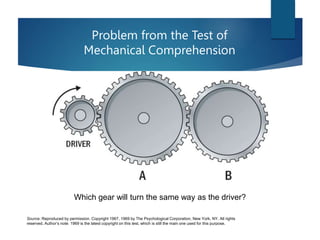
Problem from the Test of
Mechanical Comprehension
Which gear will turn the same way as the driver?
Source: Reproduced by permission. Copyright 1967, 1969 by The Psychological Corporation, New York, NY. All rights
reserved. Author’s note: 1969 is the latest copyright on this test, which is still the main one used for this purpose.
Measuring Personality and
Interests
Personality tests
 Tests that use projective techniques and trait inventories to
measure basic aspects of an applicant’s personality, such as
introversion, stability, and motivation.
 Disadvantage
 Personality tests—particularly the projective type—are the
most difficult tests to evaluate and use.
 Advantage
 Tests have been used successfully to predict dysfunctional
job behaviors and identify successful candidates for
overseas assignments.
Work Simulations
 Management assessment center
 A simulation in which management
candidates are asked to perform realistic
tasks in hypothetical situations and are
scored on their performance.
 Typical simulated exercises include:
 The in-basket
 Leaderless group discussion
 Management games
 Individual presentations
 Objective tests
 The interview
 Video-Based situational testing
 A situational test comprised of several
video scenarios, each followed by a
multiple choice question that requires
the candidate to choose from among
several courses of action.
 While the evidence is mixed, the results
suggest that video-based situational
tests can be useful for selecting
employees.
Work Simulations (cont’d)
 The miniature job training and evaluation approach
 Candidates are trained to perform a sample of the job’s
tasks, and then are evaluated on their performance.
 The approach assumes that a person who demonstrates that
he or she can learn and perform the sample of tasks will be
able to learn and perform the job itself.
16
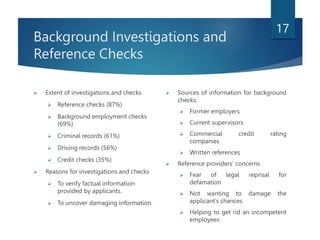
Background Investigations and
Reference Checks
 Extent of investigations and checks
 Reference checks (87%)
 Background employment checks
(69%)
 Criminal records (61%)
 Driving records (56%)
 Credit checks (35%)
 Reasons for investigations and checks
 To verify factual information
provided by applicants.
 To uncover damaging information.
 Sources of information for background
checks:
 Former employers
 Current supervisors
 Commercial credit rating
companies
 Written references
 Reference providers’ concerns
 Fear of legal reprisal for
defamation
 Not wanting to damage the
applicant’s chances
 Helping to get rid an incompetent
employees
17
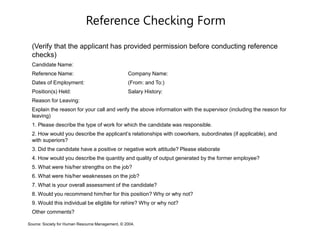
Reference Checking Form
(Verify that the applicant has provided permission before conducting reference
checks)
Candidate Name:
Reference Name: Company Name:
Dates of Employment: (From: and To:)
Position(s) Held: Salary History:
Reason for Leaving:
Explain the reason for your call and verify the above information with the supervisor (including the reason for
leaving)
1. Please describe the type of work for which the candidate was responsible.
2. How would you describe the applicant’s relationships with coworkers, subordinates (if applicable), and
with superiors?
3. Did the candidate have a positive or negative work attitude? Please elaborate
4. How would you describe the quantity and quality of output generated by the former employee?
5. What were his/her strengths on the job?
6. What were his/her weaknesses on the job?
7. What is your overall assessment of the candidate?
8. Would you recommend him/her for this position? Why or why not?
9. Would this individual be eligible for rehire? Why or why not?
Other comments?
Source: Society for Human Resource Management, © 2004.
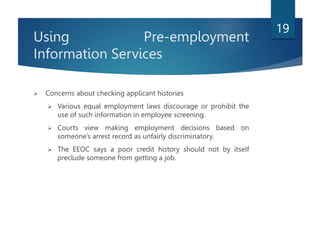
Using Pre-employment
Information Services
 Concerns about checking applicant histories
 Various equal employment laws discourage or prohibit the
use of such information in employee screening.
 Courts view making employment decisions based on
someone’s arrest record as unfairly discriminatory.
 The EEOC says a poor credit history should not by itself
preclude someone from getting a job.
19
Checking Background Information
 Step 1—Disclosure and authorization.
 Inform the employee/applicant that a report will be requested and
obtain written authorization.
 Step 2—Certification.
 The employer must certify to the reporting agency that the employer
will comply with the federal and state legal requirements.
 Step 3—Providing copies of reports.
 The employer must provide copies of the report to the applicant or
employee if adverse action is contemplated.
 Step 4—Notice after adverse action.
 After the employer provides the employee or applicant with copies of
the investigative reports and a “reasonable period” has elapsed, the
employer may take an adverse action.
The Polygraph and Honesty
Testing
 The polygraph (or lie detector)
 A device that measures physiological changes,
 The assumption is that such changes reflect changes in
emotional state that accompany lying.
 Employee Polygraph Protection Act of 1988.
 Prohibits employers (in most all cases) from conducting
polygraph examinations of all job applicants and most
employees.
 Also prohibited are other mechanical or electrical devices
including psychological stress evaluators and voice stress
analyzers.
Permitted Users of the Polygraph
 Employers with contracts involving:
 National defense or security
 Nuclear-power (Department of Energy)
 Access to highly classified information
 Counterintelligence (the FBI or Department of Justice)
 Other exceptions
 Hiring of private security personnel
 Hiring persons with access to drugs
 Conducting ongoing investigations involving economic loss
or injury to an employer’s business.
Paper-and-Pencil Honesty Tests
Paper-and-pencil honesty tests
 Psychological tests designed to predict job applicants’
proneness to dishonesty and other forms of
counterproductivity.
 Measure attitudes regarding things like tolerance of
others who steal, acceptance of rationalizations for
theft, and admission of theft-related activities.
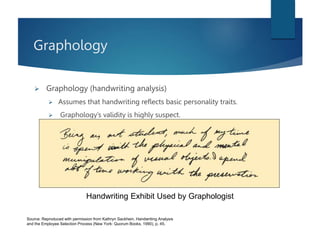
Graphology
 Graphology (handwriting analysis)
 Assumes that handwriting reflects basic personality traits.
 Graphology’s validity is highly suspect.
Source: Reproduced with permission from Kathryn Sackhein, Handwriting Analysis
and the Employee Selection Process (New York: Quorum Books, 1990), p. 45.
Handwriting Exhibit Used by Graphologist
Physical Examination
 Reasons for preemployment medical examinations:
 To verify that the applicant meets the physical requirements
of the position
 To discover any medical limitations you should take into
account in placing the applicant.
 To establish a record and baseline of the applicant’s health
for future insurance or compensation claims.
 To reduce absenteeism and accidents
 To detect communicable diseases that may be unknown to
the applicant.
QUESTIONS

5 - Testing and Selection.pptx

  • 1.
    HUMAN RESOURCE MANAGEMENT Dr.Nadia Nasir Department of Management Sciences CHAPTER 5 : TESTING & SELECTION
  • 2.
    Why Careful Selectionis Important The importance of selecting the right employees  Organizational performance always depends in part on subordinates having the right skills and attributes.  Recruiting and hiring employees is costly.  The legal implications of incompetent hiring  EEO laws and court decisions related to nondiscriminatory selection procedures  The liability of negligent hiring of workers with questionable backgrounds
  • 3.
    Avoiding Negligent HiringClaims 1. Carefully scrutinize information supplied by the applicant on his or her employment application. 2. Get the applicant’s written authorization for reference checks, and carefully check references. 3. Save all records and information you obtain about the applicant. 4. Reject applicants who make false statements of material facts or who have conviction records for offenses directly related and important to the job in question. 5. Balance the applicant’s privacy rights with others’ “need to know,” especially when you discover damaging information. 6. Take immediate disciplinary action if problems arise.
  • 4.
    Basic Testing Concepts Reliability  The consistency of scores obtained by the same person when retested with the identical or equivalent tests.  Are the test results stable over time?  Test validity  The accuracy with which a test, interview, and so on measures what it purports to measure or fulfills the function it was designed to fill.  Does the test actually measure what we need for it to measure?
  • 5.
    Sample Picture Cardfrom Thematic Apperception Test How do you interpret this picture? Source: Harvard University Press. Used with permission.
  • 6.
    Examples of WebSites Offering Information on Tests or Testing Programs  www.hr-guide.com/data/G371.htm  Provides general information and sources for all types of employment tests.  http://buros.unl.edu/buros/jsp/search.jsp  Provides technical information on all types of employment and nonemployment tests.  www.ets.org/testcoll/index.html  Provides information on over 20,000 tests.  www.kaplan.com/  Information from Kaplan test preparation on how various admissions tests work.  www.assessments.biz/default.asp?source=GW-emptest  One of many firms offering employment tests. 6
  • 7.
    How to Validatea Test Step 1: Analyze the job  Predictors: job specification (KSAOs)  Criterion: quantitative and qualitative measures of job success Step 2: Choose the tests  Test battery or single test? Step 3: Administer the test  Concurrent validation  Current employees’ scores with current performance  Predictive validation  Later-measured performance with prior scores Step 4: Relate Test Scores and Criteria  Correlation analysis  Actual scores on the test with actual performance Step 5: Cross-Validate and Revalidate  Repeat Step 3 and Step 4 with a different sample of employees.
  • 8.
    Expectancy Chart 6–8 Note:This expectancy chart shows the relation between scores made on the Minnesota Paper Form Board and rated success of junior draftspersons. Example: Those who score between 37 and 44 have a 55% chance of being rated above average and those scoring between 57 and 64 have a 97% chance.
  • 9.
    Testing Program Guidelines 1.Use tests as supplements. 2. Validate the tests. 3. Monitor your testing/selection program 4. Keep accurate records. 5. Use a certified psychologist. 6. Manage test conditions. 7. Revalidate periodically. Sample Test Source: Courtesy of NYT Permissions.
  • 10.
    Using Tests atWork  Major types of tests used by employers  Basic skills tests (45%)  Drug tests (47%)  Psychological tests (33%)  Use of testing  Less overall testing now but more testing is used as specific job skills and work demands increase.  Screen out bad or dishonest employees  Reduce turnover by personality profiling  Source of tests  Test publishers
  • 11.
    Computer-Interactive Testing  Typesof tests  Specialized work sample tests  Numerical ability tests  Reading comprehension tests  Clerical comparing and checking tests  Online tests  Telephone prescreening  Offline computer tests  Virtual “inbox” tests  Online problem solving tests
  • 12.
    Types of Tests Tests of cognitive abilities  Intelligence Tests  Tests of general intellectual abilities that measure a range of abilities, including memory, vocabulary, verbal fluency, and numerical ability.  Aptitude tests  Tests that measure specific mental abilities, such as inductive and deductive reasoning, verbal comprehension, memory, and numerical ability.  Tests of motor abilities  Tests that measure motor abilities, such as finger dexterity, manual dexterity, and reaction time.  Tests of physical abilities  Tests that measure static strength, dynamic strength, body coordination, and stamina.
  • 13.
    Problem from theTest of Mechanical Comprehension Which gear will turn the same way as the driver? Source: Reproduced by permission. Copyright 1967, 1969 by The Psychological Corporation, New York, NY. All rights reserved. Author’s note: 1969 is the latest copyright on this test, which is still the main one used for this purpose.
  • 14.
    Measuring Personality and Interests Personalitytests  Tests that use projective techniques and trait inventories to measure basic aspects of an applicant’s personality, such as introversion, stability, and motivation.  Disadvantage  Personality tests—particularly the projective type—are the most difficult tests to evaluate and use.  Advantage  Tests have been used successfully to predict dysfunctional job behaviors and identify successful candidates for overseas assignments.
  • 15.
    Work Simulations  Managementassessment center  A simulation in which management candidates are asked to perform realistic tasks in hypothetical situations and are scored on their performance.  Typical simulated exercises include:  The in-basket  Leaderless group discussion  Management games  Individual presentations  Objective tests  The interview  Video-Based situational testing  A situational test comprised of several video scenarios, each followed by a multiple choice question that requires the candidate to choose from among several courses of action.  While the evidence is mixed, the results suggest that video-based situational tests can be useful for selecting employees.
  • 16.
    Work Simulations (cont’d) The miniature job training and evaluation approach  Candidates are trained to perform a sample of the job’s tasks, and then are evaluated on their performance.  The approach assumes that a person who demonstrates that he or she can learn and perform the sample of tasks will be able to learn and perform the job itself. 16
  • 17.
    Background Investigations and ReferenceChecks  Extent of investigations and checks  Reference checks (87%)  Background employment checks (69%)  Criminal records (61%)  Driving records (56%)  Credit checks (35%)  Reasons for investigations and checks  To verify factual information provided by applicants.  To uncover damaging information.  Sources of information for background checks:  Former employers  Current supervisors  Commercial credit rating companies  Written references  Reference providers’ concerns  Fear of legal reprisal for defamation  Not wanting to damage the applicant’s chances  Helping to get rid an incompetent employees 17
  • 18.
    Reference Checking Form (Verifythat the applicant has provided permission before conducting reference checks) Candidate Name: Reference Name: Company Name: Dates of Employment: (From: and To:) Position(s) Held: Salary History: Reason for Leaving: Explain the reason for your call and verify the above information with the supervisor (including the reason for leaving) 1. Please describe the type of work for which the candidate was responsible. 2. How would you describe the applicant’s relationships with coworkers, subordinates (if applicable), and with superiors? 3. Did the candidate have a positive or negative work attitude? Please elaborate 4. How would you describe the quantity and quality of output generated by the former employee? 5. What were his/her strengths on the job? 6. What were his/her weaknesses on the job? 7. What is your overall assessment of the candidate? 8. Would you recommend him/her for this position? Why or why not? 9. Would this individual be eligible for rehire? Why or why not? Other comments? Source: Society for Human Resource Management, © 2004.
  • 19.
    Using Pre-employment Information Services Concerns about checking applicant histories  Various equal employment laws discourage or prohibit the use of such information in employee screening.  Courts view making employment decisions based on someone’s arrest record as unfairly discriminatory.  The EEOC says a poor credit history should not by itself preclude someone from getting a job. 19
  • 20.
    Checking Background Information Step 1—Disclosure and authorization.  Inform the employee/applicant that a report will be requested and obtain written authorization.  Step 2—Certification.  The employer must certify to the reporting agency that the employer will comply with the federal and state legal requirements.  Step 3—Providing copies of reports.  The employer must provide copies of the report to the applicant or employee if adverse action is contemplated.  Step 4—Notice after adverse action.  After the employer provides the employee or applicant with copies of the investigative reports and a “reasonable period” has elapsed, the employer may take an adverse action.
  • 21.
    The Polygraph andHonesty Testing  The polygraph (or lie detector)  A device that measures physiological changes,  The assumption is that such changes reflect changes in emotional state that accompany lying.  Employee Polygraph Protection Act of 1988.  Prohibits employers (in most all cases) from conducting polygraph examinations of all job applicants and most employees.  Also prohibited are other mechanical or electrical devices including psychological stress evaluators and voice stress analyzers.
  • 22.
    Permitted Users ofthe Polygraph  Employers with contracts involving:  National defense or security  Nuclear-power (Department of Energy)  Access to highly classified information  Counterintelligence (the FBI or Department of Justice)  Other exceptions  Hiring of private security personnel  Hiring persons with access to drugs  Conducting ongoing investigations involving economic loss or injury to an employer’s business.
  • 23.
    Paper-and-Pencil Honesty Tests Paper-and-pencilhonesty tests  Psychological tests designed to predict job applicants’ proneness to dishonesty and other forms of counterproductivity.  Measure attitudes regarding things like tolerance of others who steal, acceptance of rationalizations for theft, and admission of theft-related activities.
  • 24.
    Graphology  Graphology (handwritinganalysis)  Assumes that handwriting reflects basic personality traits.  Graphology’s validity is highly suspect. Source: Reproduced with permission from Kathryn Sackhein, Handwriting Analysis and the Employee Selection Process (New York: Quorum Books, 1990), p. 45. Handwriting Exhibit Used by Graphologist
  • 25.
    Physical Examination  Reasonsfor preemployment medical examinations:  To verify that the applicant meets the physical requirements of the position  To discover any medical limitations you should take into account in placing the applicant.  To establish a record and baseline of the applicant’s health for future insurance or compensation claims.  To reduce absenteeism and accidents  To detect communicable diseases that may be unknown to the applicant.
  • 26.