Employee Testing and Selection - 1


                            Dr. Shekhar
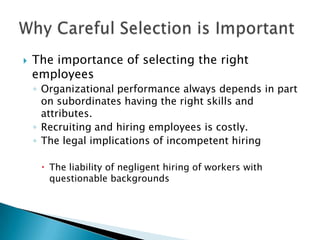
   The importance of selecting the right
    employees
    ◦ Organizational performance always depends in part
      on subordinates having the right skills and
      attributes.
    ◦ Recruiting and hiring employees is costly.
    ◦ The legal implications of incompetent hiring

      The liability of negligent hiring of workers with
       questionable backgrounds
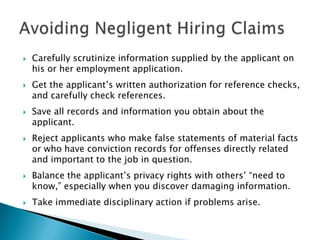
   Carefully scrutinize information supplied by the applicant on
    his or her employment application.
   Get the applicant’s written authorization for reference checks,
    and carefully check references.
   Save all records and information you obtain about the
    applicant.
   Reject applicants who make false statements of material facts
    or who have conviction records for offenses directly related
    and important to the job in question.
   Balance the applicant’s privacy rights with others’ “need to
    know,” especially when you discover damaging information.
   Take immediate disciplinary action if problems arise.
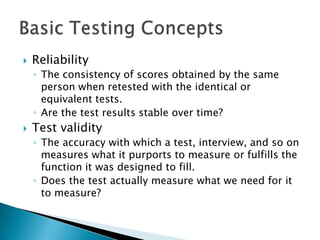
   Reliability
    ◦ The consistency of scores obtained by the same
      person when retested with the identical or
      equivalent tests.
    ◦ Are the test results stable over time?
   Test validity
    ◦ The accuracy with which a test, interview, and so on
      measures what it purports to measure or fulfills the
      function it was designed to fill.
    ◦ Does the test actually measure what we need for it
      to measure?
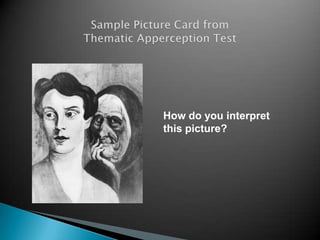
How do you interpret
this picture?
   Criterion validity
    ◦ A type of validity based on showing that scores on
      the test (predictors) are related to job performance
      (criterion).
      Are test scores in this class related to students’
       knowledge of human resource management?
   Content validity
    ◦ A test that is content valid is one that contains a
      fair sample of the tasks and skills actually needed
      for the job in question.
      Do the test questions in this course relate to human
       resource management topics?
      Is taking an HR course the same as doing HR?
   www.hr-guide.com/data/G371.htm
    ◦ Provides general information and sources for all types of
      employment tests.
   http://buros.unl.edu/buros/jsp/search.jsp
    ◦ Provides technical information on all types of employment and
      nonemployment tests.
   www.ets.org/testcoll/index.html
    ◦ Provides information on over 20,000 tests.
   www.kaplan.com/
    ◦ Information from Kaplan test preparation on how various
      admissions tests work.
   www.assessments.biz/default.asp?source=GW-emptest
    ◦ One of many firms offering employment tests.
   Step 1: Analyze the job
    ◦ Predictors: job specification (KSAOs)
    ◦ Criterion: quantitative and qualitative measures of
      job success
   Step 2: Choose the tests
    ◦ Test battery or single test?
   Step 3: Administer the test
    ◦ Concurrent validation
      Current employees’ scores with current performance
    ◦ Predictive validation
      Later-measured performance with prior scores
   Step 4: Relate Test Scores and Criteria
    ◦ Correlation analysis
      Actual scores on the test with actual performance
   Step 5: Cross-Validate and Revalidate
    ◦ Repeat Step 3 and Step 4 with a different sample of
      employees.
1.   Use tests as supplements.
2.   Validate the tests.
3.   Monitor your testing/selection program
4.   Keep accurate records.
5.   Use a certified psychologist.
6.   Manage test conditions.
7.   Revalidate periodically.
   Types of tests
    ◦   Specialized work sample tests
    ◦   Numerical ability tests
    ◦   Reading comprehension tests
    ◦   Clerical comparing and checking tests
   Online tests
    ◦   Telephone prescreening
    ◦   Offline computer tests
    ◦   Virtual “inbox” tests
    ◦   Online problem solving tests
   Tests of cognitive abilities
    ◦ Intelligence Tests
      Tests of general intellectual abilities that measure a
       range of abilities, including memory, vocabulary,
       verbal fluency, and numerical ability.
    ◦ Aptitude tests
      Tests that measure specific mental abilities, such as
       inductive and deductive reasoning, verbal
       comprehension, memory, and numerical ability.
   Tests of motor abilities
    ◦ Tests that measure motor abilities, such as finger
      dexterity, manual dexterity, and reaction time.
   Tests of physical abilities
    ◦ Tests that measure static strength, dynamic
      strength, body coordination, and stamina.
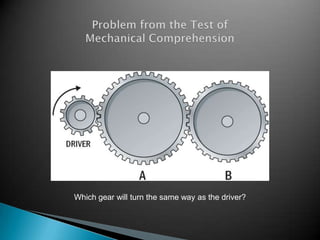
Which gear will turn the same way as the driver?
   Personality tests
    ◦ Tests that use projective techniques and trait
      inventories to measure basic aspects of an
      applicant’s personality, such as introversion,
      stability, and motivation.
    ◦ Disadvantage
      Personality tests—particularly the projective type—are
       the most difficult tests to evaluate and use.
    ◦ Advantage
      Tests have been used successfully to predict
       dysfunctional job behaviors and identify successful
       candidates for overseas assignments.
   Extraversion
    ◦ The tendency to be sociable, assertive, active, and to experience positive
      effects, such as energy and zeal.
   Emotional stability/neuroticism
    ◦ The tendency to exhibit poor emotional adjustment and experience
      negative effects, such as anxiety, insecurity, and hostility.
   Openness to experience
    ◦ The disposition to be imaginative, nonconforming, unconventional, and
      autonomous.
   Agreeableness
    ◦ The tendency to be trusting, compliant, caring, and gentle.
   Conscientiousness
    ◦ Is comprised of two related facets: achievement and dependability.
   Interest inventories
    ◦ Personal development and selection devices that
      compare the person’s current interests with those
      of others now in various occupations so as to
      determine the preferred occupation for the
      individual.
   Achievement tests
    ◦ Test that measure what a person has already
      learned—“job knowledge” in areas like accounting,
      marketing, or personnel.
   Web-Based (Online) testing
    ◦ Eliminates costly and inefficient paper-and-pencil
      testing processes.
    ◦ Allows for role-playing by applicants.
    ◦ Use of computer-based scoring eliminates rater
      bias.
    ◦ Provides immediate scoring and feedback of results
      to applicants.
    ◦ Can be readily customized for specific jobs.
   Work samples
    ◦ Actual job tasks are used in testing applicants’
      performance.
   Work sampling technique
    ◦ A testing method based on measuring an
      applicant’s performance on actual basic job tasks.
   Management assessment center
    ◦ A simulation in which management candidates are
      asked to perform realistic tasks in hypothetical
      situations and are scored on their performance.
   Typical simulated exercises include:
    ◦   The in-basket
    ◦   Leaderless group discussion
    ◦   Management games
    ◦   Individual presentations
    ◦   Objective tests
    ◦   The interview
   Video-Based situational testing
    ◦ A situational test comprised of several video
      scenarios, each followed by a multiple choice
      question that requires the candidate to choose from
      among several courses of action.
    ◦ While the evidence is mixed, the results suggest
      that video-based situational tests can be useful for
      selecting employees.
   The miniature job training and evaluation
    approach
    ◦ Candidates are trained to perform a sample of
      the job’s tasks, and then are evaluated on their
      performance.
    ◦ The approach assumes that a person who
      demonstrates that he or she can learn and
      perform the sample of tasks will be able to learn
      and perform the job itself.
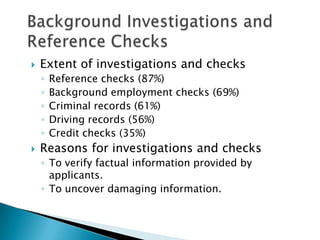
   Extent of investigations and checks
    ◦   Reference checks (87%)
    ◦   Background employment checks (69%)
    ◦   Criminal records (61%)
    ◦   Driving records (56%)
    ◦   Credit checks (35%)
   Reasons for investigations and checks
    ◦ To verify factual information provided by
      applicants.
    ◦ To uncover damaging information.
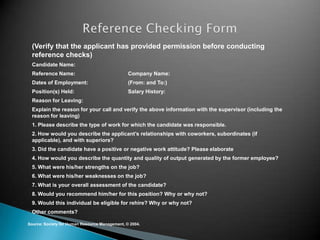
(Verify that the applicant has provided permission before conducting
  reference checks)
  Candidate Name:
  Reference Name:                               Company Name:
  Dates of Employment:                          (From: and To:)
  Position(s) Held:                             Salary History:
  Reason for Leaving:
  Explain the reason for your call and verify the above information with the supervisor (including the
  reason for leaving)
  1. Please describe the type of work for which the candidate was responsible.
  2. How would you describe the applicant’s relationships with coworkers, subordinates (if
  applicable), and with superiors?
  3. Did the candidate have a positive or negative work attitude? Please elaborate
  4. How would you describe the quantity and quality of output generated by the former employee?
  5. What were his/her strengths on the job?
  6. What were his/her weaknesses on the job?
  7. What is your overall assessment of the candidate?
  8. Would you recommend him/her for this position? Why or why not?
  9. Would this individual be eligible for rehire? Why or why not?
  Other comments?

Source: Society for Human Resource Management, © 2004.
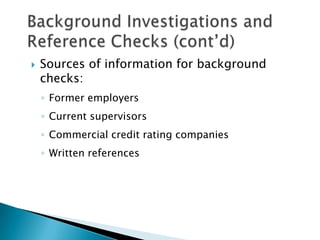
   Sources of information for background
    checks:
    ◦ Former employers
    ◦ Current supervisors
    ◦ Commercial credit rating companies
    ◦ Written references
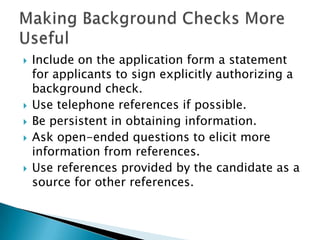
   Include on the application form a statement
    for applicants to sign explicitly authorizing a
    background check.
   Use telephone references if possible.
   Be persistent in obtaining information.
   Ask open-ended questions to elicit more
    information from references.
   Use references provided by the candidate as a
    source for other references.
   Concerns about checking applicant
    histories
    ◦ Various equal employment laws discourage or
      prohibit the use of such information in employee
      screening.
    ◦ Courts view making employment decisions
      based on someone’s arrest record as unfairly
      discriminatory.
    ◦ The EEOC says a poor credit history should not
      by itself preclude someone from getting a job.
   The polygraph (or lie detector)
    ◦ A device that measures physiological changes,
    ◦ The assumption is that such changes reflect
      changes in emotional state that accompany lying.
   Employers with contracts involving:
    ◦   National defense or security
    ◦   Nuclear-power (Department of Energy)
    ◦   Access to highly classified information
    ◦   Counterintelligence (the FBI or Department of
        Justice)
   Other exceptions
    ◦ Hiring of private security personnel
    ◦ Hiring persons with access to drugs
    ◦ Conducting ongoing investigations involving
      economic loss or injury to an employer’s business.
   Paper-and-pencil honesty tests
    ◦ Psychological tests designed to predict job
      applicants’ proneness to dishonesty and other
      forms of counterproductivity.
    ◦ Measure attitudes regarding things like tolerance of
      others who steal, acceptance of rationalizations for
      theft, and admission of theft-related activities.
   Ask blunt questions.
   Listen, rather than talk.
   Do a credit check.
   Check all employment and personal
    references.
   Use paper-and-pencil honesty tests and
    psychological tests.
   Test for drugs.
   Establish a search-and-seizure policy and
    conduct searches.
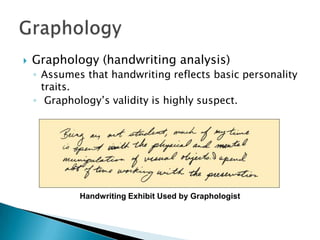
   Graphology (handwriting analysis)
    ◦ Assumes that handwriting reflects basic personality
      traits.
    ◦ Graphology’s validity is highly suspect.


             Handwriting Exhibit Used by Graphologist
   Reasons for preemployment medical
    examinations:
    ◦ To verify that the applicant meets the physical
      requirements of the position
    ◦ To discover any medical limitations you should take
      into account in placing the applicant.
    ◦ To establish a record and baseline of the
      applicant’s health for future insurance or
      compensation claims.
    ◦ To reduce absenteeism and accidents
    ◦ To detect communicable diseases that may be
      unknown to the applicant.
Employee Testing and Selection - 2


     Interviewing Candidates


                               Dr. Shekhar
   An interview
    ◦ A procedure designed to obtain information from a
      person through oral responses to oral inquiries
   Types of interviews
    ◦ Selection interview
    ◦ Appraisal interview
    ◦ Exit interview
   Interviews formats
    ◦ Structured
    ◦ Unstructured
   Selection interview
    ◦ A selection procedure designed to predict future job
      performance on the basis of applicants’ oral responses
      to oral inquiries.
   Appraisal interview
    ◦ A discussion, following a performance appraisal, in
      which supervisor and employee discuss the employee’s
      rating and possible remedial actions.
   Exit interview
    ◦ An interview to elicit information about the job or
      related matters to the employer some insight into what’s
      right or wrong about the firm.
   Unstructured or nondirective interview
    ◦ An unstructured conversational-style interview in
      which the interviewer pursues points of interest as
      they come up in response to questions.
   Structured or directive interview
    ◦ An interview following a set sequence of questions.
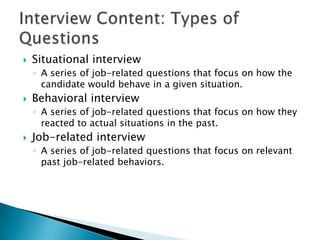
   Situational interview
    ◦ A series of job-related questions that focus on how the
      candidate would behave in a given situation.
   Behavioral interview
    ◦ A series of job-related questions that focus on how they
      reacted to actual situations in the past.
   Job-related interview
    ◦ A series of job-related questions that focus on relevant
      past job-related behaviors.
   Stress interview
    ◦ An interview in which the interviewer seeks to make the
      applicant uncomfortable with occasionally rude
      questions that supposedly to spot sensitive applicants
      and those with low or high stress tolerance.
   Puzzle questions
    ◦ Recruiters for technical, finance, and other types of jobs
      use questions to pose problems requiring unique (“out-
      of-the-box”) solutions to see how candidates think
      under pressure.
Personal or Individual Interviews
   Unstructured sequential interview
    ◦ An interview in which each interviewer forms an
      independent opinion after asking different questions.
   Structured sequential interview
    ◦ An interview in which the applicant is interviewed
      sequentially by several persons; each rates the applicant
      on a standard form.
   Panel interview
    ◦ An interview in which a group of interviewers questions
      the applicant.
   Panel (broad) interview
    ◦ An interview in which a group of interviewers
      questions the applicant.
   Mass interview
    ◦ A panel interviews several candidates
      simultaneously.
   Computerized selection interview
    ◦ An interview in which a job candidate’s oral and/or
      computerized replies are obtained in response to
      computerized oral, visual, or written questions and/or
      situations.
   Characteristics
    ◦ Reduces amount of time managers devote to
      interviewing unacceptable candidates.
    ◦ Applicants are more honest with computers
    ◦ Avoids problems of interpersonal interviews
    ◦ Mechanical nature of computer-aided interview can
      leave an applicant dissatisfied.
   First impressions
    ◦ The tendency for interviewers to jump to
      conclusions—make snap judgments—about
      candidates during the first few minutes of the
      interview.
    ◦ Negative bias: unfavorable information about an
      applicant influences interviewers more than does
      positive information.
   Misunderstanding the job
    ◦ Not knowing precisely what the job entails and what
      sort of candidate is best suited causes interviewers
      to make decisions based on incorrect stereotypes of
      what a good applicant is.
   Candidate-order error
    ◦ An error of judgment on the part of the interviewer
      due to interviewing one or more very good or very
      bad candidates just before the interview in
      question.
   Nonverbal behavior and impression
    management
    ◦ Interviewers’ inferences of the interviewee’s
      personality from the way he or she acts in the
      interview have a large impact on the interviewer’s
      rating of the interviewee.
    ◦ Clever interviewees attempt to manage the
      impression they present to persuade interviewers to
      view them more favorably.
   Effect of personal characteristics:
    attractiveness, gender, race
    ◦ Interviewers tend have a less favorable view of
      candidates who are:
       Physically unattractive
       Female
       Of a different racial background
       Disabled
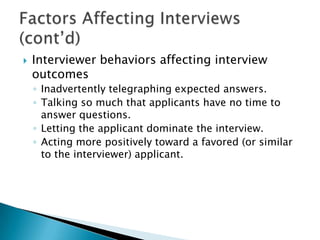
   Interviewer behaviors affecting interview
    outcomes
    ◦ Inadvertently telegraphing expected answers.
    ◦ Talking so much that applicants have no time to
      answer questions.
    ◦ Letting the applicant dominate the interview.
    ◦ Acting more positively toward a favored (or similar
      to the interviewer) applicant.
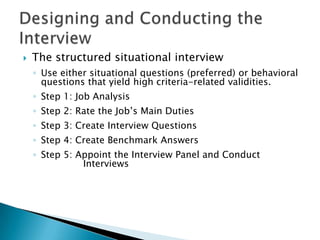
   The structured situational interview
    ◦ Use either situational questions (preferred) or behavioral
      questions that yield high criteria-related validities.
    ◦ Step 1: Job Analysis
    ◦ Step 2: Rate the Job’s Main Duties
    ◦ Step 3: Create Interview Questions
    ◦ Step 4: Create Benchmark Answers
    ◦ Step 5: Appoint the Interview Panel and Conduct
               Interviews
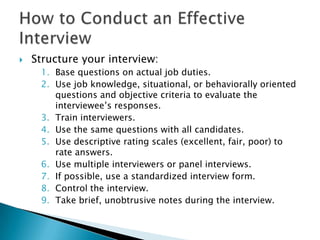
   Structure your interview:
     1. Base questions on actual job duties.
     2. Use job knowledge, situational, or behaviorally oriented
        questions and objective criteria to evaluate the
        interviewee’s responses.
     3. Train interviewers.
     4. Use the same questions with all candidates.
     5. Use descriptive rating scales (excellent, fair, poor) to
        rate answers.
     6. Use multiple interviewers or panel interviews.
     7. If possible, use a standardized interview form.
     8. Control the interview.
     9. Take brief, unobtrusive notes during the interview.
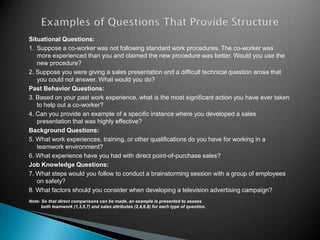
Situational Questions:
1. Suppose a co-worker was not following standard work procedures. The co-worker was
   more experienced than you and claimed the new procedure was better. Would you use the
   new procedure?
2. Suppose you were giving a sales presentation and a difficult technical question arose that
   you could not answer. What would you do?
Past Behavior Questions:
3. Based on your past work experience, what is the most significant action you have ever taken
   to help out a co-worker?
4. Can you provide an example of a specific instance where you developed a sales
   presentation that was highly effective?
Background Questions:
5. What work experiences, training, or other qualifications do you have for working in a
   teamwork environment?
6. What experience have you had with direct point-of-purchase sales?
Job Knowledge Questions:
7. What steps would you follow to conduct a brainstorming session with a group of employees
   on safety?
8. What factors should you consider when developing a television advertising campaign?
Note: So that direct comparisons can be made, an example is presented to assess
      both teamwork (1,3,5,7) and sales attributes (2,4,6,8) for each type of question.
   Prepare for the interview
    ◦ Secure a private room to minimize interruptions.
    ◦ Review the candidate’s application and résumé.
    ◦ Review the job specifications
   Establish rapport
    ◦ Put the person at ease.
   Ask questions
    ◦ Follow your list of questions.
    ◦ Don’t ask questions that can be answered yes or no.
Thanks

Session6 gary dessler ch06 testing and selection (1)

  • 1.
    Employee Testing andSelection - 1 Dr. Shekhar
  • 2.
    The importance of selecting the right employees ◦ Organizational performance always depends in part on subordinates having the right skills and attributes. ◦ Recruiting and hiring employees is costly. ◦ The legal implications of incompetent hiring  The liability of negligent hiring of workers with questionable backgrounds
  • 3.
    Carefully scrutinize information supplied by the applicant on his or her employment application.  Get the applicant’s written authorization for reference checks, and carefully check references.  Save all records and information you obtain about the applicant.  Reject applicants who make false statements of material facts or who have conviction records for offenses directly related and important to the job in question.  Balance the applicant’s privacy rights with others’ “need to know,” especially when you discover damaging information.  Take immediate disciplinary action if problems arise.
  • 4.
    Reliability ◦ The consistency of scores obtained by the same person when retested with the identical or equivalent tests. ◦ Are the test results stable over time?  Test validity ◦ The accuracy with which a test, interview, and so on measures what it purports to measure or fulfills the function it was designed to fill. ◦ Does the test actually measure what we need for it to measure?
  • 5.
    How do youinterpret this picture?
  • 6.
    Criterion validity ◦ A type of validity based on showing that scores on the test (predictors) are related to job performance (criterion).  Are test scores in this class related to students’ knowledge of human resource management?  Content validity ◦ A test that is content valid is one that contains a fair sample of the tasks and skills actually needed for the job in question.  Do the test questions in this course relate to human resource management topics?  Is taking an HR course the same as doing HR?
  • 7.
    www.hr-guide.com/data/G371.htm ◦ Provides general information and sources for all types of employment tests.  http://buros.unl.edu/buros/jsp/search.jsp ◦ Provides technical information on all types of employment and nonemployment tests.  www.ets.org/testcoll/index.html ◦ Provides information on over 20,000 tests.  www.kaplan.com/ ◦ Information from Kaplan test preparation on how various admissions tests work.  www.assessments.biz/default.asp?source=GW-emptest ◦ One of many firms offering employment tests.
  • 8.
    Step 1: Analyze the job ◦ Predictors: job specification (KSAOs) ◦ Criterion: quantitative and qualitative measures of job success  Step 2: Choose the tests ◦ Test battery or single test?  Step 3: Administer the test ◦ Concurrent validation  Current employees’ scores with current performance ◦ Predictive validation  Later-measured performance with prior scores
  • 9.
    Step 4: Relate Test Scores and Criteria ◦ Correlation analysis  Actual scores on the test with actual performance  Step 5: Cross-Validate and Revalidate ◦ Repeat Step 3 and Step 4 with a different sample of employees.
  • 10.
    1. Use tests as supplements. 2. Validate the tests. 3. Monitor your testing/selection program 4. Keep accurate records. 5. Use a certified psychologist. 6. Manage test conditions. 7. Revalidate periodically.
  • 12.
    Types of tests ◦ Specialized work sample tests ◦ Numerical ability tests ◦ Reading comprehension tests ◦ Clerical comparing and checking tests  Online tests ◦ Telephone prescreening ◦ Offline computer tests ◦ Virtual “inbox” tests ◦ Online problem solving tests
  • 13.
    Tests of cognitive abilities ◦ Intelligence Tests  Tests of general intellectual abilities that measure a range of abilities, including memory, vocabulary, verbal fluency, and numerical ability. ◦ Aptitude tests  Tests that measure specific mental abilities, such as inductive and deductive reasoning, verbal comprehension, memory, and numerical ability.
  • 14.
    Tests of motor abilities ◦ Tests that measure motor abilities, such as finger dexterity, manual dexterity, and reaction time.  Tests of physical abilities ◦ Tests that measure static strength, dynamic strength, body coordination, and stamina.
  • 15.
    Which gear willturn the same way as the driver?
  • 16.
    Personality tests ◦ Tests that use projective techniques and trait inventories to measure basic aspects of an applicant’s personality, such as introversion, stability, and motivation. ◦ Disadvantage  Personality tests—particularly the projective type—are the most difficult tests to evaluate and use. ◦ Advantage  Tests have been used successfully to predict dysfunctional job behaviors and identify successful candidates for overseas assignments.
  • 17.
    Extraversion ◦ The tendency to be sociable, assertive, active, and to experience positive effects, such as energy and zeal.  Emotional stability/neuroticism ◦ The tendency to exhibit poor emotional adjustment and experience negative effects, such as anxiety, insecurity, and hostility.  Openness to experience ◦ The disposition to be imaginative, nonconforming, unconventional, and autonomous.  Agreeableness ◦ The tendency to be trusting, compliant, caring, and gentle.  Conscientiousness ◦ Is comprised of two related facets: achievement and dependability.
  • 18.
    Interest inventories ◦ Personal development and selection devices that compare the person’s current interests with those of others now in various occupations so as to determine the preferred occupation for the individual.  Achievement tests ◦ Test that measure what a person has already learned—“job knowledge” in areas like accounting, marketing, or personnel.
  • 19.
    Web-Based (Online) testing ◦ Eliminates costly and inefficient paper-and-pencil testing processes. ◦ Allows for role-playing by applicants. ◦ Use of computer-based scoring eliminates rater bias. ◦ Provides immediate scoring and feedback of results to applicants. ◦ Can be readily customized for specific jobs.
  • 20.
    Work samples ◦ Actual job tasks are used in testing applicants’ performance.  Work sampling technique ◦ A testing method based on measuring an applicant’s performance on actual basic job tasks.
  • 21.
    Management assessment center ◦ A simulation in which management candidates are asked to perform realistic tasks in hypothetical situations and are scored on their performance.  Typical simulated exercises include: ◦ The in-basket ◦ Leaderless group discussion ◦ Management games ◦ Individual presentations ◦ Objective tests ◦ The interview
  • 22.
    Video-Based situational testing ◦ A situational test comprised of several video scenarios, each followed by a multiple choice question that requires the candidate to choose from among several courses of action. ◦ While the evidence is mixed, the results suggest that video-based situational tests can be useful for selecting employees.
  • 23.
    The miniature job training and evaluation approach ◦ Candidates are trained to perform a sample of the job’s tasks, and then are evaluated on their performance. ◦ The approach assumes that a person who demonstrates that he or she can learn and perform the sample of tasks will be able to learn and perform the job itself.
  • 24.
    Extent of investigations and checks ◦ Reference checks (87%) ◦ Background employment checks (69%) ◦ Criminal records (61%) ◦ Driving records (56%) ◦ Credit checks (35%)  Reasons for investigations and checks ◦ To verify factual information provided by applicants. ◦ To uncover damaging information.
  • 25.
    (Verify that theapplicant has provided permission before conducting reference checks) Candidate Name: Reference Name: Company Name: Dates of Employment: (From: and To:) Position(s) Held: Salary History: Reason for Leaving: Explain the reason for your call and verify the above information with the supervisor (including the reason for leaving) 1. Please describe the type of work for which the candidate was responsible. 2. How would you describe the applicant’s relationships with coworkers, subordinates (if applicable), and with superiors? 3. Did the candidate have a positive or negative work attitude? Please elaborate 4. How would you describe the quantity and quality of output generated by the former employee? 5. What were his/her strengths on the job? 6. What were his/her weaknesses on the job? 7. What is your overall assessment of the candidate? 8. Would you recommend him/her for this position? Why or why not? 9. Would this individual be eligible for rehire? Why or why not? Other comments? Source: Society for Human Resource Management, © 2004.
  • 26.
    Sources of information for background checks: ◦ Former employers ◦ Current supervisors ◦ Commercial credit rating companies ◦ Written references
  • 27.
    Include on the application form a statement for applicants to sign explicitly authorizing a background check.  Use telephone references if possible.  Be persistent in obtaining information.  Ask open-ended questions to elicit more information from references.  Use references provided by the candidate as a source for other references.
  • 28.
    Concerns about checking applicant histories ◦ Various equal employment laws discourage or prohibit the use of such information in employee screening. ◦ Courts view making employment decisions based on someone’s arrest record as unfairly discriminatory. ◦ The EEOC says a poor credit history should not by itself preclude someone from getting a job.
  • 29.
    The polygraph (or lie detector) ◦ A device that measures physiological changes, ◦ The assumption is that such changes reflect changes in emotional state that accompany lying.
  • 30.
    Employers with contracts involving: ◦ National defense or security ◦ Nuclear-power (Department of Energy) ◦ Access to highly classified information ◦ Counterintelligence (the FBI or Department of Justice)  Other exceptions ◦ Hiring of private security personnel ◦ Hiring persons with access to drugs ◦ Conducting ongoing investigations involving economic loss or injury to an employer’s business.
  • 31.
    Paper-and-pencil honesty tests ◦ Psychological tests designed to predict job applicants’ proneness to dishonesty and other forms of counterproductivity. ◦ Measure attitudes regarding things like tolerance of others who steal, acceptance of rationalizations for theft, and admission of theft-related activities.
  • 32.
    Ask blunt questions.  Listen, rather than talk.  Do a credit check.  Check all employment and personal references.  Use paper-and-pencil honesty tests and psychological tests.  Test for drugs.  Establish a search-and-seizure policy and conduct searches.
  • 33.
    Graphology (handwriting analysis) ◦ Assumes that handwriting reflects basic personality traits. ◦ Graphology’s validity is highly suspect. Handwriting Exhibit Used by Graphologist
  • 34.
    Reasons for preemployment medical examinations: ◦ To verify that the applicant meets the physical requirements of the position ◦ To discover any medical limitations you should take into account in placing the applicant. ◦ To establish a record and baseline of the applicant’s health for future insurance or compensation claims. ◦ To reduce absenteeism and accidents ◦ To detect communicable diseases that may be unknown to the applicant.
  • 35.
    Employee Testing andSelection - 2 Interviewing Candidates Dr. Shekhar
  • 36.
    An interview ◦ A procedure designed to obtain information from a person through oral responses to oral inquiries  Types of interviews ◦ Selection interview ◦ Appraisal interview ◦ Exit interview  Interviews formats ◦ Structured ◦ Unstructured
  • 37.
    Selection interview ◦ A selection procedure designed to predict future job performance on the basis of applicants’ oral responses to oral inquiries.  Appraisal interview ◦ A discussion, following a performance appraisal, in which supervisor and employee discuss the employee’s rating and possible remedial actions.  Exit interview ◦ An interview to elicit information about the job or related matters to the employer some insight into what’s right or wrong about the firm.
  • 38.
    Unstructured or nondirective interview ◦ An unstructured conversational-style interview in which the interviewer pursues points of interest as they come up in response to questions.  Structured or directive interview ◦ An interview following a set sequence of questions.
  • 39.
    Situational interview ◦ A series of job-related questions that focus on how the candidate would behave in a given situation.  Behavioral interview ◦ A series of job-related questions that focus on how they reacted to actual situations in the past.  Job-related interview ◦ A series of job-related questions that focus on relevant past job-related behaviors.
  • 40.
    Stress interview ◦ An interview in which the interviewer seeks to make the applicant uncomfortable with occasionally rude questions that supposedly to spot sensitive applicants and those with low or high stress tolerance.  Puzzle questions ◦ Recruiters for technical, finance, and other types of jobs use questions to pose problems requiring unique (“out- of-the-box”) solutions to see how candidates think under pressure.
  • 41.
    Personal or IndividualInterviews  Unstructured sequential interview ◦ An interview in which each interviewer forms an independent opinion after asking different questions.  Structured sequential interview ◦ An interview in which the applicant is interviewed sequentially by several persons; each rates the applicant on a standard form.  Panel interview ◦ An interview in which a group of interviewers questions the applicant.
  • 42.
    Panel (broad) interview ◦ An interview in which a group of interviewers questions the applicant.  Mass interview ◦ A panel interviews several candidates simultaneously.
  • 43.
    Computerized selection interview ◦ An interview in which a job candidate’s oral and/or computerized replies are obtained in response to computerized oral, visual, or written questions and/or situations.  Characteristics ◦ Reduces amount of time managers devote to interviewing unacceptable candidates. ◦ Applicants are more honest with computers ◦ Avoids problems of interpersonal interviews ◦ Mechanical nature of computer-aided interview can leave an applicant dissatisfied.
  • 44.
    First impressions ◦ The tendency for interviewers to jump to conclusions—make snap judgments—about candidates during the first few minutes of the interview. ◦ Negative bias: unfavorable information about an applicant influences interviewers more than does positive information.
  • 45.
    Misunderstanding the job ◦ Not knowing precisely what the job entails and what sort of candidate is best suited causes interviewers to make decisions based on incorrect stereotypes of what a good applicant is.  Candidate-order error ◦ An error of judgment on the part of the interviewer due to interviewing one or more very good or very bad candidates just before the interview in question.
  • 46.
    Nonverbal behavior and impression management ◦ Interviewers’ inferences of the interviewee’s personality from the way he or she acts in the interview have a large impact on the interviewer’s rating of the interviewee. ◦ Clever interviewees attempt to manage the impression they present to persuade interviewers to view them more favorably.
  • 47.
    Effect of personal characteristics: attractiveness, gender, race ◦ Interviewers tend have a less favorable view of candidates who are:  Physically unattractive  Female  Of a different racial background  Disabled
  • 48.
    Interviewer behaviors affecting interview outcomes ◦ Inadvertently telegraphing expected answers. ◦ Talking so much that applicants have no time to answer questions. ◦ Letting the applicant dominate the interview. ◦ Acting more positively toward a favored (or similar to the interviewer) applicant.
  • 49.
    The structured situational interview ◦ Use either situational questions (preferred) or behavioral questions that yield high criteria-related validities. ◦ Step 1: Job Analysis ◦ Step 2: Rate the Job’s Main Duties ◦ Step 3: Create Interview Questions ◦ Step 4: Create Benchmark Answers ◦ Step 5: Appoint the Interview Panel and Conduct Interviews
  • 50.
    Structure your interview: 1. Base questions on actual job duties. 2. Use job knowledge, situational, or behaviorally oriented questions and objective criteria to evaluate the interviewee’s responses. 3. Train interviewers. 4. Use the same questions with all candidates. 5. Use descriptive rating scales (excellent, fair, poor) to rate answers. 6. Use multiple interviewers or panel interviews. 7. If possible, use a standardized interview form. 8. Control the interview. 9. Take brief, unobtrusive notes during the interview.
  • 51.
    Situational Questions: 1. Supposea co-worker was not following standard work procedures. The co-worker was more experienced than you and claimed the new procedure was better. Would you use the new procedure? 2. Suppose you were giving a sales presentation and a difficult technical question arose that you could not answer. What would you do? Past Behavior Questions: 3. Based on your past work experience, what is the most significant action you have ever taken to help out a co-worker? 4. Can you provide an example of a specific instance where you developed a sales presentation that was highly effective? Background Questions: 5. What work experiences, training, or other qualifications do you have for working in a teamwork environment? 6. What experience have you had with direct point-of-purchase sales? Job Knowledge Questions: 7. What steps would you follow to conduct a brainstorming session with a group of employees on safety? 8. What factors should you consider when developing a television advertising campaign? Note: So that direct comparisons can be made, an example is presented to assess both teamwork (1,3,5,7) and sales attributes (2,4,6,8) for each type of question.
  • 52.
    Prepare for the interview ◦ Secure a private room to minimize interruptions. ◦ Review the candidate’s application and résumé. ◦ Review the job specifications  Establish rapport ◦ Put the person at ease.  Ask questions ◦ Follow your list of questions. ◦ Don’t ask questions that can be answered yes or no.
  • 53.