SEISMIC RETROFITTING USING
PRECAST ELEMENTS
RETROFITTING
• Modification of existing building
• 3 methods
• Increasing lateral load carrying capacity
• Increasing ductility of beams and columns
• Reducing seismic response
2
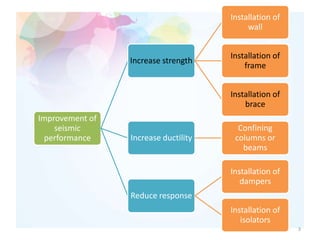
Improvement of
seismic
performance
Increase strength
Installation of
wall
Installation of
frame
Installation of
brace
Increase ductility
Confining
columns or
beams
Reduce response
Installation of
dampers
Installation of
isolators
3
1.PRECAST CONCRETE FRAMES
• External PCaPC frame
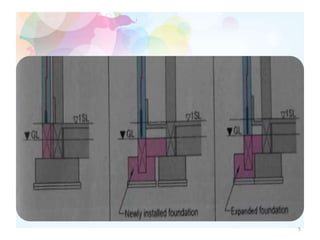
• On existing or new foundation
• 2 methods
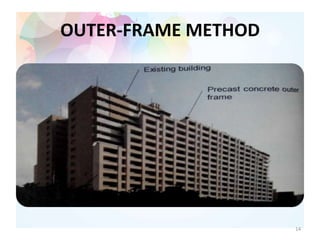
• PCaPC outer-frame method
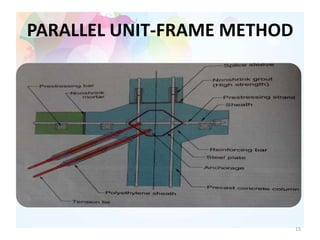
• PCaPC parallel unit-frame method
4
5
CONSTRUCTION
1. Evaluation of seismic capacity
2. Selecting desired retrofit method
3. Excavation of the ground for extending or
construction of foundation
4. Erection of PCaC columns
6
5. Setting of PCaC beams
6. Filling joints
7. Post-tensioning beam - column joints
8. Providing shear transfer
9. Integration of external frame with building
7
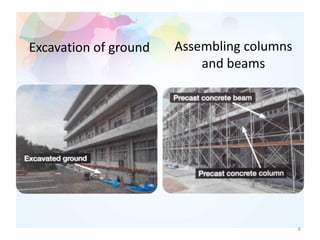
Excavation of ground Assembling columns
and beams
8
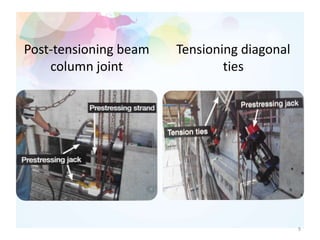
Post-tensioning beam
column joint
Tensioning diagonal
ties
9
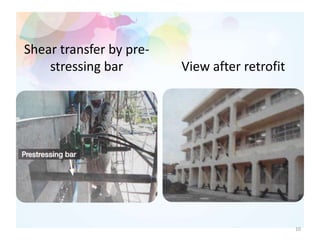
Shear transfer by pre-
stressing bar View after retrofit
10
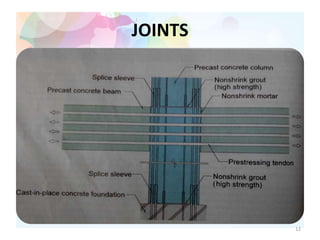
CONNECTIONS
• Column - foundation: splice sleeve connectors
• Column - column: splice sleeve connectors
• Column - beam: post-tensioning
• Vertical joints: high strength non-shrink grout
• Horizontal joints: non-shrink mortar
11
JOINTS
12
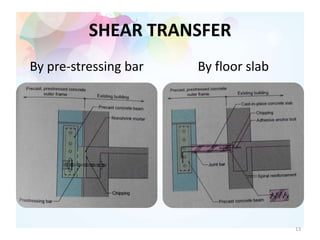
SHEAR TRANSFER
By pre-stressing bar By floor slab
13
OUTER-FRAME METHOD
14
PARALLEL UNIT-FRAME METHOD
15
ADVANTAGES
• Faster construction
• Less or no interior work
• Ventilation and lighting unaffected
• Room layout unchanged
16
LIMITATIONS
• Building concrete strength - 13.5MPa
• Cost - $20,000 to $25,000
• Outer-frame method – 14 storeys
• Parallel unit-frame method – 12 storeys
17
NOTE
• Outer-frame method: 1999 to 2012: 493 projects
• Parallel unit-frame method: 2005 to 2012: 220
projects
• Tohoku earthquake (March 2011) of intensity 9
on moment magnitude scale - 59 buildings
survived
18
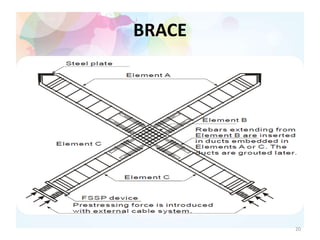
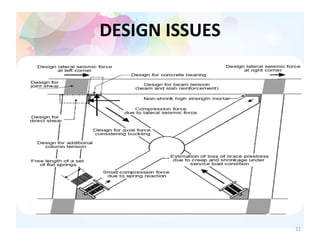
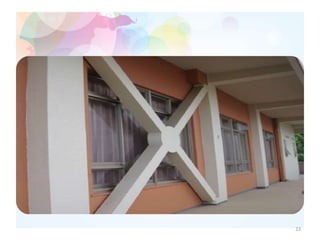
2.PRECAST CONCRETE BRACE
• 5 unit assemblage
• 4 legs and a central unit
• Pre-stress through external cables
• Brace fits the frame by itself
• Frictional control joints
19
BRACE
20
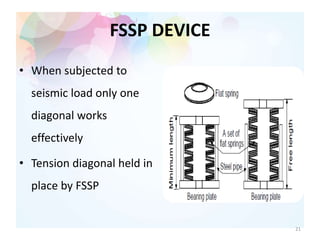
FSSP DEVICE
• When subjected to
seismic load only one
diagonal works
effectively
• Tension diagonal held in
place by FSSP
21
DESIGN ISSUES
22
23
NOTE
• Suggested by Susumu Kono & Fumio
Watanabe
• Lateral load carrying capacity increased by 3
times
• Remedies to brittle failure: CFT & FRC
24
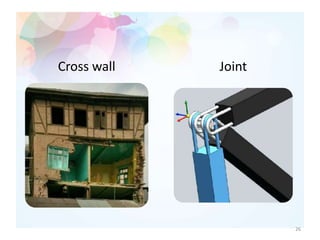
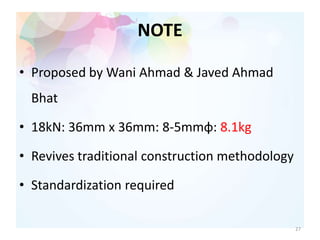
3.PRECAST ARMATURE CROSS WALL
• Replacement of timber members
• PCaP elements pinned at joints
• Light grouting
• Cotter pin
• Truss arrangement: tensional strength
• Pre-stress: bending strength
25
Cross wall Joint
26
NOTE
• Proposed by Wani Ahmad & Javed Ahmad
Bhat
• 18kN: 36mm x 36mm: 8-5mmφ: 8.1kg
• Revives traditional construction methodology
• Standardization required
27
REFERENCE
• Kiyoji Takeda, Kyoya Tanaka, Toshiaki Someya, Asao Sakuda and Yoshiteru Ohno;
“Seismic retrofit of reinforced concrete buildings in Japan using external precast,
pre-stressed concrete frames”; PCI Journal Summer 2013, Volume 58, Pages 41-61.
• Mamoru Oda, Susumu Kono and Fumio Watanabe; “Seismic retrofit of RC buildings
with pre-stressed precast CFT and FRC braces”; The 14th World Conference on
Earthquake Engineering, October 2008, Beijing, China.
• Susumu Kono and Fumio Watanabe; “Retrofitting RC structures with precast pre-
stressed concrete braces”; Proceedings of the 8th U.S. National Conference on
Earthquake Engineering, April 2006, California, USA.
28
REFERENCE
• Toshimi Kabeyasawa (Editor); “Recent development of seismic retrofit
methods in Japan”; Japan Building Disaster Prevention Association; January
2005.
• Wani Ahmad and Javed Ahmad Bhat; “Pre-tensioned precast elements as a
replacement to wooden bracings in the armature cross-wall system: An
approach to revive forgotten heritage”; IJCIET 2012, Volume 3, Issue 2, Pages
181-187.
• http://en.wikipedia.org/wiki/Seismic_retrofit
29
THANK YOU
30

seismic retrofitting using precast elements

  • 1.
  • 2.
    RETROFITTING • Modification ofexisting building • 3 methods • Increasing lateral load carrying capacity • Increasing ductility of beams and columns • Reducing seismic response 2
  • 3.
    Improvement of seismic performance Increase strength Installationof wall Installation of frame Installation of brace Increase ductility Confining columns or beams Reduce response Installation of dampers Installation of isolators 3
  • 4.
    1.PRECAST CONCRETE FRAMES •External PCaPC frame • On existing or new foundation • 2 methods • PCaPC outer-frame method • PCaPC parallel unit-frame method 4
  • 5.
  • 6.
    CONSTRUCTION 1. Evaluation ofseismic capacity 2. Selecting desired retrofit method 3. Excavation of the ground for extending or construction of foundation 4. Erection of PCaC columns 6
  • 7.
    5. Setting ofPCaC beams 6. Filling joints 7. Post-tensioning beam - column joints 8. Providing shear transfer 9. Integration of external frame with building 7
  • 8.
    Excavation of groundAssembling columns and beams 8
  • 9.
  • 10.
    Shear transfer bypre- stressing bar View after retrofit 10
  • 11.
    CONNECTIONS • Column -foundation: splice sleeve connectors • Column - column: splice sleeve connectors • Column - beam: post-tensioning • Vertical joints: high strength non-shrink grout • Horizontal joints: non-shrink mortar 11
  • 12.
  • 13.
    SHEAR TRANSFER By pre-stressingbar By floor slab 13
  • 14.
  • 15.
  • 16.
    ADVANTAGES • Faster construction •Less or no interior work • Ventilation and lighting unaffected • Room layout unchanged 16
  • 17.
    LIMITATIONS • Building concretestrength - 13.5MPa • Cost - $20,000 to $25,000 • Outer-frame method – 14 storeys • Parallel unit-frame method – 12 storeys 17
  • 18.
    NOTE • Outer-frame method:1999 to 2012: 493 projects • Parallel unit-frame method: 2005 to 2012: 220 projects • Tohoku earthquake (March 2011) of intensity 9 on moment magnitude scale - 59 buildings survived 18
  • 19.
    2.PRECAST CONCRETE BRACE •5 unit assemblage • 4 legs and a central unit • Pre-stress through external cables • Brace fits the frame by itself • Frictional control joints 19
  • 20.
  • 21.
    FSSP DEVICE • Whensubjected to seismic load only one diagonal works effectively • Tension diagonal held in place by FSSP 21
  • 22.
  • 23.
  • 24.
    NOTE • Suggested bySusumu Kono & Fumio Watanabe • Lateral load carrying capacity increased by 3 times • Remedies to brittle failure: CFT & FRC 24
  • 25.
    3.PRECAST ARMATURE CROSSWALL • Replacement of timber members • PCaP elements pinned at joints • Light grouting • Cotter pin • Truss arrangement: tensional strength • Pre-stress: bending strength 25
  • 26.
  • 27.
    NOTE • Proposed byWani Ahmad & Javed Ahmad Bhat • 18kN: 36mm x 36mm: 8-5mmφ: 8.1kg • Revives traditional construction methodology • Standardization required 27
  • 28.
    REFERENCE • Kiyoji Takeda,Kyoya Tanaka, Toshiaki Someya, Asao Sakuda and Yoshiteru Ohno; “Seismic retrofit of reinforced concrete buildings in Japan using external precast, pre-stressed concrete frames”; PCI Journal Summer 2013, Volume 58, Pages 41-61. • Mamoru Oda, Susumu Kono and Fumio Watanabe; “Seismic retrofit of RC buildings with pre-stressed precast CFT and FRC braces”; The 14th World Conference on Earthquake Engineering, October 2008, Beijing, China. • Susumu Kono and Fumio Watanabe; “Retrofitting RC structures with precast pre- stressed concrete braces”; Proceedings of the 8th U.S. National Conference on Earthquake Engineering, April 2006, California, USA. 28
  • 29.
    REFERENCE • Toshimi Kabeyasawa(Editor); “Recent development of seismic retrofit methods in Japan”; Japan Building Disaster Prevention Association; January 2005. • Wani Ahmad and Javed Ahmad Bhat; “Pre-tensioned precast elements as a replacement to wooden bracings in the armature cross-wall system: An approach to revive forgotten heritage”; IJCIET 2012, Volume 3, Issue 2, Pages 181-187. • http://en.wikipedia.org/wiki/Seismic_retrofit 29
  • 30.