1
A REPORT ON
SEISMIC RETROFIT OF R.C.C. STRUCTURES
SUBJECT TEACHER
AR.PANKAJ BANKAR
PRESENTED BY
MR.SUNIL MARUTI LOKHANDE
FOURTH YEAR B.ARCH
PRAVARA EDUCATION SOCIETY’S
PRAVARA RURAL COLLEGE OF ARCHITECTURE, LONI
PRAVARA EDUCATION SOCIETY’S
PRAVARA RURAL COLLEGE OF ARCHITECTURE,
LONI
Certificate
THIS IS CERTIFY THAT
MR. SUNIL MARUTI LOKHANDE
Has satisfactorily completed the Seminar work entitled,
DESIGN & TECHNOLOGY ELECTIVE
This work is being submitted for the partial fulfillment of prescribed syllabus of
Fourth Year Architecture University of Pune
For the academic year 2017-2018
AR.PANKAJ BANKAR AR.PRADIP BALOTE
(Subject Teacher) (Principal)
EXTERNAL EXAMINER COLLEGE STAMP
2
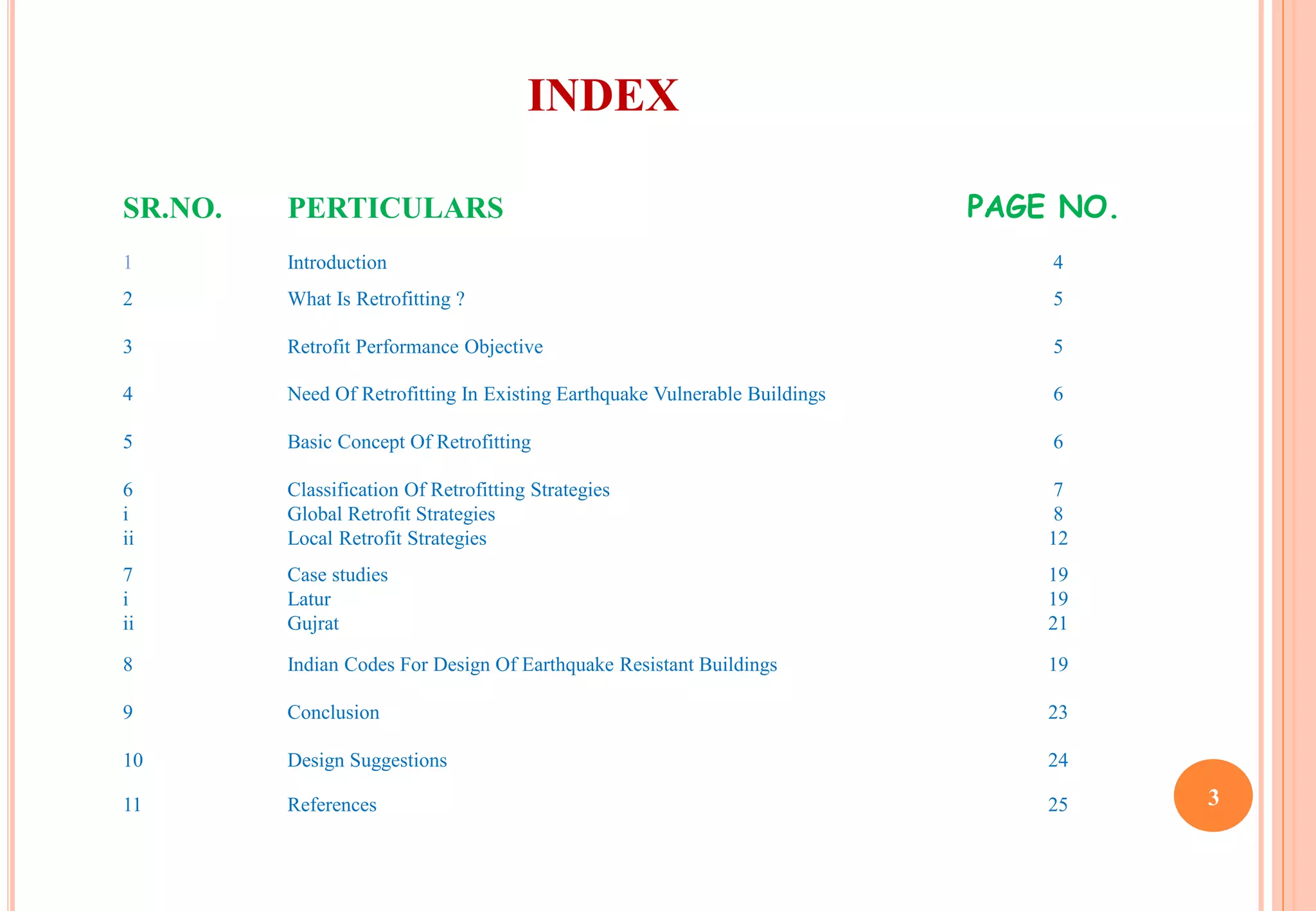
INDEX
SR.NO. PERTICULARS PAGE NO.
1 Introduction 4
2 What Is Retrofitting ? 5
3 Retrofit Performance Objective 5
4 Need Of Retrofitting In Existing Earthquake Vulnerable Buildings 6
5 Basic Concept Of Retrofitting 6
6
i
ii
Classification Of Retrofitting Strategies
Global Retrofit Strategies
Local Retrofit Strategies
7
8
12
7
i
ii
Case studies
Latur
Gujrat
19
19
21
8 Indian Codes For Design Of Earthquake Resistant Buildings 19
9 Conclusion 23
10 Design Suggestions 24
11 References 25 3
 INTRODUCTION
 Is your building safe against earthquake? This is a question that everybody should be concerned about. Many earthquakes have
taken place recently in India and its neighborhood [e.g., Uttarkashi (1991), Latur (1993), Jabalpur (1997), Bhuj (2001), Sumatra
(2004), Kashmir (2005)], and these have proved to be disastrous. A large number of buildings have collapsed and countless lives
have been lost.
 There is usually a huge public outcry after every seismic disaster. But public memory is short-lived, and people tend to forget, until
another major tremor occurs to wake them up. When will that quake happen in our neighborhood? Nobody can predict this. But
when it comes one day, unexpectedly, it could destroy our buildings and take our lives. Can we do something to save our lives and
protect our buildings? Yes! Because,
Earthquakes do not kill; unsafe buildings do.
 EARTHQUAKE
 Sudden shaking and vibrations of earth is known as Earthquake.
 The inside of our earth consists of many layers (crust, mantle, inner and outer cores). Formed
by complex processes over countless years, they continue to be active.
 Once in awhile, the disturbances below the earth get transmitted to the surface, causing
earthquakes.
4
 The waves generated in the soil during an earthquake travel long distances in many directions in
a very short time, shaking the ground. The buildings that cannot resist this ground shaking can
collapse, causing disaster and loss of human life.
 WHAT IS RETROFITTING?
 DEFINITION
• It is the modification of existing structures to make them more resistant to seismic activity, ground motion, or soil failure due to
earthquakes.
• The retrofit techniques are also applicable for other natural hazards such as cyclones, severe winds from thunderstorms.
• The seismic retrofitting gives improvements to an existing buildings and increasing the global capacity of the building.
 WHEN THE RETROFITTING IS NEEDED ?
 The two circumstances are:-
• Earthquake damaged buildings, and
• Earthquake-vulnerable buildings (with no exposure to severe earthquakes)
 RETROFIT PERFORMANCE OBJECTIVES
 Public safety only:
• The goal is to protect human life, ensuring that the structure will not collapse upon its occupants or passersby, and that the
structure can be safely exited. Under severe seismic conditions the structure may be a total economic write-off, requiring tear-
down and replacement.
 Structure survivability:
• The goal is that the structure, while remaining safe for exit, may require extensive repair (but not replacement) before it is
generally useful or considered safe for occupation. This is typically the lowest level of retrofit applied to bridges. 5
6
 Structure functionality:
• Primary structure undamaged and the structure is undiminished in utility for its primary application.
 Structure unaffected:
• This level of retrofit is preferred for historic structures of high cultural significance.
 NEED OF RETROFITTING IN EXISTING EARTHQUAKE VULNERABLE
BUILDINGS
• Buildings have been designed according to a seismic code, but the code has been upgraded in later years;
• Essential buildings must be strengthened like hospitals, historical monuments and architectural buildings;
• Important buildings whose services are assumed to be essential just after an earthquake like hospitals;
• Buildings that are expanded, renovated or rebuilt.
• Buildings, the use of which has changed through the years.
 BASIC CONCEPT OF RETROFITTING IS TO-
 Up gradation of lateral strength of the structure;
 Increase in strength and ductility.
7
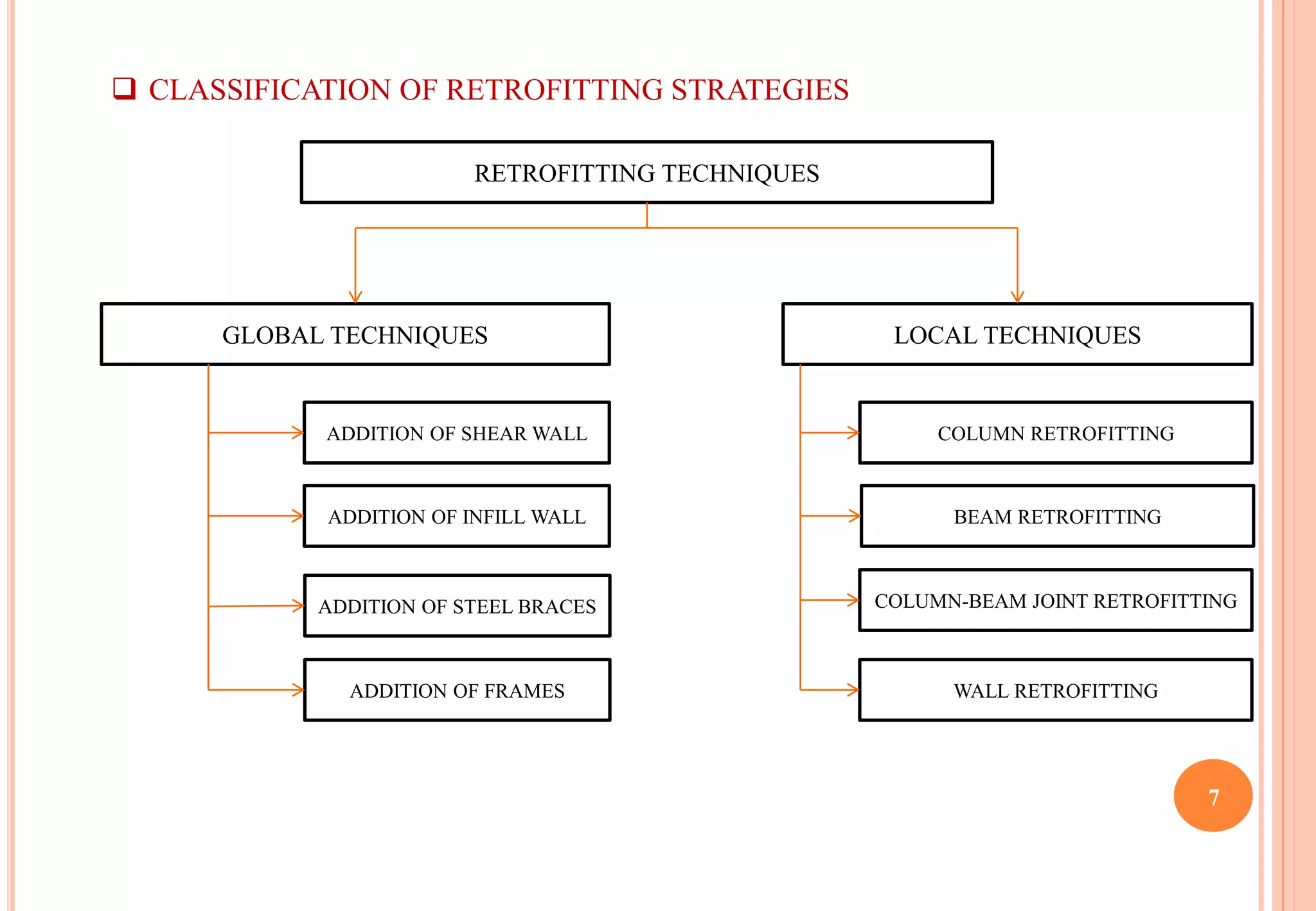
 CLASSIFICATION OF RETROFITTING STRATEGIES
RETROFITTING TECHNIQUES
GLOBAL TECHNIQUES LOCAL TECHNIQUES
ADDITION OF SHEAR WALL
ADDITION OF INFILL WALL
ADDITION OF STEEL BRACES
ADDITION OF FRAMES
COLUMN RETROFITTING
BEAM RETROFITTING
COLUMN-BEAM JOINT RETROFITTING
WALL RETROFITTING
8
 GLOBAL RETROFIT STRATEGIES
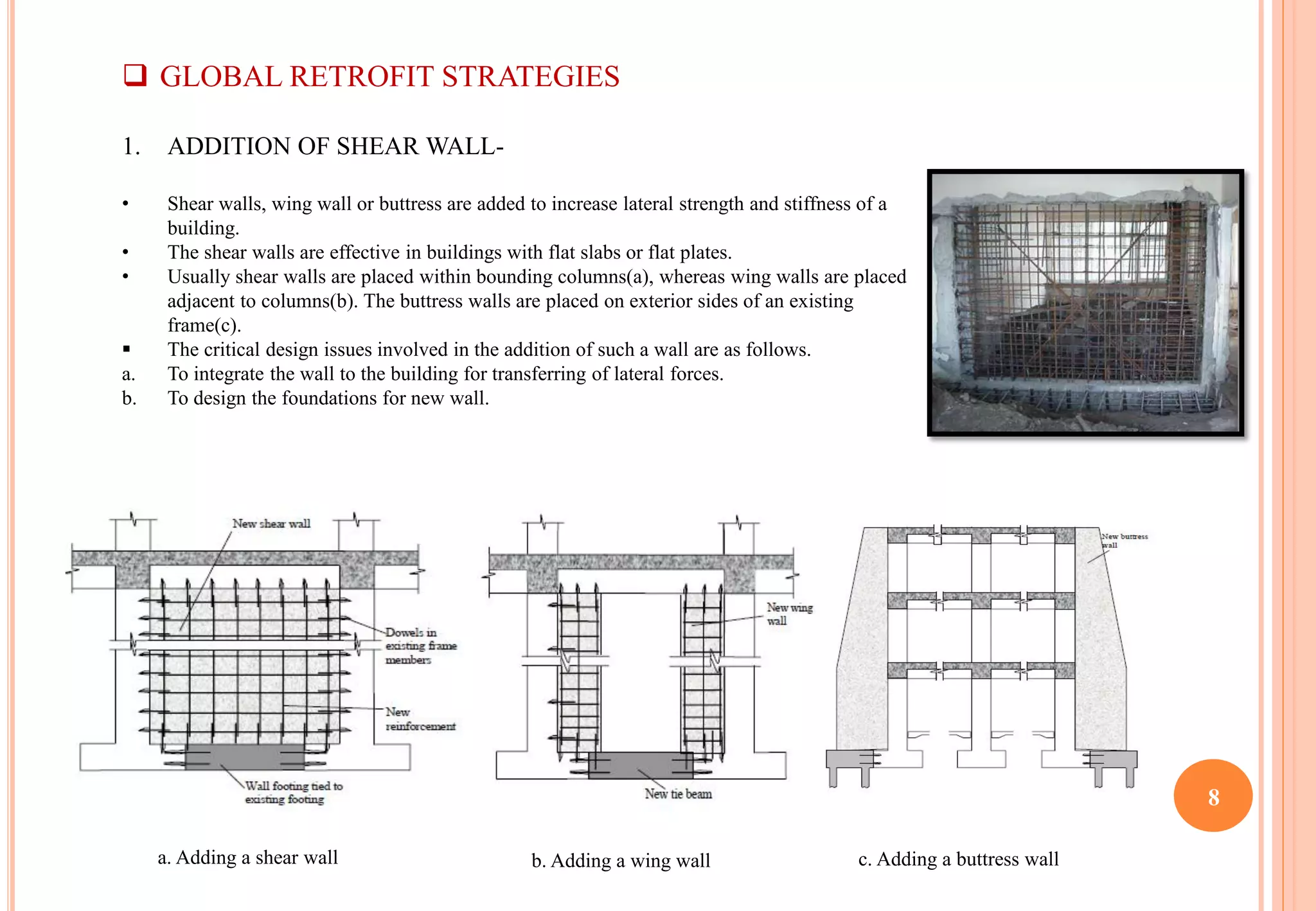
1. ADDITION OF SHEAR WALL-
• Shear walls, wing wall or buttress are added to increase lateral strength and stiffness of a
building.
• The shear walls are effective in buildings with flat slabs or flat plates.
• Usually shear walls are placed within bounding columns(a), whereas wing walls are placed
adjacent to columns(b). The buttress walls are placed on exterior sides of an existing
frame(c).
 The critical design issues involved in the addition of such a wall are as follows.
a. To integrate the wall to the building for transferring of lateral forces.
b. To design the foundations for new wall.
a. Adding a shear wall b. Adding a wing wall c. Adding a buttress wall
9
• The disadvantage is that if only one or two walls are introduced, the increase in lateral resistance is concentrated near the new
walls. Hence it is preferred to have distributed and symmetrically placed walls.
• For a buttress wall, the new foundation should be adequate to resist the overturning moment due to the lateral seismic forces
without rocking or uplift.
2. ADDITION OF AN INFILL WALL-
• The lateral stiffness of a storey increases with infill walls. Addition of infill walls in the ground storey is a viable option to
retrofit buildings with open ground storeys(d).
• Due to the „strut action‟ of the in filled walls, the flexural and shear forces and the ductility demand on the ground storey
columns are substantially reduced.
• Of course, infill walls do not increase the ductility of the overall response of the buildings.
d. Addition of masonry infill wall
10
3. ADDITION OF STEEL BRACES-
• A steel bracing system can be inserted in a frame to provide lateral stiffness, strength, ductility, hysteretic energy dissipation, or
any combination of these.
• The braces are effective for more relatively more flexible frames, such as those without infill walls.
• The braces can be added at the exterior frames with least disruption of the building use.
• For an open ground storey, the braces can be placed in appropriate bays while maintaining the functional use.
 TYPE I
• The force in brace is transferred to the frame through the gusset plate,
end plates and anchor inserts.
 TYPE II
• Similar to type I, except an end plate is connected using through
bolts which are anchored at the opposite face to a bearing plate.
 TYPE III
• Similar to type II, except the end plates and bearing plate project
beyond the width of the beam and column.
11
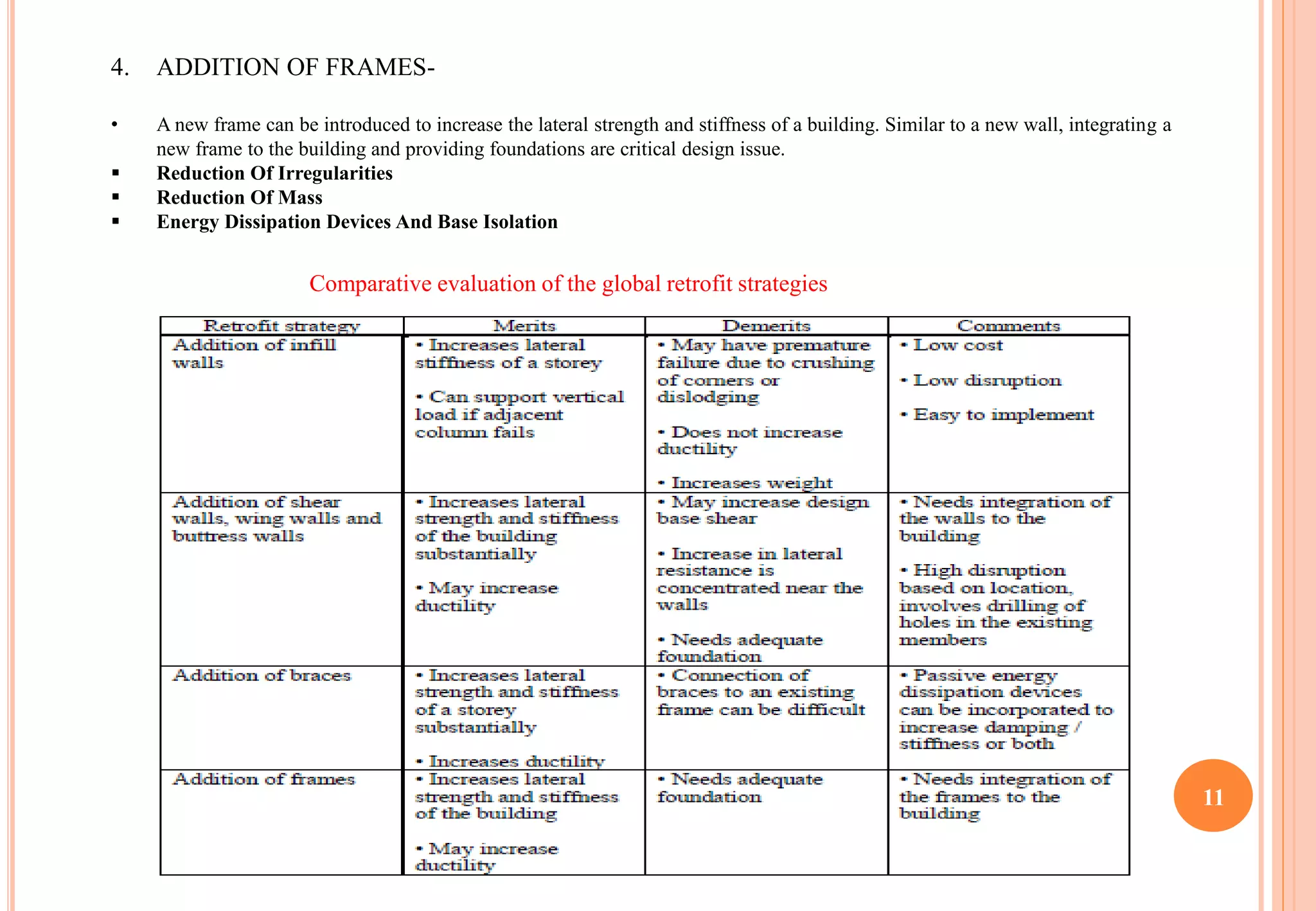
4. ADDITION OF FRAMES-
• A new frame can be introduced to increase the lateral strength and stiffness of a building. Similar to a new wall, integrating a
new frame to the building and providing foundations are critical design issue.
 Reduction Of Irregularities
 Reduction Of Mass
 Energy Dissipation Devices And Base Isolation
Comparative evaluation of the global retrofit strategies
12
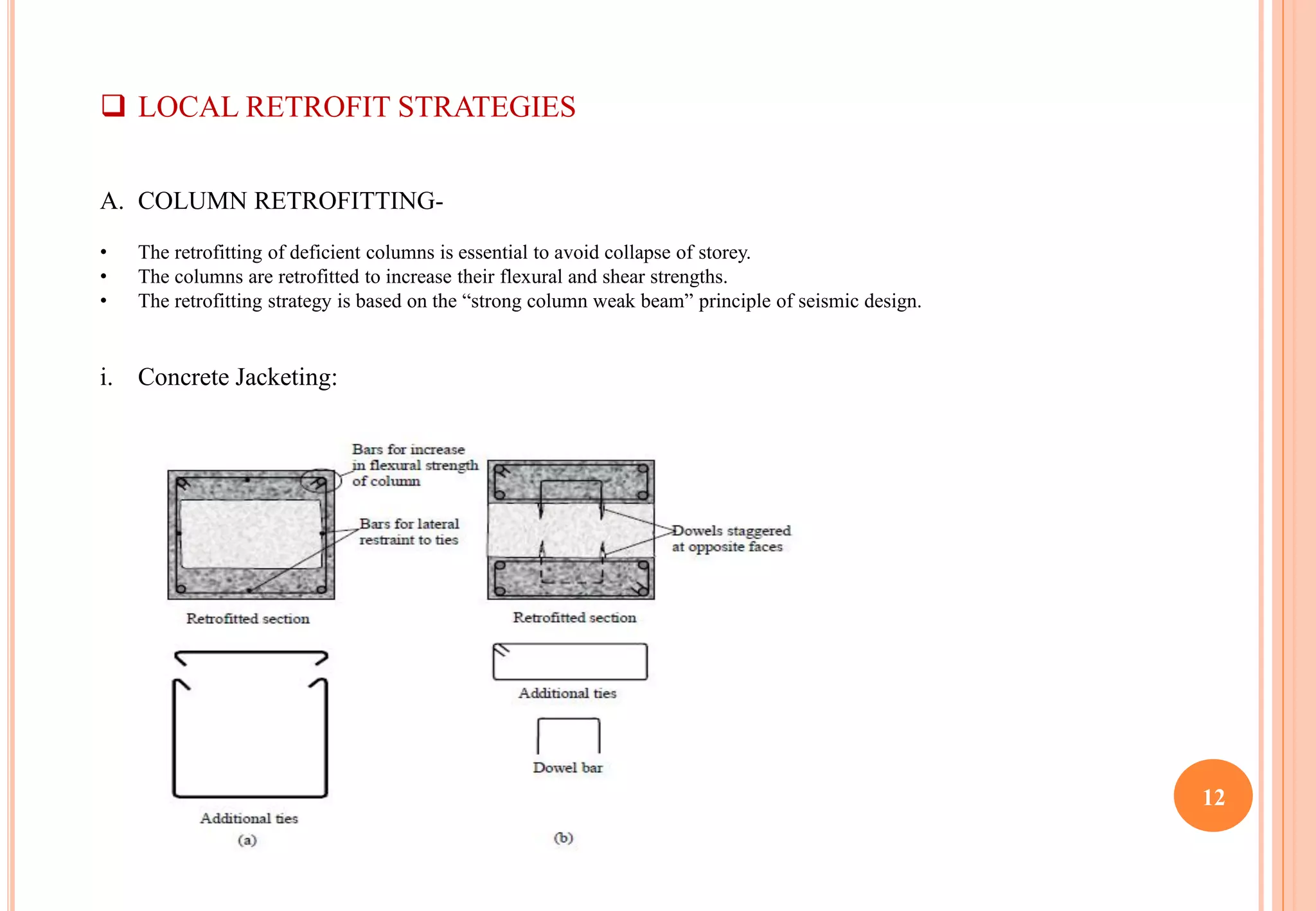
 LOCAL RETROFIT STRATEGIES
A. COLUMN RETROFITTING-
• The retrofitting of deficient columns is essential to avoid collapse of storey.
• The columns are retrofitted to increase their flexural and shear strengths.
• The retrofitting strategy is based on the “strong column weak beam” principle of seismic design.
i. Concrete Jacketing:
13
Techniques of concrete jacketing of columns
14
ii. Steel Jacketing:
Techniques of steel jacketing of columns
iii. Fibre Reinforced Polymer Sheet Wrapping:
• Fibre-reinforced polymer (FRP) has desirable physical properties like high tensile strength to weight
ratio and corrosion resistance.
• FRP sheets are thin, light and flexible enough to be inserted behind pipes and other service ducts, thus
facilitating installation.
15
B. BEAM RETROFITTING-
• The beams are retrofitted to increase their positive flexural strength, shear strength and deformation capacity near the beam-
column joint.
i. Concrete jacketing:
Techniques of concrete jacketing of beams
16
ii. Bonding Steel Plate:
• The technique of binding mild steel plates to beams is used to improve their flexural and shear strengths.
• The addition of steel plate is rapid to apply, dose not reduce the storey clear height significantly and can be applied while the
building is in use.
• The plates are attached to the tension face of a beam to increase the flexural strength, whereas they are attached to the side face
of a beam to increase the shear strength.
• The plates can be attached by adhesive or bolts.
iii. FRP Wrapping (FIBRE REINFORCED POLYMER SHEET WRAPPING)
• Like steel plates, FRP laminates are attached to beams to increase their flexural and shear strengths.
C. BEAM-COLUMN JOINT RETROFITTING-
i. Concrete Jacketing:
• A joint can be strengthened by placing ties through drilled holes in the adjacent beams.
ii. Steel Jacketing:
• If space is available, steel jacketing can be used to enhance the performance of joints.
ii. FRP Wrapping:
• In the use of FRP sheets to strengthen the joints, the considerations are number of layers, orientation and anchorage of the FRP
sheets and the preparation of the existing concrete.
17
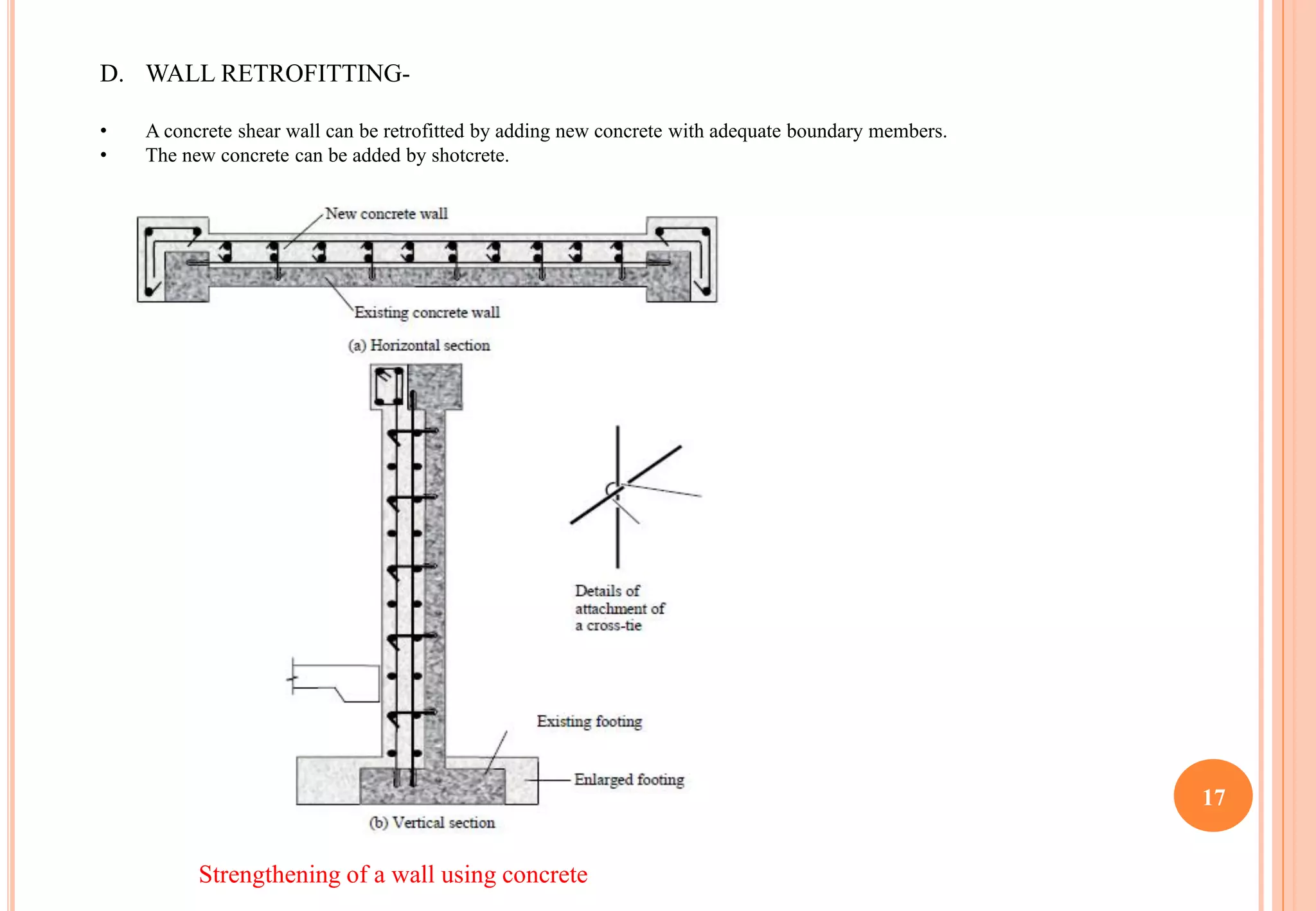
D. WALL RETROFITTING-
• A concrete shear wall can be retrofitted by adding new concrete with adequate boundary members.
• The new concrete can be added by shotcrete.
Strengthening of a wall using concrete
18
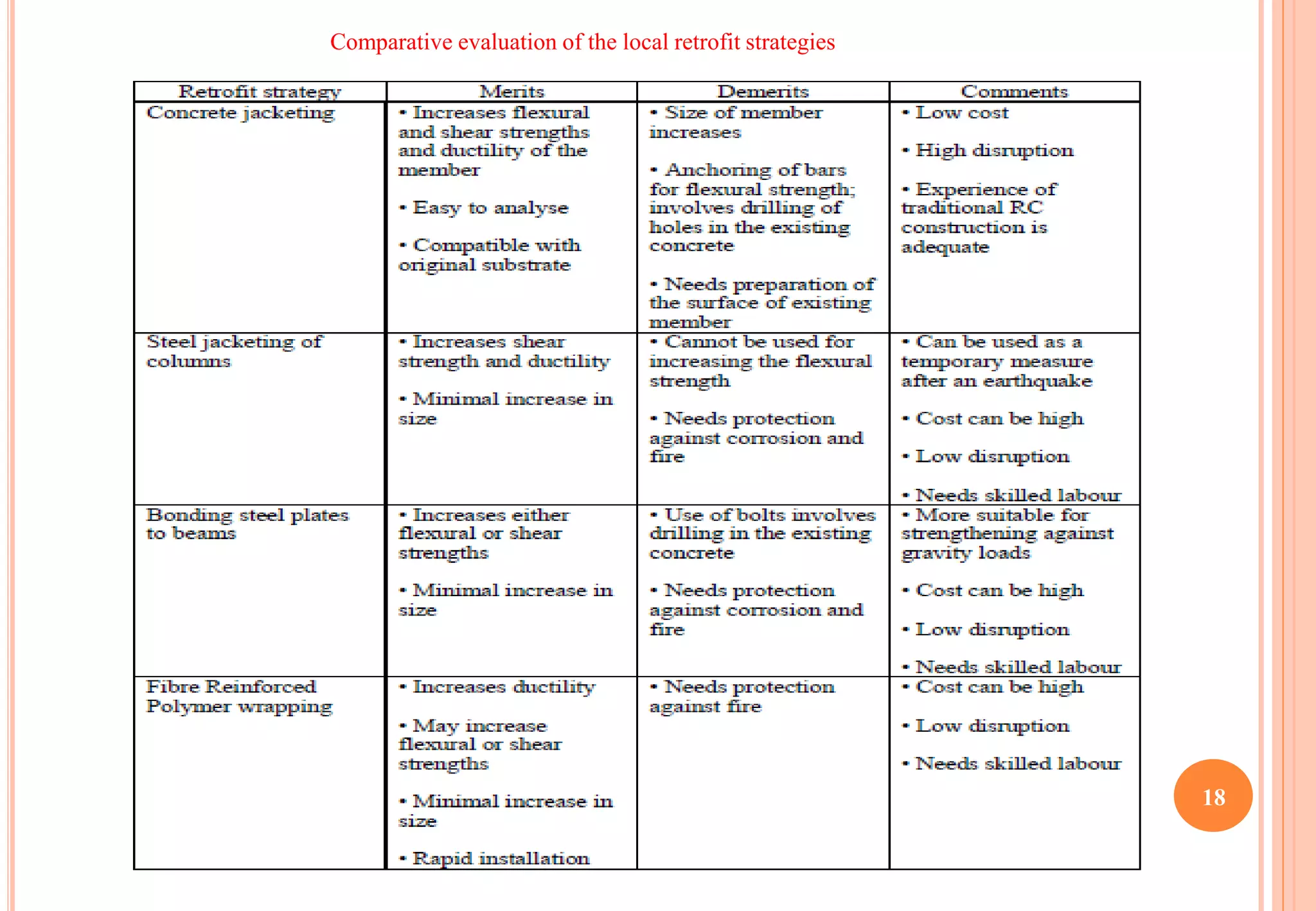
Comparative evaluation of the local retrofit strategies
19
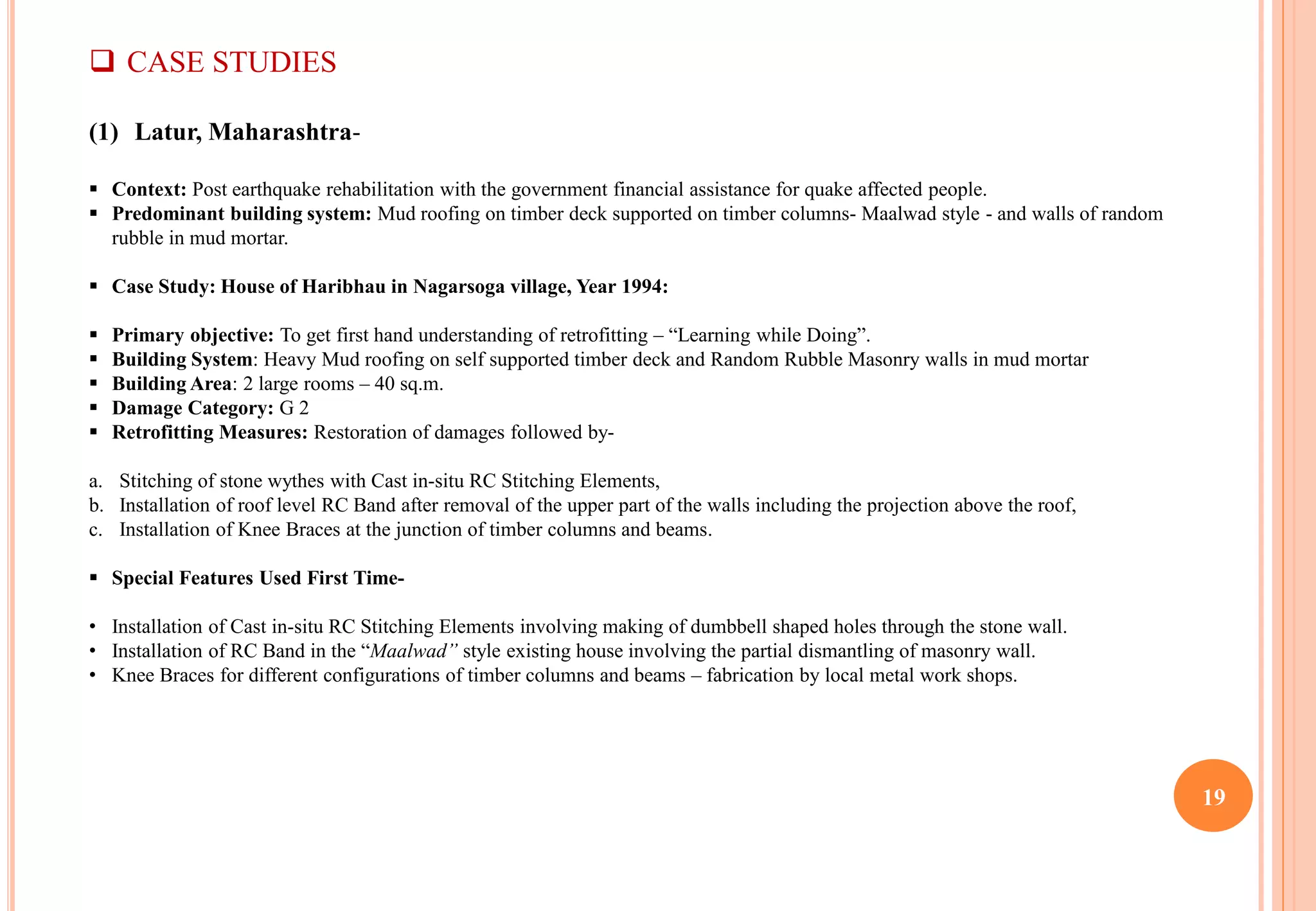
 CASE STUDIES
(1) Latur, Maharashtra-
 Context: Post earthquake rehabilitation with the government financial assistance for quake affected people.
 Predominant building system: Mud roofing on timber deck supported on timber columns- Maalwad style - and walls of random
rubble in mud mortar.
 Case Study: House of Haribhau in Nagarsoga village, Year 1994:
 Primary objective: To get first hand understanding of retrofitting – “Learning while Doing”.
 Building System: Heavy Mud roofing on self supported timber deck and Random Rubble Masonry walls in mud mortar
 Building Area: 2 large rooms – 40 sq.m.
 Damage Category: G 2
 Retrofitting Measures: Restoration of damages followed by-
a. Stitching of stone wythes with Cast in-situ RC Stitching Elements,
b. Installation of roof level RC Band after removal of the upper part of the walls including the projection above the roof,
c. Installation of Knee Braces at the junction of timber columns and beams.
 Special Features Used First Time-
• Installation of Cast in-situ RC Stitching Elements involving making of dumbbell shaped holes through the stone wall.
• Installation of RC Band in the “Maalwad” style existing house involving the partial dismantling of masonry wall.
• Knee Braces for different configurations of timber columns and beams – fabrication by local metal work shops.
20
 Problems Encountered:
• No awareness of retrofitting option among people. As a result not many people were interested in this option.
• Lack of confidence among engineers did not help this process.
• Complicated selection process of a house (simple with no major damage) to work upon because of lack of experience of
restoration, retrofitting and random rubble masonry.
• The risk and the skills involved in the installation of Cast in-situ RC Stitching Elements.
Retrofitting & Restoration completed Knee braces at beam-column joint
Upper Wall removed for band installation & Roof
deck opened for repairs
Cast in-situ RC Stitching Element being plaster
21
2. Gujarat:
 Context: Post earthquake rehabilitation with financial assistance for quake affected people from Government of Gujarat.
 Objective: Demonstration and training of Government engineers.
 Predominant building system: Tiled roof or RC slab over stone, brick or concrete block masonry walls.
 Case Study: R & B Office cum Storage at Patadi town, Year 2002:
 Primary objective: To demonstrate the technology and to train government engineers.
 Building System: AC Sheeting over wooden understructure supported on Random Rubble Masonry in cement mortar
 Building Area: 4 rooms and a passage – 80sq.m. covered area
 Damage Category: G 2
 Retrofitting Measures:
a. Stitching of stone wythes with Cast insitu RC Stitching Elements,
b. WWM Seismic Belt at eave level,
c. Vertical Reinforcing Bars in corners anchored to walls and encased in micro concrete,
d. Encasing of wall openings with WWM Seismic Straps,
e. Roof diaphragm improvement with the help of Diagonal Ties made of 13 gauge pre-tensioned multiple strand GI wires and timber
struts,
f. Strengthening of connections between roofing elements,
g. Anchoring of elements of roof understructure to walls,
h. closing off of a window opening and,
i. Restoration of earthquake damage
22
Gable & Lintel Seismic Belt, Stitching element, window
blocking
Lintel & Ridge Seismic Belt, Roof Bracing,
Stitching Elements
 Special Features Used First Time By Author:
• Additional Seismic Belt with WWM for extra high walls.
• Extensive use of Seismic Belt with WWM for encasement of
• openings.
• Anchoring of roofing elements to support walls
• Blocking off of a window opening
 Problems:
• Absence of awareness about the significance of retrofitting in public as well as R & B engineers resulted in to little learning by them
for future use.
• Absence of necessary skills with masons required their training and more supervision.
23
 INDIAN CODES FOR DESIGN OF EARTHQUAKE RESISTANT BUILDINGS
• IS: 1893-2002 (part-1) Criteria for Earthquake Resistant Design of Structures (Part 1 : General Provision and Buildings) - Code of
Practice
• IS: 4326-1993 Earthquake Resistant Design and Construction of Buildings – Code of Practice
• IS: 13920-1993 Ductile Detailing of Reinforced Concrete Structures subjected to Seismic Forces -Code of Practice
• IS: 13935-1993 Repair and Seismic Strengthening of Buildings – Guidelines
• IS: 13828-1993 Improving Earthquake Resistance of Low Strength Masonry Buildings – Guidelines
• IS: 13827-1993 Improving Earthquake Resistance of Earthen Buildings – Guidelines
24
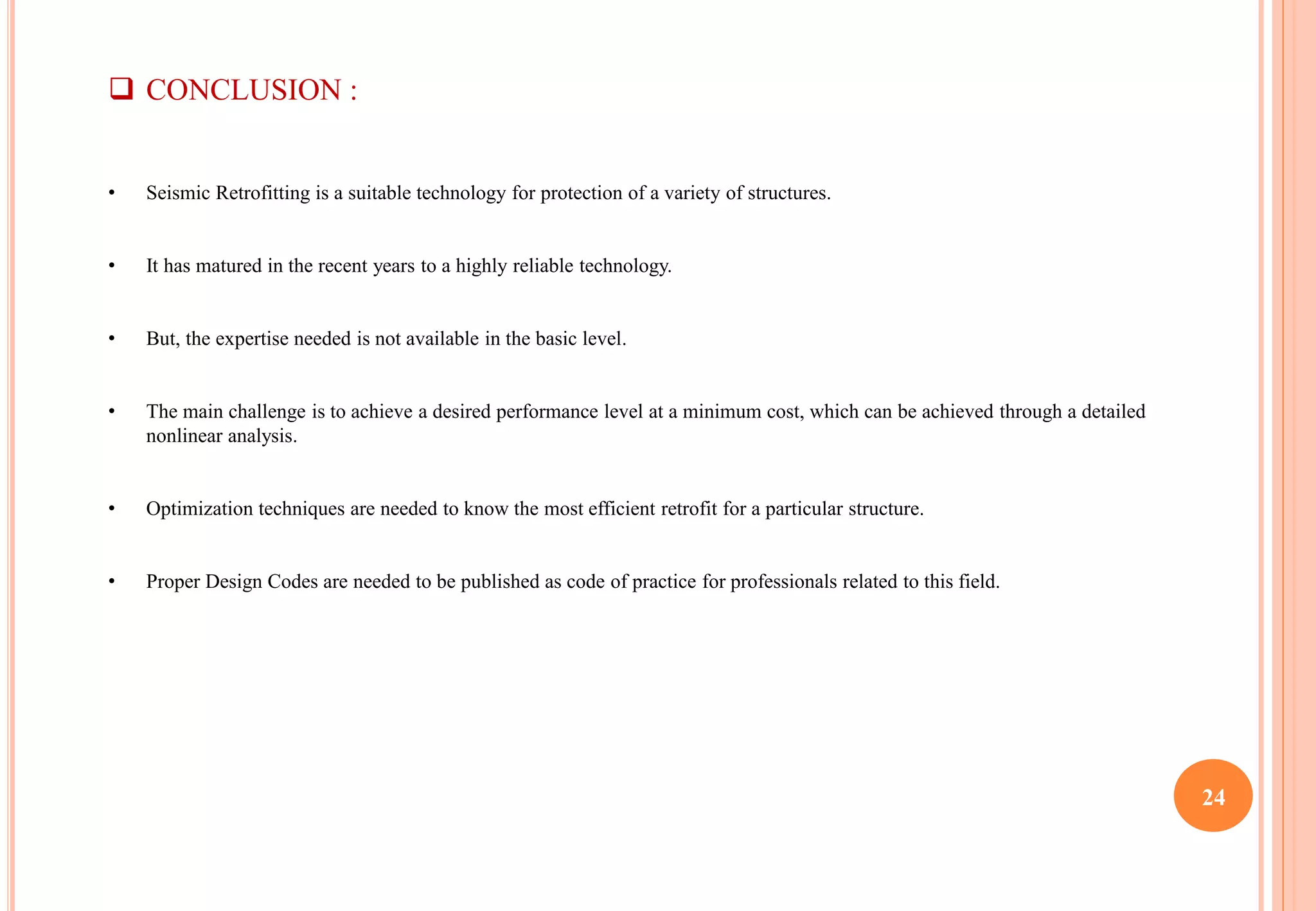
 CONCLUSION :
• Seismic Retrofitting is a suitable technology for protection of a variety of structures.
• It has matured in the recent years to a highly reliable technology.
• But, the expertise needed is not available in the basic level.
• The main challenge is to achieve a desired performance level at a minimum cost, which can be achieved through a detailed
nonlinear analysis.
• Optimization techniques are needed to know the most efficient retrofit for a particular structure.
• Proper Design Codes are needed to be published as code of practice for professionals related to this field.
25
 REFERENCES :
• IS 1893: 2002, “Indian Standard Criteria for Earthquake Resistant Design of Structures, Part 1
General provisions and buildings”, Bureau of Indian Standards, New Delhi, 2002.
• IS 4326: 1993, “Indian Standard Code of Practice for Earthquake Resistant Design and
Construction of Buildings”, Bureau of Indian Standards, New Delhi, 1993.
• IS 13920: 1993, “Indian Standard Code of Practice for Ductile Detailing of Reinforced
Concrete Structures Subjected to Seismic Forces”, Bureau of Indian Standards, New Delhi,
1993.
• IS 13935: 1993, “Indian Standard for Repair and Seismic Strengthening of Buildings –
Guidelines”, Bureau of Indian Standards, New Delhi, 1993.
• White, R. N., “Seismic Rehabilitation of Non-Ductile Reinforced Concrete Frames – A
Summary of Issues, Methods, and Needs”, Proceedings, Workshop on the Seismic
• Rehabilitation of Lightly Reinforced Concrete Frames, Gaithersburg, USA, June 12 – 13, 1995,
National Institute of Standards and Technology, USA, pp. 39 – 71.

seismic retrofit

  • 1.
    1 A REPORT ON SEISMICRETROFIT OF R.C.C. STRUCTURES SUBJECT TEACHER AR.PANKAJ BANKAR PRESENTED BY MR.SUNIL MARUTI LOKHANDE FOURTH YEAR B.ARCH PRAVARA EDUCATION SOCIETY’S PRAVARA RURAL COLLEGE OF ARCHITECTURE, LONI
  • 2.
    PRAVARA EDUCATION SOCIETY’S PRAVARARURAL COLLEGE OF ARCHITECTURE, LONI Certificate THIS IS CERTIFY THAT MR. SUNIL MARUTI LOKHANDE Has satisfactorily completed the Seminar work entitled, DESIGN & TECHNOLOGY ELECTIVE This work is being submitted for the partial fulfillment of prescribed syllabus of Fourth Year Architecture University of Pune For the academic year 2017-2018 AR.PANKAJ BANKAR AR.PRADIP BALOTE (Subject Teacher) (Principal) EXTERNAL EXAMINER COLLEGE STAMP 2
  • 3.
    INDEX SR.NO. PERTICULARS PAGENO. 1 Introduction 4 2 What Is Retrofitting ? 5 3 Retrofit Performance Objective 5 4 Need Of Retrofitting In Existing Earthquake Vulnerable Buildings 6 5 Basic Concept Of Retrofitting 6 6 i ii Classification Of Retrofitting Strategies Global Retrofit Strategies Local Retrofit Strategies 7 8 12 7 i ii Case studies Latur Gujrat 19 19 21 8 Indian Codes For Design Of Earthquake Resistant Buildings 19 9 Conclusion 23 10 Design Suggestions 24 11 References 25 3
  • 4.
     INTRODUCTION  Isyour building safe against earthquake? This is a question that everybody should be concerned about. Many earthquakes have taken place recently in India and its neighborhood [e.g., Uttarkashi (1991), Latur (1993), Jabalpur (1997), Bhuj (2001), Sumatra (2004), Kashmir (2005)], and these have proved to be disastrous. A large number of buildings have collapsed and countless lives have been lost.  There is usually a huge public outcry after every seismic disaster. But public memory is short-lived, and people tend to forget, until another major tremor occurs to wake them up. When will that quake happen in our neighborhood? Nobody can predict this. But when it comes one day, unexpectedly, it could destroy our buildings and take our lives. Can we do something to save our lives and protect our buildings? Yes! Because, Earthquakes do not kill; unsafe buildings do.  EARTHQUAKE  Sudden shaking and vibrations of earth is known as Earthquake.  The inside of our earth consists of many layers (crust, mantle, inner and outer cores). Formed by complex processes over countless years, they continue to be active.  Once in awhile, the disturbances below the earth get transmitted to the surface, causing earthquakes. 4  The waves generated in the soil during an earthquake travel long distances in many directions in a very short time, shaking the ground. The buildings that cannot resist this ground shaking can collapse, causing disaster and loss of human life.
  • 5.
     WHAT ISRETROFITTING?  DEFINITION • It is the modification of existing structures to make them more resistant to seismic activity, ground motion, or soil failure due to earthquakes. • The retrofit techniques are also applicable for other natural hazards such as cyclones, severe winds from thunderstorms. • The seismic retrofitting gives improvements to an existing buildings and increasing the global capacity of the building.  WHEN THE RETROFITTING IS NEEDED ?  The two circumstances are:- • Earthquake damaged buildings, and • Earthquake-vulnerable buildings (with no exposure to severe earthquakes)  RETROFIT PERFORMANCE OBJECTIVES  Public safety only: • The goal is to protect human life, ensuring that the structure will not collapse upon its occupants or passersby, and that the structure can be safely exited. Under severe seismic conditions the structure may be a total economic write-off, requiring tear- down and replacement.  Structure survivability: • The goal is that the structure, while remaining safe for exit, may require extensive repair (but not replacement) before it is generally useful or considered safe for occupation. This is typically the lowest level of retrofit applied to bridges. 5
  • 6.
    6  Structure functionality: •Primary structure undamaged and the structure is undiminished in utility for its primary application.  Structure unaffected: • This level of retrofit is preferred for historic structures of high cultural significance.  NEED OF RETROFITTING IN EXISTING EARTHQUAKE VULNERABLE BUILDINGS • Buildings have been designed according to a seismic code, but the code has been upgraded in later years; • Essential buildings must be strengthened like hospitals, historical monuments and architectural buildings; • Important buildings whose services are assumed to be essential just after an earthquake like hospitals; • Buildings that are expanded, renovated or rebuilt. • Buildings, the use of which has changed through the years.  BASIC CONCEPT OF RETROFITTING IS TO-  Up gradation of lateral strength of the structure;  Increase in strength and ductility.
  • 7.
    7  CLASSIFICATION OFRETROFITTING STRATEGIES RETROFITTING TECHNIQUES GLOBAL TECHNIQUES LOCAL TECHNIQUES ADDITION OF SHEAR WALL ADDITION OF INFILL WALL ADDITION OF STEEL BRACES ADDITION OF FRAMES COLUMN RETROFITTING BEAM RETROFITTING COLUMN-BEAM JOINT RETROFITTING WALL RETROFITTING
  • 8.
    8  GLOBAL RETROFITSTRATEGIES 1. ADDITION OF SHEAR WALL- • Shear walls, wing wall or buttress are added to increase lateral strength and stiffness of a building. • The shear walls are effective in buildings with flat slabs or flat plates. • Usually shear walls are placed within bounding columns(a), whereas wing walls are placed adjacent to columns(b). The buttress walls are placed on exterior sides of an existing frame(c).  The critical design issues involved in the addition of such a wall are as follows. a. To integrate the wall to the building for transferring of lateral forces. b. To design the foundations for new wall. a. Adding a shear wall b. Adding a wing wall c. Adding a buttress wall
  • 9.
    9 • The disadvantageis that if only one or two walls are introduced, the increase in lateral resistance is concentrated near the new walls. Hence it is preferred to have distributed and symmetrically placed walls. • For a buttress wall, the new foundation should be adequate to resist the overturning moment due to the lateral seismic forces without rocking or uplift. 2. ADDITION OF AN INFILL WALL- • The lateral stiffness of a storey increases with infill walls. Addition of infill walls in the ground storey is a viable option to retrofit buildings with open ground storeys(d). • Due to the „strut action‟ of the in filled walls, the flexural and shear forces and the ductility demand on the ground storey columns are substantially reduced. • Of course, infill walls do not increase the ductility of the overall response of the buildings. d. Addition of masonry infill wall
  • 10.
    10 3. ADDITION OFSTEEL BRACES- • A steel bracing system can be inserted in a frame to provide lateral stiffness, strength, ductility, hysteretic energy dissipation, or any combination of these. • The braces are effective for more relatively more flexible frames, such as those without infill walls. • The braces can be added at the exterior frames with least disruption of the building use. • For an open ground storey, the braces can be placed in appropriate bays while maintaining the functional use.  TYPE I • The force in brace is transferred to the frame through the gusset plate, end plates and anchor inserts.  TYPE II • Similar to type I, except an end plate is connected using through bolts which are anchored at the opposite face to a bearing plate.  TYPE III • Similar to type II, except the end plates and bearing plate project beyond the width of the beam and column.
  • 11.
    11 4. ADDITION OFFRAMES- • A new frame can be introduced to increase the lateral strength and stiffness of a building. Similar to a new wall, integrating a new frame to the building and providing foundations are critical design issue.  Reduction Of Irregularities  Reduction Of Mass  Energy Dissipation Devices And Base Isolation Comparative evaluation of the global retrofit strategies
  • 12.
    12  LOCAL RETROFITSTRATEGIES A. COLUMN RETROFITTING- • The retrofitting of deficient columns is essential to avoid collapse of storey. • The columns are retrofitted to increase their flexural and shear strengths. • The retrofitting strategy is based on the “strong column weak beam” principle of seismic design. i. Concrete Jacketing:
  • 13.
    13 Techniques of concretejacketing of columns
  • 14.
    14 ii. Steel Jacketing: Techniquesof steel jacketing of columns iii. Fibre Reinforced Polymer Sheet Wrapping: • Fibre-reinforced polymer (FRP) has desirable physical properties like high tensile strength to weight ratio and corrosion resistance. • FRP sheets are thin, light and flexible enough to be inserted behind pipes and other service ducts, thus facilitating installation.
  • 15.
    15 B. BEAM RETROFITTING- •The beams are retrofitted to increase their positive flexural strength, shear strength and deformation capacity near the beam- column joint. i. Concrete jacketing: Techniques of concrete jacketing of beams
  • 16.
    16 ii. Bonding SteelPlate: • The technique of binding mild steel plates to beams is used to improve their flexural and shear strengths. • The addition of steel plate is rapid to apply, dose not reduce the storey clear height significantly and can be applied while the building is in use. • The plates are attached to the tension face of a beam to increase the flexural strength, whereas they are attached to the side face of a beam to increase the shear strength. • The plates can be attached by adhesive or bolts. iii. FRP Wrapping (FIBRE REINFORCED POLYMER SHEET WRAPPING) • Like steel plates, FRP laminates are attached to beams to increase their flexural and shear strengths. C. BEAM-COLUMN JOINT RETROFITTING- i. Concrete Jacketing: • A joint can be strengthened by placing ties through drilled holes in the adjacent beams. ii. Steel Jacketing: • If space is available, steel jacketing can be used to enhance the performance of joints. ii. FRP Wrapping: • In the use of FRP sheets to strengthen the joints, the considerations are number of layers, orientation and anchorage of the FRP sheets and the preparation of the existing concrete.
  • 17.
    17 D. WALL RETROFITTING- •A concrete shear wall can be retrofitted by adding new concrete with adequate boundary members. • The new concrete can be added by shotcrete. Strengthening of a wall using concrete
  • 18.
    18 Comparative evaluation ofthe local retrofit strategies
  • 19.
    19  CASE STUDIES (1)Latur, Maharashtra-  Context: Post earthquake rehabilitation with the government financial assistance for quake affected people.  Predominant building system: Mud roofing on timber deck supported on timber columns- Maalwad style - and walls of random rubble in mud mortar.  Case Study: House of Haribhau in Nagarsoga village, Year 1994:  Primary objective: To get first hand understanding of retrofitting – “Learning while Doing”.  Building System: Heavy Mud roofing on self supported timber deck and Random Rubble Masonry walls in mud mortar  Building Area: 2 large rooms – 40 sq.m.  Damage Category: G 2  Retrofitting Measures: Restoration of damages followed by- a. Stitching of stone wythes with Cast in-situ RC Stitching Elements, b. Installation of roof level RC Band after removal of the upper part of the walls including the projection above the roof, c. Installation of Knee Braces at the junction of timber columns and beams.  Special Features Used First Time- • Installation of Cast in-situ RC Stitching Elements involving making of dumbbell shaped holes through the stone wall. • Installation of RC Band in the “Maalwad” style existing house involving the partial dismantling of masonry wall. • Knee Braces for different configurations of timber columns and beams – fabrication by local metal work shops.
  • 20.
    20  Problems Encountered: •No awareness of retrofitting option among people. As a result not many people were interested in this option. • Lack of confidence among engineers did not help this process. • Complicated selection process of a house (simple with no major damage) to work upon because of lack of experience of restoration, retrofitting and random rubble masonry. • The risk and the skills involved in the installation of Cast in-situ RC Stitching Elements. Retrofitting & Restoration completed Knee braces at beam-column joint Upper Wall removed for band installation & Roof deck opened for repairs Cast in-situ RC Stitching Element being plaster
  • 21.
    21 2. Gujarat:  Context:Post earthquake rehabilitation with financial assistance for quake affected people from Government of Gujarat.  Objective: Demonstration and training of Government engineers.  Predominant building system: Tiled roof or RC slab over stone, brick or concrete block masonry walls.  Case Study: R & B Office cum Storage at Patadi town, Year 2002:  Primary objective: To demonstrate the technology and to train government engineers.  Building System: AC Sheeting over wooden understructure supported on Random Rubble Masonry in cement mortar  Building Area: 4 rooms and a passage – 80sq.m. covered area  Damage Category: G 2  Retrofitting Measures: a. Stitching of stone wythes with Cast insitu RC Stitching Elements, b. WWM Seismic Belt at eave level, c. Vertical Reinforcing Bars in corners anchored to walls and encased in micro concrete, d. Encasing of wall openings with WWM Seismic Straps, e. Roof diaphragm improvement with the help of Diagonal Ties made of 13 gauge pre-tensioned multiple strand GI wires and timber struts, f. Strengthening of connections between roofing elements, g. Anchoring of elements of roof understructure to walls, h. closing off of a window opening and, i. Restoration of earthquake damage
  • 22.
    22 Gable & LintelSeismic Belt, Stitching element, window blocking Lintel & Ridge Seismic Belt, Roof Bracing, Stitching Elements  Special Features Used First Time By Author: • Additional Seismic Belt with WWM for extra high walls. • Extensive use of Seismic Belt with WWM for encasement of • openings. • Anchoring of roofing elements to support walls • Blocking off of a window opening  Problems: • Absence of awareness about the significance of retrofitting in public as well as R & B engineers resulted in to little learning by them for future use. • Absence of necessary skills with masons required their training and more supervision.
  • 23.
    23  INDIAN CODESFOR DESIGN OF EARTHQUAKE RESISTANT BUILDINGS • IS: 1893-2002 (part-1) Criteria for Earthquake Resistant Design of Structures (Part 1 : General Provision and Buildings) - Code of Practice • IS: 4326-1993 Earthquake Resistant Design and Construction of Buildings – Code of Practice • IS: 13920-1993 Ductile Detailing of Reinforced Concrete Structures subjected to Seismic Forces -Code of Practice • IS: 13935-1993 Repair and Seismic Strengthening of Buildings – Guidelines • IS: 13828-1993 Improving Earthquake Resistance of Low Strength Masonry Buildings – Guidelines • IS: 13827-1993 Improving Earthquake Resistance of Earthen Buildings – Guidelines
  • 24.
    24  CONCLUSION : •Seismic Retrofitting is a suitable technology for protection of a variety of structures. • It has matured in the recent years to a highly reliable technology. • But, the expertise needed is not available in the basic level. • The main challenge is to achieve a desired performance level at a minimum cost, which can be achieved through a detailed nonlinear analysis. • Optimization techniques are needed to know the most efficient retrofit for a particular structure. • Proper Design Codes are needed to be published as code of practice for professionals related to this field.
  • 25.
    25  REFERENCES : •IS 1893: 2002, “Indian Standard Criteria for Earthquake Resistant Design of Structures, Part 1 General provisions and buildings”, Bureau of Indian Standards, New Delhi, 2002. • IS 4326: 1993, “Indian Standard Code of Practice for Earthquake Resistant Design and Construction of Buildings”, Bureau of Indian Standards, New Delhi, 1993. • IS 13920: 1993, “Indian Standard Code of Practice for Ductile Detailing of Reinforced Concrete Structures Subjected to Seismic Forces”, Bureau of Indian Standards, New Delhi, 1993. • IS 13935: 1993, “Indian Standard for Repair and Seismic Strengthening of Buildings – Guidelines”, Bureau of Indian Standards, New Delhi, 1993. • White, R. N., “Seismic Rehabilitation of Non-Ductile Reinforced Concrete Frames – A Summary of Issues, Methods, and Needs”, Proceedings, Workshop on the Seismic • Rehabilitation of Lightly Reinforced Concrete Frames, Gaithersburg, USA, June 12 – 13, 1995, National Institute of Standards and Technology, USA, pp. 39 – 71.