INTRODUCTION
Seismic retrofitting isa collection mitigation technique for earthquake engineering.
It is the modification of existing structures to make
them more resistant to seismic activity,
ground or soil failure due to earthquake.
It is of very important for historic monuments,
areas prone to severe earthquakes and tall or
expensive structures.
The retrofitting techniques are also applicable for other natural hazards such as tropical cyclones, tornadoes and severe
winds from thunderstorms.
Retrofitting proves to be a better economic consideration and immediate shelter to problems rather than replacement of
building.
4.
The two circumstancesare:
1. Earthquake damaged buildings,
2. Earthquake-vulnerable buildings(with no exposure to severe earthquakes)
Nearly 5,00,090 earthquakes occur every year around world among which about 1,00,000 are felt and the rest occur
nearly constantly almost anywhere .Large number of casualties occur in buildings due to earthquake.
Reasons may be;
➤ Inadequate design
➤ Poor construction and maintenance
➤Lack of resources Inadequate knowledge
➤ Inadequate safety implementation
5.
WHY I CHOSETHIS TOPIC
I chose this topic because:
1. Increasing Seismic Risks:
o Many regions worldwide are prone to frequent and high-magnitude earthquakes.
o Aging infrastructure, particularly in developing countries, lacks proper earthquake-resistant design.
2. Safety and Disaster Prevention:
o Retrofitting reduces the risk of structural collapse, saving lives and preventing economic losses.
o Essential for critical structures like hospitals, schools, and bridges.
3. Technological Advancements:
o New materials like Fiber-Reinforced Polymers (FRP), base isolators, and energy dissipation systems improve
retrofitting efficiency.
o Modern analytical tools, such as finite element modeling and fragility analysis, enhance structural assessments.
6.
4. Sustainability andCost-Effectiveness:
• Retrofitting extends the lifespan of buildings, reducing the need for costly demolitions and
reconstructions.
• Environmentally friendly as it minimizes construction waste and conserves resources.
5. Real-World Applications and Case Studies:
• Several successful retrofitting projects, like the Golden Gate Bridge (USA) and historic masonry
structures in Italy, highlight its importance.
• Research in negative stiffness devices, energy-based retrofitting, and hybrid solutions offers
innovative approaches to earthquake resilience.
7.
HISTORY
Seismic retrofitting,strengthening existing structures for earthquake resistance, evolved from a reactive approach to a proactive
one, driven by the need to protect lives and property after major earthquakes and the development of modern seismic codes.
Early Approaches & Evolution:
Before modern codes:
Structures were often built without adequate seismic detailing or reinforcement, leading to vulnerability during earthquakes.
Post-earthquake response:
Major earthquakes highlighted the need for seismic retrofitting, prompting research and the development of techniques to fortify
existing buildings.
Modern codes and guidelines:
The introduction of modern seismic codes (late 1960s for developed countries, late 1970s for others) and guidelines (like ASCE-
SEI 41 and NZSEE) provided a framework for seismic assessment and retrofitting.
Ongoing research and development:
Research continues to refine retrofitting techniques and address the limitations of existing methods, as seen with the 1994
Northridge earthquake exposing the brittleness of welded steel frames.
• Seismic retrofittingtechniques aim to strengthen existing structures to withstand earthquakes,
and common methods include jacketing, base isolation, shear walls, steel bracing, external
post-tensioning, and external plate bonding.
• Jacketing:
• This involves encasing existing concrete columns or beams with additional concrete or steel,
increasing their strength and resistance to seismic forces.
• Base Isolation:
• This technique involves placing flexible bearings or isolators between a building's foundation
and superstructure, decoupling the structure from ground motion during an earthquake.
• Shear Walls:
• These are reinforced concrete walls that resist lateral forces, enhancing the overall seismic
resistance of a building.
• Steel Bracing:
• Adding steel braces to the structure, often in the form of frames, increases the lateral rigidity
and strength of the building.
10.
• External Post-Tensioning:
•This method involves placing high-strength steel tendons outside concrete members, creating a
moment-resisting system that can recenter itself during a seismic event.
• External Plate Bonding:
• This involves bonding steel plates or strips to the exterior of concrete members, strengthening
them against shear forces.
• Fibre-Reinforced Plastics (FRP):
• Using FRP composites to increase the strength and ductility of concrete members, potentially
preventing the need for retrofitting other parts of the structure.
• Energy Dissipation Devices:
• These devices are used to absorb and dissipate earthquake energy, reducing the impact on the
structure.
Literature / AnalyticalStudy:-
• Seismic retrofitting research faces key gaps, including a narrow focus on specific structure types,
limited long-term performance data, and insufficient economic analysis. Many studies prioritize short-
term seismic resilience, neglecting environmental factors like temperature and corrosion. Over-reliance
on simulations with minimal real-world validation and the lack of multi-hazard frameworks further
limit practical applicability. Additionally, the use of local materials and eco-friendly solutions remains
underexplore. Addressing these gaps with hybrid solutions, adaptive monitoring, and comprehensive
lifecycle analysis could enhance seismic resilience and sustainability.
• Future Scope
• Future research should focus on developing integrated hybrid solutions that combine multiple
retrofitting techniques for enhanced resilience. Real-time monitoring systems using smart materials
and IoT can enable adaptive responses to seismic activity. Establishing globally recognized guidelines
that are adaptable to local contexts can standardize retrofitting practices. Comprehensive lifecycle and
economic analyses will improve decision-making by balancing cost, durability, and sustainability.
Expanding research to include multi-hazard resilience frameworks and exploring the use of recyclable
or biodegradable materials can further enhance the long-term effectiveness of seismic retrofitting
efforts.
13.
LITERATURE REVIEW
S.NO TitleOf
Paper
Author Year Of
Publishing /
DOI
Number/
Published on
Journal
Objective Methodology Explanation Of Work Conclusion
1. Design and
Modelling
Tools for
Timber-Based
Seismic
Retrofitting
Mirra And
Gerardini
2024
/https://doi.org/
10.1016/j.prostr
.2024.09.362 /
Procedia
Structural
Integrity/
The paper aims to develop and
promote timber-based
retrofitting techniques for
improving the seismic resistance
of historical and existing
buildings. It focuses on plywood
panel overlays as a method to
enhance the in-plane strength,
stiffness, and energy dissipation
of timber diaphragms. The study
presents design and modeling
tools to facilitate the application
of this retrofitting method in
real- world scenarios.
The research introduces calculation
tools for designing and modeling
plywood-retrofitted timber diaphragms.
Parametric analyses were conducted
using software tools such as ApPlyWood
and SimPlyWood (integrated with DIANA
FEA).
Three case-study buildings (two masonry
churches and a historical sawmill) in
Brescia, Italy, were analyzed.
The methodology included numerical
simulations, finite element modeling, and
cost-benefit assessments to evaluate the
impact of timber-based retrofitting
strategies.
Identification of Seismic Vulnerabilities:
Many historical buildings have weak timber floors
and inadequate connections between walls and
floors, leading to structural failures during
earthquake
The primary intervention involved fastening plywood
panels over existing timber floors, significantly
improving their seismic performance.
The tools developed help engineers design
interventions that balance stiffness, strength, and
energy dissipation.
Application in Three Case Studies:
St. Andrew’s Church, Ceto: Retrofitted roof using
plywood overlays to improve diaphragmatic action.St.
Rocco’s Church, Collio: Evaluated multiple plywood-
based strengthening configurations using parametric
analysis.
Venetian Sawmill, Vallaro: Combined plywood and
CLT elements to strengthen deteriorated timber floors
and roofs.
Timber-based seismic
retrofitting using
plywood overlays is a
reversible, cost-effective,
and efficient solution for
enhancing the seismic
resilience of historic and
existing buildings.
14.
2. Effectiveness of
Some
Conventional
Seismic
Retrofitting
Techniquesfor
Bare and
Infilled R/C
Frames
Kakaletsis et.al 2024 /
https://doi.org/1
0.12989/sem.20
11.39.4.499 /
Structural
Engineering and
Mechanics
The study investigates the
effectiveness of conventional
seismic retrofitting techniques
for reinforced concrete (R/C)
frames with and without
masonry infills, damaged due
to cyclic loading. The goal is to
evaluate various repair
techniques in terms of restoring
strength, stiffness, and energy
dissipation capacities.
Three single-story, one-bay, 1/3-scale
R/C frame specimens were tested under
cyclic horizontal loading up to 4% drift:
Bare frame (BS)
Weakly infilled frame (SS)
Strongly infilled frame (ISS)
Retrofitting techniques applied:
Epoxy resin injections for R/C joints
Polymer modified cement mortar
for infilled masonry walls
Identification of Seismic Vulnerabilities
R/C frames with masonry infills experience
significant damage during earthquakes due to
weak joints and brittle masonry
failure.Conventional retrofitting techniques like
epoxy injections, polymer mortar overlays, and
CFRP sheets are used to improve seismic
performance.
Experimental Testing & Repair Techniques
The bare frame (BS) developed plastic hinges
in beams and columns.
The applied retrofitting
techniques effectively
restored seismic
resistance, with polymer
mortar overlays proving
highly effective, while
CFRP reinforcement
faced debonding issues
under cyclic loading.
15.
Carbon Fiber ReinforcedPolymer
(CFRP) plates for external reinforcement
The retrofitted specimens were retested
under the same cyclic loading
conditions, and their performance was
analyzed based on maximum cycle load,
stiffness, and hysteretic energy absorption.
The weakly infilled frame (SS) failed due to
internal crushing of the infill.
The strongly infilled frame (ISS) failed due to
sliding of infill along its bed joints.After damage,
specimens were retrofitted and reloaded to
compare performance improvements.
Analysis of Retrofitting Effectiveness
Epoxy injections restored joint integrity but had
limitations in restoring bond strength.
Polymer modified cement mortar improved
in- plane resistance of masonry infills and
prevented out-of-plane failure.
CFRP plates provided external reinforcement
but resulted in brittle failure due to early
debonding
3. Advanced
Retrofitting
Techniques for
RC Building: A
State of an Art
Review
Vaghani
et.al
2024/
https://www.res
earchgate.net/pu
blication/38888
2625_Seismic_
Retrofitting_Te
The paper aims to review
advanced seismic retrofitting
techniques for reinforced
concrete (RC) buildings and
evaluate their effectiveness in
enhancing seismic resistance,
The paper examines various
retrofitting techniques, categorized as:
Jacketing of beams, columns, or joints
Retrofitting Needs & Challenges
Many RC structures are not designed for seismic
loads, leading to premature failure.
The optimal retrofitting
technique depends on
structural deficiencies,
cost, and seismic
demands, with jacketing
and steel bracing
16.
chniques_and_I
nnovations_for_
Structural_Resil
ience /
International
Journal of
Current
Engineeringand
Technology
stiffness, and ductility. The
study highlights modern
strengthening techniques,
their application, and selection
criteria based on cost,
performance, and
constructability.
Use of Fiber Reinforced Cement (FRC)
Confinement of columns using
embedded composite grids
Use of metal shear panels (steel and
aluminum)
Use of steel fiber reinforced mortar
Steel wire reinforced polymer (SWRP)
Steel bracing systems
Shape modification of columns
External prestressing and post-
tensioning
Performance evaluation is based on
strength, stiffness, ductility, cost-
effectiveness, and ease of application.
Weak beam-column joints, inadequate
reinforcement, and poor material quality make
retrofitting essential.
Analysis of Retrofitting Techniques
Jacketing (Concrete, Steel, or Fiber Wraps):
Effective for columns but less so for beams or
slabs.
Fiber Reinforced Cement (FRC): Improves
strength and ductility of unreinforced masonry
walls.
Friction Dampers & Steel Bracing: Reduce
seismic loads on structures by absorbing energy.
Metal Shear Panels: Improve stiffness and
energy dissipation, with aluminum panels
providing better ductility.
Shape Modification in Columns: Enhances
performance by changing square columns to
circular ones for better confinement.
Steel Wire Reinforced Polymer (SWRP):
Combines the advantages of steel and fiber-
reinforced polymers for better seismic
resistance.
Selection Criteria for Retrofitting
Cost, importance of the structure, duration of
work, disruption to building use, aesthetic
compatibility, and foundation capacity.
enhancing strength,
while fiber composites
and metal shear panels
improve ductility and
energy dissipation.
4. Advancements
in Fiber-
Reinforced
Polymer (FRP)
Kabashi et.al 2025 /
https://doi.org/1
0.3390/building
s15040587 /
The study explores
advancements in Fiber-
Reinforced Polymer (FRP)
retrofitting techniques for
Case Studies: Three post-earthquake
assessments in Albania were analyzed to
examine the effects of poor concrete
quality and inadequate detailing.
FRP Retrofitting Strategy & Implementation FRP retrofitting
significantly enhances
seismic resilience by
improving ductility,
17.
Retrofitting
Techniques for
Seismic
Resilience of
Reinforced
Concrete
Structures
Buildings
(MDPI)
reinforcedconcrete (RC)
structures, with a particular
focus on beam-column joints.
It evaluates how FRP
strengthening can improve
seismic resilience by
mitigating shear deficiencies,
brittle failure modes, and
displacement limitations.
Experimental Testing:
Nonlinear Finite Element Analysis
(NLFEA) was used for localized analysis
of FRP-strengthened joints.
Finite Element Modeling (FEM) was used
for global structural analysis to assess
the overall behavior of FRP retrofitted
structures.
Performance Evaluation Metrics:
Peak shear force
Displacement capacity
Energy dissipation efficiency
Externally bonded CFRP sheets were used for
beam-column joint strengthening.
Two methods were applied:
Column Jacketing
Single-sided Joint Covering
The MapeWrap system fabrics were used as the
FRP reinforcement material.
Testing & Analysis
Three study cases were analyzed based on varying
levels of concrete quality and detailing.
Numerical models were calibrated using
experimental data to simulate the behavior of FRP-
reinforced joints under cyclic loads.
Key Findings
FRP retrofitting increased peak shear force by
25%.
Displacement capacity improved by 20%,
leading to enhanced ductility and better load
redistribution.
Error margins in FEM analysis remained below
5%, confirming the accuracy of numerical
predictions.
shear strength, and
energy dissipation in
reinforced concrete
structures.
18.
Experimental Study
Experimental seismicretrofitting studies reveal several recurring gaps that highlight the need for
further research and development. A significant limitation is the focus on individual retrofitting
methods without extensive comparison or integration of multiple approaches, which may yield
better performance in diverse scenarios
. Many studies prioritize structural performance during
seismic events but often overlook the impact on long-term durability and maintenance costs
.
Furthermore, there is an over-reliance on laboratory conditions that may not adequately replicate
real-world seismic activity, leading to uncertainties when scaling up to full-scale applications
.
Another common issue is the insufficient exploration of cost-efficiency and economic feasibility of
retrofitting techniques, which is crucial for practical implementation, especially in developing
regions
. Environmental sustainability is another underexplored aspect, with limited research on eco-
friendly materials or energy-efficient retrofitting solutions
. Additionally, studies on retrofitting
techniques for special structures like underground facilities and school shelters remain sparse,
despite their critical role in disaster resilience
.
19.
• Future Scope:Toaddress these gaps, future research should focus on integrating multiple
retrofitting techniques to create hybrid systems that offer better seismic performance and
cost-efficiency. Long-term performance analysis, including maintenance needs and
lifecycle costs, should be incorporated into experimental studies. Expanding research to
include full-scale testing and real-world conditions can improve reliability. Economic
analysis models that balance initial costs with long-term benefits are essential to ensure
feasible implementation. Additionally, developing eco-friendly retrofitting materials and
incorporating energy efficiency into seismic retrofitting could enhance sustainability
.
More research is also needed on retrofitting critical infrastructure and essential facilities,
such as underground structures and emergency shelters, to improve disaster resilience
20.
14. Comparing
Seismic
Performances of
Single-SpanRC
Frames with and
Without Wing
Wall Retrofitting
by Shaking Table
Tests
Zhang e t . a l 2024/
https://doi.org/1
0.1016/j.jobe.20
24.109158 /
Journal of
Building
Engineering
The study aims to evaluate the
effectiveness of wing wall
retrofitting in enhancing the
seismic performance of single-
span reinforced concrete (RC)
frames, which lack sufficient
seismic defense lines. The research
investigates whether adding wing
walls can improve structural
redundancy, reduce damage, and
control lateral deformation during
earthquakes.
Shaking table tests were
conducted on two 1:5 scale RC
frame specimens:
One without retrofitting (bare
frame).
One retrofitted with wing
walls.
Both frames were tested
simultaneously under 20 different
earthquake cases on the same shaking
table board.
The seismic performance was
assessed based on:
Crack patterns and failure modes
Displacement response
Damage severity at different Peak
Ground Accelerations (PGAs)
Selection of Retrofit Scheme
Wing walls were added to a single-span RC frame in a bi-
directional configuration to improve seismic resistance.
Shaking Table Testing Results
The bare frame developed cracks early and rapidly formed
plastic hinges at beam and column ends.
The retrofitted frame initially showed cracks at the construction
joints between the wing walls and beams, which later spread.
The retrofitted frame exhibited greater redundancy, acting as
the first line of seismic defense.
Seismic Performance Improvements
The peak floor displacement of the retrofitted frame was
reduced by 30%-40% compared to the bare frame.
Under 0.15g PGA (design-based earthquake):
The retrofitted frame had slight damage, while the bare frame
had moderate damage.
Under 0.30g PGA (rare earthquake):
The retrofitted frame had moderate damage, while the
bare frame experienced severe damage
Adding wing walls to
single-span RC frames
effectively enhances
seismic resistance,
reduces lateral
displacement, and delays
structural failure, making
it a viable and practical
retrofitting solution for
earthquake-prone regions.
21.
.
15. Evaluation of
Seismic
Retrofitting
Techniques
Usedin Old
Reinforced
Concrete
Buildings
Farghaly And
Abdallah
2025/
http://www.iosrj
en.org / IOSR
Journal of
Engineering
(IOSRJEN)
The paper aims to evaluate
various seismic retrofitting
techniques for old reinforced
concrete (RC) buildings that
do not meet modern seismic
design requirements. The goal
is to determine the most
effective retrofitting methods
for different structural types by
analyzing their impact on
displacement, acceleration,
base shear, and period time.
Four existing RC structures were
selected for testing.
Four different retrofitting
techniques were applied:
Reinforced Concrete (RC) Walls
Steel Bracing
Column Jacketing
Column Strengthening with Steel
Angles
Structural models were analyzed
to measure:
Top displacement
Top floor
acceleration
Maximum base shear
Period time of first
mode
The optimal technique for each
structure was determined based on
Assessment of Existing Structures
Many old RC buildings lack proper lateral load
resistance due to outdated codes.
Common retrofitting methods include shear walls,
column jacketing, steel braces, and epoxy injections.
Testing & Results
Shear walls significantly improved structural stiffness
and reduced top displacement.
Steel bracing was effective in reducing lateral loads
while maintaining flexibility.
Column jacketing increased strength and ductility but
had minimal effect on overall stiffness.
Steel angle strengthening improved load-carrying
capacity but was less effective in reducing displacement.
Comparison of Techniques
Low-rise buildings benefited the most from staggered
RC walls.
Staggered RC walls are
the most effective
retrofitting technique for
low and medium-rise
buildings, while steel
bracing is ideal for high-
rise structures due to its
flexibility and seismic
resistance.
22.
minimum structural responseto
seismic loads.
Medium-rise structures responded best to column
jacketing.
High-rise buildings required steel bracing for optimal
seismic performance
16. Experimental
Behaviour of
Traditional
Seismic
Retrofitting
Techniques in
Earthen
Buildings in
Peru
Daniel
et.al
2024 /
https://www.aca
demia.edu/7170
8716/Experime
ntal_Behaviour
_of_Traditional
_Seismic_Retro
fitting_Techniq
ues_in_Earthen
_Buildings_in_
Peru / 9th
International
Conference on
Structural
Analysis of
Historical
Constructions
(SAHC 2014)
The study evaluates the seismic
performance of traditional
retrofitting techniques used in
earthen buildings in the
Andean region of Peru. It
focuses on tie beams and
corner keys, which have been
historically used to enhance
lateral stability and prevent
wall overturning during
earthquakes.
Field survey conducted in
Cusco, Peru, to identify commonly
used retrofitting techniques.
Experimental testing on nine
full-scale adobe walls (1.50m ×
1.90m) of varying
thicknesses (0.26m, 0.54m,
and 0.86m),
reinforced with tie beams
(wooden elements anchored with
keys).
Corner key pull-out tests
were
conducted on six full-scale wall
assemblies to evaluate mechanical
connections between orthogonal
walls.
Numerical modeling was
performed to estimate shear
strength and failure patterns
under seismic loading.
Seismic Challenges in Earthen Buildings
Earthen buildings in the Andes lack structural
continuity, making them vulnerable to out-of-plane
failure during earthquakes.
Historical retrofitting methods like wooden tie beams
and corner keys aim to reinforce structural stability.
Experimental Findings
Tie Beams: The slimmest walls (0.26m thick) failed by
out-of-plane bending, while thicker walls (0.54m &
0.86m) failed by punching shear.
Corner Keys: Shear failure was the dominant failure
mode, with 45° failure planes observed in all tested
assemblies.
Load-Displacement Behavior: Shear stress values
derived from experiments matched numerical shear
strength predictions, validating the effectiveness of these
techniques.
Traditional retrofitting
techniques like tie
beams and corner keys
are effective, low-cost
solutions for improving
the seismic stability of
earthen buildings.
Experimental data
supports their
engineering feasibility,
enabling the
development of design
guidelines for seismic
retrofitting in historical
structures.
23.
Practical Implications
Tie beamsand corner keys significantly reduce seismic
vulnerability by enhancing lateral resistance and
structural connectivity.
These methods are cost-effective, locally available, and
widely accepted by builders in the region.
17. Influence of
Retrofitting in
the Seismic
Behaviour of
Precast
Reinforced
Concrete
Industrial
Buildings
Liana Ostetto
Nádia Batalha
Romain Sousa
Paulo
Fernandes
Hugo
Rodrigue
s
2024 /
https://doi.org/1
0.1007/s41062-
024-01786-x /
Innovative
Infrastructure
Solutions
The study assesses the seismic
risk and economic impact of
retrofitting precast reinforced
concrete (PRC) industrial
buildings in Portugal. It aims
to determine the effectiveness
of different retrofitting
strategies in improving
horizontal strength and
reducing economic losses in
case of earthquakes
Retrofitting Techniques
Analyzed:
Bracing System to
enhance
horizontal strength
(50%, 75%,
and 100% improvement).
Assessment
Approach:
Seismic Risk & Structural Weaknesses
PRC buildings lack horizontal strength, making them
vulnerable to beam-column failures.
Bracing systems were applied to increase stiffness and
reduce deformation under seismic loads.
Bracing retrofitting
significantly improves
the seismic resilience of
PRC industrial buildings,
reducing economic
losses and structural
damage, making it a
cost-effective solution
for earthquake-prone
regions.
24.
Nonlinear static (pushover)
analysisto evaluate structural
performance.
Seismic fragility functions derived
for different retrofit levels.
Economic loss assessment based
on expected damage reduction.
Retrofitting Effectiveness
A 50% increase in horizontal strength reduced
economic losses by 49%.
A 75% increase in horizontal strength reduced losses
by 58%.
A 100% increase in horizontal strength led to 64%
lower economic losses.
18. Integrated
Seismic and
Energy
Retrofitting of
Masonry
Elements
Strengthened
with PCM-
Enhanced
GTRM/FRCM
Systems
FathiAzar et.al 2024 /
https://doi.org/1
0.1051/matecco
nf/20244030500
7 / MATEC
Web of
Conferences
(SUBLime
Conference
2024)
The study explores integrated
seismic and energy
retrofitting for unreinforced
masonry (URM) buildings,
aiming to improve seismic
resistance and energy
efficiency simultaneously by
using Phase Change Materials
(PCMs) in GTRM/FRCM
strengthening systems.
The study explores integrated
seismic and energy retrofitting for
unreinforced masonry (URM)
buildings, aiming to improve
seismic resistance and energy
efficiency simultaneously by using
Phase Change Materials (PCMs)
in GTRM/FRCM strengthening
systems.
PCM-enhanced TRM/FRCM systems provide both
structural reinforcement and thermal energy storage.
Shear strength improvements were analyzed by
modifying failure domains.
Thermal performance was assessed by measuring
energy savings and temperature regulation.
Integrated retrofitting showed significant
reductions in seismic vulnerability and
energy consumption compared to conventional
methods.
Integrating seismic and
energy retrofitting
using PCM-enhanced
GTRM/FRCM systems
significantly improves
structural resilience
and thermal efficiency,
offering a cost-effective
and sustainable
solution for URM
buildings.
26.
Numerical and StructureModeling
Numerical seismic retrofitting studies reveal several recurring gaps. A predominant issue is the
over-reliance on idealized numerical models, which often fail to capture real-world complexities
such as construction imperfections, material degradation, and variable loading conditions
. Many
studies use linear or simplified nonlinear models that do not accurately represent the behavior of
retrofitted structures under dynamic seismic loads
. Another gap is the limited focus on multi-hazard
scenarios, where seismic events may coincide with or follow other natural disasters, potentially
affecting the efficacy of the retrofitting measures
. Additionally, most research prioritizes
performance improvement metrics, such as reduced drift ratios or energy dissipation, but neglects
long-term durability and maintenance costs
. Economic feasibility is another underexplored area;
few studies evaluate cost-benefit analyses, lifecycle costs, or optimal retrofitting strategies for
different structural types
. The specific needs of critical infrastructure, such as hospitals and
emergency facilities, also remain insufficiently addressed despite their importance during disasters
27.
• Future Scope:
Futureresearch should aim to integrate more comprehensive, real-world conditions
into numerical models, including material degradation, construction defects, and
time-dependent loading scenarios. The development of advanced nonlinear
dynamic models with higher fidelity could improve the predictive accuracy of
retrofitting performance
. Multi-hazard simulation frameworks are essential to
evaluate the resilience of retrofitted structures in compound disaster scenarios
.
Expanding economic models to incorporate lifecycle cost analysis, payback periods,
and risk-based optimization would help policymakers and engineers make
informed decisions
. Moreover, focusing on retrofitting critical infrastructure, such
as hospitals and emergency response facilities, can enhance community resilience
in post-disaster recovery phases
. Finally, innovative materials and hybrid
retrofitting systems that balance cost, durability, and seismic performance offer
promising avenues for future research.
28.
26. Comparative
Design andCost
Analysis of
Common Retrofit
Techniques for
RC Building
Gautam et.al
2024 /
https://www.res
earchgate.net/pu
blication/38353
5617_Comparat
ive_Design_and
_Cost_Analysis
_of_Common_
Retrofit_Techni
ques_for_RC_B
uilding / 3rd
International
Conference on
Earthquake
Engineering and
Post Disaster
Reconstruction
Planning
(ICEE-PDRP
2023)
The study evaluates and compares
common seismic retrofitting
techniques for reinforced concrete
(RC) buildings based on structural
performance and cost-
effectiveness. The research aims to
determine the most feasible
retrofitting strategy by analyzing
column and beam jacketing and
shear wall retrofitting in an
earthquake-prone region.
Case Study Building:
A three-story RC school building
(Shramik Shanti Secondary School,
Lalitpur, Nepal) was selected.
Seismic vulnerability assessment was
performed using field surveys, material
testing, and ETABS 2020 modeling.
Structural Analysis: Linear
Static Analysis and
Response Spectrum Analysis were
conducted per IS 1893 (Part 1):
2016.
Evaluated base shear, base moment,
drift ratios, and PMM (axial-moment)
interaction ratios.
Retrofitting Approaches:
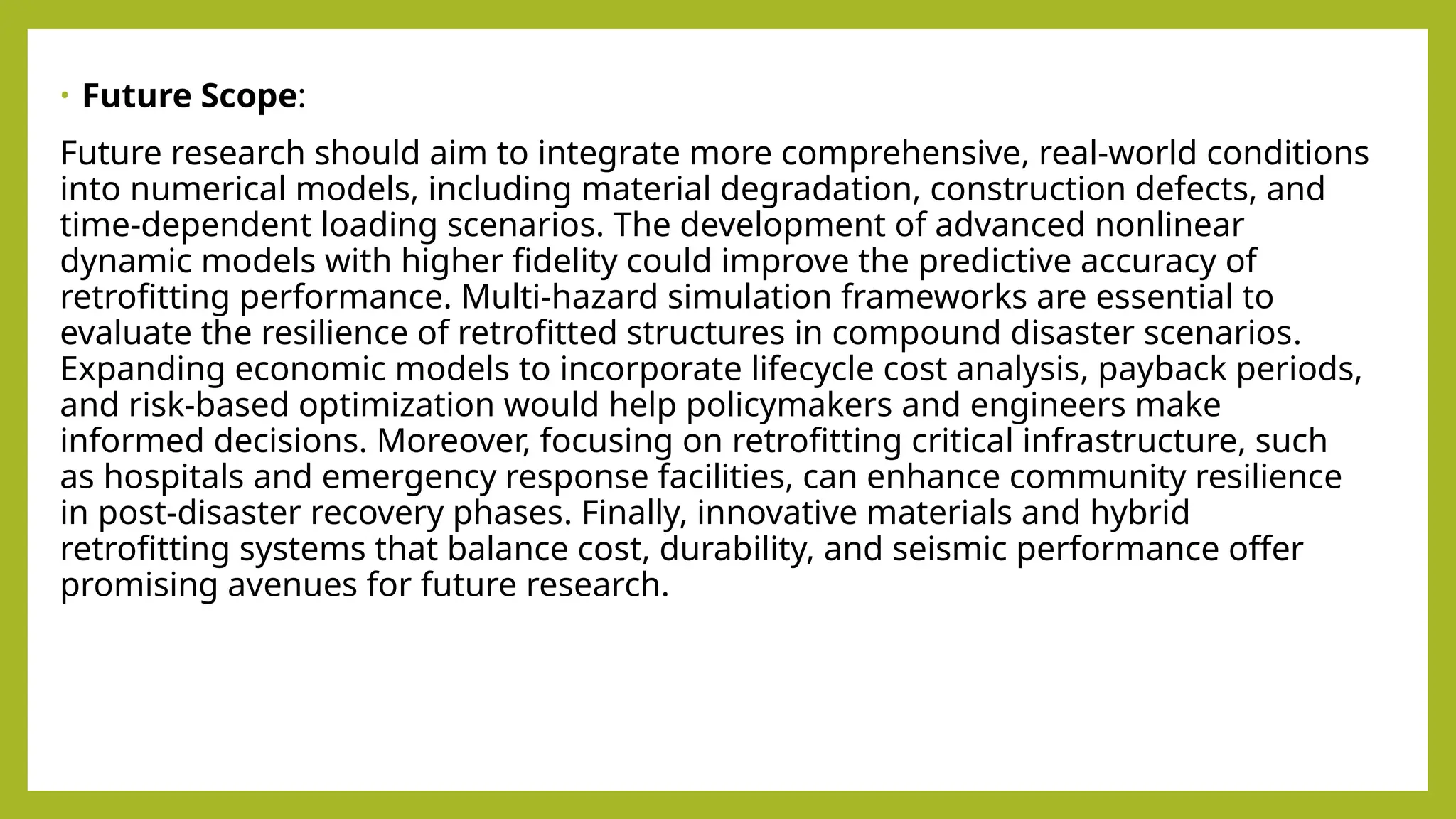
Alternative I: Column and Beam
Jacketing
Alternative II: Shear Walls with
Minimal Jacketing
Seismic Vulnerability Assessment
The building showed torsional irregularities and exceeded the
permissible drift ratio (0.004 per IS 1893).
60 columns failed the PMM interaction check,
requiring structural intervention.
Retrofitting Strategies & Analysis Alternative I:
Column and Beam Jacketing
Strengthened 41 beams and 55 columns using M25
concrete and Fe500 steel.
Alternative II: Shear Walls with Limited Jacketing
Installed 26 shear wall sections while jacketing only 2 beams
and 2 columns.
Shear walls minimized drift ratios more effectively and
required less foundation reinforcement than jacketing.
Comparison of Seismic Performance & Cost
Shear walls reduced storey drift more effectively than
jacketing.
Base shear and base moment were lower for shear walls,
reducing the need for extensive foundation retrofitting.
Shear wall retrofitting is the
most effective and cost-
efficient strategy for seismic
strengthening, as it
significantly reduces drift
ratios and base shear
while minimizing costs
compared to column and
beam jacketing.
30.
27. Base Isolation
forSeismic
Retrofitting of
Structures
Vasant
et.al
2023 /
https://doi.org/1
0.1061/(ASCE)
1084-
0680(2008)13:4
(175) / Practice
Periodical on
Structural
Design and
Construction
The study investigates the
effectiveness of base isolation
techniques for seismic
retrofitting of various
structures, including
historical buildings, bridges,
and liquid storage tanks. The
goal is to evaluate how
different isolation devices
(such as elastomeric bearings
and sliding systems) reduce
seismic forces and improve
structural resilience.
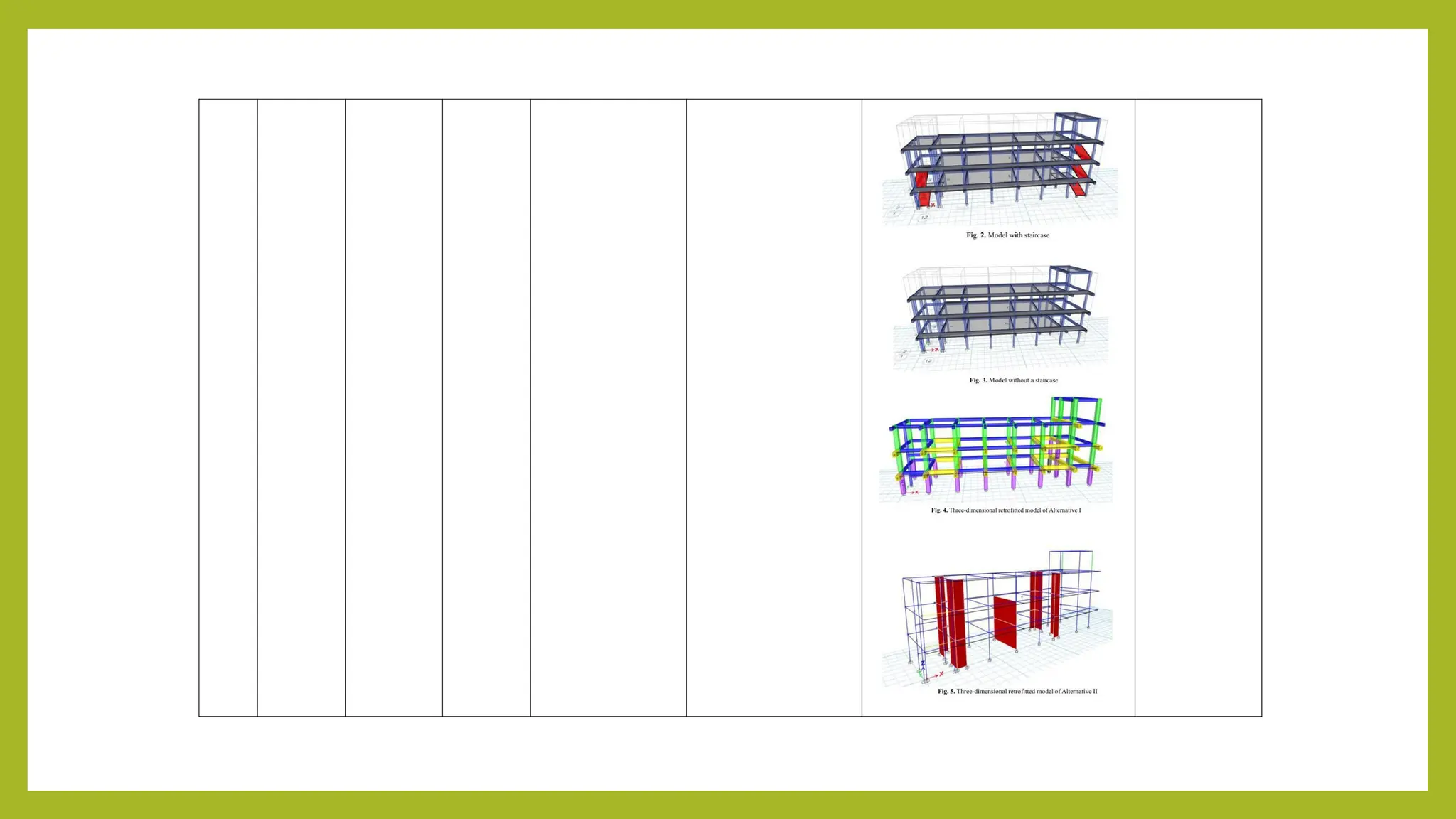
Analytical seismic response
studies were conducted on three
types of structures:
Historical
buildings Bridges
Liquid storage
tanks
Types of Isolation Devices
Studied:
Elastomeric Bearings (High-
Damping Rubber Bearings, Lead-
Rubber Bearings)
Sliding Systems
(Friction Pendulum
Systems)
Structural
Response Analysis:
Governing equations of
motion were solved
numerically under different
earthquake scenarios.
Base-isolated structures
were compared to
conventional non- isolated
structures
Base Isolation Mechanism
Base isolation decouples structures from seismic ground
motions, shifting their fundamental frequency away
from the dominant earthquake frequencies.
Reduces seismic acceleration and lateral forces, thereby
minimizing damage.
Effectiveness Across Different Structures
Historical Buildings: Maintains architectural integrity
while enhancing seismic resilience.
Bridges: Reduces base shear by up to 80%,
improving safety and durability.
Liquid Storage Tanks: Prevents buckling and
structural failure by controlling seismic displacements.
Base isolation is a highly
effective seismic
retrofitting technique
that significantly
reduces seismic forces,
enhances structural
safety, and preserves
historic buildings while
maintaining functionality
during retrofitting.
31.
28. Assessment and
Retrofittingof a
Multi-Storey
Reinforced
Concrete
Building
Koureme
nos et.al
2024 /
https://doi.org/1
0.11159/icceia2
4.131 /
Proceedings of
the 10th World
Congress on
New
Technologies
(NewTech'24)
The study aims to assess the
seismic vulnerability of an
existing five-story reinforced
concrete (RC) building in
Cyprus, constructed in the
1970s, and to evaluate the
effectiveness of various
retrofitting strategies to
improve its seismic resilience.
The research compares
reinforced concrete jacketing
and infill walls to determine
the most effective seismic
upgrade method.
Seismic Assessment:
Conducted pushover analysis
(nonlinear static analysis) to
evaluate base shear capacity and
structural response.
Used EN 1998-3:2005 (Eurocode
8, Part 3) for seismic assessment.
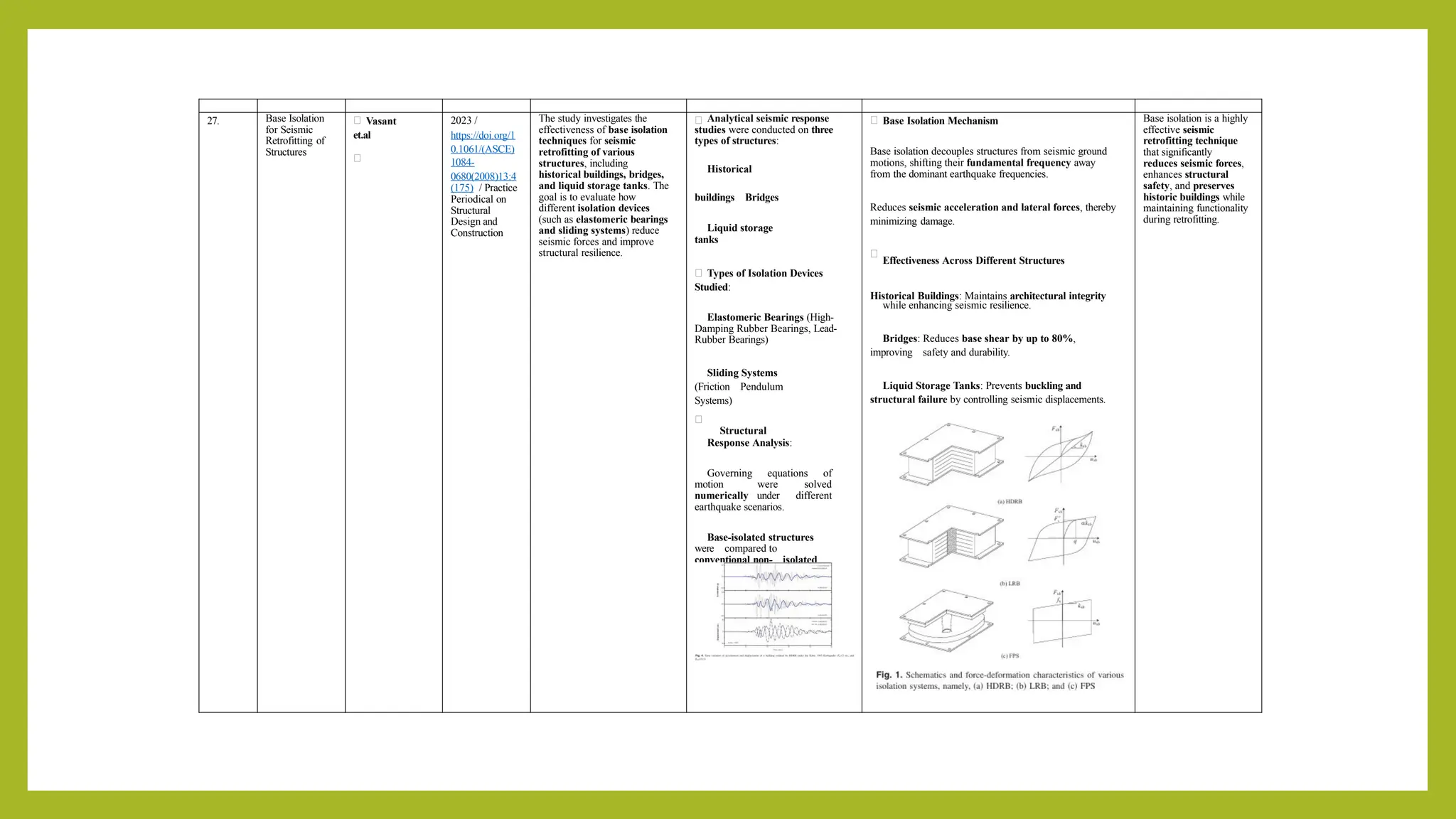
Retrofitting Techniques Tested:
Concrete Jacketing (Columns &
Beams)
Reinforced Concrete (RC) Infill
Walls
Combination of Both Techniques
Seismic Vulnerability Findings
The initial structure was found incapable of
withstanding seismic loads, failing to meet damage
limitation (DL) performance levels.
Observed Deficiencies:
Insufficient longitudinal & transverse reinforcement.
Plastic hinge formation in beam-column joints.
High displacement demands under earthquake loading.
Retrofitting Strategies & Their Effectiveness
Concrete Jacketing:
Increased ductility and strength but required substantial
material usage and foundation reinforcement.
Reinforced Concrete Infill Walls:
Significantly reduced structural drift and improved
lateral resistance.
Combined Jacketing & Infill Walls:
Most effective in improving base shear strength and
reducing displacement, achieving a 61.59% increase in
base shear capacity compared to the original structure.
The combined use of
reinforced concrete
jacketing and infill
walls is the most
effective retrofitting
strategy, significantly
improving seismic
resilience, structural
stiffness, and base
shear capacity while
ensuring the building
meets damage
limitation (DL)
performance criteria.
32.
29. Seismic
Retrofitting of
Reinforced
Concrete
Structureswith
Precast Pre-
Stressed
Concrete
Braces: An
Overview
Vatando
ost et.al
2024 /
https://doi.org/1
0.5772/intechop
en.1006362 /
IntechOpen
The study explores the use of
Precast Pre-Stressed
Concrete Braces (PPCB) for
seismic retrofitting of
reinforced concrete (RC)
structures, aiming to enhance
stiffness, strength, and energy
dissipation while avoiding the
need for wet concrete work.
Finite Element Analysis (FEA)
conducted using ABAQUS
software.
Evaluation of PPCB
Performance under lateral seismic
loads.
Comparison of
PPCB Configurations:
X-shaped braces
Single diagonal braces
V-shaped braces
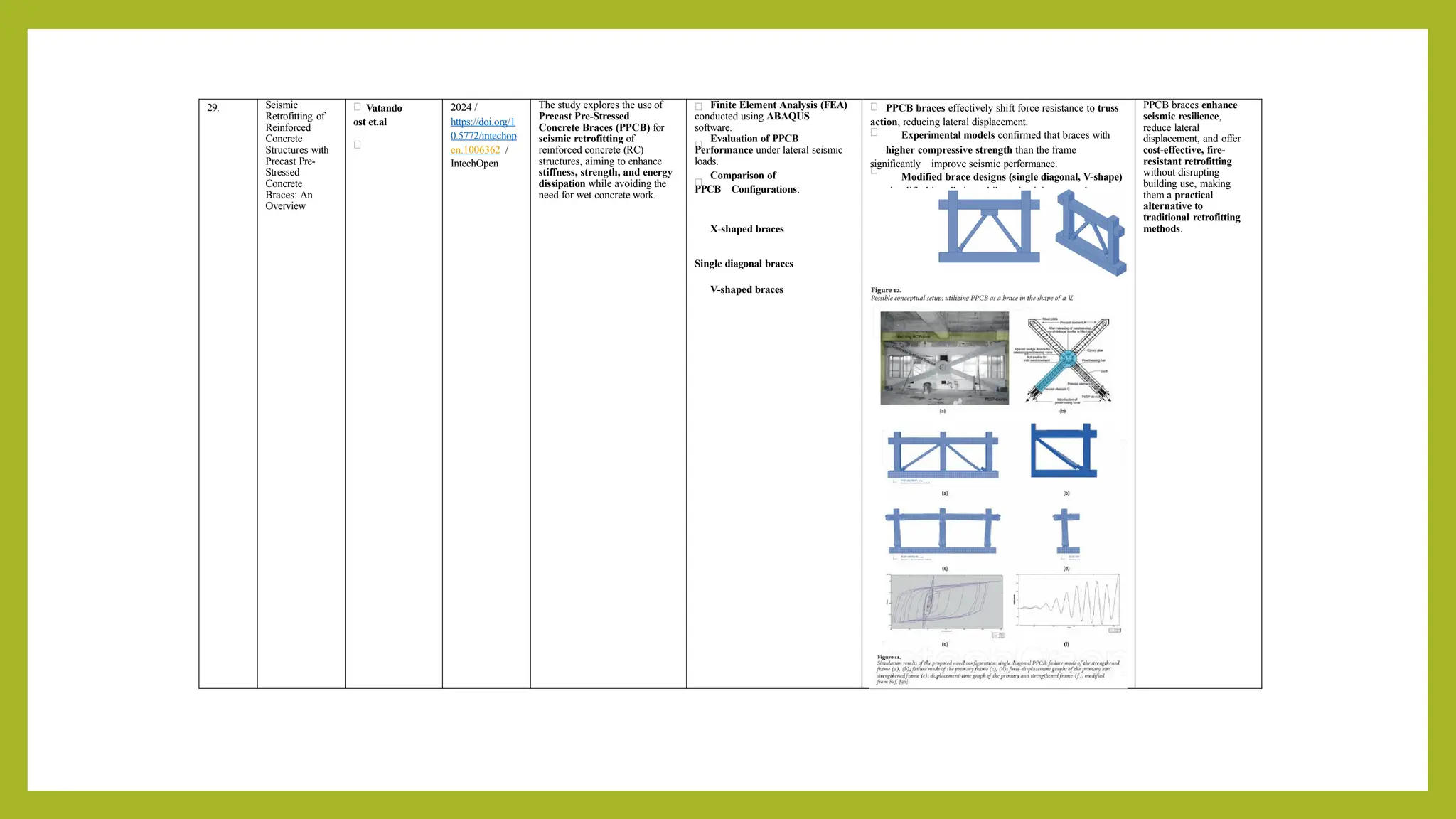
PPCB braces effectively shift force resistance to truss
action, reducing lateral displacement.
Experimental models confirmed that braces with
higher compressive strength than the frame
significantly improve seismic performance.
Modified brace designs (single diagonal, V-shape)
simplified installation while maintaining strength.
PPCB braces enhance
seismic resilience,
reduce lateral
displacement, and offer
cost-effective, fire-
resistant retrofitting
without disrupting
building use, making
them a practical
alternative to
traditional retrofitting
methods.
33.
30. Methodical
Investigations
on Seismic
Retrofittingof
Steel Plate
Shear Wall
Systems
Tadeh Zirakian 2024
/https://doi.org/
10.3390/buildin
gs14010258 /
Building
s
(MDPI)
The study aims to develop and
assess an optimal strategy for
the seismic retrofitting of Steel
Plate Shear Wall (SPSW)
systems using Low Yield
Point (LYP) steel to enhance
seismic performance while
minimizing additional
structural demand.
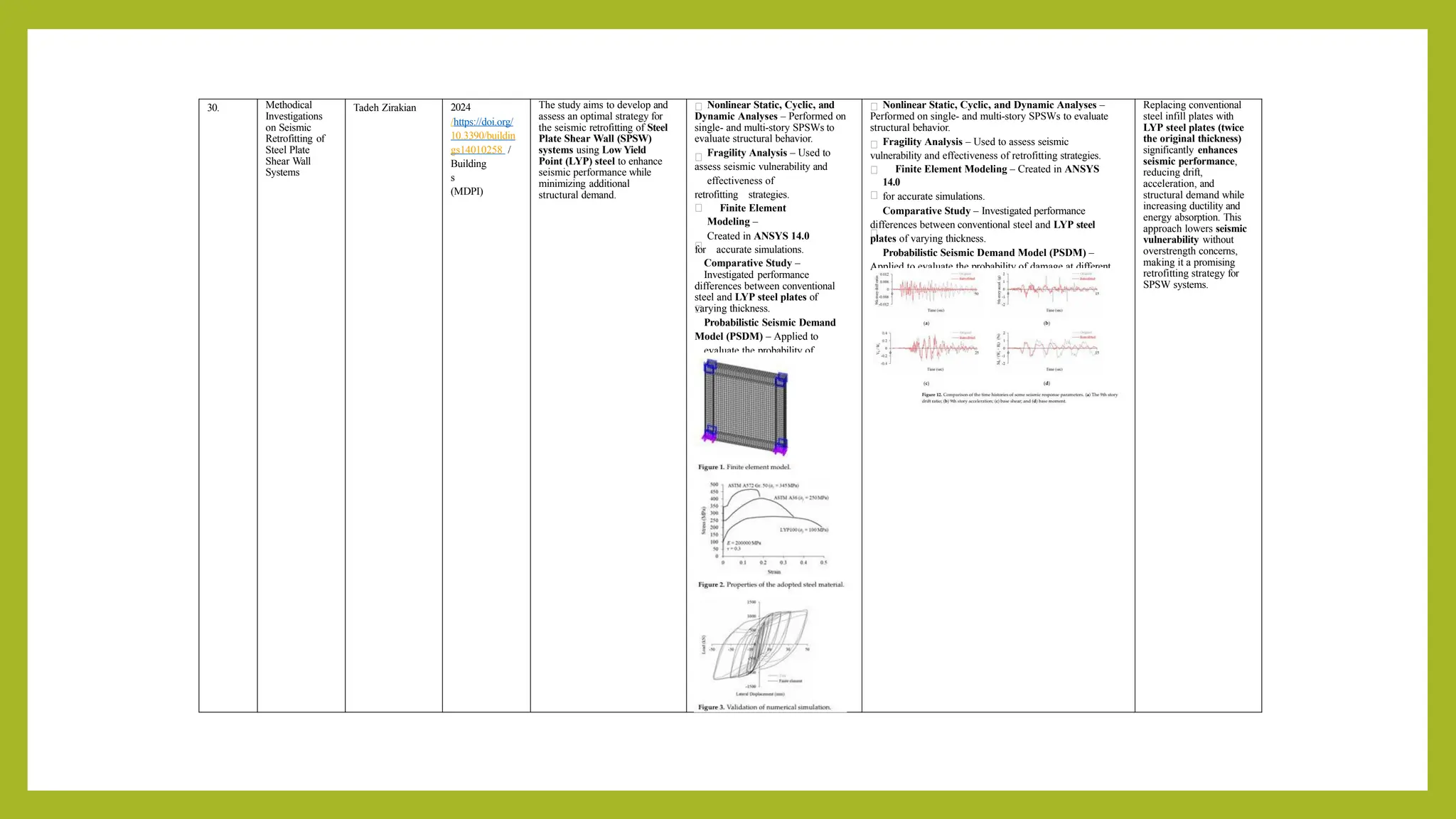
Nonlinear Static, Cyclic, and
Dynamic Analyses – Performed on
single- and multi-story SPSWs to
evaluate structural behavior.
Fragility Analysis – Used to
assess seismic vulnerability and
effectiveness of
retrofitting strategies.
Finite Element
Modeling –
Created in ANSYS 14.0
for accurate simulations.
Comparative Study –
Investigated performance
differences between conventional
steel and LYP steel plates of
varying thickness.
Probabilistic Seismic Demand
Model (PSDM) – Applied to
evaluate the probability of
damage at different seismic
intensities.
Nonlinear Static, Cyclic, and Dynamic Analyses –
Performed on single- and multi-story SPSWs to evaluate
structural behavior.
Fragility Analysis – Used to assess seismic
vulnerability and effectiveness of retrofitting strategies.
Finite Element Modeling – Created in ANSYS
14.0
for accurate simulations.
Comparative Study – Investigated performance
differences between conventional steel and LYP steel
plates of varying thickness.
Probabilistic Seismic Demand Model (PSDM) –
Applied to evaluate the probability of damage at different
seismic intensities.
Replacing conventional
steel infill plates with
LYP steel plates (twice
the original thickness)
significantly enhances
seismic performance,
reducing drift,
acceleration, and
structural demand while
increasing ductility and
energy absorption. This
approach lowers seismic
vulnerability without
overstrength concerns,
making it a promising
retrofitting strategy for
SPSW systems.
34.
Field Based Study
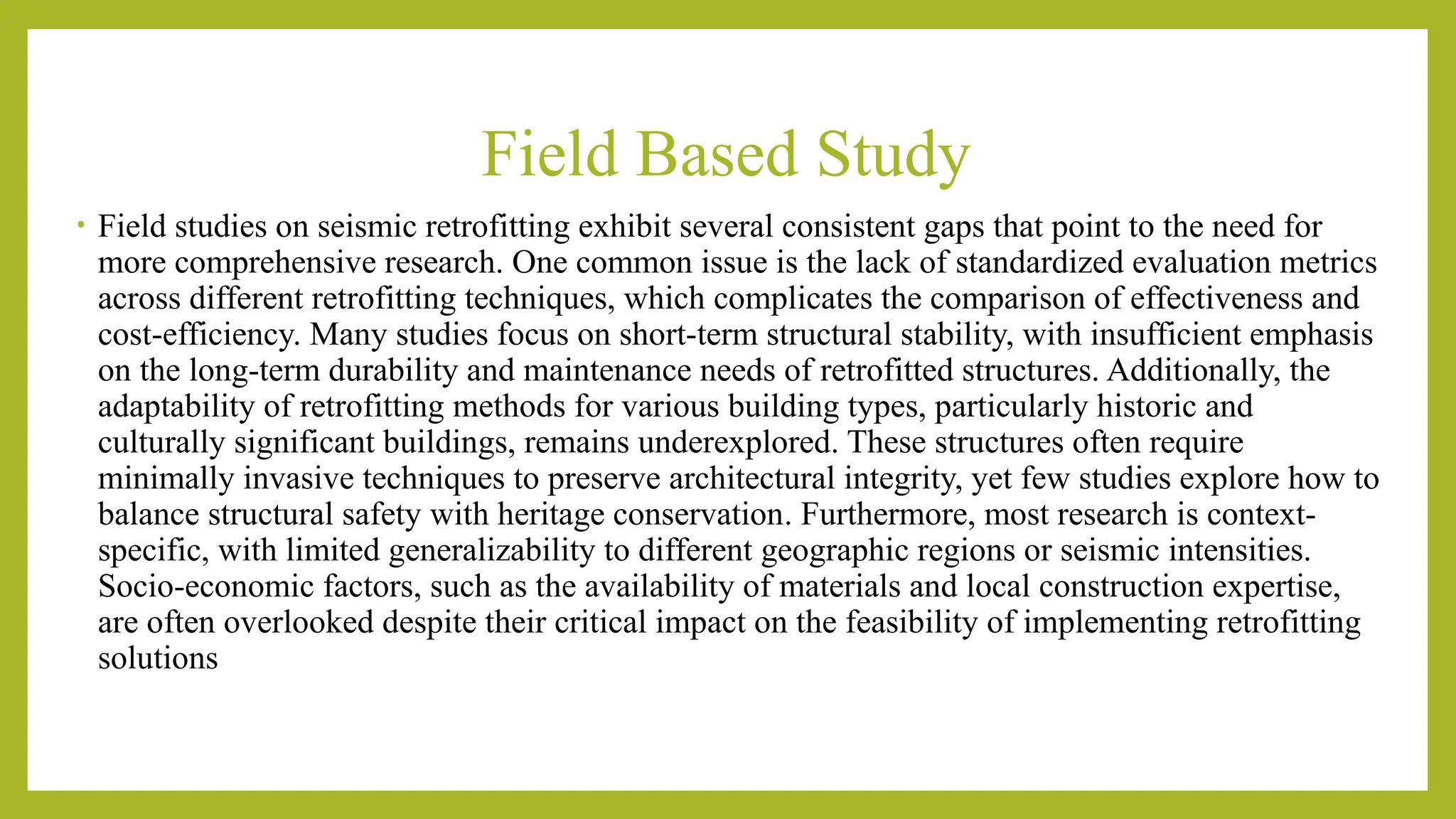
•Field studies on seismic retrofitting exhibit several consistent gaps that point to the need for
more comprehensive research. One common issue is the lack of standardized evaluation metrics
across different retrofitting techniques, which complicates the comparison of effectiveness and
cost-efficiency
. Many studies focus on short-term structural stability, with insufficient emphasis
on the long-term durability and maintenance needs of retrofitted structures. Additionally, the
adaptability of retrofitting methods for various building types, particularly historic and
culturally significant buildings, remains underexplored. These structures often require
minimally invasive techniques to preserve architectural integrity, yet few studies explore how to
balance structural safety with heritage conservation
. Furthermore, most research is context-
specific, with limited generalizability to different geographic regions or seismic intensities.
Socio-economic factors, such as the availability of materials and local construction expertise,
are often overlooked despite their critical impact on the feasibility of implementing retrofitting
solutions
35.
Future Scope:
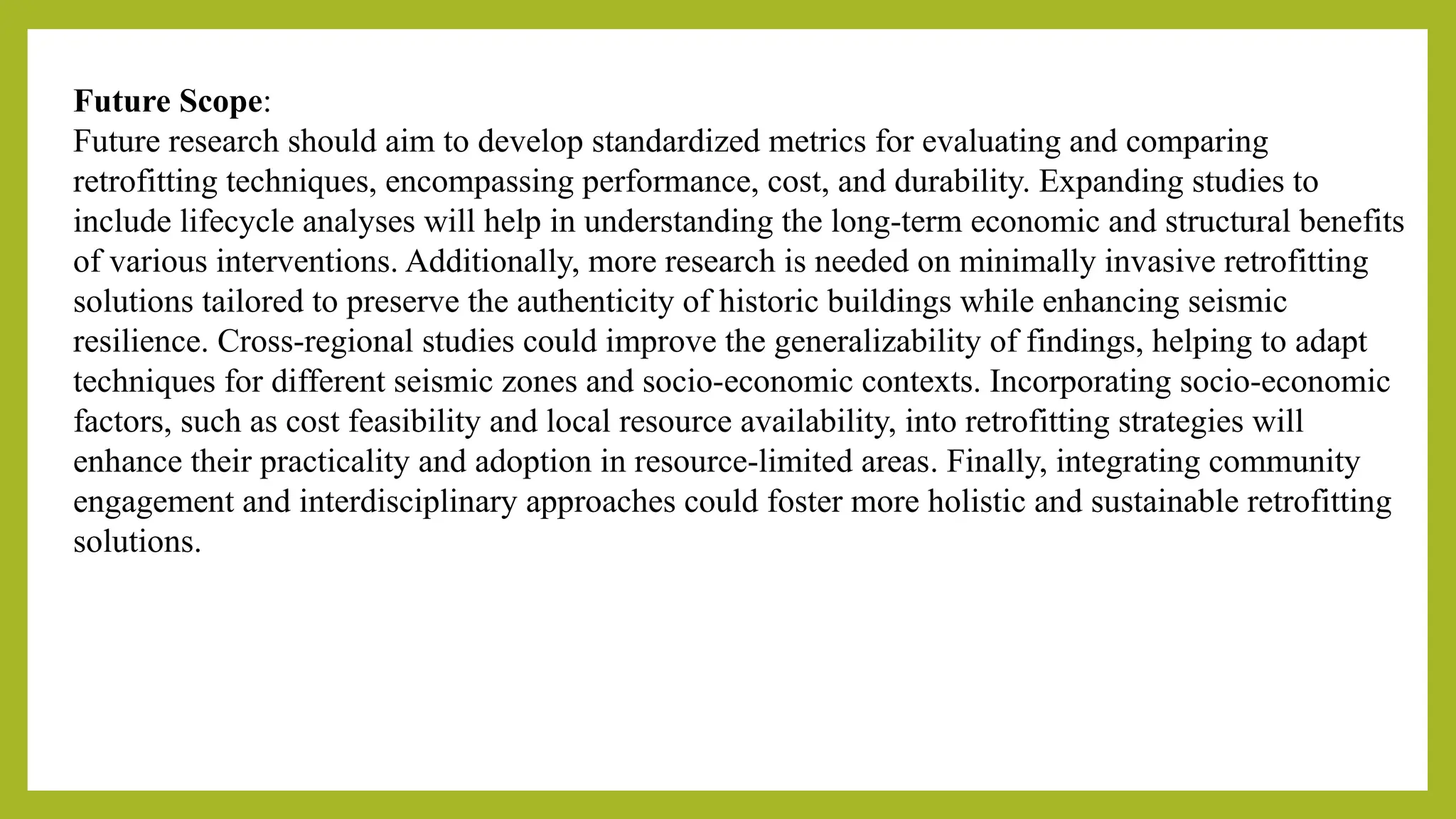
Future researchshould aim to develop standardized metrics for evaluating and comparing
retrofitting techniques, encompassing performance, cost, and durability. Expanding studies to
include lifecycle analyses will help in understanding the long-term economic and structural benefits
of various interventions. Additionally, more research is needed on minimally invasive retrofitting
solutions tailored to preserve the authenticity of historic buildings while enhancing seismic
resilience
. Cross-regional studies could improve the generalizability of findings, helping to adapt
techniques for different seismic zones and socio-economic contexts. Incorporating socio-economic
factors, such as cost feasibility and local resource availability, into retrofitting strategies will
enhance their practicality and adoption in resource-limited areas
. Finally, integrating community
engagement and interdisciplinary approaches could foster more holistic and sustainable retrofitting
solutions.
36.
39. Comparing
Seismic
Retrofitting
Techniques for
aHistorically
Significant
Masonry
Building’s
Minaret
Adnan Kiral et.al 2024 / /
Engineering
Failure Analysis
The study aims to compare
different seismic retrofitting
techniques for a historically
significant masonry minaret,
evaluating their effectiveness in
preserving structural integrity and
minimizing seismic
vulnerabilities.
Case Study Approach – Focuses
on a specific historical masonry
minaret.
Structural Analysis – Evaluates
the existing vulnerabilities of the
minaret.
Comparison of Retrofitting
Techniques – Assesses various
strengthening methods.
Performance Evaluation – Uses
structural modeling and simulations to
test retrofitting effectiveness.
The study highlights seismic risks faced by historical
minarets and the need for effective retrofitting techniques.
Various structural interventions are analyzed,
including traditional and modern strengthening
techniques.
The research provides a comparative analysis to determine
which retrofitting approach is most effective in preserving
both structural and historical value.
The study finds that
carefully selected
seismic retrofitting
techniques can
significantly enhance
the stability of
historically significant
masonry minarets
without compromising
their architectural
heritage.
40. Seismic
Retrofitting of
Existing
Structures
Cetin Sahin 2024/
https://doi.org/1
0.15760/CEEM
P.34 / Civil and
Environmental
Engineering
Master's Project
Reports
The study aims to evaluate
seismic retrofitting methods for
existing structures, focusing on
earthquake-resistant design,
seismic evaluation, and
rehabilitation strategies. It also
explores computer modeling
techniques to assess and enhance
structural performance under
seismic loads.
Seismic Evaluation: Assessing
if structures meet target
performance levels to prevent
collapse and minimize casualties.
Identifying weak components and
deficiencies.
Seismic Retrofitting
Strategies:
Adding new
structural elements
(shear walls, bracing).
Enhancing existing elements
(concrete jacketing, FRP
strengthening).
Improving connections (steel
bracing, bolting).
Reducing seismic demand (base
isolation, damping devices).
The study reviews earthquake-resistant design
principles and their application to retrofitting.
Various seismic strengthening techniques are
analyzed in terms of effectiveness, cost, and
practicality.
A performance-based design approach is applied to a real
building, assessing story drift, damage potential, and
structural stability under seismic loads.
The pushover analysis method is highlighted as an
effective tool for evaluating structural failure
mechanisms and retrofit efficiency.
Seismic retrofitting,
particularly
concentrically braced
frames, significantly
improves structural
performance, preventing
collapse and ensuring
safety. Computer-based
seismic analysis is
crucial for optimizing
retrofit strategies,
enhancing strength,
stiffness, and ductility
beyond earthquake
demands.
37.
ADVANTAGES
Enhanced Structural Safety:
•Seismic retrofitting strengthens buildings to better withstand earthquake forces, reducing the risk of collapse or
severe damage.
Reduced Earthquake Damage:
• By reinforcing key structural elements like foundations, walls, and roofs, retrofitting minimizes potential damage
during an earthquake.
Cost Savings:
• While retrofitting involves initial costs, it can prevent far greater expenses associated with repairing or rebuilding
damaged structures after an earthquake.
Compliance with Building Codes:
• Retrofitting ensures that existing buildings meet current seismic safety standards, which can be crucial in
earthquake-prone regions.
38.
• Improved OccupantSafety:
• By strengthening buildings, retrofitting significantly enhances the safety of people inside during and after an
earthquake.
• Increased Resilience:
• Retrofitted buildings are more resilient to future seismic events, reducing the potential for disruption and loss of life
and property.
• Economic Benefits:
• By reducing damage and downtime, retrofitting can help businesses and communities maintain economic activity
during and after earthquakes.
39.
LIMITATIONS
• Cost andFinancial Burden:
• Seismic retrofitting can be expensive, especially for large or complex buildings, making it a significant financial burden for
owners.
• The cost can vary widely depending on the type of retrofitting technique used, the extent of damage, and the building's size
and complexity.
• 2. Disruption and Inconvenience:
• Retrofitting work can be disruptive to building occupants, requiring temporary relocation or causing inconvenience during
construction.
• The process may involve noise, dust, and temporary access restrictions, which can be challenging for tenants and
businesses.
• 3. Technical Challenges and Expertise:
• Seismic retrofitting requires specialized knowledge and expertise, making it difficult for non-experts to undertake.
• Accurate assessment of a building's vulnerability and the selection of appropriate retrofitting techniques require experienced
engineers and structural specialists.
• The availability of skilled labor and specialized equipment can also be a constraint.
40.
• Potential Damageto Heritage Buildings:
• Seismic retrofitting may cause damage to heritage or archaeological buildings, requiring careful planning and execution to
minimize harm.
• Retrofitting techniques may not always be compatible with the original architectural features or materials of older buildings.
• Space Limitations:
• Some retrofitting techniques, such as adding internal wall insulation or bracing, may reduce internal space.
• This can be a significant issue in older buildings with limited space or in buildings with specific functional requirements.
• Permitting and Regulations:
• Contractors need to acquire special permits and comply with building codes and regulations for seismic retrofitting
procedures.
• This can add to the complexity and time required for retrofitting projects.
• Material Availability and Quality:
• The availability and quality of materials used in retrofitting can be a challenge, especially in remote areas or during times of
high demand.
• Ensuring that materials meet the required standards and specifications is crucial for the effectiveness of the retrofitting.
41.
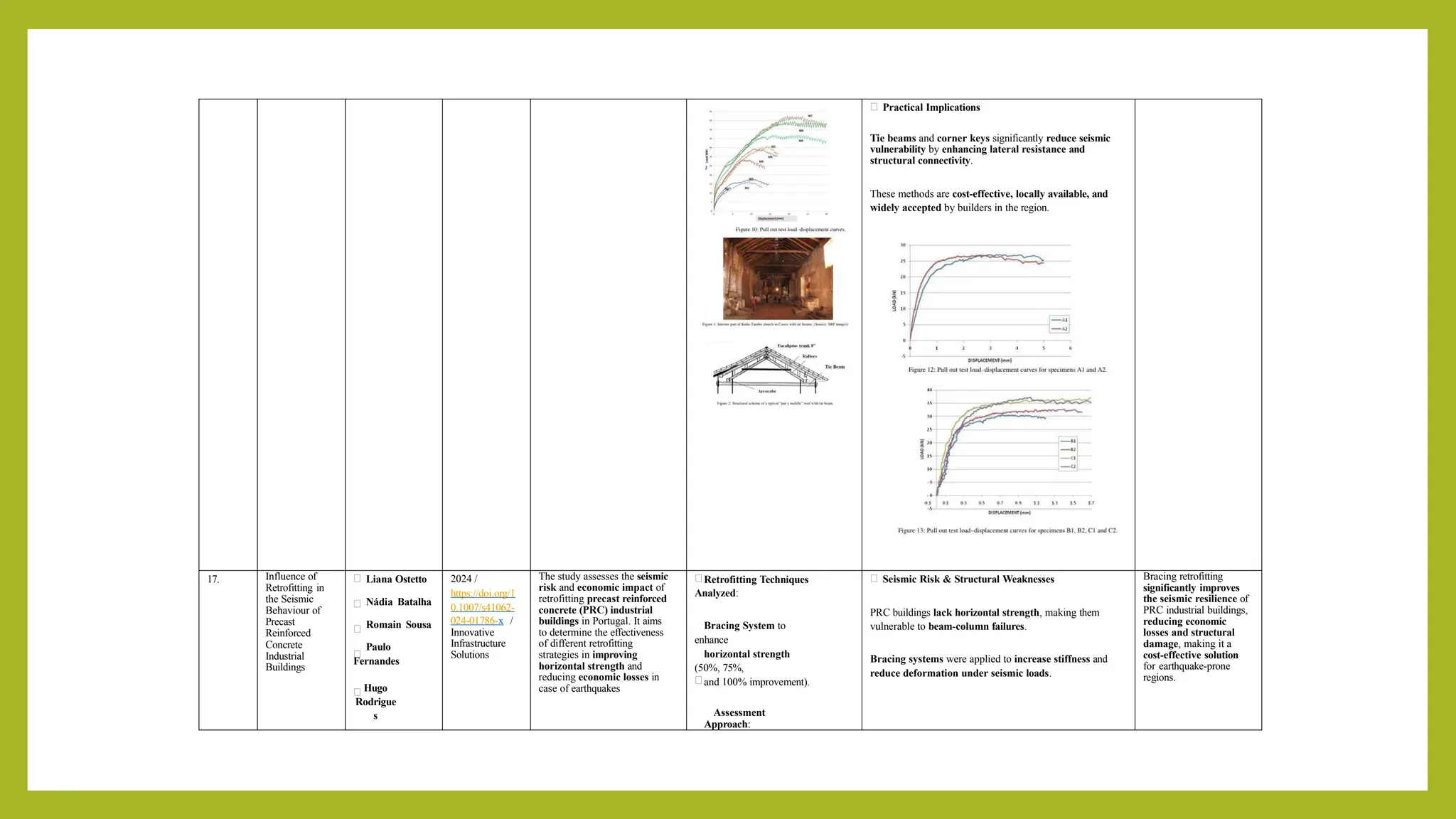
REFERENCES
Mirra, M., &Gerardini, A. (2024). Design and modelling tools for timber-based seismic retrofitting: from research to practice. Procedia
Structural Integrity, 64, 877–884. https://doi.org/10.1016/j.prostr.2024.09.362
Kakaletsis, D., David, K., & Karayannis, C. (2011). Effectiveness of some conventional seismic retrofitting techniques for bare
and infilled R/C frames. STRUCTURAL ENGINEERING AND MECHANICS, 39(4), 499–520.
https://doi.org/10.12989/sem.2011.39.4.499
Aljawhari, K., Gentile, R., & Carmine Galasso, M.EERI. (2022). A fragility-oriented approach for seismic
retrofit design. Earthquake Spectra, 3–3, 1813–1843. https://doi.org/10.1177/87552930221078324
Kakaletsis, D., David, K., & Karayannis, C. (2011). Effectiveness of some conventional seismic retrofitting
techniques for bare and infilled R/C frames. STRUCTURAL ENGINEERING AND MECHANICS, 39(4), 499–
520. https://doi.org/10.12989/sem.2011.39.4.499
Marini, A., Passoni, C., Belleri, A., Feroldi, F., Preti, M., Metelli, G., Riva, P., Giuriani, E., & Plizzari, G.
(2017). Combining seismic retrofit with energy refurbishment for the sustainable renovation of RC buildings: a
proof of concept. European Journal of Environmental and Civil Engineering.
https://doi.org/10.1080/19648189.2017.1363665​:contentReference[oaicite:0]{index=0}
42.
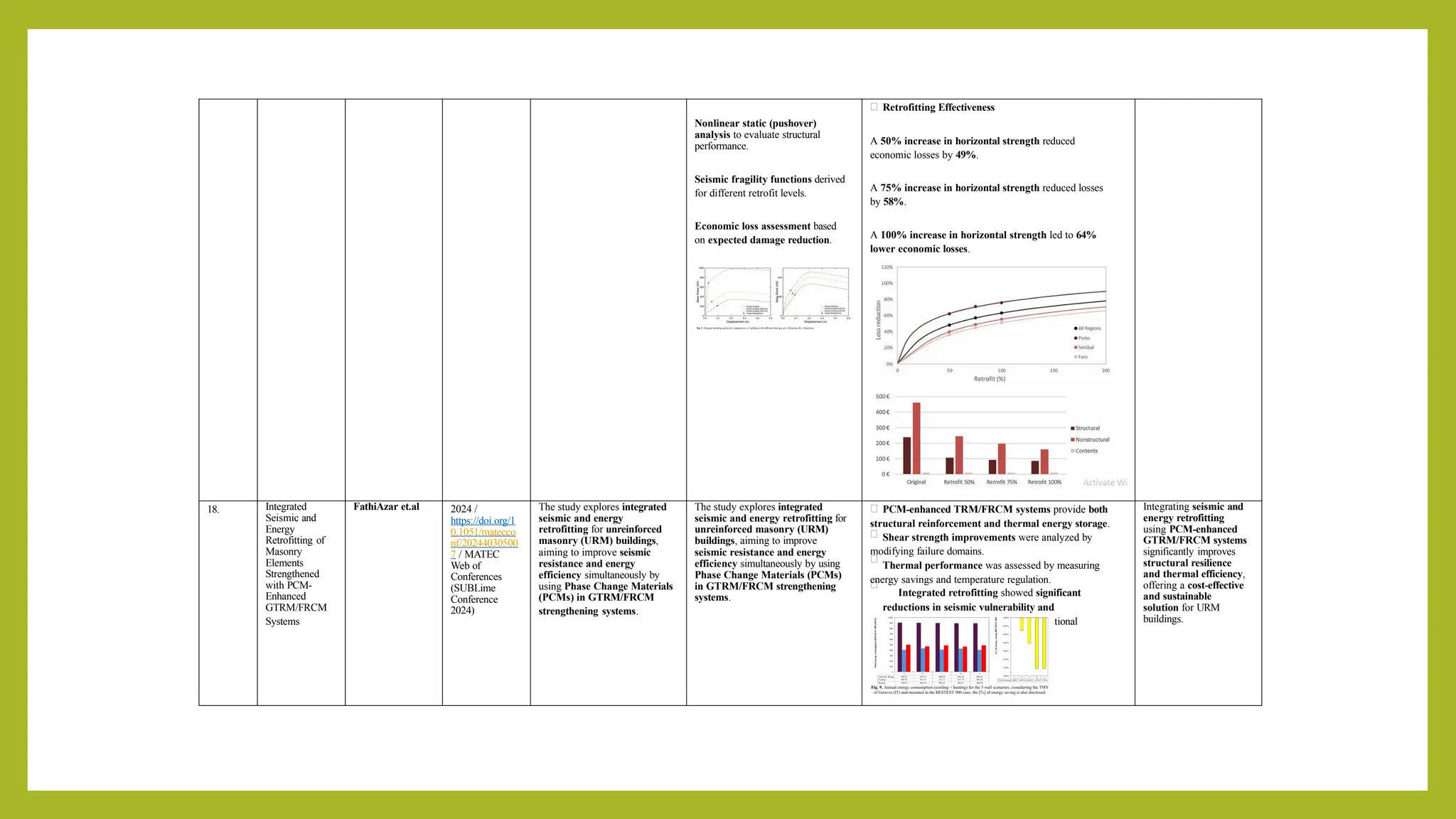
• Aljawhari, K.,Gentile, R., & Galasso, C. (2022). A fragility-oriented approach for seismic retrofit design.
Earthquake Spectra, 38(3), 1813–1843.
https://doi.org/10.1177/87552930221078324​:contentReference[oaicite:1]{index=1}
• Mantakas, A. G., Kapasakalis, K. A., Alvertos, A. E., Antoniadis, I. A., & Sapountzakis, E. J. (Year
Unknown). A Negative Stiffness Dynamic Base Absorber for Seismic Retrofitting of Residential Buildings.
Institute of Structural Analysis and Antiseismic Research, National Technical University of Athens
• Zhang, L., Wang, C., & Chen, Y. (2024). Comparing seismic performances of single-span RC frames with
and without wing wall retrofitting by shaking table tests. Journal of Building Engineering, 88, 109158.
https://doi.org/10.1016/j.jobe.2024.109158​:contentReference[oaicite:3]{index=3}
• Farghaly, A. A., & Abdallah, A. M. (2014). Evaluation of Seismic Retrofitting Techniques Used in Old
Reinforced Concrete Buildings. IOSR Journal of Engineering, 4(6), 1-7
• Torrealva, D. E., & Vicente, E. F. (2014). Experimental Behaviour of Traditional Seismic Retrofitting
Techniques in Earthen Buildings in Peru. 9th International Conference on Structural Analysis of
Historical Constructions
43.
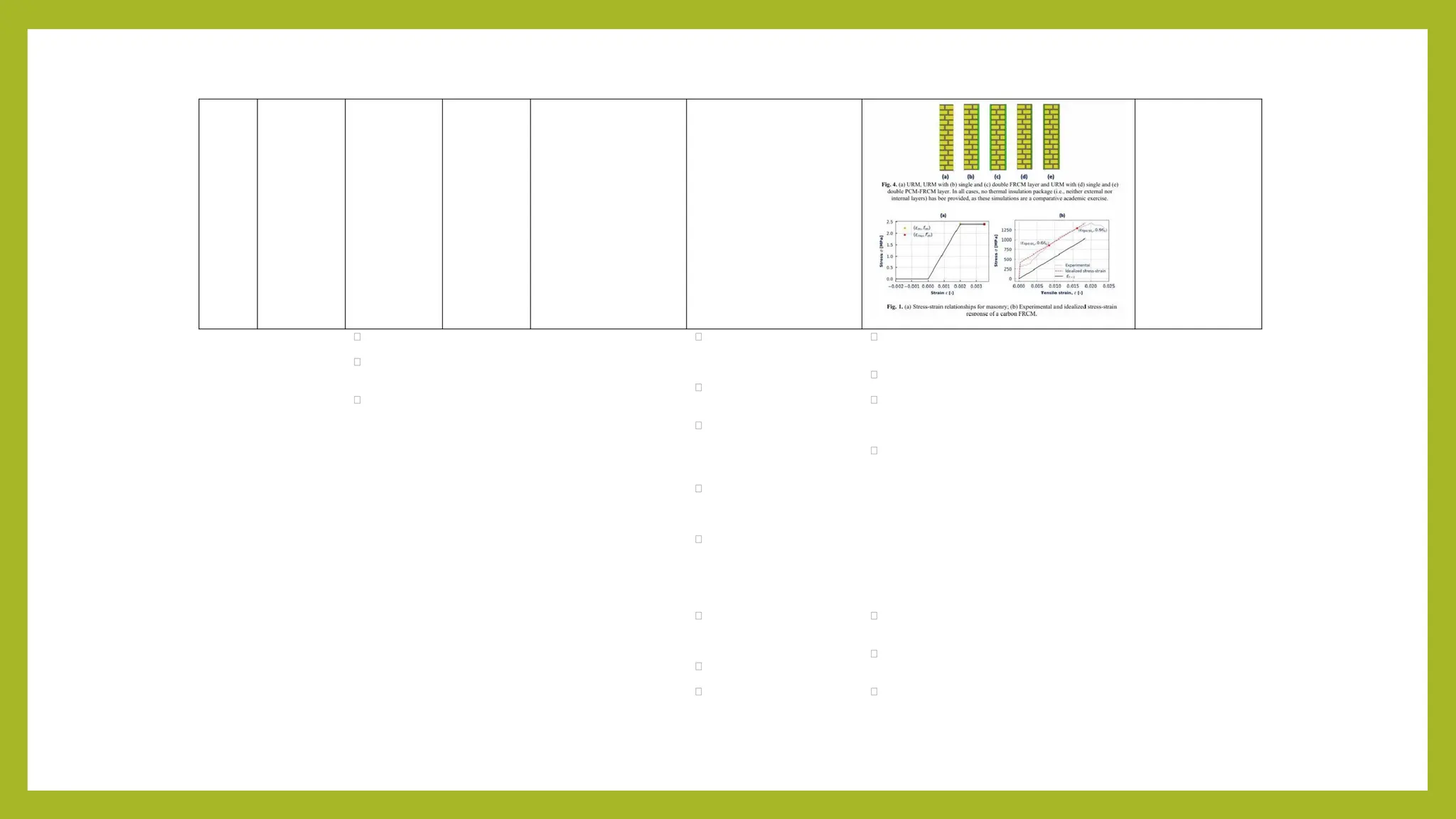
• Vaghani, M.V., Vasanwala, S. A., & Desai, A. K. (2014). Advanced Retrofitting Techniques for RC Building: A
State of an Art Review. International Journal of Current Engineering and Technology, 4(2), 579-585
• Kabashi, N., Muhaxheri, M., Krasniqi, E., Murati, Y., & Latifi, F. (2025). Advancements in Fiber-Reinforced
Polymer (FRP) Retrofitting Techniques for Seismic Resilience of Reinforced Concrete Structures. Buildings,
15(4), 587. https://doi.org/10.3390/buildings15040587​:contentReference[oaicite:2]{index=2}
• Labib, A. A. A., Khan, T. A., & Ahmad, S. (2024). Assessment of the Cost-effectiveness of Seismic Retrofitting
and Reconstruction for an Existing Garment Factory Building. ICACE 2024 Conference Proceedings
• Matsagar, V., & Jangid, R. S. (2008). Base Isolation for Seismic Retrofitting of Structures. Practice Periodical on
Structural Design and Construction, 13(4), 175-185.
https://doi.org/10.1061/(ASCE)1084-0680(2008)13:4(175)​:contentReference[oaicite:4]{index=4}
• Camayang, J. P., & Padilla, J. (2025). Seismic Retrofitting: Techniques and Innovations for Structural Resilience.
IOP Conference Series: Earth and Environmental Science, 1450(1), 012008.
https://doi.org/10.1088/1755-1315/1450/1/012008​:contentReference[oaicite:5]{index=5}
44.
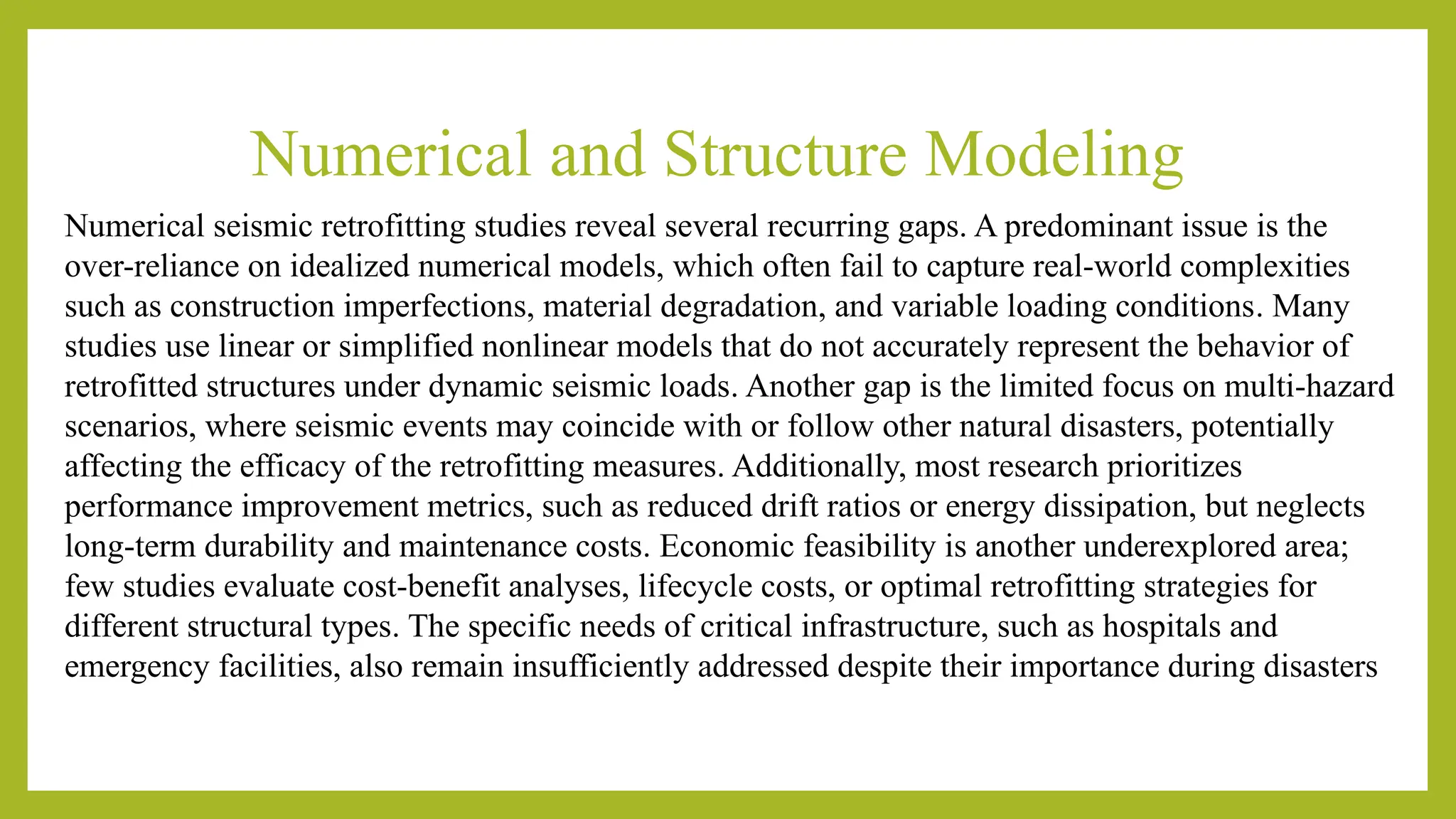
• Hajimirzajan, A.,Kazemian, M., & Fischer, S. (2025). A Fuzzy Framework for Assessing and
Prioritizing Railway Infrastructure Retrofitting Against Seismic Hazards – A Case Study. Acta
Polytechnica Hungarica, 22(4).
https://doi.org/10.12700/APH.22.4.2025.4.16​:contentReference[oaicite:8]{index=8}
• Salomi Papamichael, Anthos Ioannis Ioannou, John Bellos. (2024). Assessment and Retrofitting Of
a Multi-Storey Reinforced Concrete Building. Conference Paper, August 2024. DOI:
10.11159/icceia24.131
• Liana Ostetto, Nádia Batalha, Romain Sousa, Paulo Fernandes, Hugo Rodrigues. (2024). Influence
of Retrofitting in the Seismic Behaviour of Precast Reinforced Concrete Industrial Buildings.
Innovative Infrastructure Solutions, 9:469. DOI: 10.1007/s41062-024-01786-x
• Mohsen Vatandoost, Fariborz Nateghi-A. (2024). Seismic Retrofitting Reinforced Concrete
Structures with Precast Pre-Stressed Concrete Braces: An Overview. Chapter in InTechOpen,
October 2024. DOI: 10.5772/intechopen.1006362
• Abbas FathiAzar, Mahdi Zanjani, Ignacio Peralta, Serena Cattari, Silvia De Angeli, Victor
Fachinotti, Antonio Caggiano, Sergio Lagomarsino. (2024). Integrated Seismic and Energy
Retrofitting of Masonry Elements Strengthened with PCM-enhanced GTRM/FRCM Systems.
MATEC Web of Conferences, 403, 05007. DOI: 10.1051/matecconf/202440305007
45.
• Chetan JaiprakashChitte. (2020). Study of Seismic Retrofitting Techniques. International Research Journal of
Engineering and Technology (IRJET), Vol. 07, Issue 04, April 2020. Available at: www.irjet.net
• Tadeh Zirakian. (2024). Methodical Investigations on Seismic Retrofitting of Steel Plate Shear Wall Systems.
Buildings, 14, 258. DOI: 10.3390/buildings14010258
• Adnan Kiral, Mustafa Ergün, Zeliha Tonyali, Musa Artar. (2024). A Case Study Comparing Seismic Retrofitting
Techniques for a Historically Significant Masonry Building’s Minaret. Engineering Failure Analysis, September
2024. DOI: 10.383881910
• Mohammad Mahdi Khodavirdi Zanjani, Ignacio Peralta, Antonio Caggiano. (2024). Integrated Structural and
Energy Retrofitting Based on Cementitious Composites and Phase Change Materials. RILEM Bookseries, February
2024. DOI: 10.1007/978-3-031-53389-1_53
• Federico Gusella, Gianni Bartoli. (2025). Retrofitting Through the Loss-Based Earthquake Engineering. Bulletin of
Earthquake Engineering, 23:275–299. DOI: 10.1007/s10518-024-02036-2
• Kirtika Gupta, Abhishek Kumar, Mohd. Afaque Khan. (2017). Review Paper on Seismic Retrofitting of Structures.
International Research Journal of Engineering and Technology (IRJET), Vol. 04, Issue 04, April 2017. Available at:
www.irjet.net
46.
• Majid Mehrjoo,Seyed Bahram Beheshti Aval. (2024). Proposing New Design and Retrofitting Objectives for Seismic
Design of Hospital Structures: A Case Study of Imam Khomeini Hospital in Eslamabad-e Gharb. Bulletin of
Earthquake Engineering, 22:4745–4777. DOI: 10.1007/s10518-024-01892-2
• Majid Mehrjoo, Seyed Bahram Beheshti Aval. (2024). Proposing New Design and Retrofitting Objectives for Seismic
Design of Hospital Structures: A Case Study of Imam Khomeini Hospital in Eslamabad-e Gharb. Bulletin of
Earthquake Engineering, 22:4745–4777. DOI: 10.1007/s10518-024-01892-2
• Zainab Q Hassan, Saad Al-Wazni. (2024). Seismic Evaluation of Retrofitting Technique Using Bracing Systems for
Steel Multi-Story Building. BIO Web of Conferences, 97, 00018. DOI: 10.1051/bioconf/20249700018
• Fauzan, Zev Al Jauhari, Geby Aryo Agista, Atsushi Yokota, Masharya Eko Putra. (2025). Seismic and Tsunamis
Vulnerability Assessment of the Shelter School Building Structure with and without Retrofitting. Journal of the Civil
Engineering Forum, 11(1):85-96. DOI: 10.22146/jcef.13432
• Chao Ma, Xiaolei Li, Guosheng Wang, Dechun Lu, Xiuli Du. (2024). Seismic Performance Enhancement of
Underground Structure Influenced by CFRP Wrapping Schemes. Urban Lifeline, 2:14. DOI:
10.1007/s44285-024-00022-3
47.
• Patrício Rocha,Pedro Delgado, Aníbal Costa, Raimundo Delgado. "Seismic Retrofit of RC Frames."
Computers and Structures, 82 (2004): 1523–1534. doi:10.1016/j.compstruc.2004.03.048
• Amritha Ranganadhan, Anju Paul. "Seismic Retrofitting of an Existing Structure." IJRET: International Journal of
Research in Engineering and Technology, Vol. 04 Special Issue: 03, INCEPTION-2015, Apr-2015
• Giuseppe Oliveto, Massimo Marletta. "Seismic Retrofitting of Reinforced Concrete Buildings Using Traditional
and Innovative Techniques." ISET Journal of Earthquake Technology, Paper No. 454, Vol. 42, No. 2-3, June-
September 2005, pp. 21-46
• Tim L. G. Michiels. "Seismic Retrofitting Techniques for Historic Adobe Buildings." International Journal of
Architectural Heritage, 9:8 (2015): 1059-1068. doi:10.1080/15583058.2014.924604
•
• Toshiyuki Kitada, Masahide Matsumura, Yukitoshi Otoguro. "Seismic Retrofitting Techniques Using an Energy
Absorption Segment for Steel Bridge Piers." Engineering Structures, 25 (2003): 621–635. doi:10.1016/S0141-
0296(02)00179-7
• Kamal Hosen. "Seismic Vulnerability and Rehabilitation Strategies for Industrial RC Structures." Civil and
Environmental Engineering Reports, 34 (4): 0328-0343, November 2024. doi:10.59440/ceer/194875
•
• Leonidas Alexandros Kouris, Dionysios A. Bournas, Daniel A. Pohoryles, George Valsamos, et al. "Seismic Plus
Energy Upgrading of Masonry Buildings Using Advanced Materials." EUR 30563 EN, Luxembourg: Publications
Office of the European Union, 2024. doi:10.2760/66556
48.
• Xiaohui Yu,Zenghui Li, Zhichao Jiang, Kuangyu Dai. "The Effect of FRP Retrofitting on the Seismic Resilience of
Low-Ductility RC Frame Structures: A Case Study." Disaster Prevention and Resilience, 3 (2024): 11.
doi:10.20517/dpr.2024.14
• Rita Couto, Gianrocco Mucedero, Rita Bento, Ricardo Monteiro. "Understanding the Impact of Climate and Seismic
Hazard Conditions on Multi-criteria Based Retrofitting of Existing Buildings." Preprints.org, 11 April 2024.
doi:10.20944/preprints202404.0748.v1
• Reza Amiraslanzadeh, Toshikazu Ikemoto, Masakatsu Miyajima, Abdolhossein Fallahi. "A Comparative Study on
Seismic Retrofitting Methods for Unreinforced Masonry Brick Walls." 15th World Conference on Earthquake
Engineering (WCEE), 2012



![REFERENCES
Mirra, M., & Gerardini, A. (2024). Design and modelling tools for timber-based seismic retrofitting: from research to practice. Procedia
Structural Integrity, 64, 877–884. https://doi.org/10.1016/j.prostr.2024.09.362
Kakaletsis, D., David, K., & Karayannis, C. (2011). Effectiveness of some conventional seismic retrofitting techniques for bare
and infilled R/C frames. STRUCTURAL ENGINEERING AND MECHANICS, 39(4), 499–520.
https://doi.org/10.12989/sem.2011.39.4.499
Aljawhari, K., Gentile, R., & Carmine Galasso, M.EERI. (2022). A fragility-oriented approach for seismic
retrofit design. Earthquake Spectra, 3–3, 1813–1843. https://doi.org/10.1177/87552930221078324
Kakaletsis, D., David, K., & Karayannis, C. (2011). Effectiveness of some conventional seismic retrofitting
techniques for bare and infilled R/C frames. STRUCTURAL ENGINEERING AND MECHANICS, 39(4), 499–
520. https://doi.org/10.12989/sem.2011.39.4.499
Marini, A., Passoni, C., Belleri, A., Feroldi, F., Preti, M., Metelli, G., Riva, P., Giuriani, E., & Plizzari, G.
(2017). Combining seismic retrofit with energy refurbishment for the sustainable renovation of RC buildings: a
proof of concept. European Journal of Environmental and Civil Engineering.
https://doi.org/10.1080/19648189.2017.1363665​:contentReference[oaicite:0]{index=0}](https://image.slidesharecdn.com/ashishseminarpresentation-250429164538-01c9affb/75/Ashish-Seminar-Presentation-pptx-on-retrofitting-41-2048.jpg)
![• Aljawhari, K., Gentile, R., & Galasso, C. (2022). A fragility-oriented approach for seismic retrofit design.
Earthquake Spectra, 38(3), 1813–1843.
https://doi.org/10.1177/87552930221078324​:contentReference[oaicite:1]{index=1}
• Mantakas, A. G., Kapasakalis, K. A., Alvertos, A. E., Antoniadis, I. A., & Sapountzakis, E. J. (Year
Unknown). A Negative Stiffness Dynamic Base Absorber for Seismic Retrofitting of Residential Buildings.
Institute of Structural Analysis and Antiseismic Research, National Technical University of Athens
• Zhang, L., Wang, C., & Chen, Y. (2024). Comparing seismic performances of single-span RC frames with
and without wing wall retrofitting by shaking table tests. Journal of Building Engineering, 88, 109158.
https://doi.org/10.1016/j.jobe.2024.109158​:contentReference[oaicite:3]{index=3}
• Farghaly, A. A., & Abdallah, A. M. (2014). Evaluation of Seismic Retrofitting Techniques Used in Old
Reinforced Concrete Buildings. IOSR Journal of Engineering, 4(6), 1-7
• Torrealva, D. E., & Vicente, E. F. (2014). Experimental Behaviour of Traditional Seismic Retrofitting
Techniques in Earthen Buildings in Peru. 9th International Conference on Structural Analysis of
Historical Constructions](https://image.slidesharecdn.com/ashishseminarpresentation-250429164538-01c9affb/75/Ashish-Seminar-Presentation-pptx-on-retrofitting-42-2048.jpg)
![• Vaghani, M. V., Vasanwala, S. A., & Desai, A. K. (2014). Advanced Retrofitting Techniques for RC Building: A
State of an Art Review. International Journal of Current Engineering and Technology, 4(2), 579-585
• Kabashi, N., Muhaxheri, M., Krasniqi, E., Murati, Y., & Latifi, F. (2025). Advancements in Fiber-Reinforced
Polymer (FRP) Retrofitting Techniques for Seismic Resilience of Reinforced Concrete Structures. Buildings,
15(4), 587. https://doi.org/10.3390/buildings15040587​:contentReference[oaicite:2]{index=2}
• Labib, A. A. A., Khan, T. A., & Ahmad, S. (2024). Assessment of the Cost-effectiveness of Seismic Retrofitting
and Reconstruction for an Existing Garment Factory Building. ICACE 2024 Conference Proceedings
• Matsagar, V., & Jangid, R. S. (2008). Base Isolation for Seismic Retrofitting of Structures. Practice Periodical on
Structural Design and Construction, 13(4), 175-185.
https://doi.org/10.1061/(ASCE)1084-0680(2008)13:4(175)​:contentReference[oaicite:4]{index=4}
• Camayang, J. P., & Padilla, J. (2025). Seismic Retrofitting: Techniques and Innovations for Structural Resilience.
IOP Conference Series: Earth and Environmental Science, 1450(1), 012008.
https://doi.org/10.1088/1755-1315/1450/1/012008​:contentReference[oaicite:5]{index=5}](https://image.slidesharecdn.com/ashishseminarpresentation-250429164538-01c9affb/75/Ashish-Seminar-Presentation-pptx-on-retrofitting-43-2048.jpg)
![• Hajimirzajan, A., Kazemian, M., & Fischer, S. (2025). A Fuzzy Framework for Assessing and
Prioritizing Railway Infrastructure Retrofitting Against Seismic Hazards – A Case Study. Acta
Polytechnica Hungarica, 22(4).
https://doi.org/10.12700/APH.22.4.2025.4.16​:contentReference[oaicite:8]{index=8}
• Salomi Papamichael, Anthos Ioannis Ioannou, John Bellos. (2024). Assessment and Retrofitting Of
a Multi-Storey Reinforced Concrete Building. Conference Paper, August 2024. DOI:
10.11159/icceia24.131
• Liana Ostetto, Nádia Batalha, Romain Sousa, Paulo Fernandes, Hugo Rodrigues. (2024). Influence
of Retrofitting in the Seismic Behaviour of Precast Reinforced Concrete Industrial Buildings.
Innovative Infrastructure Solutions, 9:469. DOI: 10.1007/s41062-024-01786-x
• Mohsen Vatandoost, Fariborz Nateghi-A. (2024). Seismic Retrofitting Reinforced Concrete
Structures with Precast Pre-Stressed Concrete Braces: An Overview. Chapter in InTechOpen,
October 2024. DOI: 10.5772/intechopen.1006362
• Abbas FathiAzar, Mahdi Zanjani, Ignacio Peralta, Serena Cattari, Silvia De Angeli, Victor
Fachinotti, Antonio Caggiano, Sergio Lagomarsino. (2024). Integrated Seismic and Energy
Retrofitting of Masonry Elements Strengthened with PCM-enhanced GTRM/FRCM Systems.
MATEC Web of Conferences, 403, 05007. DOI: 10.1051/matecconf/202440305007 ](https://image.slidesharecdn.com/ashishseminarpresentation-250429164538-01c9affb/75/Ashish-Seminar-Presentation-pptx-on-retrofitting-44-2048.jpg)



![Communication_Protocols[2][1].pptx on protocoals](https://cdn.slidesharecdn.com/ss_thumbnails/communicationprotocols21-250429164707-38355411-thumbnail.jpg?width=640&height=640&fit=bounds)


