INDIAN STRUCTURAL INTEGRITY SOCIETY
WORKSHOP
9th – 10th May 2018
AERB Auditorium,Niyamak Bhavan-B Mumbai .
Structural Integrity Assessment of Nuclear Energy Assets
SEISMIC QUALIFICATION OF EQUIPMENT BY
TESTING
S. D. BHAWSAR
Addl. Chief. Engr,(Stress Analysis & Seismology)
Nabhkiya Urja Bhavan,
NPCIL, MUMBAI
Contents
• Seismic qualification purpose & Methods of seismic qualification
• Qualification standards/guides
• Active Equipment type and safety function
• Shaketable types and list of shaketable
• Combination of analysis and test
• Assembly test and device test
• Proof test, generic test and fragility test
• Test procedure : mounting, monitoring, simulation of loads, seismic motion : single frequency, multifrequency
• Table Input motion : Sinusoidal, sine sweep, time history
• Test sequence : Resonance, OBE, SSE
• Inspection, functional monitoring, accelerometer , strain gauge mounting, TRS and functional Acceptance criteria
• Seismic test on valve : side load test (static equivalent)
• Fragility test on relay
• Test report contents
• Guidelines for design
SEISMIC QUALIFICATION OF EQUIPMENT
SEISMIC QUALIFICATION OF AN
EQUIPMENT IS TO DEMONSTRATE THAT
EQUIPMENT CAN WITHSTAND THE FORCES
GENERATED DURING THE SPECIFIED
EARTHQUAKE MOTION AND CAN PERFORM
ITS INTENDED SAFETY FUNCTION DURING
AND/OR AFTER AN EARTHQUAKE.
SAFETY FUNCTION
• STRUCTURAL INTEGRITY
• FUNCTIONAL OPERABILITY
• COMBINATION OF BOTH
– CIVIL STRUCTURE IS REQUIRED TO MAINTAIN
STRUCTURAL INTEGRITY (PASSIVE)
– VALVES ARE REQUIRED TO MAINTAIN
STRUCTURAL INTEGRITY AND FUNCTIONAL
OPERABILITY BOTH (ACTIVE)
– For Active equipmnt qualification by test is
recommended.
QUALIFICATION METHODS
• QUALIFICATION METHOD CAN BE SELECTED
BASED ON SAFETY FUNCTION
REQUIREMENT
• ANALYSIS
• TESTS
• COMBINATION OF ANALYSIS AND TEST
• PAST EXPERIENCE
QUALIFICATION STANDARADS
• ASME QME -1 for qualification of active mechanical
equipment used in NPP (pumps & valves) ANSI B16.41
• IEEE 344 Guidelines for seismic qualification of class
1E equipment for NPP
• IEEE 382 qualification of valve actuators for power
operated valve assemblies
• IEEE 501 Seismic testing of relays
• IEC 60980 Seismic qualification of class 1E equipment
used in NPP
QUALIFICATION STANDARDS CONTD..
• IEEE 639 Seismic design of substation
• ICBO AC 156 Jan 2000 Acceptance criteria for
seismic qualification testing of non structural
components
• ACI 355.2 Evaluating performance of post installed
mechanical anchors in concrete
• IS 14989/IEC 60898 :2001 Guidelines for seismic
qualification of Electrical equipment for NPP
• AERB SG D 23
LIST OF ACTIVE EQUIPMENT
• Mechanical
• Valves, pumps, compressors etc.
• Electrical
• Battery bank, battery charger, relay,
switchgear etc.
• C&I
• Control panel, relays, Solenoid valve,
meters etc.
SAFETY FUNCTION OF ACTIVE EQUIPMENT
•The behavior of active equipment should
not disturb the functioning of the system
during or after an earthquake i.e.
• The equipment should continue to
maintain the state of position / operation, if
there is no demand for such a change viz no
malfunction
or
• change the state of position / operation
whenever demanded, viz, starting or
stopping on demand
Seismic qualification of active equipment
The equipment/components that have
– Close gaps/clearances
– complex geometries
– uncommon materials
making it difficult to model and analyze to
determine failure or malfunction are qualified by
testing on a shake table or by combination of
analysis and test or other justifiable method (past
experience) depending on size, complexity and
function of equipment.
Qualification of equipment by Shake table test
1.The seismic qualification test is conducted by
mounting the equipment on a shake table.
2. During the test, the operating conditions/loads of the
equipment are simulated adequately viz., Electrical
loads,Mechanical loads, Pressure loads which
represent the normal functioning of the equipment.
3. While seismic motion is given to the shake table, the
equipment is checked for its intended functional
operability
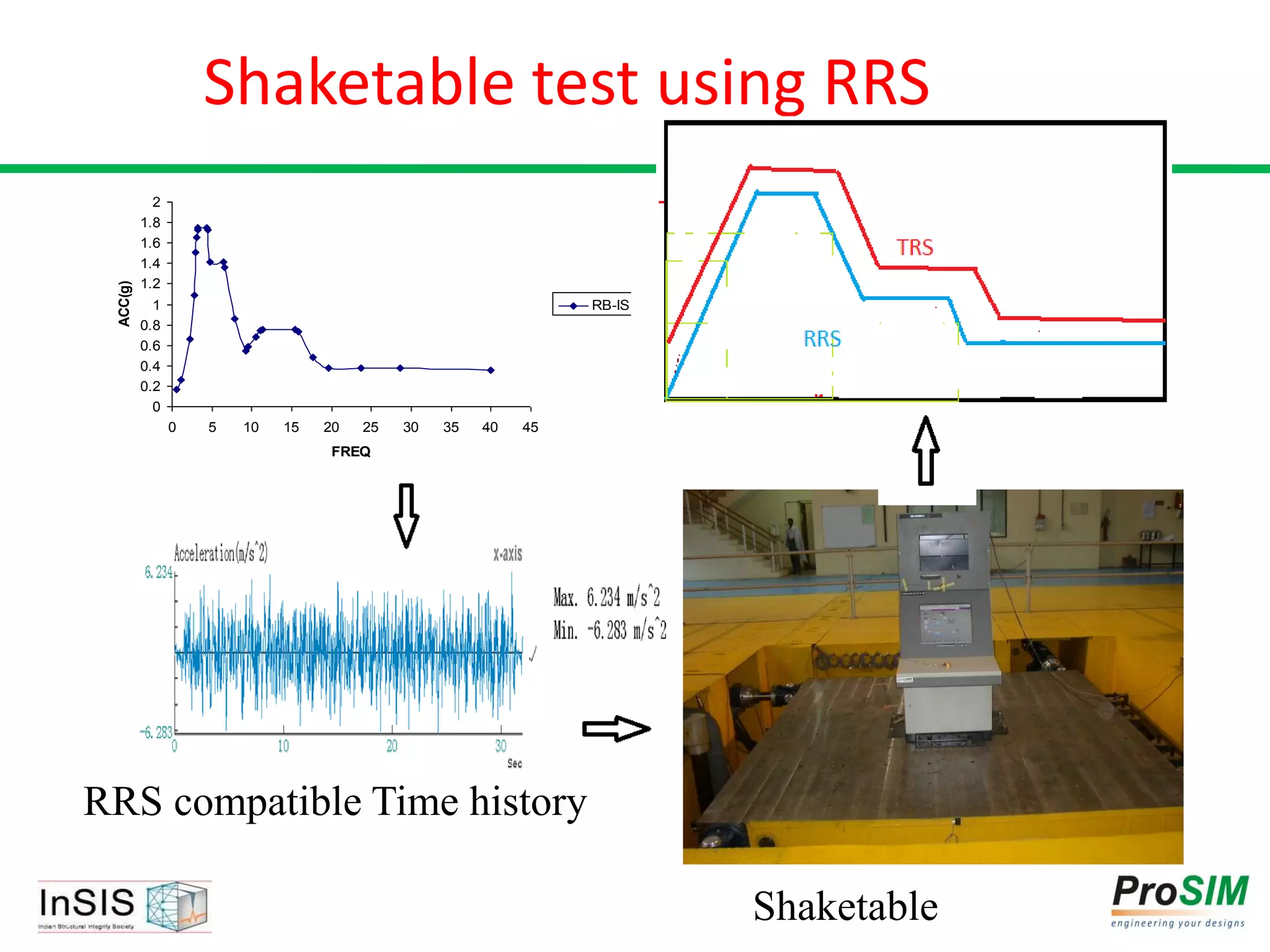
4. The Test Response Spectrum (TRS) should envelop the
Required Response Spectrum (RRS) defined at the
base of the equipment.
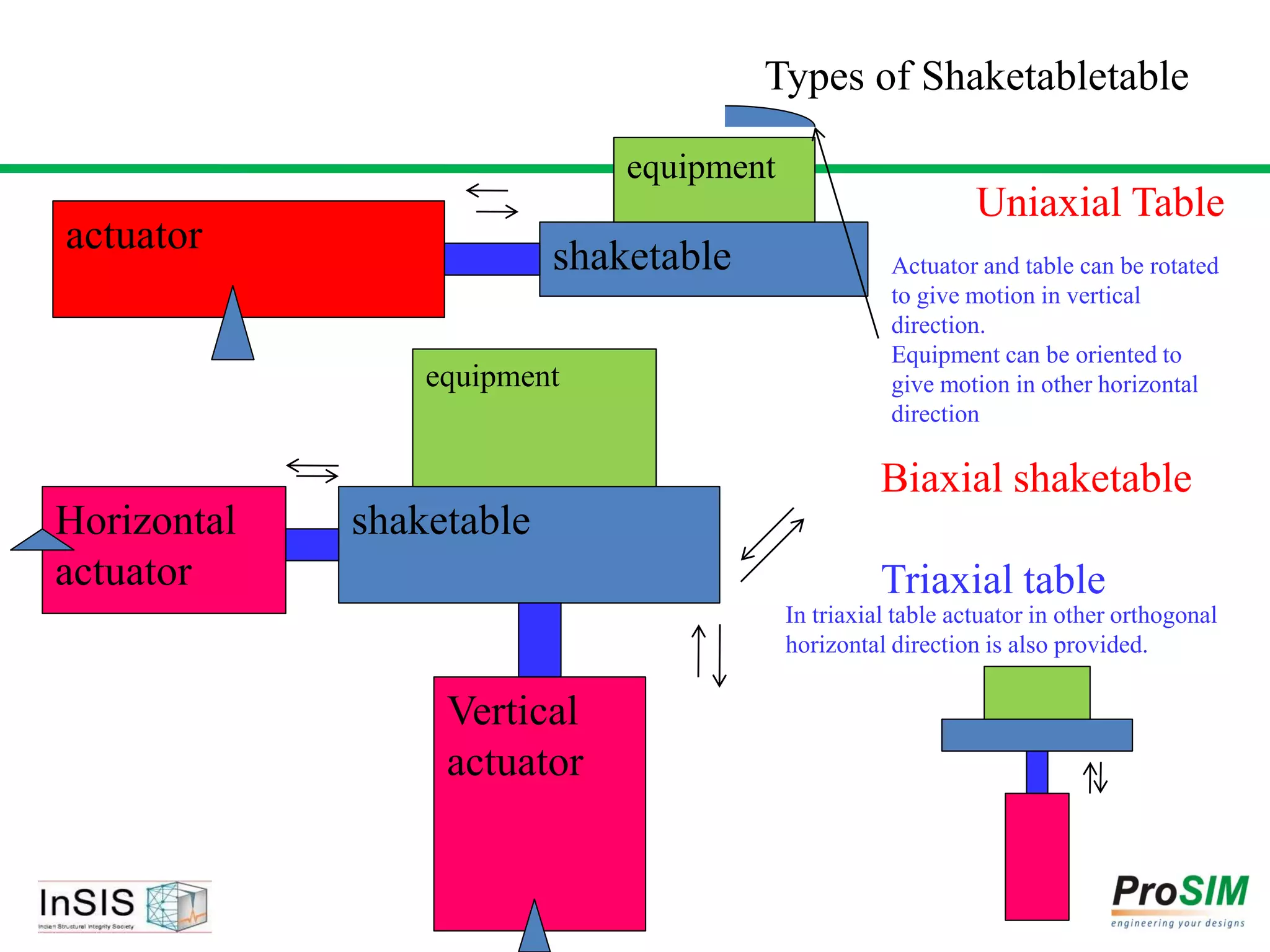
shaketable
actuator
Uniaxial Table
shaketableHorizontal
actuator
Vertical
actuator
Biaxial shaketable
Triaxial table
Types of Shaketabletable
equipment
equipment
Actuator and table can be rotated
to give motion in vertical
direction.
Equipment can be oriented to
give motion in other horizontal
direction
In triaxial table actuator in other orthogonal
horizontal direction is also provided.
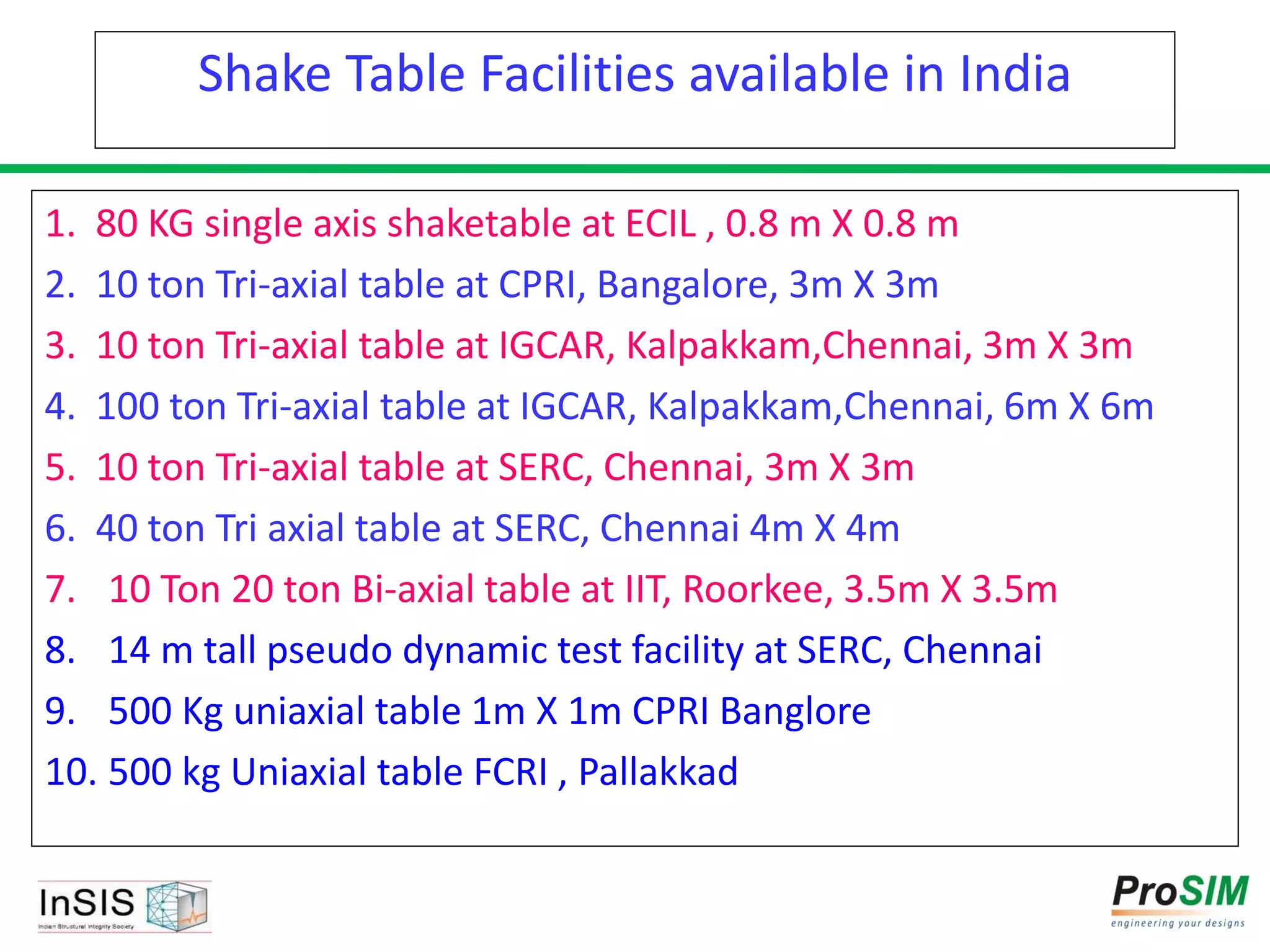
Shake Table Facilities available in India
1. 80 KG single axis shaketable at ECIL , 0.8 m X 0.8 m
2. 10 ton Tri-axial table at CPRI, Bangalore, 3m X 3m
3. 10 ton Tri-axial table at IGCAR, Kalpakkam,Chennai, 3m X 3m
4. 100 ton Tri-axial table at IGCAR, Kalpakkam,Chennai, 6m X 6m
5. 10 ton Tri-axial table at SERC, Chennai, 3m X 3m
6. 40 ton Tri axial table at SERC, Chennai 4m X 4m
7. 10 Ton 20 ton Bi-axial table at IIT, Roorkee, 3.5m X 3.5m
8. 14 m tall pseudo dynamic test facility at SERC, Chennai
9. 500 Kg uniaxial table 1m X 1m CPRI Banglore
10. 500 kg Uniaxial table FCRI , Pallakkad
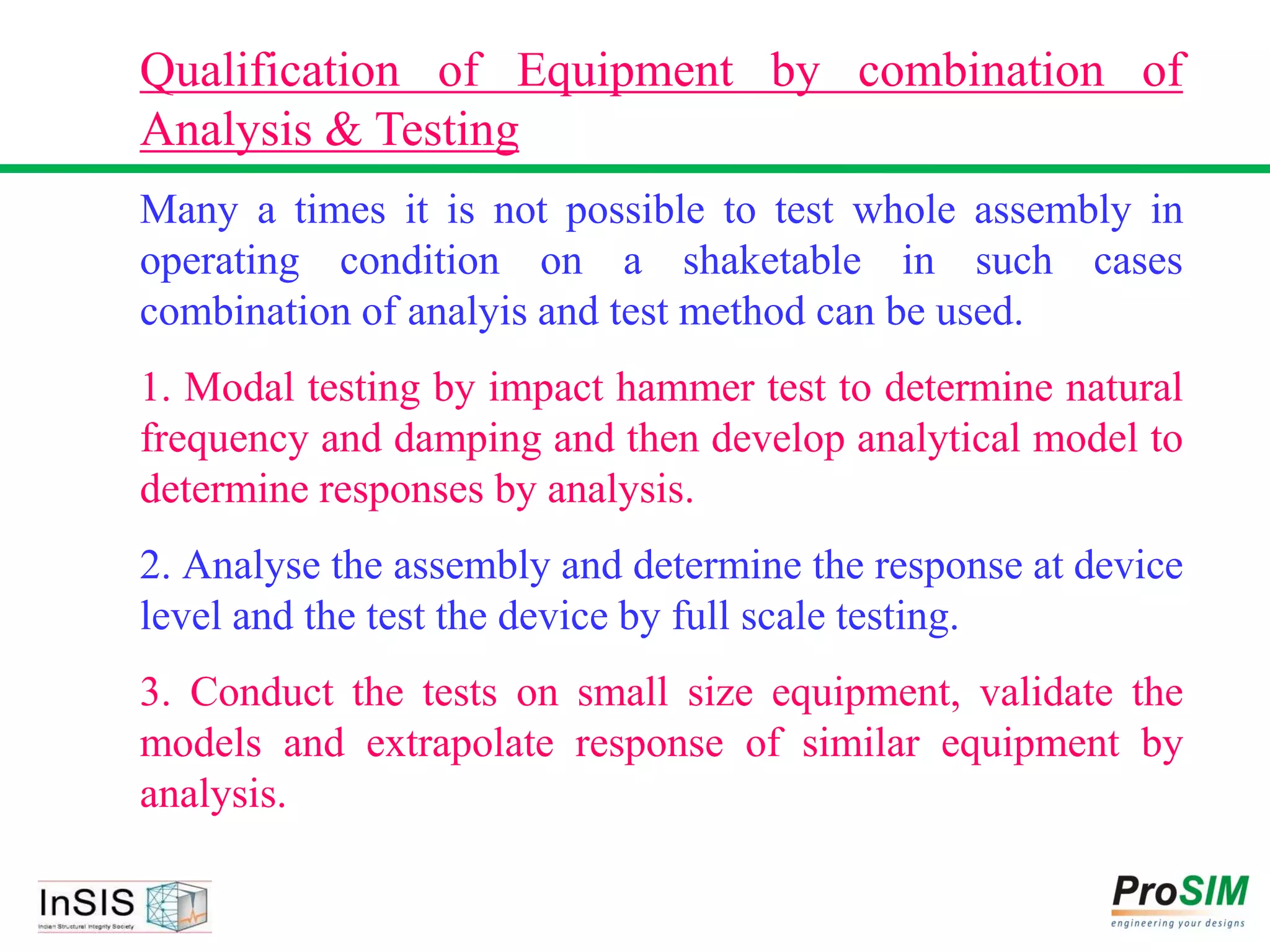
Qualification of Equipment by combination of
Analysis & Testing
Many a times it is not possible to test whole assembly in
operating condition on a shaketable in such cases
combination of analyis and test method can be used.
1. Modal testing by impact hammer test to determine natural
frequency and damping and then develop analytical model to
determine responses by analysis.
2. Analyse the assembly and determine the response at device
level and the test the device by full scale testing.
3. Conduct the tests on small size equipment, validate the
models and extrapolate response of similar equipment by
analysis.
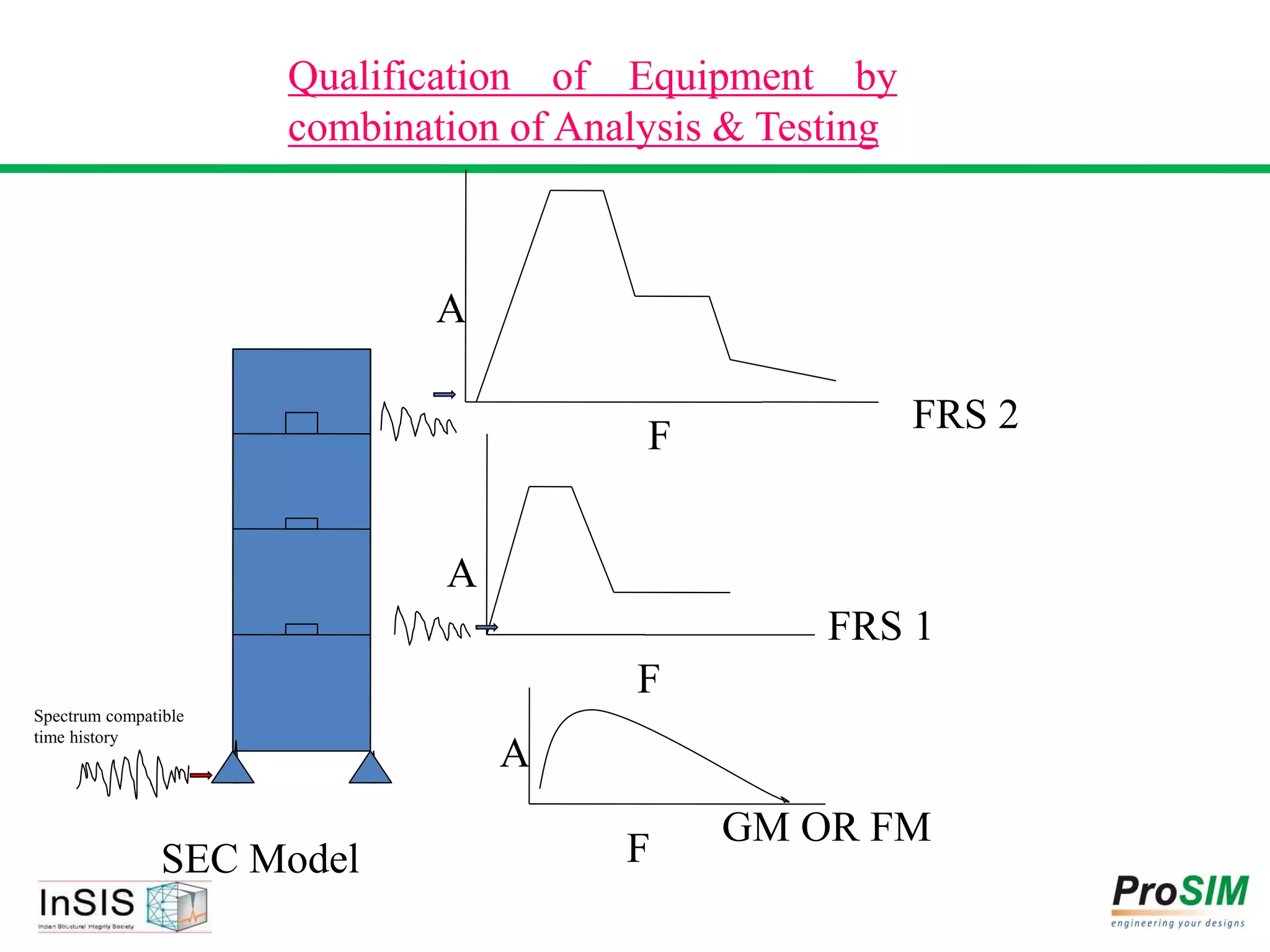
GM OR FM
FRS 1
FRS 2
F
A
F
A
FSEC Model
Qualification of Equipment by
combination of Analysis & Testing
A
Spectrum compatible
time history
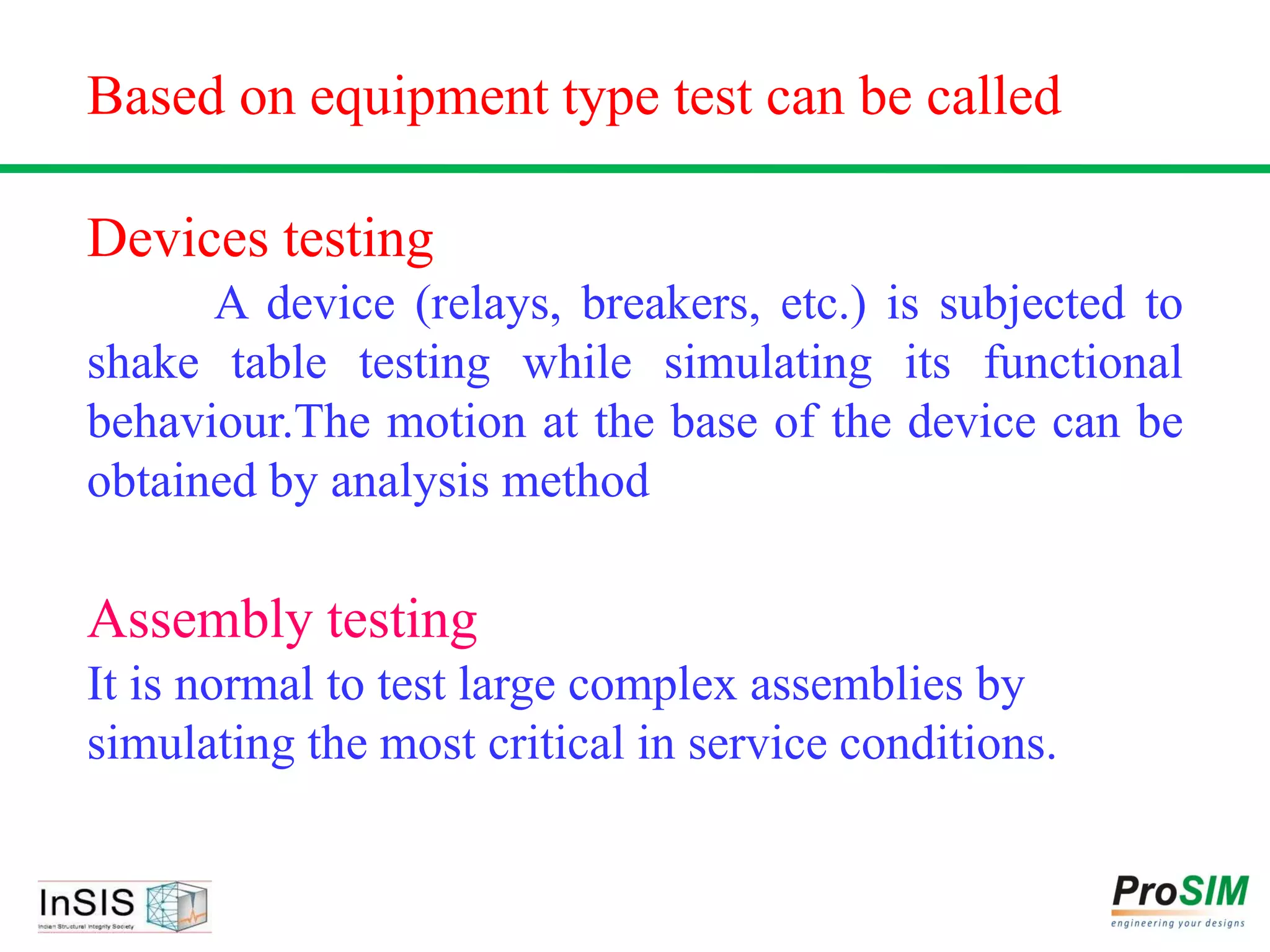
Based on equipment type test can be called
Devices testing
A device (relays, breakers, etc.) is subjected to
shake table testing while simulating its functional
behaviour.The motion at the base of the device can be
obtained by analysis method
Assembly testing
It is normal to test large complex assemblies by
simulating the most critical in service conditions.
Based on application type, the seismic test can be
called as
Generic test : for multiple application
Valves mounted at various location
Proof test: for single location
MCRP at one location
Fragility test : For limit to failure
Relays sensitive to input motion amplitude and
frequency.
Test procedure should include
a) Equipment description
b) Mounting and connection arrangment
c) Shaketable description
d) Resonance search parameters, OBE, SSE response spectra
e) Temp, flow, current etc parameters as applicable
f) Strain gauges, accelermeters mounting locations
g) performance monitoring and acceptance criteria
f) Maintenance and repairs allowed during testing.
i) Pre, during and post test inspection and functional
monitoring scheme and acceptance limits.
j) Test sequence
k) Documentation of test data/test report
Continued
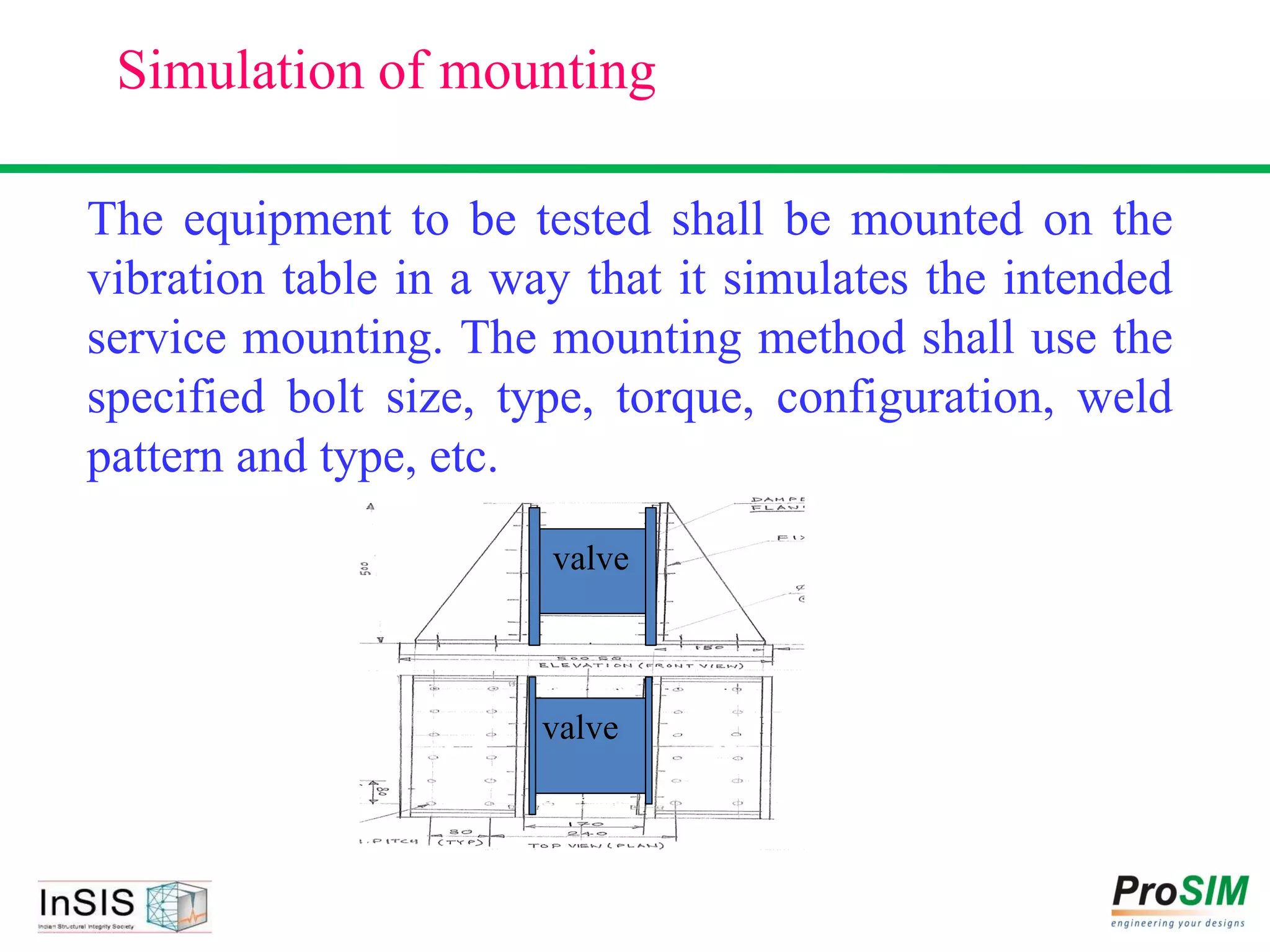
The equipment to be tested shall be mounted on the
vibration table in a way that it simulates the intended
service mounting. The mounting method shall use the
specified bolt size, type, torque, configuration, weld
pattern and type, etc.
Simulation of mounting
valve
valve
SIMULATION OF LOADS
•Seismic qualification tests on equipment shall be
performed with the equipment subjected to normal
operating loads.
•electrical loads
•mechanical loads
•thermal loads
•pressure etc as applicable.
•Accelerometers mounted on table to determine the
applied vibration levels.
•Accelerometers are also mounted on equipment to
determine the response of the equipment along all three
orthogonal axes simultaneously
•Accelerometers are also mounted at those points where
critical devices and displacements are expected.
Monitoring input & output vibrations
Demonstration of Functional Performance
functions and functional parameters associated with
various devices and sub-devices in the equipment
which are to be monitored during shake table test shall
be brought out in test specification,
•Timing of opening and closing of valves;
•leakge rates
•Making and breaking of electrical contacts;
•Relay position
•allowable chattering time
•pressure, temperature, voltage, current, humidity,
radiation & chemical and other load conditions
Monitoring of performance
•To monitor relay chattering PLC may be employed
• for opening and closing of valves stop watches etc are
provided or recorders are used
• Battery output is continuously monitored using
osciloscope etc.
• strain gauges be mounted to determine the response of
the equipment at those points within the structure of the
equipment that reflect the equipment response
associated with its structural integrity.
Specifying Seismic Motion at equipment
mounting location
The seismic motion expected at the place of
installation of equipment is given in the form of
• Horizontal and vertical directions of Required
Response Spectra (RRS) for 5% damping
• Calculated / expected acceleration in terms of ‘g’
A
F
RRS
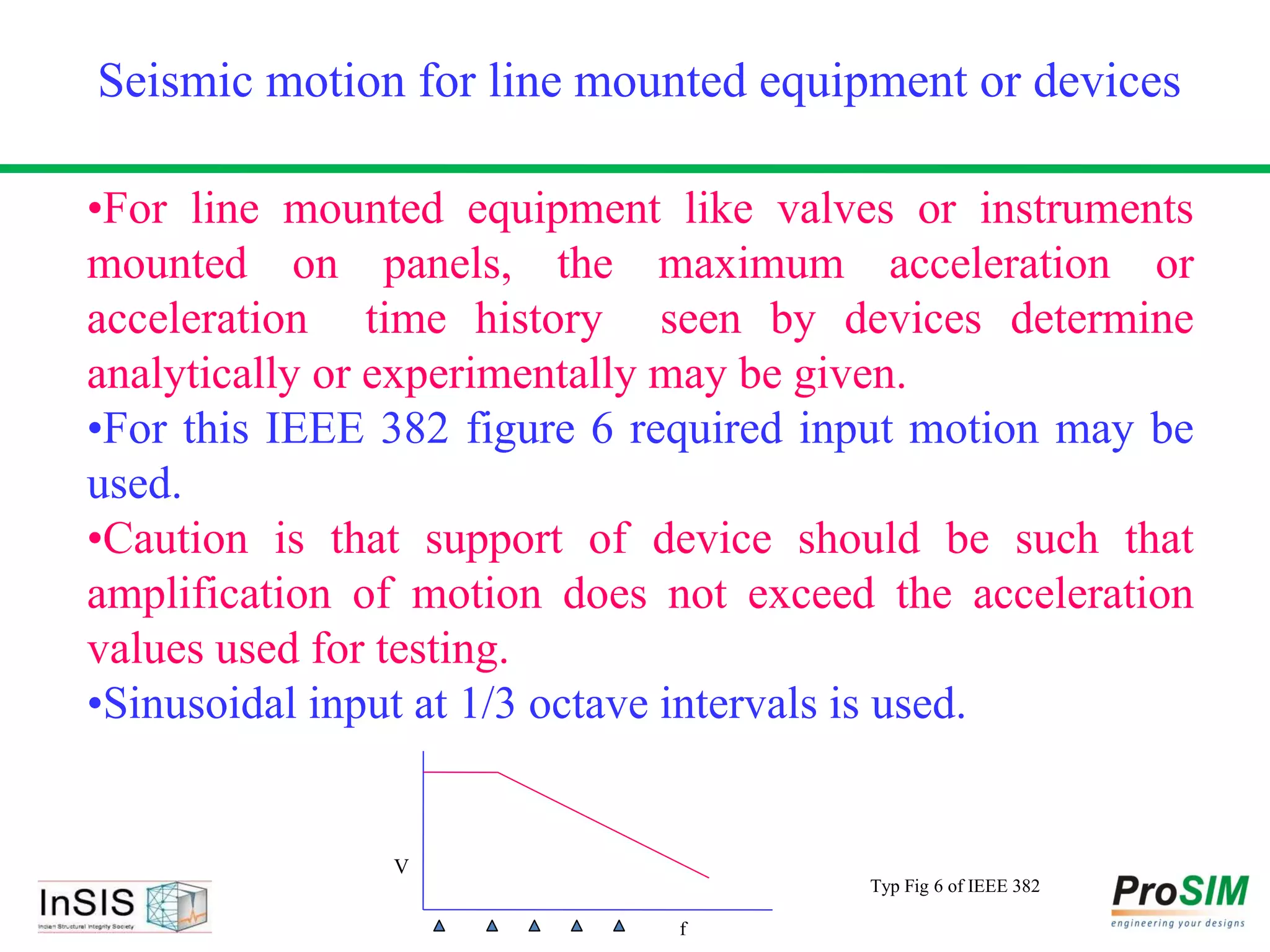
•For line mounted equipment like valves or instruments
mounted on panels, the maximum acceleration or
acceleration time history seen by devices determine
analytically or experimentally may be given.
•For this IEEE 382 figure 6 required input motion may be
used.
•Caution is that support of device should be such that
amplification of motion does not exceed the acceleration
values used for testing.
•Sinusoidal input at 1/3 octave intervals is used.
Seismic motion for line mounted equipment or devices
V
f
Typ Fig 6 of IEEE 382
The test facility should generate suitable input motion of
the shake table so that seismic loads as defined by RRS or
acceleration levels at different frequencies as per the
expected seismic loading are achieved.
•Single or multi axis table may be used
•single or multi frequency waves are used
•sine wave, sine beat, sine sweep
•random motion
•time history test
•or other waveforms in such a way that earthquake
environment is appropriately simulated. Eg Shakers,
hammers, eq static test, etc may be employed.
SIMULATION OF EARTHQUAKE MOTION
INPUT WAVEFORMS SINE BEAT & SINE DWELL
1 octave = double of initial frequency
1/6 octave = 1 , 1.12, 1.26, 1.41, 1.58, 1.78, 2= 2^(1/6)
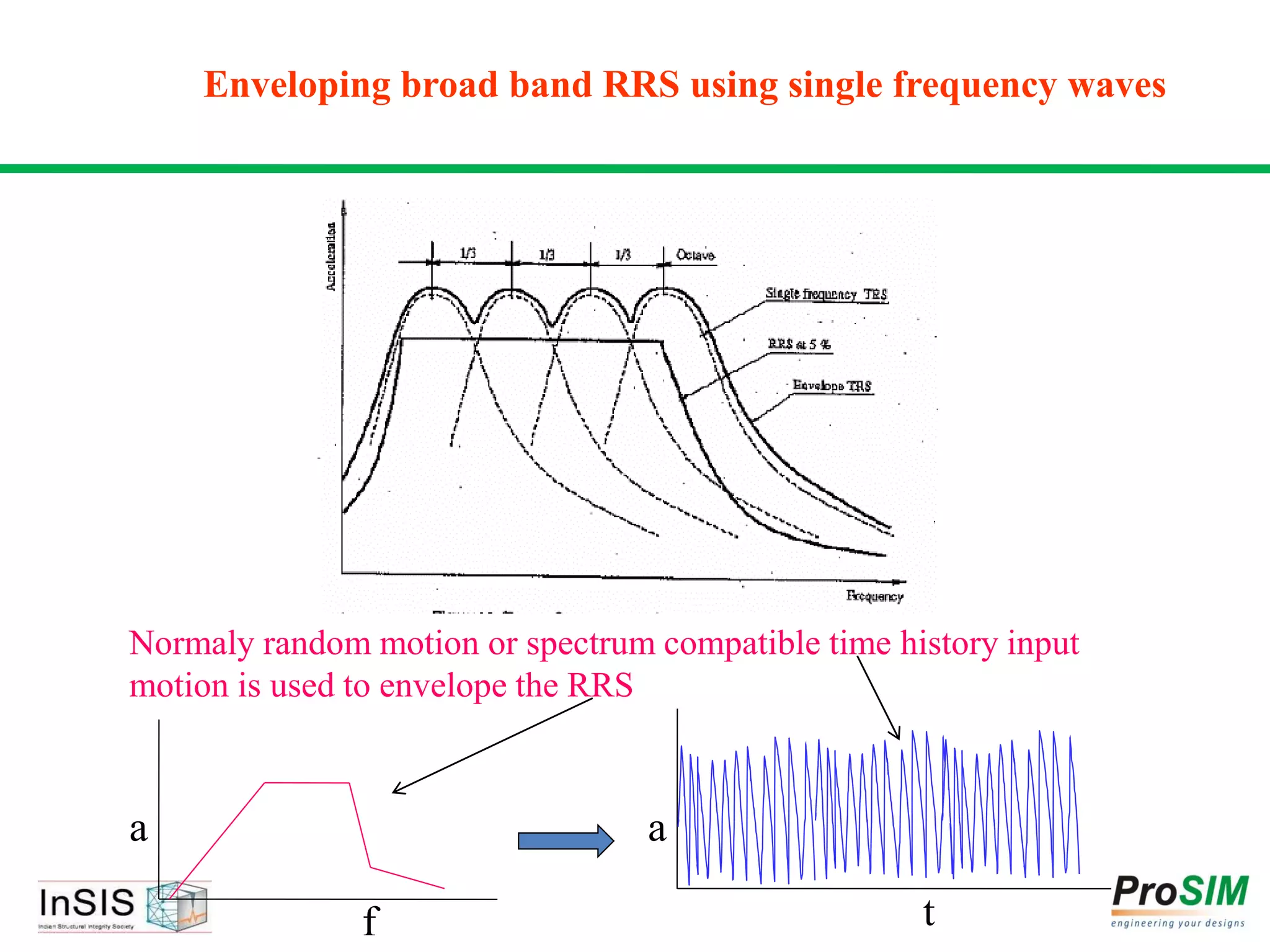
Enveloping broad band RRS using single frequency waves
Normaly random motion or spectrum compatible time history input
motion is used to envelope the RRS
a
f
a
t
Enveloping RRS peak using resonance using single frequency
Test Sequence
a) Pre-test inspection and functional checks
b) Resonance search test
c)Intermediate inspection and functional checks
d)OBE test and functional checks
e)Intermediate inspection and functional checks
f)SSE test and functional checks
g)Post test inspection and functional checks
Inspection [Pre-test, Intermediate]
This inspection as a minimum shall include thorough
visual examination of the equipment to ensure correct
assembly of all the components, proper calibration of
the assembly, proper calibration of test equipment,
security of fasteners, adequacy of power supply and
appropriateness of all control settings etc.
Resonance serch test
• The test shall be performed (along each principal axis)
in the frequency range equal to or greater than that
specified for seismic input motion.
•A continuous sinusoidal uni-axial sweep input at low
level acceleration (0.2 g) with the sweep rate not greater
than 2 octaves per minute. 1 octave / min is used.
• Resonances are determined by mounting accelerometers
at the input location and at those locations where the
structural response is desired.
•This data can be used to decide test axes or input motion
to be used for seismic qualification test or equipment
upgrades.
OBE and SSE Earthquake (SSE) Testing
Seismic test specifications include 5 OBE tests & 1 SSE.
The purpose of multiple OBE testing is to demonstrate
that OBE earthquakes which are most likely to occur
prior to SSE are not detrimental to functional
performance of the equipment.
Functional Checks [Pre, Post, Intermediate]
1. Opening or closing of electrical contacts & timing
2. Opening or closing of valves & timing
3. Various outputs indications on volt meter/ampere
meter etc.
4. Operation of limit switches
5. Actuation of mechanical/electrical operation etc.
6. Any other peculiar function to be performed by
equipment as per the specification of equipment e.g. in
case of valves opening closing time should be monitored.
Post-test Inspection
Upon completion of testing, equipment shall be
dismantled as far as necessary to permit all parts to
be appropriately checked and visually inspected.
The condition of electrical insulation, mechanical
parts, bearings, lubricants, electrical contacts,
wiring, gear drive trains, linkages and other related
constituents shall be recorded.
TEST RESPONSE SPECTRA (TRS)
ACCEPTABILITY
For any waveform employed, the motion of the shake table must
be adjusted so that
• The TRS envelops the RRS over the frequency range of
interest.
• The shake table maximum peak acceleration is at least equal
to ZPA of RRS.
• Waveform has sufficient duration matching with strong
motion part and fatigue inducing potential of the time history.
• The frequency content is within 1 to 33 Hz range only.
• For the comparison of TRS and RRS, the TRS is computed
with a damping value equal to or greater than that of the RRS.
• It is recommended that TRS be computed with 1/6 octave or
narrower band width resolution.
0
0.2
0.4
0.6
0.8
1
1.2
1.4
1.6
1.8
2
0 5 10 15 20 25 30 35 40 45
FREQ
ACC(g)
RB-IS
RRS compatible Time history
Shaketable
Shaketable test using RRS
Test Acceptance Criteria
• Structural failure or deflection which would prevent
intended performance of the equipment is not
acceptable.
• Loss of output signal: for example open or short
circuit;
• Spurious or unwanted output: for example relay
contact bounce exceeding the specified limits (5 m
second);
• Drift of set-point or trip setting greater than the
specified accuracy over the full range;
SEISMIC QUALIFICATION TEST FOR VALVES
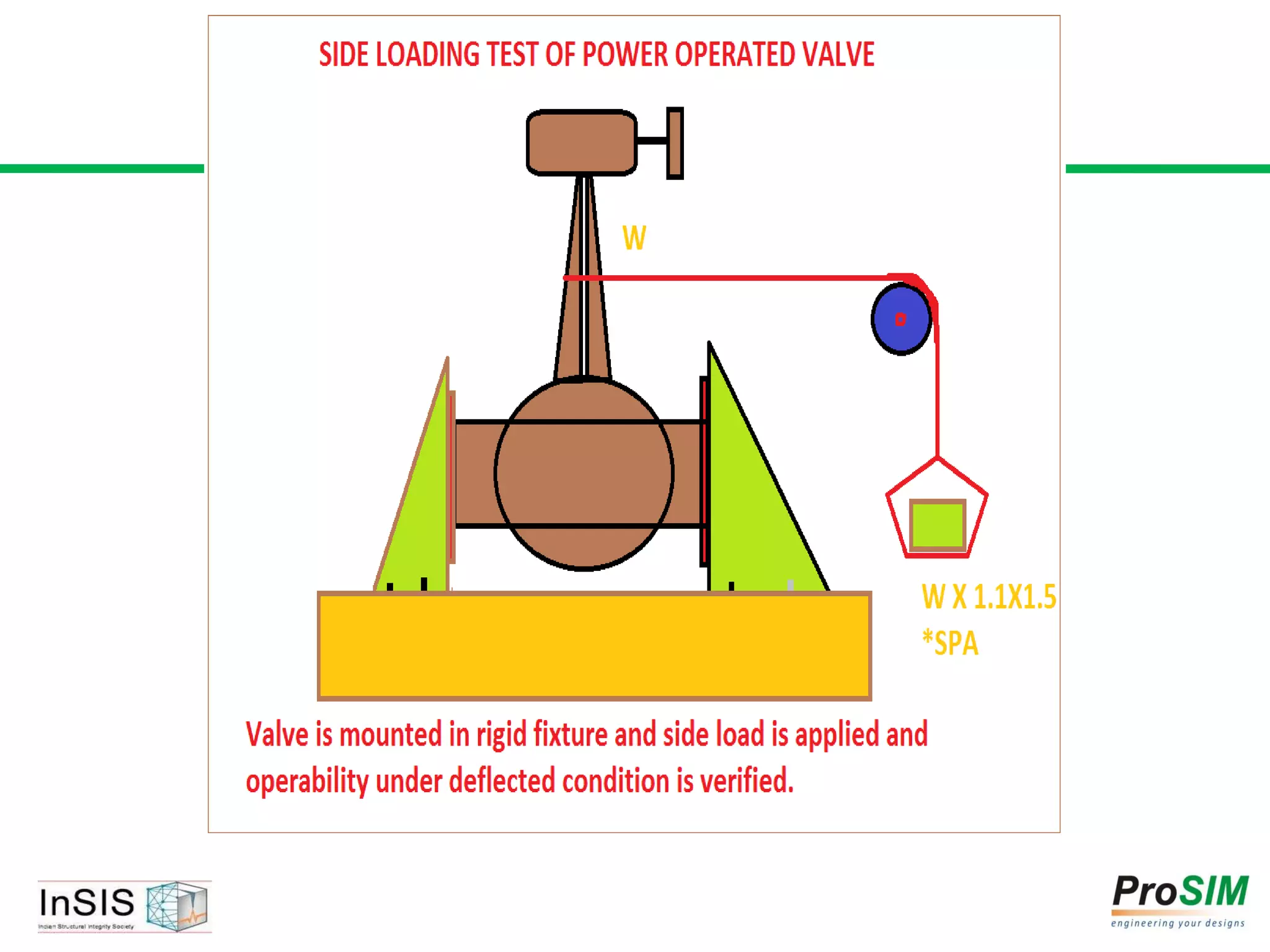
• As per ASME QME 1
• Valve CAN BE TESTED BY SIDE LOAD TEST.
• IN THIS TEST VALVE STEM IS PULLED BY LOAD
EQUIVALENT TO EXTENDED MASS TIMES SEISMIC
ACCELERATION AND COEFFIENT
• COEFFICIENT IS 1.1 FOR RIGID VALVE
• AND 1.65 FOR FLEXIBLE VALVE.
IEEE 382 VALVE ACTUATORS SEISMIC
QUALIFICATION TEST
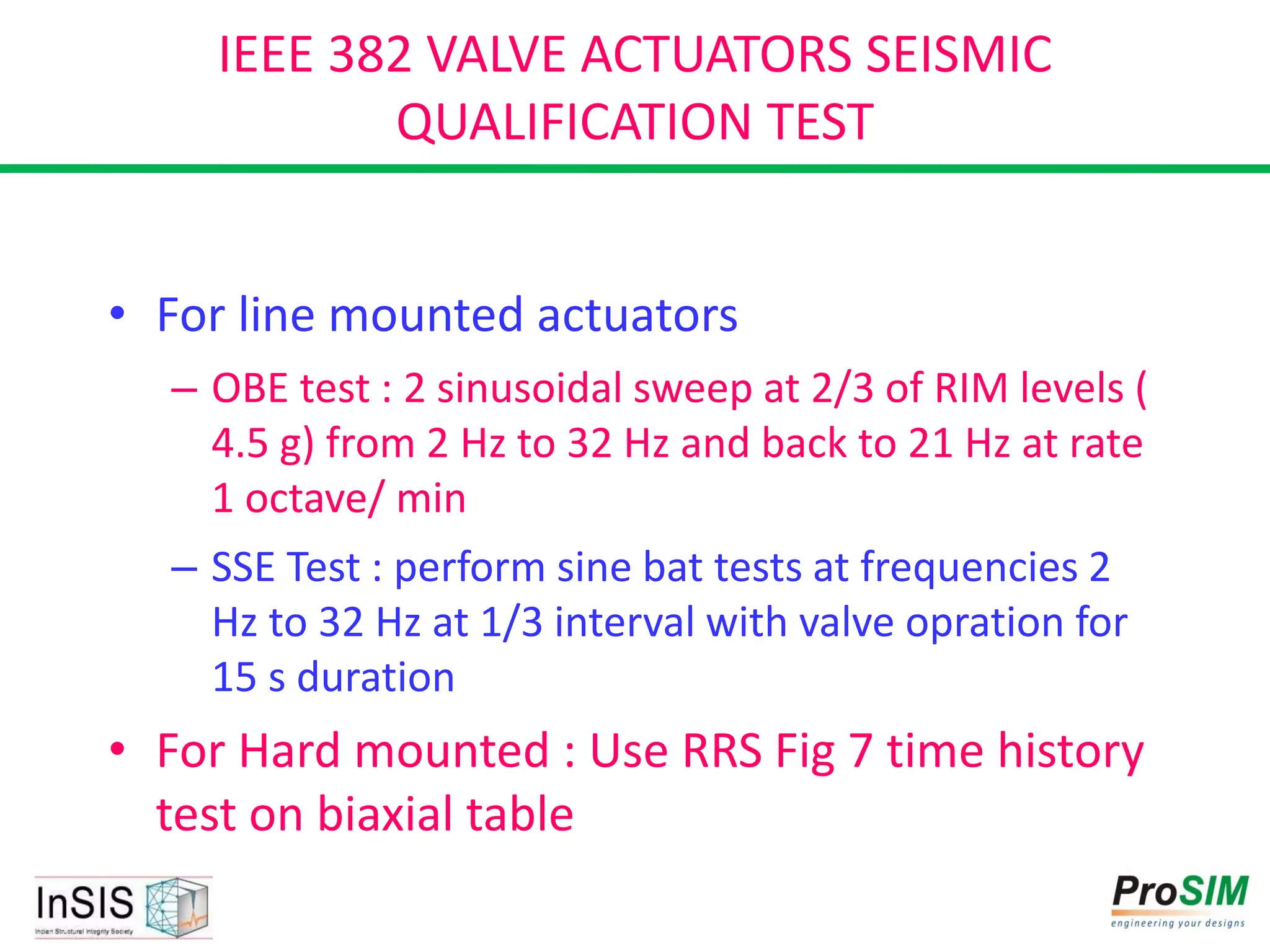
• For line mounted actuators
– OBE test : 2 sinusoidal sweep at 2/3 of RIM levels (
4.5 g) from 2 Hz to 32 Hz and back to 21 Hz at rate
1 octave/ min
– SSE Test : perform sine bat tests at frequencies 2
Hz to 32 Hz at 1/3 interval with valve opration for
15 s duration
• For Hard mounted : Use RRS Fig 7 time history
test on biaxial table
IEEE 501 RELAY TESTING
• Generate fragility response spectrum (FRS) to
envelope standard response respectrum
• Use biaxial table and multifrequency
waveform and increase ZPA in each test.
A= 1 Hz 25 of ZPA
B= 4 Hz 250 of ZPA
C= 16 Hz 250 of ZPA
D= 33 Hz ZPA
A
B C
D
Reports
a) Equipment description: project, name, capacity, application,
mounting elevation etc.
b) Analysis or test methods.
c) Operating loads and load combinations.
e) Stresses and deformations with acceptance criteria:
f) References
g) Validated softwares, frequency, modal participation factors,
missing mass etc.
h) Shaketable, calibration strain gauge, accelerometer etc.
i) Spectra used for test TRS more than RRS
j) Damping used
k) If intermediate damping then calculation shall be as per guide
clause. 2.5.2 etc
l) Uplift calculation if required for civil structures.
Test Report should content
a) Equipment description: project, name, capacity, application, mounting
elevation etc.
b) Approved test procedure.
c) test records functional and inspection reports
d) Video shooting/photo
e) Strain gauge and accelerometer osciloscope records
f) TRS and RRS acceptance
g) frequency, damping in resonance search test etc.
h) Shaketable, calibration strain gauge, accelerometer etc.
i) Spectra used for test TRS more than RRS
j) Any maintainance / repaires carried
k) Test engineers signatures on report
GENERAL GUIDELINES FOR SEISMIC DESIGN
• Keep heavy components at low level
• Keep the CG of SSC as low as possible
• Keep natural frequency away from spectral peak
• Keep pump and motor on common pedstal
• Do not use Anti vibration pads for mounting panels.
• Do not mount devices on unlocked doors.
• Provide seismic lateral and vertical supports for piping, ducts, cable trays etc.
• Keep all equipment properly anchored.
• Avoid hanging, rolling or sliding of SSC.
• Avoid friction grip type connection.
• Avoid spring loaded connection.
• Detialing of connection joints, bracing etc shold be done.
ProSIM R And D Pvt Ltd
Website : www.pro-sim.com
Contact us: enquiry@pro-sim.com
INDIAN STRUCTURAL INTEGREITY SOCIETY
(InSIS)
Website: www.instint.in
Contact us: insisblr@gmail.com

Seismic qualification of equipment by testing-Bhavsar

  • 1.
    INDIAN STRUCTURAL INTEGRITYSOCIETY WORKSHOP 9th – 10th May 2018 AERB Auditorium,Niyamak Bhavan-B Mumbai . Structural Integrity Assessment of Nuclear Energy Assets
  • 2.
    SEISMIC QUALIFICATION OFEQUIPMENT BY TESTING S. D. BHAWSAR Addl. Chief. Engr,(Stress Analysis & Seismology) Nabhkiya Urja Bhavan, NPCIL, MUMBAI
  • 3.
    Contents • Seismic qualificationpurpose & Methods of seismic qualification • Qualification standards/guides • Active Equipment type and safety function • Shaketable types and list of shaketable • Combination of analysis and test • Assembly test and device test • Proof test, generic test and fragility test • Test procedure : mounting, monitoring, simulation of loads, seismic motion : single frequency, multifrequency • Table Input motion : Sinusoidal, sine sweep, time history • Test sequence : Resonance, OBE, SSE • Inspection, functional monitoring, accelerometer , strain gauge mounting, TRS and functional Acceptance criteria • Seismic test on valve : side load test (static equivalent) • Fragility test on relay • Test report contents • Guidelines for design
  • 4.
    SEISMIC QUALIFICATION OFEQUIPMENT SEISMIC QUALIFICATION OF AN EQUIPMENT IS TO DEMONSTRATE THAT EQUIPMENT CAN WITHSTAND THE FORCES GENERATED DURING THE SPECIFIED EARTHQUAKE MOTION AND CAN PERFORM ITS INTENDED SAFETY FUNCTION DURING AND/OR AFTER AN EARTHQUAKE.
  • 5.
    SAFETY FUNCTION • STRUCTURALINTEGRITY • FUNCTIONAL OPERABILITY • COMBINATION OF BOTH – CIVIL STRUCTURE IS REQUIRED TO MAINTAIN STRUCTURAL INTEGRITY (PASSIVE) – VALVES ARE REQUIRED TO MAINTAIN STRUCTURAL INTEGRITY AND FUNCTIONAL OPERABILITY BOTH (ACTIVE) – For Active equipmnt qualification by test is recommended.
  • 6.
    QUALIFICATION METHODS • QUALIFICATIONMETHOD CAN BE SELECTED BASED ON SAFETY FUNCTION REQUIREMENT • ANALYSIS • TESTS • COMBINATION OF ANALYSIS AND TEST • PAST EXPERIENCE
  • 7.
    QUALIFICATION STANDARADS • ASMEQME -1 for qualification of active mechanical equipment used in NPP (pumps & valves) ANSI B16.41 • IEEE 344 Guidelines for seismic qualification of class 1E equipment for NPP • IEEE 382 qualification of valve actuators for power operated valve assemblies • IEEE 501 Seismic testing of relays • IEC 60980 Seismic qualification of class 1E equipment used in NPP
  • 8.
    QUALIFICATION STANDARDS CONTD.. •IEEE 639 Seismic design of substation • ICBO AC 156 Jan 2000 Acceptance criteria for seismic qualification testing of non structural components • ACI 355.2 Evaluating performance of post installed mechanical anchors in concrete • IS 14989/IEC 60898 :2001 Guidelines for seismic qualification of Electrical equipment for NPP • AERB SG D 23
  • 9.
    LIST OF ACTIVEEQUIPMENT • Mechanical • Valves, pumps, compressors etc. • Electrical • Battery bank, battery charger, relay, switchgear etc. • C&I • Control panel, relays, Solenoid valve, meters etc.
  • 10.
    SAFETY FUNCTION OFACTIVE EQUIPMENT •The behavior of active equipment should not disturb the functioning of the system during or after an earthquake i.e. • The equipment should continue to maintain the state of position / operation, if there is no demand for such a change viz no malfunction or • change the state of position / operation whenever demanded, viz, starting or stopping on demand
  • 11.
    Seismic qualification ofactive equipment The equipment/components that have – Close gaps/clearances – complex geometries – uncommon materials making it difficult to model and analyze to determine failure or malfunction are qualified by testing on a shake table or by combination of analysis and test or other justifiable method (past experience) depending on size, complexity and function of equipment.
  • 12.
    Qualification of equipmentby Shake table test 1.The seismic qualification test is conducted by mounting the equipment on a shake table. 2. During the test, the operating conditions/loads of the equipment are simulated adequately viz., Electrical loads,Mechanical loads, Pressure loads which represent the normal functioning of the equipment. 3. While seismic motion is given to the shake table, the equipment is checked for its intended functional operability 4. The Test Response Spectrum (TRS) should envelop the Required Response Spectrum (RRS) defined at the base of the equipment.
  • 13.
    shaketable actuator Uniaxial Table shaketableHorizontal actuator Vertical actuator Biaxial shaketable Triaxialtable Types of Shaketabletable equipment equipment Actuator and table can be rotated to give motion in vertical direction. Equipment can be oriented to give motion in other horizontal direction In triaxial table actuator in other orthogonal horizontal direction is also provided.
  • 14.
    Shake Table Facilitiesavailable in India 1. 80 KG single axis shaketable at ECIL , 0.8 m X 0.8 m 2. 10 ton Tri-axial table at CPRI, Bangalore, 3m X 3m 3. 10 ton Tri-axial table at IGCAR, Kalpakkam,Chennai, 3m X 3m 4. 100 ton Tri-axial table at IGCAR, Kalpakkam,Chennai, 6m X 6m 5. 10 ton Tri-axial table at SERC, Chennai, 3m X 3m 6. 40 ton Tri axial table at SERC, Chennai 4m X 4m 7. 10 Ton 20 ton Bi-axial table at IIT, Roorkee, 3.5m X 3.5m 8. 14 m tall pseudo dynamic test facility at SERC, Chennai 9. 500 Kg uniaxial table 1m X 1m CPRI Banglore 10. 500 kg Uniaxial table FCRI , Pallakkad
  • 15.
    Qualification of Equipmentby combination of Analysis & Testing Many a times it is not possible to test whole assembly in operating condition on a shaketable in such cases combination of analyis and test method can be used. 1. Modal testing by impact hammer test to determine natural frequency and damping and then develop analytical model to determine responses by analysis. 2. Analyse the assembly and determine the response at device level and the test the device by full scale testing. 3. Conduct the tests on small size equipment, validate the models and extrapolate response of similar equipment by analysis.
  • 16.
    GM OR FM FRS1 FRS 2 F A F A FSEC Model Qualification of Equipment by combination of Analysis & Testing A Spectrum compatible time history
  • 17.
    Based on equipmenttype test can be called Devices testing A device (relays, breakers, etc.) is subjected to shake table testing while simulating its functional behaviour.The motion at the base of the device can be obtained by analysis method Assembly testing It is normal to test large complex assemblies by simulating the most critical in service conditions.
  • 18.
    Based on applicationtype, the seismic test can be called as Generic test : for multiple application Valves mounted at various location Proof test: for single location MCRP at one location Fragility test : For limit to failure Relays sensitive to input motion amplitude and frequency.
  • 19.
    Test procedure shouldinclude a) Equipment description b) Mounting and connection arrangment c) Shaketable description d) Resonance search parameters, OBE, SSE response spectra e) Temp, flow, current etc parameters as applicable f) Strain gauges, accelermeters mounting locations g) performance monitoring and acceptance criteria f) Maintenance and repairs allowed during testing. i) Pre, during and post test inspection and functional monitoring scheme and acceptance limits. j) Test sequence k) Documentation of test data/test report Continued
  • 20.
    The equipment tobe tested shall be mounted on the vibration table in a way that it simulates the intended service mounting. The mounting method shall use the specified bolt size, type, torque, configuration, weld pattern and type, etc. Simulation of mounting valve valve
  • 21.
    SIMULATION OF LOADS •Seismicqualification tests on equipment shall be performed with the equipment subjected to normal operating loads. •electrical loads •mechanical loads •thermal loads •pressure etc as applicable.
  • 22.
    •Accelerometers mounted ontable to determine the applied vibration levels. •Accelerometers are also mounted on equipment to determine the response of the equipment along all three orthogonal axes simultaneously •Accelerometers are also mounted at those points where critical devices and displacements are expected. Monitoring input & output vibrations
  • 23.
    Demonstration of FunctionalPerformance functions and functional parameters associated with various devices and sub-devices in the equipment which are to be monitored during shake table test shall be brought out in test specification, •Timing of opening and closing of valves; •leakge rates •Making and breaking of electrical contacts; •Relay position •allowable chattering time •pressure, temperature, voltage, current, humidity, radiation & chemical and other load conditions
  • 24.
    Monitoring of performance •Tomonitor relay chattering PLC may be employed • for opening and closing of valves stop watches etc are provided or recorders are used • Battery output is continuously monitored using osciloscope etc. • strain gauges be mounted to determine the response of the equipment at those points within the structure of the equipment that reflect the equipment response associated with its structural integrity.
  • 25.
    Specifying Seismic Motionat equipment mounting location The seismic motion expected at the place of installation of equipment is given in the form of • Horizontal and vertical directions of Required Response Spectra (RRS) for 5% damping • Calculated / expected acceleration in terms of ‘g’ A F RRS
  • 26.
    •For line mountedequipment like valves or instruments mounted on panels, the maximum acceleration or acceleration time history seen by devices determine analytically or experimentally may be given. •For this IEEE 382 figure 6 required input motion may be used. •Caution is that support of device should be such that amplification of motion does not exceed the acceleration values used for testing. •Sinusoidal input at 1/3 octave intervals is used. Seismic motion for line mounted equipment or devices V f Typ Fig 6 of IEEE 382
  • 27.
    The test facilityshould generate suitable input motion of the shake table so that seismic loads as defined by RRS or acceleration levels at different frequencies as per the expected seismic loading are achieved. •Single or multi axis table may be used •single or multi frequency waves are used •sine wave, sine beat, sine sweep •random motion •time history test •or other waveforms in such a way that earthquake environment is appropriately simulated. Eg Shakers, hammers, eq static test, etc may be employed. SIMULATION OF EARTHQUAKE MOTION
  • 28.
    INPUT WAVEFORMS SINEBEAT & SINE DWELL 1 octave = double of initial frequency 1/6 octave = 1 , 1.12, 1.26, 1.41, 1.58, 1.78, 2= 2^(1/6)
  • 29.
    Enveloping broad bandRRS using single frequency waves Normaly random motion or spectrum compatible time history input motion is used to envelope the RRS a f a t
  • 30.
    Enveloping RRS peakusing resonance using single frequency
  • 31.
    Test Sequence a) Pre-testinspection and functional checks b) Resonance search test c)Intermediate inspection and functional checks d)OBE test and functional checks e)Intermediate inspection and functional checks f)SSE test and functional checks g)Post test inspection and functional checks
  • 32.
    Inspection [Pre-test, Intermediate] Thisinspection as a minimum shall include thorough visual examination of the equipment to ensure correct assembly of all the components, proper calibration of the assembly, proper calibration of test equipment, security of fasteners, adequacy of power supply and appropriateness of all control settings etc.
  • 33.
    Resonance serch test •The test shall be performed (along each principal axis) in the frequency range equal to or greater than that specified for seismic input motion. •A continuous sinusoidal uni-axial sweep input at low level acceleration (0.2 g) with the sweep rate not greater than 2 octaves per minute. 1 octave / min is used. • Resonances are determined by mounting accelerometers at the input location and at those locations where the structural response is desired. •This data can be used to decide test axes or input motion to be used for seismic qualification test or equipment upgrades.
  • 34.
    OBE and SSEEarthquake (SSE) Testing Seismic test specifications include 5 OBE tests & 1 SSE. The purpose of multiple OBE testing is to demonstrate that OBE earthquakes which are most likely to occur prior to SSE are not detrimental to functional performance of the equipment.
  • 35.
    Functional Checks [Pre,Post, Intermediate] 1. Opening or closing of electrical contacts & timing 2. Opening or closing of valves & timing 3. Various outputs indications on volt meter/ampere meter etc. 4. Operation of limit switches 5. Actuation of mechanical/electrical operation etc. 6. Any other peculiar function to be performed by equipment as per the specification of equipment e.g. in case of valves opening closing time should be monitored.
  • 36.
    Post-test Inspection Upon completionof testing, equipment shall be dismantled as far as necessary to permit all parts to be appropriately checked and visually inspected. The condition of electrical insulation, mechanical parts, bearings, lubricants, electrical contacts, wiring, gear drive trains, linkages and other related constituents shall be recorded.
  • 37.
    TEST RESPONSE SPECTRA(TRS) ACCEPTABILITY For any waveform employed, the motion of the shake table must be adjusted so that • The TRS envelops the RRS over the frequency range of interest. • The shake table maximum peak acceleration is at least equal to ZPA of RRS. • Waveform has sufficient duration matching with strong motion part and fatigue inducing potential of the time history. • The frequency content is within 1 to 33 Hz range only. • For the comparison of TRS and RRS, the TRS is computed with a damping value equal to or greater than that of the RRS. • It is recommended that TRS be computed with 1/6 octave or narrower band width resolution.
  • 38.
    0 0.2 0.4 0.6 0.8 1 1.2 1.4 1.6 1.8 2 0 5 1015 20 25 30 35 40 45 FREQ ACC(g) RB-IS RRS compatible Time history Shaketable Shaketable test using RRS
  • 39.
    Test Acceptance Criteria •Structural failure or deflection which would prevent intended performance of the equipment is not acceptable. • Loss of output signal: for example open or short circuit; • Spurious or unwanted output: for example relay contact bounce exceeding the specified limits (5 m second); • Drift of set-point or trip setting greater than the specified accuracy over the full range;
  • 40.
    SEISMIC QUALIFICATION TESTFOR VALVES • As per ASME QME 1 • Valve CAN BE TESTED BY SIDE LOAD TEST. • IN THIS TEST VALVE STEM IS PULLED BY LOAD EQUIVALENT TO EXTENDED MASS TIMES SEISMIC ACCELERATION AND COEFFIENT • COEFFICIENT IS 1.1 FOR RIGID VALVE • AND 1.65 FOR FLEXIBLE VALVE.
  • 42.
    IEEE 382 VALVEACTUATORS SEISMIC QUALIFICATION TEST • For line mounted actuators – OBE test : 2 sinusoidal sweep at 2/3 of RIM levels ( 4.5 g) from 2 Hz to 32 Hz and back to 21 Hz at rate 1 octave/ min – SSE Test : perform sine bat tests at frequencies 2 Hz to 32 Hz at 1/3 interval with valve opration for 15 s duration • For Hard mounted : Use RRS Fig 7 time history test on biaxial table
  • 43.
    IEEE 501 RELAYTESTING • Generate fragility response spectrum (FRS) to envelope standard response respectrum • Use biaxial table and multifrequency waveform and increase ZPA in each test. A= 1 Hz 25 of ZPA B= 4 Hz 250 of ZPA C= 16 Hz 250 of ZPA D= 33 Hz ZPA A B C D
  • 44.
    Reports a) Equipment description:project, name, capacity, application, mounting elevation etc. b) Analysis or test methods. c) Operating loads and load combinations. e) Stresses and deformations with acceptance criteria: f) References g) Validated softwares, frequency, modal participation factors, missing mass etc. h) Shaketable, calibration strain gauge, accelerometer etc. i) Spectra used for test TRS more than RRS j) Damping used k) If intermediate damping then calculation shall be as per guide clause. 2.5.2 etc l) Uplift calculation if required for civil structures.
  • 45.
    Test Report shouldcontent a) Equipment description: project, name, capacity, application, mounting elevation etc. b) Approved test procedure. c) test records functional and inspection reports d) Video shooting/photo e) Strain gauge and accelerometer osciloscope records f) TRS and RRS acceptance g) frequency, damping in resonance search test etc. h) Shaketable, calibration strain gauge, accelerometer etc. i) Spectra used for test TRS more than RRS j) Any maintainance / repaires carried k) Test engineers signatures on report
  • 46.
    GENERAL GUIDELINES FORSEISMIC DESIGN • Keep heavy components at low level • Keep the CG of SSC as low as possible • Keep natural frequency away from spectral peak • Keep pump and motor on common pedstal • Do not use Anti vibration pads for mounting panels. • Do not mount devices on unlocked doors. • Provide seismic lateral and vertical supports for piping, ducts, cable trays etc. • Keep all equipment properly anchored. • Avoid hanging, rolling or sliding of SSC. • Avoid friction grip type connection. • Avoid spring loaded connection. • Detialing of connection joints, bracing etc shold be done.
  • 48.
    ProSIM R AndD Pvt Ltd Website : www.pro-sim.com Contact us: enquiry@pro-sim.com INDIAN STRUCTURAL INTEGREITY SOCIETY (InSIS) Website: www.instint.in Contact us: insisblr@gmail.com