IJRET: International Journal of Research in Engineering and Technology eISSN: 2319-1163 | pISSN: 2321-7308
_______________________________________________________________________________________
Volume: 04 Issue: 06 | June-2015, Available @ http://www.ijret.org 367
SEISMIC POUNDING BETWEEN ADJACENT RC BUILDINGS WITH
AND WITHOUT BASE ISOLATION SYSTEM
Raghunandan M H1
, Suma Devi2
1
Post Graduate student, Structural Engineering, SVCE Bangalore, Karnataka, India
2
Assistant Professor, Civil Engineering, SVCE Bangalore, Karnataka, India
Abstract
Among the possible structural damages during an earthquake, the seismic induced pounding also has been one of the commonly
observed phenomena. This is because the separation gap between many adjacent buildings is inadequate to accommodate the
relative motions, so buildings vibrate out of phase and collides. Despite the fact that the seismic pounding between nearby
structures is considered in the codal procurements, the act of development is still an issue in numerous metropolitan zones where
the structures are built with no adequate partition separation which brings about their pounding. In this study E-Tabs nonlinear
software is used for simulation of adjacent multi-storeyed RC frame buildings of G+14 and G+9 storey, the provisions that may
reduce the effects of pounding like the separation distance, addition of shear walls, lateral bracings and variation in storey height
of the buildings have been considered for analysis. And the responses like storey-displacement and pounding force by considering
both fixed base and base-isolated conditions are arrived.
Keywords: Seismic pounding, RC frame building, Separation distance, Gap elements, Storey-displacement Pounding
force, Fixed-base, Base isolation.
--------------------------------------------------------------------***-----------------------------------------------------------------
1. INTRODUCTION
This seismic pounding causes severe damage to the
structures under earthquakes, owing to their different
dynamic characteristics. During earthquake the building
structures vibrate in out of phase and the separation is not
sufficient to accommodate their relative motions. But this
collision can be avoided by providing safe separation
distance also called as seismic gap; however sometimes
getting the required safe separations is not possible in
metropolitan areas, due to increase in land values and
population [1]. So the buildings may have been constructed
very close to each other and the existing space between
those buildings may not be enough for avoiding the
pounding. Although the seismic pounding between fixed-
base buildings had been studied exclusively for more than
decades, the seismic pounding between base-isolated
buildings had not drawn much attention. Also the past
earthquakes showed us the detrimental effects caused by
seismic pounding on performance of the conventional
buildings with fixed base, which ranges from the local
damage to severe structural failure. But, the consequences of
earthquake induced pounding on the seismically isolated
buildings may be more substantial and those required being
assessed [6]. Thus there is a need for studying the effects of
isolated buildings on pounding as well as of pounding on
base isolated buildings. If the building separation is found to
be inefficient for avoiding the pounding, then there should
be some suitable methods for preventing the structural
pounding between adjacent buildings. This can be achieved
by including superior design procedures for making the
buildings stable against strong ground motions. Since
distance between the buildings cannot be increased in case
of existing buildings and new buildings due to
constructional difficulties, so we have to arrive at an
alternate solution for this problem. This is done by
enhancing the lateral stiffness of one building or both the
buildings by providing the shear walls or lateral bracings in
a way that it will reduce the displacement and can be
accommodated between the available separation distances.
On the other hand if the strength and stiffness of a frame is
not adequate then the frame system may be strengthened by
including load-bearing walls, lateral bracings or shear walls.
Bracings and shear walls are also helpful in preventing the
failure of non-structural components by reducing the
deflection. Shear walls or lateral bracings located at suitable
positions in a building can significantly resist lateral loads
due to earthquake or wind. These may be of RCC, steel or
composite etc. Both lateral bracings and shear walls are used
as effective mitigation strategies. The location of shear walls
in building are selected in such a way, that the distance
between center of mass and center of rigidity is kept as low
as possible in order to reduce the additional forces
developed due to torsion.
1.1 Base Isolation System
The base isolation technology is one of the most innovative
approaches for anti-seismic designing of the structures that
has been widely used from last few years. The term base
isolation in which the word isolation means state of being
separated and the word base is a part that supports beneath
or serves as a foundation for super structure. So we can
understand this concept as the structures which are separated
from their foundation. In other sense, the term seismic
isolation is more accurate in which the structure is being
IJRET: International Journal of Research in Engineering and Technology eISSN: 2319-1163 | pISSN: 2321-7308
_______________________________________________________________________________________
Volume: 04 Issue: 06 | June-2015, Available @ http://www.ijret.org 368
separated from the ill effects of seismic motion [5]. The new
design philosophy on anti-seismic design criteria emerged
aiming for reducing the seismic damages by providing
isolators at the base of the structures. However, in
seismically isolated structures the peak base displacement
increases significantly during earthquake and the structure
can impact on adjacent structures like buildings, retaining
walls, ramps, boundary walls etc. In case of longer buildings
the expansion gaps are provided invariably in order to
accommodate the displacements due to variation in
temperature. For such buildings there are likely chances of
impact at their expansion gap when these two buildings
vibrate out of phase.
1.2 Lead Rubber Bearing (LRB)
This is a type of elastomeric bearing having higher value of
damping which is obtained by arranging a core of lead in the
centre of the bearing, where the energy absorption is
obtained by yielding of the lead, which remains hooped by
the thin layers of low damping natural rubber and alternate
layers of steel plates.
1.3 Gap Elements
Gap element is an element which connects two adjacent
nodes to model the contact and is defined as a link element
in ETABS software, this link element is activated only when
the structures come closer and deactivate when they go far
away and a collision force will be generated when they
come closer. So it is a compression-only element required to
assess the pounding force and to simulate the effect of
pounding.
1.4 Analysis Methods
Equivalent Static Analysis: Seismic analysis of most
structures is still carried out on the assumption that the
lateral force is equivalent to the actual loading. This method
of finding design lateral forces is also known as the static
method or the equivalent lateral force method or the seismic
coefficient method.
Response Spectrum Analysis: This method is also known
as modal method or mode superposition method. In the
response spectrum method, the peak response of a structure
during an earthquake is obtained directly from the
earthquake response spectrum. The responses of different
modes are combined to provide an estimate of total response
of the structure using modal combination methods such as
complete quadratic combinations (CQC), square root of sum
of squares (SRSS), or absolute sum (ABS) method.
Time History Analysis: A time history analysis overcomes
all the disadvantages of a modal response spectrum analysis.
This method requires greater computational efforts for
calculating the response at discrete times. One interesting
advantage of such a procedure is that the relative signs of
response quantities are preserved in the response histories.
This is important when interaction effects are considered
among stress resultants [7].
2. METHODOLOGY
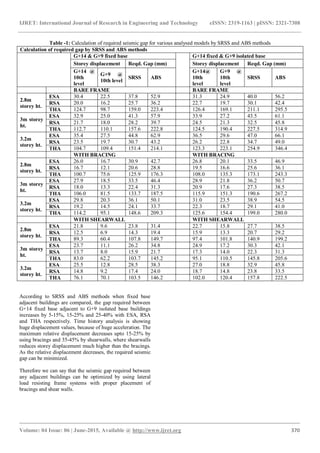
The multi-storeyed RC frame buildings are modelled in
ETABS nonlinear software. The two buildings consist of
G+14 and G+9 special moment resisting frame considered
to be situated in seismic zone V having medium soil and
intended for residential use and separated by an initial gap of
50mm. Both buildings are modelled in E-tabs software, are
subjected to gravity and dynamic loads are analysed by
equivalent static analysis and response spectrum analysis
methods. And to observe pounding, time history analysis is
carried out taking data of Elcentro.
Pounding is considered at slab level of tenth storey, for
observing positive displacement of G+14 storey building
and negative displacement of G+9 storey building. Beams
and column members have been defined as frame elements
and the columns have been restrained in all six degrees of
freedom at the base. Slabs are defined as area elements
having the properties of membrane elements and have been
modelled as rigid diaphragms. Also concrete bracings and
shear walls are defined as frame elements and shell area
elements respectively.
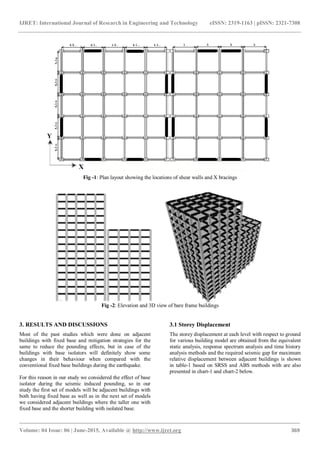
Building 1 and 2 having grade of concrete for beam, slab,
brace and shear wall is M20 and for column is M25, with
unit weight of concrete being 25kN/m3
, Column size for
building 1 and 2 is taken as 0.6 x 1 m, while the beam size is
0.35 x 0.6 m and bracing size of 0.2 x 0.2 m. The slab
thickness of 130 mm and shear wall thickness of 200mm are
taken. Building 1 having G+14 storeys with 5 bays in X and
Y directions, width of bay in X direction is 4.5 m and in Y
direction is 4.5 m. Building 2 having G+9 storeys with 4
bays in X, 5 bays in Y direction, and width of bay in X
direction is 4 m and in Y direction is 5 m.
IJRET: International Journal of Research in Engineering and Technology eISSN: 2319-1163 | pISSN: 2321-7308
_______________________________________________________________________________________
Volume: 04 Issue: 06 | June-2015, Available @ http://www.ijret.org 369
Fig -1: Plan layout showing the locations of shear walls and X bracings
Fig -2: Elevation and 3D view of bare frame buildings
3. RESULTS AND DISCUSSIONS
Most of the past studies which were done on adjacent
buildings with fixed base and mitigation strategies for the
same to reduce the pounding effects, but in case of the
buildings with base isolators will definitely show some
changes in their behaviour when compared with the
conventional fixed base buildings during the earthquake.
For this reason in our study we considered the effect of base
isolator during the seismic induced pounding, so in our
study the first set of models will be adjacent buildings with
both having fixed base as well as in the next set of models
we considered adjacent buildings where the taller one with
fixed base and the shorter building with isolated base.
3.1 Storey Displacement
The storey displacement at each level with respect to ground
for various building model are obtained from the equivalent
static analysis, response spectrum analysis and time history
analysis methods and the required seismic gap for maximum
relative displacement between adjacent buildings is shown
in table-1 based on SRSS and ABS methods with are also
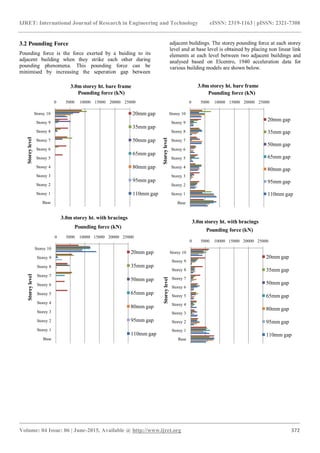
presented in chart-1 and chart-2 below.
IJRET: International Journal of Research in Engineering and Technology eISSN: 2319-1163 | pISSN: 2321-7308
_______________________________________________________________________________________
Volume: 04 Issue: 06 | June-2015, Available @ http://www.ijret.org 370
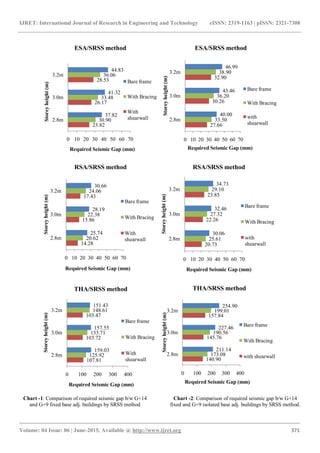
Table -1: Calculation of required seismic gap for various analysed models by SRSS and ABS methods
Calculation of required gap by SRSS and ABS methods
G+14 & G+9 fixed base G+14 fixed & G+9 isolated base
Storey displacement Reqd. Gap (mm) Storey displacement Reqd. Gap (mm)
G+14 @
10th
level
G+9 @
10th level
SRSS ABS
G+14@
10th
level
G+9 @
10th
level
SRSS ABS
BARE FRAME BARE FRAME
2.8m
storey ht.
ESA 30.4 22.5 37.8 52.9 31.3 24.9 40.0 56.2
RSA 20.0 16.2 25.7 36.2 22.7 19.7 30.1 42.4
THA 124.7 98.7 159.0 223.4 126.4 169.1 211.1 295.5
3m storey
ht.
ESA 32.9 25.0 41.3 57.9 33.9 27.2 43.5 61.1
RSA 21.7 18.0 28.2 39.7 24.5 21.3 32.5 45.8
THA 112.7 110.1 157.6 222.8 124.5 190.4 227.5 314.9
3.2m
storey ht.
ESA 35.4 27.5 44.8 62.9 36.5 29.6 47.0 66.1
RSA 23.5 19.7 30.7 43.2 26.2 22.8 34.7 49.0
THA 104.7 109.4 151.4 214.1 123.3 223.1 254.9 346.4
WITH BRACING WITH BRACING
2.8m
storey ht.
ESA 26.0 16.7 30.9 42.7 26.8 20.1 33.5 46.9
RSA 16.7 12.1 20.6 28.8 19.5 16.6 25.6 36.1
THA 100.7 75.6 125.9 176.3 108.0 135.3 173.1 243.3
3m storey
ht.
ESA 27.9 18.5 33.5 46.4 28.9 21.8 36.2 50.7
RSA 18.0 13.3 22.4 31.3 20.9 17.6 27.3 38.5
THA 106.0 81.5 133.7 187.5 115.9 151.3 190.6 267.2
3.2m
storey ht.
ESA 29.8 20.3 36.1 50.1 31.0 23.5 38.9 54.5
RSA 19.2 14.5 24.1 33.7 22.3 18.7 29.1 41.0
THA 114.2 95.1 148.6 209.3 125.6 154.4 199.0 280.0
WITH SHEARWALL WITH SHEARWALL
2.8m
storey ht.
ESA 21.8 9.6 23.8 31.4 22.7 15.8 27.7 38.5
RSA 12.5 6.9 14.3 19.4 15.9 13.3 20.7 29.2
THA 89.3 60.4 107.8 149.7 97.4 101.8 140.9 199.2
3m storey
ht.
ESA 23.7 11.1 26.2 34.8 24.9 17.2 30.3 42.1
RSA 13.7 8.0 15.9 21.7 17.3 14.0 22.3 31.3
THA 83.0 62.2 103.7 145.2 95.1 110.5 145.8 205.6
3.2m
storey ht.
ESA 25.5 12.8 28.5 38.3 27.0 18.8 32.9 45.8
RSA 14.8 9.2 17.4 24.0 18.7 14.8 23.8 33.5
THA 76.1 70.1 103.5 146.2 102.0 120.4 157.8 222.5
According to SRSS and ABS methods when fixed base
adjacent buildings are compared, the gap required between
G+14 fixed base adjacent to G+9 isolated base buildings
increases by 5-15%, 15-25% and 25-40% with ESA, RSA
and THA respectively. Time history analysis is showing
huge displacement values, because of huge acceleration. The
maximum relative displacement decreases upto 15-25% by
using bracings and 35-45% by shearwalls, where shearwalls
reduces storey displacement much higher than the bracings.
As the relative displacement decreases, the required seismic
gap can be minimized.
Therefore we can say that the seismic gap required between
any adjacent buildings can be optimized by using lateral
load resisting frame systems with proper placement of
bracings and shear walls.
IJRET: International Journal of Research in Engineering and Technology eISSN: 2319-1163 | pISSN: 2321-7308
_______________________________________________________________________________________
Volume: 04 Issue: 06 | June-2015, Available @ http://www.ijret.org 371
Chart -1: Comparison of required seismic gap b/w G+14
and G+9 fixed base adj. buildings by SRSS method
Chart -2: Comparison of required seismic gap b/w G+14
fixed and G+9 isolated base adj. buildings by SRSS method.
23.82
26.17
28.53
30.90
33.48
36.06
37.82
41.32
44.83
0 10 20 30 40 50 60 70
2.8m
3.0m
3.2m
Required Seismic Gap (mm)
Storeyheight(m) ESA/SRSS method
Bare frame
With Bracing
With
shearwall
27.66
30.26
32.90
33.50
36.20
38.90
40.00
43.46
46.99
0 10 20 30 40 50 60 70
2.8m
3.0m
3.2m
Required Seismic Gap (mm)
Storeyheight(m)
ESA/SRSS method
Bare frame
With Bracing
with
shearwall
14.28
15.86
17.43
20.62
22.38
24.06
25.74
28.19
30.66
0 10 20 30 40 50 60 70
2.8m
3.0m
3.2m
Required Seismic Gap (mm)
Storeyheight(m)
RSA/SRSS method
Bare frame
With Bracing
With
shearwall
20.73
22.26
23.85
25.61
27.32
29.10
30.06
32.46
34.73
0 10 20 30 40 50 60 70
2.8m
3.0m
3.2m
Required Seismic Gap (mm)
Storeyheight(m)
RSA/SRSS method
Bare frame
With Bracing
with
shearwall
107.81
103.72
103.47
125.92
133.71
148.61
159.03
157.55
151.43
0 100 200 300 400
2.8m
3.0m
3.2m
Required Seismic Gap (mm)
Storeyheight(m)
THA/SRSS method
Bare frame
With Bracing
With
shearwall 140.90
145.76
157.84
173.08
190.56
199.01
211.14
227.46
254.90
0 100 200 300 400
2.8m
3.0m
3.2m
Required Seismic Gap (mm)
Storeyheight(m)
THA/SRSS method
Bare frame
With Bracing
with shearwall
IJRET: International Journal of Research in Engineering and Technology eISSN: 2319-1163 | pISSN: 2321-7308
_______________________________________________________________________________________
Volume: 04 Issue: 06 | June-2015, Available @ http://www.ijret.org 372
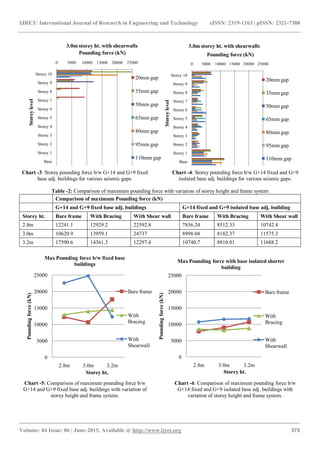
3.2 Pounding Force
Pounding force is the force exerted by a buiding to its
adjacent building when they strike each other during
pounding phenomena. This pounding force can be
minimised by increasing the seperation gap between
adjacent buildings. The storey pounding force at each storey
level and at base level is obtained by placing non linear link
elements at each level between two adjacent buildings and
analysed based on Elcentro, 1940 acceleration data for
various building models are shown below.
0 5000 10000 15000 20000 25000
Storey 10
Storey 9
Storey 8
Storey 7
Storey 6
Storey 5
Storey 4
Storey 3
Storey 2
Storey 1
Base
Pounding force (kN)
Storeylevel
3.0m storey ht. bare frame
20mm gap
35mm gap
50mm gap
65mm gap
80mm gap
95mm gap
110mm gap
0 5000 10000 15000 20000 25000
Storey 10
Storey 9
Storey 8
Storey 7
Storey 6
Storey 5
Storey 4
Storey 3
Storey 2
Storey 1
Base
Pounding force (kN)
Storeylevel
3.0m storey ht. bare frame
20mm gap
35mm gap
50mm gap
65mm gap
80mm gap
95mm gap
110mm gap
0 5000 10000 15000 20000 25000
Storey 10
Storey 9
Storey 8
Storey 7
Storey 6
Storey 5
Storey 4
Storey 3
Storey 2
Storey 1
Base
Pounding force (kN)
Storeylevel
3.0m storey ht. with bracings
20mm gap
35mm gap
50mm gap
65mm gap
80mm gap
95mm gap
110mm gap
0 5000 10000 15000 20000 25000
Storey 10
Storey 9
Storey 8
Storey 7
Storey 6
Storey 5
Storey 4
Storey 3
Storey 2
Storey 1
Base
Pounding force (kN)
Storeylevel
3.0m storey ht. with bracings
20mm gap
35mm gap
50mm gap
65mm gap
80mm gap
95mm gap
110mm gap
IJRET: International Journal of Research in Engineering and Technology eISSN: 2319-1163 | pISSN: 2321-7308
_______________________________________________________________________________________
Volume: 04 Issue: 06 | June-2015, Available @ http://www.ijret.org 373
Chart -3: Storey pounding force b/w G+14 and G+9 fixed
base adj. buildings for various seismic gaps.
Chart -4: Storey pounding force b/w G+14 fixed and G+9
isolated base adj. buildings for various seismic gaps.
Table -2: Comparison of maximum pounding force with variation of storey height and frame system
Comparison of maximum Pounding force (kN)
G+14 and G+9 fixed base adj. buildings G+14 fixed and G+9 isolated base adj. building
Storey ht. Bare frame With Bracing With Shear wall Bare frame With Bracing With Shear wall
2.8m 12241.1 12929.2 22592.8 7856.24 8512.33 10742.4
3.0m 10620.9 13959.1 24737 8998.04 8182.37 11575.3
3.2m 17590.6 14361.3 12297.4 10740.7 8810.81 11688.2
Chart -5: Comparison of maximum pounding force b/w
G+14 and G+9 fixed base adj. buildings with variation of
storey height and frame system.
Chart -6: Comparison of maximum pounding force b/w
G+14 fixed and G+9 isolated base adj. buildings with
variation of storey height and frame system.
0 5000 10000 15000 20000 25000
Storey 10
Storey 9
Storey 8
Storey 7
Storey 6
Storey 5
Storey 4
Storey 3
Storey 2
Storey 1
Base
Pounding force (kN)
Storeylevel
3.0m storey ht. with shearwalls
20mm gap
35mm gap
50mm gap
65mm gap
80mm gap
95mm gap
110mm gap
0 5000 10000 15000 20000 25000
Storey 10
Storey 9
Storey 8
Storey 7
Storey 6
Storey 5
Storey 4
Storey 3
Storey 2
Storey 1
Base
Pounding force (kN)
Storeylevel
3.0m storey ht. with shearwalls
20mm gap
35mm gap
50mm gap
65mm gap
80mm gap
95mm gap
110mm gap
0
5000
10000
15000
20000
25000
2.8m 3.0m 3.2m
Poundingforce(kN)
Max Pounding force b/w fixed base
buildings
Bare frame
With
Bracing
With
Shearwall
Storey ht.
0
5000
10000
15000
20000
25000
2.8m 3.0m 3.2m
Poundingforce(kN)
Max Pounding force with base isolated shorter
building
Bare frame
With
Bracing
With
Shearwall
Storey ht.
IJRET: International Journal of Research in Engineering and Technology eISSN: 2319-1163 | pISSN: 2321-7308
_______________________________________________________________________________________
Volume: 04 Issue: 06 | June-2015, Available @ http://www.ijret.org 374
From the above chart 3 and 4 we can observe that incase of
G+14 and G+9 fixed base adjacent buildings pounding
effect is experienced only at few of the top storeys and the
force non linearly varies and diminishes with increase in
seperation distance. But in case of G+14 fixed adjacent to
G+9 isolated-base building the effect can be seen through
the height of the buildings. Also we see the maximum
pounding force at the top for G+14 and G+9 fixed base
adjacent buildings, where as for G+14 fixed adjacent to G+9
isolated base building the maximum pounding force is at the
base level.
From table-2, chart 5 and 6 we found that both incase of the
G+14 and G+9 fixed base adjacent buildings and G+14
fixed adjacent to G+9 isolated base building the presence of
shearwalls shows maximum pounding force when compared
with bare framed or withbracings. And the bracings in
buildings helps in maintaining the linearity of pounding
force with variation of storey height. Therefore we can say
that the pounding effect between any adjacent buildings can
be optimized by use of bracings and increase in seperation
gap between them.
4. CONCLUSION
4.1 Storey Displacement
 Storey displacement value increases with increase in
the storey height or building height. Use of isolators
induces displacement even at the base level in addition
to increase in top displacement when compared to
fixed base building.
 The gap required between fixed base taller adjacent to
isolated base shorter buildings increases by 5-15%, 15-
25% and 25-40% with ESA, RSA and THA
respectively when compared with fixed base adjacent
buildings.
 The maximum relative displacement decreases by
using bracings and shearwalls. As relative
displacement decreases, the required seismic gap can
be minimized.
4.2 Pounding Force
 In fixed base adjacent buildings pounding effects only
at few of the top storeys, but in case of fixed base taller
adjacent to isolated base shorter building the pounding
effects through the height of the buildings.
 Also the maximum pounding force occurs at the top for
fixed base adjacent buildings, where as for fixed base
taller adjacent to isolated base shorter building the
maximum pounding force will be at the base level.
 The presence of shearwalls shows maximum pounding
force when compared with bare framed or with
bracings. Where as bracings in buildings helps in
maintaining the linearity in pounding force with
variation of storey height.
 Finally the pounding effect between any adjacent
buildings can be optimized by use of bracings and
increase in seperation gap between them.
REFERENCES
[1] Ravindranatha, Tauseef M Honnyal, Shivananda
S.M, H Suresh, “ A Study of Seismic Pounding
between Adjacent Buildings” International Journal of
Research in Engineering and Technology, vol-03,
special issue-03, May-2014, pp.795-799.
[2] Khaja Afroz Jamal, H.S.Vidyadhara, “Seismic
Pounding of Multi-storeyed Buildings”, International
Journal of Research in Engineering and Technology,
IC-RICE conference issue, Nov-2013, pp.12-17.
[3] Shahzad Jamil Sardar, Umesh. N. Karadi, “Effect of
Change in Shear Wall Location on Storey Drift of
Multi-storey Building Subjected to Lateral Loads”,
International Journal of Innovative Research in
Science, Engineering and Technology, vol-2, issue-9,
Sept-2013, pp.4241-4249.
[4] Shirule Pravin Ashok , Niraj Mehta , Rahul Wagh ,
Mayur Padhiyar ,Ankesh Samare & Yogesh Patil,
“Response Spectrum Analysis of Multi Storeyed
Base-Isolated Building”, International Journal of
Civil, Structural, Environmental and Infrastructure
Engineering Research and Development, vol-2, issue
3, Sept 2012, pp.66-75.
[5] A. B. M. Saiful Islam, Mohammed Jameel and Mohd
Zamin Jumaat, “Seismic Isolation in Buildings to be
a Practical Reality: Behavior of Structure and
Installation Technique”, Journal of Engineering and
Technology Research, vol-3, issue-4, April 2011,
pp.99-117.
[6] Panayiotis C. Polycarpou, Petros Komodromos,
“Earthquake-Induced Poundings of a Seismically
Isolated Building with Adjacent Structures”,
Engineering Structures, vol-32, 2010, pp.1937-1951.
[7] S.K. Duggal, “Earthquake Resistant Design of
Structures”, Oxford University Press, 2007.
[8] Susendar Muthukumar and Reginald DesRoches, “A
Hertz contact model with non-linear damping for
pounding simulation”, Earthquake Engineering and
Structural Dynamics, vol-35, Feb-2006, pp.811-828.
[9] C. V. R. Murty, “Earthquake Tips - Learning
Earthquake Design and Construction”, Department of
Civil Engineering, Indian Institute of Technology
Kanpur, Sept-2005.
[10] CSI Analysis Reference Manual for E-tabs,
Computers and Structures, Inc, Berkeley, California,
USA, 2005.
[11] IS 1893 (Part-1):2002, “Indian Standard Criteria for
Earthquake Resistant Design of Structures, General
Provisions and Buildings, (Fifth Revision)”, Bureau
of Indian Standards, New Delhi.
[12] FEMA-273:1997, “NEHRP guidelines for the
seismic rehabilitation of buildings”, Washington DC.
IJRET: International Journal of Research in Engineering and Technology eISSN: 2319-1163 | pISSN: 2321-7308
_______________________________________________________________________________________
Volume: 04 Issue: 06 | June-2015, Available @ http://www.ijret.org 375
BIOGRAPHIES
Raghunandan M H PG student in
Structural Engineering at SVCE,
Bangalore and obtained his B.E. in Civil
Engineering from SJBIT, Bangalore.
Suma Devi obtained her M.E. in
Earthquake Engineering from Bangalore
University and B.Tech in Civil
Engineering from Calicut University.
She has 11 years industrial experience in
residential, commercial, infrastructure
projects & 15 years of academic experience

Seismic pounding between adjacent rc buildings with and without base isolation system

  • 1.
    IJRET: International Journalof Research in Engineering and Technology eISSN: 2319-1163 | pISSN: 2321-7308 _______________________________________________________________________________________ Volume: 04 Issue: 06 | June-2015, Available @ http://www.ijret.org 367 SEISMIC POUNDING BETWEEN ADJACENT RC BUILDINGS WITH AND WITHOUT BASE ISOLATION SYSTEM Raghunandan M H1 , Suma Devi2 1 Post Graduate student, Structural Engineering, SVCE Bangalore, Karnataka, India 2 Assistant Professor, Civil Engineering, SVCE Bangalore, Karnataka, India Abstract Among the possible structural damages during an earthquake, the seismic induced pounding also has been one of the commonly observed phenomena. This is because the separation gap between many adjacent buildings is inadequate to accommodate the relative motions, so buildings vibrate out of phase and collides. Despite the fact that the seismic pounding between nearby structures is considered in the codal procurements, the act of development is still an issue in numerous metropolitan zones where the structures are built with no adequate partition separation which brings about their pounding. In this study E-Tabs nonlinear software is used for simulation of adjacent multi-storeyed RC frame buildings of G+14 and G+9 storey, the provisions that may reduce the effects of pounding like the separation distance, addition of shear walls, lateral bracings and variation in storey height of the buildings have been considered for analysis. And the responses like storey-displacement and pounding force by considering both fixed base and base-isolated conditions are arrived. Keywords: Seismic pounding, RC frame building, Separation distance, Gap elements, Storey-displacement Pounding force, Fixed-base, Base isolation. --------------------------------------------------------------------***----------------------------------------------------------------- 1. INTRODUCTION This seismic pounding causes severe damage to the structures under earthquakes, owing to their different dynamic characteristics. During earthquake the building structures vibrate in out of phase and the separation is not sufficient to accommodate their relative motions. But this collision can be avoided by providing safe separation distance also called as seismic gap; however sometimes getting the required safe separations is not possible in metropolitan areas, due to increase in land values and population [1]. So the buildings may have been constructed very close to each other and the existing space between those buildings may not be enough for avoiding the pounding. Although the seismic pounding between fixed- base buildings had been studied exclusively for more than decades, the seismic pounding between base-isolated buildings had not drawn much attention. Also the past earthquakes showed us the detrimental effects caused by seismic pounding on performance of the conventional buildings with fixed base, which ranges from the local damage to severe structural failure. But, the consequences of earthquake induced pounding on the seismically isolated buildings may be more substantial and those required being assessed [6]. Thus there is a need for studying the effects of isolated buildings on pounding as well as of pounding on base isolated buildings. If the building separation is found to be inefficient for avoiding the pounding, then there should be some suitable methods for preventing the structural pounding between adjacent buildings. This can be achieved by including superior design procedures for making the buildings stable against strong ground motions. Since distance between the buildings cannot be increased in case of existing buildings and new buildings due to constructional difficulties, so we have to arrive at an alternate solution for this problem. This is done by enhancing the lateral stiffness of one building or both the buildings by providing the shear walls or lateral bracings in a way that it will reduce the displacement and can be accommodated between the available separation distances. On the other hand if the strength and stiffness of a frame is not adequate then the frame system may be strengthened by including load-bearing walls, lateral bracings or shear walls. Bracings and shear walls are also helpful in preventing the failure of non-structural components by reducing the deflection. Shear walls or lateral bracings located at suitable positions in a building can significantly resist lateral loads due to earthquake or wind. These may be of RCC, steel or composite etc. Both lateral bracings and shear walls are used as effective mitigation strategies. The location of shear walls in building are selected in such a way, that the distance between center of mass and center of rigidity is kept as low as possible in order to reduce the additional forces developed due to torsion. 1.1 Base Isolation System The base isolation technology is one of the most innovative approaches for anti-seismic designing of the structures that has been widely used from last few years. The term base isolation in which the word isolation means state of being separated and the word base is a part that supports beneath or serves as a foundation for super structure. So we can understand this concept as the structures which are separated from their foundation. In other sense, the term seismic isolation is more accurate in which the structure is being
  • 2.
    IJRET: International Journalof Research in Engineering and Technology eISSN: 2319-1163 | pISSN: 2321-7308 _______________________________________________________________________________________ Volume: 04 Issue: 06 | June-2015, Available @ http://www.ijret.org 368 separated from the ill effects of seismic motion [5]. The new design philosophy on anti-seismic design criteria emerged aiming for reducing the seismic damages by providing isolators at the base of the structures. However, in seismically isolated structures the peak base displacement increases significantly during earthquake and the structure can impact on adjacent structures like buildings, retaining walls, ramps, boundary walls etc. In case of longer buildings the expansion gaps are provided invariably in order to accommodate the displacements due to variation in temperature. For such buildings there are likely chances of impact at their expansion gap when these two buildings vibrate out of phase. 1.2 Lead Rubber Bearing (LRB) This is a type of elastomeric bearing having higher value of damping which is obtained by arranging a core of lead in the centre of the bearing, where the energy absorption is obtained by yielding of the lead, which remains hooped by the thin layers of low damping natural rubber and alternate layers of steel plates. 1.3 Gap Elements Gap element is an element which connects two adjacent nodes to model the contact and is defined as a link element in ETABS software, this link element is activated only when the structures come closer and deactivate when they go far away and a collision force will be generated when they come closer. So it is a compression-only element required to assess the pounding force and to simulate the effect of pounding. 1.4 Analysis Methods Equivalent Static Analysis: Seismic analysis of most structures is still carried out on the assumption that the lateral force is equivalent to the actual loading. This method of finding design lateral forces is also known as the static method or the equivalent lateral force method or the seismic coefficient method. Response Spectrum Analysis: This method is also known as modal method or mode superposition method. In the response spectrum method, the peak response of a structure during an earthquake is obtained directly from the earthquake response spectrum. The responses of different modes are combined to provide an estimate of total response of the structure using modal combination methods such as complete quadratic combinations (CQC), square root of sum of squares (SRSS), or absolute sum (ABS) method. Time History Analysis: A time history analysis overcomes all the disadvantages of a modal response spectrum analysis. This method requires greater computational efforts for calculating the response at discrete times. One interesting advantage of such a procedure is that the relative signs of response quantities are preserved in the response histories. This is important when interaction effects are considered among stress resultants [7]. 2. METHODOLOGY The multi-storeyed RC frame buildings are modelled in ETABS nonlinear software. The two buildings consist of G+14 and G+9 special moment resisting frame considered to be situated in seismic zone V having medium soil and intended for residential use and separated by an initial gap of 50mm. Both buildings are modelled in E-tabs software, are subjected to gravity and dynamic loads are analysed by equivalent static analysis and response spectrum analysis methods. And to observe pounding, time history analysis is carried out taking data of Elcentro. Pounding is considered at slab level of tenth storey, for observing positive displacement of G+14 storey building and negative displacement of G+9 storey building. Beams and column members have been defined as frame elements and the columns have been restrained in all six degrees of freedom at the base. Slabs are defined as area elements having the properties of membrane elements and have been modelled as rigid diaphragms. Also concrete bracings and shear walls are defined as frame elements and shell area elements respectively. Building 1 and 2 having grade of concrete for beam, slab, brace and shear wall is M20 and for column is M25, with unit weight of concrete being 25kN/m3 , Column size for building 1 and 2 is taken as 0.6 x 1 m, while the beam size is 0.35 x 0.6 m and bracing size of 0.2 x 0.2 m. The slab thickness of 130 mm and shear wall thickness of 200mm are taken. Building 1 having G+14 storeys with 5 bays in X and Y directions, width of bay in X direction is 4.5 m and in Y direction is 4.5 m. Building 2 having G+9 storeys with 4 bays in X, 5 bays in Y direction, and width of bay in X direction is 4 m and in Y direction is 5 m.
  • 3.
    IJRET: International Journalof Research in Engineering and Technology eISSN: 2319-1163 | pISSN: 2321-7308 _______________________________________________________________________________________ Volume: 04 Issue: 06 | June-2015, Available @ http://www.ijret.org 369 Fig -1: Plan layout showing the locations of shear walls and X bracings Fig -2: Elevation and 3D view of bare frame buildings 3. RESULTS AND DISCUSSIONS Most of the past studies which were done on adjacent buildings with fixed base and mitigation strategies for the same to reduce the pounding effects, but in case of the buildings with base isolators will definitely show some changes in their behaviour when compared with the conventional fixed base buildings during the earthquake. For this reason in our study we considered the effect of base isolator during the seismic induced pounding, so in our study the first set of models will be adjacent buildings with both having fixed base as well as in the next set of models we considered adjacent buildings where the taller one with fixed base and the shorter building with isolated base. 3.1 Storey Displacement The storey displacement at each level with respect to ground for various building model are obtained from the equivalent static analysis, response spectrum analysis and time history analysis methods and the required seismic gap for maximum relative displacement between adjacent buildings is shown in table-1 based on SRSS and ABS methods with are also presented in chart-1 and chart-2 below.
  • 4.
    IJRET: International Journalof Research in Engineering and Technology eISSN: 2319-1163 | pISSN: 2321-7308 _______________________________________________________________________________________ Volume: 04 Issue: 06 | June-2015, Available @ http://www.ijret.org 370 Table -1: Calculation of required seismic gap for various analysed models by SRSS and ABS methods Calculation of required gap by SRSS and ABS methods G+14 & G+9 fixed base G+14 fixed & G+9 isolated base Storey displacement Reqd. Gap (mm) Storey displacement Reqd. Gap (mm) G+14 @ 10th level G+9 @ 10th level SRSS ABS G+14@ 10th level G+9 @ 10th level SRSS ABS BARE FRAME BARE FRAME 2.8m storey ht. ESA 30.4 22.5 37.8 52.9 31.3 24.9 40.0 56.2 RSA 20.0 16.2 25.7 36.2 22.7 19.7 30.1 42.4 THA 124.7 98.7 159.0 223.4 126.4 169.1 211.1 295.5 3m storey ht. ESA 32.9 25.0 41.3 57.9 33.9 27.2 43.5 61.1 RSA 21.7 18.0 28.2 39.7 24.5 21.3 32.5 45.8 THA 112.7 110.1 157.6 222.8 124.5 190.4 227.5 314.9 3.2m storey ht. ESA 35.4 27.5 44.8 62.9 36.5 29.6 47.0 66.1 RSA 23.5 19.7 30.7 43.2 26.2 22.8 34.7 49.0 THA 104.7 109.4 151.4 214.1 123.3 223.1 254.9 346.4 WITH BRACING WITH BRACING 2.8m storey ht. ESA 26.0 16.7 30.9 42.7 26.8 20.1 33.5 46.9 RSA 16.7 12.1 20.6 28.8 19.5 16.6 25.6 36.1 THA 100.7 75.6 125.9 176.3 108.0 135.3 173.1 243.3 3m storey ht. ESA 27.9 18.5 33.5 46.4 28.9 21.8 36.2 50.7 RSA 18.0 13.3 22.4 31.3 20.9 17.6 27.3 38.5 THA 106.0 81.5 133.7 187.5 115.9 151.3 190.6 267.2 3.2m storey ht. ESA 29.8 20.3 36.1 50.1 31.0 23.5 38.9 54.5 RSA 19.2 14.5 24.1 33.7 22.3 18.7 29.1 41.0 THA 114.2 95.1 148.6 209.3 125.6 154.4 199.0 280.0 WITH SHEARWALL WITH SHEARWALL 2.8m storey ht. ESA 21.8 9.6 23.8 31.4 22.7 15.8 27.7 38.5 RSA 12.5 6.9 14.3 19.4 15.9 13.3 20.7 29.2 THA 89.3 60.4 107.8 149.7 97.4 101.8 140.9 199.2 3m storey ht. ESA 23.7 11.1 26.2 34.8 24.9 17.2 30.3 42.1 RSA 13.7 8.0 15.9 21.7 17.3 14.0 22.3 31.3 THA 83.0 62.2 103.7 145.2 95.1 110.5 145.8 205.6 3.2m storey ht. ESA 25.5 12.8 28.5 38.3 27.0 18.8 32.9 45.8 RSA 14.8 9.2 17.4 24.0 18.7 14.8 23.8 33.5 THA 76.1 70.1 103.5 146.2 102.0 120.4 157.8 222.5 According to SRSS and ABS methods when fixed base adjacent buildings are compared, the gap required between G+14 fixed base adjacent to G+9 isolated base buildings increases by 5-15%, 15-25% and 25-40% with ESA, RSA and THA respectively. Time history analysis is showing huge displacement values, because of huge acceleration. The maximum relative displacement decreases upto 15-25% by using bracings and 35-45% by shearwalls, where shearwalls reduces storey displacement much higher than the bracings. As the relative displacement decreases, the required seismic gap can be minimized. Therefore we can say that the seismic gap required between any adjacent buildings can be optimized by using lateral load resisting frame systems with proper placement of bracings and shear walls.
  • 5.
    IJRET: International Journalof Research in Engineering and Technology eISSN: 2319-1163 | pISSN: 2321-7308 _______________________________________________________________________________________ Volume: 04 Issue: 06 | June-2015, Available @ http://www.ijret.org 371 Chart -1: Comparison of required seismic gap b/w G+14 and G+9 fixed base adj. buildings by SRSS method Chart -2: Comparison of required seismic gap b/w G+14 fixed and G+9 isolated base adj. buildings by SRSS method. 23.82 26.17 28.53 30.90 33.48 36.06 37.82 41.32 44.83 0 10 20 30 40 50 60 70 2.8m 3.0m 3.2m Required Seismic Gap (mm) Storeyheight(m) ESA/SRSS method Bare frame With Bracing With shearwall 27.66 30.26 32.90 33.50 36.20 38.90 40.00 43.46 46.99 0 10 20 30 40 50 60 70 2.8m 3.0m 3.2m Required Seismic Gap (mm) Storeyheight(m) ESA/SRSS method Bare frame With Bracing with shearwall 14.28 15.86 17.43 20.62 22.38 24.06 25.74 28.19 30.66 0 10 20 30 40 50 60 70 2.8m 3.0m 3.2m Required Seismic Gap (mm) Storeyheight(m) RSA/SRSS method Bare frame With Bracing With shearwall 20.73 22.26 23.85 25.61 27.32 29.10 30.06 32.46 34.73 0 10 20 30 40 50 60 70 2.8m 3.0m 3.2m Required Seismic Gap (mm) Storeyheight(m) RSA/SRSS method Bare frame With Bracing with shearwall 107.81 103.72 103.47 125.92 133.71 148.61 159.03 157.55 151.43 0 100 200 300 400 2.8m 3.0m 3.2m Required Seismic Gap (mm) Storeyheight(m) THA/SRSS method Bare frame With Bracing With shearwall 140.90 145.76 157.84 173.08 190.56 199.01 211.14 227.46 254.90 0 100 200 300 400 2.8m 3.0m 3.2m Required Seismic Gap (mm) Storeyheight(m) THA/SRSS method Bare frame With Bracing with shearwall
  • 6.
    IJRET: International Journalof Research in Engineering and Technology eISSN: 2319-1163 | pISSN: 2321-7308 _______________________________________________________________________________________ Volume: 04 Issue: 06 | June-2015, Available @ http://www.ijret.org 372 3.2 Pounding Force Pounding force is the force exerted by a buiding to its adjacent building when they strike each other during pounding phenomena. This pounding force can be minimised by increasing the seperation gap between adjacent buildings. The storey pounding force at each storey level and at base level is obtained by placing non linear link elements at each level between two adjacent buildings and analysed based on Elcentro, 1940 acceleration data for various building models are shown below. 0 5000 10000 15000 20000 25000 Storey 10 Storey 9 Storey 8 Storey 7 Storey 6 Storey 5 Storey 4 Storey 3 Storey 2 Storey 1 Base Pounding force (kN) Storeylevel 3.0m storey ht. bare frame 20mm gap 35mm gap 50mm gap 65mm gap 80mm gap 95mm gap 110mm gap 0 5000 10000 15000 20000 25000 Storey 10 Storey 9 Storey 8 Storey 7 Storey 6 Storey 5 Storey 4 Storey 3 Storey 2 Storey 1 Base Pounding force (kN) Storeylevel 3.0m storey ht. bare frame 20mm gap 35mm gap 50mm gap 65mm gap 80mm gap 95mm gap 110mm gap 0 5000 10000 15000 20000 25000 Storey 10 Storey 9 Storey 8 Storey 7 Storey 6 Storey 5 Storey 4 Storey 3 Storey 2 Storey 1 Base Pounding force (kN) Storeylevel 3.0m storey ht. with bracings 20mm gap 35mm gap 50mm gap 65mm gap 80mm gap 95mm gap 110mm gap 0 5000 10000 15000 20000 25000 Storey 10 Storey 9 Storey 8 Storey 7 Storey 6 Storey 5 Storey 4 Storey 3 Storey 2 Storey 1 Base Pounding force (kN) Storeylevel 3.0m storey ht. with bracings 20mm gap 35mm gap 50mm gap 65mm gap 80mm gap 95mm gap 110mm gap
  • 7.
    IJRET: International Journalof Research in Engineering and Technology eISSN: 2319-1163 | pISSN: 2321-7308 _______________________________________________________________________________________ Volume: 04 Issue: 06 | June-2015, Available @ http://www.ijret.org 373 Chart -3: Storey pounding force b/w G+14 and G+9 fixed base adj. buildings for various seismic gaps. Chart -4: Storey pounding force b/w G+14 fixed and G+9 isolated base adj. buildings for various seismic gaps. Table -2: Comparison of maximum pounding force with variation of storey height and frame system Comparison of maximum Pounding force (kN) G+14 and G+9 fixed base adj. buildings G+14 fixed and G+9 isolated base adj. building Storey ht. Bare frame With Bracing With Shear wall Bare frame With Bracing With Shear wall 2.8m 12241.1 12929.2 22592.8 7856.24 8512.33 10742.4 3.0m 10620.9 13959.1 24737 8998.04 8182.37 11575.3 3.2m 17590.6 14361.3 12297.4 10740.7 8810.81 11688.2 Chart -5: Comparison of maximum pounding force b/w G+14 and G+9 fixed base adj. buildings with variation of storey height and frame system. Chart -6: Comparison of maximum pounding force b/w G+14 fixed and G+9 isolated base adj. buildings with variation of storey height and frame system. 0 5000 10000 15000 20000 25000 Storey 10 Storey 9 Storey 8 Storey 7 Storey 6 Storey 5 Storey 4 Storey 3 Storey 2 Storey 1 Base Pounding force (kN) Storeylevel 3.0m storey ht. with shearwalls 20mm gap 35mm gap 50mm gap 65mm gap 80mm gap 95mm gap 110mm gap 0 5000 10000 15000 20000 25000 Storey 10 Storey 9 Storey 8 Storey 7 Storey 6 Storey 5 Storey 4 Storey 3 Storey 2 Storey 1 Base Pounding force (kN) Storeylevel 3.0m storey ht. with shearwalls 20mm gap 35mm gap 50mm gap 65mm gap 80mm gap 95mm gap 110mm gap 0 5000 10000 15000 20000 25000 2.8m 3.0m 3.2m Poundingforce(kN) Max Pounding force b/w fixed base buildings Bare frame With Bracing With Shearwall Storey ht. 0 5000 10000 15000 20000 25000 2.8m 3.0m 3.2m Poundingforce(kN) Max Pounding force with base isolated shorter building Bare frame With Bracing With Shearwall Storey ht.
  • 8.
    IJRET: International Journalof Research in Engineering and Technology eISSN: 2319-1163 | pISSN: 2321-7308 _______________________________________________________________________________________ Volume: 04 Issue: 06 | June-2015, Available @ http://www.ijret.org 374 From the above chart 3 and 4 we can observe that incase of G+14 and G+9 fixed base adjacent buildings pounding effect is experienced only at few of the top storeys and the force non linearly varies and diminishes with increase in seperation distance. But in case of G+14 fixed adjacent to G+9 isolated-base building the effect can be seen through the height of the buildings. Also we see the maximum pounding force at the top for G+14 and G+9 fixed base adjacent buildings, where as for G+14 fixed adjacent to G+9 isolated base building the maximum pounding force is at the base level. From table-2, chart 5 and 6 we found that both incase of the G+14 and G+9 fixed base adjacent buildings and G+14 fixed adjacent to G+9 isolated base building the presence of shearwalls shows maximum pounding force when compared with bare framed or withbracings. And the bracings in buildings helps in maintaining the linearity of pounding force with variation of storey height. Therefore we can say that the pounding effect between any adjacent buildings can be optimized by use of bracings and increase in seperation gap between them. 4. CONCLUSION 4.1 Storey Displacement  Storey displacement value increases with increase in the storey height or building height. Use of isolators induces displacement even at the base level in addition to increase in top displacement when compared to fixed base building.  The gap required between fixed base taller adjacent to isolated base shorter buildings increases by 5-15%, 15- 25% and 25-40% with ESA, RSA and THA respectively when compared with fixed base adjacent buildings.  The maximum relative displacement decreases by using bracings and shearwalls. As relative displacement decreases, the required seismic gap can be minimized. 4.2 Pounding Force  In fixed base adjacent buildings pounding effects only at few of the top storeys, but in case of fixed base taller adjacent to isolated base shorter building the pounding effects through the height of the buildings.  Also the maximum pounding force occurs at the top for fixed base adjacent buildings, where as for fixed base taller adjacent to isolated base shorter building the maximum pounding force will be at the base level.  The presence of shearwalls shows maximum pounding force when compared with bare framed or with bracings. Where as bracings in buildings helps in maintaining the linearity in pounding force with variation of storey height.  Finally the pounding effect between any adjacent buildings can be optimized by use of bracings and increase in seperation gap between them. REFERENCES [1] Ravindranatha, Tauseef M Honnyal, Shivananda S.M, H Suresh, “ A Study of Seismic Pounding between Adjacent Buildings” International Journal of Research in Engineering and Technology, vol-03, special issue-03, May-2014, pp.795-799. [2] Khaja Afroz Jamal, H.S.Vidyadhara, “Seismic Pounding of Multi-storeyed Buildings”, International Journal of Research in Engineering and Technology, IC-RICE conference issue, Nov-2013, pp.12-17. [3] Shahzad Jamil Sardar, Umesh. N. Karadi, “Effect of Change in Shear Wall Location on Storey Drift of Multi-storey Building Subjected to Lateral Loads”, International Journal of Innovative Research in Science, Engineering and Technology, vol-2, issue-9, Sept-2013, pp.4241-4249. [4] Shirule Pravin Ashok , Niraj Mehta , Rahul Wagh , Mayur Padhiyar ,Ankesh Samare & Yogesh Patil, “Response Spectrum Analysis of Multi Storeyed Base-Isolated Building”, International Journal of Civil, Structural, Environmental and Infrastructure Engineering Research and Development, vol-2, issue 3, Sept 2012, pp.66-75. [5] A. B. M. Saiful Islam, Mohammed Jameel and Mohd Zamin Jumaat, “Seismic Isolation in Buildings to be a Practical Reality: Behavior of Structure and Installation Technique”, Journal of Engineering and Technology Research, vol-3, issue-4, April 2011, pp.99-117. [6] Panayiotis C. Polycarpou, Petros Komodromos, “Earthquake-Induced Poundings of a Seismically Isolated Building with Adjacent Structures”, Engineering Structures, vol-32, 2010, pp.1937-1951. [7] S.K. Duggal, “Earthquake Resistant Design of Structures”, Oxford University Press, 2007. [8] Susendar Muthukumar and Reginald DesRoches, “A Hertz contact model with non-linear damping for pounding simulation”, Earthquake Engineering and Structural Dynamics, vol-35, Feb-2006, pp.811-828. [9] C. V. R. Murty, “Earthquake Tips - Learning Earthquake Design and Construction”, Department of Civil Engineering, Indian Institute of Technology Kanpur, Sept-2005. [10] CSI Analysis Reference Manual for E-tabs, Computers and Structures, Inc, Berkeley, California, USA, 2005. [11] IS 1893 (Part-1):2002, “Indian Standard Criteria for Earthquake Resistant Design of Structures, General Provisions and Buildings, (Fifth Revision)”, Bureau of Indian Standards, New Delhi. [12] FEMA-273:1997, “NEHRP guidelines for the seismic rehabilitation of buildings”, Washington DC.
  • 9.
    IJRET: International Journalof Research in Engineering and Technology eISSN: 2319-1163 | pISSN: 2321-7308 _______________________________________________________________________________________ Volume: 04 Issue: 06 | June-2015, Available @ http://www.ijret.org 375 BIOGRAPHIES Raghunandan M H PG student in Structural Engineering at SVCE, Bangalore and obtained his B.E. in Civil Engineering from SJBIT, Bangalore. Suma Devi obtained her M.E. in Earthquake Engineering from Bangalore University and B.Tech in Civil Engineering from Calicut University. She has 11 years industrial experience in residential, commercial, infrastructure projects & 15 years of academic experience