SEIL: Student engagement with information literacy Lyn Parker,  Academic Services Development Librarian
Outline CILASS and Library involvement Inquiry-based learning and IL Library toolkit Individual CILASS projects  Evaluation and feedback Reflection
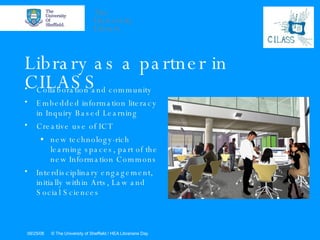
Library as a partner in CILASS Collaboration and community  Embedded information literacy in Inquiry Based Learning  Creative use of ICT  new technology-rich learning spaces, part of the new Information Commons  Interdisciplinary engagement, initially within Arts, Law and Social Sciences
Inquiry-based Learning "Modelling the process of research within the student learning experience" IBL can be used as the design principle for whole modules or programmes, teaching strategies will be designed to support the inquiry process.  The stimulus for an inquiry could, be an intriguing fieldwork problem, a complex `real-life´ case-study, or an interesting research question Inquiry is an active, self-directed, questioning and critical approach to developing knowledge
Embedding IL in the curriculum How? Use of the Library’s information skills tutorials Extra support for literature searching Additional tutorials to teach information literacy in the context of specific assignments Explicit Learning Outcomes and Assessment strategies
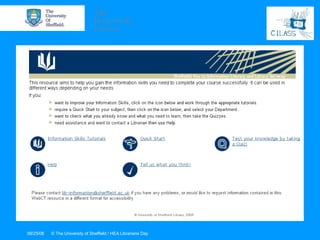
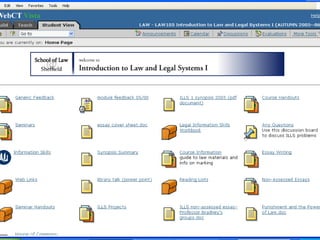
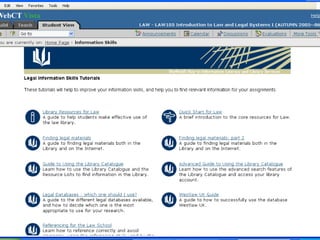
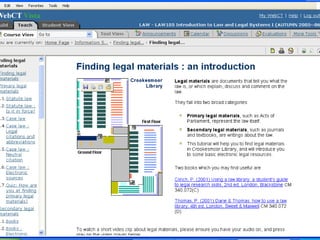
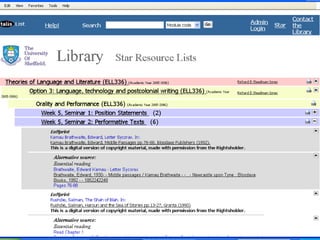
Library Toolkit Resource Lists ( TalisList ) Pro-active dialogue re: availability Course packs Digitisation of key readings ( Eoffprints ) Information Skills Resource (WebCT  Vista ) Additional information literacy sessions and workshops


IL Projects: Philosophy Compulsory completion of “Guide to the Library catalogue” and “Effective searching on the Internet” Students to attend one hour “Advanced Google skills” seminar LDRA associate to train the trainers Use annotated bibliographies Will be seeking to adapt Information skills resource for Philosophy
Information literacy audit Information Studies, Human Communication Sciences and Economics Interviews/questionnaire with all module leaders Map their practice onto the SCONUL “seven pillars” model Identify areas in programmes where IL skills development should be enhanced
Information Literacy Network – Engaging academics Partnership between CILASS, Library and DIS Electronic community – IBL Blog  http://cilass.group.shef.ac.uk/ IL Resources, including online resource list Workshops on developing LTA strategies  Learning Through Enquiry Alliance conference: workshop on IL and IBL – 29 th  June 2006
Feedback on work to date “ We strongly welcome the close collaboration… with colleagues in Library Services.” (Politics) “…  continue this important dialogue with the library team and … endeavour to ensure that more credit goes to them.” (English Literature) “…  the real differences will be seen in Levels 2 and 3 of this year's entry.”(Politics) “…  a marked improvement in these areas, when compared to other cohorts. And they enjoyed using the resource.” (ScHaRR)
What have we learnt to date? Embedding information literacy into the curriculum Strategic approach – top down, bottom up? Project money helps! Jargon can get in the way Collaboration/Partnership not ‘support service’
Questions? Contact details: Lyn Parker,  [email_address] Pam McKinney,  [email_address] Clare Scott,  [email_address]

SEIL: Student engagement with information literacy

  • 1.
    SEIL: Student engagementwith information literacy Lyn Parker, Academic Services Development Librarian
  • 2.
    Outline CILASS andLibrary involvement Inquiry-based learning and IL Library toolkit Individual CILASS projects Evaluation and feedback Reflection
  • 3.
    Library as apartner in CILASS Collaboration and community Embedded information literacy in Inquiry Based Learning Creative use of ICT new technology-rich learning spaces, part of the new Information Commons Interdisciplinary engagement, initially within Arts, Law and Social Sciences
  • 4.
    Inquiry-based Learning "Modellingthe process of research within the student learning experience" IBL can be used as the design principle for whole modules or programmes, teaching strategies will be designed to support the inquiry process. The stimulus for an inquiry could, be an intriguing fieldwork problem, a complex `real-life´ case-study, or an interesting research question Inquiry is an active, self-directed, questioning and critical approach to developing knowledge
  • 5.
    Embedding IL inthe curriculum How? Use of the Library’s information skills tutorials Extra support for literature searching Additional tutorials to teach information literacy in the context of specific assignments Explicit Learning Outcomes and Assessment strategies
  • 6.
    Library Toolkit ResourceLists ( TalisList ) Pro-active dialogue re: availability Course packs Digitisation of key readings ( Eoffprints ) Information Skills Resource (WebCT Vista ) Additional information literacy sessions and workshops
  • 7.
  • 8.
  • 9.
  • 10.
  • 11.
  • 12.
    IL Projects: PhilosophyCompulsory completion of “Guide to the Library catalogue” and “Effective searching on the Internet” Students to attend one hour “Advanced Google skills” seminar LDRA associate to train the trainers Use annotated bibliographies Will be seeking to adapt Information skills resource for Philosophy
  • 13.
    Information literacy auditInformation Studies, Human Communication Sciences and Economics Interviews/questionnaire with all module leaders Map their practice onto the SCONUL “seven pillars” model Identify areas in programmes where IL skills development should be enhanced
  • 14.
    Information Literacy Network– Engaging academics Partnership between CILASS, Library and DIS Electronic community – IBL Blog http://cilass.group.shef.ac.uk/ IL Resources, including online resource list Workshops on developing LTA strategies Learning Through Enquiry Alliance conference: workshop on IL and IBL – 29 th June 2006
  • 15.
    Feedback on workto date “ We strongly welcome the close collaboration… with colleagues in Library Services.” (Politics) “… continue this important dialogue with the library team and … endeavour to ensure that more credit goes to them.” (English Literature) “… the real differences will be seen in Levels 2 and 3 of this year's entry.”(Politics) “… a marked improvement in these areas, when compared to other cohorts. And they enjoyed using the resource.” (ScHaRR)
  • 16.
    What have welearnt to date? Embedding information literacy into the curriculum Strategic approach – top down, bottom up? Project money helps! Jargon can get in the way Collaboration/Partnership not ‘support service’
  • 17.
    Questions? Contact details:Lyn Parker, [email_address] Pam McKinney, [email_address] Clare Scott, [email_address]

Editor's Notes

  • #2 Academic Services Development Librarian. Work on new developments to support learning, teaching and research. Particularly been concentrating on supporting students in becoming information literate. SEIL – student engagement with information literacy is the University Library project funded through CILASS …