Strategy and implementation
plan to create a 21st Century
Academic Library
Dr Heila Pienaar
CV: https://www.slideshare.net/heila1/dr-heila-Pienaar-cvfeb2019
Content
• Background
• Creativity and innovation
• Strategic management
• Examples of strategic frameworks
• Trends: identification, analysis, synthesis
• Strategy @ UP Library
• Essentials for formulating and implementing a strategy
Creativity and innovation
• Organisation creativity: the generation of new ideas, products and
services
• Organisational innovation: the implementation of new ideas,
products and services
• Four types of organisations: creative, creative and innovative,
imitative and innovative, conservative
• University libraries can be seen as imitative and innovative or
conservative
• Best organisation structure for creativity: adhocracy and a high
tolerance for ambiguity
• Best organisation structure for innovation: more structured with a
focus on timelines, goals etc. Pienaar, H., Boshoff, A.B. 1996. Relationship between creativity and innovation
in university libraries and the organizational climate. South African Journal of Library and Information Science, June 1996, 64(2):67-75.
Also available on Researchgate.
Strategic management
‘Strategic management is the set of actions used to
formulate and implement specific strategies that will
achieve a competitively superior fit between the
organisation and its environment, so as to achieve
organisational goals’ created at http://www.b2bwhiteboard.com
https://www.youtube.com/watch?v=ExiF7SeIOas
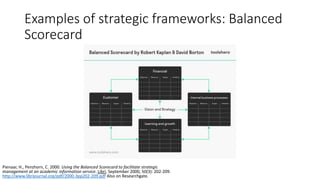
Examples of strategic frameworks: Balanced
Scorecard
Pienaar, H., Penzhorn, C. 2000. Using the Balanced Scorecard to facilitate strategic
management at an academic information service. Libri, September 2000, 50(3): 202-209.
http://www.librijournal.org/pdf/2000-3pp202-209.pdf Also on Researchgate.
Examples of strategic frameworks: Blue Oceans
• The metaphor of red and blue oceans describes the market universe.
• Red oceans represent all the industries in existence today – the known
market space. In the red oceans, industry boundaries are defined and
accepted, and the competitive rules of the game are known. Here
companies try to outperform their rivals to grab a greater share of product
or service demand. As the market space gets crowded, prospects for profits
and growth are reduced. Products become commodities or niche, and
cutthroat competition turns the ocean bloody; hence, the term "red
oceans".[9]
• Blue oceans, in contrast, denote all the industries not in existence today –
the unknown market space, untainted by competition. In blue oceans,
demand is created rather than fought over. There is ample opportunity for
growth that is both profitable and rapid. In blue oceans, competition is
irrelevant because the rules of the game are waiting to be set. Blue ocean
is an analogy to describe the wider, deeper potential of market space that
is not yet explored.[9]
• Wikipedia
Trends: identification, analysis, synthesis
• See example of trend identification, analysis and synthesis:
https://www.slideshare.net/heila1/trends-analysis2015-136775692
• Examples of current trends:
• 4th Industrial Revolution (4IR): augmented reality (AR), Blockchain, Chatbot,
Internet of Things (IoT), Machine learning, Robotics, Smart manufacturing,
Smart cities, Biotechnology
• Research: Open science / research, e-Research, VRE’s/science
gateways/virtual labs, RDM
• Teaching and Learning: e-Learning, Flipped classroom, Maker education,
Adaptive technologies
• Library and information profession: Embedded librarian, Data librarian,
Research librarian, Teaching and Learning librarian
Department of
Library Services
Strategic plan: 2017-2019
Unlocking the information
environment for our clients’ success
Strategic plan: 2017-2019
Department of Library Services:
Mandate, Vision & Intent
• Mandate: To be responsible for the
management of academic information and
knowledge, and for leading the University in
information innovation.
• Vision: To be a research library which is
internationally recognised for redefining
academic librarianship.
• Benevolent intent: Unlocking the information
environment for our clients’ success.
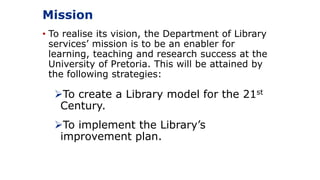
Mission
• To realise its vision, the Department of Library
services’ mission is to be an enabler for
learning, teaching and research success at the
University of Pretoria. This will be attained by
the following strategies:
To create a Library model for the 21st
Century.
To implement the Library’s
improvement plan.
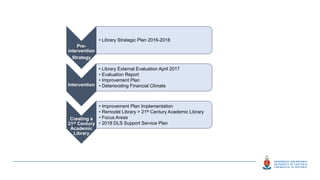
Pre-
intervention
Strategy
• Library Strategic Plan 2016-2018
Intervention
• Library External Evaluation April 2017
• Evaluation Report
• Improvement Plan
• Deteriorating Financial Climate
Creating a
21st Century
Academic
Library
• Improvement Plan Implementation
• Remodel Library > 21st Century Academic Library
• Focus Areas
• 2018 DLS Support Service Plan
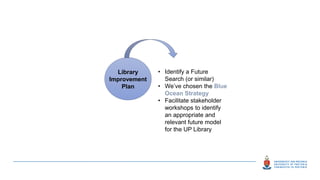
Library
Improvement
Plan
• Identify a Future
Search (or similar)
• We’ve chosen the Blue
Ocean Strategy
• Facilitate stakeholder
workshops to identify
an appropriate and
relevant future model
for the UP Library
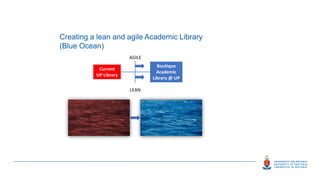
Current
UP Library
Boutique
Academic
Library @ UP
AGILE
LEAN
Creating a lean and agile Academic Library
(Blue Ocean)
Digital
Scholarship
Centre
Spaces
Teaching &
Learning
enablement
Driver & Project
Leader: Gerda
Driver & Project
Leader: Isak
Driver & Project
Leader: Julene
Driver & Project
Leader: Sean
Driver & Project
Leader: Johann
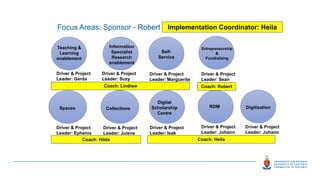
Focus Areas: Sponsor - Robert
Information
Specialist
Research
enablement
Driver & Project
Leader: Suzy
RDM
Driver & Project
Leader: Ephenia
Collections
Driver & Project
Leader: Marguerite
Self-
Service
Coach: Lindiwe Coach: Robert
Coach: Hilda Coach: Heila
Entrepreneurship
&
Fundraising
Digitisation
Driver & Project
Leader: Johann
Implementation Coordinator: Heila
Product /
Service
Implementation
activities / process
Resources Date of
implemen
tation
Team
members
Relationship
with other
focus areas /
role players
Enhanced
research
roadmap
(DRI)
-Invite DRI to give
their input
Lindiwe
Isak
Heila
End Aug? Current
research IS
Digital
Scholarship
RDM
Research IS
gap analysis
Gap analysis IS
Lindiwe
End Aug? Ibid Relevant
focus areas
e.g. RDM
Focus area / strategic project: IS research enablement
Driver / Project leader: Suzy Nyakala
Coaches: Heila & Lindiwe
Strategic / Conceptual framework: To integrate research IS into the research process of
their clients
Strategies Focused Actions & Timeframe
Responsible
Drivers
Measurement
Improvement plan (long-
term): Create Library
model for 21st Century
(End 2019)
• Create specialised units for Research;
Teaching & Learning.
Suzy
Coach: Lindiwe
• Create Digital Scholarship Centre. Isak
Coach: Heila
• Create research, learning, innovative and
collaborative spaces, including off-site
storage (Hilda) & Merensky 1 (Robert).
Ephenia
Coach: Hilda
• Create digital self-services. Marguerite
Coach: Lindiwe
• Create entrepreneurship and fundraising
abilities.
Sean
Coach: Robert
Improvement plan
(medium to short-term -
End 2018)
• Organise regular strategic meetings
about collaborative projects with
Faculties and relevant support services.
Robert
• Support the FLY@UP project. Lindiwe
• Support the FLYHIGHER@UP project. Lindiwe
• Implement RDM. Johann & Heila
• Staff alignment: -Implement plan for
transitioning to technology; Prepare staff
who are receptive to new technologies;
Hilda
Essentials for formulating and implementing a strategy
Trends
Strategic
framework?
Mandate: Vision, Mission, Benevolent intent
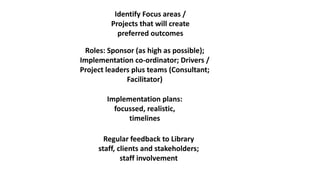
Identify Focus areas /
Projects that will create
preferred outcomes
Roles: Sponsor (as high as possible);
Implementation co-ordinator; Drivers /
Project leaders plus teams (Consultant;
Facilitator)
Implementation plans:
focussed, realistic,
timelines
Regular feedback to Library
staff, clients and stakeholders;
staff involvement
“ If you don’t know where you’re going, any
road will take you there” is a paraphrase of
an exchange between Alice and the Cheshire
Cat in Lewis Carroll's Alice’s Adventures in
Wonderland: “Would you tell me please,
which way I ought to go from here?”

Strategy and implementation plan to create a 21st Century Academic Library

  • 1.
    Strategy and implementation planto create a 21st Century Academic Library Dr Heila Pienaar CV: https://www.slideshare.net/heila1/dr-heila-Pienaar-cvfeb2019
  • 2.
    Content • Background • Creativityand innovation • Strategic management • Examples of strategic frameworks • Trends: identification, analysis, synthesis • Strategy @ UP Library • Essentials for formulating and implementing a strategy
  • 3.
    Creativity and innovation •Organisation creativity: the generation of new ideas, products and services • Organisational innovation: the implementation of new ideas, products and services • Four types of organisations: creative, creative and innovative, imitative and innovative, conservative • University libraries can be seen as imitative and innovative or conservative • Best organisation structure for creativity: adhocracy and a high tolerance for ambiguity • Best organisation structure for innovation: more structured with a focus on timelines, goals etc. Pienaar, H., Boshoff, A.B. 1996. Relationship between creativity and innovation in university libraries and the organizational climate. South African Journal of Library and Information Science, June 1996, 64(2):67-75. Also available on Researchgate.
  • 4.
    Strategic management ‘Strategic managementis the set of actions used to formulate and implement specific strategies that will achieve a competitively superior fit between the organisation and its environment, so as to achieve organisational goals’ created at http://www.b2bwhiteboard.com
  • 5.
  • 6.
    Examples of strategicframeworks: Balanced Scorecard Pienaar, H., Penzhorn, C. 2000. Using the Balanced Scorecard to facilitate strategic management at an academic information service. Libri, September 2000, 50(3): 202-209. http://www.librijournal.org/pdf/2000-3pp202-209.pdf Also on Researchgate.
  • 7.
    Examples of strategicframeworks: Blue Oceans • The metaphor of red and blue oceans describes the market universe. • Red oceans represent all the industries in existence today – the known market space. In the red oceans, industry boundaries are defined and accepted, and the competitive rules of the game are known. Here companies try to outperform their rivals to grab a greater share of product or service demand. As the market space gets crowded, prospects for profits and growth are reduced. Products become commodities or niche, and cutthroat competition turns the ocean bloody; hence, the term "red oceans".[9] • Blue oceans, in contrast, denote all the industries not in existence today – the unknown market space, untainted by competition. In blue oceans, demand is created rather than fought over. There is ample opportunity for growth that is both profitable and rapid. In blue oceans, competition is irrelevant because the rules of the game are waiting to be set. Blue ocean is an analogy to describe the wider, deeper potential of market space that is not yet explored.[9] • Wikipedia
  • 9.
    Trends: identification, analysis,synthesis • See example of trend identification, analysis and synthesis: https://www.slideshare.net/heila1/trends-analysis2015-136775692 • Examples of current trends: • 4th Industrial Revolution (4IR): augmented reality (AR), Blockchain, Chatbot, Internet of Things (IoT), Machine learning, Robotics, Smart manufacturing, Smart cities, Biotechnology • Research: Open science / research, e-Research, VRE’s/science gateways/virtual labs, RDM • Teaching and Learning: e-Learning, Flipped classroom, Maker education, Adaptive technologies • Library and information profession: Embedded librarian, Data librarian, Research librarian, Teaching and Learning librarian
  • 10.
    Department of Library Services Strategicplan: 2017-2019 Unlocking the information environment for our clients’ success Strategic plan: 2017-2019
  • 11.
    Department of LibraryServices: Mandate, Vision & Intent • Mandate: To be responsible for the management of academic information and knowledge, and for leading the University in information innovation. • Vision: To be a research library which is internationally recognised for redefining academic librarianship. • Benevolent intent: Unlocking the information environment for our clients’ success.
  • 12.
    Mission • To realiseits vision, the Department of Library services’ mission is to be an enabler for learning, teaching and research success at the University of Pretoria. This will be attained by the following strategies: To create a Library model for the 21st Century. To implement the Library’s improvement plan.
  • 13.
    Pre- intervention Strategy • Library StrategicPlan 2016-2018 Intervention • Library External Evaluation April 2017 • Evaluation Report • Improvement Plan • Deteriorating Financial Climate Creating a 21st Century Academic Library • Improvement Plan Implementation • Remodel Library > 21st Century Academic Library • Focus Areas • 2018 DLS Support Service Plan
  • 14.
    Library Improvement Plan • Identify aFuture Search (or similar) • We’ve chosen the Blue Ocean Strategy • Facilitate stakeholder workshops to identify an appropriate and relevant future model for the UP Library
  • 15.
    Current UP Library Boutique Academic Library @UP AGILE LEAN Creating a lean and agile Academic Library (Blue Ocean)
  • 16.
    Digital Scholarship Centre Spaces Teaching & Learning enablement Driver &Project Leader: Gerda Driver & Project Leader: Isak Driver & Project Leader: Julene Driver & Project Leader: Sean Driver & Project Leader: Johann Focus Areas: Sponsor - Robert Information Specialist Research enablement Driver & Project Leader: Suzy RDM Driver & Project Leader: Ephenia Collections Driver & Project Leader: Marguerite Self- Service Coach: Lindiwe Coach: Robert Coach: Hilda Coach: Heila Entrepreneurship & Fundraising Digitisation Driver & Project Leader: Johann Implementation Coordinator: Heila
  • 17.
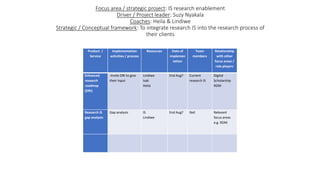
    Product / Service Implementation activities /process Resources Date of implemen tation Team members Relationship with other focus areas / role players Enhanced research roadmap (DRI) -Invite DRI to give their input Lindiwe Isak Heila End Aug? Current research IS Digital Scholarship RDM Research IS gap analysis Gap analysis IS Lindiwe End Aug? Ibid Relevant focus areas e.g. RDM Focus area / strategic project: IS research enablement Driver / Project leader: Suzy Nyakala Coaches: Heila & Lindiwe Strategic / Conceptual framework: To integrate research IS into the research process of their clients
  • 18.
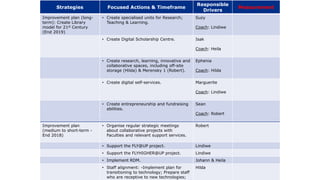
    Strategies Focused Actions& Timeframe Responsible Drivers Measurement Improvement plan (long- term): Create Library model for 21st Century (End 2019) • Create specialised units for Research; Teaching & Learning. Suzy Coach: Lindiwe • Create Digital Scholarship Centre. Isak Coach: Heila • Create research, learning, innovative and collaborative spaces, including off-site storage (Hilda) & Merensky 1 (Robert). Ephenia Coach: Hilda • Create digital self-services. Marguerite Coach: Lindiwe • Create entrepreneurship and fundraising abilities. Sean Coach: Robert Improvement plan (medium to short-term - End 2018) • Organise regular strategic meetings about collaborative projects with Faculties and relevant support services. Robert • Support the FLY@UP project. Lindiwe • Support the FLYHIGHER@UP project. Lindiwe • Implement RDM. Johann & Heila • Staff alignment: -Implement plan for transitioning to technology; Prepare staff who are receptive to new technologies; Hilda
  • 19.
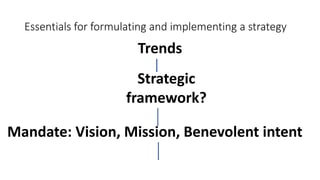
    Essentials for formulatingand implementing a strategy Trends Strategic framework? Mandate: Vision, Mission, Benevolent intent
  • 20.
    Identify Focus areas/ Projects that will create preferred outcomes Roles: Sponsor (as high as possible); Implementation co-ordinator; Drivers / Project leaders plus teams (Consultant; Facilitator) Implementation plans: focussed, realistic, timelines Regular feedback to Library staff, clients and stakeholders; staff involvement
  • 21.
    “ If youdon’t know where you’re going, any road will take you there” is a paraphrase of an exchange between Alice and the Cheshire Cat in Lewis Carroll's Alice’s Adventures in Wonderland: “Would you tell me please, which way I ought to go from here?”

Editor's Notes

  • #14 The Library had already embarked on the process to transform itself into a modern academic library. However we were doing it in relation to the past or where we come from. In other words we were like a driver of car who is going forward looking at a rear-view mirror. We requested the pane that reviewed the Library in April 2017 to advice us on how we can make a fundamental break with the past. How we can bring about revolution rather than evolution. The report of the review panel constitutes the foundation of this remodelling project. The deteriorating financial climate in the higher education sector has added impetus to this project. This project constitutes a radical departure from the Library’s earlier strategic plans.
  • #15 The review panel in response to our request for advise on a revolutionary approach to transformation advised us to look at the Future Search or similar strategy. We opted for the Blue Ocean Strategy. This is a strategy that was developed by Chan Kim and Renee Mauborne in 2005. It contrasts to red ocean (where is a lot of blood letting as a result of intense competition) to the blue ocean. An organization is in the blue ocean when it has positioned itself in the market space where it virtually has no competition due to the valuable but unique offerings to the market. The panel recommended that we engage the stakeholders as we continue working on this project.
  • #16 We are guided by the principles of Agility and Leanness to transform the DLS from what it is currently to a Boutique academic Library. Currently huge amount of space is occupied by books some of which have not be used for more than ten years. The transformed library will have fewer books which are heavily used. Its spaces will be repurposed in alignment with the technology that will be used by the users. The UP Library of the 21st century will have fewer but highly qualified staff member who will specialize in assisting users with solving complex problems. These staff members will provide highly specialized premium services at an additional fee to internal and external users. The cost for core services will be covered by the subsidy and tuition fees.
  • #17 We have identified broad overarching areas through which we will drive this revolutionary change in the Library. Each Focus area has a project leader. The members of the Executive team serve as coaches to the project leaders.